Within Coordination
Public AI capability
Government AI helps only when pilots are backed by data quality, skilled staff, audit trails, and routes for redress.
On this page
- What public sector AI is already being used for
- Why pilots get stuck before changing institutions
- The boring safeguards that make AI useful in government
Page outline Jump by section
Introduction
Public-sector AI only improves coordination when governments turn isolated experiments into durable institutional capability. Many countries now have impressive pilots: systems that summarise planning applications, detect fraud, classify documents, translate citizen requests, analyse disaster imagery, or help overworked officials process routine cases faster. But pilots alone do not create a more capable state. A ministry can demo an AI chatbot in six weeks and still fail to deliver reliable public services five years later.
 The gap matters because the wider promise of an AI-enabled civilisation depends heavily on institutions. Better medicine, energy systems, scientific discovery, climate adaptation, infrastructure planning, and disaster response all require governments that can absorb and use intelligence well. If public institutions remain slow, fragmented, opaque, or unable to coordinate across agencies, then even powerful AI systems may produce only scattered productivity gains rather than broad human flourishing.
The main lesson emerging from recent government deployments is surprisingly unglamorous. Public-sector AI becomes real capability only when institutions invest in high-quality data, trained staff, procurement systems, audit trails, public accountability, and clear routes for appeal and correction. The “boring” administrative foundations often matter more than the model itself. OECD [2National Audit Office (NAO]nao.org.ukuse of artificial intelligence in government3. In 2023 the Cabinet…Read more…
What public-sector AI is already being used for
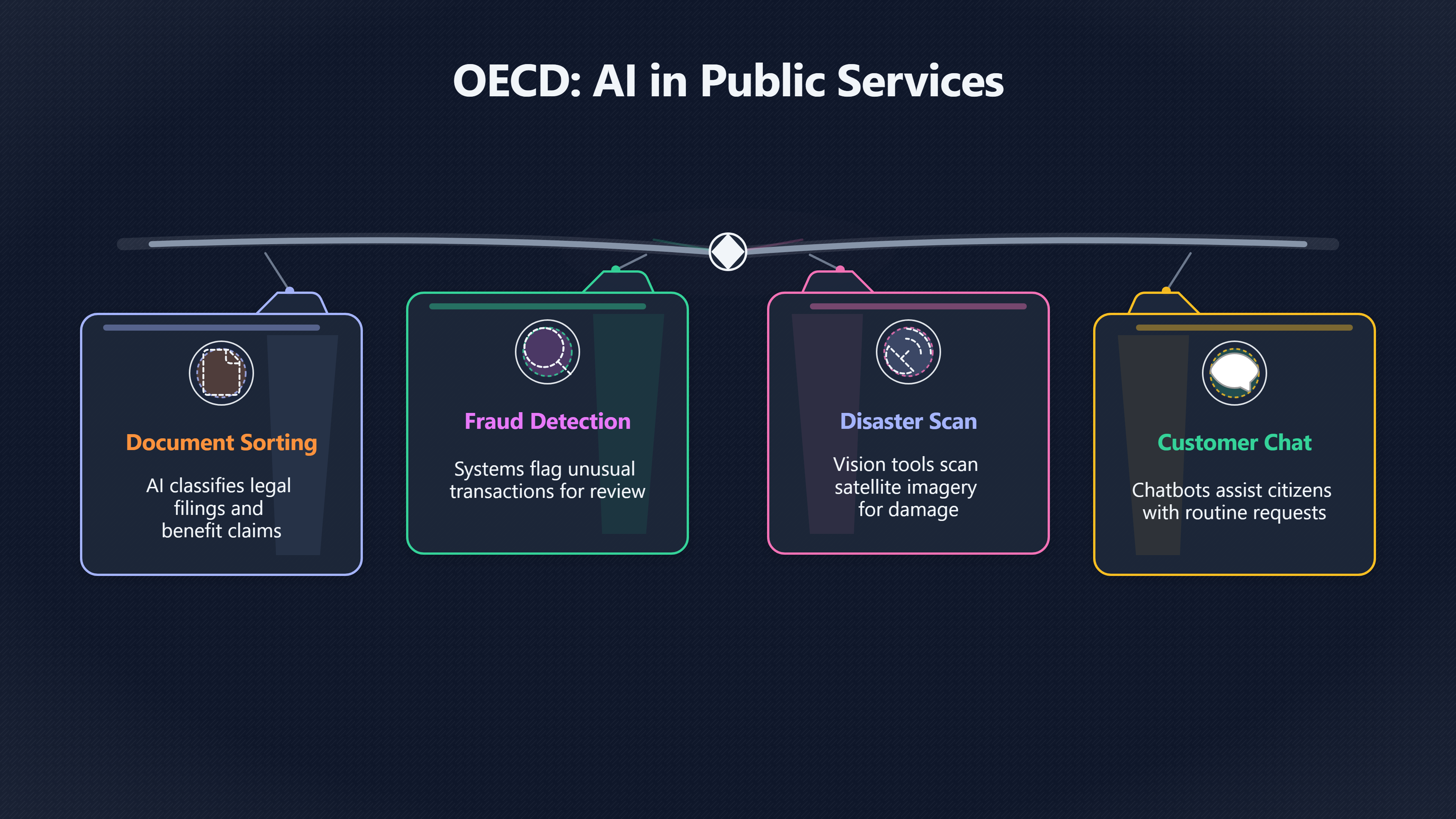
The current generation of government AI systems is much less futuristic than popular imagination suggests. Most deployments focus on narrow operational tasks rather than autonomous decision-making.
The OECD’s review of 200 government AI use cases found that adoption is concentrated in public services and internal administration rather than grand strategic planning. Governments are mainly using AI to classify documents, process forms, assist customer service, support regulatory work, detect anomalies, and manage large information flows. [OECD]oecd.orgIt finds using AI is a priority for governments, but adoption is…Read more… [OECD]oecd.orgai in public service design and delivery 09704c1aOECDAI in public service design and delivery: Governing with…18 Sept 2025 — AI can streamline bureaucratic tasks, freeing time for pub…
Several patterns appear repeatedly across countries.
Administrative triage rather than automated rule
The most successful systems usually help officials prioritise work rather than replace judgement entirely.
Disaster-response systems provide a good example. Agencies increasingly use computer vision to scan satellite or drone imagery after floods, hurricanes, or fires so that human teams can identify likely damage zones faster. The AI narrows attention; officials still decide where aid goes. This approach improves coordination without pretending that the model fully understands the social situation on the ground.
The same pattern appears in tax administration, procurement oversight, and healthcare administration. AI flags unusual transactions, probable errors, or urgent cases for human review. That often works better than fully automated systems because governments operate in messy environments with legal obligations, edge cases, and political consequences.
Document-heavy bureaucracies are natural targets
Governments process enormous amounts of text: legal filings, planning documents, benefit claims, procurement contracts, parliamentary submissions, inspection reports, and citizen complaints. Large language models are unusually well suited to this environment.
Estonia’s public-sector AI initiatives illustrate the attraction. The country experimented with reusable AI components and shared digital infrastructure so agencies could build text-analysis systems without each ministry reinventing its own tools. One early use case involved identifying potentially sensitive or mishandled documents within government workflows. [Observatory of Public Sector Innovation]oecd-opsi.orgest ai sandboxObservatory of Public Sector InnovationFirst free-for-all AI software developed in Public-Private…23 Jun 2020 — The first piece of AI…
This matters because coordination failures inside states are often information failures. Departments cannot see the same facts at the same time, cannot interpret them quickly enough, or cannot transfer information between incompatible systems. AI can reduce those frictions, but only when records are digitised and standardised in the first place.
Governments increasingly want “co-pilots” for staff
A recurring theme in recent deployments is augmentation rather than replacement. The OECD notes that many systems aim to free public servants from repetitive work so they can focus on tasks requiring discretion and judgement. [OECD]oecd.orgai in public procurement 2e095543AI in public procurement: Governing with Artificial Intelligence18 Sept 2025 — AI technologies can enable stakeholders to monitor procure…
That distinction matters politically as well as technically. Citizens are often more willing to accept AI that helps a caseworker than AI that silently decides eligibility, punishment, or surveillance outcomes on its own.
For an AI bloom scenario, this is an important early signal. It suggests that the most plausible path toward better-coordinated institutions may not be fully automated governance, but institutions where human judgement scales further because machine systems handle administrative overload.
Why pilots get stuck before changing institutions
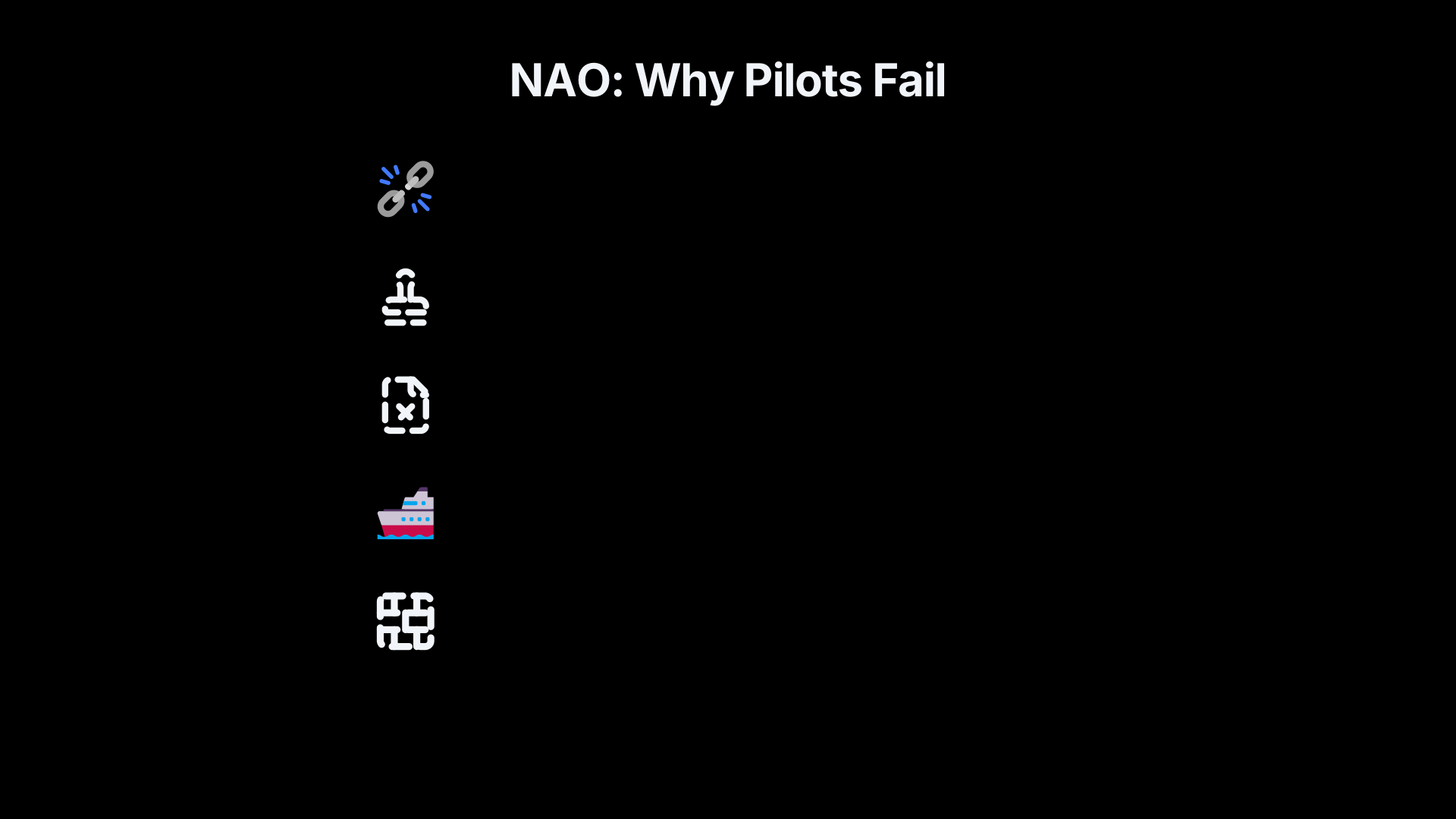
Governments are now full of AI pilots that never become routine capability. Reports from the UK National Audit Office, the OECD, and audit bodies across multiple countries all point to the same obstacles. [National Audit Office (NAO]nao.org.ukuse of artificial intelligence in government3. In 2023 the Cabinet…Read more… [OECD]wp.oecd.aiOECD AIPhase 2: A practical tool for government data sharing for AIOxford Insights was contracted to develop a practical roadmap for gove…
The barriers are usually organisational rather than computational.
Bad data breaks public AI quickly
Many states still run on fragmented databases, inconsistent records, legacy software, and incompatible departmental systems. AI systems trained on poor-quality data inherit those weaknesses.
A predictive model for housing enforcement becomes unreliable if addresses are inconsistent across agencies. Healthcare systems fail if patient records are incomplete. Fraud detection systems become biased if historical enforcement data reflects uneven policing.
This is one reason public-sector AI often advances slower than consumer AI. Governments cannot simply scrape the internet and optimise for engagement. They operate under legal duties involving accuracy, fairness, explainability, privacy, and equal treatment.
The UK National Audit Office concluded that successful AI adoption depends on foundational capabilities including high-quality data, infrastructure, and organisational change, not merely software procurement. [National Audit Office (NAO]nao.org.ukuse of artificial intelligence in government3. In 2023 the Cabinet…Read more…
Procurement systems are often designed for old technology
Public procurement rules were built mainly for roads, buildings, hardware, and traditional IT contracts. AI systems evolve continuously and often depend on changing models, datasets, and external providers.
This creates a mismatch. Governments frequently struggle to buy AI safely without locking themselves into opaque vendors or systems they cannot inspect properly.
Estonia’s experimentation with public-private “sandbox” frameworks emerged partly from this problem. Officials tried to create reusable public digital components and more flexible cooperation structures so innovation could happen without bypassing accountability rules entirely. [Observatory of Public Sector Innovation]oecd-opsi.orgest ai sandboxObservatory of Public Sector InnovationFirst free-for-all AI software developed in Public-Private…23 Jun 2020 — The first piece of AI…
The deeper issue is strategic dependence. If governments rely entirely on a handful of private firms for core decision infrastructure, public capability may weaken rather than strengthen. States need enough internal expertise to understand, test, and challenge the systems they deploy.
Skills shortages are often more serious than hardware shortages
One of the clearest findings across public-sector reviews is that governments lack enough technically literate staff to manage AI deployment effectively. [KPMG Assets]assets.kpmg.comKPMG AssetsAI in Government Audit and Public ExpenditureAcross jurisdictions, Supreme Audit Institutions (SAIs) and finance ministries ar…
The problem is not only hiring machine-learning engineers. Governments also need procurement specialists, auditors, policy officials, legal teams, regulators, and operational managers who understand what AI systems can and cannot reliably do.
Without that internal capability, ministries become dependent on consultants and vendors who may have incentives misaligned with long-term public value.
This creates a paradox at the centre of AI governance. Advanced AI could eventually help states coordinate more intelligently, but states need competent institutions before they can safely absorb that intelligence.
Pilot culture rewards demonstrations rather than reliability
A successful pilot is not necessarily a successful institution.
Governments often reward innovation announcements, prototype launches, or temporary funding wins. But durable capability requires long maintenance cycles, integration into ordinary workflows, security reviews, retraining, monitoring, and adaptation to legal changes.
Those tasks are less visible politically, yet they determine whether AI becomes dependable public infrastructure or another abandoned experiment.
The OECD’s review found that many AI efforts remain fragmented and uneven rather than systemic. [OECD]oecd.orgIt finds using AI is a priority for governments, but adoption is…Read more…
That fragmentation matters because coordination gains compound only when systems become interoperable across agencies and over time. A single chatbot does little. Shared digital standards across healthcare, infrastructure, emergency response, and administration can gradually change how a state functions.
The boring safeguards that make AI useful in government
Public trust is not a side issue in government AI. It is the operating condition that determines whether systems can scale politically.
Many of the most important safeguards sound administrative rather than futuristic, but they are exactly what separates a capable institution from an unreliable one.
Audit trails matter more than impressive demos
Governments need to know how decisions were reached, what data was used, and who remains accountable.
This is particularly important because public institutions exercise coercive power: they tax, regulate, deny applications, investigate wrongdoing, allocate welfare, and enforce laws. Citizens therefore need ways to inspect and challenge automated processes.
The Netherlands’ algorithm register, often cited in governance discussions, attempts to make government algorithms visible to the public rather than hidden inside opaque systems. Audit institutions increasingly emphasise logging, monitoring, and traceability as core requirements for trustworthy AI deployment. [KPMG Assets]assets.kpmg.comKPMG AssetsAI in Government Audit and Public ExpenditureAcross jurisdictions, Supreme Audit Institutions (SAIs) and finance ministries ar…
In practice, this means recording:
- which model produced a recommendation;
- what inputs were used;
- whether a human overrode the output;
- how often the system fails;
- whether errors disproportionately affect particular groups.
These mechanisms are not glamorous, but they allow institutions to learn and correct mistakes instead of scaling them invisibly.
Human review and routes for appeal are essential
Citizens need ways to contest decisions.
The history of public-sector algorithms already includes major failures, including welfare fraud systems, predictive policing controversies, and automated benefits assessments that produced harmful errors or discrimination. In many cases, the core problem was not merely technical bias but the absence of meaningful human review.
A government that cannot explain or correct an automated decision weakens democratic legitimacy even if the system is statistically efficient overall.
This becomes more important as AI systems grow more capable. A civilisation that increasingly coordinates through machine-assisted systems will need robust mechanisms for disagreement, correction, and procedural fairness. Otherwise coordination turns into administrative opacity.
Transparency improves institutional learning
One underappreciated benefit of public accountability is that it improves capability over time.
When agencies publish standards, evaluation criteria, and failure reports, other institutions can learn from them. Shared frameworks reduce duplication and help governments avoid repeating the same mistakes.
The US Government Accountability Office’s AI accountability framework, for example, has become influential partly because it translates abstract ethical principles into operational categories such as governance, data quality, performance, and monitoring. [KPMG Assets]assets.kpmg.comKPMG AssetsAI in Government Audit and Public ExpenditureAcross jurisdictions, Supreme Audit Institutions (SAIs) and finance ministries ar…
That operationalisation matters. General promises about “responsible AI” rarely help frontline administrators deciding whether a model is accurate enough to use in housing inspections or emergency triage.

Data governance becomes a strategic state capability
The most effective governments increasingly treat data infrastructure as public infrastructure.
Recent OECD and GPAI work on government data-sharing stresses that AI capability depends heavily on whether agencies can share trustworthy data legally and securely across organisational boundaries. [OECD AI]wp.oecd.aiOECD AIPhase 2: A practical tool for government data sharing for AIOxford Insights was contracted to develop a practical roadmap for gove…
This sounds technical, but it has large civilisational implications. A society capable of coordinating climate adaptation, pandemic response, energy systems, transport networks, and scientific research needs institutions that can combine information across domains without collapsing privacy or accountability protections.
In that sense, modern state capacity may increasingly depend on information architecture as much as roads, ports, or physical bureaucracy.
The deeper question: can AI make states wiser, not just faster?
The optimistic case for public-sector AI is not mainly about shaving minutes off paperwork. It is about whether governments can become more competent at civilisation-scale coordination.
If advanced AI eventually helps institutions model infrastructure needs, anticipate disasters, accelerate scientific regulation, improve budgeting, or identify policy failures earlier, then public capability could compound over decades. Faster administrative learning could support wider goals associated with AI bloom: cleaner energy deployment, better healthcare systems, scientific acceleration, and stronger resilience against shocks.
But the evidence so far suggests an important constraint. AI does not automatically create wise institutions. In some environments it may merely accelerate confusion, surveillance, or bureaucratic overload.
Several tensions remain unresolved:
- Efficiency versus accountability: faster decisions can reduce scrutiny.
- Centralisation versus resilience: shared AI infrastructure may create single points of failure.
- Automation versus legitimacy: citizens may reject systems they cannot understand or challenge.
- Vendor dependence versus public capability: outsourcing too much expertise weakens state competence.
- Optimisation versus human judgement: measurable outcomes do not capture every public value.
These are not peripheral governance debates. They determine whether AI strengthens democratic coordination or produces brittle administrative systems that lose public trust.
The strongest emerging lesson is therefore modest but significant. Public-sector AI works best when institutions treat it as part of a broader project of state capability: improving data quality, administrative competence, transparency, interoperability, and human decision-making capacity.
That may sound less dramatic than visions of fully automated governance. Yet it may ultimately be more important for a flourishing long-term future. Civilisation-scale coordination is unlikely to emerge from a single superintelligent system issuing commands. It is more likely to emerge from institutions that become gradually better at seeing reality clearly, sharing information honestly, correcting mistakes quickly, and acting coherently across large societies.
Public-sector AI becomes transformative not when governments deploy the most impressive model, but when they build institutions capable of using intelligence well.
Endnotes
-
Source: oecd.org
Link: https://www.oecd.org/en/publications/2025/06/governing-with-artificial-intelligence_398fa287/full-report/trends-and-early-lessons-from-the-use-of-ai-across-functions-of-government_c4968cb1.htmlSource snippet
It finds using AI is a priority for governments, but adoption is...Read more...
-
Source: assets.kpmg.com
Link: https://assets.kpmg.com/content/dam/kpmgsites/in/pdf/2026/02/ai-in-government-audit-and-public-expenditure-from-pilots-to-productivity-at-scale.pdfSource snippet
KPMG AssetsAI in Government Audit and Public ExpenditureAcross jurisdictions, Supreme Audit Institutions (SAIs) and finance ministries ar...
-
Source: oecd.org
Title: ai in public service design and delivery 09704c1a
Link: https://www.oecd.org/en/publications/2025/06/governing-with-artificial-intelligence_398fa287/full-report/ai-in-public-service-design-and-delivery_09704c1a.htmlSource snippet
OECDAI in public service design and delivery: Governing with...18 Sept 2025 — AI can streamline bureaucratic tasks, freeing time for pub...
-
Source: oecd.org
Title: ai in public procurement 2e095543
Link: https://www.oecd.org/en/publications/2025/06/governing-with-artificial-intelligence_398fa287/full-report/ai-in-public-procurement_2e095543.htmlSource snippet
AI in public procurement: Governing with Artificial Intelligence18 Sept 2025 — AI technologies can enable stakeholders to monitor procure...
-
Source: wp.oecd.ai
Link: https://wp.oecd.ai/app/uploads/2024/12/07-The-Role-of-Government-as-a-Provider-of-Data-for-Artificial-Intelligence-practical-tool-for-government-data-sharing-for-AI.pdfSource snippet
OECD AIPhase 2: A practical tool for government data sharing for AIOxford Insights was contracted to develop a practical roadmap for gove...
-
Source: nao.org.uk
Title: use of artificial intelligence in government
Link: https://www.nao.org.uk/wp-content/uploads/2024/03/use-of-artificial-intelligence-in-government.pdfSource snippet
3. In 2023 the Cabinet...Read more...
-
Source: oecd-opsi.org
Title: est ai sandbox
Link: https://oecd-opsi.org/innovations/est-ai-sandbox/Source snippet
Observatory of Public Sector InnovationFirst free-for-all AI software developed in Public-Private...23 Jun 2020 — The first piece of AI...
Additional References
-
Source: cife.eu
Link: https://www.cife.eu/Ressources/FCK/image/Theses/2025/GEGPA_Doberdolani_Thesis_2025.pdfSource snippet
AI-driven public administration: mitigating sludge and...It addresses the research question; how AI affects Estonian and Singaporean pub...
-
Source: odi.org
Title: ai in the public sector five lessons from the oecds governing with ai report
Link: https://odi.org/en/insights/ai-in-the-public-sector-five-lessons-from-the-oecds-governing-with-ai-report/Source snippet
ODI: Think changeAI in the public sector: five lessons from the OECD's '...3 Dec 2025 — The OECD's latest report makes the idea of AI in...
-
Source: youtube.com
Title: AI in Government: What’s Actually Working Right Now (Host: Gov Tech)
Link: https://www.youtube.com/watch?v=gTRnaADecDcSource snippet
CoMotion MIAMI '26 - AI in Government: From Experimentation to Everyday Operations...
-
Source: youtube.com
Title: Co Motion MIAMI ‘26
Link: https://www.youtube.com/watch?v=mStBo9qf4RASource snippet
E166 - AI Agents at the Government Offices of Sweden...
-
Source: youtube.com
Title: The Policy Fix | How to make the UK a world leader in public sector AI
Link: https://www.youtube.com/watch?v=kmZHuOrmWhESource snippet
AI in Government: What's Actually Working Right Now (Host: GovTech)...
-
Source: elgaronline.com
Link: https://www.elgaronline.com/edcollchap/book/9781035334353/chapter31.xmlSource snippet
31: Public policy and government in: Artificial Intelligenceby C Kerrigan · 2025 — This chapter surveys government approaches to AI polic...
-
Source: youtube.com
Link: https://www.youtube.com/watch?v=Rx6Ix3zdyr0Source snippet
Innovation in Government: AI for Government Summit...
-
Source: youtube.com
Title: Innovation in Government: AI for Government Summit
Link: https://www.youtube.com/watch?v=G3E_yUOazUE
Amazon book picks
Further Reading
Books and field guides related to Public AI capability. Use these as the next step if you want deeper reading beyond the article.

Ethical Governance of Artificial Intelligence in the Public S...
First published 2021. Subjects: Science, Artificial intelligence, Moral and ethical aspects, Government policy, Intelligence artificielle.

Digital Government
E-government has emerged not merely as a specialization in public administration but as a transformative force affecting all levels and f...
Digital government
First published 2011. Subjects: Administrative agencies, Political participation, Democracy.

Foundations of Digital Government
First published 2013. Subjects: Public administration.
eBay marketplace picks
Marketplace Samples
Example marketplace items related to this page. Use the search link to explore similar finds on eBay.

Example eBay listing
A.I. Artificial Intelligence Original Movie Poster Signed By Jude Law
USD 125.00 | Shipping USD 25.00 | US

Example eBay listing
Artificial Intelligence D/S Original Movie Poster - 27 x 40"
USD 19.50 | Shipping USD 13.65 | US

Example eBay listing
612388 Artificial Intelligence Movie Science Fiction Drama Wall Print Poster
USD 22.95 | Shipping USD 12.95 | JP

Example eBay listing
Companion - Artificial Intelligence Dark Comedy Cinema Film - POSTER 20"x30"
USD 23.99 | Free shipping | US
Topic Tree