Within Safety Gaps
Cobots and misplaced trust
Collaborative robots can reduce some hazards, but setup, tooling, payloads and overconfidence can still make close human work risky.
On this page
- What collaborative robot safety features can and cannot do
- End effectors, payloads and system level hazards
- Why small firms may underestimate integration risks
Page outline Jump by section
Introduction
Collaborative robots, usually called cobots, are marketed as a safer kind of automation: machines designed to work beside people rather than behind cages. That promise matters to the wider vision of AI-enabled abundance. If intelligent robotics can safely take over dirty, repetitive and dangerous labour, human work could become less physically punishing while productivity rises across manufacturing, logistics, food production and healthcare.
 But cobots also create a subtle safety problem: they can look safer than they really are.
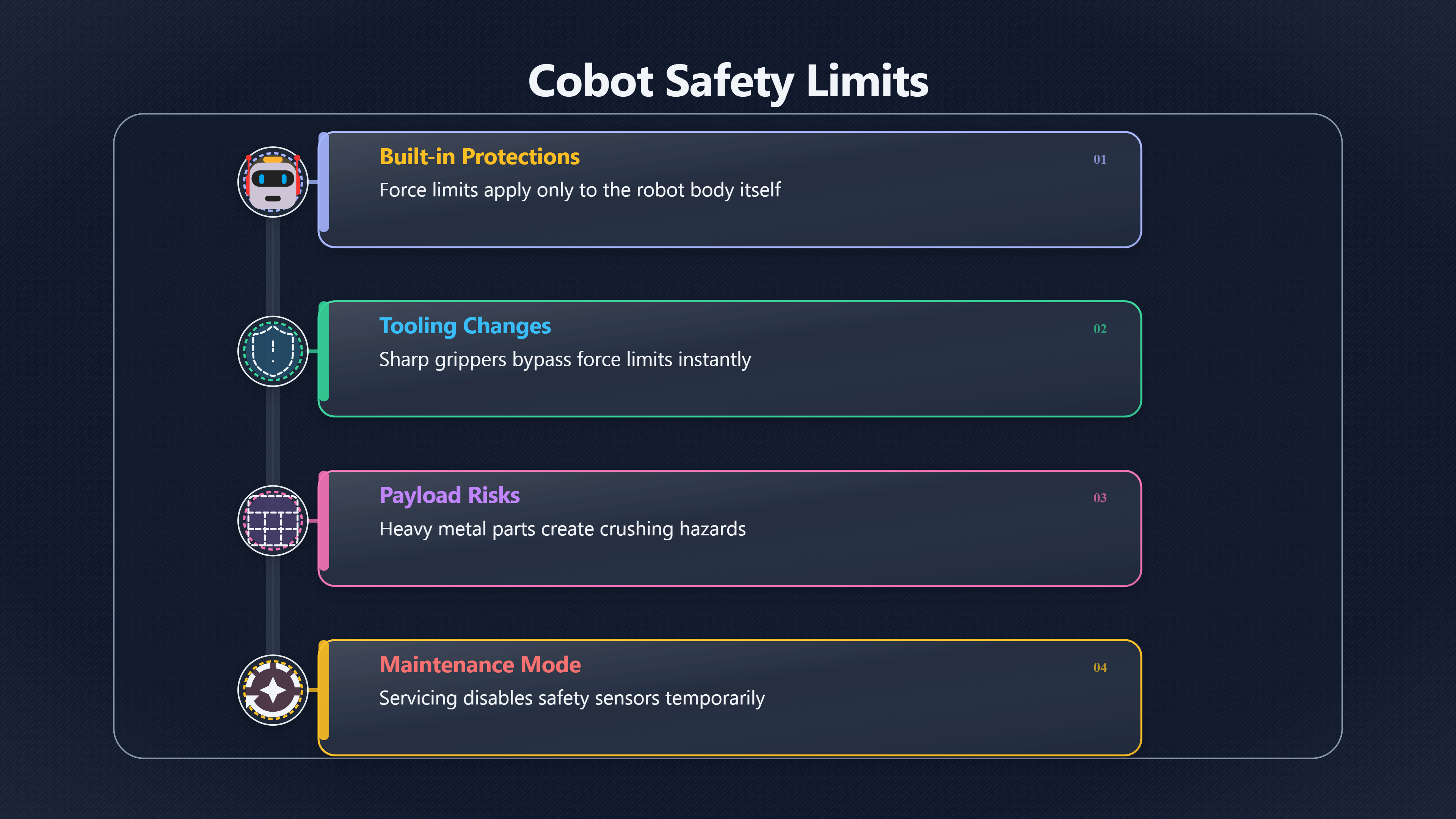
Many collaborative robots are slower, lighter and equipped with force-limiting features that reduce injury risk during normal operation. Yet maintenance, setup, tooling changes and fault recovery often bypass the conditions that make collaborative operation safe in the first place. A robot arm that is considered safe while moving an empty carton may become dangerous once fitted with a sharp gripper, welding tool or heavy payload. A small factory that buys a “safe” cobot package may underestimate the engineering needed to integrate sensors, software, tooling and lockout procedures correctly. The result is not usually science-fiction loss of control. It is misplaced trust. [JHFOSTER]jhfoster.comJHFOSTERA Guide to Collaborative Robot Standards, Hazards and…Ensure maximum efficiency and workplace safety with collaborative robots… [Automate]automate.orgiso ts 15066 explainedTech Papers: ISO/TS 15066 Explained | Robotiq25 May 2016 — ISO/TS 15066 provides guidelines for the design and implementation of a collab…
What collaborative robot safety features can and cannot do
Collaborative robots differ from traditional industrial robots because they are designed for some degree of shared human workspace. Standards such as ISO/TS 15066 and the newer ISO 10218 revisions describe several collaborative modes, including speed reduction, monitored stopping and power-and-force limiting. The basic idea is that contact between human and robot should not cause serious injury under expected operating conditions. [ISO]iso.orgISOISO/TS 15066:2016(en), Robots and robotic devicesThis Technical Specification provides guidance for collaborative robot operation wher… [Automate That has encouraged a common impression that cobots are inherently safe. In practice]automate.orgiso ts 15066 explainedTech Papers: ISO/TS 15066 Explained | Robotiq25 May 2016 — ISO/TS 15066 provides guidelines for the design and implementation of a collab…, safety depends heavily on context.
A collaborative robot’s built-in protections mainly apply to the robot body itself and only under defined operating assumptions. Integrators still need to assess the entire work cell, including:
- attached tools
- workpiece shape and weight
- surrounding machinery
- pinch points
- movement paths
- maintenance procedures
- software behaviour
- restart conditions
- human behaviour during troubleshooting [ilearnengineering.com]ilearnengineering.comSafety Challenges in Industrial RoboticsOSHA identifies seven main potential hazards for humans working with robots: Human Errors: Mistak…
Industrial guidance repeatedly stresses that risk assessment applies to the whole system, not merely the robot arm. [JHFOSTER]jhfoster.comJHFOSTERA Guide to Collaborative Robot Standards, Hazards and…Ensure maximum efficiency and workplace safety with collaborative robots… [Cobots & Machinery Safety]cobotsmachinerysafety.co.ukCollaborative Robot Safety | Risk Assessment & ComplianceOur team evaluates your collaborative robot setups in accordance with EN ISO 102…
This distinction matters because maintenance work often changes the system completely. A cobot may operate safely at reduced speed during normal production, then switch into higher-force manual teaching mode during calibration. Workers may disable sensors temporarily to diagnose faults. Guards may remain open while technicians test movements incrementally. A robot considered “collaborative” during packaging may become much less predictable during software updates or tooling replacement.
OSHA has long warned that many robot injuries occur during servicing, testing and adjustment rather than ordinary automated production. [OSHA]osha.govTechnical Manual (OTMPossible causes: Lockout/tagout was not applied or was not properly applied, which would have prevented…Read more… [OSHA]osha.govork on a machine, the lockout/tagout standard (29 CFR §1910.147) applies, and…Read more…
The danger is partly psychological. Traditional industrial robots signal danger clearly: fences, cages and warning lights communicate that workers should stay away. Cobots can encourage the opposite instinct. Because they are intentionally approachable, workers may become more willing to enter operating areas casually, trust proximity sensors too much or assume a machine will always stop before contact.
That can produce what safety engineers sometimes call “risk normalisation”: behaviour gradually becomes less cautious because nothing bad happened the previous hundred times.
End effectors, payloads and system-level hazards
The most misleading aspect of collaborative robotics is often the gap between the robot arm and the real machine.
A collaborative robot without tooling may be relatively harmless at low speed. But many cobots are used with:
- sharp grippers
- vacuum systems
- drills
- screwdrivers
- welding torches
- cutters
- adhesive dispensers
- heavy metal parts
- glass sheets
- rotating tools
Safety guidance repeatedly warns that end effectors and payloads can introduce hazards far beyond the robot’s own force limits. [Olympus Technologies]olympustechnologies.co.ukOlympus Technologies Ensuring Cobot Safety and Compliance: EssentialOlympus TechnologiesEnsuring Cobot Safety and Compliance: Essential…April 15, 2025 — 15 Apr 2025 — This includes obvious dangers like… [JHFOSTER A force-limited robot carrying a sharp tool can still puncture skin. A lightweight cobot moving a large metal panel can pin a worker against]jhfoster.comJHFOSTERA Guide to Collaborative Robot Standards, Hazards and…Ensure maximum efficiency and workplace safety with collaborative robots… a structure. Even relatively slow motion can create crushing hazards when a person is trapped between the robot and fixed equipment.
Research on collaborative robot impacts also shows that real-world force behaviour is more complicated than many users assume. Experimental work on collision-force mapping found that impact forces can vary substantially across different parts of a robot’s workspace, meaning that a robot considered safe in one position may behave differently in another. [arXiv]arxiv.orgar Xiv3D Collision-Force-Map for Safe Human-Robot CollaborationarXiv3D Collision-Force-Map for Safe Human-Robot CollaborationSeptember 2, 2020…
That matters during maintenance because technicians frequently work inside awkward geometries:
- reaching behind fixtures
- leaning into cells
- holding components manually
- testing incremental movement
- repositioning sensors
- clearing jams
In those conditions, even modest forces can become dangerous if there is nowhere to escape.
Another overlooked issue is stored or indirect energy. Cobots are often integrated into larger systems involving conveyors, pneumatic devices, machine vision systems and external controllers. A worker may isolate the robot arm while another linked device still has power. OSHA guidance emphasises that servicing hazards include unexpected energisation and movement from interconnected systems, not only the robot itself. [OSHA]osha.gove Tool: Lockout-TagoutOSHAeTool: Lockout-Tagout - Case StudiesAn employee who is inside a cage when a robot is activated could be struck by the robot arm or o… [OSHA]osha.govThe Control of Hazardous Energy (Lockout/TagoutMay 20, 2562 BE — This RFI seeks information regarding two areas where modernizing the Lockout/Tagout standard might better promote worke…
This is especially important in an AI-heavy industrial future. As factories become more software-defined, maintenance increasingly involves networked systems, remote diagnostics and autonomous coordination between machines. The more capable the automation stack becomes, the harder it may be for frontline workers to understand exactly which systems retain authority to move equipment.
Why small firms may underestimate integration risks
Large automotive manufacturers usually employ dedicated robotics safety specialists, formal lockout procedures and extensive compliance teams. Many newer cobot adopters do not.
One reason collaborative robots spread rapidly is that they are marketed as accessible automation for small and medium-sized businesses. Vendors often emphasise fast deployment, intuitive programming and low barrier to entry. In many cases that is true. But easier deployment can also mean weaker safety culture if firms assume cobots are almost consumer-grade devices rather than industrial machinery.
This creates several recurring problems.
The “plug-and-play” illusion
Collaborative robots are frequently advertised with drag-and-drop interfaces and simple demonstration videos. That lowers adoption friction but can blur the line between operating a robot and engineering a safe robotic system.
Safety standards still require application-specific risk assessment, even for collaborative deployments. [AMD Machines]amdmachines.comrobot safety standards iso 10218 and ts 15066 explainedAMD MachinesISO 10218 & ISO/TS 15066 Explained: Robot Safety…10 Jan 2026 — Practical guide to ISO 10218 and ISO/TS 15066 robot safety… [JHFOSTER A cobot performing one task safely may become hazardous after apparently small changes:]jhfoster.comJHFOSTERA Guide to Collaborative Robot Standards, Hazards and…Ensure maximum efficiency and workplace safety with collaborative robots…
- faster cycle times
- heavier payloads
- new tooling
- altered workstation layout
- software modifications
- sensor repositioning
- temporary overrides during debugging
Smaller firms may not revisit hazard analysis thoroughly after incremental modifications.
Maintenance shortcuts under production pressure
Cobots are often justified economically through flexibility and uptime. That can create pressure to fix faults quickly without full shutdown procedures.
OSHA case studies repeatedly identify failures in lockout-tagout — physically isolating machinery from hazardous energy during servicing — as a central cause of robot injuries. [OSHA]osha.govHome | Occupational Safety and Health AdministrationOSHA · Learn more about the National Safety Stand-Down to Prevent Falls in Constructi… [OSHA]osha.govThis section highlights OSHA standards and documents related to robotics.Read more… [OSHA]osha.govTechnical Manual (OTMPossible causes: Lockout/tagout was not applied or was not properly applied, which would have prevented…Read more…
The challenge becomes harder when operators believe the robot is intrinsically safe because it is collaborative. Workers may leave systems partially energised during troubleshooting because the robot “only moves slowly” or “normally stops when touched”.
But maintenance is precisely when normal assumptions break down.
Skill gaps in mixed human-AI environments
Advanced robotics increasingly combines machine vision, AI planning systems and adaptive behaviour. That could eventually help factories become vastly more productive and responsive, supporting the broader AI bloom vision of abundant manufacturing and safer labour.
Yet it also increases integration complexity.
A small firm may buy:
- a collaborative arm from one supplier
- vision software from another
- AI quality-control tools from a third
- custom grippers from an integrator
- cloud monitoring services from elsewhere
The resulting system may behave in ways that no individual component supplier fully tested together.
Safety researchers have increasingly argued that collaborative robotics cannot be treated as a static compliance checklist because actual risk emerges from the interaction between hardware, software and workplace practice. [arXiv]arxiv.orgar Xiv3D Collision-Force-Map for Safe Human-Robot CollaborationarXiv3D Collision-Force-Map for Safe Human-Robot CollaborationSeptember 2, 2020…

Why this matters for the broader AI future
The optimistic case for AI-enabled robotics is compelling. Intelligent machines could eventually reduce workplace injuries, eliminate exhausting manual labour and make high-quality production dramatically cheaper. In the best scenario, automation expands human freedom rather than merely cutting labour costs.
Collaborative robots are part of that story because they allow automation to spread into environments where fully isolated industrial robots would be impractical. They can help smaller firms automate tasks that previously remained manual. That could increase productivity far beyond elite mega-factories.
But the maintenance problem exposes a deeper truth about technological abundance: safer systems do not emerge automatically from smarter machines.
Human flourishing depends on operational reality, not marketing categories.
A future filled with intelligent robotics only improves life broadly if:
- maintenance procedures remain rigorous
- safety incentives survive production pressure
- small firms can access real integration expertise
- workers are trained for mixed human-machine environments
- standards evolve with increasingly adaptive systems
- safety culture scales alongside capability
Otherwise the gains from advanced robotics may arrive unevenly: more output and lower costs alongside persistent hidden injury risks for technicians, installers and subcontractors working behind the scenes.
That tension appears repeatedly across AI debates. Technologies that promise abundance can simultaneously increase complexity, concentration of expertise and dependence on systems ordinary workers do not fully understand. Collaborative robots are a practical example of that broader challenge. The issue is not whether automation can help humanity flourish. It is whether institutions, training and workplace design evolve fast enough to make increasingly powerful systems genuinely trustworthy in everyday use.
Endnotes
-
Source: jhfoster.com
Link: https://jhfoster.com/automation-blogs/cobot-safety/Source snippet
JHFOSTERA Guide to Collaborative Robot Standards, Hazards and...Ensure maximum efficiency and workplace safety with collaborative robots...
-
Source: automate.org
Title: iso ts 15066 explained
Link: https://www.automate.org/robotics/tech-papers/iso-ts-15066-explainedSource snippet
Tech Papers: ISO/TS 15066 Explained | Robotiq25 May 2016 — ISO/TS 15066 provides guidelines for the design and implementation of a collab...
Published: May 2016
-
Source: osha.gov
Title: Technical Manual (OTM)
Link: https://www.osha.gov/otm/section-4-safety-hazards/chapter-4Source snippet
Possible causes: Lockout/tagout was not applied or was not properly applied, which would have prevented...Read more...
-
Source: iso.org
Link: https://www.iso.org/obp/ui/es/Source snippet
ISOISO/TS 15066:2016(en), Robots and robotic devicesThis Technical Specification provides guidance for collaborative robot operation wher...
-
Source: osha.gov
Link: https://www.osha.gov/laws-regs/standardinterpretations/2005-07-07Source snippet
ork on a machine, the lockout/tagout standard (29 CFR §1910.147) applies, and...Read more...
-
Source: arxiv.org
Title: ar Xiv3D Collision-Force-Map for Safe Human-Robot Collaboration
Link: https://arxiv.org/abs/2009.01036Source snippet
arXiv3D Collision-Force-Map for Safe Human-Robot CollaborationSeptember 2, 2020...
Published: September 2, 2020
-
Source: osha.gov
Title: e Tool: Lockout-Tagout
Link: https://www.osha.gov/etools/lockout-tagout/case-studies/automotive-lubrication-roboticsSource snippet
OSHAeTool: Lockout-Tagout - Case StudiesAn employee who is inside a cage when a robot is activated could be struck by the robot arm or o...
-
Source: osha.gov
Title: The Control of Hazardous Energy (Lockout/Tagout)
Link: https://www.osha.gov/laws-regs/federalregister/2019-05-20Source snippet
May 20, 2562 BE — This RFI seeks information regarding two areas where modernizing the Lockout/Tagout standard might better promote worke...
Published: May 20, 2562
-
Source: arxiv.org
Link: https://arxiv.org/abs/2203.02706Source snippet
arXivISO/TS 15066: How Different Interpretations Affect Risk AssessmentMarch 5, 2022...
Published: March 5, 2022
-
Source: arxiv.org
Link: https://arxiv.org/abs/2602.17822Source snippet
arXivEvolution of Safety Requirements in Industrial Robotics: Comparative Analysis of ISO 10218-1/2 (2011 vs. 2025) and Integration of IS...
-
Source: osha.gov
Link: https://www.osha.gov/Source snippet
Home | Occupational Safety and Health AdministrationOSHA · Learn more about the National Safety Stand-Down to Prevent Falls in Constructi...
-
Source: osha.gov
Link: https://www.osha.gov/robotics/standardsSource snippet
This section highlights OSHA standards and documents related to robotics.Read more...
-
Source: automate.org
Link: https://www.automate.org/userAssets/a3/events/file/17%20-%20Hazen%20Price%20-%20OSHA%20Presentation%20Day%201.pdf -
Source: amdmachines.com
Title: robot safety standards iso 10218 and ts 15066 explained
Link: https://amdmachines.com/blog/robot-safety-standards-iso-10218-and-ts-15066-explained/Source snippet
AMD MachinesISO 10218 & ISO/TS 15066 Explained: Robot Safety...10 Jan 2026 — Practical guide to ISO 10218 and ISO/TS 15066 robot safety...
-
Source: cobotsmachinerysafety.co.uk
Link: https://www.cobotsmachinerysafety.co.uk/cobot-risk-assessmentsSource snippet
Collaborative Robot Safety | Risk Assessment & ComplianceOur team evaluates your collaborative robot setups in accordance with EN ISO 102...
-
Source: olympustechnologies.co.uk
Title: Olympus Technologies Ensuring Cobot Safety and Compliance: Essential
Link: https://olympustechnologies.co.uk/cobot-safety-and-complience/Source snippet
Olympus TechnologiesEnsuring Cobot Safety and Compliance: Essential...April 15, 2025 — 15 Apr 2025 — This includes obvious dangers like...
Published: April 15, 2025
Additional References
-
Source: researchgate.net
Link: https://www.researchgate.net/publication/341524467_Orienting_safety_assurance_with_outcomes_of_hazard_analysis_and_risk_assessment_A_review_of_the_ISO_15066_standard_for_collaborative_robot_systemsSource snippet
A review of the ISO 15066 standard for collaborative robot...17 Oct 2025 — This article reviews requirements for safety assurance of col...
-
Source: oshacademy.com
Link: https://www.oshacademy.com/ -
Source: ilearnengineering.com
Link: https://www.ilearnengineering.com/electronical-and-electronic/safety-challenges-in-industrial-roboticsSource snippet
Safety Challenges in Industrial RoboticsOSHA identifies seven main potential hazards for humans working with robots: Human Errors: Mistak...
-
Source: blog.oshaeducationschool.com
Title: machine guarding and lockout tagout essential practices for industrial safety
Link: https://blog.oshaeducationschool.com/machine-guarding-and-lockout-tagout-essential-practices-for-industrial-safety/Source snippet
Guarding and Lockout/Tagout: Essential Practices for...Apr 26, 2023 — This guide will provide an overview of these essential practices...
-
Source: jacksonlewis.com
Title: robotic systems compel osha consider revising its lockouttagout standard
Link: https://www.jacksonlewis.com/insights/robotic-systems-compel-osha-consider-revising-its-lockouttagout-standardSource snippet
Robotic Systems Compel OSHA to Consider Revising Its...Mar 27, 2023 — Manufacturers' increasingly advanced robotic systems have made the...
-
Source: shrm.org
Title: robotic systems compel osha to consider revising lockout tagout standard
Link: https://www.shrm.org/topics-tools/employment-law-compliance/robotic-systems-compel-osha-to-consider-revising-lockout-tagout-standardSource snippet
Robotic Systems Compel OSHA to Consider Revising...Mar 31, 2023 — OSHA's lockout/tagout standard regulates the control of exposure to un...
-
Source: hokuyo-usa.com
Link: https://www.hokuyo-usa.com/resources/blog/osha-standards-and-robotics-what-you-need-knowSource snippet
Therefore, this OSHA standard is applicable to industrial robotics. Industrial Robots and...Read more...
-
Source: cris.vtt.fi
Link: https://cris.vtt.fi/ws/portalfiles/portal/58293171/VTT_Sgn_CobotSafety2022.pdfSource snippet
Yes. No. Reduce robot speed to fulfil impact forces/pressures limits. (see ISO TS 15066)...Read more...
-
Source: lasersafetycertification.com
Link: https://www.lasersafetycertification.com/blog/industrial-robotics-safety-hazards/Source snippet
out/tagout procedures are critical components of robot safety certification training.Read more...
-
Source: usa.gov
Link: https://www.usa.gov/agencies/occupational-safety-and-health-administrationSource snippet
orking conditions by setting and enforcing standards.Read more...
Amazon book picks
Further Reading
Books and field guides related to Cobots and misplaced trust. Use these as the next step if you want deeper reading beyond the article.
Handbook of Industrial Robotics
About the Handbook of Industrial Robotics, Second Edition: "Once again, the Handbook of Industrial Robotics, in its Second Edition, expla...

Industrial Robotics Handbook
Presents information obtained from a variety of knowledgeable sources. Provides an extensive list of various robotics systems, and the po...

Collaborative Robots (Cobots) Human-Robot Teamwork
Step into the future of work with Collaborative Robots (Cobots): Human-Robot Teamwork. This insightful guide explores how collaborative r...
eBay marketplace picks
Marketplace Samples
Example marketplace items related to this page. Use the search link to explore similar finds on eBay.

Example eBay listing
Artificial intelligence Framed Wall Art Poster Canvas Print Picture
USD 40.12 | GB

Example eBay listing
Artificial intelligence Framed Wall Art Poster Canvas Print Picture
USD 40.12 | GB

Example eBay listing
A.I. Artificial Intelligence Movie Poster Print, Wall Art - Unframed
USD 8.99 | Free shipping | US

Example eBay listing
612388 Artificial Intelligence Movie Science Fiction Drama Wall Print Poster
USD 22.95 | Shipping USD 12.95 | JP
Topic Tree