Within Coordination
AI peace mediation
AI negotiation tools may help mediators map incentives and commitments, but they cannot manufacture trust or legitimacy.
On this page
- What mediation teams need help with
- How AI could map trade offs, spoilers, and verification
- Why diplomacy must not become automated bargaining
Page outline Jump by section
Introduction
AI is unlikely to “solve” war or replace diplomacy. Peace agreements fail for deeply human reasons: fear, humiliation, domestic politics, broken promises, and the simple fact that armed groups often profit from continued conflict. But AI may still become useful in one narrow, important area of civilisational coordination: helping mediators understand complex negotiations well enough to identify deals that rival parties could realistically accept.
 That matters because modern conflicts are extraordinarily information-heavy. Negotiators must track shifting alliances, ceasefire violations, economic pressures, refugee movements, public opinion, sanctions, military realities, constitutional questions, and dozens of competing demands across years of talks. Human mediation teams already struggle to absorb the volume of information involved. AI systems are increasingly being explored as tools for mapping positions, identifying hidden overlaps, modelling trade-offs, and monitoring whether commitments are being kept. The optimistic case is not “robot diplomats”. It is that better analytical tools could slightly improve humanity’s ability to coordinate under conditions where coordination failure costs lives. Cambridge University Press & Assessment [2arXiv]arxiv.orgarXiv Machine Learning for Mediation in Armed ConflictsMachine Learning for Mediation in Armed Conflictsby M Arana-Catania · 2021 · Cited by 11 — This study shows how machine-learning tools ca…
The limits are just as important as the promise. AI cannot manufacture trust between enemies, guarantee compliance, or decide what justice requires. In peace processes, legitimacy matters as much as optimisation. A mathematically elegant settlement is worthless if the people expected to live under it see it as imposed, manipulative, or illegitimate.
What mediation teams actually struggle with
Peace negotiations are often imagined as dramatic meetings between leaders. In reality, most mediation work is administrative, analytical, and painfully slow. Teams spend huge amounts of time organising information, tracing how positions evolve, identifying which actors matter, and checking whether apparent disagreements are genuine or merely semantic.
Modern conflicts also involve far more actors than older diplomatic models assumed. Civil wars may include militias, regional governments, foreign sponsors, humanitarian agencies, tribal leaders, criminal networks, online propaganda groups, and diaspora activists, all exerting pressure simultaneously. Mediators must understand not just what each side says publicly, but which demands are flexible, which are symbolic, and which are politically impossible to concede.
Researchers working on Yemen peace negotiations described this as a core bottleneck for mediation. A 2022 study using machine learning on negotiation transcripts found that AI tools could help mediation teams manage years of accumulated dialogue material, identify changing positions over time, and analyse links between issues and actors. The researchers argued that international mediation increasingly struggles because conflicts are “complex, fluid and fragmented”, while human teams have limited capacity to process the information involved. [Cambridge University Press & Assessment]cambridge.orgCambridge University Press & AssessmentSupporting peace negotiations in the Yemen war through…by M Arana-Catania · 2022 · Cited by 15…
This is where AI may genuinely help. Large language models and related systems are unusually good at compressing, organising, and cross-referencing enormous amounts of text. In theory, that allows mediation teams to:
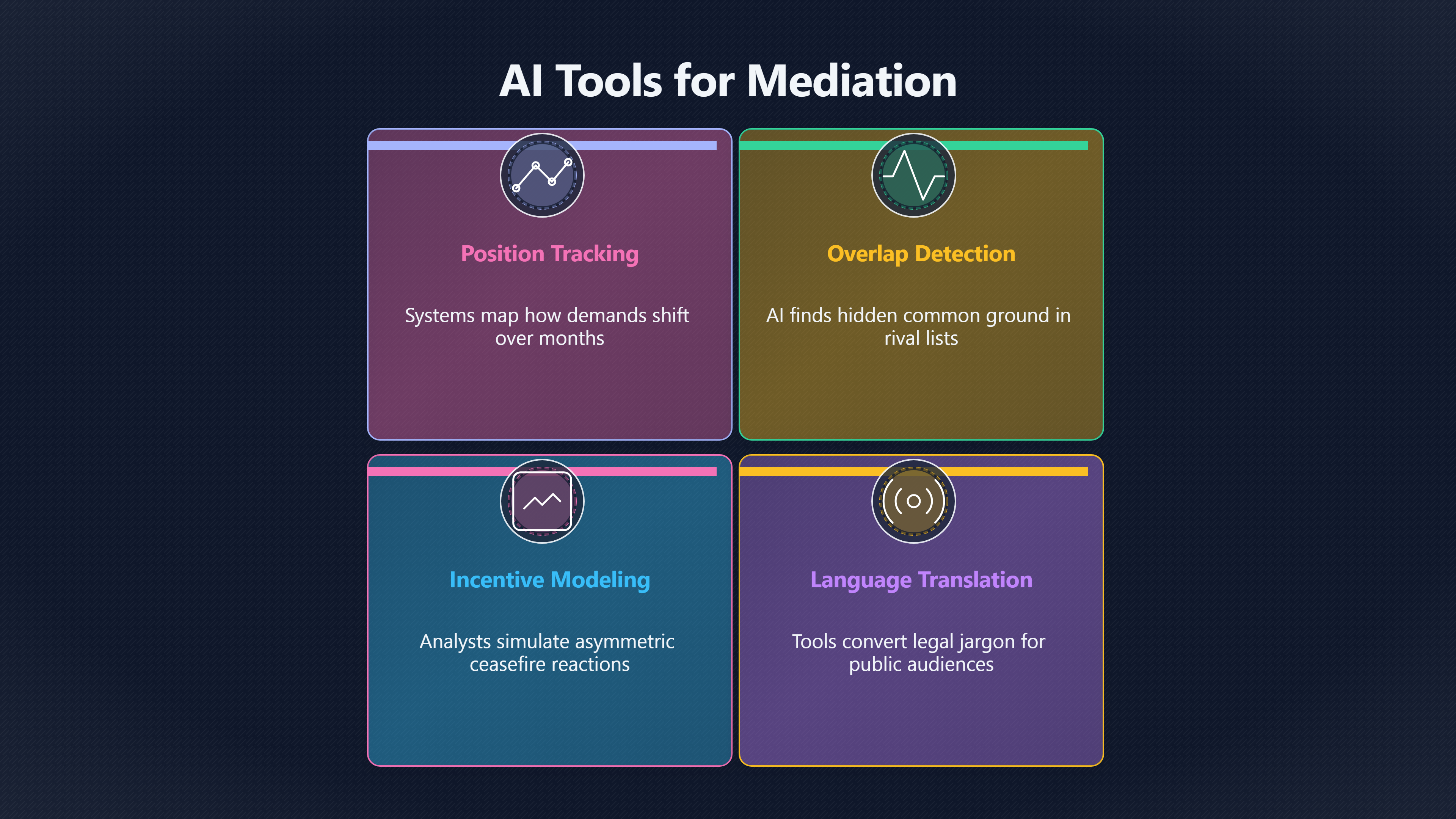
- Track how negotiating positions shift over months or years.
- Identify proposals that previously failed and why.
- Detect hidden overlaps between rival demands.
- Model possible compromise packages.
- Analyse whether a ceasefire proposal creates asymmetric incentives.
- Simulate likely reactions from domestic factions or spoilers.
- Translate technical or legal language across multiple audiences.
- Summarise large public consultations more quickly.
None of these tasks requires AI to “understand peace” philosophically. They require pattern recognition, memory, and information synthesis at scales difficult for human teams alone.
How AI could map trade-offs and compromise zones
One reason negotiations fail is that parties often misjudge what the other side can actually accept. Leaders may posture publicly while privately signalling flexibility. Negotiators may also become trapped by complexity: changing one issue alters five others.
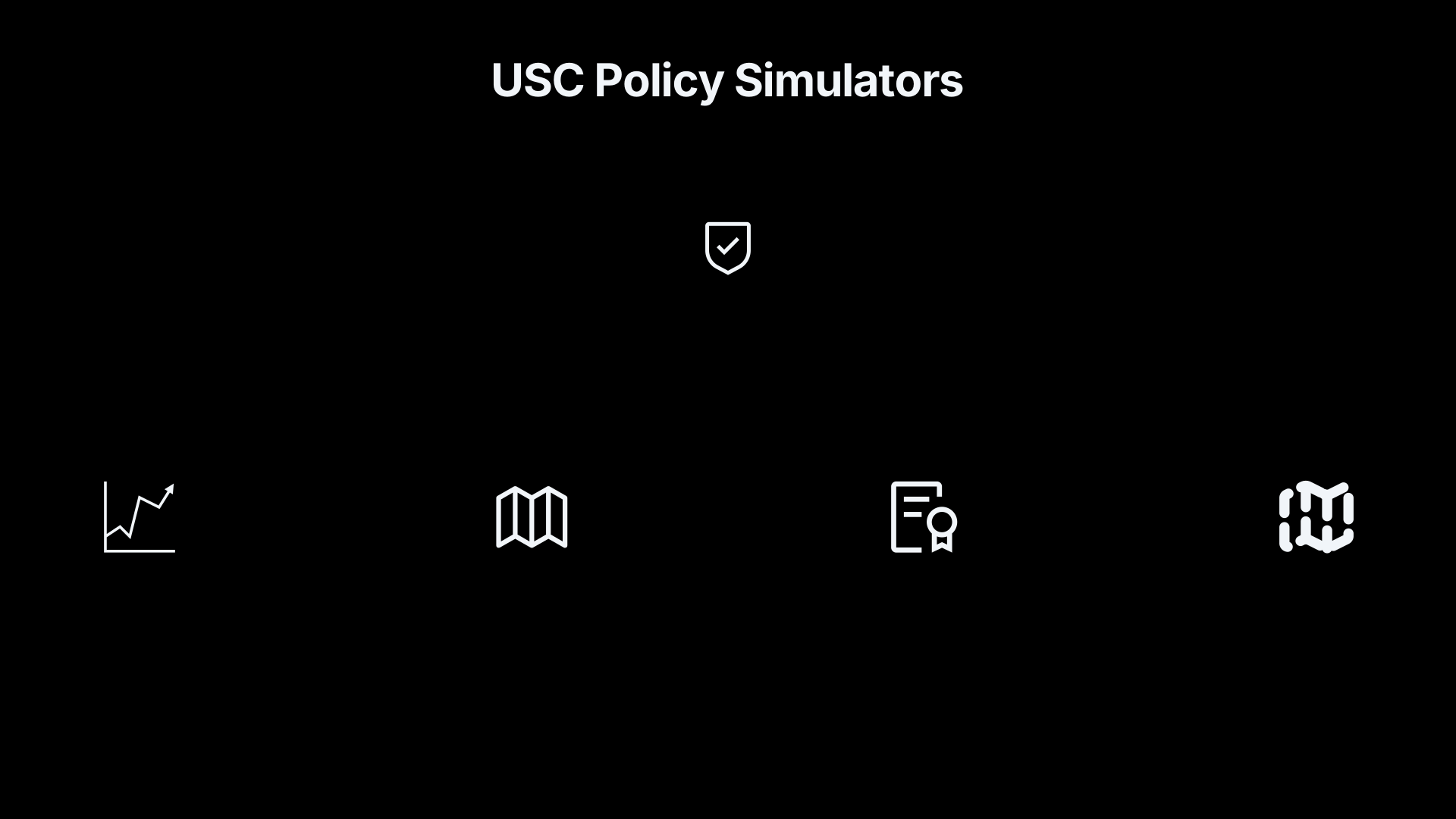
AI systems are increasingly being explored as policy simulators that help negotiators examine these interdependencies before making commitments. Analysts at the USC Center on Public Diplomacy argued that AI could help diplomats model trade-offs and unintended consequences during multilateral negotiations by acting as “real-time policy simulators”. [USC Center on Public Diplomacy]uscpublicdiplomacy.orgrethinking diplomatic negotiations age aiUSC Center on Public DiplomacyRethinking Diplomatic Negotiations in the Age of AIJune 11, 2025 — 11 Jun 2025 — AI doesn't replace the del…
This matters especially in conflicts where deals involve linked concessions across territory, security guarantees, sanctions, constitutional reform, prisoner exchanges, reconstruction aid, and resource sharing. Human negotiators often explore these combinations slowly because the number of possible packages becomes overwhelming.
An AI system cannot decide which settlement is morally correct. But it may help identify “negotiation space”: combinations of concessions that satisfy minimum requirements for all major parties better than negotiators initially realised.
Some researchers have experimented with systems trained on historical peace agreements and strategic bargaining data. A 2025 analysis from the Center for Strategic and International Studies suggested generative AI tools could assist analysis of possible Ukraine war settlement scenarios by comparing historical precedents and sequencing negotiation questions more systematically. [CSIS]csis.orgmachine learning meets war termination using ai explore peace scenarios ukraineCSISMachine Learning Meets War Termination: Using AI…27 Feb 2025 — AI moves beyond simple summarization to become a tool for systemati…
The key insight is not that history repeats mechanically. It is that humans are poor at comparing hundreds of partial analogies simultaneously. AI systems may help mediators explore a wider range of settlement structures more quickly than traditional teams can manage alone.
This resembles a broader AI bloom argument about cognitive abundance. If advanced AI makes high-level analysis cheaper and more scalable, institutions may gain access to forms of strategic modelling previously available only to elite governments with large analytical bureaucracies.
AI may be most useful before and after the deal
The hardest part of many peace agreements is not drafting terms but creating confidence that promises will be honoured. Civil wars often restart because parties suspect cheating, hidden rearmament, or covert attacks.
This creates a narrower but potentially more practical role for AI: verification and monitoring.
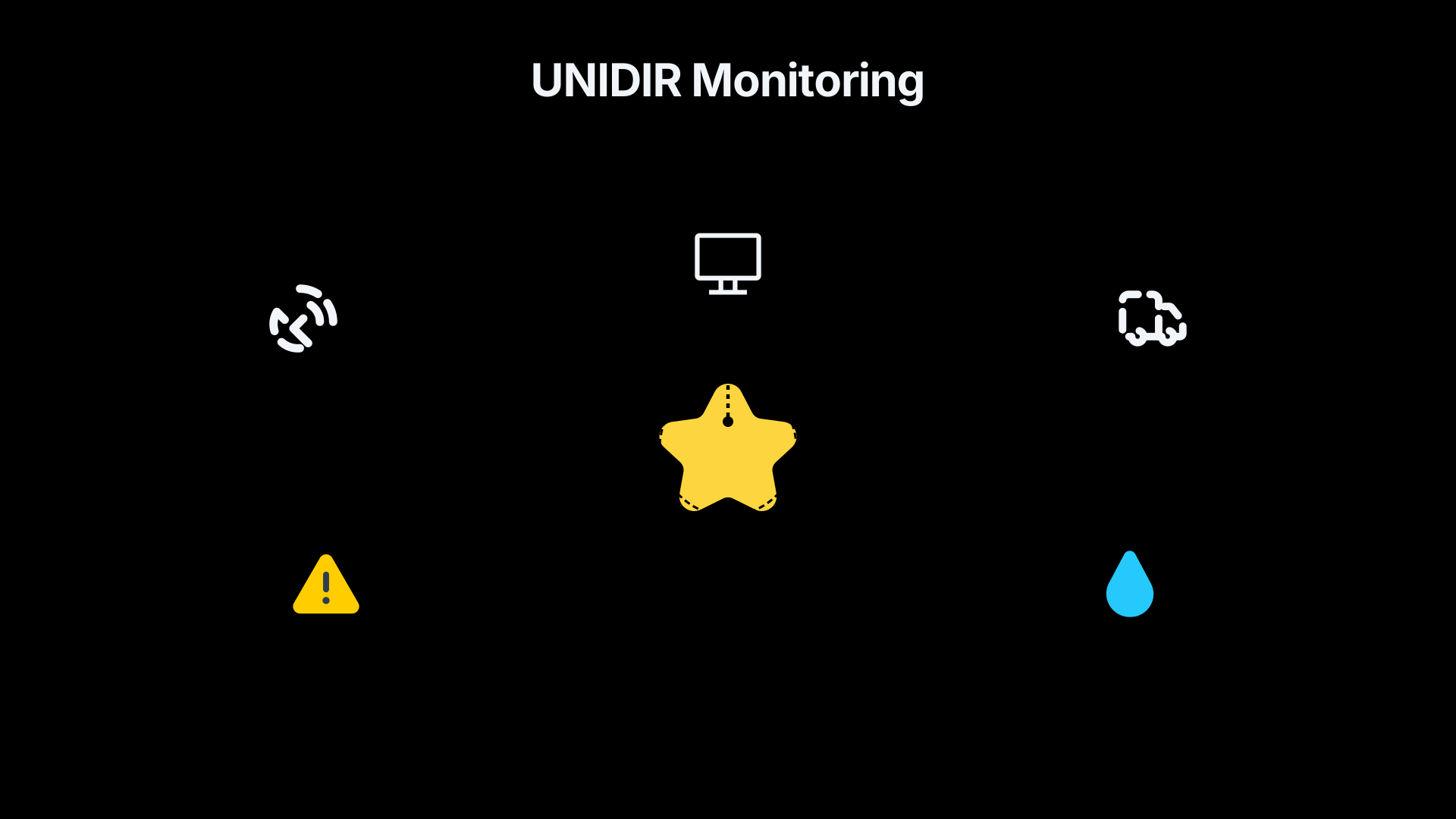
Digital monitoring tools already help ceasefire missions analyse satellite imagery, population movements, and reports from the ground. The HD Centre and UN-affiliated research bodies have explored how digital technologies can support ceasefire verification and confidence-building. HD [2UNIDIR → Building a more secure world.]unidir.orgUNIDIR → Building a more secure world.exploring the use of technology for remote ceasefire…This study is aimed at United Nations perso…
AI systems could strengthen these efforts by:
- Detecting unusual military movements from imagery.
- Identifying coordinated online incitement campaigns.
- Flagging patterns consistent with sanctions evasion or arms transfers.
- Tracking humanitarian access in near real time.
- Monitoring local reports for signs of escalating violence.
- Analysing whether ceasefire violations cluster geographically or politically.
In theory, better verification lowers the fear that compromise equals vulnerability. If both parties can independently inspect evidence about compliance, agreements may become easier to sustain.
This is especially important because peace processes frequently collapse over uncertainty rather than explicit rejection. One faction suspects another is secretly mobilising. Rumours spread online. Local commanders act independently. Politicians fear appearing weak domestically. AI-assisted monitoring cannot remove these dynamics, but it may reduce informational fog.
The broader coordination relevance is significant. Advanced societies depend on systems that make commitments credible at large scale. Peace agreements are one of the most difficult possible versions of that problem.
Inclusion may matter more than optimisation
One of the more interesting arguments for AI-assisted mediation is not speed or efficiency but inclusion.
Traditional peace negotiations often exclude ordinary civilians because consultation at national scale is expensive and slow. That can produce agreements negotiated among armed elites while women, minority groups, refugees, or local communities remain marginalised.
Some researchers and mediation organisations argue AI tools could help process large-scale public input more effectively. A recent paper on peace processes in Africa suggested AI might help gather and summarise citizen perspectives at scales difficult for traditional consultation mechanisms. [CIGI]cigionline.orgCIGICan AI Enhance Peace Processes in Africa?January 14, 2026 — by J Temin — → One of the most promising potential uses is in making peac…
Experiments outside formal war mediation point in the same direction. Researchers behind the “Habermas Machine”, an AI-assisted deliberation system tested with thousands of UK participants, found that AI-generated compromise statements sometimes increased agreement levels compared with standard group discussion formats. [The Guardian]theguardian.comThe system first gathers individual written views and generates group statements for participant evaluation, refining them through succes…
These experiments should not be overstated. Agreeing on childcare policy in a citizens’ assembly is not equivalent to ending a civil war. But they do hint at a potentially important capability: AI may help synthesise large numbers of conflicting preferences into proposals people recognise as broadly fairer representations of group opinion.
That matters because many peace processes fail from lack of legitimacy rather than lack of technical detail. Agreements perceived as externally imposed often collapse once political pressure rises.
A more optimistic AI bloom interpretation is that advanced intelligence systems could eventually help large societies aggregate preferences more effectively without requiring endless bureaucratic bottlenecks. Peace mediation is one early, difficult test case for whether AI can support human coordination without replacing democratic legitimacy.
Why diplomacy must not become automated bargaining
The strongest objections to AI peace mediation are not technical. They are political and moral.
Peace negotiations are not engineering problems. They involve grief, memory, identity, fear, prestige, and justice. Many conflicts persist precisely because parties disagree about values, not because they lack information.
An AI system might identify a statistically plausible compromise while completely misunderstanding symbolic realities that human negotiators immediately recognise. Territorial concessions, constitutional language, prisoner releases, and transitional justice provisions can carry meanings invisible in datasets.
There are also serious risks around bias and manipulation.
AI systems trained on historical peace agreements may inherit hidden assumptions from previous negotiations dominated by powerful states. Models could privilege stability over justice, central governments over minorities, or internationally acceptable outcomes over locally legitimate ones.
Authoritarian governments might also use “AI neutrality” rhetorically to disguise coercive bargaining. A settlement presented as algorithmically optimal could still encode political interests chosen by whoever designed the system.
Researchers and practitioners repeatedly stress that AI should support human mediators rather than replace them. The Yemen negotiation research project explicitly argued for participatory, context-sensitive development involving mediators themselves. [wrap.warwick.ac.uk]wrap.warwick.ac.ukSupporting peace negotiations in the Yemen war through…by M Arana-Catania · 2022 · Cited by 14 — The primary goal of this study was to…
This distinction matters. Decision-support systems are fundamentally different from automated decision systems.
A useful mediation AI might:
- Organise evidence.
- Model consequences.
- Detect inconsistencies.
- Suggest overlooked compromises.
- Surface minority concerns.
But humans still need to:
- Decide what counts as justice.
- Assess sincerity.
- Build trust.
- Interpret symbolism.
- Accept political responsibility for the outcome.
The phrase “algorithm for peace” remains misleading precisely because peace depends on legitimacy, not merely optimisation. [il.boell.org]il.boell.orgAn Algorithm for Peace?AI in International Peace Mediation3 Apr 2022 — While there is no “algorithm for peace,” AI tools have a role to play in the future of th…
The deeper coordination question
The wider AI bloom relevance of peace mediation is not that AI will abolish war. The stronger claim is narrower and more plausible: advanced AI could slightly improve humanity’s capacity to coordinate under conditions of extreme complexity.
Civilisation increasingly faces problems where millions of interacting variables overwhelm unaided human institutions. Climate negotiations, biosecurity governance, financial stability, migration management, arms control, and superintelligence governance all share a similar structure: many actors, asymmetric information, weak trust, and catastrophic downside risk if coordination fails.
Peace mediation is therefore a revealing test case. If AI systems cannot even help humans negotiate ceasefires more effectively, optimism about AI-assisted civilisation-scale coordination should remain cautious.
But if AI tools genuinely help mediators clarify trade-offs, identify compromise space, include neglected voices, and monitor commitments more credibly, that could represent an early example of something larger: intelligence becoming abundant enough not just to invent technologies, but to help societies govern themselves more coherently.
That would still leave the hardest parts of politics intact. AI cannot decide what humanity should value. It cannot reconcile fundamentally incompatible visions of justice. And it cannot remove the need for courage, compromise, restraint, or forgiveness.
What it may eventually do is reduce some of the informational chaos that makes those human tasks even harder than they already are.
Endnotes
-
Source: cambridge.org
Link: https://www.cambridge.org/core/journals/data-and-policy/article/supporting-peace-negotiations-in-the-yemen-war-through-machine-learning/5ABAA03195A350C3313E72736AE355EASource snippet
Cambridge University Press & AssessmentSupporting peace negotiations in the Yemen war through...by M Arana-Catania · 2022 · Cited by 15...
-
Source: arxiv.org
Title: arXiv Machine Learning for Mediation in Armed Conflicts
Link: https://arxiv.org/abs/2108.11942Source snippet
Machine Learning for Mediation in Armed Conflictsby M Arana-Catania · 2021 · Cited by 11 — This study shows how machine-learning tools ca...
-
Source: il.boell.org
Title: An Algorithm for Peace?
Link: https://il.boell.org/en/2022/04/03/algorithm-peace-ai-international-peace-mediationSource snippet
AI in International Peace Mediation3 Apr 2022 — While there is no “algorithm for peace,” AI tools have a role to play in the future of th...
-
Source: wrap.warwick.ac.uk
Link: https://wrap.warwick.ac.uk/id/eprint/167832/1/WRAP-Supporting-peace-negotiations-in-the-Yemen-war-through-machine-learning-Procter-22.pdfSource snippet
Supporting peace negotiations in the Yemen war through...by M Arana-Catania · 2022 · Cited by 14 — The primary goal of this study was to...
-
Source: csis.org
Title: machine learning meets war termination using ai explore peace scenarios ukraine
Link: https://www.csis.org/analysis/machine-learning-meets-war-termination-using-ai-explore-peace-scenarios-ukraineSource snippet
CSISMachine Learning Meets War Termination: Using AI...27 Feb 2025 — AI moves beyond simple summarization to become a tool for systemati...
-
Source: unidir.org
Link: https://unidir.org/wp-content/uploads/2023/05/UNIDIR-Exploring_Use_Technology_Remote_Ceasefire_Monitoring_Verification.pdfSource snippet
UNIDIR → Building a more secure world.exploring the use of technology for remote ceasefire...This study is aimed at United Nations perso...
-
Source: cigionline.org
Link: https://www.cigionline.org/documents/3688/no.219Temin.pdfSource snippet
CIGICan AI Enhance Peace Processes in Africa?January 14, 2026 — by J Temin — → One of the most promising potential uses is in making peac...
Published: January 14, 2026
-
Source: diplomacy.edu
Title: Mediation and AI
Link: https://www.diplomacy.edu/wp-content/uploads/2021/06/Mediation_and_AI.pdfSource snippet
Mediation and artificial intelligence: Notes on the future of...10 Nov 2019 — The use of machine learning to analyse public opinions and...
-
Source: uscpublicdiplomacy.org
Title: rethinking diplomatic negotiations age ai
Link: https://uscpublicdiplomacy.org/blog/rethinking-diplomatic-negotiations-age-aiSource snippet
USC Center on Public DiplomacyRethinking Diplomatic Negotiations in the Age of AIJune 11, 2025 — 11 Jun 2025 — AI doesn't replace the del...
Published: June 11, 2025
-
Source: theguardian.com
Link: https://www.theguardian.com/technology/2024/oct/17/ai-mediation-tool-may-help-reduce-culture-war-rifts-say-researchersSource snippet
The system first gathers individual written views and generates group statements for participant evaluation, refining them through succes...
Additional References
-
Source: researchgate.net
Link: https://www.researchgate.net/publication/386477061_AI_Artificial_Intelligence_for_Conflict_Resolution_and_Negotiation_Enhancing_Mediation_and_Collaboration_Through_Intelligent_TechnologySource snippet
(PDF) AI (Artificial Intelligence) for Conflict Resolution and...11 Jan 2025 — This paper explores the role of XAI in emotional conflict...
-
Source: researchgate.net
Link: https://www.researchgate.net/publication/391536114_Artificial_Intelligence_in_Conflict_Resolution_A_Comprehensive_Review_of_Techniques_and_ApplicationsSource snippet
(PDF) Artificial Intelligence in Conflict Resolution22 May 2025 — This paper presents a systematic review of artificial intelligence (AI)...
Published: May 2025
-
Source: researchgate.net
Link: https://www.researchgate.net/publication/392155579_AI_FOR_CONFLICT_RESOLUTION_AND_PEACEBUILDING_A_NEW_PARADIGM_FOR_SOCIO-POLITICAL_STABILITYSource snippet
ai for conflict resolution and peacebuilding28 May 2025 — This paper explores the role of AI in conflict resolution, examining how machin...
Published: May 2025
-
Source: c-r.org
Link: https://www.c-r.org/accord/still-time-talk/ai-and-future-mediationSource snippet
AI and the future of mediationThis article contemplates the potential for AI to transform the realm of peace mediation, along with the as...
-
Source: c-r.org
Link: https://www.c-r.org/accord/still-time-talk/including-digital-technologies-peace-agreementsSource snippet
Including digital technologies in peace agreementsIn response, conflict parties and mediators have begun integrating digital technologies...
-
Source: iemed.org
Link: https://www.iemed.org/publication/navigating-the-intersection-between-mediation-and-digital-technology-opportunities-to-strengthen-eu-peace-capacities/Source snippet
Navigating the Intersection between Mediation and Digital...21 Feb 2022 — This policy brief examines how digital technologies are incorp...
-
Source: cmi.fi
Link: https://cmi.fi/2026/04/27/new-practical-guidance-note-examines-how-digital-tools-can-support-inclusive-peace-mediation/Source snippet
New 'Practical Guidance Note' examines how digital tools...27 Apr 2026 — Digital technologies are reshaping conflict and peace processes...
-
Source: mediate.com
Link: https://mediate.com/computational-mediation-the-integration-of-artificial-intelligence-in-architecting-decision-trees-and-settlement-scenarios/Source snippet
Computational Mediation: The Integration of Artificial...Nov 23, 2025 — Through machine learning and natural language processing (NLP)...
-
Source: linkedin.com
Link: https://www.linkedin.com/posts/csis_machine-learning-meets-war-termination-using-activity-7301360546358980613–7JtSource snippet
How AI can help with peace negotiations28 Feb 2025 — "Techniques leveraging generative AI can be helpful in analyzing the complexities of...
-
Source: belfercenter.org
Title: ai and future conflict resolution how can artificial intelligence improve peace
Link: https://www.belfercenter.org/research-analysis/ai-and-future-conflict-resolution-how-can-artificial-intelligence-improve-peaceSource snippet
AI and the Future of Conflict Resolution: How Can Artificial...27 May 2025 — The intersection of AI and conflict resolution is rapidly b...
Published: May 2025
Amazon book picks
Further Reading
Books and field guides related to AI peace mediation. Use these as the next step if you want deeper reading beyond the article.

Artificial intelligence
First published 1994. Subjects: problem solving, constraint satisfaction, knowledge, reasoning, planning.

Ethical Governance of Artificial Intelligence in the Public S...
First published 2021. Subjects: Science, Artificial intelligence, Moral and ethical aspects, Government policy, Intelligence artificielle.

International conflict mediation
First published 2008. Subjects: International cooperation, Conflict management, Dispute resolution (law), International relations, World...

The Mediation Process
The Fourth Edition of a seminal work in the field of mediation and conflict resolution For almost thirty years, conflict resolution pract...
eBay marketplace picks
Marketplace Samples
Example marketplace items related to this page. Use the search link to explore similar finds on eBay.

Example eBay listing
A.I. Artificial Intelligence Original Movie Poster Signed By Jude Law
USD 125.00 | Shipping USD 25.00 | US

Example eBay listing
Artificial Intelligence D/S Original Movie Poster - 27 x 40"
USD 19.50 | Shipping USD 13.65 | US

Example eBay listing
612388 Artificial Intelligence Movie Science Fiction Drama Wall Print Poster
USD 22.95 | Shipping USD 12.95 | JP

Example eBay listing
Companion - Artificial Intelligence Dark Comedy Cinema Film - POSTER 20"x30"
USD 23.99 | Free shipping | US

Example eBay listing
A.I. Artificial Intelligence Movie Film Poster Art Print
GBP 4.99 | Free shipping | GB

Example eBay listing
A I Artificial Intelligence 6 Movie Poster Art Print Print Classic Rare Gallery
GBP 49.00 | Free shipping | GB

Example eBay listing
AI - Artificial Intelligence (Poster + Slipcase) Blu-Ray
GBP 10.49 | Free shipping | GB

Example eBay listing
A. I. Artificial Intelligence. Jude Law. Original UK Video Poster.
GBP 8.11 | Shipping GBP 3.38 | GB
Topic Tree