Within Peace deals
Yemen position mapping
Yemen’s peace talks show how AI could help mediators track shifting demands, actors and issue links across years of negotiation records.
On this page
- Why Yemen’s talks are hard to track
- What machine learning can extract from transcripts
- Where position mapping could mislead mediators
Page outline Jump by section
Introduction
Yemen’s peace negotiations are one of the clearest real-world examples of how AI might help mediators manage overwhelming political complexity without replacing human diplomacy. Over years of talks, ceasefires, failed agreements, shuttle diplomacy and backchannel discussions, negotiators accumulated vast numbers of transcripts, position papers, public statements and meeting notes. Human mediation teams often struggled to track which actors had shifted position, which demands were symbolic, and which trade-offs might unlock progress.
 Researchers working directly with material from Yemen’s negotiations tested whether machine learning tools could help organise and analyse this information. Their work did not promise “AI peace deals”. Instead, it explored a narrower but potentially valuable function: helping mediators map political positions across time, identify hidden overlaps between rival demands, and detect where negotiations were stuck because of misunderstanding rather than irreconcilable goals. [arXiv]arxiv.orgarXiv Supporting peace negotiations in the Yemen war througharXivSupporting peace negotiations in the Yemen war through…July 23, 2022 — by M Arana-Catania · 2022 · Cited by 14 — The “Mediating M…
Within the broader idea of AI-assisted coordination, Yemen matters because it shows both the promise and the danger of applying advanced information-processing systems to fragile political processes. AI may help humans understand complex negotiations more clearly. But it can also distort local realities, reinforce existing biases, or give false confidence in patterns that are politically meaningless.
Why Yemen’s talks are hard to track
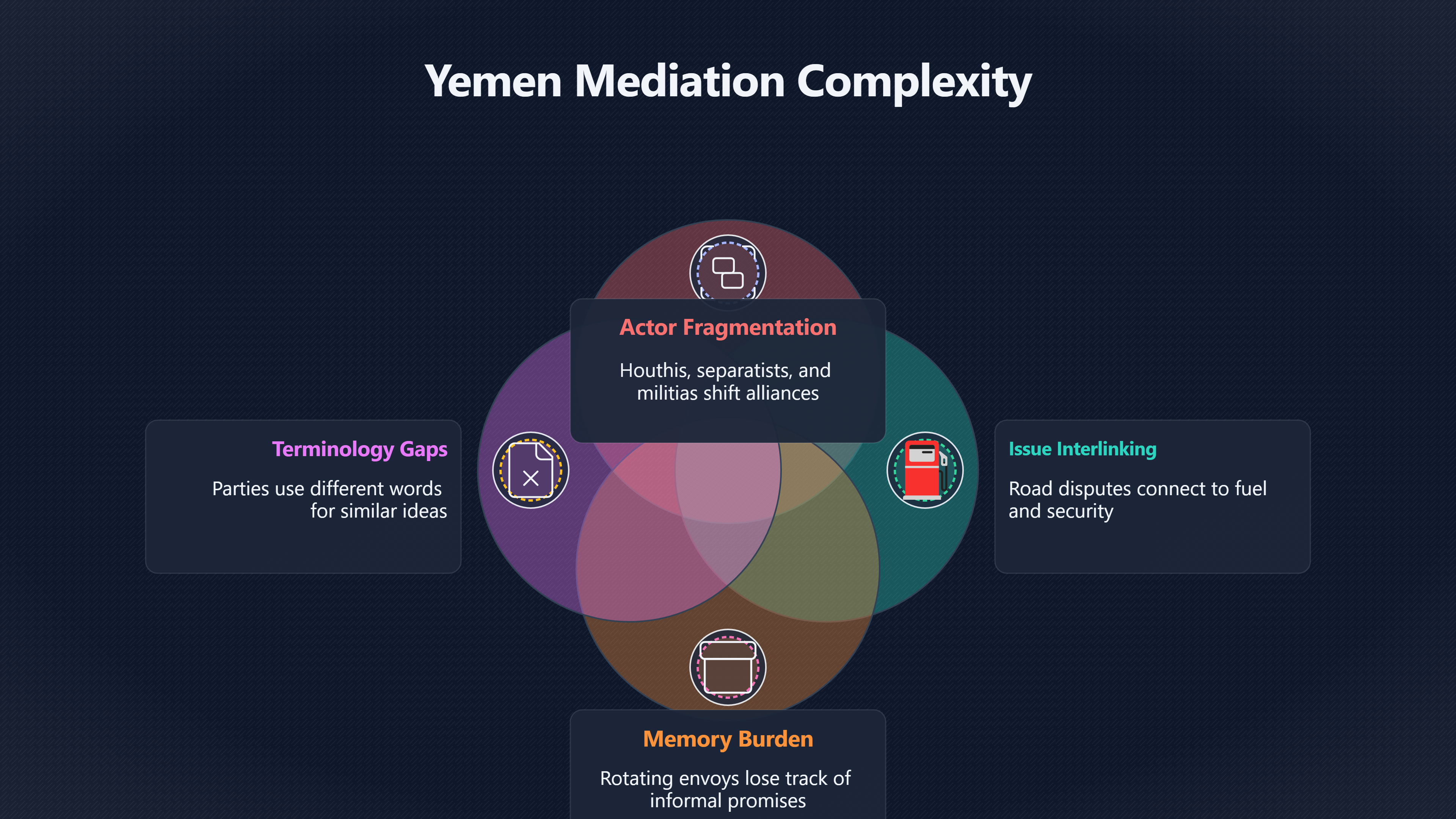
The Yemen conflict is not a simple two-sided war. Over time it has involved the Houthis, the internationally recognised government, southern separatists, tribal groups, regional militias, Saudi Arabia, the United Arab Emirates, Oman, Iran-linked networks, humanitarian organisations, women’s groups, local ceasefire committees and foreign diplomats. Many actors changed alliances or fragmented internally during the conflict. [Peace Research Institute Oslo]prio.orgPeace Research Institute OsloMediation in the Yemeni Civil War: Actors, Outcomes, and…In this brief, we analyze all mediation efforts… [RUSI]rusi.orgpeace process yemen brokenThe Peace Process in Yemen is Broken8 Feb 2021 — A persistent structural flaw in the peace process is that UN Resolution 2216 forced all…
That fragmentation created a serious information problem for mediation teams.
Negotiators were not only trying to end fighting. They were simultaneously discussing:
- ceasefire mechanisms
- prisoner exchanges
- fuel imports
- airport access
- public-sector salaries
- territorial control
- constitutional arrangements
- humanitarian access
- economic governance
- local security guarantees
Even apparently narrow disputes often linked to several others. A disagreement over roads around Taiz, for example, could connect to military logistics, local prestige, humanitarian access and broader bargaining leverage. [c-r.org]c-r.orgThe economic track in Yemen's peace processNegotiations to extend the truce again centred primarily on economic issues; Grundberg announc…
Peace processes also unfold over years. Negotiators rotate in and out. International envoys change. Informal promises may never appear in official documents. Different parties use different terminology for similar ideas. Mediators therefore face a continual memory problem: how to preserve a usable map of the negotiation as it evolves.
Researchers involved in the “Mediating Machines” project argued that this is precisely the sort of task where machine learning systems may offer practical assistance. Their Yemen work focused on whether AI tools could support “knowledge management, extraction and conflict analysis” from negotiation records. [arXiv]arxiv.orgarXiv Supporting peace negotiations in the Yemen war througharXivSupporting peace negotiations in the Yemen war through…July 23, 2022 — by M Arana-Catania · 2022 · Cited by 14 — The “Mediating M…
This is an important distinction. The proposed systems were not autonomous negotiators. They were analytical support tools designed to augment human mediation teams.
What machine learning can extract from transcripts
The Yemen experiments used natural language processing, or NLP, a branch of AI focused on extracting patterns from human language. Researchers applied machine learning methods to negotiation transcripts in order to identify recurring themes, actor relationships and shifts in political language over time. [arXiv]arxiv.orgarXiv Supporting peace negotiations in the Yemen war througharXivSupporting peace negotiations in the Yemen war through…July 23, 2022 — by M Arana-Catania · 2022 · Cited by 14 — The “Mediating M…
Tracking changing positions over time
Human negotiators often remember recent statements more vividly than older ones. AI systems can scan years of dialogue simultaneously.
In the Yemen case, researchers explored whether machine learning models could detect when parties softened or hardened their positions on particular issues. For mediators, this matters because many peace talks fail not because compromise is impossible, but because negotiators do not realise how much movement has already occurred.
An AI system might detect, for example, that language around decentralisation, salary payments or border monitoring gradually became less absolute across multiple meetings. A human mediator could then test whether a previously impossible compromise had become politically feasible.
This sort of “position drift” is difficult to notice manually when thousands of pages of negotiation material accumulate over years.
Mapping issue relationships
Negotiation issues are rarely independent.
The Yemen studies explored topic modelling systems that grouped related concepts together across documents. This helped identify which issues repeatedly appeared in the same contexts. [arXiv]arxiv.orgarXiv Supporting peace negotiations in the Yemen war througharXivSupporting peace negotiations in the Yemen war through…July 23, 2022 — by M Arana-Catania · 2022 · Cited by 14 — The “Mediating M…
For mediators, this could reveal hidden bargaining structures. One side may appear inflexible on an airport issue, for example, but historical dialogue patterns might show that the real concern is revenue flows, security guarantees or domestic legitimacy.
AI systems are unusually effective at recognising these large-scale textual correlations because they can compare every document against every other document at once.
In theory, this could help mediators design bundled agreements instead of negotiating issues one by one in isolation.
Identifying overlooked actors
Yemen’s conflict generated large numbers of local initiatives and informal discussions outside headline diplomacy.
Machine learning tools can sometimes reveal which actors appear repeatedly across negotiation networks even when they receive little international attention. Researchers suggested this could help mediators distinguish between symbolic participants and actors with genuine influence over implementation. [arXiv]arxiv.orgarXiv Supporting peace negotiations in the Yemen war througharXivSupporting peace negotiations in the Yemen war through…July 23, 2022 — by M Arana-Catania · 2022 · Cited by 14 — The “Mediating M…
This matters because peace agreements often collapse when negotiators ignore groups capable of acting as spoilers.
The same logic also supports more inclusive peacebuilding. Recent digital dialogue projects in Yemen have used AI-assisted systems to analyse large numbers of responses from youth and local communities that traditional mediation formats struggled to include. [CMI]cmi.fiamplifying youth voices in conflict zones ai for inclusive dialogue in yemenCMIAmplifying youth voices in conflict zones: AI for inclusive…4 Jun 2025 — In Yemen, AI-powered digital tools have improved participa… [UNSSC In the optimistic]unssc.orgThe AI Peace NexusElevating WPS Agenda in Yemen's…15 May 2025 — This report captures the outcomes, insights, and forward-looking recommendations to leve…“AI bloom” framing, this points toward a broader possibility: advanced AI could eventually help societies process far larger volumes of human input than traditional institutions can manage today.
Compressing overwhelming information
Perhaps the simplest benefit is also the most practical.
Modern mediation generates enormous textual archives. AI summarisation systems may help negotiators quickly review historical proposals, compare draft agreements, or identify where language has changed between versions.
This does not require superintelligence or autonomous diplomacy. It is essentially a civilisational memory aid.
But memory and coordination matter enormously in long-running conflicts. If advanced AI systems eventually become much better at synthesising institutional knowledge, they could improve humanity’s ability to govern complex systems far beyond diplomacy alone.
Yemen as a test case for AI-assisted coordination
The Yemen experiments matter partly because they remain modest.
Many public discussions of AI and governance jump immediately to speculative visions of machine-run politics. The Yemen work instead explored a constrained use case where AI acts more like an analytical assistant for human decision-makers. [c-r.org]c-r.orgAI and the future of mediationThis article contemplates the potential for AI to transform the realm of peace mediation, along with the as…
That restraint is important.
Peace mediation depends heavily on legitimacy, trust and contextual judgement. An algorithm cannot determine what justice requires after civil war. Nor can it understand the emotional and symbolic weight attached to territory, identity or historical grievance.
Yet the Yemen case still hints at something larger within the AI bloom debate.
One of the strongest arguments for advanced AI is not merely that it automates labour, but that it expands humanity’s capacity to process complexity. Civilisation increasingly struggles with coordination problems involving huge amounts of information spread across fragmented institutions. Peace negotiations are one visible example of this broader challenge.
If AI systems can help humans reason more effectively about tangled political systems without removing human accountability, they may modestly improve humanity’s ability to cooperate under pressure.
Even small improvements matter when coordination failures cost lives.
Where position mapping could mislead mediators
The same tools that help mediators organise information can also distort reality.
Researchers involved in Yemen repeatedly stressed that AI systems should support, not replace, human judgement. [arXiv]arxiv.orgarXiv Supporting peace negotiations in the Yemen war througharXivSupporting peace negotiations in the Yemen war through…July 23, 2022 — by M Arana-Catania · 2022 · Cited by 14 — The “Mediating M… [2wrap.warwick.ac.uk]wrap.warwick.ac.ukSupporting peace negotiations in the Yemen war through…by M Arana-Catania · 2022 · Cited by 14 — Using dialogue transcripts from peace…
Several risks stand out.
Negotiation language is strategic, not transparent
Political actors do not always say what they mean.
Negotiators posture for domestic audiences, conceal concessions, use ambiguity deliberately and sometimes issue contradictory statements across different forums. A machine learning system trained only on text may mistake tactical rhetoric for genuine preference.
This creates a serious danger: mediators may overestimate the importance of positions that are publicly repeated while missing informal signals communicated privately.
Human diplomats often rely on intuition, relationships and contextual knowledge precisely because formal transcripts alone are incomplete.
Training data can reinforce exclusion
Peace processes already tend to privilege actors with institutional access, international visibility and strong documentation.
AI systems trained on existing negotiation records may reproduce those biases automatically. Groups that appear less frequently in transcripts — women’s organisations, local communities, youth movements or informal tribal actors — may become statistically marginal even when they matter politically. [Inclusive Peace]inclusivepeace.orgSource details in endnotes. [UNSSC This is a wider governance problem in AI systems generally: models often inherit the blind spots of the institutions that produce the data.]unssc.orgThe AI Peace NexusElevating WPS Agenda in Yemen's…15 May 2025 — This report captures the outcomes, insights, and forward-looking recommendations to leve…
False precision is dangerous in diplomacy
Machine learning systems can produce outputs that appear objective because they are mathematical.
But political interpretation is not physics.
A visualisation showing that two factions have “72% issue overlap” may create false confidence in compromise prospects. In reality, a single symbolic issue can outweigh dozens of technical agreements.
Yemen repeatedly demonstrated that negotiations can collapse over matters outsiders perceive as secondary. The emotional and political meaning attached to an issue may matter far more than its statistical frequency within negotiation texts.
AI systems may privilege what is measurable
Negotiation transcripts capture formal dialogue more easily than fear, humiliation, trauma or informal social pressures.
This creates a risk that mediators focus increasingly on what algorithms can quantify while undervaluing harder-to-measure realities. The result could be more technically elegant mediation that is politically weaker on the ground.
The International Committee of the Red Cross has argued for a “human-centred approach” to AI in conflict settings precisely because systems that optimise information-processing can still fail morally or politically if human judgement becomes secondary. [ICRC]icrc.orgICRCArtificial intelligence and machine learning in armed conflict6 Jun 2019 — This paper sets out the ICRC's perspective on the use of A…
The larger significance beyond Yemen
The Yemen case does not prove that AI can produce peace. The evidence is far narrower than that.
What it does suggest is that advanced information-processing tools may help humans manage forms of institutional complexity that increasingly exceed ordinary bureaucratic capacity.
That possibility extends beyond mediation.
Governments, scientific institutions, disaster-response systems and international organisations all face versions of the same problem: too much information, too many actors, and limited human attention. AI systems may eventually help societies navigate these coordination bottlenecks more effectively.
Within the broader AI bloom vision, this is one of the less glamorous but potentially most important pathways to human flourishing. Civilisation does not only fail because resources are scarce. It also fails because institutions cannot process enough knowledge quickly enough to coordinate wisely.
Yemen’s negotiations offer a small, imperfect glimpse of how AI might assist with that challenge. The systems tested there did not resolve political disagreement or eliminate violence. But they pointed toward a future in which advanced AI could help humans understand complicated social systems with greater clarity, continuity and scale.
Whether that ultimately strengthens peacebuilding or merely adds another layer of technocratic power will depend less on the algorithms themselves than on the institutions, incentives and human values guiding their use.
Endnotes
-
Source: arxiv.org
Title: arXiv Supporting peace negotiations in the Yemen war through
Link: https://arxiv.org/pdf/2207.11528Source snippet
arXivSupporting peace negotiations in the Yemen war through...July 23, 2022 — by M Arana-Catania · 2022 · Cited by 14 — The “Mediating M...
Published: July 23, 2022
-
Source: arxiv.org
Title: arXiv Machine Learning for Mediation in Armed Conflicts
Link: https://arxiv.org/abs/2108.11942Source snippet
Machine Learning for Mediation in Armed Conflictsby M Arana-Catania · 2021 · Cited by 12 — This study shows how machine-learning tools ca...
-
Source: arxiv.org
Title: arXiv Supporting peace negotiations in the Yemen war through machine learning
Link: https://arxiv.org/abs/2207.11528Source snippet
Supporting peace negotiations in the Yemen war through...by M Arana-Catania · 2022 · Cited by 14 — Using dialogue transcripts from peace...
-
Source: rusi.org
Title: peace process yemen broken
Link: https://www.rusi.org/explore-our-research/publications/commentary/peace-process-yemen-brokenSource snippet
The Peace Process in Yemen is Broken8 Feb 2021 — A persistent structural flaw in the peace process is that UN Resolution 2216 forced all...
-
Source: c-r.org
Link: https://www.c-r.org/accord/still-time-talk/getting-down-business-economic-track-yemens-peace-processSource snippet
The economic track in Yemen's peace processNegotiations to extend the truce again centred primarily on economic issues; Grundberg announc...
-
Source: wrap.warwick.ac.uk
Link: https://wrap.warwick.ac.uk/id/eprint/167832/1/WRAP-Supporting-peace-negotiations-in-the-Yemen-war-through-machine-learning-Procter-22.pdfSource snippet
Supporting peace negotiations in the Yemen war through...by M Arana-Catania · 2022 · Cited by 14 — Using dialogue transcripts from peace...
-
Source: cmi.fi
Title: amplifying youth voices in conflict zones ai for inclusive dialogue in yemen
Link: https://cmi.fi/2025/06/04/amplifying-youth-voices-in-conflict-zones-ai-for-inclusive-dialogue-in-yemen/Source snippet
CMIAmplifying youth voices in conflict zones: AI for inclusive...4 Jun 2025 — In Yemen, AI-powered digital tools have improved participa...
-
Source: unssc.org
Title: The AI Peace Nexus
Link: https://www.unssc.org/news-and-insights/resources/report-ai-peace-nexus-elevating-wps-agenda-yemens-digital-futureSource snippet
Elevating WPS Agenda in Yemen's...15 May 2025 — This report captures the outcomes, insights, and forward-looking recommendations to leve...
Published: May 2025
-
Source: c-r.org
Link: https://www.c-r.org/accord/still-time-talk/ai-and-future-mediationSource snippet
AI and the future of mediationThis article contemplates the potential for AI to transform the realm of peace mediation, along with the as...
-
Source: icrc.org
Link: https://www.icrc.org/en/document/artificial-intelligence-and-machine-learning-armed-conflict-human-centred-approachSource snippet
ICRCArtificial intelligence and machine learning in armed conflict6 Jun 2019 — This paper sets out the ICRC's perspective on the use of A...
-
Source: unssc.org
Link: https://www.unssc.org/sites/default/files/node/resources/field_resource/2025-05/Report_Paris_AI_Summit_May2025-spread%20view.pdfSource snippet
The AI Peace NexusThe report highlights participants' insights on fostering an inclusive peace process in Yemen and explores strategies t...
-
Source: prio.org
Link: https://www.prio.org/publications/11353 -
Source: inclusivepeace.org
Link: https://www.inclusivepeace.org/wp-content/uploads/2022/12/Policy-Brief-Pathways-Yemen-Nov-2022-updated-25Jan.pdf
Additional References
-
Source: peaceagreements.org
Link: https://www.peaceagreements.org/media/documents/ag1400_5923ff45aad2e.pdfSource snippet
National Dialogue Conference Outcomes DocumentThis conference was the first of its kind in the history of Yemen, both in terms of its cau...
-
Source: arabstates.unwomen.org
Link: https://arabstates.unwomen.org/sites/default/files/2022-07/Local-Mediation-Paper_EN-1.pdfSource snippet
from Iraq, Libya, Syria and YemenDrawing on case studies from Iraq, Libya, Syria and Yemen, it maps entry points, techniques and outcomes...
-
Source: peacetrackinitiative.org
Link: https://peacetrackinitiative.org/storage/documents/May2025/Zupq47QffOpEKLsQdtzt.pdf -
Source: semanticscholar.org
Link: https://www.semanticscholar.org/paper/Machine-Learning-for-Mediation-in-Armed-Conflicts-Arana-Catania-Lier/160c6a9e60b736eaa3d6d2c7746680340c73e31a -
Source: wphfund.org
Link: https://wphfund.org/definitions-of-peace-process-track-1-and-track-2-and-implementation-of-a-peace-agreement/Source snippet
t through peaceful means — usually a mixture of politics, diplomacy, negotiations...Read more...
-
Source: researchgate.net
Title: 354157815 Machine Learning for Mediation in Armed Conflicts
Link: https://www.researchgate.net/publication/354157815_Machine_Learning_for_Mediation_in_Armed_ConflictsSource snippet
(PDF) Machine Learning for Mediation in Armed Conflicts27 Aug 2021 — This study shows how machine-learning tools can effectively support...
-
Source: acleddata.com
Link: https://acleddata.com/sites/default/files/wp-content-archive/uploads/dlm_uploads/2021/08/ACLED_YemenMap_Methodology_V1_2021.docx.pdfSource snippet
ts the rationale behind the creation and calculation of its map measuring territorial...
-
Source: toda.org
Title: tr 291 AI Facilitated Youth Consultation in Yemen
Link: https://toda.org/wp-content/uploads/2026/03/tr-291-AI-Facilitated-Youth-Consultation-in-Yemen.pdfSource snippet
Toda Peace InstituteAI-FACILITATED YOUTH CONSULTATION IN YEMEN31 Mar 2026 — The AI analysis subsequently identified patterns and themes w...
-
Source: osesgy.unmissions.org
Title: cutting edge tech service inclusive peace yemen
Link: https://osesgy.unmissions.org/en/news/cutting-edge-tech-service-inclusive-peace-yemenSource snippet
unmissions.orgCutting-Edge Tech in the Service of Inclusive Peace in Yemen3 Aug 2020 — And so, after some minor adjustments, on 8 and 9 J...
-
Source: foreignpolicy.com
Title: yemen saudi arabia houthis peace deal un
Link: https://foreignpolicy.com/2023/11/08/yemen-saudi-arabia-houthis-peace-deal-un/Source snippet
The U.N. Is the Only Path to Peace in Yemen8 Nov 2023 — Both Saudi Arabia and the Houthis want to bypass UN-brokered talks, but avoiding...
Amazon book picks
Further Reading
Books and field guides related to Yemen position mapping. Use these as the next step if you want deeper reading beyond the article.

Peace Negotiations and Time
This book discusses the role of time in peace negotiations and peace processes in the post-Cold War period, making reference to real-worl...
The Viet Nam Peace Negotiations
An account of the peace negotiations between the United States and Vietnam during the Vietnam War by the Special Assistant for Foreign to...

Why Peace Negotiations Frequently Fail
Why Peace Negotiation Frequently Fail by Kemal is an analytical e-book that examines the key factors behind the failure of peace negotiat...
eBay marketplace picks
Marketplace Samples
Example marketplace items related to this page. Use the search link to explore similar finds on eBay.

Example eBay listing
A.I. Artificial Intelligence Original Movie Poster Signed By Jude Law
USD 125.00 | Shipping USD 25.00 | US

Example eBay listing
Artificial Intelligence D/S Original Movie Poster - 27 x 40"
USD 19.50 | Shipping USD 13.65 | US

Example eBay listing
612388 Artificial Intelligence Movie Science Fiction Drama Wall Print Poster
USD 22.95 | Shipping USD 12.95 | JP

Example eBay listing
Companion - Artificial Intelligence Dark Comedy Cinema Film - POSTER 20"x30"
USD 23.99 | Free shipping | US
Topic Tree