Within AlphaFold Access
Neglected disease research
Open predicted structures can give neglected-disease researchers a faster starting point, but lab access still decides what discoveries become real.
On this page
- Why neglected pathogens need cheaper structural starting points
- What open AlphaFold predictions let smaller teams investigate
- Where validation, funding and medicines still bottleneck progress
Page outline Jump by section
Introduction
Open protein structure databases do not cure neglected diseases on their own. What they do is lower one of the earliest and most expensive barriers in biomedical research: obtaining a plausible model of the molecular machinery inside pathogens. For diseases such as Chagas disease, sleeping sickness, leishmaniasis and malaria, that matters because these illnesses often impose huge human costs while attracting far less commercial drug-development spending than diseases concentrated in richer countries. [PMC]pmc.ncbi.nlm.nih.govPMCDrug discovery and development for neglected diseasesPMCby E Chatelain · 2011 · Cited by 245 — DNDi's main short-term objectives are to deliver 6–8 new treatments for HAT, Chagas disease, vi…
The AlphaFold Protein Structure Database, developed by Google DeepMind and EMBL-EBI, now provides open access to more than 200 million predicted protein structures. [alphafold.ebi.ac.uk]alphafold.ebi.ac.ukAlphaFold Protein Structure DatabaseAlphaFold DB provides open access to over 200 million protein structure predictions to accelerate sci… That changes the starting conditions for smaller labs, public-health researchers and nonprofit drug-discovery groups. Instead of spending years trying to determine a protein structure experimentally before they can even begin asking drug-design questions, researchers can often start immediately with an AI-generated structural hypothesis.
For the broader idea of AI-enabled scientific acceleration, neglected disease research is an important test case. If advanced AI tools genuinely widen access to discovery, they should help fields that historically lacked money, infrastructure and pharmaceutical attention — not only the richest biomedical markets. The evidence so far suggests that open protein maps can meaningfully speed early-stage research. But they do not remove the harder bottlenecks of funding, laboratory validation, clinical trials, manufacturing and medicine delivery.
Why neglected pathogens need cheaper structural starting points
Many neglected tropical diseases are caused by parasites with complex and poorly characterised biology. Researchers often know the genome sequence of a pathogen long before they understand how its proteins fold, interact or can be targeted by drugs.
Traditionally, determining those structures required expensive experimental techniques such as X-ray crystallography or cryo-electron microscopy. These methods remain essential, but they are difficult to scale in lower-resource settings. Structural biology infrastructure is concentrated in wealthier countries and elite institutions, while neglected diseases disproportionately affect poorer regions. [PMC]pmc.ncbi.nlm.nih.govPMCDrug discovery and development for neglected diseasesPMCby E Chatelain · 2011 · Cited by 245 — DNDi's main short-term objectives are to deliver 6–8 new treatments for HAT, Chagas disease, vi…
This mismatch creates a compounding problem:
- Diseases with limited commercial return attract less investment.
- Less investment means fewer specialised facilities and datasets.
- Fewer structures mean slower drug discovery.
- Slow progress reinforces the perception that these diseases are scientifically difficult and commercially unattractive.
Open AI-predicted structures partly interrupt that cycle. Instead of waiting for a perfect experimentally solved structure, researchers can begin with a predicted model and use it to prioritise experiments, screen compounds computationally or identify candidate drug targets.
That is particularly useful for parasite organisms such as Trypanosoma cruzi and Leishmania, where large parts of the proteome historically lacked structural information. A 2021 effort to improve predicted structures for trypanosomes and related parasites described AlphaFold2 and RoseTTAFold as “transformative” for species that previously had limited structural coverage. [PLOS]journals.plos.orgThey are able to make very high-quality predictions.Read more…
The gain may actually be larger for non-human organisms than for well-studied human proteins. Researchers analysing AlphaFold’s impact on structural coverage found that AI prediction especially expanded information for bacteria and less-characterised organisms. [PLOS]journals.plos.orgPLOSThe structural coverage of the human proteome before and…by E Porta-Pardo · 2022 · Cited by 138 — In this manuscript we provide an… That matters because neglected disease pathogens are often precisely the organisms least represented in traditional structural databases.

What open AlphaFold predictions let smaller teams investigate
The biggest practical shift is not that AI replaces laboratories. It is that more researchers can now reach the “interesting question” stage much faster.
Faster target identification
Drug discovery usually begins by identifying proteins essential to a pathogen’s survival. If scientists can predict a protein’s shape, they can begin investigating where a drug molecule might bind.
For neglected diseases, that early-stage work has often been slowed by missing structural data. AlphaFold predictions now provide immediate candidate models for proteins that previously had none. [Frontiers]frontiersin.orgcruzi proteins open the way to new opportunities in drug discovery against this parasite, allowing to explore targets…
Researchers studying Trypanosoma cruzi, the parasite behind Chagas disease, used AlphaFold-generated structures to perform inverse virtual screening across the parasite proteome. Their work argued that AlphaFold models opened opportunities to explore targets that had lacked structural information entirely. [Frontiers]frontiersin.orgcruzi proteins open the way to new opportunities in drug discovery against this parasite, allowing to explore targets…
That does not mean the resulting compounds become medicines automatically. But it can dramatically narrow the search space before expensive laboratory work begins.
More globally distributed participation
The openness of the AlphaFold database matters almost as much as the technical advance itself. A proprietary structure-prediction system available only to major pharmaceutical firms would have had a much narrower effect on neglected diseases.
Instead, EMBL-EBI and DeepMind released predictions openly through a searchable database. [alphafold.ebi.ac.uk]alphafold.ebi.ac.ukebi.ac.uk AboutAlphaFold Protein Structure DatabaseAlphaFold is an AI system developed by Google DeepMind that makes state-of-the-art accurate predictio… Researchers anywhere with internet access can inspect structures, download files and integrate them into modelling workflows.
That lowers entry barriers for:
- university groups in lower-income countries,
- nonprofit drug-discovery collaborations, [frontiersin.org]frontiersin.orgcruzi proteins open the way to new opportunities in drug discovery against this parasite, allowing to explore targets…
- public-health institutes,
- early-career researchers without access to expensive structural-biology infrastructure,
- computational biology teams that can run simulations without maintaining major wet-lab facilities.
This does not erase global inequality in science. But it changes who can plausibly contribute useful hypotheses.
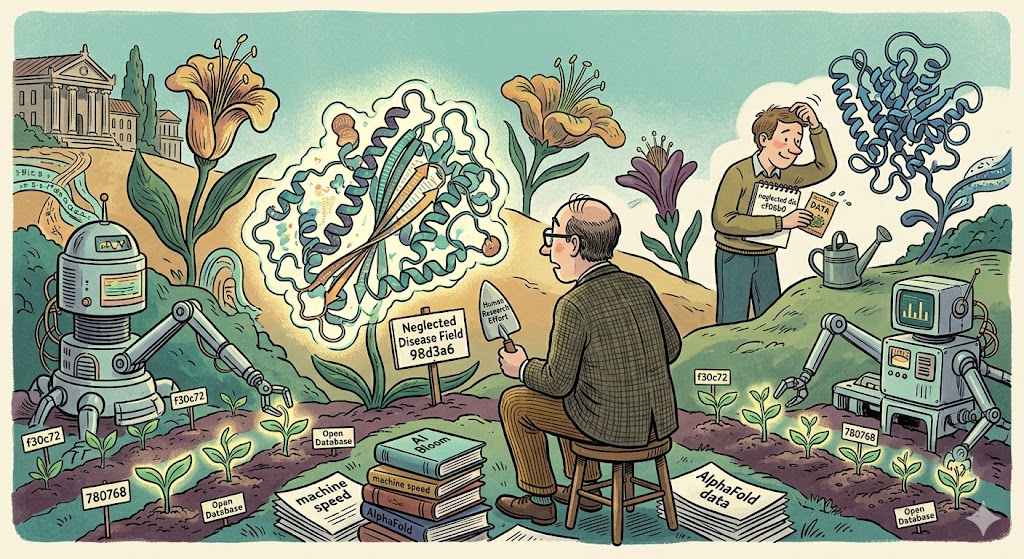
The broader AI bloom argument appears here in miniature. One optimistic claim about advanced AI is that it could make elite cognitive tools widely available rather than concentrating them inside a handful of institutions. Open protein maps are an example where at least part of that diffusion has already happened.
Support for open-science collaborations
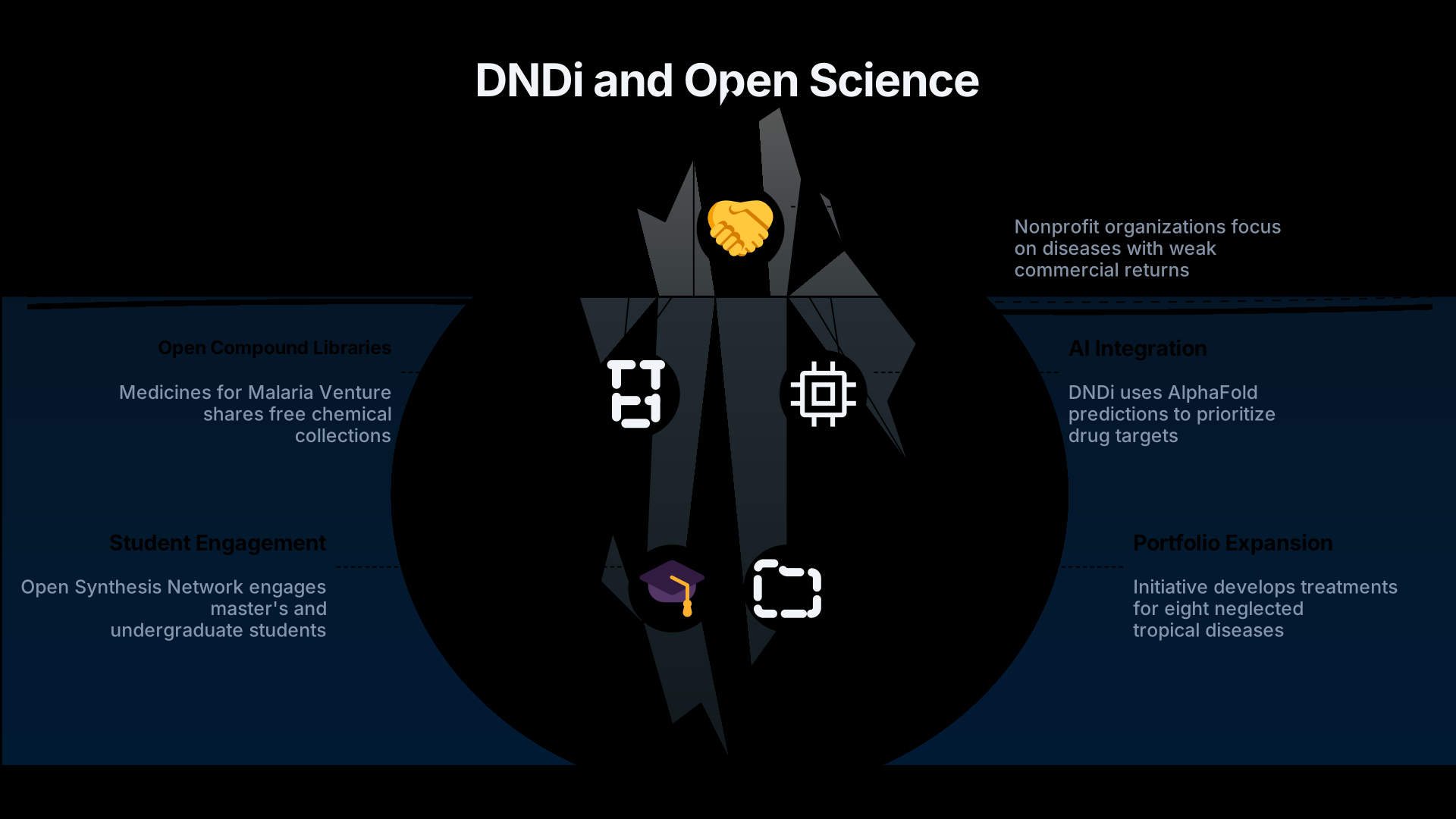
Neglected disease research has long depended on nonprofit and open-science models because conventional pharmaceutical incentives are weak. Organisations such as the Drugs for Neglected Diseases initiative (DNDi) explicitly focus on diseases underserved by commercial R&D. [dndi.org]dndi.orgNeglected Tropical Diseases (NTDs) | DNDiDNDi is working to develop new treatments for 8 neglected tropical diseases: Chagas disease…
DNDi has publicly stated that it uses AlphaFold in its work on neglected diseases. [dndi.org]dndi.orgNobel prize for chemistry awarded to Demis Hassabis and…10 Oct 2024 — Nobel prize for chemistry awarded to Demis Hassabis and John Jum… The combination is important: open AI models are most useful in fields already organised around collaborative data-sharing rather than aggressive secrecy.
There is a historical parallel here with open genomic databases and open compound libraries. DNDi and Medicines for Malaria Venture have previously supported open-access compound collections intended to accelerate neglected disease research across many labs simultaneously. [dndi.org]dndi.orgDNDi Screening of the MMV Open Access Malaria Box for…The Medicines for Malaria Venture (MMV) has made freely available a box of 400 c… Open protein maps extend that logic into structural biology.

A concrete example: malaria and parasite proteins
Malaria research illustrates both the promise and the limits of AI-enabled structural openness.
The malaria parasite Plasmodium falciparum has a highly complex life cycle and many difficult-to-characterise proteins. Structural information can help researchers understand immune evasion, drug resistance and vaccine targets.
AlphaFold does not “solve malaria”, but it gives researchers rapid structural clues about proteins that might otherwise take years to study experimentally. DeepMind highlighted malaria-related applications soon after AlphaFold’s release, arguing that predicted structures could help researchers investigate parasite biology and drug mechanisms faster. [Google DeepMind]deepmind.googleGoogle DeepMindAlphaFold — Google DeepMindAlphaFold has revealed millions of intricate 3D protein structures, and is helping scientists u…
This matters because malaria research still faces severe economic asymmetry. The disease kills hundreds of thousands of people annually, mostly in poorer countries, yet commercial incentives remain weaker than for illnesses concentrated in wealthy populations.
AI prediction changes the economics of exploration. A smaller research team can computationally investigate dozens or hundreds of candidate proteins before committing scarce laboratory resources. That does not remove the need for experiments, but it reduces wasted effort and expands the number of ideas that can be tested.
In AI bloom terms, this is an example of abundance in scientific capability rather than material abundance. The scarce resource being partially democratised is not medicine itself yet, but high-level scientific insight.
Where validation, funding and medicines still bottleneck progress
The optimistic interpretation of open protein maps can become misleading if the remaining bottlenecks are ignored.
Predicted structures are not experimental truth
AlphaFold predictions are often extremely useful, but they are still predictions. Some proteins remain difficult to model accurately, especially flexible proteins, multi-protein complexes or proteins that change shape dynamically. [arXiv]arxiv.orgarXivApplications of Knot Theory for the Improvement of the AlphaFold Protein DatabaseDecember 15, 2024…
Researchers still need laboratory validation to confirm whether a predicted binding site is real, whether a protein behaves as expected inside cells and whether a proposed drug actually works in living organisms.
This matters especially for neglected diseases because lower-resource labs may gain access to computational tools faster than they gain access to advanced experimental infrastructure.
An AI-generated structure can point researchers in a promising direction. It cannot replace wet-lab biology, toxicology studies or clinical trials.
Drug development remains expensive
Even if AI dramatically accelerates target discovery, the later stages of medicine development remain slow and costly.
[Neglected diseases face structural economic problems:]dndi.orgNeglected Tropical Diseases (NTDs) | DNDiDNDi is working to develop new treatments for 8 neglected tropical diseases: Chagas disease…
- patients are often poor, [dndi.org]dndi.orgNeglected Tropical Diseases (NTDs) | DNDiDNDi is working to develop new treatments for 8 neglected tropical diseases: Chagas disease…
- healthcare systems may be underfunded,
- expected commercial returns are limited,
- clinical trials can be difficult to organise,
- manufacturing and distribution infrastructure may be weak.
That means scientific openness alone does not guarantee therapeutic abundance.
The danger is that AI lowers the cost of generating ideas without lowering the cost of turning ideas into approved, accessible treatments. In that world, knowledge expands faster than real-world medical delivery.
Infrastructure inequality still matters
The AlphaFold database is globally accessible, but scientific capability is not evenly distributed.
Reliable internet access, computing resources, bioinformatics training, laboratory equipment, grant funding and institutional stability still vary enormously across countries. Many researchers working closest to neglected diseases remain structurally disadvantaged even when the data itself is free.
This is one reason the “AI bloom” debate increasingly focuses on distribution rather than capability alone. A future of extraordinary scientific tools does not automatically become a future of broad human flourishing unless institutions, funding systems and access mechanisms also improve.
What this case suggests about AI and scientific abundance
Neglected disease research offers a grounded way to think about larger claims surrounding AI-driven scientific acceleration.
The strongest version of the optimistic case is not that AlphaFold instantly cures major diseases. It is that AI systems can increasingly compress the time, expertise and cost needed to begin frontier scientific work. Open protein maps effectively provide millions of researchers with a starting point that previously required specialised structural-biology teams.
That matters because scientific progress is often bottlenecked not only by intelligence, but by access:
- access to tools,
- access to data,
- access to expensive infrastructure,
- access to elite institutions.
When those barriers fall, more minds can participate.
The broader AI bloom vision imagines this process extending far beyond protein structures: AI systems helping automate hypothesis generation, simulation, experimental design and eventually large parts of scientific research itself. Open protein databases are an early, concrete example of what partial democratisation of scientific capability can look like in practice.
But neglected diseases also expose the limits of purely technological optimism. Open knowledge is not the same as delivered medicine. Structural predictions do not automatically create clinics, manufacturing plants, sanitation systems or affordable healthcare.
The real long-term question is therefore not only whether AI can accelerate discovery, but whether societies can build institutions capable of translating accelerated discovery into broadly shared human gains.
Endnotes
-
Source: pmc.ncbi.nlm.nih.gov
Title: PMCDrug discovery and development for neglected diseases
Link: https://pmc.ncbi.nlm.nih.gov/articles/PMC3084299/Source snippet
PMCby E Chatelain · 2011 · Cited by 245 — DNDi's main short-term objectives are to deliver 6–8 new treatments for HAT, Chagas disease, vi...
-
Source: dndi.org
Link: https://dndi.org/diseases/neglected-tropical-diseases/Source snippet
Neglected Tropical Diseases (NTDs) | DNDiDNDi is working to develop new treatments for 8 neglected tropical diseases: Chagas disease...
-
Source: alphafold.ebi.ac.uk
Link: https://alphafold.ebi.ac.uk/Source snippet
AlphaFold Protein Structure DatabaseAlphaFold DB provides open access to over 200 million protein structure predictions to accelerate sci...
-
Source: deepmind.google
Link: https://deepmind.google/science/alphafold/Source snippet
Google DeepMindAlphaFold — Google DeepMindAlphaFold has revealed millions of intricate 3D protein structures, and is helping scientists u...
-
Source: journals.plos.org
Link: https://journals.plos.org/plosone/article?id=10.1371%2Fjournal.pone.0259871Source snippet
They are able to make very high-quality predictions.Read more...
-
Source: journals.plos.org
Link: https://journals.plos.org/ploscompbiol/article?id=10.1371%2Fjournal.pcbi.1009818Source snippet
PLOSThe structural coverage of the human proteome before and...by E Porta-Pardo · 2022 · Cited by 138 — In this manuscript we provide an...
-
Source: embl.org
Title: alphafold update neglected tropical diseases
Link: https://www.embl.org/news/updates-from-data-resources/alphafold-update-neglected-tropical-diseases/Source snippet
AlphaFold update – neglected tropical diseases28 Jan 2022 — Latest AlphaFold database update adds 27 new organisms and almost 200000 new...
-
Source: dndi.org
Link: https://dndi.org/news/2024/nobel-prize-chemistry-awarded-for-alphafold-an-ai-model-used-dndi-for-neglected-diseases/Source snippet
Nobel prize for chemistry awarded to Demis Hassabis and...10 Oct 2024 — Nobel prize for chemistry awarded to Demis Hassabis and John Jum...
-
Source: dndi.org
Link: https://dndi.org/research-development/portfolio/mmv-malaria-box-4/Source snippet
DNDi Screening of the MMV Open Access Malaria Box for...The Medicines for Malaria Venture (MMV) has made freely available a box of 400 c...
-
Source: deepmind.google
Title: Google Deep Mind The race to cure a billion people from a deadly parasitic
Link: https://deepmind.google/blog/the-race-to-cure-a-billion-people-from-a-deadly-parasitic-disease/Source snippet
Google DeepMindThe race to cure a billion people from a deadly parasitic...July 28, 2022 — 28 Jul 2022 — If AlphaFold can help unravel h...
Published: July 28, 2022
-
Source: arxiv.org
Link: https://arxiv.org/abs/2412.11229Source snippet
arXivApplications of Knot Theory for the Improvement of the AlphaFold Protein DatabaseDecember 15, 2024...
Published: December 15, 2024
-
Source: arxiv.org
Link: https://arxiv.org/abs/2410.14898 -
Source: embl.org
Link: https://www.embl.org/Source snippet
European Molecular Biology Laboratory | EMBL.orgEMBL is Europe's life sciences laboratory. Research EMBL performs fundamental research in...
-
Source: embl.org
Title: alphafold database community datasets
Link: https://www.embl.org/news/updates-from-data-resources/alphafold-database-community-datasets/Source snippet
The database is...Read more...
-
Source: embl.org
Link: https://www.embl.org/sites/heidelberg/Source snippet
is an intergovernmental organisation, headquartered in Heidelberg, and was founded in 1974 with the mission of promoting molecular biolog...
-
Source: embl.org
Link: https://www.embl.org/careers/Source snippet
s covering the spectrum of molecular...Read more...
-
Source: embl.org
Title: alphafold using open data and ai to discover the 3d protein universe
Link: https://www.embl.org/news/science/alphafold-using-open-data-and-ai-to-discover-the-3d-protein-universe/Source snippet
Case study: AlphaFold uses open data and AI to discover...9 Feb 2023 — AlphaFold database in numbers · 200 million protein structure pre...
-
Source: ebi.ac.uk
Link: https://www.ebi.ac.uk/Source snippet
EMBL-EBI homepage | EMBL-EBIEMBL-EBI is the home for big data in biology. We help scientists exploit complex information to make discover...
-
Source: alphafold.ebi.ac.uk
Title: ebi.ac.uk About
Link: https://alphafold.ebi.ac.uk/aboutSource snippet
AlphaFold Protein Structure DatabaseAlphaFold is an AI system developed by Google DeepMind that makes state-of-the-art accurate predictio...
-
Source: ebi.ac.uk
Title: alphafold 200 million
Link: https://www.ebi.ac.uk/about/news/technology-and-innovation/alphafold-200-millionSource snippet
AlphaFold predicts structure of almost every catalogued...28 Jul 2022 — The database is being expanded by approximately 200 times, from...
-
Source: alphafold.ebi.ac.uk
Title: ebi.ac.uk Collaborators
Link: https://alphafold.ebi.ac.uk/collaboratorsSource snippet
AlphaFold Protein Structure Database... structural coverage of the biological universe and provide deeper insights... proteins from Tryp...
-
Source: deepmind.google
Title: alphafold five years of impact
Link: https://deepmind.google/blog/alphafold-five-years-of-impact/Source snippet
AlphaFold: Five Years of Impact25 Nov 2025 — The freely available AlphaFold Protein Database has accelerated science on a scale that was...
-
Source: who.int
Link: https://www.who.int/health-topics/neglected-tropical-diseasesSource snippet
tropical areas, where they mostly affect impoverished...
-
Source: aiforcause.org
Title: Alpha Fold Predicted 200 Million Protein Structures
Link: https://aiforcause.org/stories/alphafold-neglected-diseasesSource snippet
Now... - AIDeepMind's AlphaFold database of 200 million protein structures is being used by over 3 million researchers, and a partnershi...
-
Source: dndi.org
Link: https://dndi.org/Source snippet
DNDi – Best science for the most neglectedDNDi has created medical history for neglected patients, globally. Since 2003, we have develope...
-
Source: dndi.org
Link: https://dndi.org/research-development/portfolio/open-synthesis-network/Source snippet
Open Synthesis NetworkThe Open Synthesis Network (OSN) is a collaborative project that aims to engage master's and undergraduate students...
-
Source: frontiersin.org
Link: https://www.frontiersin.org/journals/cellular-and-infection-microbiology/articles/10.3389/fcimb.2022.944748/fullSource snippet
cruzi proteins open the way to new opportunities in drug discovery against this parasite, allowing to explore targets...
-
Source: Wikipedia
Title: Alpha Fold
Link: https://en.wikipedia.org/wiki/AlphaFoldSource snippet
AlphaFoldAlphaFold is an artificial intelligence (AI) program developed by DeepMind, a subsidiary of Alphabet, which performs predicti...
-
Source: frontiersin.org
Link: https://www.frontiersin.org/journals/pharmacology/articles/10.3389/fphar.2026.1742086/fullSource snippet
Neglected tropical diseases: recent trends and challenges...by S Kumar · 2026 — In many endemic regions where NTDs are common, lack of r...
Additional References
-
Source: facebook.com
Link: https://www.facebook.com/ItisaScience/posts/in-a-single-publication-deepminds-alphafold-system-solved-a-problem-that-had-occ/122218598546051326/Source snippet
In a single publication, DeepMind's AlphaFold system...AlphaFold predicted the structures of over 200 million proteins — essentially eve...
-
Source: facebook.com
Link: https://www.facebook.com/aimmediahouse/posts/deepminds-partnership-with-dndi-to-use-alphafold-can-fasten-drug-discovery-for-n/4206472779375808/Source snippet
[https://zcu.io/x21e](https://zcu.io/x21e) DeepMind's partnership with DNDi to...Researchers investigating neglected tropical diseases accessed structures of p...
-
Source: assets.publishing.service.gov.uk
Link: https://assets.publishing.service.gov.uk/media/57a08ad2e5274a31e00007ce/DNDi_portfolio-map_2011_pdf.pdfSource snippet
Needs-Driven Collaborative R&D Model for Neglected...DNDi will evaluate selected biomarkers for their potential application in clinical...
-
Source: icr.ac.uk
Link: https://www.icr.ac.uk/research-and-discoveries/cancer-blogs/detail/the-drug-discoverer/reflecting-on-deepmind-s-alphafold-artificial-intelligence-success-what-s-the-real-significance-for-protein-folding-research-and-drug-discoverySource snippet
Reflecting on DeepMind's AlphaFold artificial intelligence...13 Aug 2021 — AlphaFold's machine learning methodology has been applied to...
-
Source: sciencebusiness.net
Title: embl ebi and google deepmind renew partnership and release update alphafold
Link: https://sciencebusiness.net/network-updates/embl-ebi-and-google-deepmind-renew-partnership-and-release-update-alphafoldSource snippet
EMBL-EBI and Google DeepMind renew partnership and...13 Oct 2025 — The AlphaFold Database contains protein structure predictions for ove...
-
Source: reddit.com
Link: https://www.reddit.com/r/MachineLearning/comments/wb7daf/d_alphafold_just_released_a_database_of_200/Source snippet
Researchers have used this data in the past to design new drugs, vaccines, and enzymes. You can...
-
Source: wbparasite.wordpress.com
Title: alphafold added new 3d protein structures of parasitic worms
Link: https://wbparasite.wordpress.com/2022/02/03/alphafold-added-new-3d-protein-structures-of-parasitic-worms/Source snippet
added new 3D protein structures of parasitic worms3 Feb 2022 — AlphaFold added new 3D protein structures of parasitic worms; Onchocerca...
-
Source: laskerfoundation.org
Title: alphafold a technology for predicting protein structures
Link: https://laskerfoundation.org/winners/alphafold-a-technology-for-predicting-protein-structures/Source snippet
AlphaFold—for predicting protein structures2 Sept 2025 — The artificial intelligence (AI) system that solved the long-standing challenge...
-
Source: colab.ws
Link: https://colab.ws/articles/10.1007%2F978-981-97-8476-9_6Source snippet
but the research into treatments and drug targets remains limited...
-
Source: pubmed.ncbi.nlm.nih.gov
Link: https://pubmed.ncbi.nlm.nih.gov/37933859/Source snippet
Protein Structure Database in 2024by M Varadi · 2024 · Cited by 2119 — The AlphaFold Protein Structure Database (AlphaFold DB) is a massi...
Amazon book picks
Further Reading
Books and field guides related to Neglected disease research. Use these as the next step if you want deeper reading beyond the article.

Artificial Intelligence for Molecular Biology
The integration of artificial intelligence (AI) into molecular biology has brought about a paradigm shift, enabling researchers to tackle...

Neglected Diseases And Drug Discovery
First published 2011. Subjects: Tropical medicine, Medicine, developing countries, Pharmacology.

Using Artificial Intelligence in Chemistry and Biology
Possessing great potential power for gathering and managing data in chemistry, biology, and other sciences, Artificial Intelligence (AI)...

Artificial Intelligence Methods and Tools for Systems Biology
This book provides simultaneously a design blueprint, user guide, research agenda, and communication platform for current and future deve...
eBay marketplace picks
Marketplace Samples
Example marketplace items related to this page. Use the search link to explore similar finds on eBay.

Example eBay listing
A.I. Artificial Intelligence Original Movie Poster Signed By Jude Law
USD 125.00 | Shipping USD 25.00 | US

Example eBay listing
Artificial Intelligence D/S Original Movie Poster - 27 x 40"
USD 19.50 | Shipping USD 13.65 | US

Example eBay listing
612388 Artificial Intelligence Movie Science Fiction Drama Wall Print Poster
USD 22.95 | Shipping USD 12.95 | JP

Example eBay listing
Companion - Artificial Intelligence Dark Comedy Cinema Film - POSTER 20"x30"
USD 23.99 | Free shipping | US

Example eBay listing
A.I. Artificial Intelligence Movie Film Poster Art Print
GBP 4.99 | Free shipping | GB

Example eBay listing
A I Artificial Intelligence 6 Movie Poster Art Print Print Classic Rare Gallery
GBP 49.00 | Free shipping | GB

Example eBay listing
AI - Artificial Intelligence (Poster + Slipcase) Blu-Ray
GBP 10.49 | Free shipping | GB

Example eBay listing
A. I. Artificial Intelligence. Jude Law. Original UK Video Poster.
GBP 8.11 | Shipping GBP 3.38 | GB
Topic Tree