Within Nigeria Trial
Pair Work With AI
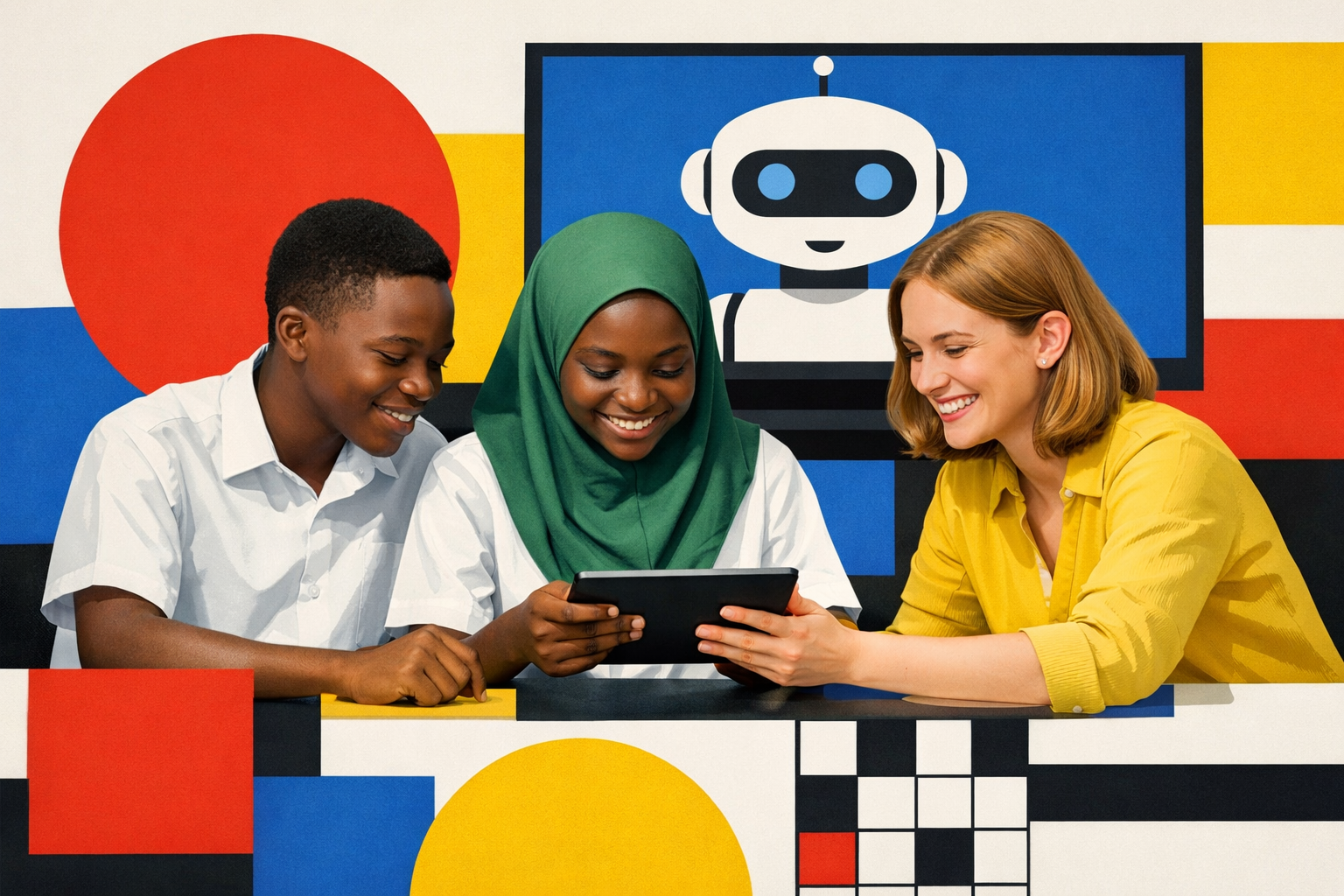
Students used the AI in pairs, making discussion, explanation, and shared checking part of the learning process.
On this page
- Why students worked in pairs
- How peer discussion changed AI use
- What collaborative tutoring adds to access
Page outline Jump by section
Introduction
One of the most important details in Nigeria’s widely discussed AI tutoring trial is also one of the easiest to miss: students did not sit alone with a chatbot. They worked in pairs. That design choice shaped how the system was used, how mistakes were caught, and possibly why the learning gains were unusually strong for such a short intervention.
The Edo State programme combined GPT-4-powered tutoring through Microsoft Copilot with structured prompts, teacher supervision, and peer discussion. Students were encouraged to talk through answers, compare interpretations, challenge the AI, and explain ideas to one another rather than silently copying outputs. Researchers and education specialists increasingly view this collaborative structure as central to the trial’s success, especially in schools where computers, internet access, and teacher time are limited. [VoxDev]voxdev.orgVoxDevHow AI tutors improved learning in Nigeriaby M De Simone — In an RCT in Nigeria, we tested a six-week after-school programme where… [World Bank Blogs]blogs.worldbank.orgFrom chalkboards to chatbots in NigeriaWorld Bank BlogsFrom chalkboards to chatbots in Nigeria18 Sept 2024 — A recent experiment in Edo State, Nigeria, represents one of the pi…
The pair-work model matters beyond this single experiment. If advanced AI is ever to contribute to large-scale human flourishing through education, the key question is not only whether models become smarter. It is whether they can help more people think better together, at low cost, in real classrooms, under real constraints.
Why students worked in pairs
The Nigeria trial was partly designed around practical necessity. Many schools did not have enough computers for every student to work individually, and keeping costs low was important for any future scaling. Pairing students allowed the programme to reach more learners without doubling hardware or connectivity requirements. [VoxDev]voxdev.orgVoxDevHow AI tutors improved learning in Nigeriaby M De Simone — In an RCT in Nigeria, we tested a six-week after-school programme where… [World Bank Blogs]blogs.worldbank.orgFrom chalkboards to chatbots in NigeriaWorld Bank BlogsFrom chalkboards to chatbots in Nigeria18 Sept 2024 — A recent experiment in Edo State, Nigeria, represents one of the pi…
But the pairing strategy was also pedagogical. Researchers did not want students treating the AI as an answer machine. Sessions were structured so that learners discussed prompts together before and after interacting with Copilot. Teachers introduced curriculum-linked topics, suggested starting prompts, and guided reflection exercises at the end of sessions. [VoxDev]voxdev.orgVoxDevHow AI tutors improved learning in Nigeriaby M De Simone — In an RCT in Nigeria, we tested a six-week after-school programme where… [World Bank Blogs]blogs.worldbank.orgFrom chalkboards to chatbots in NigeriaWorld Bank BlogsFrom chalkboards to chatbots in Nigeria18 Sept 2024 — A recent experiment in Edo State, Nigeria, represents one of the pi…
That mattered because large language models are unusually persuasive. Students working alone can easily accept plausible but incorrect explanations, drift off task, or become passive recipients of generated text. Pair work created friction against that pattern. One student could question a response while the other defended or revised it. If the AI produced a confusing answer, the pair often had to interpret it together before moving on.
The programme therefore tested something closer to “AI-mediated collaborative learning” than solitary AI tutoring.
How peer discussion changed AI use
Traditional classroom technology often fails because students disengage or use tools superficially. The Nigeria intervention attempted to avoid this by making conversation itself part of the learning process.
Researchers described sessions in which students used GPT-4 to explore grammar, writing, and comprehension tasks. The AI provided examples, explanations, and feedback, but students still had to negotiate meaning with each other. [VoxDev]voxdev.orgVoxDevHow AI tutors improved learning in Nigeriaby M De Simone — In an RCT in Nigeria, we tested a six-week after-school programme where… [World]linkedin.comWorld Bank study on AI in Nigerian educationThe World Bank Program has "From Chalkboards to Chatbots: Evaluating the Impact of Generativ…
This changed the character of the interaction in several ways.
Students had to explain ideas aloud
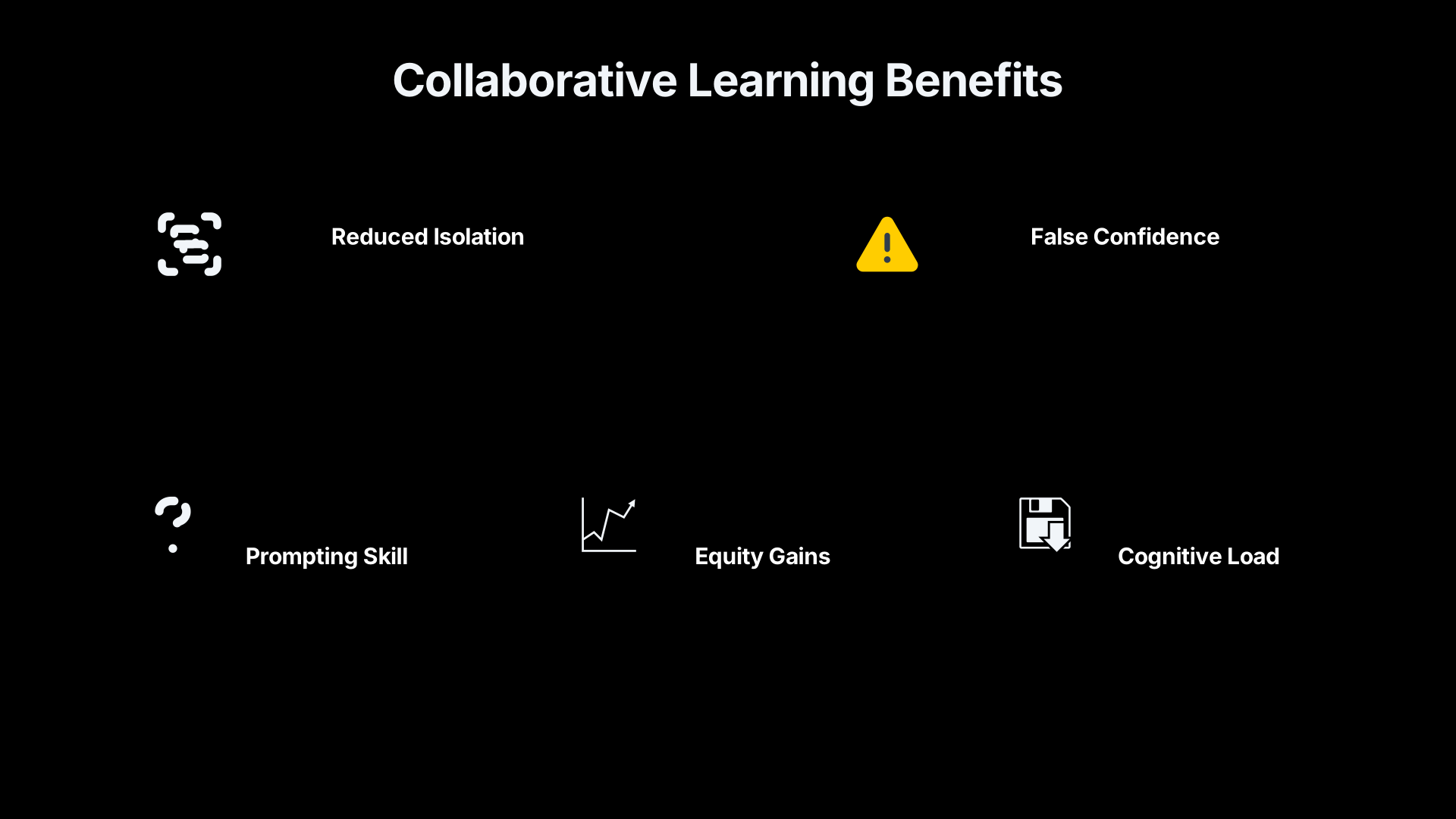
Educational psychology has long found that explaining concepts to another person strengthens understanding. Pair work pushed students to verbalise reasoning instead of silently recognising answers. When one student understood a grammatical rule or writing suggestion better than the other, the stronger student effectively became a temporary tutor.
That dynamic may have amplified the benefits of the AI system. Instead of a single stream of chatbot output entering one student’s mind, the classroom generated cycles of explanation, disagreement, correction, and reformulation.
The AI became a shared object of scrutiny
Students were not only learning from the model. They were also evaluating it.
World Bank accounts of the programme note that teachers discussed AI “hallucinations” and encouraged students to think critically about responses. [World Bank Blogs]blogs.worldbank.orgFrom chalkboards to chatbots in NigeriaWorld Bank BlogsFrom chalkboards to chatbots in Nigeria18 Sept 2024 — A recent experiment in Edo State, Nigeria, represents one of the pi… Pair work reinforced that habit because students could compare interpretations in real time.
In practice, this may have reduced a major risk in AI-assisted learning: false confidence. A student alone with a polished chatbot response can mistake fluency for truth. Two students discussing the same response are more likely to notice contradictions, vague explanations, or suspicious wording.
Prompting became collaborative
The programme did not simply hand students open internet access. Teachers provided structured prompts and encouraged students to refine them together. [VoxDev]voxdev.orgVoxDevHow AI tutors improved learning in Nigeriaby M De Simone — In an RCT in Nigeria, we tested a six-week after-school programme where…
That collaborative prompting process is important because prompting is partly a thinking skill. Students learned not only to ask for answers, but to reformulate questions, request examples, clarify instructions, and probe explanations. In effect, they practised interacting with a powerful reasoning tool in a socially guided environment.
For advocates of an “AI bloom” future, this is significant. A world with abundant machine intelligence may depend less on everyone becoming technical experts and more on ordinary people learning how to direct, critique, and collaborate with advanced systems effectively.
Pair work may have improved equity, not just scores
The collaborative format may also have helped the programme reach students who would otherwise struggle with digital tools.
In many educational settings, technology interventions unintentionally widen gaps. More confident or wealthier students adapt quickly, while others fall behind. Pair work can soften that effect because students share cognitive load and digital navigation tasks.
In the Nigeria trial, the strongest gains were reportedly observed among female students and higher-performing students, though benefits appeared across groups overall. [linkedin.com]linkedin.comAI tutoring program boosts learning in NigeriaAn after-school AI tutoring program for secondary students in Edo State, Nigeria, improved… Researchers still need longer-term evidence on distributional effects, but the shared-work model may have reduced intimidation around unfamiliar software and English-language interaction.
This matters because the broader AI abundance argument depends heavily on diffusion. If advanced AI only empowers already-advantaged populations, it does not produce broad human flourishing. Education systems therefore need mechanisms that spread capability rather than concentrate it.
Pair-based AI tutoring offers one possible mechanism:
- fewer devices needed per learner;
- lower supervision costs;
- peer support for weaker students;
- more active participation;
- less isolation;
- reduced dependence on perfect AI outputs.
Those are practical advantages in lower-resource environments where one-to-one human tutoring is financially unrealistic.
What collaborative tutoring adds beyond ordinary chatbot access
The Nigeria programme has sometimes been simplified into a headline claim that “ChatGPT produced two years of learning gains in six weeks”. That framing misses the structure surrounding the model.
Students were not simply given unrestricted AI access and left alone. The intervention combined:
- curriculum-linked sessions;
- teacher facilitation;
- shared computer use;
- guided prompting;
- peer discussion;
- reflection exercises;
- monitoring against over-reliance. [VoxDev]voxdev.orgVoxDevHow AI tutors improved learning in Nigeriaby M De Simone — In an RCT in Nigeria, we tested a six-week after-school programme where… [World Bank Blogs]blogs.worldbank.orgFrom chalkboards to chatbots in NigeriaWorld Bank BlogsFrom chalkboards to chatbots in Nigeria18 Sept 2024 — A recent experiment in Edo State, Nigeria, represents one of the pi…
The pair-work element is especially important because it hints at a different vision of AI-enhanced education. Instead of replacing classrooms with isolated human-machine interaction, AI may function more effectively as a catalyst for human collaboration.
This idea aligns with a broader pattern in technology history. Many powerful tools do not merely automate labour; they reorganise social coordination around new capabilities. Search engines changed research habits. Smartphones changed communication rhythms. AI tutors may eventually change how students reason together.
In that sense, the Nigeria trial is interesting not because it proves that AI can “teach” independently, but because it suggests that modest AI systems, embedded in cooperative learning environments, can already raise cognitive performance in meaningful ways.
The limits of the evidence
The pair-work findings are promising, but the evidence remains narrow.
The programme lasted only six weeks. Students worked in supervised after-school sessions rather than normal overcrowded classrooms. Researchers do not yet know whether gains persist long term, whether the approach transfers well to other subjects, or whether similar results appear without unusually motivated facilitators. [World Bank Blogs]blogs.worldbank.orgFrom chalkboards to chatbots in NigeriaWorld Bank BlogsFrom chalkboards to chatbots in Nigeria18 Sept 2024 — A recent experiment in Edo State, Nigeria, represents one of the pi…
There is also an unresolved question about what exactly caused the improvement:
- the AI itself;
- increased instructional time;
- structured tutoring;
- peer collaboration;
- novelty effects;
- or the unusually high level of attention and support.
Most likely, the gains emerged from the combination rather than a single factor.
That nuance matters for the larger AI bloom debate. Educational transformation is unlikely to come from raw model capability alone. Institutions, pedagogy, incentives, infrastructure, and social design all shape outcomes. The Nigeria experiment worked partly because humans carefully structured the environment around the AI.
Why the pairing model matters for an AI-enabled future
The strongest long-term implication of the Nigeria trial may not be about chatbots at all. It may be about scalable cognitive partnership.
Human civilisation has historically been constrained by the scarcity of personalised instruction. One-to-one tutoring works extremely well, but most societies cannot provide it universally. Advanced AI raises the possibility that high-quality intellectual support could become far cheaper and more widely available.
Yet intelligence support that isolates people from one another could also weaken judgement, trust, and social learning. The Nigeria programme points toward another possibility: AI systems acting as shared reasoning tools inside collaborative human settings.
That distinction matters for any serious vision of AI-enabled human flourishing. A civilisation that “blooms” through AI would need more than automated answers. It would need broader access to thinking, explanation, creativity, and problem-solving across entire populations.
The Edo State classrooms offered a small but concrete example of how that might begin:
not students replaced by machines,
but students learning to think together with them.
Endnotes
-
Source: voxdev.org
Link: https://voxdev.org/topic/education/how-ai-tutors-improved-learning-nigeriaSource snippet
VoxDevHow AI tutors improved learning in Nigeriaby M De Simone — In an RCT in Nigeria, we tested a six-week after-school programme where...
-
Source: linkedin.com
Link: https://www.linkedin.com/posts/jaime-saavedra-84590025_an-after-school-ai-tutoring-program-for-secondary-activity-7332800401664065536-b_r6Source snippet
AI tutoring program boosts learning in NigeriaAn after-school AI tutoring program for secondary students in Edo State, Nigeria, improved...
-
Source: linkedin.com
Link: https://www.linkedin.com/posts/emollick_new-randomized-controlled-trial-by-the-world-activity-7285400569274380288-wh50 -
Source: linkedin.com
Link: https://www.linkedin.com/posts/martin-elias-de-simone_check-out-our-new-voxdev-article-on-the-evaluation-activity-7439668923752431616-pBwbSource snippet
AI-assisted tutoring boosts English learning in NigeriaWe find that students working with GPT-4 in a structured after-school setting show...
-
Source: linkedin.com
Link: https://www.linkedin.com/posts/georg-huettenegger_chalkboards-chatbots-education-activity-7341439635828428800-G5wFSource snippet
World Bank study on AI in Nigerian educationThe World Bank Program has "From Chalkboards to Chatbots: Evaluating the Impact of Generativ...
-
Source: youtube.com
Title: How Can AI Support Human Collaboration In The Classroom?
Link: https://www.youtube.com/watch?v=So5vGuKwPmkSource snippet
World Bank Group: From Chalkboard to Chatbots – Evaluating the Impact of Generative AI on Learning...
-
Source: youtube.com
Link: https://www.youtube.com/watch?v=nWWN2dW4fGkSource snippet
PeerTeach: AI-Powered Peer Tutoring...
-
Source: blogs.worldbank.org
Title: From chalkboards to chatbots in Nigeria
Link: https://blogs.worldbank.org/en/education/From-chalkboards-to-chatbots-in-NigeriaSource snippet
World Bank BlogsFrom chalkboards to chatbots in Nigeria18 Sept 2024 — A recent experiment in Edo State, Nigeria, represents one of the pi...
-
Source: blogs.worldbank.org
Title: addressing the learning crisis with generative ai lessons from
Link: https://blogs.worldbank.org/en/developmenttalk/addressing-the-learning-crisis-with-generative-ai–lessons-from-Source snippet
World Bank BlogsAddressing the learning crisis with generative AIJun 25, 2025 — A randomized controlled trial in Edo State, Nigeria, expl...
-
Source: openknowledge.worldbank.org
Link: https://openknowledge.worldbank.org/entities/publication/15e1ff08-15ae-4f7a-b2a8-d146e6c113eeSource snippet
Open Knowledge RepositoryEvaluating the Impact of Generative AI on Learning Outcomes...by M De Simone · 2025 · Cited by 2 — This study e...
-
Source: documents.worldbank.org
Title: Using a randomized
Link: https://documents.worldbank.org/en/publication/documents-reports/documentdetail/099548105192529324Source snippet
World BankFrom Chalkboards to Chatbots: Evaluating the Impact of...This study evaluates the impact of a program leveraging large langua...
-
Source: blogs.worldbank.org
Title: From chalkboards to chatbots Transforming learning in Nigeria
Link: https://blogs.worldbank.org/en/education/From-chalkboards-to-chatbots-Transforming-learning-in-NigeriaSource snippet
World Bank BlogsTransforming learning in Nigeria, one prompt at a timeJan 9, 2025 — To our knowledge, this is the first study to assess t...
-
Source: worldbank.org
Link: https://www.worldbank.org/en/news/video/2025/02/18/ai-digitaldevelopment-from-chalkboards-to-chatbotsSource snippet
AI/DD Brown Bag Lunch From Chalkboards to ChatbotsThe speakers presented key findings from their study, highlighting the impact of large...
-
Source: documents1.worldbank.org
Link: https://documents1.worldbank.org/curated/en/099548105192529324/pdf/IDU-c09f40d8-9ff8-42dc-b315-591157499be7.pdfSource snippet
Students worked in pairs...Read more...
-
Source: blogs.worldbank.org
Title: people centered ai in education five lessons from the global so
Link: https://blogs.worldbank.org/en/education/people-centered-ai-in-education–five-lessons-from-the-global-soSource snippet
worldbank.orgPeople-centered AI in education: Five lessons from the...28 Aug 2025 — In just six weeks, secondary school students in Edo...
-
Source: reproducibility.worldbank.org
Title: study description
Link: https://reproducibility.worldbank.org/catalog/419/study-descriptionSource snippet
The Impact Of Generative Ai On Learning...Dec 11, 2025 — This study evaluates the impact of a program leveraging large language models (...
Additional References
-
Source: medium.com
Link: https://medium.com/%40WeWillNotBeFlattened/chatgpt-tutor-enables-2-years-of-learning-in-6-weeks-24bb13001185Source snippet
ChatGPT Tutor Enables 2 Years of Learning in 6 WeeksWorld Bank study ChatGPT-4 achieves 2 years of learning in 6 weeks but masks how tech...
-
Source: edworkingpapers.com
Link: https://edworkingpapers.com/sites/default/files/ai24_1054_v2.pdfSource snippet
Tutor CoPilot: A Human-AI Approach for Scaling Real-Time...by S Loeb — We observed a significant positive treatment effect on students p...
-
Source: ai.gov.uk
Link: https://ai.gov.uk/our-work/educationSource snippet
EducationAI Classroom Tutors. Testing AI tutoring tools that could support up to 450,000 children on free school meals with personalised...
-
Source: facebook.com
Title: how ai tutors improved learning in nigeriatoday on voxdev martín de simone worl
Link: https://www.facebook.com/voxdev.org/posts/-how-ai-tutors-improved-learning-in-nigeriatoday-on-voxdev-mart%C3%ADn-de-simone-worl/966093552755797/Source snippet
🆕 How AI tutors improved learning in Nigeria Today on...17 Mar 2026 — How AI tutors improved learning in Nigeria Today on VoxDev, Martín...
-
Source: nationalcentreforai.jiscinvolve.org
Title: empowering educators by harnessing generative ai tools navigating prompt roles
Link: https://nationalcentreforai.jiscinvolve.org/wp/2024/01/11/empowering-educators-by-harnessing-generative-ai-tools-navigating-prompt-roles/Source snippet
Educators by Harnessing Generative AI Tools11 Jan 2024 — A blog series that aims to empower educators by providing them with the knowledg...
-
Source: the-decoder.com
Title: ai tutoring helps nigerian students gain two years of learning in six weeks
Link: https://the-decoder.com/ai-tutoring-helps-nigerian-students-gain-two-years-of-learning-in-six-weeks/Source snippet
AI tutoring helps Nigerian students gain two years of learning...8 Feb 2025 — A recent pilot project in Nigeria's Edo State shows how AI...
-
Source: youtube.com
Link: https://www.youtube.com/watch?v=VnVBg1LfcSISource snippet
GOOGLE REPORT: NIGERIAN STUDENTS TURN TO AI FOR...Data released by google in nigeria shows that learners are not only curious about ai b...
-
Source: aiusecasehub.com
Link: https://www.aiusecasehub.com/case/014a84b54ae676f51aa9000202630870bde86c87f256a58281e8c31750baf9d1/nigerian-students-accelerate-academic-progress-with-ai-powered-tutoringSource snippet
acher guidance to transform digital skills acquisition and classroom learning.Read more...
-
Source: reddit.com
Link: https://www.reddit.com/r/homeschool/comments/1i2p1up/new_randomized_controlled_trial_of_students_using/Source snippet
"New randomized, controlled trial of students using GPT-4...New randomized, controlled trial of students using GPT-4 as a tutor in Nigeria...
-
Source: my.chartered.college
Title: ai tutoring bridging the educational disadvantage gap
Link: https://my.chartered.college/impact_article/ai-tutoring-bridging-the-educational-disadvantage-gap/Source snippet
tutoring: Bridging the educational disadvantage gap9 Jun 2025 — This article examines how AI tutoring could address the educational attai...
Amazon book picks
Further Reading
Books and field guides related to Pair Work With AI. Use these as the next step if you want deeper reading beyond the article.

Digital Collaborative Learning in General, Higher, and Busine...
*Please note that all spontaneous submissions are required to submit an abstract and await feedback before submitting the full manuscript...
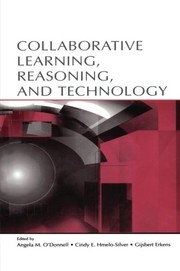
Collaborative Learning, Reasoning, and Technology
First published 2005. Subjects: Reasoning, Team learning approach in education, Computer-assisted instruction, Study and teaching, Appren...

Collaborative Learning in a Global World
This book explores the impact of global changes on education, emphasizing the need for collaborative learning skills. It highlights the i...
The International Handbook of Collaborative Learning
Collaborative learning has become an increasingly important part of education, but the research supporting it is distributed across a wid...
eBay marketplace picks
Marketplace Samples
Example marketplace items related to this page. Use the search link to explore similar finds on eBay.
Example eBay listing
A.I. Artificial Intelligence Original Movie Poster Signed By Jude Law
USD 125.00 | Shipping USD 25.00 | US
Example eBay listing
Artificial Intelligence D/S Original Movie Poster - 27 x 40"
USD 19.50 | Shipping USD 13.65 | US

Example eBay listing
612388 Artificial Intelligence Movie Science Fiction Drama Wall Print Poster
USD 22.95 | Shipping USD 12.95 | JP

Example eBay listing
Companion - Artificial Intelligence Dark Comedy Cinema Film - POSTER 20"x30"
USD 23.99 | Free shipping | US

Example eBay listing
A.I. Artificial Intelligence Movie Film Poster Art Print
GBP 4.99 | Free shipping | GB

Example eBay listing
A I Artificial Intelligence 6 Movie Poster Art Print Print Classic Rare Gallery
GBP 49.00 | Free shipping | GB

Example eBay listing
AI - Artificial Intelligence (Poster + Slipcase) Blu-Ray
GBP 10.49 | Free shipping | GB

Example eBay listing
A. I. Artificial Intelligence. Jude Law. Original UK Video Poster.
GBP 8.11 | Shipping GBP 3.38 | GB
Topic Tree