Within Efficiency Rebound
Cheaper AI Inference
Cheaper AI queries can cut electricity per task while making AI common enough that total power demand still rises.
On this page
- Why lower inference costs change behaviour
- Where everyday AI use could multiply
- When efficiency gains still lower total demand
Page outline Jump by section
Introduction
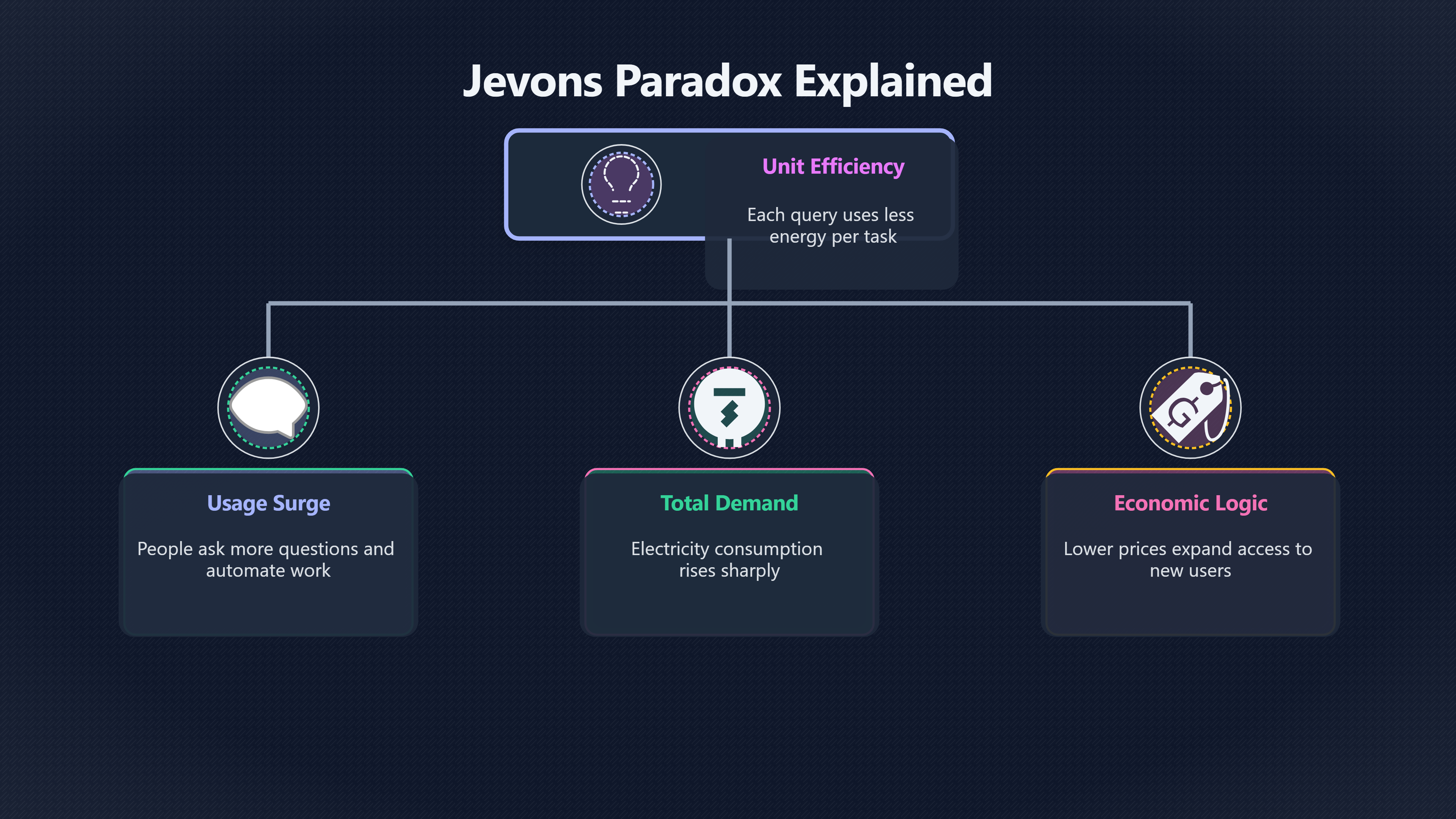
Cheaper AI inference will probably make people use much more AI, not less. That is one of the central tensions in the debate over whether AI efficiency gains will ultimately reduce electricity demand. When the cost of generating text, images, software, analysis or automated decisions falls, new uses appear faster than old uses disappear. AI stops being a scarce specialist tool and starts becoming a routine layer inside everyday life.
 This pattern is not unique to AI. Economists have long observed that efficiency improvements can increase total consumption by lowering costs and expanding access. In the AI world, the key shift is happening not only in training giant models, but in inference: the ongoing process of serving billions or trillions of queries to users. If each query becomes dramatically cheaper, faster and easier, people tend to ask more questions, automate more work, generate more media and embed AI into more products. The result may be lower energy use per task but higher electricity demand overall. [arXiv]arxiv.orgarXivThe Problem of Jevons' Paradox in AI's Polarized…27 Jan 2025 — This paper examines how the problem of Jevons' Paradox applies to… [ACM Digital Library]dl.acm.orgACM Digital LibraryThe Problem of Jevons' Paradox in AI's Polarized…by AS Luccioni · 2025 · Cited by 93 — This paper examines how the…
Why lower inference costs change behaviour
Inference is the part of AI most people actually interact with. Every chatbot reply, coding suggestion, image generation request, recommendation or AI search result requires inference compute. As costs fall, behaviour changes in several reinforcing ways.
First, people use AI more often because the friction drops. A costly or slow system gets used selectively. A cheap and near-instant system becomes ambient. Search engines start answering every query with AI summaries. Office software adds AI assistants to routine writing and spreadsheets. Messaging apps integrate live translation and content generation. Software developers increasingly keep AI coding tools running throughout the working day.
Second, companies deploy AI in situations where earlier economics made little sense. A business may not pay £2 to automate a customer-service interaction, but it may happily pay a few pence. Cheap inference opens lower-value but higher-volume use cases.
Third, lower prices encourage experimentation. Millions of users try tasks they would previously have skipped entirely: generating multiple drafts, asking follow-up questions, creating synthetic images for minor projects or using AI tutors for routine homework help.
This dynamic resembles earlier computing transitions. Cheap digital storage created vastly more stored data. Cheap bandwidth created streaming video and social media. Cheap computation enabled cloud software and smartphone ecosystems. AI may follow the same trajectory, except the expanding resource is machine intelligence itself.
Researchers and commentators increasingly describe this as a version of the Jevons paradox: efficiency gains lowering unit costs while expanding total demand. Wikipedia 3arXiv [WWT]wwt.comwhen less means more how jevons paradox applies to our post deepseek worldHow Jevons Paradox Applies to Our Post-DeepSeek WorldFeb 11, 2025 — This phenomenon, known as Jevons Paradox, suggests that as AI models…
Where everyday AI use could multiply
The most important effect of cheap inference may not be replacing existing tasks. It may be creating entirely new categories of behaviour.
AI as a constant companion layer
Many current AI interactions are still deliberate. Users open a chatbot, ask a question and close it. But cheaper inference makes continuous AI assistance economically plausible.
That could include:
- AI copilots constantly monitoring software workflows
- Real-time translation during conversations
- Wearable assistants offering contextual advice
- AI-enhanced search embedded into every web interaction
- Persistent tutoring systems following students across subjects
- Personal productivity agents coordinating schedules, documents and communication
A future with abundant low-cost inference could mean billions of people interacting with AI dozens or hundreds of times per day rather than occasionally.
This matters because inference workloads scale with usage frequency. A model serving occasional requests consumes far less electricity than one constantly running background tasks across phones, browsers, vehicles and workplaces.
Coding agents show how demand can explode
AI coding tools provide one of the clearest early examples of rebound effects.
As code generation became cheaper and more capable, developers did not simply write the same amount of software with less effort. Instead, they began generating more tests, more prototypes, more experiments and more automated workflows.
Recent reporting on heavy AI coding users illustrates how quickly inference demand can escalate. One OpenAI-linked experiment reportedly consumed hundreds of billions of tokens in a month using autonomous coding agents operating continuously. [Tom's Hardware]tomshardware.comThis staggering bill covered 603 billion tokens spread across 7.6 million API requests, driven by around 100 autonomous Codex agents. The…
The important point is not the individual case but the underlying mechanism. Once AI becomes capable enough and cheap enough, users stop rationing requests. They run agents continuously, retry outputs repeatedly and automate increasingly large systems.
The same pattern may spread into legal research, design, science, medicine, logistics and media production.
AI-generated media may become effectively unlimited
Cheap inference also changes the economics of content creation.
Historically, creating high-quality video, animation, music or interactive experiences required substantial human labour. If AI generation costs fall sharply, content production could expand almost without limit.
That does not necessarily mean infinite value. Much generated content may be low quality or commercially unimportant. But from an electricity perspective, volume matters.
Even if each generated image or short video becomes highly efficient, trillions of generations across entertainment, advertising, gaming, education and social media could still increase total energy demand.
This is especially important because newer AI applications increasingly involve multimodal outputs such as audio and video, which are often far more computationally intensive than plain text.
Why falling prices can increase total electricity demand
The key distinction is between efficiency per operation and total system-wide consumption.
Suppose an AI query becomes ten times more energy-efficient. If usage only doubles, total electricity demand falls. But if usage rises fiftyfold, electricity demand still increases.
That is the core uncertainty in the AI energy debate.
Several factors suggest demand growth could be extremely large:
- AI is still early in adoption across many industries.
- Lower costs expand access globally.
- AI agents may operate continuously rather than intermittently.
- More capable models often encourage more ambitious use.
- Generated content can scale almost without natural limits.
- Businesses compete by embedding AI into more products and services.
Recent economic analysis argues that falling inference prices may encourage firms to adopt more compute-intensive “agentic” systems rather than simply pocketing efficiency gains. [arXiv]arxiv.orgarXivThe Problem of Jevons' Paradox in AI's Polarized…27 Jan 2025 — This paper examines how the problem of Jevons' Paradox applies to…
This creates an important feedback loop. Better efficiency lowers costs. Lower costs increase adoption. Higher adoption motivates more infrastructure investment. More infrastructure supports even broader deployment.
Microsoft chief executive Satya Nadella explicitly invoked this logic after the release of more efficient AI models, arguing that cheaper AI would likely increase total demand rather than reduce it. [Reuters]reuters.comEurope's AI bulls pin hopes on 'Jevons Paradox' after Deep Seek routThis paradox, formulated by economist William Stanley Jevons, suggests that increased efficiency in resource usage leads to higher overal…
Why AI may be especially vulnerable to rebound effects
Not every technology experiences strong rebound effects. AI may be unusually prone to them because intelligence is economically useful across almost every sector.
A more efficient washing machine does not create infinite demand for laundry. There are natural limits to how many clothes people wash.
But cheaper intelligence potentially affects:
- Education
- Research
- Software
- Healthcare
- Manufacturing
- Entertainment
- Scientific modelling
- Robotics
- Administration
- Customer support
- Logistics
- Defence
- Finance
In other words, AI is a general-purpose technology rather than a narrow appliance.
That matters for the broader AI bloom idea. If advanced AI significantly lowers the cost of cognition itself, the long-term effect may resemble the historical impact of cheap energy or cheap computation: an expansion of civilisation’s productive capacity across many domains simultaneously.
The optimistic interpretation is that abundant intelligence could accelerate science, medicine, education and coordination on a civilisational scale. But from an energy perspective, abundance can increase demand as much as efficiency reduces it.
Cases where efficiency still could reduce demand
Cheaper inference does not guarantee rising electricity use forever. Several conditions could limit or reverse rebound effects.
Saturation
Some AI uses may eventually plateau. Once businesses automate the most valuable tasks, additional usage may generate diminishing returns.
Consumer behaviour also has limits. People only have so many hours in a day, even if AI services become nearly free.
Better models may replace wasteful workflows
AI systems sometimes substitute for energy-intensive activities elsewhere in the economy.
Examples could include:
- Replacing travel with AI-assisted remote collaboration
- Improving industrial efficiency
- Optimising electricity grids
- Accelerating materials discovery
- Reducing duplicated administrative work
If these savings outweigh AI electricity growth, total energy demand could still stabilise or fall.

Hardware and software efficiency may continue improving rapidly
AI efficiency gains have been unusually fast. Some estimates suggest dramatic declines in token costs over recent years. [ScienceDirect]sciencedirect.comScienceDirect Will AI lead to abundance?Exploring cost reductions from…by M Akpan · 2025 · Cited by 1 — Research suggests that AI token costs will either match digital stream…
If energy per query falls faster than usage rises, total demand may eventually level off despite wider adoption.
The difficulty is that nobody yet knows where the balance point lies.
The deeper question behind cheap inference
The argument over cheap inference is really an argument about what happens when intelligence becomes abundant.
If AI remains expensive, usage stays selective and constrained. If AI becomes extremely cheap, intelligence may start behaving more like a universal infrastructure layer: constantly available, embedded everywhere and woven into daily economic activity.
That possibility sits near the centre of the broader AI bloom vision. Supporters argue that abundant machine intelligence could help humanity accelerate scientific discovery, reduce drudgery, improve education and unlock forms of prosperity that are difficult to achieve with scarce human expertise alone.
But abundance does not automatically reduce material consumption. Historically, making a valuable capability cheaper often expands civilisation’s use of it dramatically.
The likely outcome is therefore mixed. Cheaper AI inference probably will reduce electricity use per task while simultaneously increasing the number of tasks people choose to perform. Whether total energy demand ultimately rises or falls depends on which force grows faster: efficiency or expansion.
Endnotes
-
Source: arxiv.org
Link: https://arxiv.org/html/2501.16548v1Source snippet
arXivThe Problem of Jevons' Paradox in AI's Polarized...27 Jan 2025 — This paper examines how the problem of Jevons' Paradox applies to...
-
Source: dl.acm.org
Link: https://dl.acm.org/doi/abs/10.1145/3715275.3732007Source snippet
ACM Digital LibraryThe Problem of Jevons' Paradox in AI's Polarized...by AS Luccioni · 2025 · Cited by 93 — This paper examines how the...
-
Source: wwt.com
Title: when less means more how jevons paradox applies to our post deepseek world
Link: https://www.wwt.com/wwt-research/when-less-means-more-how-jevons-paradox-applies-to-our-post-deepseek-worldSource snippet
How Jevons Paradox Applies to Our Post-DeepSeek WorldFeb 11, 2025 — This phenomenon, known as Jevons Paradox, suggests that as AI models...
-
Source: Wikipedia
Title: Jevons paradox
Link: https://en.wikipedia.org/wiki/Jevons_paradoxSource snippet
Jevons paradoxThe Jevons paradox occurs when the effect from increased demand predominates, and the improved efficiency results in a f...
-
Source: arxiv.org
Link: https://arxiv.org/abs/2601.12339Source snippet
arXivThe Economics of Digital Intelligence Capital: Endogenous Depreciation and the Structural Jevons ParadoxJanuary 18, 2026...
Published: January 18, 2026
-
Source: reuters.com
Title: Europe’s AI bulls pin hopes on ‘Jevons Paradox’ after Deep Seek rout
Link: https://www.reuters.com/technology/artificial-intelligence/europes-ai-bulls-pin-hopes-jevons-paradox-after-deepseek-rout-2025-02-04/Source snippet
This paradox, formulated by economist William Stanley Jevons, suggests that increased efficiency in resource usage leads to higher overal...
-
Source: sciencedirect.com
Title: ScienceDirect Will AI lead to abundance?
Link: https://www.sciencedirect.com/science/article/pii/S305070062500043XSource snippet
Exploring cost reductions from...by M Akpan · 2025 · Cited by 1 — Research suggests that AI token costs will either match digital stream...
-
Source: arxiv.org
Link: https://arxiv.org/abs/2603.28576 -
Source: Wikipedia
Title: William Stanley Jevons
Link: https://en.wikipedia.org/wiki/William_Stanley_JevonsSource snippet
William Stanley JevonsWilliam Stanley Jevons FRS was an English economist and logician. William Stanley Jevons. FRS. Born, (1835-09-01...
-
Source: arxiv.org
Link: https://arxiv.org/html/2602.05712v1Source snippet
code, considering its deployment at scale could result in substantial increases in energy consumption and overall computational cost.Read...
-
Source: arxiv.org
Link: https://arxiv.org/html/2603.21690Source snippet
AI Token Futures Market: Commoditization of Compute and...23 Mar 2026 — This paper systematically analyzes the commodity attributes of t...
-
Source: sciencedirect.com
Link: https://www.sciencedirect.com/science/article/pii/S2589750025001104Source snippet
The Jevons Paradox in global health: efficiency, demand...by MJA Reid · 2025 — From forecasting outbreaks, optimising supply chains, and...
-
Source: tomshardware.com
Link: https://www.tomshardware.com/tech-industry/artificial-intelligence/openclaw-creator-burns-through-1-3-million-in-openai-api-tokens-in-a-single-monthSource snippet
This staggering bill covered 603 billion tokens spread across 7.6 million API requests, driven by around 100 autonomous Codex agents. The...
Additional References
-
Source: linkedin.com
Link: https://www.linkedin.com/posts/kevinpetrietech_ai-innovation-genai-activity-7336855116685160450-fioPSource snippet
AI inference costs plummet, but training models is expensiveThe cost of AI inference is falling faster than electricity or computer memor...
-
Source: facebook.com
Link: https://www.facebook.com/groups/aisaas/posts/4450824091903638/Source snippet
Avoiding unexpected ai compute costsBut what happens when energy demand increases, GPU shortages occur, or operational costs rise? The pr...
-
Source: jylo.ai
Link: https://jylo.ai/blog/jevons-paradox-ai-and-why-seat-pricing-is-failingSource snippet
Jevons Paradox, AI, and Why Seat Pricing Is FailingAs AI shifts from tools to infrastructure, Jevons Paradox becomes dominant. Organisati...
-
Source: econlib.org
Link: https://www.econlib.org/library/Enc/bios/Jevons.htmlSource snippet
William Stanley JevonsWilliam Jevons was one of three men to simultaneously advance the so-called marginal revolution. Working in complet...
-
Source: sigarch.org
Link: https://www.sigarch.org/the-jevons-paradox-why-efficiency-alone-wont-solve-our-data-center-carbon-challenge/Source snippet
Why Efficiency Alone Won't Solve Our Data Center Carbon...14 Jul 2025 — The Jevons Paradox and the rebound effect mean that without holi...
-
Source: youtube.com
Link: https://www.youtube.com/watch?v=4jnBQ0Hr6NkSource snippet
AI's Jevons Paradox: Why “More Efficient AI” Can Still...Making AI more efficient actually makes the world use more AI and ends up cons...
-
Source: medium.com
Link: https://medium.com/data-and-beyond/the-falling-cost-of-ai-what-it-means-for-businesses-and-developers-1158dc7e7175Source snippet
This shift will fundamentally change the AI industry, allowing businesses, startups, and even...Read more...
-
Source: reddit.com
Link: https://www.reddit.com/r/cscareerquestions/comments/1sd70r3/what_happens_when_all_the_ai_companies_raise/Source snippet
Now the expectations for delivery of a project fell down to weeks from months. let's say companies like...
-
Source: ikangai.com
Title: the llm cost paradox how cheaper ai models are breaking budgets
Link: https://www.ikangai.com/the-llm-cost-paradox-how-cheaper-ai-models-are-breaking-budgets/Source snippet
The LLM Cost Paradox: How "Cheaper" AI Models Are...21 Aug 2025 — Token prices have plummeted, but reasoning models are consuming 100x m...
-
Source: medium.com
Title: trends in artificial intelligence by mary meeker 70d2ac496e07
Link: https://medium.com/%40tahirbalarabe2/trends-in-artificial-intelligence-by-mary-meeker-70d2ac496e07Source snippet
Trends in Artificial Intelligence by Mary Meeker | by TahirAI inference prices have fallen 99.7% in just two years (Nov 2022–Dec 2024). T...
Amazon book picks
Further Reading
Books and field guides related to Cheaper AI Inference. Use these as the next step if you want deeper reading beyond the article.

Artificial intelligence
First published 1994. Subjects: problem solving, constraint satisfaction, knowledge, reasoning, planning.

Artificial Intelligence in Economics and Finance Theories
As Artificial Intelligence (AI) seizes all aspects of human life, there is a fundamental shift in the way in which humans are thinking of...

Energy Economics
First published 2017. Subjects: Energy industries, Energy consumption, Energy conservation, Energy policy, Economic aspects.
Energy Economics
First published 2016. Subjects: Fossil fuels, Renewable energy sources, Power resources, Energy consumption, Energy industries.
eBay marketplace picks
Marketplace Samples
Example marketplace items related to this page. Use the search link to explore similar finds on eBay.

Example eBay listing
A.I. Artificial Intelligence Original Movie Poster Signed By Jude Law
USD 125.00 | Shipping USD 25.00 | US

Example eBay listing
Artificial Intelligence D/S Original Movie Poster - 27 x 40"
USD 19.50 | Shipping USD 13.65 | US

Example eBay listing
612388 Artificial Intelligence Movie Science Fiction Drama Wall Print Poster
USD 22.95 | Shipping USD 12.95 | JP

Example eBay listing
Companion - Artificial Intelligence Dark Comedy Cinema Film - POSTER 20"x30"
USD 23.99 | Free shipping | US
Topic Tree