Within Energy Limits
Nuclear and Geothermal AI Power
Tech firms increasingly view nuclear and geothermal power as ways to supply constant low-carbon electricity for future AI systems.
On this page
- Why AI needs reliable round the clock electricity
- The promise and delays of small modular reactors
- How geothermal could support computing hubs
Page outline Jump by section
Introduction
The race to build more advanced AI systems is turning electricity into a strategic resource. Training and running large models already requires enormous computing infrastructure, and many technology firms now assume that future AI services will need far more continuous power than today’s grids can easily provide. That is why companies such as Microsoft, Google, Amazon and Meta have shown growing interest in nuclear power and advanced geothermal energy. These technologies promise something the AI industry increasingly values: large amounts of reliable, round-the-clock, low-carbon electricity located near major computing hubs. [IEA]iea.orgIEAEnergy demand from AIToday, electricity consumption from data centres is estimated to amount to around 415 terawatt hours (TWh), or ab… [IEA]iea.orgAI is set to drive surging electricity demand from data…Apr 10, 2025 — In advanced economies more broadly, data centres are projected…
 This matters well beyond corporate energy procurement. The broader idea of AI abundance depends on whether societies can expand intelligence, automation and digital infrastructure without colliding with energy bottlenecks, rising emissions or unstable grids. Nuclear and geothermal power are attractive to AI firms not because they are fashionable, but because they address a specific fear inside the industry: that electricity, not algorithms, may become one of the main limits on long-term AI expansion.
Why AI needs reliable round-the-clock electricity
AI companies do not simply need more electricity. They increasingly want “firm power”: electricity that is available continuously rather than only when weather conditions cooperate.
Large AI data centres operate differently from many traditional commercial loads. They often run day and night, with expensive chips expected to remain highly utilised because idle hardware wastes capital. Training runs for frontier models can consume huge bursts of power, while AI cloud services create permanent demand for inference computing. The International Energy Agency estimates that data centres consumed roughly 415 terawatt-hours of electricity in 2024, about 1.5% of global electricity use, and projects strong continued growth as AI adoption expands. [IEA]iea.orgData centre electricity use surged in 2025, even with…16 Apr 2026 — New IEA report explores AI's growing energy footprint, options for… [IEA]iea.orgIEAEnergy supply for AITaken together, renewables remain the fastest-growing source of electricity for data centres, with total generatio…
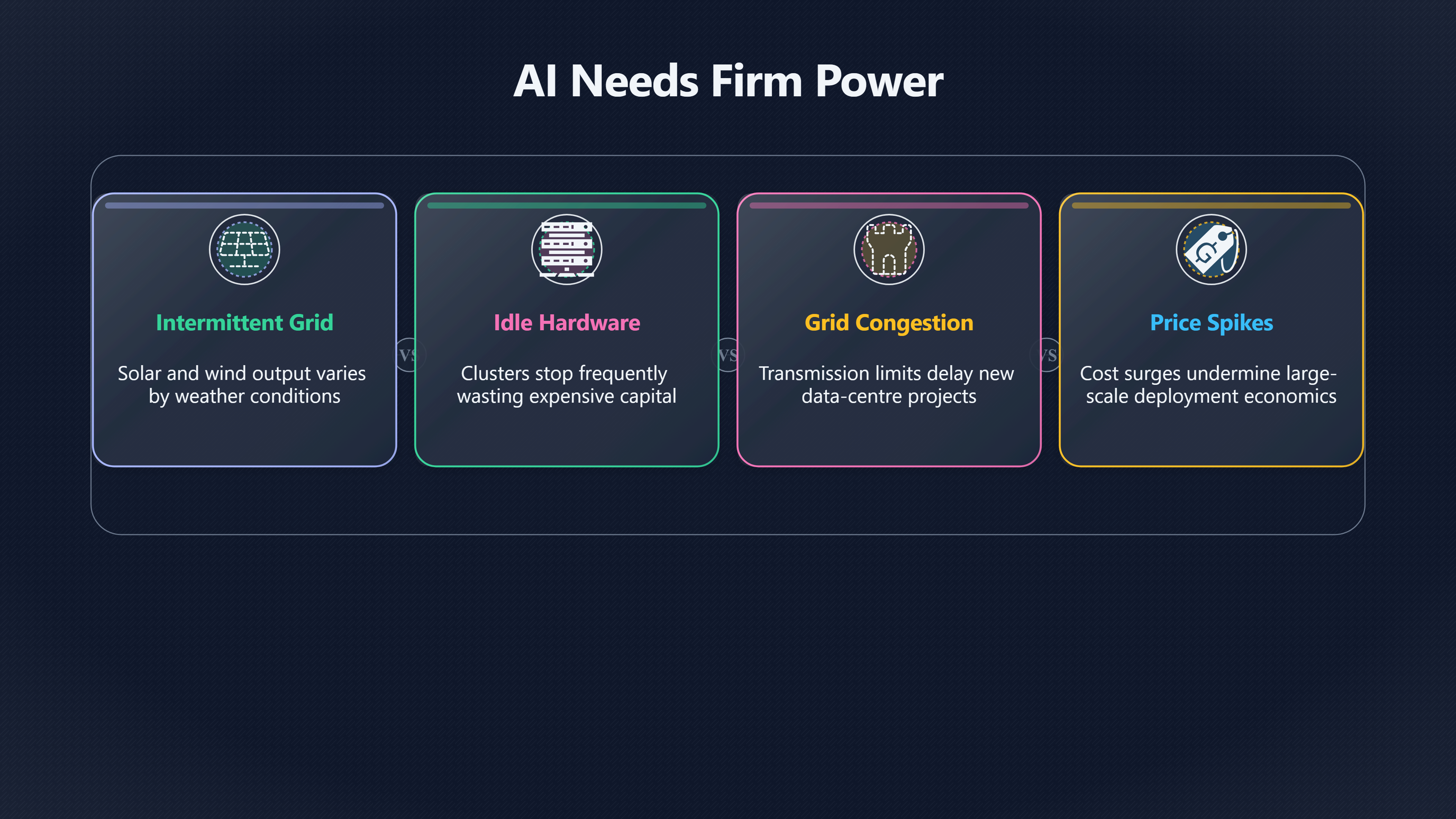
For AI firms, intermittent electricity creates several problems:
- Computing clusters are costly and economically inefficient if forced to stop frequently.
- Grid congestion can delay new data-centre projects for years.
- Carbon targets become harder to meet if companies rely heavily on gas-fired backup generation.
- Electricity price spikes can undermine the economics of large-scale AI deployment.
These concerns are already visible in major data-centre regions. Northern Virginia, parts of Texas, Ireland and the US Pacific Northwest have all faced debates over grid strain, transmission limits and electricity costs linked partly to rapid data-centre growth. Researchers modelling future AI infrastructure have warned that concentrated AI expansion could create serious regional power-system stress even if global electricity demand remains manageable overall. [arXiv]arxiv.orgarXivConcentrated siting of AI data centers drives regional power-system stress under rising global compute demandMarch 13, 2026… [Reuters Wind and solar power remain central to most technology companies’ clean-energy strategies]reuters.comr processing and cooling. The largest U.S. sites…, and the IEA expects renewables to supply much of future data-centre demand growth. But renewables alone do not always solve the “24/7” problem because output varies by hour, season and weather. Batteries help, but long-duration storage at AI-industry scale remains expensive and unevenly deployed. [IEA]iea.orgsummary – Electricity 2026 – AnalysisGlobal electricity demand is forecast to increase at a brisk average annual rate of 3.6% over the 20…
That gap is where nuclear and geothermal become strategically interesting.
Why nuclear power appeals to AI firms
Nuclear energy offers three features that align unusually well with AI infrastructure needs:
- Constant high-output electricity.
- Very low operational carbon emissions.
- Large-scale generation concentrated on relatively small sites.
For technology firms trying to guarantee dependable computing capacity decades into the future, those traits are highly attractive. Nuclear plants can operate continuously for long periods, unlike solar and wind facilities that fluctuate with environmental conditions. That makes nuclear particularly valuable for hyperscale data centres that expect steady demand growth.
A second attraction is timing. Many AI executives increasingly believe that electricity demand from advanced computing could grow faster than grids can adapt. Some firms are therefore moving beyond ordinary power-purchase agreements and trying to secure dedicated long-term generation. Reuters described major tech firms beginning to behave more like long-term infrastructure planners than ordinary software companies. [Forbes]forbes.comwhy microsoft and amazon are turning to nuclear power for aiForbesWhy Microsoft And Amazon Are Turning To Nuclear Power…19 Feb 2026 — AI's soaring energy demand is pushing Microsoft and Amazon t…
Several high-profile deals illustrate the shift:
- Microsoft backed the restart of the Three Mile Island nuclear plant in Pennsylvania to help support future AI-related electricity demand.
- Amazon invested in nuclear and small modular reactor projects linked to future data-centre supply.
- Google signed agreements connected to advanced nuclear development through Kairos Power.
- Meta and other large cloud firms have explored nuclear procurement as part of long-term clean-energy strategies. [Nuclear Business Platform]nuclearbusiness-platform.comWhy Tech Giants Are Investing Billions in Nuclear Power…May 23, 2025 — In October 2024, Amazon Web Services (AWS) partnered with nucle… [3Introl 3Introl]
The AI industry’s interest in nuclear is therefore partly defensive. Companies fear a future in which compute expansion is slowed by grid queues, political resistance to fossil fuels, or shortages of dispatchable clean electricity.
There is also a geopolitical dimension. Countries hoping to host advanced AI industries increasingly view electricity abundance as a competitive advantage. Reliable nuclear fleets can support industrial-scale computing without depending heavily on imported gas or volatile fuel markets.
The promise and delays of small modular reactors
Much of the AI-sector enthusiasm centres on small modular reactors, or SMRs. These are proposed nuclear reactors designed to be smaller, factory-built and theoretically easier to deploy than traditional gigawatt-scale plants.
The appeal for AI firms is obvious:
- SMRs could potentially be built near data-centre clusters.
- Multiple units could scale incrementally with computing demand.
- They may integrate more easily into private industrial campuses.
- Supporters argue they could shorten construction timelines and reduce financing risk.
This vision has become influential enough that some commentators now discuss “AI-powered nuclear revivals”. Introl [Nuclear Business Platform]nuclearbusiness-platform.comWhy Tech Giants Are Investing Billions in Nuclear Power…May 23, 2025 — In October 2024, Amazon Web Services (AWS) partnered with nucle…
But the reality is still uncertain.
Most advanced SMR designs are not yet operating commercially at scale in Western markets. Many projects face licensing delays, financing problems, fuel-supply constraints and unresolved cost questions. Some analysts argue that AI companies may be underestimating how slowly nuclear infrastructure can actually be built.
The main bottlenecks include:
- Lengthy regulatory approval processes.
- High upfront capital costs.
- Limited reactor-manufacturing capacity.
- Shortages of specialised nuclear labour.
- Dependence on high-assay low-enriched uranium fuel for some reactor designs. [irecruit.co]irecruit.cosmr nuclear powered data center developmentsSMR Data Centers Tracker: Nuclear-Powered Projects 20265 days ago — The SMR market, valued at $6.9 billion in 2025, is projected to grow…
This creates an important tension inside the wider AI abundance narrative. AI models can improve on software timescales measured in months, but nuclear infrastructure often develops on timescales measured in decades. Even optimistic supporters of nuclear-powered AI generally expect major deployments to arrive gradually through the 2030s rather than immediately.
There are also political risks. Communities may resist new reactors, especially if they believe electricity costs are rising mainly to support private technology firms. Concerns over nuclear waste, safety and water use remain politically significant even where modern reactor designs are safer than older generations.
How geothermal could support computing hubs
Geothermal power attracts AI firms for a different reason: it promises reliable clean electricity without many of nuclear power’s political and regulatory burdens.
Traditional geothermal plants use underground heat reservoirs to generate electricity. Advanced geothermal systems, sometimes called enhanced geothermal systems or EGS, attempt to create usable reservoirs in a much wider range of geological conditions using drilling techniques adapted partly from the oil and gas industry.
For AI companies, geothermal has several appealing characteristics:
- It can operate continuously rather than intermittently.
- Plants are relatively compact.
- Output is highly predictable.
- Carbon emissions are very low.
- Some projects may be developed faster than nuclear facilities.
Google has become one of the most visible supporters of this approach through its partnership with Fervo Energy in Nevada. In 2023, Google announced that Fervo’s geothermal project was supplying carbon-free electricity to the grid serving Google operations. Later agreements expanded planned geothermal capacity dramatically. Reuters 3blog.google [DataCenterDynamics In 2026]forbes.comwhy microsoft and amazon are turning to nuclear power for aiForbesWhy Microsoft And Amazon Are Turning To Nuclear Power…19 Feb 2026 — AI's soaring energy demand is pushing Microsoft and Amazon t…, Ormat Technologies also signed a deal tied to Google’s Nevada operations for 150 megawatts of geothermal power scheduled to come online between 2028 and 2030. [Reuters]reuters.comr processing and cooling. The largest U.S. sites…
The attraction is not only environmental branding. Geothermal directly addresses one of the AI sector’s hardest infrastructure problems: how to secure dependable low-carbon electricity close to expanding compute clusters without waiting decades for new transmission corridors or reactor fleets.
Why geothermal feels different from past clean-energy hype
Geothermal has periodically attracted excitement before without becoming a dominant energy source. What is different now is the combination of three trends:
- AI companies are unusually motivated to pay premiums for dependable electricity.
- Advanced drilling technologies have improved significantly.
- Governments increasingly want domestic clean-energy sources that strengthen industrial resilience.
Enhanced geothermal systems also benefit from an important narrative advantage. Unlike some renewables debates, geothermal projects usually do not require vast land areas or large visible infrastructure footprints. Unlike nuclear, they generally avoid fears associated with radiation and long-lived waste.
Still, geothermal faces major uncertainties of its own.
Advanced geothermal remains commercially immature in many regions. Drilling costs are high, geological conditions vary, and not every pilot project succeeds. Scaling from promising demonstrations to gigawatt-scale deployment is difficult. Many experts believe geothermal could become an important regional contributor to AI infrastructure without ever becoming the dominant energy source for global computing.

The deeper issue: AI abundance may depend on physical infrastructure after all
The growing alliance between AI firms and firm low-carbon power challenges a common assumption about digital technology: that intelligence scaling is mainly a software problem.
In practice, future AI systems depend on physical systems that are slow, capital-intensive and politically contested. Electricity generation, grid construction, cooling systems, semiconductor manufacturing and transmission infrastructure all place limits on how quickly computing can expand.
That does not invalidate the broader AI bloom thesis. In fact, supporters of long-term AI abundance often argue that advanced AI could eventually accelerate energy innovation itself through faster materials science, better drilling optimisation, smarter grid management and improved reactor design.
But there is an important sequencing problem. AI may eventually help solve energy bottlenecks, yet it first needs enormous energy supplies to reach that stage.
This is why nuclear and geothermal matter symbolically as well as practically. They represent an attempt to align AI expansion with long-duration industrial capacity rather than short-term electricity markets alone.
The criticisms and risks behind the nuclear-AI push
The enthusiasm around firm clean power does not settle the underlying political and social questions.
Critics raise several objections.
First, some argue that AI companies are effectively competing with households and other industries for scarce electricity infrastructure. Rising demand from data centres has already contributed to concerns about higher electricity prices in some regions. [Tom's Hardware]tomshardware.compower grid—has identified AI data centers as the primary cause of a dramatic 75.5% increase in electricity prices in the region. Wholesal…
Second, there is a fairness question. If advanced AI systems eventually generate enormous wealth, who benefits from the energy infrastructure built to support them? Public frustration could grow if communities absorb environmental or financial burdens while gains concentrate among a small number of technology firms and investors.
Third, nuclear and geothermal projects can become vehicles for exaggerated technological optimism. Supporters sometimes speak as though future AI growth automatically justifies massive infrastructure expansion. Yet the long-term social value of AI systems remains contested. Some critics question whether increasingly energy-intensive AI models will produce benefits proportionate to their resource consumption.
There are also climate trade-offs. Nuclear and geothermal are low-carbon compared with fossil fuels, but they are not impact-free. Nuclear plants involve mining, waste management and water use. Geothermal drilling can create local environmental concerns and, in some cases, induced seismic activity.
Most importantly, neither technology is a guaranteed solution to AI’s energy constraints. Even under optimistic assumptions, future compute demand could outpace clean-energy deployment for years.
Firm power as a test of the AI bloom vision
The attraction of nuclear and geothermal power to AI companies reveals something fundamental about the future of advanced AI.
The optimistic vision of AI abundance is not only about smarter algorithms. It also depends on whether societies can build enough durable physical infrastructure to support large-scale intelligence economically, sustainably and politically.
In that sense, the debate over “firm power” is really a debate about whether civilisation can coordinate long-term technological expansion without destabilising energy systems, worsening inequality or triggering public backlash.
If AI eventually helps humanity flourish on a far larger scale, reliable clean energy will almost certainly be part of that story. But the growing scramble for nuclear reactors and geothermal projects is also a reminder that digital abundance still rests on material foundations: mines, turbines, grids, cooling systems, drilling rigs, reactors and power lines. The future of AI may depend as much on those systems as on the models themselves.
Endnotes
-
Source: iea.org
Link: https://www.iea.org/reports/energy-and-ai/energy-demand-from-aiSource snippet
IEAEnergy demand from AIToday, electricity consumption from data centres is estimated to amount to around 415 terawatt hours (TWh), or ab...
-
Source: iea.org
Link: https://www.iea.org/news/ai-is-set-to-drive-surging-electricity-demand-from-data-centres-while-offering-the-potential-to-transform-how-the-energy-sector-worksSource snippet
AI is set to drive surging electricity demand from data...Apr 10, 2025 — In advanced economies more broadly, data centres are projected...
-
Source: reuters.com
Link: https://www.reuters.com/markets/commodities/us-ai-boom-faces-electric-shock-2026-02-25/Source snippet
r processing and cooling. The largest U.S. sites...
-
Source: iea.org
Link: https://www.iea.org/news/data-centre-electricity-use-surged-in-2025-even-with-tightening-bottlenecks-driving-a-scramble-for-solutionsSource snippet
Data centre electricity use surged in 2025, even with...16 Apr 2026 — New IEA report explores AI's growing energy footprint, options for...
-
Source: arxiv.org
Link: https://arxiv.org/abs/2604.06198Source snippet
arXivConcentrated siting of AI data centers drives regional power-system stress under rising global compute demandMarch 13, 2026...
Published: March 13, 2026
-
Source: iea.org
Link: https://www.iea.org/reports/energy-and-ai/energy-supply-for-aiSource snippet
IEAEnergy supply for AITaken together, renewables remain the fastest-growing source of electricity for data centres, with total generatio...
-
Source: forbes.com
Title: why microsoft and amazon are turning to nuclear power for ai
Link: https://www.forbes.com/sites/rrapier/2026/02/19/why-microsoft-and-amazon-are-turning-to-nuclear-power-for-ai/Source snippet
ForbesWhy Microsoft And Amazon Are Turning To Nuclear Power...19 Feb 2026 — AI's soaring energy demand is pushing Microsoft and Amazon t...
-
Source: reuters.com
Link: https://www.reuters.com/commentary/reuters-open-interest/nextera-dominion-deal-wont-be-last-ai-power-build-out-2026-05-18/Source snippet
utility sector, driven by surging electricity demands fueled by artificial intelligence (AI). With data centers becoming increasingly pow...
-
Source: introl.com
Title: “Amazon is joining Google and Microsoft in going big on nuclear power.Read more
Link: https://introl.com/blog/smr-nuclear-power-ai-data-centers-2025Source snippet
IntrolSMRs Power AI: $10B Nuclear Data Center Revolution - Introlby B Crosley · Cited by 1 — "Google signs nuclear SMR deal with Kairos f...
-
Source: introl.com
Title: smr nuclear power ai data centers implementation
Link: https://introl.com/blog/smr-nuclear-power-ai-data-centers-implementationSource snippet
SMR Nuclear Power for AI Data Centers | Introl Blog24 Mar 2026 — Microsoft's $1.6B deal to restart Three Mile Island for AI signals the n...
-
Source: irecruit.co
Title: smr nuclear powered data center developments
Link: https://www.irecruit.co/insights/smr-nuclear-powered-data-center-developmentsSource snippet
SMR Data Centers Tracker: Nuclear-Powered Projects 20265 days ago — The SMR market, valued at $6.9 billion in 2025, is projected to grow...
-
Source: blog.google
Title: [google fervo]({{ ‘ai-bloom-abun/ai-bloom-abun-98d3a6-energy-limits-d5bf69-nuclear-geoth-71149c-google-fervo-e816ce/’ | relative_url }}) geothermal energy partnership
Link: https://blog.google/company-news/outreach-and-initiatives/sustainability/google-fervo-geothermal-energy-partnership/Source snippet
A first-of-its-kind geothermal project is now operational28 Nov 2023 — We partnered with a clean-energy startup to develop a geothermal p...
-
Source: datacenterdynamics.com
Title: google buys 115mw of geothermal energy to power nevada data centers
Link: https://www.datacenterdynamics.com/en/news/google-buys-115mw-of-geothermal-energy-to-power-nevada-data-centers/Source snippet
Google buys 115MW of geothermal energy to power...Jun 14, 2024 — Dubbed a “clean transition tariff," it will see NV Energy procure 115MW...
-
Source: reuters.com
Title: google partners with nevada utility geothermal power data centers 2024 06 13
Link: https://www.reuters.com/business/energy/google-partners-with-nevada-utility-geothermal-power-data-centers-2024-06-13/Source snippet
Google partners with Nevada utility for geothermal to...Jun 13, 2024 — Google has entered into an agreement with Berkshire Hathaway elec...
-
Source: reuters.com
Link: https://www.reuters.com/sustainability/climate-energy/ormat-signs-150-mw-geothermal-power-deal-with-nv-energy-supply-google-nevada-2026-02-17/Source snippet
The new capacity will be developed through a series of geothermal projects scheduled to come online between 2028 and 2030. This deal supp...
-
Source: introl.com
Title: Nuclear power for AI: inside the data center energy deals
Link: https://introl.com/blog/nuclear-power-ai-data-centers-microsoft-google-amazon-2025Source snippet
Introl8 Jan 2026 — Amazon announced over $20 billion in investment to convert the site into an AI-ready data center campus powered entire...
-
Source: iea.org
Link: https://www.iea.org/reports/electricity-2026/executive-summarySource snippet
summary – Electricity 2026 – AnalysisGlobal electricity demand is forecast to increase at a brisk average annual rate of 3.6% over the 20...
-
Source: iea.org
Link: https://www.iea.org/reports/energy-and-ai/executive-summarySource snippet
summary – Energy and AI – AnalysisRenewables and natural gas take the lead in meeting data centre electricity demand, but a range of sour...
-
Source: iea.org
Link: https://www.iea.org/reports/electricity-2026/supplySource snippet
Electricity 2026 – AnalysisThe VRE share in the electricity generation mix is forecast to rise from 18% in 2025 to 23% in 2030, with the...
-
Source: google.com
Link: https://www.google.com/Source snippet
GoogleSearch the world's information, including webpages, images, videos and more. Google has many special features to help you find exac...
-
Source: blog.google
Link: https://blog.google/intl/en-ca/Source snippet
Canada BlogGoogle.org · Supporting Canadian families in the digital world. To celebrate Safer Internet Day 2026, Google Canada is announc...
-
Source: blog.google
Link: https://blog.google/Source snippet
on the Keyword, Google's official blog...
-
Source: about.google
Link: https://about.google/products/ -
Source: reuters.com
Title: Time to go nuclear?
Link: https://www.reuters.com/sustainability/climate-energy/time-go-nuclear-inside-battle-power-ai–ecmii-2025-12-17/Source snippet
Inside the battle to power AI9 Jan 2026 — Global data centre power demand expected to double to 200-plus gigawatts by 2030 · U.S. data ce...
-
Source: energy.gov
Link: https://www.energy.gov/oe/clean-energy-resources-meet-data-center-electricity-demandSource snippet
electricity generation annually by 2030, up from...Read more...
-
Source: accounts.google.ca
Link: https://accounts.google.ca/Source snippet
Accounts: Sign inSign in. Use your Google Account. Email or phone. Forgot email? CAPTCHA image of text used to distinguish humans from ro...
-
Source: tomshardware.com
Link: https://www.tomshardware.com/tech-industry/ai-data-centers-trigger-massive-irreversible-76-percent-electricity-price-spike-in-largest-us-region-federal-watchdog-demands-tech-giants-pay-for-their-own-power-infrastructureSource snippet
power grid—has identified AI data centers as the primary cause of a dramatic 75.5% increase in electricity prices in the region. Wholesal...
-
Source: nuclearbusiness-platform.com
Link: https://www.nuclearbusiness-platform.com/media/insights/tech-giants-are-investing-billions-in-nuclearSource snippet
Why Tech Giants Are Investing Billions in Nuclear Power...May 23, 2025 — In October 2024, Amazon Web Services (AWS) partnered with nucle...
Published: May 23, 2025
-
Source: fervoenergy.com
Title: Fervo Energy
Link: https://fervoenergy.com/Source snippet
Next-Generation Geothermal ProjectsFervo Energy delivers 24/7 carbon-free energy through development of next-generation geothermal projects...
-
Source: uk.investing.com
Title: The result?Read more
Link: https://uk.investing.com/analysis/nuclear-energy-stocks-surge-40-as-microsoft-amazon-bet-billions-on-ai-power-200619160Source snippet
Energy Stocks Surge 40% as Microsoft, Amazon...3 Oct 2025 — Technology companies are projected to invest $250 billion in AI infrastructu...
-
Source: investing.com
Title: The result?Read more
Link: https://www.investing.com/analysis/nuclear-energy-stocks-surge-40-as-microsoft-amazon-bet-billions-on-ai-power-200667915Source snippet
Nuclear Energy Stocks Surge 40% as Microsoft, Amazon...3 Oct 2025 — Technology companies are projected to invest $250 billion in AI infr...
-
Source: Wikipedia
Title: Fervo Energy
Link: https://en.wikipedia.org/wiki/Fervo_EnergySource snippet
Fervo EnergyFervo Energy is a geothermal company based in Houston, Texas, that generates electricity through enhanced geothermal syste...
Additional References
-
Source: computer.org
Link: https://www.computer.org/csdl/magazine/co/2025/12/11285923/2ckeWambfHiSource snippet
AI's Appetite for Energy: How Data Centers Are Affecting...According to the International Energy Agency (IEA), global data center electr...
-
Source: fervo.co.uk
Link: https://fervo.co.uk/Source snippet
FERVO Renewable Energy | Design and installation of...At Fervo Renewable Energy we specialise in designing and installing renewable tech...
-
Source: seequent.com
Link: https://www.seequent.com/the-geothermal-innovation-powering-googles-data-centres/Source snippet
The geothermal innovation powering Google's data centresFervo's 'Project Red' pilot successfully tested a 3.5-MW enhanced geothermal syst...
-
Source: linkedin.com
Link: https://www.linkedin.com/posts/drewselfridge_according-to-the-international-energy-agency-activity-7424240326179008513-Y-umSource snippet
US Data Centers Electricity Consumption Surges 130% by...According to the latest International Energy Agency (IEA) outlook, global elect...
-
Source: linkedin.com
Link: https://www.linkedin.com/posts/maxiereynolds_according-to-a-report-from-the-international-activity-7318656333065474049–Kb5Source snippet
Data centers' electricity demand to double by 2030According to a report from the International Energy Agency published last week, electri...
-
Source: nucnet.org
Title: meta announces 6 6 gw of nuclear energy projects to power ai revolution 1 5 2026
Link: https://www.nucnet.org/news/meta-announces-6-6-gw-of-nuclear-energy-projects-to-power-ai-revolution-1-5-2026Source snippet
Meta Announces 6.6 GW Of Nuclear Energy Projects To...9 Jan 2026 — In 2024 Google said it will back the construction of seven SMRs from...
-
Source: english.elpais.com
Title: tech giants revive nuclear power plants to meet the needs of their data centers
Link: https://english.elpais.com/technology/2025-10-23/tech-giants-revive-nuclear-power-plants-to-meet-the-needs-of-their-data-centers.htmlSource snippet
giants revive nuclear power plants to meet the needs of...23 Oct 2025 — Among other projects, Amazon will support the development of a s...
-
Source: nature.com
Link: https://www.nature.com/articles/d41586-025-01113-zSource snippet
Data centres will use twice as much energy by 2030Apr 10, 2025 — Data centres will use twice as much energy by 2030 — driven by AI...
-
Source: linkedin.com
Title: davidlinthicum why ai is going nuclear activity 7381318738832416770 3qzi
Link: https://www.linkedin.com/posts/davidlinthicum_why-ai-is-going-nuclear-activity-7381318738832416770-3qziSource snippet
Google, Microsoft, Amazon partner with nuclear energy for AIThe deal is projected to deliver 500 megawatts of carbon-free power by 2035...
-
Source: weforum.org
Title: nuclear energy crisis strait of hormuz wef small modular reactor
Link: https://www.weforum.org/stories/2026/04/nuclear-energy-crisis-strait-of-hormuz-wef-small-modular-reactor/Source snippet
Surging AI needs and geopolitical supply shocks renew...Apr 21, 2026 — AI, data centres and a more volatile geopolitical environment are...
Amazon book picks
Further Reading
Books and field guides related to Nuclear and Geothermal AI Power. Use these as the next step if you want deeper reading beyond the article.
Contesting The Future Of Nuclear Power: A Critical Global Ass...
This book provides a concise but rigorous appraisal about the future of nuclear power and the presumed nuclear renaissance. It does so by...
Geothermal Power Plants
Ron DiPippo, Professor Emeritus at the University of Massachusetts Dartmouth, is a world-regarded geothermal expert. This single resource...

Political Electricity
This study offers an analysis of current public attitudes to nuclear power, contrasting the popular negative image with the reality of th...

Thermodynamic Analysis and Optimization of Geothermal Power P...
Thermodynamic Analysis and Optimization of Geothermal Power Plants guides researchers and engineers on the analysis and optimization of g...
eBay marketplace picks
Marketplace Samples
Example marketplace items related to this page. Use the search link to explore similar finds on eBay.

Example eBay listing
A.I. Artificial Intelligence Original Movie Poster Signed By Jude Law
USD 125.00 | Shipping USD 25.00 | US

Example eBay listing
Artificial Intelligence D/S Original Movie Poster - 27 x 40"
USD 19.50 | Shipping USD 13.65 | US

Example eBay listing
612388 Artificial Intelligence Movie Science Fiction Drama Wall Print Poster
USD 22.95 | Shipping USD 12.95 | JP

Example eBay listing
Companion - Artificial Intelligence Dark Comedy Cinema Film - POSTER 20"x30"
USD 23.99 | Free shipping | US
Topic Tree