Within Discovery
AlphaFold and Open Biology
AlphaFold’s open structure database shows how AI predictions can widen who gets to ask serious biological questions.
On this page
- What changed when predicted structures became searchable
- Who benefits from open protein maps
- Why structure still needs lab validation
Page outline Jump by section
Introduction
AlphaFold did not make protein science easy, automatic or solved. What it changed was access. Before AI structure prediction, many biological questions depended on expensive equipment, specialist expertise and months or years of experimental work just to obtain a plausible protein shape. Today, millions of predicted structures can be searched freely online in seconds. That shift matters because protein structures are not just academic curiosities: they help scientists understand disease, design drugs, engineer enzymes and investigate how living systems work.
 For the broader idea of “scientific discovery at machine speed”, AlphaFold is important less as a miracle breakthrough than as evidence that AI can widen participation in frontier science. Researchers who once lacked the budget, infrastructure or institutional prestige to do structural biology can now begin with a usable structural hypothesis instead of a blank page. But the optimistic story has limits. Predicted structures are not experimental truth, many proteins remain difficult to model, and open databases alone do not solve unequal access to laboratories, funding or medicines.
What changed when predicted structures became searchable
Protein structure prediction had long been one of biology’s most difficult computational problems. Experimental techniques such as X-ray crystallography, cryo-electron microscopy and nuclear magnetic resonance spectroscopy can determine structures directly, but they are costly, labour-intensive and technically demanding. Many proteins also resist experimental analysis altogether.
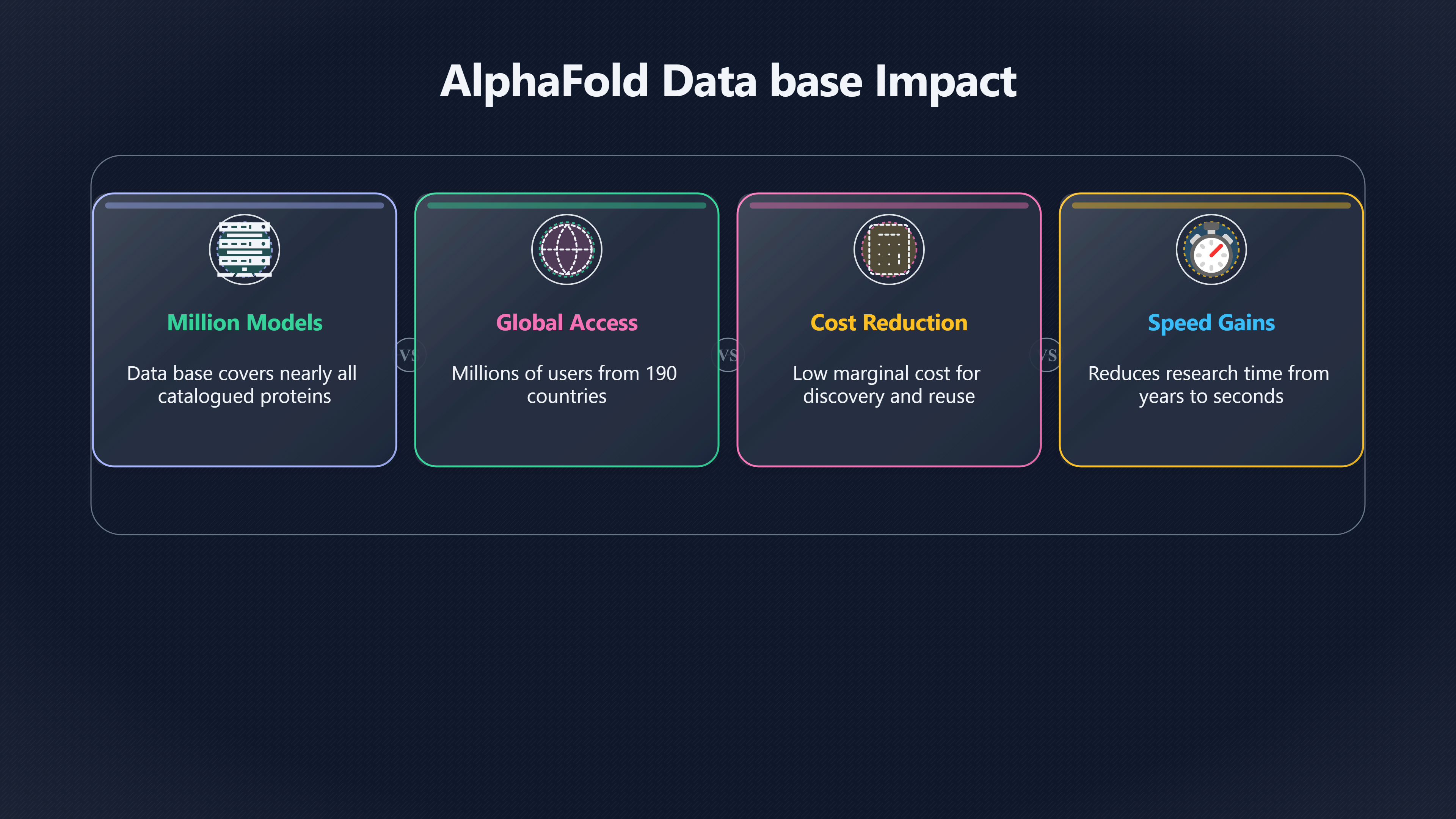
AlphaFold changed the workflow by predicting three-dimensional protein structures directly from amino-acid sequences with unprecedented accuracy in many cases. The larger transformation came when Google DeepMind and EMBL-EBI released the AlphaFold Protein Structure Database as a public resource rather than a private commercial tool. The database now contains more than 200 million predicted protein structures covering nearly all catalogued proteins known to science. embl.org 3alphafold.ebi.ac.uk [Google DeepMind]deepmind.googleGoogle DeepMindAlphaFold — Google DeepMindView over 200 million protein structure… So far, AlphaFold has predicted over 200 million pr…
That matters because modern biology increasingly depends on searchable digital infrastructure. Once structures became openly indexed, biologists no longer needed to generate every model themselves. A researcher studying a parasite enzyme, a bacterial toxin or a rare human disease protein could often retrieve a predicted structure immediately and begin asking functional questions on day one.
The change resembles what happened when genome sequencing became cheap and publicly searchable. Before large open genomic databases, sequencing capacity was concentrated in elite centres. Afterward, much more of biology became computational, collaborative and globally distributed. AlphaFold appears to be pushing structural biology in a similar direction.
The practical speed gains are substantial. DeepMind and EMBL-EBI argue that experimentally solving all proteins in the database would have taken hundreds of millions of years of cumulative research time. [Google DeepMind]deepmind.googleGoogle DeepMindAlphaFold — Google DeepMindView over 200 million protein structure… So far, AlphaFold has predicted over 200 million pr… Even if that estimate is partly rhetorical, the broader point stands: AI predictions dramatically reduce the cost of generating a first-pass structural hypothesis.
Who benefits from open protein maps
The strongest argument that AlphaFold makes protein science more open is not simply that the database is free. It is that the cost of asking sophisticated biological questions has fallen.
Researchers in lower-resource settings can now access structural information that previously required collaborations with wealthy institutions or specialised structural-biology centres. EMBL and DeepMind report millions of users across more than 190 countries. [Google DeepMind]deepmind.googleGoogle DeepMindAlphaFold — Google DeepMindView over 200 million protein structure… So far, AlphaFold has predicted over 200 million pr… That does not prove equal participation, but it does show unusually broad global uptake for a frontier scientific tool.
Several groups benefit especially strongly:
- Scientists studying neglected diseases. Diseases concentrated in poorer regions often attract less pharmaceutical investment. Open protein predictions allow smaller academic groups to investigate pathogen biology without waiting for expensive structural campaigns.
- Early-career researchers and smaller labs. Structural biology has historically rewarded institutions with expensive facilities. AlphaFold lowers the entry barrier for generating hypotheses and planning experiments.
- Researchers outside structural biology. Cell biologists, microbiologists and geneticists who are not protein-folding specialists can now use structural models as part of ordinary biological research.
- Protein engineers and synthetic biologists. Open predictions accelerate the design of enzymes for industrial chemistry, agriculture and environmental applications.
- Students and educators. Structural biology has become easier to teach because learners can directly explore predicted molecular shapes rather than relying only on textbook diagrams.
The database’s openness also changes collaboration patterns. Instead of knowledge remaining trapped inside proprietary pipelines, researchers can share candidate structures instantly across institutions and countries. This is especially important in outbreaks and rapidly evolving research areas where speed matters.
During the COVID-19 pandemic, structural biology became central to vaccine and antiviral development. While AlphaFold itself was not a standalone solution to the crisis, the broader trend towards computationally accessible biology reinforced the idea that AI-assisted structural prediction could shorten response times in future outbreaks. [arXiv]arxiv.orgarXiv On the Robustness of Alpha Fold: A COVID-19 Case StudyarXivOn the Robustness of AlphaFold: A COVID-19 Case StudyJanuary 10, 2023…
Open access does not mean equal scientific power
The phrase “open science” can sound more complete than reality. AlphaFold makes some layers of biology more accessible, but important bottlenecks remain.
The first bottleneck is experimental validation. Biology still happens in cells, organisms and laboratories, not inside databases. Researchers must verify whether predicted structures match reality closely enough for a given application. Wet-lab experiments remain expensive, unevenly distributed and highly specialised.
The second bottleneck is interpretation. A protein structure alone does not automatically reveal biological function. Scientists still need domain expertise to understand binding sites, molecular interactions and physiological effects.
The third bottleneck is downstream commercialisation. Even if structural information is public, turning biological insight into a therapy usually requires patents, clinical trials, manufacturing capacity and regulatory approval. Open protein maps do not automatically produce open medicines.
There are also concerns about concentration of power around the computational infrastructure itself. Although AlphaFold predictions are widely accessible, the largest AI models still require enormous computational resources to train. That means frontier capabilities remain concentrated in a relatively small number of technology companies and elite institutions.
So the openness created by AlphaFold is real, but partial. It democratises access to one layer of scientific capability while leaving other layers unequal.

Why structure still needs lab validation
One common misunderstanding is that AlphaFold “solved” protein folding in a complete sense. In reality, its predictions are probabilistic models, not direct observations of molecules in living systems.
For many proteins, AlphaFold predictions are remarkably accurate. But some important biological cases remain difficult:
- intrinsically disordered proteins that do not adopt one stable structure
- proteins that change shape dynamically
- alternative folding states
- large molecular assemblies
- interactions influenced by cellular environments
Researchers have repeatedly warned that confidence scores matter and that low-confidence regions should not be treated as experimentally verified structures. [ebi.ac.uk]alphafold.ebi.ac.ukAlphaFold Protein Structure DatabaseAlphaFold DB provides open access to over 200 million protein structure predictions to accelerate sci… [ebi.ac.uk]ebi.ac.ukHow accurate are AlphaFold 2 structure predictions?Overall, AlphaFold2 gets the vast majority of the side chains right, but is marginally…
Intrinsically disordered proteins are especially important because they play major roles in signalling, regulation and disease. By definition, many do not possess one fixed structure for AlphaFold to predict. Studies have shown that predictions in these regions can diverge from experimental measurements. [ScienceDirect]sciencedirect.comScienceDirectAlphaFold and Implications for Intrinsically Disordered…by KM Ruff · 2021 · Cited by 748 — AlphaFold, a deep learning-bas… [Nature]nature.comAlphaFold prediction of structural ensembles of disordered…by ZF Brotzakis · 2025 · Cited by 118 — Currently, however, structure predi…
There are also concerns about “hallucinations” or overconfident predictions in difficult cases. Some researchers argue that AlphaFold can produce highly plausible-looking structures even when the underlying biological certainty is weaker than the visual output suggests. [arXiv]arxiv.orgarXiv On the Robustness of Alpha Fold: A COVID-19 Case StudyarXivOn the Robustness of AlphaFold: A COVID-19 Case StudyJanuary 10, 2023…
This matters because the visual authority of AI-generated molecular models can create false confidence. A colourful 3D protein rendering appears concrete and precise even when uncertainty remains substantial.
The healthiest scientific use of AlphaFold therefore treats predictions as guides for experimentation, not replacements for it. The database accelerates the early stages of inquiry by narrowing search spaces and suggesting promising directions. But experiments still determine whether biological claims are true.

AlphaFold as a model for more open AI-enabled science
Despite its limits, AlphaFold represents one of the clearest existing examples of how AI could widen participation in advanced research rather than merely automate routine office work.
Several aspects of the project are especially significant for the broader “AI bloom” idea:
- Public infrastructure instead of purely private advantage. Making the database searchable and open changed its social impact dramatically compared with keeping the models proprietary.
- Lower marginal costs for discovery. Once predictions exist digitally, millions of researchers can reuse them simultaneously at near-zero distribution cost.
- Faster scientific iteration. Researchers can move more quickly from sequence to hypothesis to experiment.
- Global diffusion of capability. Open databases allow institutions without frontier AI labs to benefit from frontier AI outputs.
- Compounding knowledge effects. Shared scientific infrastructure often becomes more valuable as more researchers build on it.
This does not guarantee an era of scientific abundance. Structural biology is only one layer of a much larger discovery pipeline involving chemistry, medicine, manufacturing, regulation and political economy. But AlphaFold provides concrete evidence for a broader possibility: advanced AI systems may sometimes function best not as replacements for scientists, but as force multipliers that make sophisticated scientific reasoning available to far more people.
That possibility sits near the centre of the optimistic case for AI-driven scientific acceleration. If AI systems can increasingly generate usable maps of difficult scientific domains — proteins today, perhaps materials, cells or biological pathways tomorrow — then the number of people capable of contributing to frontier research could expand substantially.
Whether that leads to broadly shared flourishing depends less on the prediction systems alone than on the institutions surrounding them: open databases, public funding, international collaboration, affordable compute access, transparent validation standards and incentives that reward diffusion rather than enclosure. AlphaFold shows that AI can widen the scientific starting line. It does not yet prove that the benefits at the finish line will be equally shared.
Endnotes
-
Source: alphafold.ebi.ac.uk
Link: https://alphafold.ebi.ac.uk/Source snippet
AlphaFold Protein Structure DatabaseAlphaFold DB provides open access to over 200 million protein structure predictions to accelerate sci...
-
Source: deepmind.google
Link: https://deepmind.google/science/alphafold/Source snippet
Google DeepMindAlphaFold — Google DeepMindView over 200 million protein structure... So far, AlphaFold has predicted over 200 million pr...
-
Source: embl.org
Title: alphafold using open data and ai to discover the 3d protein universe
Link: https://www.embl.org/news/science/alphafold-using-open-data-and-ai-to-discover-the-3d-protein-universe/Source snippet
Case study: AlphaFold uses open data and AI to discover...9 Feb 2023 — AlphaFold database in numbers · 200 million protein structure pre...
-
Source: deepmind.google
Title: alphafold five years of impact
Link: https://deepmind.google/blog/alphafold-five-years-of-impact/Source snippet
Google DeepMindAlphaFold: Five Years of Impact25 Nov 2025 — And one year later, we released AlphaFold 2's predictions for more than 200 m...
-
Source: embl.org
Title: first complexes alphafold database
Link: https://www.embl.org/news/science-technology/first-complexes-alphafold-database/Source snippet
EBI developed the AlphaFold Database, an open resource that anyone can access. The database has over 3.4 million users from 190 countries...
-
Source: arxiv.org
Title: arXiv On the Robustness of Alpha Fold: A COVID-19 Case Study
Link: https://arxiv.org/abs/2301.04093Source snippet
arXivOn the Robustness of AlphaFold: A COVID-19 Case StudyJanuary 10, 2023...
Published: January 10, 2023
-
Source: ebi.ac.uk
Link: https://www.ebi.ac.uk/training/online/courses/alphafold/validation-and-impact/how-accurate-are-alphafold-structure-predictions/Source snippet
How accurate are AlphaFold 2 structure predictions?Overall, AlphaFold2 gets the vast majority of the side chains right, but is marginally...
-
Source: ebi.ac.uk
Title: strengths and limitations of alphafold
Link: https://www.ebi.ac.uk/training/online/courses/alphafold/an-introductory-guide-to-its-strengths-and-limitations/strengths-and-limitations-of-alphafold/Source snippet
25 Jan 2024 — AlphaFold2 can be used to identify intrinsically disordered regions. Naturally, the system cannot predict disordered or dyn...
-
Source: sciencedirect.com
Link: https://www.sciencedirect.com/science/article/pii/S0022283621004411Source snippet
ScienceDirectAlphaFold and Implications for Intrinsically Disordered...by KM Ruff · 2021 · Cited by 748 — AlphaFold, a deep learning-bas...
-
Source: nature.com
Link: https://www.nature.com/articles/s41467-025-56572-9Source snippet
AlphaFold prediction of structural ensembles of disordered...by ZF Brotzakis · 2025 · Cited by 118 — Currently, however, structure predi...
-
Source: arxiv.org
Link: https://arxiv.org/abs/2410.14898Source snippet
arXivProteins with alternative folds reveal blind spots in AlphaFold-based protein structure predictionOctober 18, 2024...
Published: October 18, 2024
-
Source: arxiv.org
Link: https://arxiv.org/abs/2510.15939 -
Source: embl.org
Link: https://www.embl.org/Source snippet
European Molecular Biology Laboratory | EMBL.orgEMBL is Europe's life sciences laboratory. Research EMBL performs fundamental research in...
-
Source: embl.org
Title: google deepmind partnership renewal
Link: https://www.embl.org/news/science-technology/google-deepmind-partnership-renewal/Source snippet
EMBL-EBI and Google DeepMind renew partnership and...7 Oct 2025 — The AlphaFold Database contains protein structure predictions for over...
-
Source: nature.com
Link: https://www.nature.com/articles/s41467-026-69172-ySource snippet
Atomic resolution ensembles of intrinsically disordered...by V Schnapka · 2026 · Cited by 19 — As a result, existing databases of IDP en...
-
Source: nature.com
Link: https://www.nature.com/articles/s41586-021-03819-2Source snippet
Highly accurate protein structure prediction with AlphaFoldby J Jumper · 2021 · Cited by 49827 — The AlphaFold network directly predicts...
-
Source: nature.com
Link: https://www.nature.com/articles/s41586-024-07487-wSource snippet
Accurate structure prediction of biomolecular interactions...by J Abramson · 2024 · Cited by 14114 — Here we describe our AlphaFold 3 mo...
-
Source: nature.com
Link: https://www.nature.com/articles/d41586-025-03886-9Source snippet
AlphaFold is five years old — these charts show how it...by E Callaway · 2025 — The huge protein database that spawned AlphaFold and bio...
-
Source: nature.com
Link: https://www.nature.com/articles/d41586-026-00787-3Source snippet
AlphaFold database hits 'next level': the AI system now...17 Mar 2026 — The database of 200 million protein-structure predictions now in...
-
Source: ebi.ac.uk
Title: first complexes alphafold database
Link: https://www.ebi.ac.uk/about/news/technology-and-innovation/first-complexes-alphafold-database/Source snippet
Four-way collaboration brings together world-...Read more...
-
Source: ebi.ac.uk
Link: https://www.ebi.ac.uk/training/online/courses/navigating-alphafold-database/what-is-the-afdb/accessing-searching-afdb/access-via-website/Source snippet
Background. AlphaFold is an AI system...Read more...
-
Source: ebi.ac.uk
Title: alphafold 200 million
Link: https://www.ebi.ac.uk/about/news/technology-and-innovation/alphafold-200-millionSource snippet
190 countries have accessed the AlphaFold Database to view over two million structures.Read more...
-
Source: ebi.ac.uk
Link: https://www.ebi.ac.uk/training/online/courses/alphafold/inputs-and-outputs/evaluating-alphafolds-predicted-structures-using-confidence-scores/plddt-understanding-local-confidence/Source snippet
However, there are some IDRs where the protein lacks a defined structure under physiological...
-
Source: alphafold.ebi.ac.uk
Title: ebi.ac.uk Downloads
Link: https://alphafold.ebi.ac.uk/downloadSource snippet
AlphaFold Protein Structure Database - EMBL-EBIThe AlphaFold DB website currently provides bulk downloads for the 48 organisms listed bel...
-
Source: alphafold.ebi.ac.uk
Title: ebi.ac.uk About
Link: https://alphafold.ebi.ac.uk/aboutSource snippet
AlphaFold Protein Structure DatabaseAlphaFold is an AI system developed by Google DeepMind that makes state-of-the-art accurate predictio...
-
Source: sciencedirect.com
Link: https://www.sciencedirect.com/science/article/pii/S0966842X25001106Source snippet
Database in 2024: providing structure coverage for over 214 million protein...Rea...
-
Source: arxiv.org
Link: https://arxiv.org/html/2510.15939v2Source snippet
Hallucinations in AlphaFold 3 for Intrinsically Disordered...11 Nov 2025 — These findings highlight the limitations of AlphaFold3 in mod...
Additional References
-
Source: linkedin.com
Link: https://www.linkedin.com/posts/pushmeet-kohli-4838994_alphafold-database-welcomes-community-datasets-activity-7429974285496061952-sbeoSource snippet
AlphaFold Database Expands to Global ResearchersToday, the scale of that impact is clear: AlphaFold is being used by over 3.3 million res...
-
Source: researchgate.net
Link: https://www.researchgate.net/publication/353994295_AlphaFold_and_Implications_for_Intrinsically_Disordered_ProteinsSource snippet
AlphaFold and Implications for Intrinsically Disordered...A key limitation, however, is that AlphaFold performs less reliably for intrin...
-
Source: linkedin.com
Link: https://www.linkedin.com/posts/sohila-a-khedr-95022b199_alphafold-proteindynamics-structuralbiology-activity-7406193770905452544-8FHxSource snippet
AlphaFold's Limitations in Protein Dynamics RevealedExisting predictive models struggle to accurately capture the complex interplay betwe...
-
Source: github.com
Link: https://github.com/google-deepmind/alphafoldSource snippet
Open source code for AlphaFold 2.This package provides an implementation of the inference pipeline of AlphaFold v2. For simplicity, we re...
-
Source: astrobiology.com
Link: https://astrobiology.com/2026/03/millions-of-protein-complexes-added-to-alphafold-database-shed-light-on-how-proteins-interact.htmlSource snippet
EBI developed the AlphaFold Database, an open resource that anyone can access. The database has over 3.4 million users from 190 countries...
-
Source: apnews.com
Link: https://apnews.com/article/4110bc9cd52904714403e0f3510c1130Source snippet
The Washington Post highlights the transformative impact of AI on chemistry and biomedicine, exemplified by the Nobel Prize in Chemistry...
-
Source: linkedin.com
Link: https://www.linkedin.com/pulse/open-access-over-200-million-protein-structures-ken-wassermanSource snippet
Open Access to Over 200 million Protein StructuresAlphaFold DB provides open access to over 200 million protein structure predictions to...
-
Source: bioworld.com
Link: https://www.bioworld.com/articles/521169-3d-view-of-the-protein-universe-as-deepmind-reveals-200m-protein-structuresSource snippet
'3D view of the protein universe' as Deepmind reveals...Jul 29, 2022 — The update of Alphafold has seen it expand to include 200 million...
-
Source: sciencebusiness.net
Title: embl millions protein complexes added alphafold database shed light how proteins
Link: https://sciencebusiness.net/network-updates/embl-millions-protein-complexes-added-alphafold-database-shed-light-how-proteinsSource snippet
EBI developed the AlphaFold Database, an open resource that anyone can access. The database has over 3.4 million users from 190 countries...
-
Source: info.hsls.pitt.edu
Title: alphafold protein structure database a must have tool for biomedical research
Link: https://info.hsls.pitt.edu/updatereport/2022/november-2022/alphafold-protein-structure-database-a-must-have-tool-for-biomedical-research/Source snippet
Protein Structure Database: A Must-Have Tool for...This freely available resource offers programmatic access to its data and interactive...
Amazon book picks
Further Reading
Books and field guides related to AlphaFold and Open Biology. Use these as the next step if you want deeper reading beyond the article.

Artificial Intelligence for Science (AI4S)
This book presents a comprehensive framework for analyzing, evaluating, and guiding AI for Sciences (AI4Sci) research, offering a unified...
Realizing the Promise and Minimizing the Perils of AI for Sci...
Recommendations from the scientific community to ensure that the development and use of AI honors scientific norms In late 2022, OpenAI r...

Advances in protein chemistry and structural biology
First published 2010. Subjects: Proteiner, Patologi, Proteins, Biochemistry, Proteins, structure.

Advancing AI in Science Education
This edited volume offers a timely, domain-specific examination of how artificial intelligence (AI) is reshaping the foundations of scien...
eBay marketplace picks
Marketplace Samples
Example marketplace items related to this page. Use the search link to explore similar finds on eBay.

Example eBay listing
A.I. Artificial Intelligence Original Movie Poster Signed By Jude Law
USD 125.00 | Shipping USD 25.00 | US

Example eBay listing
Artificial Intelligence D/S Original Movie Poster - 27 x 40"
USD 19.50 | Shipping USD 13.65 | US

Example eBay listing
612388 Artificial Intelligence Movie Science Fiction Drama Wall Print Poster
USD 22.95 | Shipping USD 12.95 | JP

Example eBay listing
Companion - Artificial Intelligence Dark Comedy Cinema Film - POSTER 20"x30"
USD 23.99 | Free shipping | US

Example eBay listing
A.I. Artificial Intelligence Movie Film Poster Art Print
GBP 4.99 | Free shipping | GB

Example eBay listing
A I Artificial Intelligence 6 Movie Poster Art Print Print Classic Rare Gallery
GBP 49.00 | Free shipping | GB

Example eBay listing
AI - Artificial Intelligence (Poster + Slipcase) Blu-Ray
GBP 10.49 | Free shipping | GB

Example eBay listing
A. I. Artificial Intelligence. Jude Law. Original UK Video Poster.
GBP 8.11 | Shipping GBP 3.38 | GB
Topic Tree