Within Robots and Work
Sharing the Robot Dividend
The promise of robot abundance depends on whether workers can negotiate over pay, pace, data, retraining and redeployment.
On this page
- Why ownership shapes automation gains
- What workers need a voice over
- Bargaining, works councils and public rules
Page outline Jump by section
Introduction
If robots and AI make production dramatically cheaper, who gets the gains? That question sits at the centre of the “robot dividend” debate. A future with abundant machine labour could mean shorter working weeks, safer jobs, higher pay and more freedom from exhausting work. It could also mean a small group of firms owning the machines while workers face tighter surveillance, weaker bargaining power and insecure employment.
 Collective bargaining matters because automation is not only a technical change. It is a negotiation over power, income and control inside workplaces. Unions, works councils and labour agreements can shape whether robots are used to eliminate dangerous tasks, intensify workloads, monitor workers minute by minute, or cut headcount without compensation. The evidence so far suggests that strong worker voice does not necessarily block automation. In some cases it helps firms adopt technology more successfully while distributing the gains more broadly. [IDEAS]ideas.repec.orgSuggested Citation.Read moreIDEAS/RePEcDo German Works Councils Counter or Foster the…by G Sabrina · 2019 — Thus, this study highlights the importance of establis… [RePEc]ideas.repec.orgSuggested Citation.Read moreIDEAS/RePEcDo German Works Councils Counter or Foster the…by G Sabrina · 2019 — Thus, this study highlights the importance of establis… [Sebastian Findeisen]sebastian-findeisen.comSebastian Findeisen Organized Labor Versus Robots?Evidence from Micro Data5 Jan 2025 — Thus, conditional on robot adoption, plants with works councils should have higher productivity gain…
Within the larger AI bloom vision, this is a crucial test. A world of intelligent machines only becomes a world of wider human flourishing if the productivity gains are shared beyond the owners of capital.
Why ownership shapes automation gains
The basic economic promise of robotics is straightforward: machines can produce more output with less human toil. Industrial robots already perform welding, lifting, sorting, packaging and inspection tasks at huge scale, while newer AI systems increasingly coordinate logistics, scheduling and quality control.
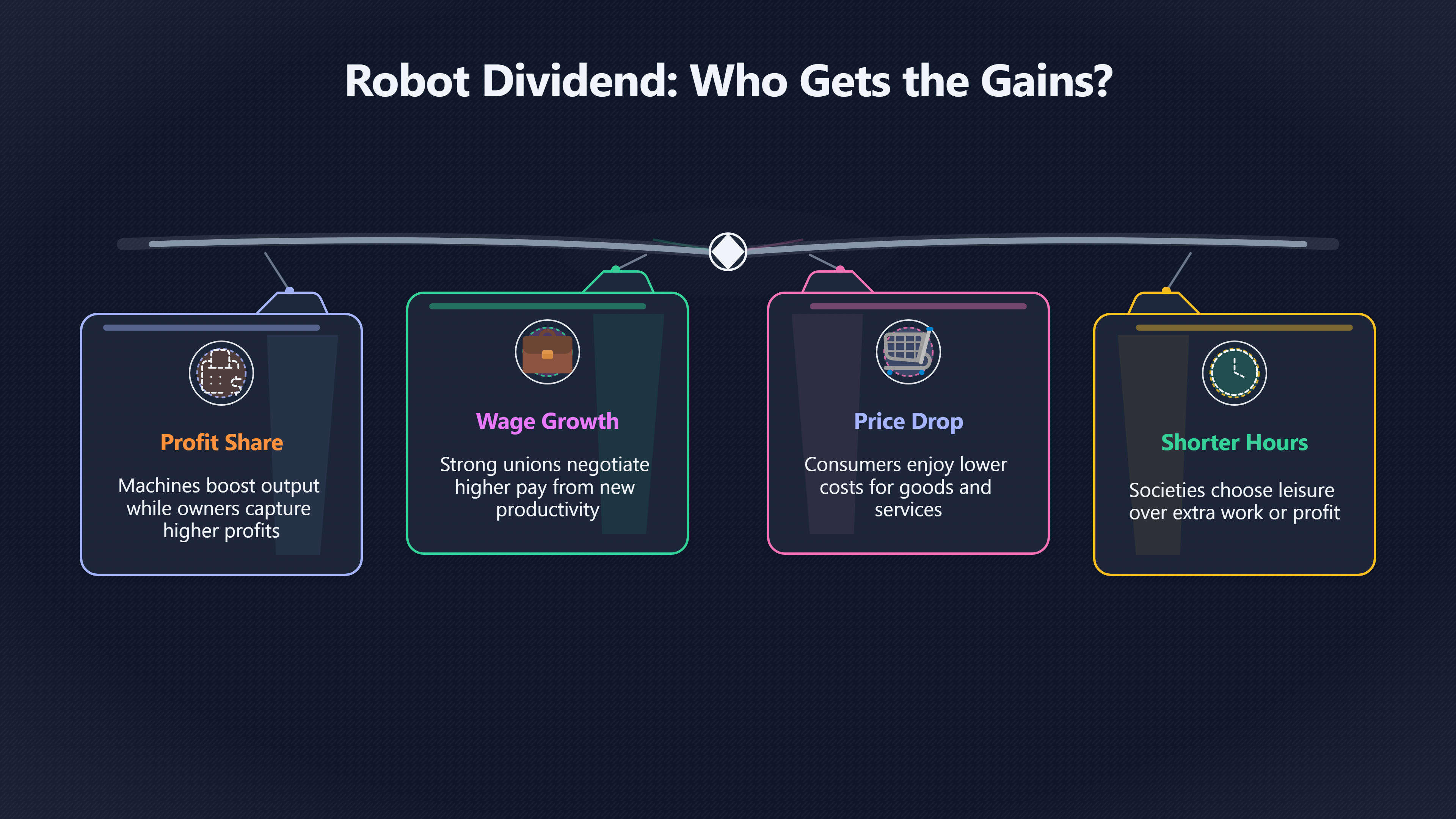
But higher productivity does not automatically raise living standards for everyone. The gains can flow in several different directions at once:
- Higher profits for shareholders and technology owners
- Lower prices for consumers
- Higher wages or better conditions for workers
- Shorter working hours
- Expanded public revenue through taxation
- Greater market concentration for dominant firms
Which outcome dominates depends heavily on bargaining power. Economists have long observed that periods with stronger unions and wider collective bargaining coverage often produced a larger labour share of national income. In highly automated sectors, that question becomes even sharper because robots are forms of capital ownership. If a small group owns the productive machines, they may capture most of the gains unless institutions redistribute bargaining power or ownership claims.
This is one reason labour politics has returned to debates once treated as purely technical. A warehouse robot is not only a machine. It is also part of a workplace system deciding pace targets, staffing levels, scheduling flexibility and who benefits from productivity improvements.
The optimistic AI bloom argument often assumes that abundant machine labour could eventually reduce scarcity itself. But abundance at the level of physical production does not guarantee abundance at the household level. A society can be technologically rich while many people remain economically insecure if access to the gains is highly unequal.
What workers actually need a voice over
Public discussion often frames automation as a simple yes-or-no choice: should a company automate or not? In practice, collective bargaining usually concerns the conditions of automation rather than outright opposition.
Modern labour agreements increasingly focus on five concrete areas.
Pay and productivity sharing
The central dispute is whether productivity gains become higher compensation, shorter hours or simply higher profits.
Historically, some automation waves supported wage growth because workers retained bargaining power during periods of rising productivity. In weaker labour markets, however, automation can increase output while wages stagnate.
[Trade unions increasingly argue that AI-driven productivity should finance:]etuc.orgtrade union perspective productivityA trade union perspective on productivity20 Nov 2025 — Evidence from coordinated bargaining systems shows that negotiated wage floors, hi…
- Wage increases
- Four-day weeks or reduced hours
- Better pensions and benefits
- Transition pay during restructuring
- Retraining funds
The UK Trades Union Congress argues that collective bargaining is one of the main mechanisms through which workers can secure a share of AI productivity gains rather than leaving them entirely to employers. [TUC]tuc.org.ukNegotiating automation and new technologyAutomation, digitisation and AI will have an impact on both 'routine' and 'high-skilled' jobs. e…
This becomes especially important if AI systems eventually produce very large productivity increases. Without institutions capable of negotiating distribution, technological abundance could coexist with weak labour income.
Surveillance and algorithmic management
Many current workplace AI disputes are less about humanoid robots than about software systems that monitor and direct workers.
Warehouse scanners, productivity dashboards, route optimisation systems and automated scheduling tools can turn work into continuous measurement. The problem is not only privacy. It is also power asymmetry. Workers may be judged by opaque metrics they cannot challenge or even fully understand.
Research for the European Parliament warned that AI monitoring systems can encourage more coercive management styles and intensify pressure on workers rather than improving skills or autonomy. [European Parliament]europarl.europa.euEuropean Parliament Improving working conditions using Artificial IntelligenceEuropean ParliamentImproving working conditions using Artificial IntelligenceJune 3, 2021 — Using AI-monitoring systems to collect perfor…
As a result, newer union agreements increasingly demand:
- Transparency about how algorithms work
- Human review of automated decisions
- Limits on biometric monitoring
- Restrictions on productivity scoring [pmc.ncbi.nlm.nih.gov]pmc.ncbi.nlm.nih.govPMCA policy primer and roadmap on AI worker surveillancepolicy primer and roadmap on AI worker surveillance… - PMCby M Hickok · 2023 · Cited by 62 — This Policy Primer and Roadmap focuses on…
- Worker access to collected data
- Negotiation before deployment of surveillance systems
Some model agreements explicitly state that AI systems should not be introduced for workforce monitoring without negotiated consent. [UNISON National]unison.org.ukUNISON National Model-new-technology-in-the-workplace-policyTechnological tools and AI will not be used for monitoring or surveillance of the workforce without express and informed agreement. Serio…
Safety and work intensity
Robots can remove dangerous labour, but they can also accelerate production speeds.
A robotic fulfilment system may reduce heavy lifting while simultaneously imposing punishing timing requirements on remaining workers. In some warehouses, automation has reduced walking distances while increasing output expectations.
This creates a central tension in the robot dividend debate. Productivity growth can either liberate workers from drudgery or compress more labour into every hour.
Collective bargaining therefore increasingly covers:
- Safe staffing levels
- Human override rights
- Pace-of-work limits
- Ergonomic standards
- Injury monitoring
- Procedures during maintenance and breakdowns
These issues matter because many robot-related injuries occur during non-routine interventions around machines rather than during ordinary operation.
Retraining and redeployment
Automation rarely removes entire occupations overnight. More often it reorganises tasks inside jobs.
The crucial question becomes whether workers are moved into better roles or discarded during restructuring. Agreements around retraining, internal mobility and redeployment can strongly affect whether automation feels like opportunity or threat.
Evidence from US retraining programmes suggests that simply offering generic retraining is often insufficient for large labour transitions, especially when workers return to similarly automation-exposed sectors. [arXiv]arxiv.orgarXiv Did US Worker Retraining Reduce Participant Automation Exposure?arXivDid US Worker Retraining Reduce Participant Automation Exposure?May 5, 2026…
Worker organisations therefore increasingly push for:
- Employer-funded retraining
- Guaranteed transition pathways
- Paid learning time
- Advance consultation before restructuring
- Internal hiring commitments
- Joint technology planning
These mechanisms try to convert automation from abrupt displacement into negotiated transition.
Germany’s works councils show a different automation model
Germany is often discussed because it combines high industrial automation with comparatively strong labour institutions.
German workplaces above certain sizes can establish works councils: elected worker bodies with legal consultation and co-determination rights over many workplace issues. Large firms also include worker representation on supervisory boards.
This system does not eliminate conflict, but it changes the structure of negotiations around technology adoption.
Several studies suggest that works councils do not necessarily slow digital adoption. Some evidence indicates they may actually support productivity-enhancing automation under conditions where workers share in the gains and retain influence over implementation. [IDEAS]ideas.repec.orgSuggested Citation.Read moreIDEAS/RePEcDo German Works Councils Counter or Foster the…by G Sabrina · 2019 — Thus, this study highlights the importance of establis… [RePEc]ideas.repec.orgSuggested Citation.Read moreIDEAS/RePEcDo German Works Councils Counter or Foster the…by G Sabrina · 2019 — Thus, this study highlights the importance of establis… [ResearchGate Research on Germany’s]researchgate.netPDF) Do German Works Councils Counter or Foster the…This paper adds the role of industrial relations to the existing literature by an…“Industry 4.0” transition found unions and works councils negotiating over:
- Skills development
- Work organisation
- Data use
- Staffing impacts
- Human-machine cooperation
- Training rights
Rather than positioning themselves simply as anti-technology, many German labour organisations attempted to shape how digitalisation occurred. [ResearchGate]researchgate.netPDF) Do German Works Councils Counter or Foster the…This paper adds the role of industrial relations to the existing literature by an…
This matters for the broader AI bloom debate because it challenges a simplistic assumption: that worker voice necessarily blocks innovation. In some cases, negotiated adoption may increase trust, improve implementation and reduce resistance to technological change.
Germany’s experience also suggests that strong labour institutions can soften some psychological harms associated with AI adoption. Research using German worker panel data argued that co-determination and employment protections may help reduce anxiety and insecurity during technological transition. [Nature]nature.comNatureArtificial intelligence and the wellbeing of workersby O Giuntella · 2025 · Cited by 26 — In this study, we examine how AI adoption…
That does not mean Germany has solved automation politics. Union coverage has declined there as well, especially in newer digital sectors. But it provides a visible example of a high-tech economy where labour institutions remain more integrated into industrial decision-making than in many Anglo-American systems.

The hard problem: automation can weaken unions themselves
There is an uncomfortable tension inside the robot dividend debate. Automation may undermine the very institutions needed to distribute its gains.
Historically, unions often gained strength in large, concentrated workplaces such as factories, docks and mines. Automation can reduce headcount, fragment workforces and shift employment into subcontracting or platform-based systems that are harder to organise.
Recent research on Italy found stronger unionised sectors experienced larger employment impacts from robot adoption, contributing to declining union density. [EurekAlert!]eurekalert.orgnews releasesEurekAlert!Robots steal jobs from unions25 Jun 2024 — Robots steal jobs from unions. Automation has had a greater impact on employment in…
This creates a feedback loop:
- Automation weakens organised labour
- Weaker labour reduces bargaining power
- Productivity gains flow upward
- Workers gain less security from future automation
That pattern is one reason many analysts argue that AI-era labour politics cannot rely only on traditional factory unionism. New forms of organisation may be needed for logistics workers, gig workers, remote contractors and highly fragmented service sectors.
It also explains growing interest in sectoral bargaining: agreements negotiated across an entire industry rather than workplace by workplace. Supporters argue this prevents firms from competing mainly by weakening labour standards during automation transitions.
Bargaining over data may become as important as bargaining over wages
Industrial-age unions mainly negotiated over hours, pay and physical safety. AI systems add a new issue: data ownership and algorithmic control.
Workers increasingly generate enormous streams of behavioural data:
- Keystrokes
- Location data
- Productivity metrics
- Customer interaction records
- Biometric information
- Training data for AI systems
This data can become economically valuable in its own right. It can also be used to train future automation systems that reduce workers’ bargaining leverage.
As a result, labour organisations increasingly treat data governance as a core workplace issue rather than a side question about privacy.
Recent collective bargaining research across Europe found growing negotiation around:
- Automated decision systems
- Explainability rights
- Human oversight
- Data protection
- AI consultation procedures
- Worker participation in technology deployment [Eurofound]eurofound.europa.eucollective bargaining on artificial intelligence at workEurofoundCollective bargaining on artificial intelligence at workby P Kerckhofs · 2025 · Cited by 2 — It was based on an analysis of 31 c…
This may become even more important if advanced AI systems eventually absorb large amounts of tacit workplace knowledge from employees themselves.
Could the robot dividend fund shorter working lives?
One of the oldest labour movement goals was not simply higher pay but less work.
From the nineteenth century onward, productivity growth often translated partly into shorter hours: weekends, paid holidays and the gradual decline of extremely long working weeks. That history matters because AI-driven automation may reopen the same question at a much larger scale.
If robots and AI systems drastically increase output per worker, societies could theoretically choose:
- More consumption
- More leisure
- Earlier retirement
- Longer education
- More caregiving time
- More creative or civic activity
Collective bargaining is one mechanism that could push automation gains toward time rather than only profit.
Some unions already frame AI productivity as a reason for:
- Four-day workweeks
- Reduced overtime
- Flexible scheduling
- Shared productivity bonuses
This possibility connects directly to the wider AI bloom vision. The deepest promise of automation is not merely producing more goods. It is reducing the degree to which human lives must revolve around exhausting labour in order to survive.
But history also warns that productivity growth alone does not guarantee liberation from work. In weak bargaining environments, workers may instead face:
- More precarious employment [eurekalert.org]eurekalert.orgnews releasesEurekAlert!Robots steal jobs from unions25 Jun 2024 — Robots steal jobs from unions. Automation has had a greater impact on employment in…
- Unpaid digital labour
- Constant availability
- Increased performance pressure
- Greater inequality
The same technologies can support radically different social outcomes.
Public rules matter alongside workplace bargaining
Collective bargaining alone cannot fully determine how automation gains are distributed. Many workers lack union representation, and highly concentrated technology markets can overwhelm individual workplace negotiations.
Public policy therefore shapes the environment in which bargaining occurs.
Important policy levers include:
- Labour law protecting organising rights
- Mandatory consultation before large automation changes
- Portable benefits systems
- Public retraining investment
- Competition policy against excessive concentration
- Tax policy affecting capital and labour
- Worker representation on corporate boards
- Data protection regulation
The UK, EU and several other jurisdictions are increasingly debating AI workplace regulation, especially around surveillance and automated management.
The broader political question is whether democratic societies can maintain meaningful worker voice during periods of rapid technological acceleration. If advanced AI sharply increases the economic importance of capital ownership relative to labour, distributional conflicts may intensify unless institutions evolve alongside the technology.
The robot dividend is ultimately a power question
The hopeful version of AI-enabled abundance imagines a civilisation where fewer people spend their lives doing repetitive, dangerous or degrading work. Robots could help build homes, maintain infrastructure, care for ageing populations and perform physically punishing labour at enormous scale. That could enlarge human freedom in ways ordinary economic growth never fully achieved.
But the route from automation to flourishing is not automatic.
Collective bargaining matters because it changes who participates in decisions about technology. It asks whether workers merely absorb automation decisions made elsewhere, or whether they help govern how intelligent machines reshape economic life.
The evidence so far suggests that strong worker voice does not necessarily stop innovation. In some settings it may produce more sustainable and broadly accepted forms of automation. The central challenge is whether institutions built for the industrial age can adapt quickly enough for an AI-intensive economy where data, algorithms and robotics increasingly organise production itself.
The “robot dividend” is therefore not only about machines becoming more capable. It is about whether societies can build arrangements that convert rising machine capability into wider human capability: more security, more autonomy, more time, and eventually more room for people to flourish beyond drudgery.
Endnotes
-
Source: ideas.repec.org
Title: Suggested Citation.Read more
Link: https://ideas.repec.org/a/jns/jbstat/v239y2019i3p523-564n3.htmlSource snippet
IDEAS/RePEcDo German Works Councils Counter or Foster the...by G Sabrina · 2019 — Thus, this study highlights the importance of establis...
-
Source: sebastian-findeisen.com
Title: Sebastian Findeisen Organized Labor Versus Robots?
Link: https://sebastian-findeisen.com/papers/OrganizedLaborRobots.pdfSource snippet
Evidence from Micro Data5 Jan 2025 — Thus, conditional on robot adoption, plants with works councils should have higher productivity gain...
-
Source: tuc.org.uk
Title: building pro worker ai innovation strategy
Link: https://www.tuc.org.uk/research-analysis/reports/building-pro-worker-ai-innovation-strategySource snippet
TUCBuilding a pro-worker AI innovation strategy | TUC27 Aug 2025 — If workers - individually and collectively - are to gain a share in pr...
-
Source: tuc.org.uk
Link: https://www.tuc.org.uk/node/528698Source snippet
Negotiating automation and new technologyAutomation, digitisation and AI will have an impact on both 'routine' and 'high-skilled' jobs. e...
-
Source: arxiv.org
Title: arXiv Did US Worker Retraining Reduce Participant Automation Exposure?
Link: https://arxiv.org/abs/2605.03767Source snippet
arXivDid US Worker Retraining Reduce Participant Automation Exposure?May 5, 2026...
Published: May 5, 2026
-
Source: researchgate.net
Link: https://www.researchgate.net/publication/333752306_Do_German_Works_Councils_Counter_or_Foster_the_Implementation_of_Digital_TechnologiesSource snippet
(PDF) Do German Works Councils Counter or Foster the...This paper adds the role of industrial relations to the existing literature by an...
-
Source: researchgate.net
Link: https://www.researchgate.net/publication/342103203Digitalisation_unions_and_participation_the_German_case_of%27industry_40%27Source snippet
ResearchGateDigitalisation, unions and participation: the German case of...The article analyses one of the main strategies German unions...
-
Source: researchgate.net
Link: [https://www.researchgate.net/publication/380197199We_are_no_Luddites-CSCW_Co-Determination_and_Digital_Transformation_in_Germany](https://www.researchgate.net/publication/380197199_We_are_no_Luddites-_CSCW_Co-Determination_and_Digital_Transformation_in_Germany)Source snippet
ResearchGate(PDF) "We are no Luddites!" - CSCW, Co-Determination...This paper presents an ethnographic study of works councils in Small...
-
Source: nature.com
Link: https://www.nature.com/articles/s41598-025-98241-3Source snippet
NatureArtificial intelligence and the wellbeing of workersby O Giuntella · 2025 · Cited by 26 — In this study, we examine how AI adoption...
-
Source: eurekalert.org
Title: news releases
Link: https://www.eurekalert.org/news-releases/1049363Source snippet
EurekAlert!Robots steal jobs from unions25 Jun 2024 — Robots steal jobs from unions. Automation has had a greater impact on employment in...
-
Source: committees.parliament.uk
Link: https://committees.parliament.uk/writtenevidence/92844/pdf/Source snippet
parliament.ukAFW0010 - Evidence on Automation and the future of workThere needs to be an extension of collective bargaining in the workpl...
-
Source: committees.parliament.uk
Link: https://committees.parliament.uk/writtenevidence/92871/pdf/Source snippet
There is clear evidence that consultation, employee engagement and decent...
-
Source: germany.travel
Link: https://www.germany.travel/en/home.htmlSource snippet
It offers a wide variety of attractions. Whether you are looking for history, culture, nature or just a good time...
-
Source: europarl.europa.eu
Title: European Parliament Improving working conditions using Artificial Intelligence
Link: https://www.europarl.europa.eu/RegData/etudes/STUD/2021/662911/IPOL_STU%282021%29662911_EN.pdfSource snippet
European ParliamentImproving working conditions using Artificial IntelligenceJune 3, 2021 — Using AI-monitoring systems to collect perfor...
Published: June 3, 2021
-
Source: unison.org.uk
Title: UNISON National Model-new-technology-in-the-workplace-policy
Link: https://www.unison.org.uk/content/uploads/2025/09/Model-new-technology-in-the-workplace-policy.docxSource snippet
Technological tools and AI will not be used for monitoring or surveillance of the workforce without express and informed agreement. Serio...
-
Source: eurofound.europa.eu
Title: collective bargaining on artificial intelligence at work
Link: https://www.eurofound.europa.eu/en/publications/all/collective-bargaining-on-artificial-intelligence-at-workSource snippet
EurofoundCollective bargaining on artificial intelligence at workby P Kerckhofs · 2025 · Cited by 2 — It was based on an analysis of 31 c...
-
Source: Wikipedia
Link: https://en.wikipedia.org/wiki/GermanySource snippet
GermanyGermany, officially the Federal Republic of Germany, is a country in Western and Central Europe. It lies between the Baltic Sea...
-
Source: britannica.com
Link: https://www.britannica.com/place/GermanySource snippet
Germany | Facts, Geography, Maps, & HistoryGermany is a country of north-central Europe. Although Germany existed as a loose polity of Ge...
-
Source: theguardian.com
Link: https://www.theguardian.com/world/germanySource snippet
May 2026 · Paediatrician in Germany charged with 130 counts of sexual abuse · Milka maker milked shoppers over size of chocolate bars, Ge...
Published: May 2026
-
Source: GOV.UK
Link: https://www.gov.uk/foreign-travel-advice/germanySource snippet
travel advice10 Apr 2026 — FCDO travel advice for Germany. Includes safety and security, insurance, entry requirements and legal differences...
-
Source: kids.nationalgeographic.com
Link: https://kids.nationalgeographic.com/geography/countries/article/germanySource snippet
Country ProfileGermany is a country of incredible variety. Germany's location at the heart of Europe has shaped its history both for good...
Additional References
-
Source: gbfinancemag.com
Link: https://gbfinancemag.com/artificial-intelligence-and-workers-wellbeing-lessons-from-germanys-early-experience/Source snippet
Global Business and Finance MagazineArtificial intelligence and workers' wellbeing: Lessons from...Works councils, co-determination, and...
-
Source: european-union.europa.eu
Link: https://european-union.europa.eu/principles-countries-history/eu-countries/germany_enSource snippet
– EU country | European UnionGermany is a federal parliamentary republic with a chancellor who is the head of government, and a president...
-
Source: pmc.ncbi.nlm.nih.gov
Title: PMCA policy primer and roadmap on AI worker surveillance
Link: https://pmc.ncbi.nlm.nih.gov/articles/PMC10026198/Source snippet
policy primer and roadmap on AI worker surveillance... - PMCby M Hickok · 2023 · Cited by 62 — This Policy Primer and Roadmap focuses on...
-
Source: americanprogress.org
Title: unions give workers a voice over how ai affects their jobs
Link: https://www.americanprogress.org/article/unions-give-workers-a-voice-over-how-ai-affects-their-jobs/Source snippet
16 May 2024 — Collective bargaining is a powerful tool workers can use to ensure artificial intelligence and algorithmic technology impro...
Published: May 2024
-
Source: ilr.cornell.edu
Title: how can unions negotiate ai workplace lessons port sector
Link: https://www.ilr.cornell.edu/carow/post/how-can-unions-negotiate-ai-workplace-lessons-port-sectorSource snippet
Can Unions Negotiate AI in the Workplace? Lessons...21 Jan 2026 — The Dockers' AI Toolkit by José Luis Gallegos provides guidance on how...
-
Source: equitablegrowth.org
Title: Equitable Growth How union contracts are protecting U.S
Link: https://equitablegrowth.org/research-paper/how-union-contracts-are-protecting-u-s-workers-from-automated-management-and-surveillance-in-the-workplace/Source snippet
workers from...12 Mar 2026 — A majority of union members report lacking provisions that cover automated management and surveillance tool...
-
Source: unitetheunion.org
Title: Unite the Union Artificial Intelligence (AI)
Link: https://www.unitetheunion.org/media/3wepvt3h/artificial-intelligence-a-guide-and-model-agreement-for-officers-and-representatives.pdfSource snippet
Artificial Intelligence (AI): - a guide and model agreement...This agreement sets out the joint values and principles held between Unite...
-
Source: facebook.com
Link: https://www.facebook.com/seiu925/posts/employers-are-using-ai-to-empower-some-workers-while-subjecting-others-to-more-i/1583108077148277/Source snippet
rency. Lawmakers and employers have completely failed to match...
-
Source: tatsachen-ueber-deutschland.de
Link: https://www.tatsachen-ueber-deutschland.de/enSource snippet
It is a cosmopolitan, democratic country with a rich heritage and a thriving present-day...Read more...
-
Source: etuc.org
Title: trade union perspective productivity
Link: https://www.etuc.org/en/document/trade-union-perspective-productivitySource snippet
A trade union perspective on productivity20 Nov 2025 — Evidence from coordinated bargaining systems shows that negotiated wage floors, hi...
Amazon book picks
Further Reading
Books and field guides related to Sharing the Robot Dividend. Use these as the next step if you want deeper reading beyond the article.

The Shift: The Future of Work is Already Here
An unhysterical look at the future of employment.

An introduction to collective bargaining and industrial relat...
First published 1991. Subjects: Collective bargaining, Industrial relations, Négociations collectives, Relations industrielles, Arbeitsbe...
Future of Work Technology and Basic Income
First published 2019. Subjects: Economics, Information society, Economic aspects, Work, Technological innovations.

Shaping the Future of Work
First published 2015. Subjects: Business ethics, Labor, Organizational behavior, Personnel management, Labor policy.
eBay marketplace picks
Marketplace Samples
Example marketplace items related to this page. Use the search link to explore similar finds on eBay.

Example eBay listing
A.I. Artificial Intelligence Original Movie Poster Signed By Jude Law
USD 125.00 | Shipping USD 25.00 | US

Example eBay listing
Artificial Intelligence D/S Original Movie Poster - 27 x 40"
USD 19.50 | Shipping USD 13.65 | US

Example eBay listing
612388 Artificial Intelligence Movie Science Fiction Drama Wall Print Poster
USD 22.95 | Shipping USD 12.95 | JP

Example eBay listing
Companion - Artificial Intelligence Dark Comedy Cinema Film - POSTER 20"x30"
USD 23.99 | Free shipping | US
Topic Tree