Within AI Profits
AI owner gains
If AI makes output soar while labour’s share falls, the biggest winners may be people who own the systems rather than people who work beside them.
On this page
- Why labour’s share could fall
- What explosive growth with weak wages would mean
- How ownership design changes who benefits
Page outline Jump by section
Introduction
AI could create an extraordinary surge in productivity without creating an equally extraordinary surge in wages. That is the central fear behind debates over AI ownership. If advanced AI systems can perform more of the economically valuable work in society, then the people who own the models, chips, cloud platforms, data centres, robotics fleets, and intellectual property may capture a growing share of the gains.
 This matters far beyond ordinary inequality debates. The optimistic “AI bloom” vision imagines a future of abundant intelligence, accelerated science, radical medical progress, and potentially post-scarcity living conditions. But abundance alone does not determine who has power, security, or access. A world where AI owners collect most of the economic upside could still be technologically dazzling while politically unstable and socially unequal.
The key question is therefore not whether AI can raise output. Many economists already expect large productivity gains. The harder question is whether the gains mainly arrive as wages for workers, or as profits and asset appreciation for owners of AI capital. The answer could shape whether AI-driven abundance becomes broadly shared prosperity or a new era of concentrated economic power.
Why labour’s share could fall
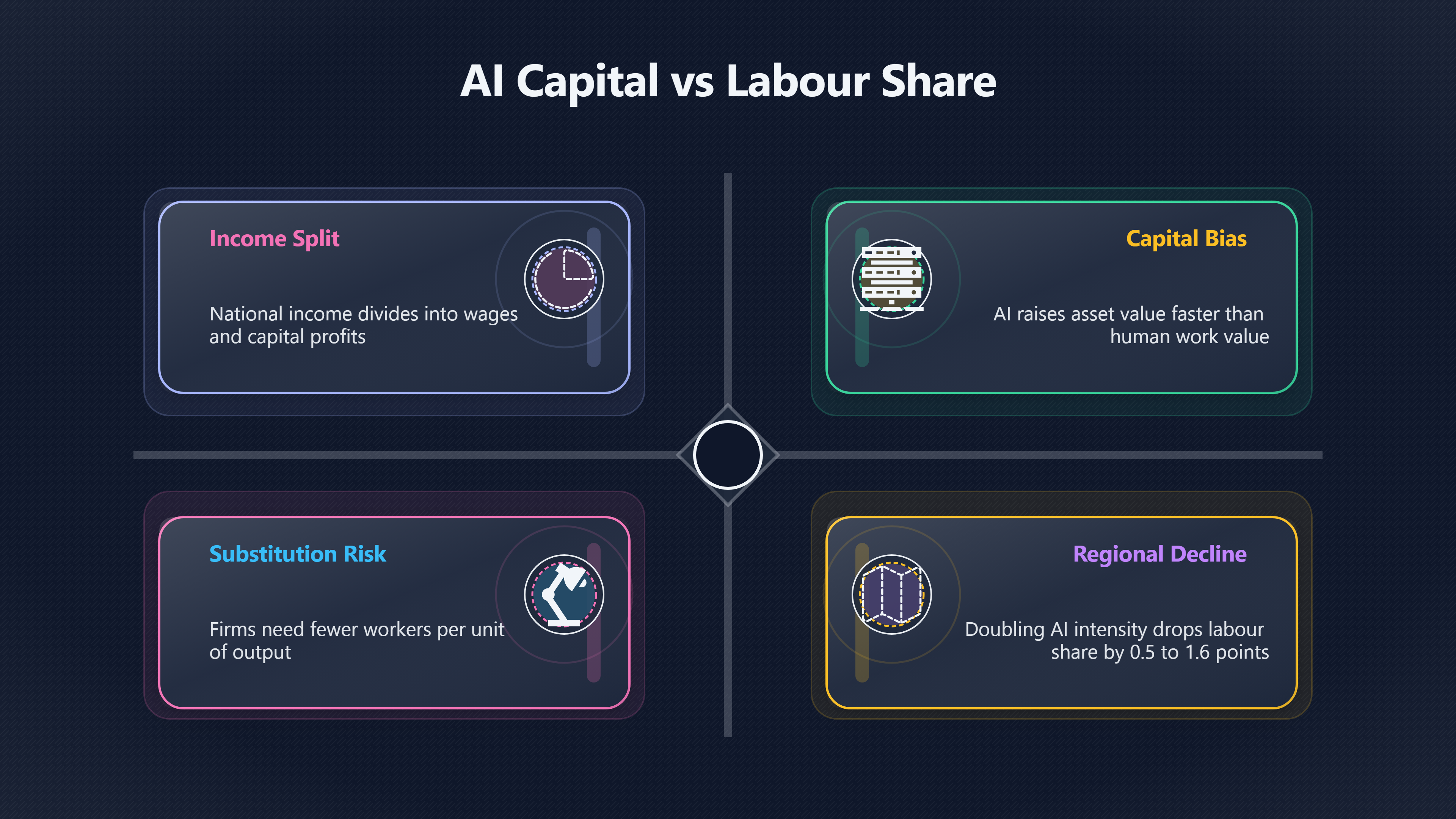
Economists divide national income into two broad categories: labour income and capital income. Labour income includes wages and salaries. Capital income includes profits, dividends, rents, intellectual property returns, and gains from ownership of productive assets.
The concern around advanced AI is that it may behave as a strongly “capital-biased” technology: one that raises the value of owned systems faster than the value of human work. Research by Anton Korinek and Joseph Stiglitz has argued that AI and other worker-replacing technologies could significantly increase inequality if the benefits flow mainly to owners of capital rather than labour. NBER [Columbia Business School]business.columbia.eduImplications for Income. Distribution and Unemployment. Anton Korinek and Joseph E. Stiglitz. Anton Korinek is associate…Read more…
This is different from many earlier technological revolutions. Industrial machinery still required large human workforces. Even computers largely complemented office workers for decades. By contrast, frontier AI aims directly at cognitive labour itself: writing, coding, analysis, customer support, design, legal drafting, diagnosis, research assistance, and eventually many forms of management and coordination.
If AI systems can perform these tasks cheaply and at scale, firms may need fewer workers per unit of output. That does not necessarily mean total unemployment, but it can weaken labour’s bargaining position. Workers become easier to substitute.
Recent empirical evidence points in this direction. A 2025 study examining European regions found that increased AI innovation was associated with a measurable decline in labour’s share of income. The paper estimated that doubling regional AI intensity reduced labour share by roughly 0.5 to 1.6 percentage points. [ScienceDirect]sciencedirect.comScienceDirectAI innovation and the labor share in European regionsby A Minniti · 2025 · Cited by 26 — This paper examines how the develop…
Researchers studying “transformative AI” scenarios go further still. Philip Trammell and Anton Korinek model cases where AI systems become highly substitutable for human labour, producing extremely rapid growth while labour’s share falls sharply. [Global Priorities Institute]globalprioritiesinstitute.orgPhilip Trammell and Anton Korinek economic growth under transformative aiA guide to the vast range of possibilities for output growth, wages, and the labor share. Philip Trammell and Anton Korinek.Read more… [CEPR]cepr.orgai and distribution income between capital and labourmore…
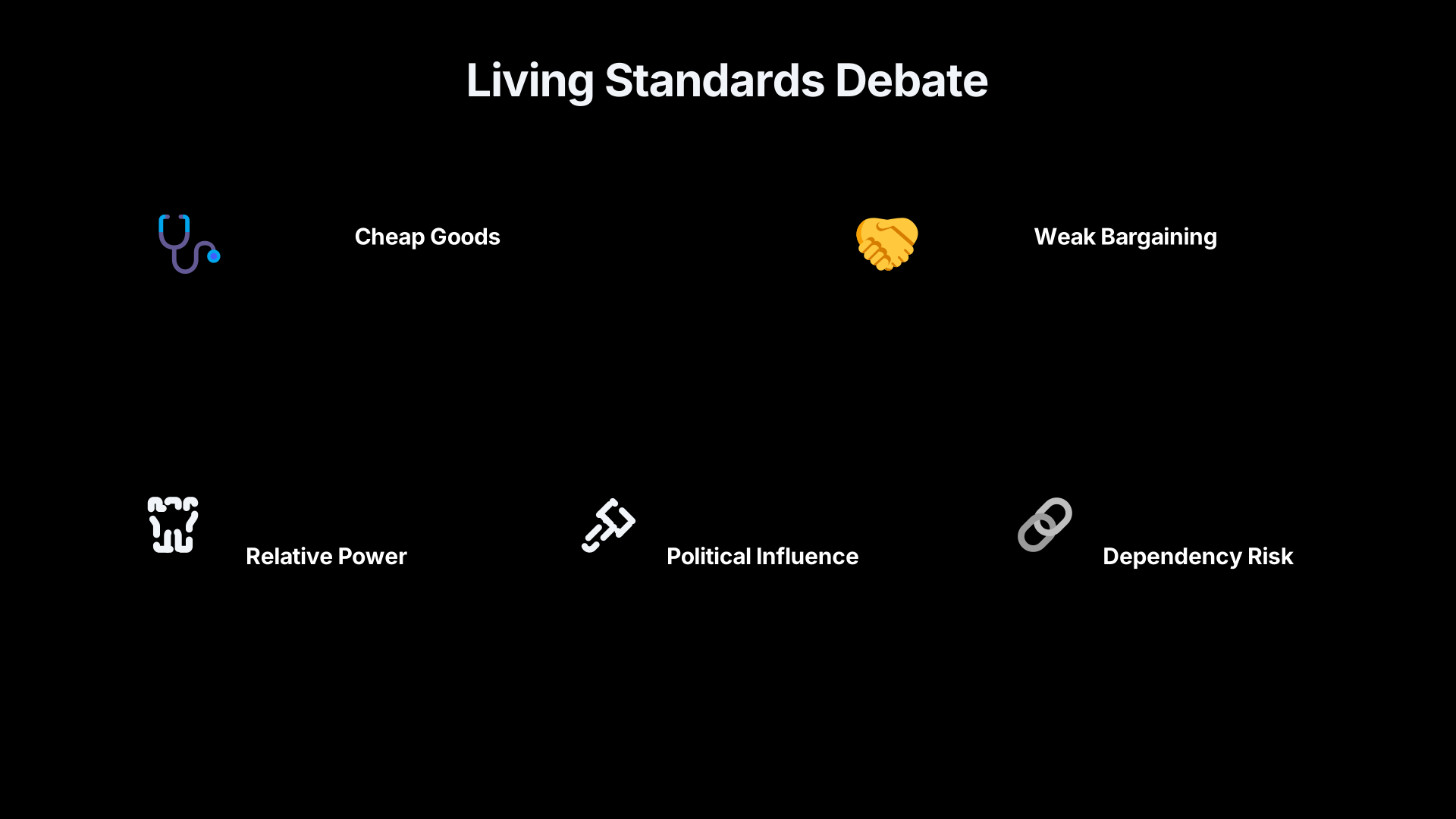
The important distinction is between absolute living standards and relative economic power. Wages could stagnate relative to profits even if material conditions improve in absolute terms. A worker might enjoy cheaper goods, better medicine, and AI-enhanced services while still owning almost none of the systems generating the new wealth.
The AI boom already looks ownership-heavy
One reason this debate has intensified is that the current AI buildout already resembles a capital-intensive infrastructure boom more than a labour-intensive employment boom.
The modern AI stack is extraordinarily expensive. Training frontier models requires vast computing clusters, specialised semiconductors, electricity infrastructure, cooling systems, networking equipment, and enormous data centres. Ownership of these assets is highly concentrated.
The companies at the centre of the current boom are mostly hyperscalers and infrastructure firms: major cloud providers, semiconductor manufacturers, private equity funds, and energy-backed data centre operators. The value is accruing heavily to shareholders and asset owners.
Recent investment patterns illustrate the scale. Reuters reported in 2026 that Google and Blackstone launched a major AI cloud venture involving billions in equity investment and potentially $25 billion in total financing. [Reuters]reuters.comBlackstone will initially contribute $5 billion in equity to develop 500 megawatts of data center capacity by 2027, with potential for fu… S&P Global data showed worldwide data-centre dealmaking reaching record highs as investors raced to secure AI infrastructure assets. [Reuters]reuters.comAI boom drives data-center dealmaking to record high, says reportBy November, over 100 deals—including mergers, acquisitions, asset sales, and equity investments—amounted to nearly $61 billion, surpassi…
This matters because ownership of these assets is not broadly distributed. Most people do not own meaningful stakes in frontier AI firms, semiconductor fabs, private infrastructure vehicles, or large compute clusters. Pension funds and index funds provide some indirect exposure, but concentrated founders, executives, venture investors, and institutional capital holders often capture disproportionate gains.
The physical structure of AI also reinforces scale advantages:
- Frontier models become more effective with larger compute budgets.
- Data-centre construction requires huge upfront capital.
- Access to power grids and advanced chips is constrained.
- Large firms can spread infrastructure costs across millions of users.
- Proprietary datasets and ecosystems create lock-in effects.
The result is an economy where returns may increasingly flow to ownership of scarce computational infrastructure rather than to broad pools of labour.
Explosive growth does not automatically mean broad prosperity
One of the strangest possibilities raised by transformative AI models is that society could become vastly richer while many workers feel economically weaker.
Historically, strong productivity growth often translated into rising wages because workers remained essential to production. But if AI systems can increasingly replace both routine and high-skill cognitive work, the link between productivity and wages may weaken.
This is the scenario some economists describe as “explosive growth with weak labour share”. Output rises rapidly, but ownership matters more than employment.
Trammell and Korinek argue that if capital can effectively “self-replicate” through automated production and automated research, growth rates could become dramatically faster than historical norms while labour income becomes a smaller slice of total output. [CEPR]cepr.orgWe then consider models in which AI increases knowledge production, capturing the…Read more… [NBER]nber.orgNBERArtificial Intelligence and Its Implications for Income…by A Korinek · 2018 · Cited by 865 — Inequality is one of the main challen…
This creates several unusual economic possibilities.
Cheap abundance alongside weak bargaining power
Workers might gain access to cheaper goods and services even while losing leverage in labour markets. AI could reduce costs in healthcare, education, logistics, energy optimisation, software creation, and manufacturing.
In principle, this could still improve quality of life substantially. If AI dramatically lowers the cost of essentials, lower wage growth may hurt less than in today’s economy.
But political and social tensions may still intensify if ownership remains concentrated. Relative power matters. People compare themselves not only to past generations, but to elites accumulating enormous wealth and influence.
Economic growth without mass employment growth
There are already hints of this pattern in parts of the AI economy. The current AI investment wave has produced huge capital expenditures in data centres and chips while employment growth has been comparatively modest.
The World Economic Forum noted that AI-related GDP growth and data-centre investment are occurring alongside weaker employment growth signals, suggesting productivity improvements with less corresponding labour demand. [World Economic Forum]weforum.orgdata centres and ai new growth engineWorld Economic ForumHow data centres and AI are becoming a new engine of…17 Dec 2025 — AI-driven investment in data centres is boostin…
If this trend deepens, societies may face a world where economic output keeps climbing but stable, high-paying employment becomes less central to wealth distribution.
The rise of “compute landlords”
In earlier eras, landlords controlled agricultural land and industrialists controlled factories. In an AI-heavy economy, strategic control over compute infrastructure may become similarly important.
The owners of:
- GPU clusters,
- advanced semiconductor supply chains,
- cloud platforms,
- energy-intensive data centres, [nucleuswealth.com]nucleuswealth.comThe Economics of Data CentresSeptember 29, 2025 — 29 Sept 2025 — The AI boom is fueling a historic data centre surge. Discover the key economics, costs, and investmen…
- robotics networks,
- proprietary models,
- and key intellectual property
could occupy unusually powerful economic positions.
Some analysts already describe AI infrastructure as a new form of strategic utility layer. [nucleuswealth.com]nucleuswealth.comThe Economics of Data CentresSeptember 29, 2025 — 29 Sept 2025 — The AI boom is fueling a historic data centre surge. Discover the key economics, costs, and investmen… [2urbanomics.substack.com]urbanomics.substack.comobservations on the data centre investmenton the data centre investment boomBetween now and 2029, however, global spending on data centres will hit almost $3tn, according to Morga… If access to intelligence increasingly depends on access to compute, ownership of that compute may become one of the defining economic advantages of the century.

The counterargument: falling labour share does not guarantee falling living standards
The pessimistic version of the ownership story is not inevitable. Several economists caution that lower labour share does not automatically imply collapsing wages or widespread immiseration.
David Autor and B. N. Kausik recently argued that automation can sometimes reduce labour’s share while still increasing real wages. In their model, productivity gains can be large enough that workers benefit materially even as capital captures a larger proportion of total output. [MIT Economics]economics.mit.eduEconomics Resolving the Automation ParadoxMIT EconomicsResolving the Automation Paradox - Falling Labor Share…by D Autor · 2026 · Cited by 1 — A central socioeconomic concern…
This distinction is crucial.
Suppose AI makes goods and services extraordinarily cheap:
- AI tutors provide near-free personalised education.
- Automated science accelerates drug discovery.
- Robotics reduce housing construction costs.
- Energy systems become vastly more efficient.
- Medical diagnostics become inexpensive and universal.
Even workers with stagnant relative incomes could enjoy dramatically improved living standards.
This is one reason some techno-optimists argue that focusing only on income shares misses the larger civilisational picture. If AI creates genuine abundance, access to goods and capabilities may matter more than relative wages alone.
But critics respond that ownership still shapes:
- political influence,
- control over institutions,
- access to frontier enhancements,
- security during transitions,
- and the ability to shape the future itself.
A world where a small set of actors controls most advanced AI infrastructure could still produce dependency, instability, or forms of oligarchic power even if material scarcity declines.
How ownership design changes who benefits
The ownership question is not fixed by technology alone. Institutions, policy choices, and governance structures could significantly affect who captures AI gains.
Broad ownership through markets and pensions
One relatively optimistic argument is that large parts of the population already indirectly own capital through pension funds, retirement accounts, sovereign wealth funds, and index investing.
If AI-driven profits mainly boost broad equity markets, ordinary savers could benefit more than critics assume.
But ownership remains highly unequal even within market democracies. Wealthier households own far larger shares of equities and private assets. Private AI infrastructure investments are often even more concentrated than public stock ownership.
Public or social ownership models
Some proposals aim to distribute AI capital returns more broadly:
- sovereign AI wealth funds,
- public compute utilities,
- citizen dividends,
- universal basic income funded by AI profits,
- or public ownership stakes in frontier infrastructure.
The logic resembles earlier debates over oil, land, or natural resources. If AI becomes foundational infrastructure for civilisation-scale productivity, some argue its gains should partly flow to the public.
Labour-complementing AI rather than labour-replacing AI
Korinek and Stiglitz have argued that societies can help steer innovation toward technologies that enhance workers rather than replace them outright. [BMJ]bmj.comBMJCovid-19 driven advances in automation and artificial…by A Korinek · 2021 · Cited by 65 — Anton Korinek and Joseph E Stiglitz make…
This may sound abstract, but design choices matter:
- AI can assist doctors or replace parts of diagnosis workflows.
- Coding systems can augment programmers or reduce programmer headcount.
- Robotics can improve worker productivity or minimise labour requirements altogether.
Economic outcomes depend partly on which path firms and governments incentivise.
Open models versus closed infrastructure
Open-source AI models and widely available tools may diffuse benefits more broadly than tightly controlled proprietary systems.
However, frontier AI increasingly depends on massive compute resources that remain expensive even when model weights are publicly released. This creates a tension between software openness and infrastructure concentration.
In practice, a handful of firms may still dominate access to the most powerful systems because they control the computational substrate beneath them.
Why this debate matters for the long-term future
The AI bloom vision is ultimately about more than quarterly profits or near-term labour markets. It concerns whether advanced AI could help humanity unlock a vastly larger future: longer healthier lives, scientific acceleration, abundant clean energy, expanded creativity, and perhaps even civilisation beyond Earth.
But the ownership question sits near the centre of that future.
If AI productivity gains are broadly distributed, AI could help create a world where more people gain access to education, healthcare, cognitive enhancement, creative tools, and material security. That would strengthen the case for AI-driven human flourishing.
If the gains remain tightly concentrated, the same technologies could instead amplify existing inequalities and create new forms of dependence on a small set of states and corporations.
The deeper issue is not simply whether AI creates wealth. It is whether humanity develops institutions capable of turning machine-generated abundance into widely shared flourishing rather than narrow control.
That question may become more important as AI systems become more capable. The more economically powerful AI becomes, the more consequential ownership structures become alongside the technology itself.
Endnotes
-
Source: nber.org
Link: https://www.nber.org/system/files/working_papers/w24174/w24174.pdfSource snippet
NBERArtificial Intelligence and Its Implications for Income...by A Korinek · 2018 · Cited by 865 — Inequality is one of the main challen...
-
Source: business.columbia.edu
Link: https://business.columbia.edu/sites/default/files-efs/imce-uploads/Joseph_Stiglitz/The%20Economics%20of%20Artificial%20Intelligence%20-%20Chapter%2014_0.pdfSource snippet
Implications for Income. Distribution and Unemployment. Anton Korinek and Joseph E. Stiglitz. Anton Korinek is associate...Read more...
-
Source: sciencedirect.com
Link: https://www.sciencedirect.com/science/article/pii/S0014292125000935Source snippet
ScienceDirectAI innovation and the labor share in European regionsby A Minniti · 2025 · Cited by 26 — This paper examines how the develop...
-
Source: cepr.org
Title: ai and distribution income between capital and labour
Link: https://cepr.org/voxeu/columns/ai-and-distribution-income-between-capital-and-labourSource snippet
more...
-
Source: cepr.org
Link: https://cepr.org/publications/dp18780Source snippet
We then consider models in which AI increases knowledge production, capturing the...Read more...
-
Source: reuters.com
Link: https://www.reuters.com/business/google-blackstone-create-new-ai-cloud-company-wsj-reports-2026-05-19/Source snippet
Blackstone will initially contribute $5 billion in equity to develop 500 megawatts of data center capacity by 2027, with potential for fu...
-
Source: reuters.com
Title: AI boom drives data-center dealmaking to record high, says report
Link: https://www.reuters.com/business/ai-boom-drives-data-center-dealmaking-record-high-says-report-2025-12-19/Source snippet
By November, over 100 deals—including mergers, acquisitions, asset sales, and equity investments—amounted to nearly $61 billion, surpassi...
-
Source: nber.org
Link: https://www.nber.org/system/files/working_papers/w31815/w31815.pdfSource snippet
NBERECONOMIC GROWTH UNDER TRANSFORMATIVE AI...by P Trammell · 2023 · Cited by 159 — This suggests that a regime of rapid growth and a pl...
-
Source: nucleuswealth.com
Title: The Economics of Data Centres
Link: https://nucleuswealth.com/blog/the-economics-of-data-centresSource snippet
September 29, 2025 — 29 Sept 2025 — The AI boom is fueling a historic data centre surge. Discover the key economics, costs, and investmen...
Published: September 29, 2025
-
Source: urbanomics.substack.com
Title: observations on the data centre investment
Link: https://urbanomics.substack.com/p/observations-on-the-data-centre-investmentSource snippet
on the data centre investment boomBetween now and 2029, however, global spending on data centres will hit almost $3tn, according to Morga...
-
Source: economics.mit.edu
Title: Economics Resolving the Automation Paradox
Link: https://economics.mit.edu/sites/default/files/2026-03/Resolving%20the%20Automation%20Paradox%20-%20Falling%20Labor%20Share%2C%20Rising%20Wages.pdfSource snippet
MIT EconomicsResolving the Automation Paradox - Falling Labor Share...by D Autor · 2026 · Cited by 1 — A central socioeconomic concern...
-
Source: bmj.com
Link: https://www.bmj.com/content/372/bmj.n367Source snippet
BMJCovid-19 driven advances in automation and artificial...by A Korinek · 2021 · Cited by 65 — Anton Korinek and Joseph E Stiglitz make...
-
Source: governance.ai
Title: joseph stiglitz anton korinek on ai and inequality
Link: https://www.governance.ai/post/joseph-stiglitz-anton-korinek-on-ai-and-inequalitySource snippet
Joseph Stiglitz & Anton Korinek on AI and Inequality12 May 2021 — Over the next decades, AI will dramatically change the economic landsca...
Published: May 2021
-
Source: governance.ai
Link: https://www.governance.ai/research-paper/economic-growth-under-transformative-ai-a-guide-to-the-vast-range-of-possibilities-for-output-growth-wages-and-the-laborshareSource snippet
al transformations in economics: the potential impacts on output growth, on wage...Read more...
-
Source: nber.org
Link: https://www.nber.org/system/files/working_papers/w31815/revisions/w31815.rev2.pdfSource snippet
likely prevail at some point in the future, whether or not economic data suggest...Read more...
-
Source: korinek.com
Title: Homepage of Anton Korinek
Link: https://www.korinek.com/researchSource snippet
Research2024. If transformative AI makes human labor redundant, what are the economic and social implications, and how can we prepare for...
-
Source: globalprioritiesinstitute.org
Title: Philip Trammell and Anton Korinek economic growth under transformative ai
Link: https://www.globalprioritiesinstitute.org/wp-content/uploads/Philip-Trammell-and-Anton-Korinek_economic-growth-under-transformative-ai.pdfSource snippet
A guide to the vast range of possibilities for output growth, wages, and the labor share. Philip Trammell and Anton Korinek.Read more...
-
Source: weforum.org
Title: data centres and ai new growth engine
Link: https://www.weforum.org/stories/2025/12/data-centres-and-ai-new-growth-engine/Source snippet
World Economic ForumHow data centres and AI are becoming a new engine of...17 Dec 2025 — AI-driven investment in data centres is boostin...
Additional References
-
Source: digitaleconomy.stanford.edu
Link: https://digitaleconomy.stanford.edu/publication/economic-growth-under-transformative-ai/Source snippet
Stanford Digital Economy LabEconomic Growth Under Transformative AIWages— multiplying exploding output and a plummeting labor share—may r...
-
Source: linkedin.com
Link: https://www.linkedin.com/posts/geoffyang_something-im-pondering-we-are-becoming-activity-7382046069548969984-cCwxSource snippet
Something I'm pondering. | Geoff YangThe AI “boom” is grounded in real infrastructure and tangible investment (data centers, chip fabs) r...
-
Source: facebook.com
Link: https://www.facebook.com/imf/posts/ai-is-now-a-major-engine-of-global-growth-driving-investment-in-data-centers-sof/1361248382712614/Source snippet
view-ai-can-lift-global-growth-marcello-estevaoArtificial intelligence increasingly drives economic growth, but power grids are straining...
-
Source: youtube.com
Link: https://www.youtube.com/watch?v=dx8R-1cFRYUSource snippet
The Booming Business of Artificial Intelligence Data CentersCorv has raised billions winning lucrative contracts with companies desperate...
-
Source: youtube.com
Link: https://www.youtube.com/watch?v=Z8K-Np6HCWESource snippet
The Economics of Transformative AI by Anton KorinekThere is the productivity and growth impact of hi transformative AI that's the good th...
-
Source: laweconcenter.org
Title: ai productivity and labor markets a review of the empirical evidence
Link: https://laweconcenter.org/resources/ai-productivity-and-labor-markets-a-review-of-the-empirical-evidence/Source snippet
AI, Productivity, and Labor Markets: A Review of the...5 Feb 2026 — Erik Brynjolfsson, Bharat Chandar, and Ruyu Chen (2025), using ADP p...
-
Source: brookings.edu
Title: turning the data center boom into long term local prosperity
Link: https://www.brookings.edu/articles/turning-the-data-center-boom-into-long-term-local-prosperity/Source snippet
Turning the data center boom into long-term, local prosperity5 Feb 2026 — With AI centers spreading across the country and with more bein...
-
Source: GOV.UK
Title: artificial intelligence sector study 2024
Link: https://www.gov.uk/government/publications/artificial-intelligence-sector-study-2024/artificial-intelligence-sector-study-2024Source snippet
Intelligence sector study 20243 Sept 2025 — Dedicated AI company revenues rose by 9% between 2023 and 2024, from £4.4 billion to £4.9 bil...
-
Source: ideas.repec.org
Link: https://ideas.repec.org/a/eee/eecrev/v177y2025ics0014292125000935.htmlSource snippet
innovation and the labor share in European regionsby A Minniti · 2025 · Cited by 30 — This paper examines how the development of Artifici...
-
Source: theguardian.com
Title: data centers ai investment
Link: https://www.theguardian.com/technology/2025/dec/19/data-centers-ai-investmentSource snippet
This growth continues from 2024's $60.8 billion in investment and reflects what analysts describe as a continued "construction frenzy" wo...
Amazon book picks
Further Reading
Books and field guides related to AI owner gains. Use these as the next step if you want deeper reading beyond the article.

Prediction Machines, Updated and Expanded
Named one of "The five best books to understand AI" by The Economist The impact AI will have is profound, but the economic framework for...

Artificial Intelligence in Economics and Finance Theories
As Artificial Intelligence (AI) seizes all aspects of human life, there is a fundamental shift in the way in which humans are thinking of...
Technological Unemployment, Basic Income, and Well-being
The main novelty of the Fourth Industrial Revolution is the entry of robots and Artificial Intelligence into the production process. This...

The Economics of Artificial Intelligence
A timely investigation of the potential economic effects, both realized and unrealized, of artificial intelligence within the United Stat...
eBay marketplace picks
Marketplace Samples
Example marketplace items related to this page. Use the search link to explore similar finds on eBay.

Example eBay listing
A.I. Artificial Intelligence Original Movie Poster Signed By Jude Law
USD 125.00 | Shipping USD 25.00 | US

Example eBay listing
Artificial Intelligence D/S Original Movie Poster - 27 x 40"
USD 19.50 | Shipping USD 13.65 | US

Example eBay listing
612388 Artificial Intelligence Movie Science Fiction Drama Wall Print Poster
USD 22.95 | Shipping USD 12.95 | JP

Example eBay listing
Companion - Artificial Intelligence Dark Comedy Cinema Film - POSTER 20"x30"
USD 23.99 | Free shipping | US

Example eBay listing
A.I. Artificial Intelligence Movie Film Poster Art Print
GBP 4.99 | Free shipping | GB

Example eBay listing
A I Artificial Intelligence 6 Movie Poster Art Print Print Classic Rare Gallery
GBP 49.00 | Free shipping | GB

Example eBay listing
AI - Artificial Intelligence (Poster + Slipcase) Blu-Ray
GBP 10.49 | Free shipping | GB

Example eBay listing
A. I. Artificial Intelligence. Jude Law. Original UK Video Poster.
GBP 8.11 | Shipping GBP 3.38 | GB
Topic Tree