Within Coordination
Trusted AI warnings
AI can improve forecasts, but warnings only save lives when institutions and communities know how to act on them.
On this page
- Why prediction is only the first step
- How warnings become action through trust and preparation
- What floods and extreme weather reveal about coordination gaps
Page outline Jump by section
Introduction
AI is making weather and disaster forecasting faster, cheaper, and often more accurate. Flood models can now combine satellite imagery, rainfall data, river sensors, and machine learning to predict dangerous conditions days earlier than older systems could manage. That matters for the wider hope that AI could help civilisation coordinate better: shared foresight is one of the foundations of collective action.
 But prediction alone does not save lives. A forecast only becomes useful when people trust it, understand it, and have realistic ways to respond. An AI system may correctly predict catastrophic flooding, yet residents may ignore the warning because previous alerts proved false, local authorities may fail to communicate clearly, or evacuation routes may not exist. The coordination problem is therefore not just technical. It is social, institutional, and political.
This matters well beyond weather. The same lesson applies to pandemics, infrastructure stress, cyber risks, food shocks, and even advanced AI itself. Better forecasting can help civilisation see danger earlier, but warnings only work when societies know how to turn knowledge into action.
Why prediction is only the first step
The optimistic case for AI forecasting is real. Research groups and meteorological agencies are using machine learning to improve flood prediction, rainfall modelling, and extreme-weather detection. Google Research, for example, says its AI flood forecasting systems now provide warnings across more than 80 countries. [Google Research]sites.research.googleGoogle ResearchFlood ForecastingAs part of our efforts to advance AI to address the climate crisis and help communities affected, Google…
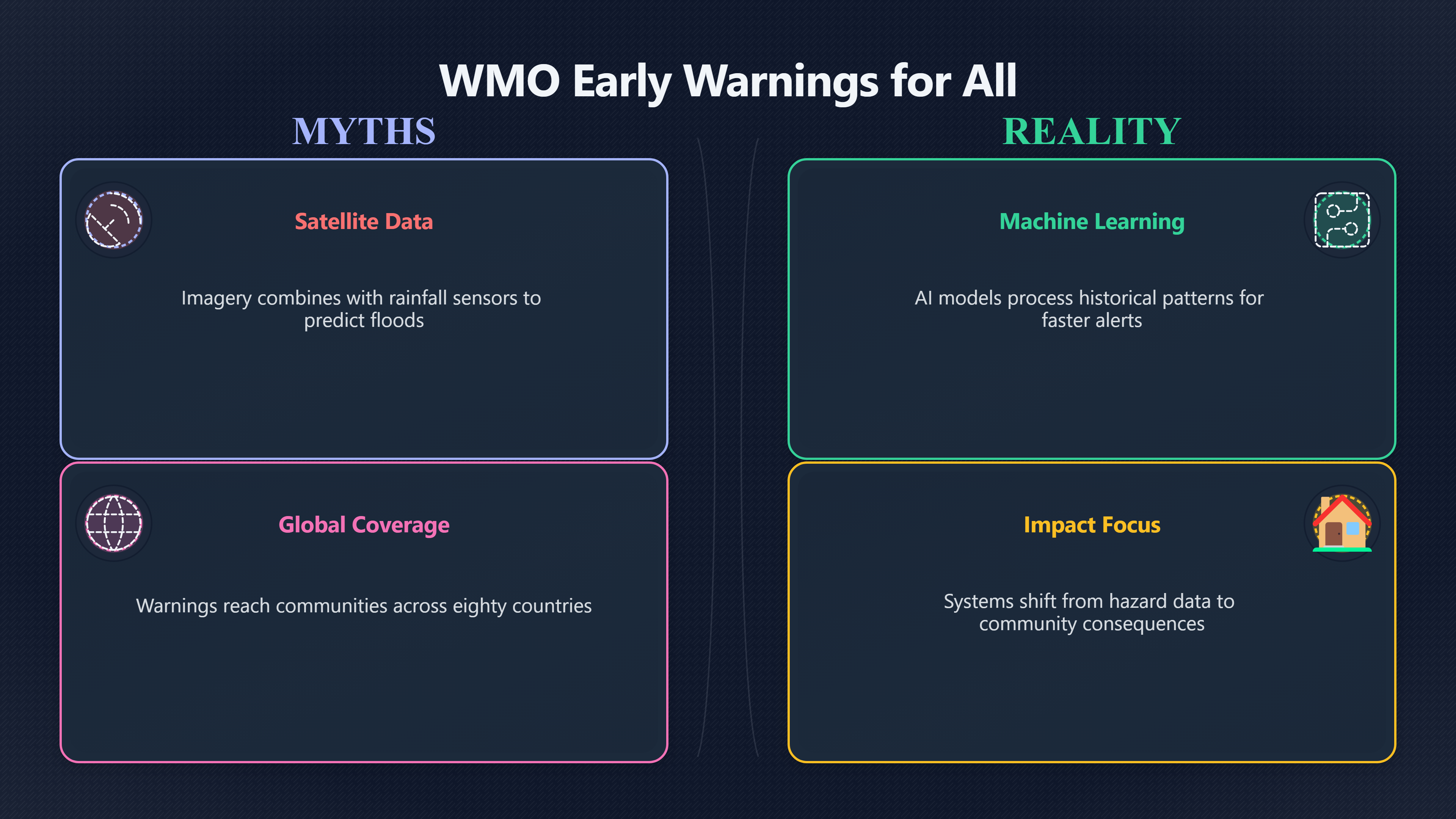
The World Meteorological Organization (WMO) has also promoted AI-assisted forecasting as part of its “Early Warnings for All” initiative, which aims to expand global access to life-saving warning systems. [World Meteorological Organization]instagram.comWMO on Instagram…It provides weather and climate data, standards and guidance to help countries with weather forecasting, disaster ris… [World Meteorological Organization]instagram.comWMO on Instagram…It provides weather and climate data, standards and guidance to help countries with weather forecasting, disaster ris…
Yet modern disaster research repeatedly reaches the same conclusion: the forecast itself is only one link in a much larger chain.
The WMO describes effective warning systems as moving “from hazard to impact”. The question is not merely what the weather will be, but what the weather will do to roads, homes, hospitals, farms, and communities. [World Meteorological Organization]instagram.comWMO on Instagram…It provides weather and climate data, standards and guidance to help countries with weather forecasting, disaster ris… Research published in the journal Weather, Climate, and Society similarly warns that repeated false alarms can erode public trust and reduce compliance with future evacuation orders. [American Meteorological Society Journals]journals.ametsoc.orgAmerican Meteorological Society JournalsCausal Effects of Perceived False Alarm Ratio on Flood…by H Matsuda · 2025 — Frequent false al…
This creates a difficult trade-off:
- If authorities warn too aggressively, people may stop believing future alerts.
- If they warn too cautiously, communities may not have enough time to act.
- If warnings are technically correct but socially confusing, panic and paralysis can coexist.
AI does not remove this dilemma. In some ways it sharpens it. Machine learning systems can generate more frequent and more granular forecasts, but that can also increase the number of uncertain alerts that governments and citizens must interpret.
A highly accurate prediction model does not automatically answer questions such as:
- Should schools close?
- Which neighbourhoods should evacuate first?
- Who pays for relocation?
- Which warnings deserve interruption of normal life?
- What level of uncertainty justifies emergency action?
Those are coordination problems rather than forecasting problems.
How warnings become action through trust and preparation
The crucial mechanism is not prediction alone, but trusted translation from prediction into behaviour.
Disaster researchers increasingly describe early-warning systems as requiring four connected components:
- Risk knowledge [2. Forecasting and monitoring]wmo.intearly warnings all focus hazard monitoring and forecastingWorld Meteorological OrganizationEarly Warnings for All in Focus: Hazard Monitoring and…Oct 20, 2025 — Through the WMO Integrated Proc… [3. Communication and dissemination]sciencedirect.comScienceDirectInvest in communication and response to weather early…by EC de Perez · 2022 · Cited by 49 — We argue that the largest gap…
- Response capability
Studies on global early-warning systems argue that the largest current gaps are often in communication and response rather than forecasting accuracy itself. [ScienceDirect]sciencedirect.comScienceDirectInvest in communication and response to weather early…by EC de Perez · 2022 · Cited by 49 — We argue that the largest gap…
That distinction matters because communities respond to warnings through social trust, not raw data.
Trust is built before disasters happen
People rarely evaluate warnings as detached statisticians. They judge them through memory, experience, institutions, and social networks.
If earlier alerts appeared exaggerated, future warnings may be ignored. Experimental research on seasonal forecasts found that both false alarms and missed alarms can reduce public responsiveness over time. [OUP Academic]academic.oup.comOUP AcademicFalse and missed alarms in seasonal forecasts affect…by K Hembach-Stunden · 2024 · Cited by 7 — Using an online experiment…
This means highly capable AI systems still depend on ordinary institutional competence:
- trusted local broadcasters
- reliable emergency agencies
- clear public messaging
- functioning transport
- rehearsed evacuation plans
- neighbourhood-level preparation
Without these, prediction gains may produce surprisingly small real-world benefits.
The contrast between forecast skill and response capacity is especially visible in poorer regions. AI may allow countries with limited meteorological infrastructure to gain access to sophisticated forecasting tools, potentially narrowing global inequality in hazard detection. [arXiv]arxiv.orgarXiv AI Increases Global Access to Reliable Flood ForecastsarXiv AI Increases Global Access to Reliable Flood Forecasts But if communities lack mobile alerts, shelters, roads, insurance, or confidence in authorities, the practical value of those forecasts remains constrained.
Warnings fail when they ask for impossible actions
A warning is only meaningful if people can realistically comply.
Telling residents to evacuate matters less if:
- they lack transport,
- cannot afford hotel costs,
- fear losing wages,
- distrust police,
- care for vulnerable relatives,
- or have nowhere safe to go.
This is why disaster planning increasingly emphasises “impact-based warnings”. The aim is not merely to predict rainfall totals or river height, but to explain concrete consequences and practical responses. [World Meteorological Organization]instagram.comWMO on Instagram…It provides weather and climate data, standards and guidance to help countries with weather forecasting, disaster ris…
AI may improve this process by translating technical forecasts into neighbourhood-specific risk estimates. But the institutional layer remains decisive. Forecasting systems can suggest where floods are likely to hit hardest; they cannot independently create social legitimacy or emergency capacity.

What floods and extreme weather reveal about coordination gaps
Floods are a revealing case because they compress the entire coordination problem into hours.
A severe flood often requires:
- rapid interpretation of uncertain data,
- communication across agencies,
- public trust,
- transport coordination,
- hospital readiness,
- utility management,
- and individual behavioural change.
Even small delays can become fatal.
Accurate forecasts can still end in catastrophe
One of the clearest recent examples came during the deadly Texas floods of 2025. Meteorologists and former National Weather Service officials argued that the forecasts themselves were broadly accurate and timely. Flood watches and warnings had already been issued before the disaster escalated. Yet dozens of people still died. [Politico]politico.comTexas flood forecasts were accurateIt wasn't enough to save lives.July 7, 2025 — Despite accurate and timely warnings issued by the National Weather Service (NWS), the cata…
The breakdown occurred across the wider response chain:
- local warning systems were limited,
- communication infrastructure was inconsistent,
- some alerts arrived during sleeping hours,
- and local preparedness measures proved insufficient. [Politico]politico.comTexas flood forecasts were accurateIt wasn't enough to save lives.July 7, 2025 — Despite accurate and timely warnings issued by the National Weather Service (NWS), the cata…
This is an important lesson for the wider AI bloom debate. Intelligence is not identical to coordination. A society may possess excellent predictive systems while still struggling to mobilise collective action quickly enough.
AI systems also inherit data and governance weaknesses
Forecast quality depends heavily on observational infrastructure: satellites, weather stations, river gauges, ocean buoys, and long historical records.
Experts have warned that AI forecasting systems remain vulnerable when these underlying data systems weaken. Recent criticism of weather-data cuts in the United States highlighted fears that advanced AI models could become less reliable if the observational foundation deteriorates. [The Guardian]theguardian.comweather forecasts, particularly during a time of increasing extreme weather. Despite a slight funding boost to the National Weather Servi…
Researchers have also found that some AI weather systems struggle with unprecedented extremes because they learn patterns from historical data. In a climate-changed world, truly novel events may not resemble the past closely enough. [The Guardian]theguardian.comweather forecasts, particularly during a time of increasing extreme weather. Despite a slight funding boost to the National Weather Servi…
This exposes another coordination challenge: maintaining long-term public investment in scientific infrastructure that may seem invisible during normal periods but becomes essential during crises.
Forecasting abundance does not guarantee resilience
The broader AI bloom vision often imagines intelligence becoming dramatically cheaper and more abundant. Forecasting may eventually become near-instantaneous and globally available.
But floods reveal why abundance alone is not enough.
Civilisation benefits when:
- forecasts are credible,
- institutions cooperate,
- citizens trust alerts,
- infrastructure supports evacuation,
- and political systems sustain preparation even between disasters.
Without those layers, advanced forecasting can produce a strange imbalance: societies become better at seeing danger without becoming equally good at responding to it.
Why this matters beyond weather
The warning problem extends far beyond storms and floods.
Many future coordination challenges may look structurally similar:
- AI systems may forecast disease outbreaks before hospitals are ready.
- Models may detect financial instability before regulators can agree on interventions.
- Cyber-defence systems may identify attacks before institutions coordinate responses.
- Advanced AI evaluations may identify dangerous capabilities before governments decide how to regulate them.
In each case, the bottleneck is not merely information scarcity. It is trusted collective action under uncertainty.
This is one reason the AI bloom conversation increasingly includes governance, legitimacy, and institutional resilience rather than focusing only on raw capability growth. A civilisation with abundant predictive intelligence but collapsing public trust may become more anxious and reactive rather than wiser.
The hopeful interpretation is still substantial. AI could help societies build shared situational awareness at a scale previously impossible. Better forecasts may reduce disaster deaths, improve food planning, strengthen infrastructure resilience, and allow earlier responses to emerging crises. Global early-warning initiatives already show measurable progress in expanding coverage and preparedness. [UNDRR]undrr.orgglobal status mhews 2025UNDRRGlobal Status of Multi-Hazard Early Warning Systems 2025In its third year since the global call for Early Warnings for All (EW4All)… [World Meteorological Organization]instagram.comWMO on Instagram…It provides weather and climate data, standards and guidance to help countries with weather forecasting, disaster ris…
But the deeper lesson is that civilisation-scale coordination depends on more than seeing the future clearly. It depends on whether people believe the warnings, whether institutions deserve that trust, and whether societies can act together before crises become irreversible.
Endnotes
-
Source: arxiv.org
Title: arXiv AI Increases Global Access to Reliable Flood Forecasts
Link: https://arxiv.org/abs/2307.16104 -
Source: wmo.int
Link: https://wmo.int/activities/early-warnings-all/wmo-and-early-warnings-all-initiativeSource snippet
World Meteorological OrganizationWMO and the Early Warnings for All InitiativeThe Early Warnings for All initiative aims to ensure univer...
-
Source: wmo.int
Link: https://wmo.int/activities/early-warnings-allSource snippet
World Meteorological OrganizationEarly Warnings for AllEarly Warnings for All is a groundbreaking initiative to ensure that everyone on E...
-
Source: wmo.int
Link: https://wmo.int/impact-based-forecast-and-warning-servicesSource snippet
World Meteorological OrganizationIMPACT-BASED FORECAST AND WARNING SERVICESTimely, accurate, actionable information on the likelihood and...
-
Source: sciencedirect.com
Link: https://www.sciencedirect.com/science/article/pii/S2212096322000687Source snippet
ScienceDirectInvest in communication and response to weather early...by EC de Perez · 2022 · Cited by 49 — We argue that the largest gap...
-
Source: academic.oup.com
Link: https://academic.oup.com/qopen/article/4/1/qoad031/7459342Source snippet
OUP AcademicFalse and missed alarms in seasonal forecasts affect...by K Hembach-Stunden · 2024 · Cited by 7 — Using an online experiment...
-
Source: wmo.int
Title: early warnings all focus hazard [monitoring]({{ ‘ai-bloom-abun/ai-bloom-abun-98d3a6-ai-coordinati-e1e5d8-ai-peace-medi-f1e1df-ai-ceasefire-cf9e0a/’ | relative_url }}) and forecasting
Link: https://wmo.int/resources/publication-series/global-status-of-multi-hazard-early-warning-systems/early-warnings-all-focus-hazard-monitoring-and-forecastingSource snippet
World Meteorological OrganizationEarly Warnings for All in Focus: Hazard Monitoring and...Oct 20, 2025 — Through the WMO Integrated Proc...
-
Source: politico.com
Title: Texas flood forecasts were accurate
Link: https://www.politico.com/news/2025/07/07/texas-flood-forecasts-accuracy-lives-lost-00441068Source snippet
It wasn't enough to save lives.July 7, 2025 — Despite accurate and timely warnings issued by the National Weather Service (NWS), the cata...
Published: July 7, 2025
-
Source: sciencedirect.com
Title: ScienceDirect When are AI models ready for deployment?
Link: https://www.sciencedirect.com/science/article/pii/S2589915526000027 -
Source: undrr.org
Title: global status mhews 2025
Link: https://www.undrr.org/reports/global-status-mhews-2025Source snippet
UNDRRGlobal Status of Multi-Hazard Early Warning Systems 2025In its third year since the global call for Early Warnings for All (EW4All)...
-
Source: wmo.int
Title: launches community of practice flood forecasting
Link: https://wmo.int/media/update/wmo-launches-community-of-practice-flood-forecastingSource snippet
WMO launches Community of Practice on Flood ForecastingOct 20, 2025 — The Flood Forecasting and Warning Community of Practice is a collab...
-
Source: wmo.int
Link: https://wmo.int/resources/videos/foundation-of-every-early-warning-science-and-researchSource snippet
The Foundation of Every Early Warning: Science and ResearchDiscover how WMO research activities help predict tropical storms, floods, and...
-
Source: wmo.int
Title: lets safeguard humanity through science based early warning systems
Link: https://wmo.int/news/media-centre/lets-safeguard-humanity-through-science-based-early-warning-systemsSource snippet
Let's safeguard humanity through science-based early...21 Oct 2025 — Early Warnings for All aims to cover the entire value chain and sys...
-
Source: wmo.int
Link: https://wmo.int/site/science-action/weather-forecasts-and-early-warningsSource snippet
Weather forecasts and early warningsSince the establishment of WMO there have been huge strides in the accuracy and effectiveness of weat...
-
Source: wmo.int
Link: https://wmo.int/content/early-warnings-all -
Source: wmo.int
Link: https://wmo.int/news/media-centre/early-warning-systems-reach-new-heights-critical-gaps-jeopardize-global-progressSource snippet
Early warning systems reach new heights, but critical gaps...Nov 12, 2025 — The Early Warnings for All initiative was launched by the UN...
-
Source: sites.research.google
Link: https://sites.research.google/gr/floodforecasting/Source snippet
Google ResearchFlood ForecastingAs part of our efforts to advance AI to address the climate crisis and help communities affected, Google...
-
Source: journals.ametsoc.org
Link: https://journals.ametsoc.org/view/journals/wcas/17/4/WCAS-D-24-0106.1.xmlSource snippet
American Meteorological Society JournalsCausal Effects of Perceived False Alarm Ratio on Flood...by H Matsuda · 2025 — Frequent false al...
-
Source: journals.ametsoc.org
Link: https://journals.ametsoc.org/view/journals/bams/106/12/BAMS-D-24-0267.1.xmlSource snippet
American Meteorological Society JournalsNowcasting and Early Warning Systems across WMO Regions...by P Salio · 2025 · Cited by 1 — The i...
-
Source: theguardian.com
Link: https://www.theguardian.com/us-news/2026/may/18/trump-cuts-ai-weather-prediction-forecastsSource snippet
weather forecasts, particularly during a time of increasing extreme weather. Despite a slight funding boost to the National Weather Servi...
-
Source: earlywarningsforall.org
Link: https://earlywarningsforall.org/site/early-warnings-all/dashboards/early-warnings-all-dashboardSource snippet
World Meteorological OrganizationEarly Warnings for All DashboardThe Early Warnings for All Initiative dashboard aims at tracking progres...
-
Source: instagram.com
Title: World Meteorological Organization
Link: https://www.instagram.com/reel/DTCxJmeCHbS/?hl=enSource snippet
WMO on Instagram...It provides weather and climate data, standards and guidance to help countries with weather forecasting, disaster ris...
Additional References
-
Source: linkedin.com
Link: https://www.linkedin.com/posts/stephane-hallegatte_four-conditions-for-ai-in-weather-forecasts-activity-7406807107863433219-enTNSource snippet
AI transforms weather forecasting with accurate predictions...The integration of AI in weather forecasting not only saves lives but also...
-
Source: icef.go.jp
Link: https://www.icef.go.jp/wp-content/themes/icef_new/pdf/roadmap/2024/14_ICEF2.0%20Extreme%20Weather%20Response_stand%20alone.pdfSource snippet
EXTREME WEATHER RESPONSEThis chapter explores how artificial intelligence (AI) can enhance adaptation in the essential area of forecastin...
-
Source: earlywarningsforall.org
Link: https://earlywarningsforall.org/site/early-warnings-allSource snippet
Early Warnings for AllThe Early Warnings for All (EW4All) initiative aims to ensure universal protection from hazardous hydrometeorologic...
-
Source: reuters.com
Link: https://www.reuters.com/sustainability/cop/global-warming-is-pushing-planet-brink-says-un-secretary-general-2025-10-22/Source snippet
Speaking at a World Meteorological Organization (WMO) conference in Geneva, he highlighted that each of the last ten years has been the h...
-
Source: proclim.scnat.ch
Link: https://proclim.scnat.ch/en/uuid/i/4e56aa34-5b75-59a8-bbde-7d2a12065fbc-Early_Warnings_for_All_in_Focus_Hazard_Monitoring_and_ForecastingSource snippet
Warnings for All in Focus: Hazard Monitoring and...Through the WMO Integrated Processing and Prediction System (WIPPS), Members now acce...
-
Source: un.org
Link: https://www.un.org/en/climatechange/early-warnings-for-allSource snippet
United NationsEarly Warnings for AllEarly Warnings for All is a groundbreaking initiative to ensure that everyone on Earth is protected f...
-
Source: assets.publishing.service.gov.uk
Link: https://assets.publishing.service.gov.uk/media/602d4dd5d3bf7f721a23a9a5/Probabilistic_Flood_Forecasting_Scoping_Study_technical_report.pdfSource snippet
Flood Forecasting Scoping StudyThis technical report presents a review of international developments in probabilistic flood forecasting...
-
Source: ioppublishing.org
Title: ai shows promise for flood forecasting and water security in data scarce regions
Link: https://ioppublishing.org/news/ai-shows-promise-for-flood-forecasting-and-water-security-in-data-scarce-regions/Source snippet
AI shows promise for flood forecasting and water security in...20 Mar 2026 — New research reveals that 'foundation models' trained on va...
-
Source: preventionweb.net
Title: wmo guidelines multi hazard impact based forecast and warning services
Link: https://www.preventionweb.net/publication/wmo-guidelines-multi-hazard-impact-based-forecast-and-warning-servicesSource snippet
WMO guidelines on multi-hazard impact-based forecast...Apr 9, 2024 — This guide covers how to shift from weather forecasts and warnings...
-
Source: zcralliance.org
Link: https://zcralliance.org/resources/item/flood-forecasting-and-early-warning/Source snippet
Zurich Climate Resilience AllianceFlood Forecasting and Early WarningThis tool provides a concise overview of concepts and approaches in...
Amazon book picks
Further Reading
Books and field guides related to Trusted AI warnings. Use these as the next step if you want deeper reading beyond the article.

Artificial intelligence
First published 1994. Subjects: problem solving, constraint satisfaction, knowledge, reasoning, planning.

Effective Risk Communication
First published 2012. Subjects: Communication, Risk management, Risk communication, Communication du risque, PSYCHOLOGY.
Risk Communication
First published 2008. Subjects: Risk management, Communication of technical information.
Warnings and risk communication
First published 1999. Subjects: Risk communication, Warnings, Industrial safety, Risk, Sociological aspects.
eBay marketplace picks
Marketplace Samples
Example marketplace items related to this page. Use the search link to explore similar finds on eBay.

Example eBay listing
A.I. Artificial Intelligence Original Movie Poster Signed By Jude Law
USD 125.00 | Shipping USD 25.00 | US

Example eBay listing
Artificial Intelligence D/S Original Movie Poster - 27 x 40"
USD 19.50 | Shipping USD 13.65 | US

Example eBay listing
612388 Artificial Intelligence Movie Science Fiction Drama Wall Print Poster
USD 22.95 | Shipping USD 12.95 | JP

Example eBay listing
Companion - Artificial Intelligence Dark Comedy Cinema Film - POSTER 20"x30"
USD 23.99 | Free shipping | US

Example eBay listing
A.I. Artificial Intelligence Movie Film Poster Art Print
GBP 4.99 | Free shipping | GB

Example eBay listing
A I Artificial Intelligence 6 Movie Poster Art Print Print Classic Rare Gallery
GBP 49.00 | Free shipping | GB

Example eBay listing
AI - Artificial Intelligence (Poster + Slipcase) Blu-Ray
GBP 10.49 | Free shipping | GB

Example eBay listing
A. I. Artificial Intelligence. Jude Law. Original UK Video Poster.
GBP 8.11 | Shipping GBP 3.38 | GB
Topic Tree