Within AI Literacy
Classroom AI Rules
Clear classroom norms can separate useful AI assistance from substitution, while making student reasoning visible.
On this page
- Assistance versus assessed work
- Assignments that make reasoning visible
- Why some learning spaces should stay AI free
Page outline Jump by section
Introduction
Schools are discovering that the hardest question about classroom AI is not whether students should use chatbots at all. It is how to stop AI from replacing the mental effort that learning depends on.
A complete ban is increasingly unrealistic. Students already use tools such as ChatGPT, Claude and Gemini for revision, coding help, summarising readings and drafting essays. But unrestricted use creates another problem: students can produce polished work while skipping the difficult reasoning that builds understanding in the first place. Research on “cognitive offloading” increasingly suggests that heavy dependence on AI can reduce deep engagement, memory formation and independent problem-solving if students are not required to think actively themselves. [ScienceDirect]sciencedirect.comhave lasting negative effects on what students remember.Read moreScienceDirectChatGPT as a cognitive crutch: Evidence from…by A Barcaui · 2025 · Cited by 28 — This follows from cognitive offloading a… [ScienceDirect]sciencedirect.comLearners' AI dependence and critical thinkingby J Tian · 2025 · Cited by 49 — Scholars have cautioned that excessive AI use may promote c…
That is why many schools and universities are moving away from both extremes — total prohibition and unlimited permissiveness — toward clearer classroom rules. The goal is not to pretend AI does not exist. It is to design learning environments where AI can assist thinking without replacing it.
This matters well beyond homework policy. If advanced AI eventually becomes a powerful cognitive partner for billions of people, humanity will need citizens who can question, verify, interpret and reason with machine-generated knowledge rather than passively accept it. Classroom rules are becoming early experiments in how to preserve human judgement in an AI-rich world.
Why schools now need explicit AI rules
For decades, most classroom technologies still required students to do the central intellectual work themselves. Calculators accelerated arithmetic but did not write essays. Search engines helped students find sources but still required interpretation.
Generative AI changes that balance because it can imitate finished intellectual products: essays, explanations, code, lab reports, revision notes and arguments. The danger is not simply cheating in the traditional sense. It is that students may begin outsourcing the very cognitive processes education is supposed to develop.
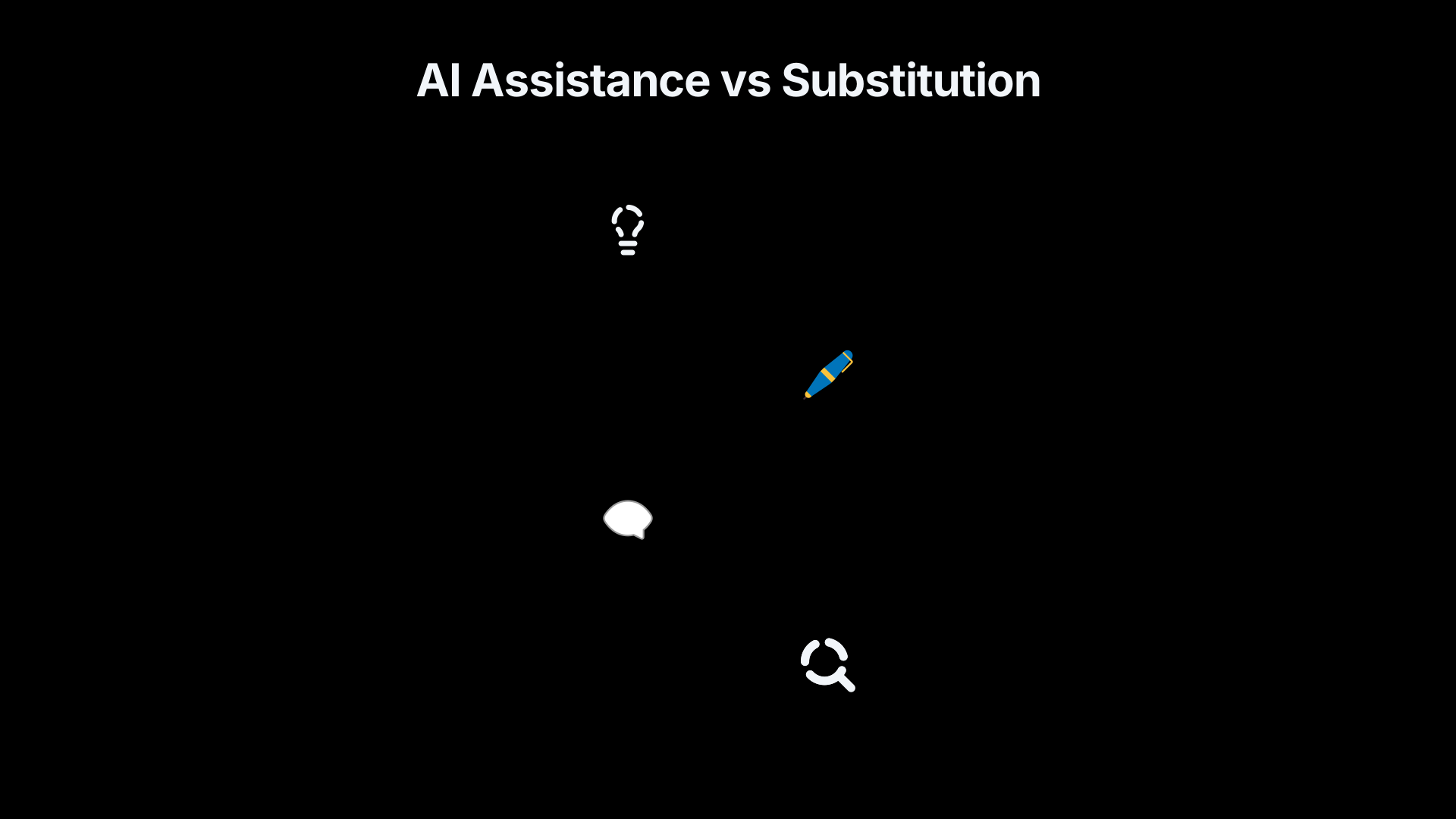
Researchers increasingly distinguish between useful assistance and harmful substitution. Useful assistance might include:
- brainstorming questions
- receiving feedback on draft structure
- generating practice quizzes
- explaining a difficult concept in simpler language
- translating notes into revision cards
Substitution begins when the chatbot performs the core reasoning task that the student was meant to practise:
- writing the final argument
- solving the problem without explanation
- selecting evidence
- evaluating competing interpretations
- constructing the thesis
- performing reflection or synthesis
This distinction sounds simple in theory but becomes messy in practice. A chatbot that “helps” outline an essay may already be shaping its argument. A coding assistant may silently solve the hardest parts of a task. A history chatbot may generate persuasive but inaccurate claims that the student never checks.
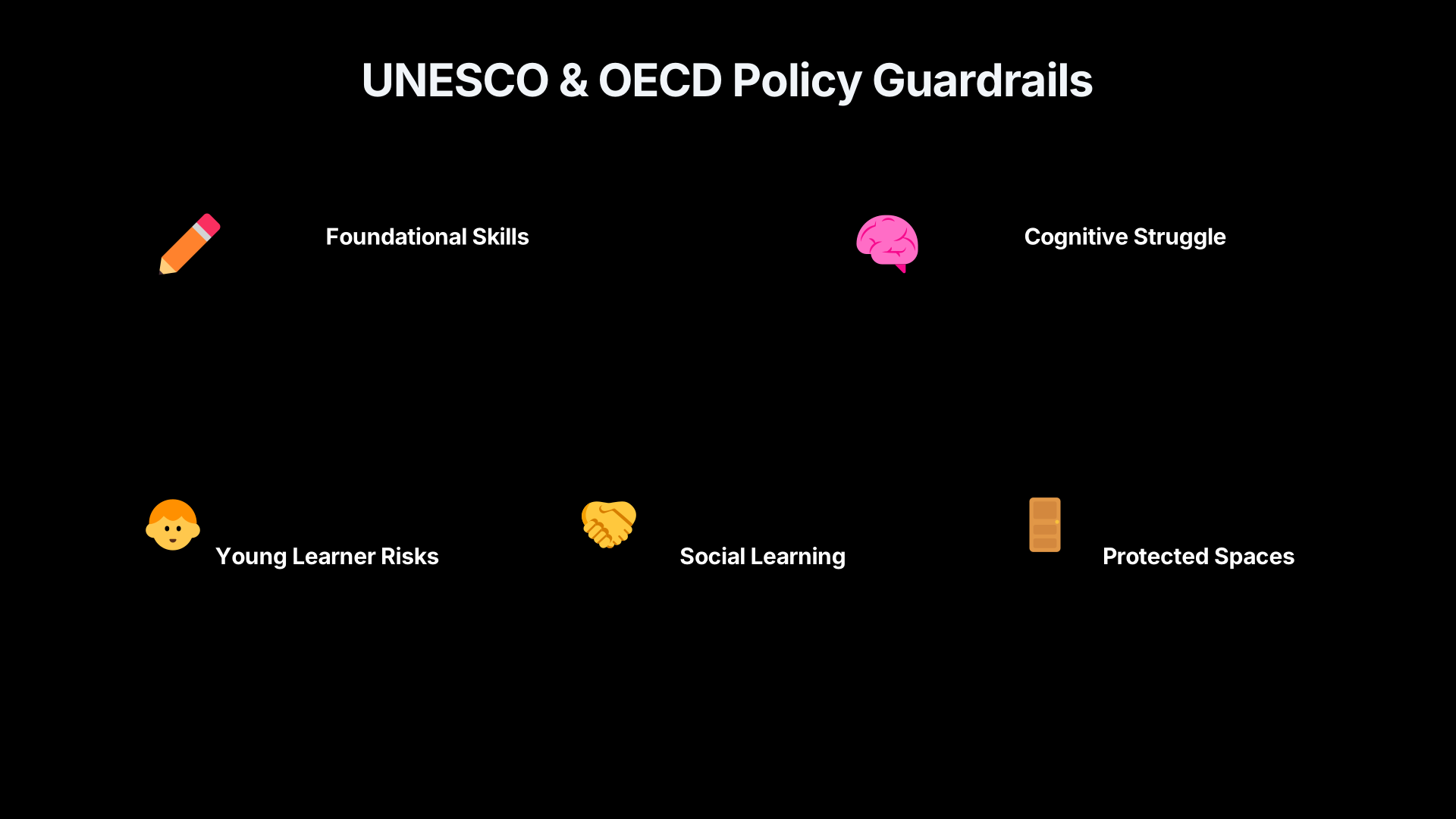
UNESCO and OECD guidance increasingly argues that AI policy in education must protect “human agency” and preserve meaningful learning rather than treating efficiency as the only goal. [Teacher Task Force]teachertaskforce.orgTeacher Task Force AI and educationTeacher Task ForceAI and education - Guidance for policy-makersMay 3, 2023 — Accordingly, this UNESCO guidance seeks to help policy- make… [OECD]oecd.orgOECDOpportunities, guidelines and guardrails for effective and…This discussion paper on AI in education was jointly developed by the…
The most effective classroom rules therefore focus less on punishment and more on visibility: making it possible to see whether thinking actually occurred.
Assistance versus assessed work
One of the clearest emerging norms is separating practice spaces from assessment spaces.
In many schools, confusion comes from students hearing two contradictory messages at once:
- “AI will be essential for your future.”
- “Using AI on schoolwork is cheating.”
That ambiguity often produces covert use rather than responsible use. Clearer rules work better when they specify which forms of AI support are acceptable for which stages of learning.
A growing model divides work into categories.
AI-allowed learning activities
These are tasks where support matters more than independent demonstration. Examples include:
- brainstorming
- revision planning
- language support
- idea generation
- coding hints
- mock interview practice
- quiz generation
- draft feedback
In these contexts, teachers may explicitly encourage chatbot use while requiring students to verify claims and explain what they accepted or rejected.
This approach treats AI partly as a tutor or cognitive amplifier. Used carefully, that can widen access to personalised support, especially for students who struggle to get one-to-one help outside school.
AI-limited assessment tasks
Other tasks exist specifically to reveal what the student can do unaided:
- timed essays
- oral exams
- handwritten reasoning
- in-class problem-solving
- source interpretation
- live coding
- mathematical derivations
These assessments remain important because education is not merely about producing outputs. It is about building durable cognitive ability.
Research on “desirable difficulties” in learning suggests that effortful thinking improves retention and understanding, even when it feels slower or more frustrating. [ScienceDirect]sciencedirect.comThe cognitive impact of ChatGPT in higher educationby C Li · 2026 — This systematic review examines how ChatGPT influences university stu… If AI removes all friction, students may complete assignments more efficiently while learning less.
This is one reason many educators increasingly compare unrestricted AI use to using a forklift in a gym. The task may still get completed, but the exercise disappears.
Disclosure rules matter more than detection wars
Many schools initially responded to generative AI with detection software intended to identify chatbot-written text. But these systems quickly proved unreliable, often falsely accusing students or failing to identify edited AI text.
As a result, some institutions are shifting toward disclosure-based norms instead:
- students state whether AI was used
- they explain how it was used
- they cite prompts or generated material
- they reflect on what they changed or rejected
This resembles citation practices for other tools and sources. The aim is not to criminalise AI assistance but to keep intellectual responsibility visible.
Assignments that make reasoning visible
The strongest anti-substitution strategy may not be policing at all. It may be redesigning assignments so that genuine thinking becomes harder to fake.
Traditional homework often rewards polished final products while hiding the process that produced them. Generative AI thrives in exactly this environment because it can imitate finished prose convincingly.
Educators are increasingly experimenting with assessments that expose the thinking pathway rather than only the final answer.
Process logs and reasoning traces
Some teachers now require students to submit:
- rough drafts
- annotations
- planning notes
- revision histories
- reflection journals
- prompt histories
- verbal explanations of decisions
This changes the educational target. Instead of merely presenting an answer, students must demonstrate how they arrived there.
A history student, for example, may need to explain:
- why they selected certain evidence
- why they rejected alternative interpretations
- where AI suggestions were misleading
- how their argument evolved
A science student may need to document failed approaches before presenting a successful solution.
These approaches do not eliminate AI use. They make passive dependence harder.
Oral defence is returning
Universities in particular are rediscovering older assessment methods:
- viva voce examinations
- seminar questioning
- oral presentations
- live demonstrations
- collaborative problem-solving
These formats reveal comprehension quickly. A student who relied entirely on AI-generated reasoning often struggles to explain or defend the work under questioning.
Ironically, highly advanced AI may push education toward more human interaction rather than less. If written output becomes easy to automate, authentic understanding becomes more valuable.
Personal and local assignments resist generic AI answers
Assignments become harder to outsource when they require:
- local observation
- personal reflection
- classroom discussion
- fieldwork
- original data collection
- iterative experimentation
For example:
- analysing a local river sample
- interviewing community members
- reflecting on a classroom debate
- documenting a design process
- recording athletic training data
These tasks force engagement with reality rather than pure text generation.
That does not make them AI-proof. Students may still use AI to organise or interpret material. But the core intellectual experience remains tied to lived observation and judgement.
Why some learning spaces should stay AI-free
Not every educational environment benefits from AI access.
One of the emerging consensus points among many educators is that some forms of learning require protected spaces for unassisted cognition. [Time]time.comTimeChatGPT's Impact On Our Brains According to an MIT StudyJune 17, 2025 — 17 Jun 2025 — I think that would be absolutely bad and detrim… [Frontiers]frontiersin.orgThe cognitive paradox of AI in educationby B Jose · 2025 · Cited by 190 — Here we will introduce an end-to-end framework that will allow…
This is especially true for foundational skill-building.
Early-stage learning needs cognitive struggle
Students learning algebra, writing, languages or scientific reasoning often need repeated mental practice before concepts become automatic.
A chatbot can short-circuit that process by supplying instant completion before cognitive structures fully form.
The concern is not nostalgia for harder schooling. It is how human learning works. Cognitive science consistently shows that retrieval, effort and productive struggle strengthen memory and understanding more effectively than passive exposure.
This is why many schools still insist on:
- mental arithmetic before calculators
- handwriting before keyboards
- memorisation before open-book assessment
- independent drafting before collaborative editing
Generative AI intensifies these debates because it can perform not just calculation but composition and reasoning.

Younger students may be more vulnerable
Some researchers argue that developing learners face particular risks from premature AI dependence because they are still forming core cognitive habits. [Time]time.comTimeChatGPT's Impact On Our Brains According to an MIT StudyJune 17, 2025 — 17 Jun 2025 — I think that would be absolutely bad and detrim…
A student who turns to AI immediately whenever confusion appears may never build:
- frustration tolerance
- persistence
- metacognition
- independent problem decomposition
These are not secondary educational traits. They are central to long-term intellectual autonomy.
That does not imply children should never encounter AI. But many educators now argue for staged exposure:
- foundational skills first
- AI-supported acceleration later
This resembles how schools historically introduced calculators or internet research after basic competencies were established.
AI-free classrooms can preserve social learning
Another reason some educators defend AI-free spaces is that classrooms are social environments, not merely information-delivery systems.
Group discussion, disagreement, collaborative reasoning and shared uncertainty all matter educationally. If every student privately consults a chatbot during discussion, conversation can flatten into machine-mediated responses.
Teachers increasingly report that unrestricted chatbot access can reduce:
- peer debate
- question asking
- exploratory thinking
- intellectual risk-taking
A classroom where students occasionally struggle together may produce deeper learning than one where every uncertainty is instantly outsourced to a machine.
The historical pattern: schools adapt to powerful cognitive tools
Fears about AI in education often sound unprecedented, but schools have repeatedly adapted to technologies that changed intellectual work.
Calculators triggered fears about mental arithmetic. Search engines raised concerns about memorisation. Wikipedia provoked warnings about unreliable knowledge. Spellcheck altered writing habits.
In each case, education eventually rebalanced:
- some older skills became less central
- some remained essential
- new literacies emerged
The difference with generative AI is scale. Chatbots do not merely store information. They simulate reasoning, explanation and authorship.
That raises a deeper educational question: which cognitive activities should humans continue practising even if machines can perform them more quickly?
The answer matters far beyond schools. In a future where advanced AI systems may help accelerate science, medicine and civilisation-scale coordination, humanity could gain extraordinary capabilities. But those gains depend partly on preserving human capacities for judgement, interpretation and moral reasoning.
A civilisation that automates routine drudgery while strengthening human understanding may flourish. A civilisation that automates thought itself without preserving intellectual agency may become more dependent, manipulable and cognitively fragile.
Classroom rules are therefore not just bureaucratic policies. They are early attempts to decide which forms of human thinking remain worth protecting in an age of abundant machine intelligence.
The most useful classroom rule may be the simplest
Many successful AI classroom policies converge on a deceptively simple principle:
Use AI to support thinking, not to avoid it.
In practice, that usually means:
- students should still wrestle with problems before requesting AI help
- reasoning should remain visible
- foundational skills should sometimes be practised without assistance
- AI outputs should be questioned rather than trusted automatically
- assessment should prioritise understanding over polished appearance
The long-term goal is not merely preventing cheating. It is preserving human intellectual development while gaining the benefits of increasingly capable AI systems.
If AI eventually becomes a genuine cognitive multiplier for humanity, schools will play a major role in determining whether future citizens become passive consumers of machine-generated answers or active participants in a far more intelligent civilisation.
Endnotes
-
Source: sciencedirect.com
Title: have lasting negative effects on what students remember.Read more
Link: https://www.sciencedirect.com/science/article/pii/S2590291125010186Source snippet
ScienceDirectChatGPT as a cognitive crutch: Evidence from...by A Barcaui · 2025 · Cited by 28 — This follows from cognitive offloading a...
-
Source: sciencedirect.com
Link: https://www.sciencedirect.com/science/article/pii/S0001691825010388Source snippet
Learners' AI dependence and critical thinkingby J Tian · 2025 · Cited by 49 — Scholars have cautioned that excessive AI use may promote c...
-
Source: oecd.org
Link: https://www.oecd.org/content/dam/oecd/en/about/projects/edu/smart-data-and-digital-technology-in-education/Opportunities%2C%20guidelines%20and%20guardrails%20for%20effective%20and%20equitable%20use%20of%20AI%20in%20education.pdfSource snippet
OECDOpportunities, guidelines and guardrails for effective and...This discussion paper on AI in education was jointly developed by the...
-
Source: time.com
Link: https://time.com/7295195/ai-chatgpt-google-learning-school/Source snippet
TimeChatGPT's Impact On Our Brains According to an MIT StudyJune 17, 2025 — 17 Jun 2025 — I think that would be absolutely bad and detrim...
Published: June 17, 2025
-
Source: unesdoc.unesco.org
Link: https://unesdoc.unesco.org/ark%3A/48223/pf0000385146Source snippet
UNESCO (2021) AI and education: Guidance for policy-makers. Available at...Read more...
-
Source: unesdoc.unesco.org
Title: pf0000387030 eng
Link: https://unesdoc.unesco.org/ark%3A/48223/pf0000387030_engSource snippet
must be kept in check at schoolAI must be kept in check at school; Person as author. Williamson, Ben [author]; In. The UNESCO Courier...
-
Source: sciencedirect.com
Link: https://www.sciencedirect.com/science/article/pii/S2666920X26000330Source snippet
The cognitive impact of ChatGPT in higher educationby C Li · 2026 — This systematic review examines how ChatGPT influences university stu...
-
Source: sciencedirect.com
Link: https://www.sciencedirect.com/science/article/pii/S2666920X25000621Source snippet
Fostering responsible [AI literacy]({{ 'ai-bloom-abun/ai-bloom-abun-98d3a6-ai-tutors-lea-43972c-student-ai-li-44f049/' | relative_url }}): A systematic review of K-...by M Ma · 2025 · Cited by 48 — This systematic rev...
Published: January 2014
-
Source: teachertaskforce.org
Title: Teacher Task Force AI and education
Link: https://teachertaskforce.org/sites/default/files/2023-07/2021_UNESCO_AI-and-education-Guidande-for-policy-makers_EN.pdfSource snippet
Teacher Task ForceAI and education - Guidance for policy-makersMay 3, 2023 — Accordingly, this UNESCO guidance seeks to help policy- make...
Published: May 3, 2023
-
Source: frontiersin.org
Link: https://www.frontiersin.org/journals/psychology/articles/10.3389/fpsyg.2025.1550621/fullSource snippet
The cognitive paradox of AI in educationby B Jose · 2025 · Cited by 190 — Here we will introduce an end-to-end framework that will allow...
Additional References
-
Source: sjtylr.net
Title: Wayfinder Learning Lab
Link: https://sjtylr.net/wp-content/uploads/2024/09/taylors_edd_-policy_unescogenai.pdfSource snippet
Stephen TaylorIs UNESCO's Guidance for Generative AI (GenAI) in Education...by S Taylor · Cited by 9 — Building on UNESCO's AI and educa...
-
Source: ailiteracyframework.org
Link: https://ailiteracyframework.org/wp-content/uploads/2025/05/AILitFramework_ReviewDraft.pdfSource snippet
and learning designers to understand AI literacy and decide...Read more...
-
Source: news.harvard.edu
Title: is ai dulling our minds
Link: https://news.harvard.edu/gazette/story/2025/11/is-ai-dulling-our-minds/Source snippet
AI dulling our minds?13 Nov 2025 — Experts weigh in on whether tech poses threat to critical thinking, pointing to cautionary tales in us...
-
Source: hechingerreport.org
Title: proof points offload critical thinking ai
Link: https://hechingerreport.org/proof-points-offload-critical-thinking-ai/Source snippet
University students offload critical thinking, other hard work...19 May 2025 — Two studies show that many college students are offloadin...
Published: May 2025
-
Source: researchgate.net
Title: 374092520 ChatGPT The cognitive effects on learning and memory
Link: https://www.researchgate.net/publication/374092520_ChatGPT_The_cognitive_effects_on_learning_and_memorySource snippet
ChatGPT: The cognitive effects on learning and memory16 Mar 2026 — The paper concludes by encouraging further research into the long‐term...
-
Source: researchgate.net
Link: https://www.researchgate.net/publication/389936132_Integrating_AI_in_Education_Navigating_UNESCO_Global_Guidelines_Emerging_Trends_and_Its_Intersection_with_Sustainable_Development_GoalsSource snippet
Integrating AI in Education: Navigating UNESCO Global...18 Mar 2025 — This comprehensive review explores the integration of artificial i...
-
Source: researchgate.net
Link: https://www.researchgate.net/publication/396665060_The_Influence_of_Chat_GPT_Use_on_University_Students%27_Critical_Thinking_SkillsSource snippet
The Influence of Chat GPT Use on University Students...24 Oct 2025 — This study investigates the relationship between AI tool usage and...
-
Source: sciencealert.com
Title: study finds chatgpt may help you learn faster but theres a catch
Link: https://www.sciencealert.com/study-finds-chatgpt-may-help-you-learn-faster-but-theres-a-catchSource snippet
Study Finds ChatGPT May Help You Learn Faster, But...2 Apr 2026 — AI chatbots can act as a "cognitive crutch" that reduces our ability t...
-
Source: sea-vet.net
Link: https://sea-vet.net/images/seb/e-library/doc_file/1417/386693eng.pdfSource snippet
Guidance for generative AI in education and researchThe publication offers concrete recommendations for policy-makers and education insti...
-
Source: link.springer.com
Link: https://link.springer.com/article/10.1186/s41239-023-00408-3Source snippet
comprehensive AI policy education framework for university...by CKY Chan · 2023 · Cited by 2357 — This study aims to develop an AI educa...
Amazon book picks
Further Reading
Books and field guides related to Classroom AI Rules. Use these as the next step if you want deeper reading beyond the article.
AI and the Future of Education
Clear away the fog surrounding AI in education—and regain your peace of mind Among teachers, there is a cloud of rumors, confusion, and f...
The AI Classroom
What is the role of educators with the rise of the artificial intelligence era? We are entering an unprecedented era of innovation, where...
Generative AI in Education
As artificial intelligence (AI) rapidly transforms education, tools like ChatGPT and Claude are revolutionizing the way we teach and lear...
Classroom 2.0: Integrating AI into Modern Education
Are you ready to redefine education for the 21st century? "Classroom 2.0: Integrating AI into Modern Education" is not just a book—it's a...
Topic Tree