Within Grid Strain
Who Pays for Upgrades?
The politics of AI infrastructure turn sharp when communities fear higher bills, new power lines and local burdens for global digital benefits.
On this page
- Why data centre grid costs become politically contested
- How ratepayers, utilities and AI firms frame the fairness question
- What fairer connection and cost sharing rules might look like
Page outline Jump by section
Introduction
The argument over who should pay for AI-related grid upgrades is becoming one of the most politically sensitive parts of the AI boom. Advanced AI systems may promise scientific acceleration, medical breakthroughs and large-scale economic growth, but the infrastructure needed to run them is intensely physical: substations, transformers, transmission lines and new generating capacity. When those costs begin appearing in household electricity bills, enthusiasm for AI abundance can quickly collide with questions of fairness.
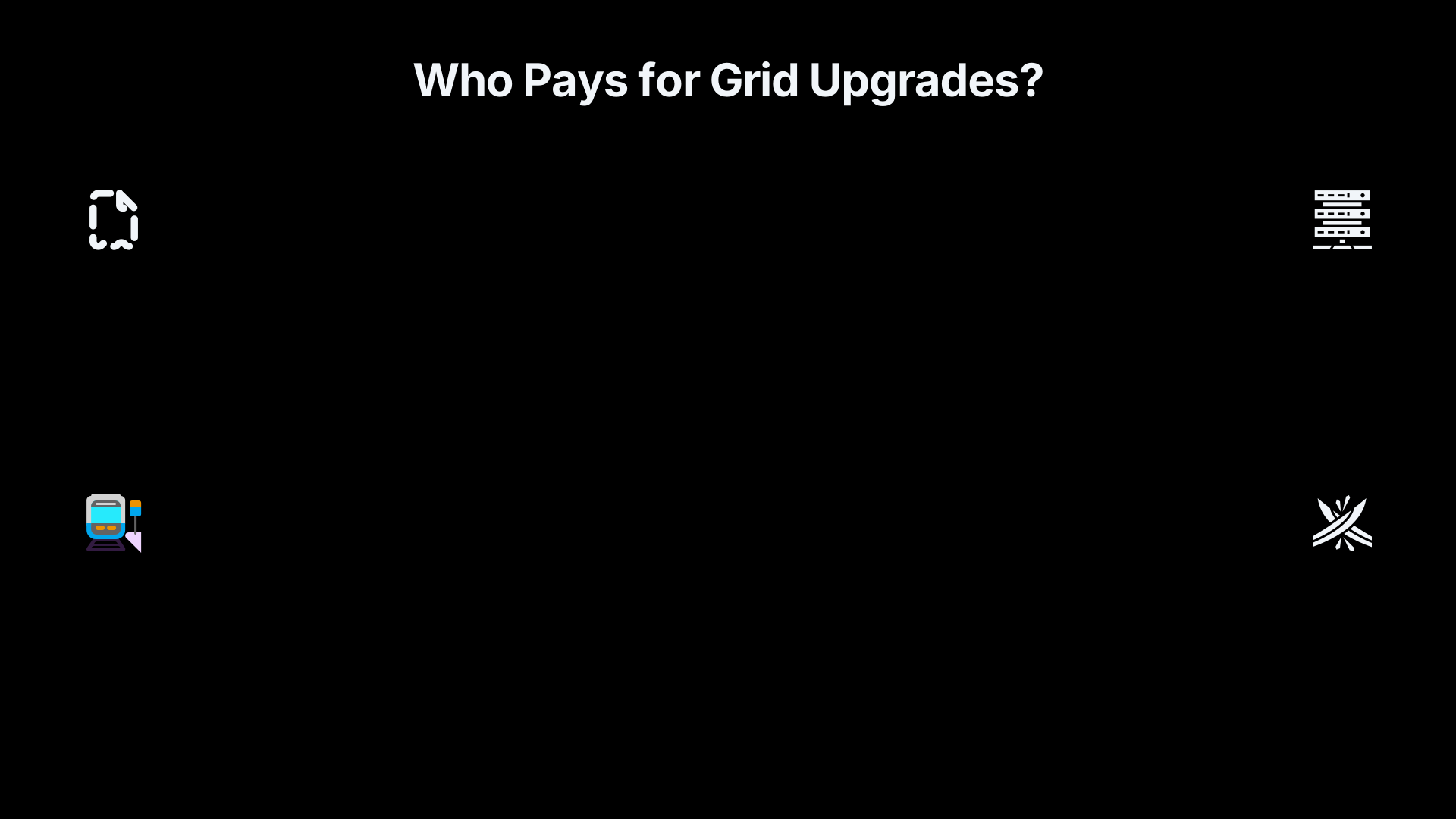 In practice, households are already helping to fund parts of the wider electricity system that enables AI data centres, even when regulators try to prevent direct subsidies. The central dispute is not whether grids need upgrading. It is whether ordinary ratepayers should shoulder the costs of infrastructure built primarily to support some of the world’s richest technology firms. Utilities, governments and AI companies increasingly give different answers to that question, and the outcome may shape whether public support for large-scale AI infrastructure survives.
Why grid costs become politically explosive
Electric grids are usually financed collectively. Utilities recover the costs of new infrastructure through electricity tariffs spread across households and businesses over many years. That model worked relatively smoothly when demand grew gradually and broadly across society.
AI data centres disrupt that pattern because they create enormous concentrated loads in specific regions. A single AI campus can require hundreds of megawatts of continuous power, sometimes comparable to a heavy industrial zone or a small city. Upgrading the local grid to support that demand may require:
- new transmission lines
- larger substations
- grid-balancing equipment
- backup generation
- reliability reserves
- land acquisition and permitting
Those investments are expensive, slow and politically visible. Residents may see new pylons, hear about grid congestion or face higher bills long before they experience any direct benefits from AI.
That tension is especially sharp because the benefits of AI are globally distributed while the burdens are local. A household in Maryland or rural Ireland may reasonably ask why its electricity bill should rise to support computing infrastructure used by multinational firms serving customers around the world.
The concern is no longer theoretical. Bloomberg reported in 2025 that wholesale electricity prices had surged in some regions near major data-centre clusters, with costs increasingly passed on to consumers. [Bloomberg]bloomberg.com2025 ai data centers electricity pricesBloombergAI Data Centers Are Sending Power Bills Soaring29 Sept 2025 — Wholesale electricity costs as much as 267% more than it did five… Consumer Reports similarly noted that rising AI data-centre demand is becoming a meaningful contributor to electricity-price pressure in some states, alongside ageing infrastructure and inflation. [Consumer Reports]consumerreports.orgConsumer ReportsAI Data Centers Impact on Electric Bills, Water, and More20 Mar 2026 — Residential prices jumped 7.1 percent in 2025—more…
The fairness argument from households and consumer advocates
Consumer advocates usually frame the issue around a simple principle: the party creating the new demand should pay for the infrastructure required to serve it.
From that perspective, households did not ask for gigawatt-scale AI clusters. They are ordinary electricity users whose local grid suddenly became valuable to global technology firms. Asking residents to absorb the resulting upgrade costs can therefore look like a transfer of wealth from households to hyperscale AI companies.
This argument has become particularly intense in regions where data centres already consume a very large share of electricity.
In Ireland, official statistics show data centres rose from 5% of metered electricity consumption in 2015 to 22% by 2024. [Central Statistics Office]cso.ieCentral Statistics OfficeData Centres Metered Electricity Consumption 2024Jun 10, 2025 — % of metered electricity consumed by data centre… The concentration is even higher around Dublin and nearby counties. Critics argue that households face some of Europe’s highest electricity prices while large technology operators benefit from preferential industrial pricing and lower network charges. Irish Independent [The Labour Party]labour.ieThey already account for roughly 50 per…Read more… [TheJournal.ie]thejournal.ieIreland has the highest household electricity prices in the EU3 hours ago — Increases in prices last year means the average household is…
The political danger is that people may come to see AI infrastructure as socially extractive: consuming local power, land and water while pushing costs onto residents who receive few immediate gains.
The Maryland dispute in the PJM regional grid area shows how quickly this can escalate. Maryland’s Office of People’s Counsel argued in 2026 that residents could end up helping finance billions of dollars in transmission upgrades largely driven by AI-related demand growth elsewhere in the region. [Tom's Hardware]tomshardware.comThese upgrades are meant to support rising electricity demand from AI-focused data centers, many of which are located outside of Maryland…
These disputes matter beyond local politics because the broader AI bloom vision depends on public legitimacy. If ordinary citizens conclude that AI abundance means privatised gains and socialised infrastructure costs, political resistance to further expansion may harden quickly.
Why utilities and grid operators resist simple answers
Utilities and grid planners often argue that the picture is more complicated than “tech firms versus households”.
Electric grids are shared systems. A new transmission line built partly for data centres may also improve reliability for homes, enable renewable-energy connections or reduce future congestion. Utilities therefore argue that at least some costs should be socialised because the wider network benefits everyone.
There is also a practical problem with assigning exact causation. Once a major transmission project enters the grid, many users may benefit over decades. Regulators therefore struggle to determine:
- which upgrades are exclusively for data centres
- which upgrades improve the general system
- how future demand should be forecast
- whether AI demand will remain stable
- how stranded costs should be handled if projects fail
This is why regulators increasingly focus on “cost allocation” rules rather than absolute yes-or-no answers.
The Federal Energy Regulatory Commission in the United States has opened major proceedings specifically on large-load interconnection rules, including whether data centres should pay the full cost of triggered upgrades. [Federal Energy Regulatory Commission]ferc.govrm26 4Federal Energy Regulatory CommissionInterconnection of Large Loads to the Interstate…Jan 13, 2026 — Whether large loads and co-located… [Federal Energy Regulatory Commission]ferc.govrm26 4Federal Energy Regulatory CommissionInterconnection of Large Loads to the Interstate…Jan 13, 2026 — Whether large loads and co-located…
One proposed approach is “participant funding”: if a data centre creates the need for a specific upgrade, the operator pays upfront. Supporters argue this follows the principle of cost causation. [CSIS]csis.orgwhats stake fercs large load proposalCSISWhat's at Stake in FERC's Large Load Proposal?Dec 9, 2025 — FERC's proposal adopts a 100 percent participant funding model that would…
But utilities warn that overly strict rules could slow AI infrastructure deployment, discourage investment or create endless legal disputes over which upgrades count as “AI-driven”.
The AI industry’s argument: society will benefit too
AI companies increasingly defend infrastructure expansion by arguing that society as a whole will benefit from advanced AI capabilities.
The strongest version of this argument links directly to the broader AI bloom thesis. If advanced AI accelerates medical research, materials science, robotics, energy innovation and scientific discovery, then AI infrastructure is not merely a private luxury. It becomes part of civilisation-scale productive capacity.
Under this view, grid upgrades resemble earlier public investments in railways, electrification or broadband. Society paid collectively for enabling infrastructure because the long-term gains were expected to spread widely across the economy.
Some AI firms also argue that restricting infrastructure growth too aggressively could weaken national competitiveness. Governments in the US, Europe and Asia increasingly treat AI capacity as strategically important, especially relative to geopolitical rivals.
That does not automatically resolve the fairness question, however. Public benefit alone does not guarantee equitable financing. Roads benefit society too, but governments still debate fuel taxes, tolls and freight charges. The same political logic now applies to AI electricity demand.
Importantly, some AI companies appear to recognise the reputational risk of appearing subsidised by households. In 2026, Anthropic publicly stated it would cover the full costs of grid upgrades needed for its data-centre interconnections rather than passing them to ratepayers. [Business Insider]businessinsider.comThe company emphasized its commitment to responsible AI development, extending that responsibility to the infrastructure needed to suppor…
That announcement mattered less for its immediate financial impact than for what it signalled politically: AI firms increasingly understand that public acceptance may depend on visible cost-sharing commitments.

Why “households versus data centres” can become misleading
The public debate often sounds binary: either households pay or AI firms pay. Real electricity systems are messier.
In practice, costs can spread through several channels simultaneously:
- direct interconnection charges to data centres
- regional transmission tariffs shared across users
- higher wholesale electricity prices caused by demand growth
- tax incentives or subsidies from governments
- long-term utility rate increases
- public financing for generation projects
Even if a regulator formally requires a data centre to pay for a new substation, broader system demand can still increase electricity prices regionally.
That distinction matters because AI demand may reshape entire energy markets rather than merely adding isolated facilities. Reuters reported in 2026 that rising data-centre demand was already contributing to reliability stress and expensive emergency payments within the PJM grid system. [Reuters]reuters.combiggest us grid paid record 1 billion money losing power plants q1 2026 05 20electric grid, paid a record $990 million in uplift payments to power plants, surpassing the $764 million total for all of 2025. These pa…
In other words, households may end up paying indirectly even when explicit subsidies are prohibited.
This is one reason some critics argue that the AI industry should contribute not just to local interconnection costs but also to broader long-term capacity expansion, including generation and transmission reserves.
What fairer cost-sharing rules might look like
Several emerging policy ideas attempt to balance infrastructure growth with public legitimacy.
Stronger “cost causation” rules
One approach is to require large AI loads to pay the direct costs they trigger. If a new campus requires a transmission upgrade, the developer funds it upfront.
This principle is gaining traction in regulatory debates because it is intuitively legible to the public: the entity creating the demand pays the associated infrastructure cost. [Federal Energy Regulatory Commission]ferc.govrm26 4Federal Energy Regulatory CommissionInterconnection of Large Loads to the Interstate…Jan 13, 2026 — Whether large loads and co-located…
The downside is that strict participant funding can make projects financially riskier and may slow deployment.
Long-term capacity contracts
Another model requires AI firms to commit to long-term electricity purchasing agreements or capacity guarantees before connection approval.
This reduces the risk that utilities overbuild infrastructure based on speculative AI demand projections that later collapse.
Time-limited industrial discounts
Some governments may continue offering discounted rates or tax incentives to attract AI investment, but with expiry dates or clawback provisions tied to local economic benefits.
The political logic here is that temporary incentives may be acceptable if they genuinely create jobs, tax revenue or regional infrastructure improvements.
Local benefit agreements
Communities increasingly demand direct compensation for hosting large infrastructure projects. That can include:
- local electricity rebates
- community investment funds
- renewable-energy commitments
- water-use restrictions
- public infrastructure improvements
These agreements effectively acknowledge that AI infrastructure imposes concentrated local burdens even when national governments support expansion.
Dynamic pricing and flexible computing
A more technical solution involves encouraging AI facilities to reduce demand during peak grid stress periods.
Unlike hospitals or rail systems, some AI workloads can shift in time or location. If training runs become more flexible, data centres may place less strain on local infrastructure and reduce the scale of required upgrades.
The deeper political question behind the bills
The argument over electricity bills is partly about money, but it is also about trust.
The AI bloom vision asks societies to tolerate massive infrastructure expansion today in exchange for the possibility of extraordinary future gains: scientific acceleration, abundance, cleaner energy systems, medical breakthroughs and eventually forms of prosperity far beyond ordinary economic growth.
People are more willing to support that transition if they believe:
- the benefits will spread broadly
- burdens are distributed fairly
- corporations are sharing risks
- governments remain accountable
- local communities are not treated as expendable infrastructure zones
If those conditions fail, AI infrastructure politics may begin to resemble earlier backlashes against globalisation or extractive industrial development.
That does not mean households should never contribute to grid expansion. Electricity systems have always involved shared public investment. But politically, the case for collective funding becomes much stronger when ordinary citizens can plausibly see themselves as beneficiaries of the future being built.
The long-term optimistic case for AI depends not only on whether advanced systems become powerful, but on whether societies believe the transition toward that future is fair enough to sustain.
Endnotes
-
Source: bloomberg.com
Title: 2025 ai data centers electricity prices
Link: https://www.bloomberg.com/graphics/2025-ai-data-centers-electricity-prices/Source snippet
BloombergAI Data Centers Are Sending Power Bills Soaring29 Sept 2025 — Wholesale electricity costs as much as 267% more than it did five...
-
Source: labour.ie
Link: https://labour.ie/news/2026/02/25/households-paying-twice-as-much-as-data-centres-for-electricity/Source snippet
They already account for roughly 50 per...Read more...
-
Source: thejournal.ie
Link: https://www.thejournal.ie/ireland-highest-electricity-prices-european-union-7031945-May2026/Source snippet
Ireland has the highest household electricity prices in the EU3 hours ago — Increases in prices last year means the average household is...
-
Source: independent.ie
Link: https://www.independent.ie/business/personal-finance/its-a-slap-in-the-face-irish-households-are-paying-twice-as-much-for-electricity-as-data-centres/a1352574572.htmlSource snippet
Irish IndependentIrish households are paying twice as much for electricity...24 Feb 2026 — But big energy users, such as data centres, a...
-
Source: reuters.com
Title: biggest us grid paid record 1 billion money losing power plants q1 2026 05 20
Link: https://www.reuters.com/legal/litigation/biggest-us-grid-paid-record-1-billion-money-losing-power-plants-q1-2026-05-20/Source snippet
electric grid, paid a record $990 million in uplift payments to power plants, surpassing the $764 million total for all of 2025. These pa...
-
Source: csis.org
Title: whats stake fercs large load proposal
Link: https://www.csis.org/analysis/whats-stake-fercs-large-load-proposalSource snippet
CSISWhat's at Stake in FERC's Large Load Proposal?Dec 9, 2025 — FERC's proposal adopts a 100 percent participant funding model that would...
-
Source: keentelengineering.com
Link: https://keentelengineering.com/ai-data-centers-grid-regulationSource snippet
AI Data Centers & Grid: Tariffs and Rate ImpactsFeb 7, 2026 — Data-driven analysis of AI data center load growth, large-load tariffs, tra...
-
Source: consumerreports.org
Link: https://www.consumerreports.org/data-centers/ai-data-centers-impact-on-electric-bills-water-and-more-a1040338678/Source snippet
Consumer ReportsAI Data Centers Impact on Electric Bills, Water, and More20 Mar 2026 — Residential prices jumped 7.1 percent in 2025—more...
-
Source: cso.ie
Link: https://www.cso.ie/en/releasesandpublications/ep/p-dcmec/datacentresmeteredelectricityconsumption2024/Source snippet
Central Statistics OfficeData Centres Metered Electricity Consumption 2024Jun 10, 2025 — % of metered electricity consumed by data centre...
-
Source: cso.ie
Link: https://www.cso.ie/en/releasesandpublications/ep/p-dcmec/datacentresmeteredelectricityconsumption2023/keyfindings/Source snippet
Central Statistics OfficeData Centres Metered Electricity Consumption 202323 Jul 2024 — The percentage of total metered electricity consu...
-
Source: tomshardware.com
Link: https://www.tomshardware.com/tech-industry/artificial-intelligence/maryland-citizens-slapped-with-usd2-billion-grid-upgrade-bill-for-out-of-state-ai-data-centers-state-complains-to-federal-energy-regulators-says-additional-cost-breaks-ratepayer-protection-pledge-promisesSource snippet
These upgrades are meant to support rising electricity demand from AI-focused data centers, many of which are located outside of Maryland...
-
Source: ferc.gov
Title: rm26 4
Link: https://www.ferc.gov/rm26-4Source snippet
Federal Energy Regulatory CommissionInterconnection of Large Loads to the Interstate...Jan 13, 2026 — Whether large loads and co-located...
-
Source: ferc.gov
Title: ferc act large load interconnection docket june 2026
Link: https://www.ferc.gov/news-events/news/ferc-act-large-load-interconnection-docket-june-2026Source snippet
Federal Energy Regulatory CommissionFERC to Act on Large Load Interconnection Docket...16 Apr 2026 — The Federal Energy Regulatory Commi...
Published: june 2026
-
Source: businessinsider.com
Link: https://www.businessinsider.com/anthropic-cover-grid-upgrade-cost-ai-data-center-electricity-2026-2Source snippet
The company emphasized its commitment to responsible AI development, extending that responsibility to the infrastructure needed to suppor...
-
Source: ferc.gov
Link: https://www.ferc.gov/news-events/news/e-1-commissioner-rosners-concurrence-pjm-co-locationSource snippet
E-1: Commissioner Rosner's Concurrence on PJM Co-...Dec 18, 2025 — Co-located loads will continue to receive a bill for state-regulated...
-
Source: ferc.gov
Link: https://www.ferc.gov/explainer-interconnection-final-ruleSource snippet
Explainer on the Interconnection Final RuleThe final rule allocates network upgrade costs to interconnection customers within a cluster u...
-
Source: ferc.gov
Title: fact sheet ferc directs nations largest grid operator create new rules embrace
Link: https://www.ferc.gov/news-events/news/fact-sheet-ferc-directs-nations-largest-grid-operator-create-new-rules-embraceSource snippet
FACT SHEET | FERC Directs Nation's Largest Grid...Dec 18, 2025 — Today, FERC directed grid operator PJM to establish transparent rules t...
-
Source: ferc.gov
Link: https://www.ferc.gov/news-events/events/commissioner-led-technical-conference-regarding-large-loads-co-locatedSource snippet
the co-location of large loads at generating facilities.Read more...
Additional References
-
Source: quillbot.com
Link: https://quillbot.com/ai-chatSource snippet
AI ChatUnlock your potential with QuillBot's free AI chat! Brainstorm, draft content, get instant research & overcome writer's block. Try...
-
Source: sas.com
Link: https://www.sas.com/en_gb/insights/analytics/what-is-artificial-intelligence.htmlSource snippet
Artificial Intelligence (AI): What it is and why it mattersArtificial intelligence (AI) makes it possible for machines to learn from expe...
-
Source: theguardian.com
Title: ireland datacentres overtake electricity use of all homes combined figures show
Link: https://www.theguardian.com/world/article/2024/jul/23/ireland-datacentres-overtake-electricity-use-of-all-homes-combined-figures-showSource snippet
Ireland's datacentres overtake electricity use of all urban...23 Jul 2024 — Ireland's energy-hungry datacentres consumed more electricit...
-
Source: sinnfein.ie
Link: https://sinnfein.ie/news/households-paying-twice-as-much-for-electricity-as-compared-to-data-centres-boylan/Source snippet
Households are paying twice as much for their electricity as data centres according to new figures published by Eurostat.Read more...
-
Source: williamfry.com
Title: cru publishes long awaited final policy on data centre connections
Link: https://www.williamfry.com/knowledge/cru-publishes-long-awaited-final-policy-on-data-centre-connections/Source snippet
CRU Publishes Long Awaited Final Policy on Data Centre...15 Dec 2025 — Since 2015, Ireland's annual data centre electricity consumption...
-
Source: davisgraham.com
Title: federal and colorado action on data centers and large power loads
Link: https://davisgraham.com/news-events/federal-and-colorado-action-on-data-centers-and-large-power-loads/Source snippet
Federal and Colorado Action on Data Centers and Large...Jan 12, 2026 — The Secretary of Energy directed FERC to consider an Advanced Not...
-
Source: britannica.com
Link: https://www.britannica.com/technology/artificial-intelligenceSource snippet
r-controlled robot to perform tasks commonly associated with intelligent beings.Read more...
-
Source: wattcharger.com
Link: https://www.wattcharger.com/blog/data-centres-use-32-of-irelands-electricity-how-to-stop-competing-with-themSource snippet
Data Centres Use 32% of Ireland's Electricity: How to Stop...Data centres consume 32% of Ireland's electricity by 2026 while paying half...
-
Source: hklaw.com
Title: ferc to act on large load interconnection docket in june
Link: https://www.hklaw.com/en/insights/publications/2026/04/ferc-to-act-on-large-load-interconnection-docket-in-juneSource snippet
Holland & KnightFERC to Act on Large-Load Interconnection Docket in JuneApr 17, 2026 — FERC emphasized that unprecedented growth in large...
-
Source: whitecase.com
Title: doe directs ferc accelerate interconnection data centers
Link: https://www.whitecase.com/insight-alert/doe-directs-ferc-accelerate-interconnection-data-centersSource snippet
FERC has the mandate to ensure that wholesale rates are just and reasonable, which should be extended to large loads and data centers. No...
Amazon book picks
Further Reading
Books and field guides related to Who Pays for Upgrades?. Use these as the next step if you want deeper reading beyond the article.

Urban Energy Transition
This compendium of 29 chapters from 18 countries contains both fundamental and advanced insight into the inevitable shift from cities dom...

Artificial Intelligence in Economics and Finance Theories
As Artificial Intelligence (AI) seizes all aspects of human life, there is a fundamental shift in the way in which humans are thinking of...

Discounting For Time And Risk In Energy Policy
First published 1982. Subjects: Energy development, Energy policy, united states, Cost effectiveness, Energy policy, Énergie.

Making national energy policy
First published 1993. Subjects: Congresses, Energy policy, Energy policy, united states, Politique énergétique, Congrès.
eBay marketplace picks
Marketplace Samples
Example marketplace items related to this page. Use the search link to explore similar finds on eBay.

Example eBay listing
A.I. Artificial Intelligence Original Movie Poster Signed By Jude Law
USD 125.00 | Shipping USD 25.00 | US

Example eBay listing
Artificial Intelligence D/S Original Movie Poster - 27 x 40"
USD 19.50 | Shipping USD 13.65 | US

Example eBay listing
612388 Artificial Intelligence Movie Science Fiction Drama Wall Print Poster
USD 22.95 | Shipping USD 12.95 | JP

Example eBay listing
Companion - Artificial Intelligence Dark Comedy Cinema Film - POSTER 20"x30"
USD 23.99 | Free shipping | US

Example eBay listing
A.I. Artificial Intelligence Movie Film Poster Art Print
GBP 4.99 | Free shipping | GB

Example eBay listing
A I Artificial Intelligence 6 Movie Poster Art Print Print Classic Rare Gallery
GBP 49.00 | Free shipping | GB

Example eBay listing
AI - Artificial Intelligence (Poster + Slipcase) Blu-Ray
GBP 10.49 | Free shipping | GB

Example eBay listing
A. I. Artificial Intelligence. Jude Law. Original UK Video Poster.
GBP 8.11 | Shipping GBP 3.38 | GB
Topic Tree