Within First Tasks
Robots in Extreme Sites
The strongest case for automation is often where the alternative is sending people into unstable tunnels, fires, radiation, or rubble.
On this page
- Why hostile environments change the ethics of automation
- Mining, bomb disposal, fire response, and radiation zone examples
- Limits of remote operation, reliability, and accountability
Page outline Jump by section
Introduction
If robots are going to replace human labour anywhere first, the strongest case is not supermarkets, offices, or creative work. It is places where sending a human being is already close to a moral failure: collapsing mines, radiation zones, burning industrial sites, bomb scenes, chemical spills, and unstable disaster rubble.
 These environments reveal a different logic for automation. The point is not convenience. It is survival. A mining robot can enter a tunnel after an explosion without risking another rescue crew. A bomb disposal robot can approach an improvised explosive device that would otherwise require a person in a protective suit. A radiation-resistant inspection robot can enter reactor buildings that would slowly poison workers. In these cases, automation is not mainly about productivity gains. It is about reducing the need to trade human lives for industrial extraction, emergency response, or disaster recovery.
This is one of the clearest links between robotics and the broader idea of AI-enabled human flourishing. A society with capable machines may be able to preserve more human health, reduce traumatic labour, and push dangerous work further away from direct bodily risk. But the real-world history of disaster robotics also shows how hard that goal remains. Machines fail. Communications collapse. Terrain becomes unpredictable. And many of the most famous robots in this field were built precisely because earlier systems proved inadequate during real catastrophes.
Why hostile environments change the ethics of automation
Most automation debates focus on economics: jobs, wages, efficiency, or productivity. Extreme-site robotics changes the ethical framing because the alternative is often immediate danger rather than ordinary employment.
Mining disasters illustrate the point sharply. Underground rescues expose crews to cave-ins, toxic gases, explosions, flooding, and oxygen loss. After methane explosions or coal dust ignitions, even experienced rescuers may have only fragmentary information about tunnel stability. Research into underground rescue robotics repeatedly describes the aim as reducing “unnecessary human exposure” during emergency response operations. [PMC]pmc.ncbi.nlm.nih.govPMCUnderground mine rescue robotic systems: insights intoPMCby R Bakzadeh · 2026 · Cited by 1 — Robotic assistance offers the potential to reduce unnecessary human exposure during such operation… [MDPI]mdpi.comRescue robots are classified as field robots, built to operate in unstructured, dynamic, and high-risk…
The same logic appears in nuclear accidents. The 2011 Fukushima Daiichi disaster became a turning point in global disaster robotics because many areas inside the damaged plant were too radioactive for prolonged human access. The disaster exposed how poorly prepared even technologically advanced countries were for robotic operation in degraded environments with broken infrastructure and unreliable communications. [Scientific American]scientificamerican.comfukushima disaster inspires better emergency response robotsThe course is designed to…Read more… [IEEE Spectrum]spectrum.ieee.orgdarpas rescuerobot showdownIEEE SpectrumDARPA's Rescue-Robot Showdown31 Dec 2013 — DARPA specifically mentions the Fukushima accident as an example of a disaster th…
In these settings, robots are not replacing fulfilling human activity. They are replacing exposure to lethal uncertainty.
That distinction matters for the wider AI bloom argument. The optimistic case for advanced robotics is strongest when machines absorb physical danger while humans shift toward supervision, coordination, science, engineering, caregiving, or creative work. Even critics of aggressive automation often accept that bomb disposal, toxic cleanup, and disaster-zone reconnaissance are among the most defensible uses of robotics.
Mining robots and the long history of underground danger
Mining has always been one of the deadliest major industries. Tunnel collapse, methane ignition, silica dust, flooding, and heavy machinery accidents have killed workers for centuries. Even modern mines remain hazardous because underground geology is inherently unstable and visibility is poor.
Robotic systems in mining generally fall into three overlapping categories:
- Inspection and mapping robots [spectrum.ieee.org]spectrum.ieee.orgparticle 1the Robots of Fukushima DaiichiRobots are surveying radiation levels and starting the cleanup. The PackBot, an inspection bot from iRobot…
- Autonomous extraction vehicles
- Emergency rescue robots [mdpi.com]mdpi.comRescue robots are classified as field robots, built to operate in unstructured, dynamic, and high-risk…
The emergency category is especially important because rescue itself can multiply casualties. Historically, secondary explosions or collapses have killed rescuers attempting to reach trapped miners.
Modern rescue robots are designed to enter first. Many include gas sensors, thermal cameras, LiDAR mapping systems, and communications relays. Some are explosion-proof and waterproof to survive methane-rich or flooded tunnels. Research on coal mine rescue robots highlights the need for specialised suspension systems and rugged designs because ordinary wheeled robots fail easily on debris-strewn terrain. [ResearchGate]researchgate.netResearchGateDevelopment of Search-and-rescue Robots for…May 1, 2014 — The design and development experiences may provide a reference f…
Yet underground autonomy remains extraordinarily difficult.
Why underground environments defeat robots
A mine is close to a worst-case environment for autonomous systems:
- GPS does not work underground.
- Dust obscures cameras and sensors.
- Water and mud damage electronics.
- Communication signals degrade rapidly.
- Tunnels may partially collapse after the robot enters.
- Lighting conditions vary from darkness to smoke-filled glare.
- Terrain changes unpredictably after explosions.
DARPA’s Subterranean Challenge was created partly to push robotics toward these problems. Teams had to explore tunnels, caves, and underground urban systems while dealing with degraded communications and uncertain terrain. Winning systems often combined flying drones, wheeled vehicles, and legged robots because no single form factor handled all conditions effectively. [arXiv]arxiv.orgarXivSystem for multi-robotic exploration of underground environments CTU-CRAS-NORLAB in the DARPA Subterranean ChallengeOctober 12, 2021…
One revealing outcome was that even highly advanced robots still required significant human oversight. The future envisioned by many researchers is not fully independent rescue machines but human-robot teams where operators supervise multiple semi-autonomous systems from safer locations.
That matters politically as well as technically. The practical near-term future is less “human replacement” than “human distance from lethal risk”.
Fukushima and the rebirth of disaster robotics
The Fukushima nuclear disaster became a defining psychological and technical shock for the robotics field.
Japan was widely viewed as a global leader in robotics before 2011, yet the crisis exposed major gaps between impressive laboratory demonstrations and machines that could function in real catastrophes. Researchers later argued that technological, organisational, and political failures all contributed to the limited effectiveness of early robotic deployment. [Taylor & Francis Online]tandfonline.comTaylor & Francis OnlineWhen hazardous-duty robots met the Fukushima nuclear…by YJ Ji · 2024 · Cited by 5 — This paper explores the pro…
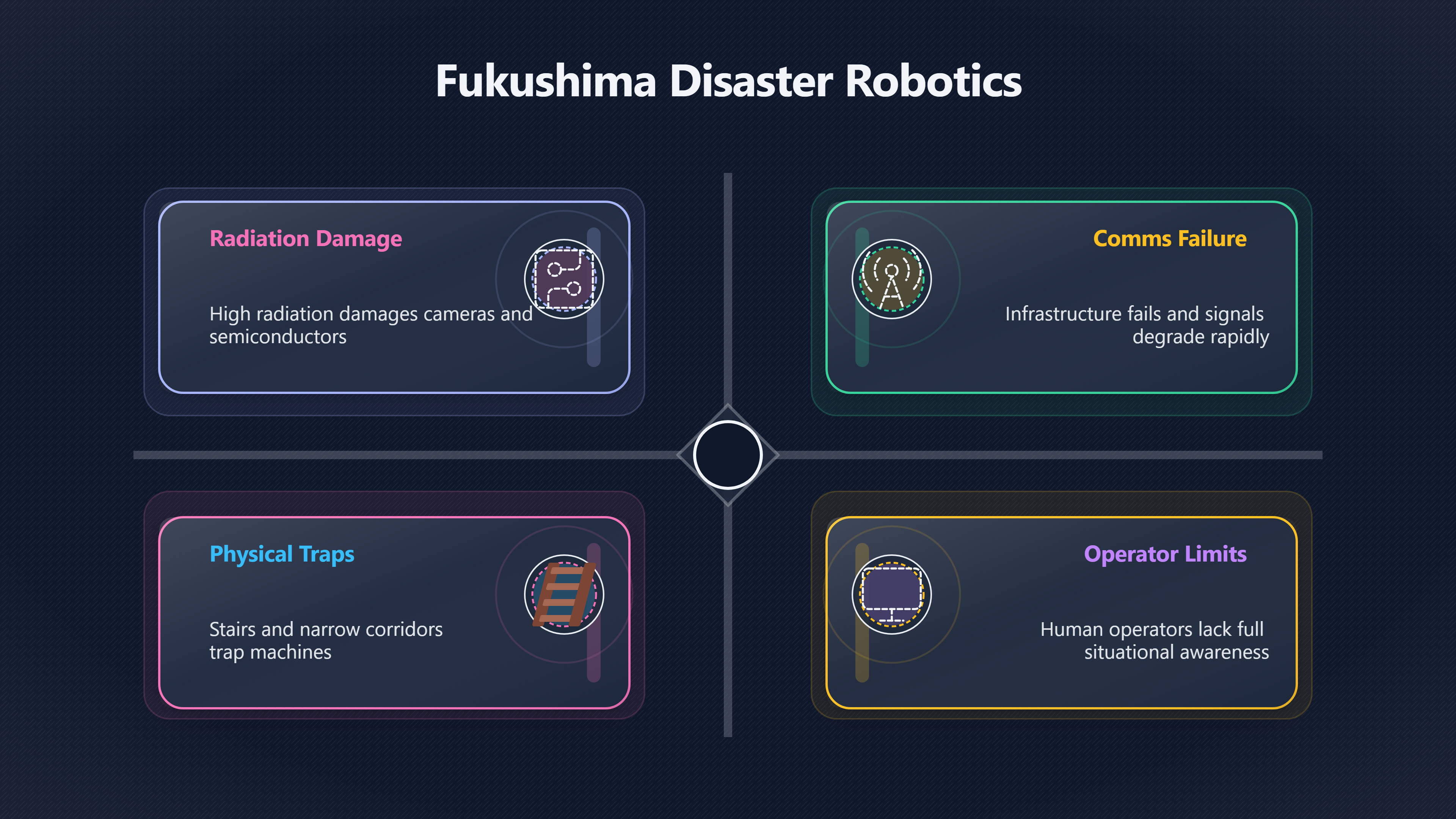
Several problems emerged simultaneously:
- Radiation damaged electronics.
- Communications infrastructure failed.
- Stairs, rubble, and narrow corridors trapped robots.
- Machines built for demonstrations struggled in chaotic conditions.
- Human operators had incomplete situational awareness.
The disaster nevertheless accelerated investment in emergency robotics worldwide. DARPA explicitly cited Fukushima as motivation for the DARPA Robotics Challenge, a competition intended to develop machines capable of operating in “dangerous, degraded, human-engineered environments”. [IEEE Spectrum]spectrum.ieee.orgdarpas rescuerobot showdownIEEE SpectrumDARPA's Rescue-Robot Showdown31 Dec 2013 — DARPA specifically mentions the Fukushima accident as an example of a disaster th…
The competition asked robots to perform tasks such as:
- Climbing stairs
- Driving vehicles
- Turning valves
- Using tools
- Crossing rubble
- Opening doors
These were not arbitrary engineering puzzles. They reflected a core insight from Fukushima: disaster zones are usually built for humans. A useful emergency robot must interact with human infrastructure under damaged conditions.
The challenge also deliberately degraded communications between robots and operators to simulate real disaster environments. [Scientific American]scientificamerican.comfukushima disaster inspires better emergency response robotsThe course is designed to…Read more…
The resulting machines were often slow, awkward, and prone to falling over. Public videos of robots collapsing became internet comedy material. But the deeper lesson was more important: reliable operation in chaotic real-world environments is vastly harder than controlled factory automation.
Bomb disposal and the quiet success of teleoperated robots
Not all disaster robotics is futuristic. Bomb disposal robots are already a mature and widely accepted technology.
Explosive ordnance disposal units in many countries routinely deploy remotely operated tracked robots equipped with cameras, articulated arms, and explosive disruptors. These systems allow technicians to inspect suspicious packages, manipulate explosive devices, and perform controlled detonations from safer distances.
Unlike humanoid disaster robots, bomb disposal systems succeeded relatively early because the operational problem is narrower:
- Movement distances are shorter.
- Tasks are more predictable. [jpl.nasa.gov]jpl.nasa.govtwo robots one challenge endless possibilityRobots, One Challenge, Endless PossibilityDec 9, 2014 — An innovative robot developed at JPL will perform several disaster-relief tasks i…
- Human operators remain closely involved.
- Environments are often accessible by radio link.
- Speed matters less than caution.
This reveals an important pattern in robotics progress. Narrowly scoped danger reduction tends to succeed before general autonomy.
Bomb disposal robotics also changed institutional expectations. Once remote handling became practical, many operations that previously required direct human exposure started to look ethically outdated. The threshold for acceptable risk shifted downward.
A similar pattern may emerge in mining and firefighting as robotic systems improve. Once reliable robotic entry becomes normal, sending humans first into unstable tunnels or toxic smoke may increasingly appear unacceptable except in exceptional circumstances.

Firefighting and disaster response beyond the laboratory
Firefighting robots are now used in some industrial fires, chemical incidents, and high-temperature environments where ordinary crews cannot safely approach.
These systems typically prioritise a few specific capabilities:
- Remote water or foam delivery
- Thermal imaging
- Hazard detection
- Structural reconnaissance
- Victim location
Industrial fire robots are especially valuable in petrochemical facilities, fuel depots, and toxic smoke conditions. Some departments now deploy tracked firefighting robots ahead of crews to assess explosion hazards or structural instability. [Shark Robotics]shark-robotics.comShark Robotics How robotics can reduce firefighter injuries?Shark RoboticsHow robotics can reduce firefighter injuries?July 7, 2025 — From remote suppression to real-time data collection, discover…
Search-and-rescue robots have also been used after earthquakes, hurricanes, and building collapses. According to the Center for Robot-Assisted Search and Rescue, deployments stretch back to the World Trade Center attacks in 2001. [Robozaps Blog]blog.robozaps.comhumanoid robots in disaster responseRobozaps BlogRobots in Disaster Response [2026]7 days ago — Search and rescue robots have been deployed in real disasters since 2001 (9/1…
But disaster robotics remains constrained by a harsh reality: the worst disasters are often exactly the places where machines work least reliably.
Smoke blinds cameras. Rubble blocks tracks. Water destroys electronics. Communications fail inside concrete structures. Batteries drain quickly. Terrain changes unexpectedly after aftershocks or secondary collapses.
Human responders are still vastly better at improvisation in ambiguous environments.
For that reason, many current systems are designed less as “replacement firefighters” and more as force multipliers:
- scouting ahead,
- carrying sensors,
- mapping hazards,
- transporting supplies,
- or operating briefly in zones too dangerous for sustained human presence.
Radiation zones and the problem of machine fragility
Radiation environments reveal another important truth about robotics: machines are not invulnerable simply because they are not biological.
High radiation damages cameras, semiconductors, sensors, and wiring. Some Fukushima robots failed after relatively limited exposure. Radiation-hardened systems exist, but they are expensive and often less capable than conventional electronics.
Even so, robotics can dramatically reduce cumulative exposure for human workers. Nuclear decommissioning agencies increasingly use robots for inspection, waste handling, and remote manipulation precisely because long-term radiation exposure is difficult to eliminate otherwise. [nda.blog.gov.uk]nda.blog.gov.ukrobots reduce radioactive risks for workers in nuclear decommissioningRobots reduce radioactive risks for workers in nuclear…25 Jun 2018 — For many years, the nuclear industry has used robots to reduce th…
This matters beyond nuclear accidents alone. If advanced civilisation expands into harsher industrial environments — deep geothermal drilling, extreme manufacturing, orbital construction, asteroid mining, or contaminated climate-repair zones — robotics may become a prerequisite for keeping humans physically distant from chronic danger.
In that sense, disaster robotics may be an early version of a broader civilisational pattern: machines extending human reach into environments that biological bodies cannot safely tolerate.
The limits of remote operation
Popular discussion sometimes imagines a clean division where robots do the dangerous work while humans remain safely removed. Real operations are messier.
Most extreme-site robots still depend heavily on teleoperation, meaning a human operator remotely controls many actions. That creates several persistent problems.

Communication delays and signal loss
Underground tunnels, thick concrete, metal structures, and collapsed buildings disrupt radio signals. Robots may lose contact precisely when conditions become most dangerous.
This was one reason the DARPA Robotics Challenge emphasised degraded communications. Researchers recognised that uninterrupted broadband control is unrealistic during disasters. [Scientific American]scientificamerican.comfukushima disaster inspires better emergency response robotsThe course is designed to…Read more…
Human cognitive overload
Remote operators often rely on incomplete camera feeds and noisy sensor data. Controlling a robot in rubble can resemble “looking through a straw” while attempting delicate physical actions.
A robot may technically survive the environment while the operator lacks enough situational awareness to use it effectively.
Reliability versus autonomy
Greater autonomy could reduce operator burden, but fully autonomous systems introduce new concerns:
- unexpected behaviour,
- navigation errors,
- unsafe decisions,
- and accountability problems if something goes wrong.
In many safety-critical industries, operators still prefer predictable semi-autonomous machines over fully independent systems.
Responsibility when systems fail
If a robot malfunctions during a rescue attempt, responsibility becomes complicated.
Questions include:
- Did the operator make a poor decision?
- Did engineers inadequately test the system?
- Did managers deploy the robot beyond safe parameters?
- Did overconfidence in automation delay human intervention?
These accountability issues become sharper as AI systems gain more decision-making authority.
What extreme-site robotics says about the wider AI future
Disaster and mining robots are a useful test case for broader claims about AI abundance and human flourishing because the benefits are unusually concrete.
The argument is not mainly speculative. Few people believe humans are intrinsically enriched by crawling into radioactive buildings or entering tunnels after methane explosions. The humanitarian case for robotic substitution is comparatively strong.
But these systems also expose the limits of technological optimism.
The hardest environments remain difficult for machines because the real world is chaotic, partially observable, and physically unforgiving. Robots that look impressive in demonstrations often struggle in smoke, mud, darkness, debris, or damaged infrastructure.
That tension is important for the larger AI bloom debate.
The optimistic view is not simply that robots will replace labour cheaply. It is that sufficiently capable systems could help civilisation reduce suffering, danger, and physical drudgery at large scale. Extreme-site robotics offers one of the clearest examples where even partial success already improves human welfare.
At the same time, the field demonstrates that capability advances arrive unevenly. Reliable operation in harsh physical environments may require decades of engineering beyond headline AI breakthroughs. Better reasoning systems alone are not enough. Real-world robotics also depends on batteries, materials science, sensing, communications, rugged hardware, and careful integration with human teams.
The likely long-term outcome is neither total automation nor permanent human dominance in dangerous work. It is a gradual redistribution of risk. Machines increasingly absorb the first entry into unstable or toxic environments, while humans supervise, intervene, and handle the most ambiguous decisions.
If that trajectory continues, one measure of technological progress may simply be this: how few people civilisation still asks to risk death doing work that a machine could plausibly do instead.
Endnotes
-
Source: pmc.ncbi.nlm.nih.gov
Title: PMCUnderground mine rescue robotic systems: insights into
Link: https://pmc.ncbi.nlm.nih.gov/articles/PMC12932144/Source snippet
PMCby R Bakzadeh · 2026 · Cited by 1 — Robotic assistance offers the potential to reduce unnecessary human exposure during such operation...
-
Source: mdpi.com
Link: https://www.mdpi.com/2218-6581/14/11/148Source snippet
Rescue robots are classified as field robots, built to operate in unstructured, dynamic, and high-risk...
-
Source: spectrum.ieee.org
Title: darpas rescuerobot showdown
Link: https://spectrum.ieee.org/darpas-rescuerobot-showdownSource snippet
IEEE SpectrumDARPA's Rescue-Robot Showdown31 Dec 2013 — DARPA specifically mentions the Fukushima accident as an example of a disaster th...
-
Source: researchgate.net
Link: https://www.researchgate.net/publication/260530940_Development_of_Search-and-rescue_Robots_for_Underground_Coal_Mine_ApplicationsSource snippet
ResearchGateDevelopment of Search-and-rescue Robots for...May 1, 2014 — The design and development experiences may provide a reference f...
Published: May 1, 2014
-
Source: arxiv.org
Link: https://arxiv.org/abs/2110.05911Source snippet
arXivSystem for multi-robotic exploration of underground environments CTU-CRAS-NORLAB in the DARPA Subterranean ChallengeOctober 12, 2021...
Published: October 12, 2021
-
Source: arxiv.org
Link: https://arxiv.org/abs/2207.04914 -
Source: darpa.mil
Link: https://www.darpa.mil/research/programs/darpa-robotics-challengeSource snippet
DARPA Robotics Challenge (DRC)The DARPA Robotics Challenge (DRC) is a competition of robot systems and software teams vying to develop ro...
-
Source: shark-robotics.com
Title: Shark Robotics How robotics can reduce firefighter injuries?
Link: https://www.shark-robotics.com/how-robotics-can-reduce-firefighter-injuries/Source snippet
Shark RoboticsHow robotics can reduce firefighter injuries?July 7, 2025 — From remote suppression to real-time data collection, discover...
Published: July 7, 2025
-
Source: blog.robozaps.com
Title: humanoid robots in disaster response
Link: https://blog.robozaps.com/b/humanoid-robots-in-disaster-responseSource snippet
Robozaps BlogRobots in Disaster Response [2026]7 days ago — Search and rescue robots have been deployed in real disasters since 2001 (9/1...
-
Source: nda.blog.gov.uk
Title: robots reduce radioactive risks for workers in nuclear decommissioning
Link: https://nda.blog.gov.uk/robots-reduce-radioactive-risks-for-workers-in-nuclear-decommissioning/Source snippet
Robots reduce radioactive risks for workers in nuclear...25 Jun 2018 — For many years, the nuclear industry has used robots to reduce th...
-
Source: darpa.mil
Title: robotics challenge trial
Link: https://www.darpa.mil/news/2013/robotics-challenge-trialSource snippet
DARPA Robotics Challenge Trials Get Off to a Positive Start21 Dec 2013 — The two-day competition has drawn teams from around the world wi...
-
Source: darpa.mil
Title: robots elicit cheer
Link: https://www.darpa.mil/news/2015/robots-elicit-cheerSource snippet
s, Gasps and Groans6 Jun 2015 — DARPA Robotics Challenge Finals test state-of-the-art robots' ability to perform tasks related to disaste...
-
Source: spectrum.ieee.org
Title: darpa robotics challenge here are the official details
Link: https://spectrum.ieee.org/darpa-robotics-challenge-here-are-the-official-detailsSource snippet
Robotics Challenge: Here Are the Official Details10 Apr 2012 — Want to win $2 million? Build a robot that can drive a truck, operate powe...
-
Source: spectrum.ieee.org
Title: particle 1
Link: https://spectrum.ieee.org/meet-the-robots-of-fukushima-daiichi/particle-1Source snippet
the Robots of Fukushima DaiichiRobots are surveying radiation levels and starting the cleanup. The PackBot, an inspection bot from iRobot...
-
Source: researchgate.net
Title: 309414209 Robot Assisted Smart Firefighting and Interdisciplinary Perspectives
Link: https://www.researchgate.net/publication/309414209_Robot-Assisted_Smart_Firefighting_and_Interdisciplinary_PerspectivesSource snippet
Robot-Assisted Smart Firefighting and Interdisciplinary...7 Sept 2016 — This paper provides a review on the robot-assisted firefighting...
-
Source: scientificamerican.com
Title: fukushima disaster inspires better emergency response robots
Link: https://www.scientificamerican.com/article/fukushima-disaster-inspires-better-emergency-response-robots/Source snippet
The course is designed to...Read more...
-
Source: tandfonline.com
Link: https://www.tandfonline.com/doi/abs/10.1080/13669877.2024.2387353Source snippet
Taylor & Francis OnlineWhen hazardous-duty robots met the Fukushima nuclear...by YJ Ji · 2024 · Cited by 5 — This paper explores the pro...
-
Source: dictionary.cambridge.org
Link: https://dictionary.cambridge.org/zht/%E8%A9%9E%E5%85%B8/%E8%8B%B1%E8%AA%9E-%E6%BC%A2%E8%AA%9E-%E7%B9%81%E9%AB%94/humanoidSource snippet
cambridge.orgHUMANOID中文(繁體)翻譯:劍橋詞典HUMANOID翻譯:人形機器人;似人的生物。了解更多。...
Additional References
-
Source: techbriefs.com
Link: https://www.techbriefs.com/component/content/article/31190-darpa-robotics-challenge-winnerSource snippet
DARPA Challenge Winner Transforms from Standing to...The goal was to accelerate progress in robotics and hasten the day when robots have...
-
Source: herox.com
Link: https://www.herox.com/blog/148-the-darpa-robotics-challengeSource snippet
The DARPA Robotics ChallengeDARPA says that the point of the competition is to provide a baseline from which to develop robotics for disa...
-
Source: ehstoday.com
Link: https://www.ehstoday.com/safety/niosh-seeks-proposals-mine-rescue-roboticsSource snippet
NIOSH Seeks Proposals for Mine-Rescue RoboticsNIOSH's Office of Mine Safety and Health Research is seeking proposals for practical roboti...
-
Source: facebook.com
Link: https://www.facebook.com/fox4kc/posts/over-the-weekend-the-kansas-city-fire-department-put-its-remote-controlled-track/1287782249370797/Source snippet
Over the weekend, the Kansas City Fire DepartmentDesigned to enter dangerous areas that are too risky for human firefighters, these robot...
-
Source: cordis.europa.eu
Link: https://cordis.europa.eu/article/id/117049-trending-science-three-european-teams-demonstrate-progress-in-emergency-response-robotics-sinSource snippet
Science: Three European teams demonstrate...Three European teams – including the EU-funded WALK-MAN – will present their emergency-respo...
-
Source: youtube.com
Link: https://www.youtube.com/watch?v=w0tFuzheyK4Source snippet
Fighting wildfires with intelligent robots | AI for Good WebinarThe target use case for intelligent robots and AI is diverse from wildfir...
-
Source: war.gov
Title: human robot teams compete june 5 at darpa finals
Link: https://www.war.gov/News/Article/604732/human-robot-teams-compete-june-5-at-darpa-finals/Source snippet
Human-robot Teams Compete June 5 at DARPA Finals27 May 2015 — In eight days, 25 human-robot teams will compete on the rubble-strewn field...
Published: May 2015
-
Source: jpl.nasa.gov
Title: two robots one challenge endless possibility
Link: https://www.jpl.nasa.gov/news/two-robots-one-challenge-endless-possibility/Source snippet
Robots, One Challenge, Endless PossibilityDec 9, 2014 — An innovative robot developed at JPL will perform several disaster-relief tasks i...
-
Source: nationaldefensemagazine.org
Title: 2015february darpa contest seeking humanoid rescue robot
Link: https://www.nationaldefensemagazine.org/articles/2015/1/31/2015february-darpa-contest-seeking-humanoid-rescue-robotSource snippet
DARPA Contest Seeking Humanoid Rescue Robot1 Feb 2015 — A robot going into a radioactive disaster zone has to remove and manipulate objec...
-
Source: frontiersin.org
Link: https://www.frontiersin.org/journals/robotics-and-ai/articles/10.3389/frobt.2026.1698570/fullSource snippet
FrontiersUnderground mine rescue robotic systems: insights into...by R Bakzadeh · 2026 · Cited by 1 — Robotic assistance offers the pote...
Amazon book picks
Further Reading
Books and field guides related to Robots in Extreme Sites. Use these as the next step if you want deeper reading beyond the article.
Disaster Robotics
This book offers the definitive guide to the theory and practice of disaster robotics. It can serve as an introduction for researchers an...
AI and Robotics Applications in Disaster Response
"AI and Robotics Applications in Disaster Response" explores the innovative use of artificial intelligence and robotics in managing emerg...
Disaster Robotics
This book introduces readers to the latest findings on disaster robotics. It is based on the ImPACT Tough Robotics Challenge, a national...

eBay marketplace picks
Marketplace Samples
Example marketplace items related to this page. Use the search link to explore similar finds on eBay.

Example eBay listing
A.I. Artificial Intelligence Original Movie Poster Signed By Jude Law
USD 125.00 | Shipping USD 25.00 | US

Example eBay listing
Artificial Intelligence D/S Original Movie Poster - 27 x 40"
USD 19.50 | Shipping USD 13.65 | US

Example eBay listing
612388 Artificial Intelligence Movie Science Fiction Drama Wall Print Poster
USD 22.95 | Shipping USD 12.95 | JP

Example eBay listing
Companion - Artificial Intelligence Dark Comedy Cinema Film - POSTER 20"x30"
USD 23.99 | Free shipping | US

Example eBay listing
A.I. Artificial Intelligence Movie Film Poster Art Print
GBP 4.99 | Free shipping | GB

Example eBay listing
A I Artificial Intelligence 6 Movie Poster Art Print Print Classic Rare Gallery
GBP 49.00 | Free shipping | GB

Example eBay listing
Artificial intelligence is no a mat Framed Wall Art Poster Canvas Print Picture
GBP 14.99 | Shipping GBP 4.95 | GB

Example eBay listing
A.I. - Artificial Intelligence Movie/Film Poster Art PICTURE / PRINT 9" x 8"
GBP 2.49 | Shipping GBP 1.75 | GB
Topic Tree