Within Hard Limits
Nature as scarce wealth
As manufactured goods become abundant, intact forests, reefs, rivers and wild landscapes may become more valuable and more politically contested.
On this page
- Why mature ecosystems cannot be rapidly manufactured
- The commons problem after material abundance
- AI monitoring, stewardship and political limits
Page outline Jump by section
Introduction
If advanced AI eventually makes energy, manufactured goods, transport, and many services extremely cheap, scarcity does not disappear. It shifts. One of the things most likely to become more valuable is intact nature: old forests, healthy rivers, coral reefs, wetlands, species-rich coastlines, and large wild landscapes that still function as living ecosystems rather than engineered parks.
 That creates a strange possibility for an AI-enabled age of abundance. A civilisation capable of manufacturing almost anything may discover that the hardest things to reproduce are precisely the things that evolved slowly without human control. Ancient woodland, deep soil ecology, reef complexity, migratory networks, and biodiversity built over centuries cannot simply be printed on demand. Even where restoration succeeds, mature ecosystems remain path-dependent and time-intensive. The result is that wild nature may increasingly function like a luxury scarce good: deeply desired, politically contested, economically valuable, and vulnerable to capture by wealthy societies and individuals.
This matters because the politics of abundance may become less about access to consumer goods and more about stewardship of irreplaceable commons.
Why mature ecosystems cannot be rapidly manufactured
Modern economies already know how to mass-produce many forms of artificial abundance. Food yields can rise quickly. Buildings can be copied. Solar panels, batteries, and consumer electronics can scale through industrial learning curves. Ecosystems behave differently.
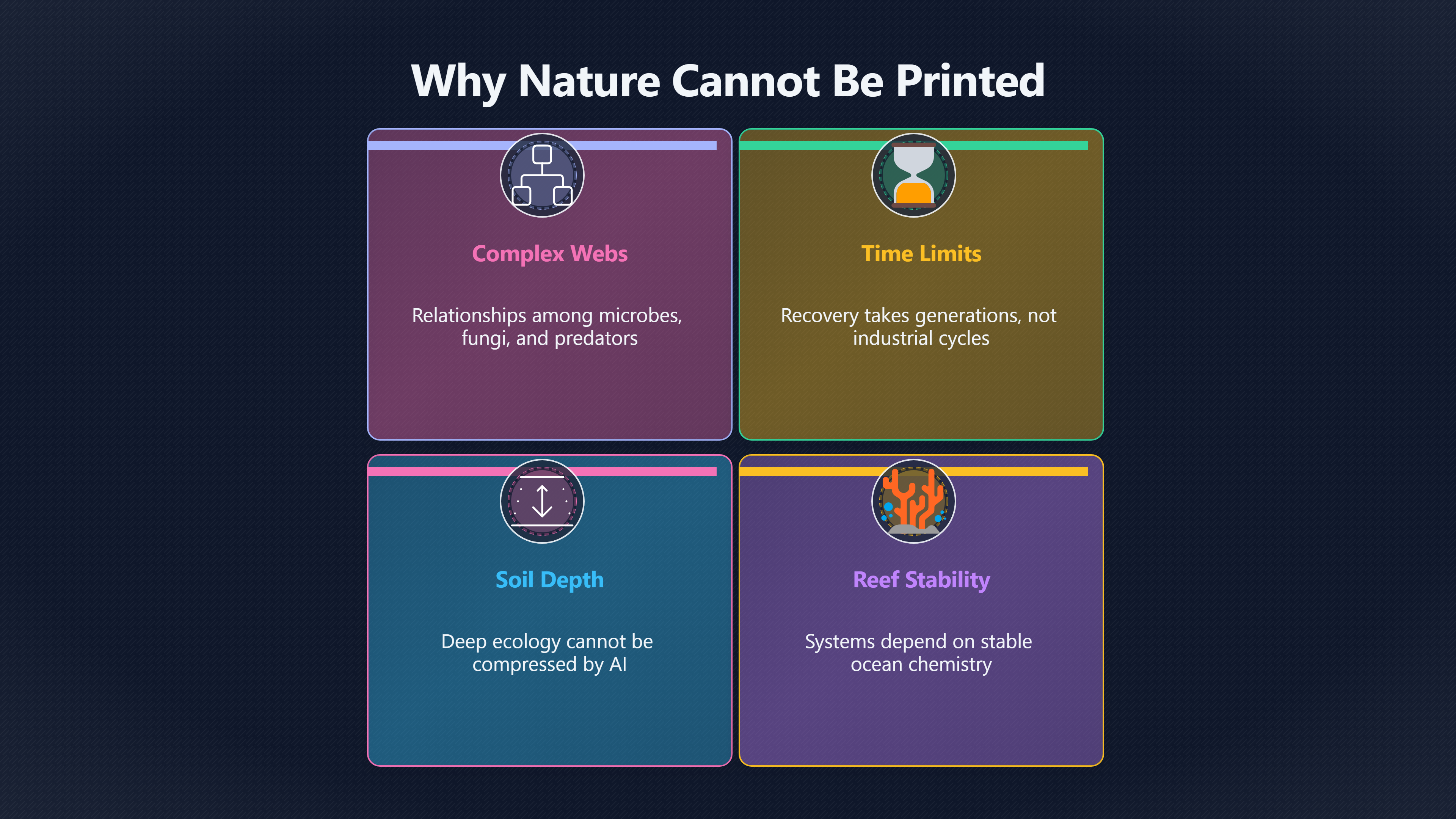
A rainforest is not just “many trees”. A coral reef is not merely coral-shaped material underwater. Mature ecosystems are dense webs of relationships among microbes, fungi, insects, predators, pollinators, climate cycles, soil chemistry, water flows, and evolutionary history. Their value comes partly from accumulated complexity that emerges over long timescales.
Ecological restoration can help damaged systems recover, but restoration science repeatedly stresses that rebuilding ecosystem function is slow, uncertain, and incomplete. The Society for Ecological Restoration defines restoration as assisting recovery rather than perfectly recreating a lost original state. [US Forest Service R&D]research.fs.usda.govUS Forest Service R&DInternational principles and standards for the practice of…June 23, 2020 — by GD Gann · 2019 · Cited by 2357 — SE…
Ancient woodland illustrates the point clearly. Britain’s remaining ancient woods contain ecological relationships that developed continuously over centuries. Once fragmented or replaced, many species communities recover poorly or not at all. Campaigners and ecologists warn that even restoration efforts can take generations to recover lost complexity. [The Guardian]theguardian.comWild Card’s analysis indicates that over the past decade, only 5.8% (2,484 hectares) of publicly owned plantations on ancient woodland si…
Coral reefs reveal another limit. Reef restoration projects can transplant coral fragments or support local recovery, but large reef systems depend on stable ocean chemistry, biodiversity, and climatic conditions. Scientists increasingly warn that many reefs face irreversible tipping points under warming conditions, with restoration unable to match the scale of damage. [Coral Guardian]coralguardian.orgCoral Guardian UN Decade on Restoration: what is coral restoration & whyCoral GuardianUN Decade on Restoration: what is coral restoration & why…June 16, 2021 — 16 Jun 2021 — Coral restoration consists in as…
This creates a crucial distinction between artificial abundance and ecological abundance:
- Manufactured goods scale mainly with energy, materials, and industrial capacity.
- Mature ecosystems scale with time, stability, and evolutionary continuity.
Even highly advanced AI cannot compress all ecological timescales indefinitely. It may accelerate monitoring, simulation, restoration planning, or synthetic biology, but an ecosystem that requires centuries of uninterrupted development still remains scarce in a civilisation only decades into ecological repair.
That makes intact nature economically and emotionally unusual. It becomes one of the few goods whose value may rise precisely because everything else becomes easier to produce.
The paradox of abundance: richer societies may desire wildness more
Historically, environmental destruction often accompanied industrial growth because survival and expansion took priority over conservation. But affluent societies also tend to place higher value on clean air, biodiversity, recreation, and landscape protection once basic needs are secure.
An AI-driven abundance economy could intensify this trend.
If automation reduces dangerous labour and increases leisure time, more people may seek access to beautiful, quiet, ecologically healthy environments. If virtual experiences become hyper-realistic, authentic physical nature may become more culturally prized rather than less. Scarcity itself can increase perceived value. The rarer untouched ecosystems become, the more they may function as symbols of status, identity, meaning, and quality of life.
This dynamic already appears in miniature today:
- Property near protected coastlines or forests often commands large premiums.
- Ecotourism markets depend on access to relatively intact ecosystems.
- Urban populations increasingly compete for proximity to parks, rivers, and cleaner environments.
- Countries market biodiversity and landscape quality as national assets.
In a richer civilisation, the definition of wealth may partly change. Beyond a certain point, another luxury apartment or consumer device adds less value than access to silence, beauty, biodiversity, stable climate, or low-pollution environments.
The irony is that technological success may increase pressure on nature rather than automatically relieving it. If billions of wealthier people want more travel, more coastal access, more wilderness recreation, and more land-intensive lifestyles, ecosystems could face escalating demand precisely during an era of material abundance.
Wild nature as positional wealth
Economist Fred Hirsch argued that some goods are “positional”: their value depends partly on exclusivity and limited access. Ecosystems increasingly fit this category.
An intact river valley cannot simultaneously host mass tourism, dense housing, industrial extraction, and pristine biodiversity. A quiet coastline ceases to be quiet once overcrowded. A wilderness reserve loses part of its ecological and cultural character when overdeveloped.
This means ecological goods remain rivalrous even in a post-scarcity economy.
In practice, several forms of scarcity persist:
- Limited ecological carrying capacity
- Finite land area
- Irreversible biodiversity loss
- Time needed for ecosystem recovery
- Human preference for authentic rather than simulated environments
As abundance expands elsewhere, ecosystems may begin functioning more like cultural treasures or protected heritage assets. Access to them could become increasingly unequal.
One possible future is optimistic: societies become rich enough to preserve large areas permanently, treating biodiversity as civilisational infrastructure rather than exploitable surplus.
Another possibility is less attractive: ecological luxury enclaves emerge where wealthy regions maintain beautiful landscapes through heavy exclusion, while poorer areas bear extraction, pollution, and climate disruption.
That tension already exists globally. High-income countries often preserve domestic landscapes while outsourcing environmentally intensive production abroad. AI abundance does not automatically solve this political economy problem.
The commons problem after material abundance
Environmental economists and political theorists have long argued that ecosystems are difficult to govern because they behave as commons: resources that many people depend upon but no single actor fully controls.
Forests, fisheries, groundwater systems, wetlands, oceans, and the atmosphere all exhibit versions of this problem. Individual actors often gain from exploiting them, while the long-term costs are distributed across society.
Elinor Ostrom’s work challenged the simplistic idea that commons inevitably collapse. She showed that many communities successfully manage shared ecological resources through monitoring, norms, sanctions, local participation, and adaptive governance. [Actu Environnement]actu-environnement.comActu EnvironnementGOVERNING theCOMMONSPage 1. GOVERNING. theCOMMONS. ELINOR OSTROM. The Evolution of Institution… [Wikipedia But abundance could make commons governance simultaneously easier and harder.]WikipediaCommon-pool resourceCommon-pool resourceA common-pool resource (CPR) is a type of good consisting of a natural or human-made resource system (eg an irriga…
Why abundance may help
An AI-rich civilisation could dramatically improve environmental management through:
- Real-time ecosystem monitoring
- Cheap sensors and satellite observation
- Better climate and biodiversity modelling
- Precision agriculture reducing land pressure
- Synthetic substitutes for destructive extraction
- Automated restoration systems
- Lower dependence on environmentally destructive labour
If clean energy becomes abundant, pressure for fossil fuel extraction may decline. If cultivated meat scales successfully, land use for livestock could fall. If desalination and recycling become cheap, water scarcity pressures may ease in some regions.
AI systems may also help governments detect illegal logging, fishing, mining, and pollution at planetary scale.
Why abundance may worsen pressure
At the same time, abundance can increase total consumption.
Historically, efficiency improvements often reduce costs and therefore increase overall demand — a pattern known as the rebound effect or Jevons paradox. Cheaper travel can increase travel volume. Cheaper materials can increase total material throughput. More leisure can increase ecological visitation pressure.
A civilisation with vast productive power could consume ecosystems faster unless strong governance institutions restrain extraction and habitat conversion.
This is especially true because ecological value is unevenly distributed. A few regions contain disproportionately valuable biodiversity. UNESCO sites, tropical rainforests, mangroves, coral systems, and old-growth forests become geopolitical assets as well as ecological ones. [Le Monde.fr]lemonde.frLe Monde.fr UNESC O sites are havens for rare biodiversity under growing threatThey also contain vital ecosystems like the world’s tallest tree and extensive seagrass meadows. A new conservation report by UNESCO and…
The central post-scarcity question becomes political rather than technical:
Who decides which ecosystems remain protected, who gets access, and what trade-offs are acceptable?
AI stewardship may improve management without solving values conflicts
One of the strongest optimistic arguments is that advanced AI could make environmental stewardship radically more competent.
Today, environmental governance is often fragmented, reactive, and information-poor. Regulators struggle to monitor ecosystems in real time. Biodiversity data is incomplete. Enforcement is expensive. Political incentives are short-term.
AI could improve all of these.
Machine learning systems already assist with species recognition, deforestation detection, wildfire forecasting, fisheries monitoring, and ecosystem modelling. In principle, future systems could integrate planetary-scale ecological data continuously and recommend interventions far more effectively than current institutions.
That matters because ecosystems are complex adaptive systems. Human managers frequently discover ecological damage only after collapse thresholds are crossed. Better forecasting and earlier intervention could reduce irreversible losses.
Yet AI stewardship does not eliminate political disagreement.
A highly capable system may predict the ecological effects of a dam, mining project, or coastal development with extraordinary precision. But it still cannot determine society’s values automatically.
Conflicts remain:
- Should some regions remain permanently off-limits to development?
- How much biodiversity loss is acceptable for economic expansion?
- Should future generations have legal claims over present ecosystems?
- Who bears the cost of conservation?
- Should wealthy societies compensate poorer countries for preserving forests or biodiversity?
These are governance questions, not merely optimisation problems.
There is also a risk that “smart stewardship” becomes technocratic justification for elite control. If ecosystems become extremely valuable, governments or corporations may centralise authority over land, water, and biodiversity in the name of efficient management. Surveillance technologies intended for conservation could also expand state or corporate power.
The challenge is therefore dual:
- civilisation may need much better ecological intelligence;
- but it also needs legitimate institutions for deciding how that intelligence is used.
Climate repair does not fully restore lost ecosystems
AI optimism often includes climate repair scenarios: advanced clean energy, carbon removal, geoengineering support systems, precision agriculture, and accelerated restoration.
These tools could substantially reduce environmental damage compared with current trajectories. They may prevent catastrophic biodiversity collapse in many regions.
But avoiding collapse is not the same as recreating lost ecological history.
An ecosystem destroyed today cannot necessarily be reconstructed tomorrow simply because future technology becomes powerful. Extinction remains largely irreversible. Soil systems, species interactions, and evolutionary pathways may disappear permanently.
This is why many conservation scientists increasingly frame biodiversity as natural capital or ecological infrastructure rather than aesthetic luxury alone. Ecosystems provide climate regulation, pollination, water purification, flood protection, fisheries support, and resilience against environmental shocks. [CIEEM]cieem.netNatural Capital and Biodiversity: A Briefing Note for PolicyCIEEMNatural Capital and Biodiversity: A Briefing Note for Policy-…July 7, 2019 — Natural capital refers to the Stock of natural resou… [National Biodiversity Network]nbn.org.ukNational Biodiversity NetworkState of Natural Capital Report for England 20249 Oct 2024 — Increasing biodiversity in our extensive seas a…
In an AI-enabled civilisation, these functions may become more visible economically because advanced modelling makes ecological dependencies easier to measure. Nature could become more legible to markets and governments.
Yet measurement itself introduces another tension. Once ecosystems are financially legible, they also become more easily commodified.
That may help conservation in some cases. It may also encourage speculative ownership, offset schemes of dubious quality, or concentration of control over ecological assets.
A flourishing civilisation may be judged by what it refuses to consume
The optimistic AI bloom vision is often associated with expansion: more intelligence, more energy, more capability, more creation, more freedom from material constraint.
But ecosystems introduce a counterpoint. Some forms of flourishing depend not on maximising production, but on preserving restraint.
A civilisation that can industrialise everything may eventually decide that not everything should be industrialised.
That changes the meaning of wealth. In a world where computation, manufacturing, and synthetic experiences are abundant, the rarest goods may include:
- ancient forests;
- biologically rich oceans;
- dark night skies;
- low-noise landscapes;
- stable climates;
- living evolutionary diversity;
- places minimally shaped by industrial systems.
These become markers not of technological weakness, but of long-term stewardship capacity.
The deepest scarcity in a post-scarcity civilisation may therefore not be production power. It may be the collective discipline required to leave some things partially outside the logic of extraction and optimisation.
Whether advanced AI helps humanity achieve that restraint — or merely accelerates humanity’s ability to consume the remaining wild world — remains one of the defining uncertainties inside the broader AI bloom debate.
Endnotes
-
Source: research.fs.usda.gov
Link: https://research.fs.usda.gov/treesearch/download/60367.pdfSource snippet
US Forest Service R&DInternational principles and standards for the practice of...June 23, 2020 — by GD Gann · 2019 · Cited by 2357 — SE...
Published: June 23, 2020
-
Source: actu-environnement.com
Link: https://www.actu-environnement.com/media/pdf/ostrom_1990.pdfSource snippet
Actu EnvironnementGOVERNING theCOMMONSPage 1. [GOVERNING]({{ 'ai-bloom-abun/ai-bloom-abun-98d3a6-energy-limits-d5bf69-ai-efficiency-c31719-governing-low-bd9a4c/' | relative_url }}). theCOMMONS. ELINOR OSTROM. The Evol...
-
Source: Wikipedia
Title: Common-pool resource
Link: https://en.wikipedia.org/wiki/Common-pool_resourceSource snippet
Common-pool resourceA common-pool resource (CPR) is a type of good consisting of a natural or human-made resource system (eg an irriga...
-
Source: cieem.net
Title: Natural Capital and Biodiversity: A Briefing Note for Policy
Link: https://cieem.net/wp-content/uploads/2019/07/CIEEM-Natural-Capital-Briefing-for-Policy-Makers-July2019.pdfSource snippet
CIEEMNatural Capital and Biodiversity: A Briefing Note for Policy-...July 7, 2019 — Natural capital refers to the Stock of natural resou...
Published: July 7, 2019
-
Source: Wikipedia
Title: Elinor Ostrom
Link: https://en.wikipedia.org/wiki/Elinor_OstromSource snippet
Elinor OstromIn Governing the Commons, Ostrom summarized eight design principles that were present in the sustainable common pool reso...
-
Source: theguardian.com
Link: https://www.theguardian.com/environment/2025/jul/11/step-up-restoration-ancient-woodland-before-lost-forestry-englandSource snippet
Wild Card’s analysis indicates that over the past decade, only 5.8% (2,484 hectares) of publicly owned plantations on ancient woodland si...
-
Source: coralguardian.org
Title: Coral Guardian UN Decade on Restoration: what is coral restoration & why
Link: https://www.coralguardian.org/en/un-decade-on-restoration-what-is-coral-restoration-why-is-it-useful/Source snippet
Coral GuardianUN Decade on Restoration: what is coral restoration & why...June 16, 2021 — 16 Jun 2021 — Coral restoration consists in as...
Published: June 16, 2021
-
Source: theguardian.com
Link: https://www.theguardian.com/environment/ng-interactive/2025/jun/25/tipping-points-coral-oceans-climate-crisis-marine-ecologistSource snippet
Coral reefs are vital for biodiversity, coastal protection, and local economies. However, half of the world’s live coral has already been...
-
Source: lemonde.fr
Title: Le Monde.fr UNESC O sites are havens for rare biodiversity under growing threat
Link: https://www.lemonde.fr/en/environment/article/2026/04/21/unesco-sites-are-havens-for-rare-biodiversity-under-growing-threat_6752651_114.htmlSource snippet
They also contain vital ecosystems like the world’s tallest tree and extensive seagrass meadows. A new conservation report by UNESCO and...
-
Source: nbn.org.uk
Link: https://nbn.org.uk/wp-content/uploads/2024/11/NERR137-Edition-1-State-of-Natural-Capital-Report-for-England-2024-Risks-to-nature-and-why-it-matters.pdfSource snippet
National Biodiversity NetworkState of Natural Capital Report for England 20249 Oct 2024 — Increasing biodiversity in our extensive seas a...
-
Source: medium.com
Title: Governing the Commons
Link: https://medium.com/%40w_watson/governing-the-commons-1397b74b8eccSource snippet
Introduction | by W WatsonA common pool resource is a natural or man made resource system that is sufficiently large as to make it costly...
-
Source: theguardian.com
Title: elinor ostrom commons rio20
Link: https://www.theguardian.com/global-development/poverty-matters/2012/jun/14/elinor-ostrom-commons-rio20Source snippet
Elinor Ostrom's trailblazing commons research can inspire...14 Jun 2012 — Ruth Meinzen-Dick: The late Nobel laureate Elinor Ostrom's wor...
Additional References
-
Source: capitalscoalition.org
Link: https://capitalscoalition.org/wp-content/uploads/2016/07/CCI-Natural-Capital-Paper-July-2016-low-res.pdfSource snippet
Biodiversity at the heart of accounting for natural capital:Natural capital is an anthropocentric framework for understanding the multipl...
-
Source: systemiq.earth
Link: https://www.systemiq.earth/wp-content/uploads/2025/09/2025_IHLEG_Making-Natural-Capital-Count_fullreport-1.pdfSource snippet
Making Natural Capital CountNature underpins our economies, our societies, and our very survival. Yet, since economic and financial decis...
-
Source: democracy.derbyshire.gov.uk
Link: https://democracy.derbyshire.gov.uk/documents/s20226/Appendix%202%20Natural%20Capital%20Strategy%20for%20Derbyshire.pdfSource snippet
38. Biodiversity and irreplaceable Habitats. Very significant areas of biodiversity stock, known as biodiversity hotspots...Read more...
-
Source: youtube.com
Link: https://www.youtube.com/watch?v=BGYuKz5Qvn8Source snippet
Elinor Ostrom's Design Principles for InstitutionsI explain Elinor Ostrom's seven principles for designing institutions that are communit...
-
Source: un.org
Title: ecosystem restoration and species recovery benefit people and planet
Link: https://www.un.org/en/un-chronicle/ecosystem-restoration-and-species-recovery-benefit-people-and-planetSource snippet
Ecosystem Restoration and Species Recovery Benefit...3 Mar 2022 — Ecosystem restoration offers the opportunity to effectively halt and r...
-
Source: unep-wcmc.org
Title: ecosystem restoration key to future of people and planet new report
Link: https://www.unep-wcmc.org/news/ecosystem-restoration-key-to-future-of-people-and-planet–new-reportSource snippet
Ecosystem restoration key to future of people and planet...5 Jun 2021 — Ecosystem restoration is the process of halting and reversing de...
-
Source: blogs.lse.ac.uk
Title: elinor ostroms work on governing the commons an appreciation
Link: https://blogs.lse.ac.uk/lsereviewofbooks/2012/06/17/elinor-ostroms-work-on-governing-the-commons-an-appreciation/Source snippet
Ostrom's work on Governing The Commons17 Jun 2012 — Leading political scientist Elinor Ostrom passed away on 6 June 2012. Wyn Grant gives...
Published: June 2012
-
Source: youtube.com
Link: https://www.youtube.com/watch?v=VHHhtd6mp-wSource snippet
The economics of biodiversity dasgupta review The economics of biodiversity: Partha Dasgupta Stockholm Resilience Centre...
-
Source: millenniumassessment.org
Link: https://www.millenniumassessment.org/documents/document.356.aspx.pdfSource snippet
Here we show the change in net national savings in 2001 for countries in which...Read more...
-
Source: researchgate.net
Title: Continuing advances in the field will require that
Link: https://www.researchgate.net/publication/260027489_Studying_the_commons_governing_common-pool_resource_outcomes_Some_concluding_thoughtsSource snippet
Studying the commons, governing common-pool resource...The study of common-pool resources has benefited immensely from the contributions...
Amazon book picks
Further Reading
Books and field guides related to Nature as scarce wealth. Use these as the next step if you want deeper reading beyond the article.
Natural Resource and Environmental Economics
This text has been written primarily for the specialist market of second and third year undergraduate and post-graduate students of econo...
Handbook of Environmental Economics
Many of the frontiers of environmental economics research are at the interface of large-scale and long-term environmental change with nat...

Environmental Economics
'Environmental Economics' is about the contribution economics can make to solving environmental problems, and about the questions raised...
Environmental Economics
If environmental protection is costly, how much should we spend on pollution control? Is it worth reducing pollution to zero, or should w...
eBay marketplace picks
Marketplace Samples
Example marketplace items related to this page. Use the search link to explore similar finds on eBay.

Example eBay listing
A.I. Artificial Intelligence Original Movie Poster Signed By Jude Law
USD 125.00 | Shipping USD 25.00 | US

Example eBay listing
Artificial Intelligence D/S Original Movie Poster - 27 x 40"
USD 19.50 | Shipping USD 13.65 | US

Example eBay listing
612388 Artificial Intelligence Movie Science Fiction Drama Wall Print Poster
USD 22.95 | Shipping USD 12.95 | JP

Example eBay listing
Companion - Artificial Intelligence Dark Comedy Cinema Film - POSTER 20"x30"
USD 23.99 | Free shipping | US
Topic Tree