Within Trusted warnings
Impact based warnings
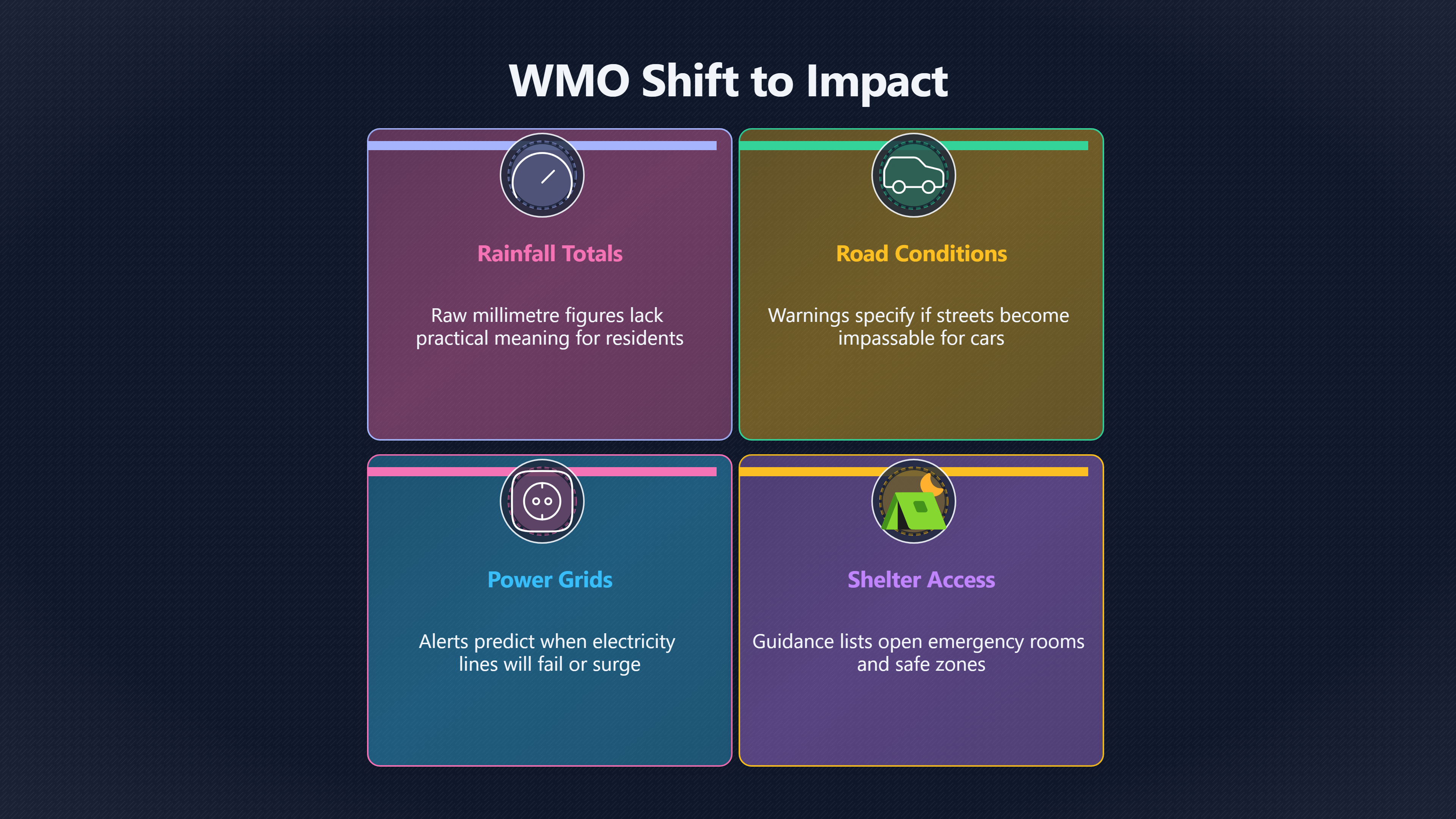
Impact-based warnings translate technical forecasts into practical choices about roads, schools, hospitals, homes, and evacuation.
On this page
- From hazard forecasts to real world consequences
- What people need to know during a flood
- Where AI can help and where institutions still matter
Page outline Jump by section
Introduction
A flood warning that says “120mm of rain expected” may be scientifically accurate and still fail the people who need it most. Most residents do not naturally think in millimetres of rainfall. They think in practical questions: will the road to the hospital flood, should schools close, can elderly relatives evacuate safely, and is the ground floor of the house at risk?
 That is why disaster agencies increasingly focus on impact-based warnings rather than raw hazard data alone. The key shift is from predicting what the weather will be to explaining what the weather will do. The World Meteorological Organization describes this as moving “from hazard to impact”. [World Meteorological Organization]WikipediaWorld Meteorological OrganizationThe World Meteorological Organization (WMO) is a specialized agency of the United Nations responsible…
This distinction matters for the broader question of whether AI can help civilisation coordinate more effectively. Advanced AI systems may greatly improve forecasting accuracy, but human safety depends on whether warnings are trusted, understandable, and tied to real decisions. Better prediction is only useful if societies can translate it into action.
From hazard forecasts to real-world consequences
Traditional weather forecasts focus on physical measurements: rainfall totals, wind speeds, river levels, storm tracks, or probabilities. Those figures matter to meteorologists, engineers, and emergency planners. But they are not always meaningful to the public without context.
A forecast of 80mm of rain can mean very different things depending on where it falls:
- In one area, drainage systems may cope easily.
- In another, the same rainfall may overwhelm ageing infrastructure.
- In steep terrain, it may trigger landslides.
- In dense urban areas, underground transport may flood rapidly.
- In poorer communities, even shallow flooding may destroy homes or contaminate drinking water.
Impact-based forecasting tries to combine the hazard itself with exposure and vulnerability. Instead of merely reporting rainfall, the warning explains expected consequences: flooded roads, dangerous travel conditions, power failures, overwhelmed drainage systems, or likely evacuation zones. [ScienceDirect]sciencedirect.commore… [Anticipation]anticipation-hub.orgWMO Guidelines on Multi-hazard Impact-based Forecast…The guidance provides practical information and case studies on how to move from…
This is partly a communication problem and partly a governance problem. A technically sophisticated AI model may identify flash-flood risk six hours earlier than previous systems, but someone still has to decide:
- Which neighbourhoods receive evacuation orders.
- Whether trains stop operating.
- Which hospitals need backup generators.
- How emergency shelters are opened.
- Which populations need targeted assistance.
The warning becomes valuable when it changes behaviour in time.
The US National Weather Service moved toward “impact-based warnings” precisely because hazard-only alerts often failed to produce clear public responses. Its system now includes explicit impact language intended to support faster decisions by emergency managers and residents. [National Weather Service]weather.govNational Weather ServiceImpact Based WarningsThe National Weather Service (NWS) communicates weather threats to partners and constituents…
The broader lesson reaches beyond weather. Many optimistic visions of AI abundance assume that more information automatically improves coordination. In practice, societies also need institutions capable of interpreting, prioritising, and communicating that information under uncertainty.
What people need to know during a flood
During a fast-moving disaster, people rarely need more raw data. They need decision-relevant guidance.
A family deciding whether to evacuate does not mainly care about atmospheric modelling. They care about timing, safety, transport, and consequences. Useful questions include:
- Which roads are likely to become impassable?
- Is flooding expected on the ground floor or only in basements?
- How quickly will conditions worsen?
- Which areas should leave first?
- Is electricity likely to fail?
- Are emergency shelters open?
- When is it too late to drive?
[Impact-based warnings are designed around these choices.]etrp.wmo.intTHE WMO GUIDELINES ON MULTI-HAZARD IMPACT…These Guidelines are designed to assist WMO Members to progress from weather forecasts and w…
Research on warning communication repeatedly shows that comprehension and behavioural response matter as much as forecast accuracy. Studies in Weather, Climate, and Society emphasise that effective warnings depend on whether people receive, understand, and act on the message. [American Meteorological Society Journals+2American Meteorological Society Journals]
This is especially important during flash floods because the danger is often underestimated. Many deaths occur when drivers attempt to cross flooded roads or when residents delay evacuation because earlier warnings appeared exaggerated.
A rainfall forecast may also fail because ordinary people lack local hydrological knowledge. Few residents know how many millimetres of rain typically overwhelm nearby rivers or drainage systems. But they do understand phrases such as:
- “Cars may be swept away.”
- “Ground-floor flooding expected.”
- “Travel likely to become impossible after 6pm.”
- “Power outages probable in low-lying areas.”
These statements convert abstract probability into actionable judgement.
The challenge becomes even larger in unequal societies. Wealthier households may have insurance, multiple vehicles, remote-working options, and alternative accommodation. Poorer households may face impossible trade-offs between safety and income. A warning that assumes everyone can simply leave may not work in practice.
This is why modern early-warning research increasingly stresses “people-centred” systems rather than forecast systems alone. [ScienceDirect]sciencedirect.commore…
False alarms, trust, and the problem of warning fatigue
One reason impact-based warnings matter is that public trust is fragile.
If authorities repeatedly issue dramatic alerts that do not visibly match lived experience, people may begin ignoring future warnings. Disaster researchers call this the “false alarm effect” or “cry wolf” problem. [University College London]ucl.ac.ukFalse Alarm: An event that does not occur when a warning is issued. Near Miss: An event without a warning that could have caused harm… [PrepareCenter This creates a difficult balancing act:]preparecenter.orgWarnings Briefing Note: False Alarms and Near MissesFalse alarms and near misses can erode public trust in weathe…
- Warnings issued too late cost lives.
- Warnings issued too often erode credibility.
- Overly technical warnings confuse people.
- Overly dramatic warnings may eventually be ignored.
AI can improve parts of this problem while worsening others.
Machine-learning systems can generate more localised and more frequent predictions. They may detect flood risk earlier and model cascading failures more accurately. But more predictions can also mean more alerts, more uncertainty, and more opportunities for public confusion.
Research on warning systems suggests that people respond better when warnings clearly explain expected impacts and behavioural recommendations instead of merely escalating technical severity categories. [American Meteorological Society Journals+2American Meteorological Society Journals]
Trust also depends heavily on institutions and messengers. Residents may believe local emergency managers more than national authorities. They may trust community leaders more than automated alerts. Warnings delivered in inaccessible language or through unreliable channels often fail even when the underlying forecast is correct.
This is a reminder that AI-assisted governance still depends on social legitimacy. A civilisation with extraordinary predictive systems but weak public trust may struggle to coordinate during crises.
Where AI can help and where institutions still matter
[AI is already improving several components of impact-based forecasting.]anticipation-hub.orgIMPACT-BASED FORECASTINGImpact-based forecasts, by communicating the level of certainty within forecasts and warnings, can be issued with…
Machine-learning systems can combine satellite imagery, rainfall forecasts, terrain models, river sensors, traffic information, and historical disaster data at speeds older systems could not manage. This can improve both lead time and geographic precision. NOAA’s “Warn-on-Forecast” programme, for example, aims to extend warning lead times for tornadoes and flash floods by using advanced modelling and prediction systems. [NOAA National Severe Storms Laboratory]nssl.noaa.govNOAA National Severe Storms LaboratoryWarn-on-ForecastWarn-on-Forecast is a NOAA research program tasked to increase tornado, severe thun…
AI may become especially valuable in identifying cascading risks:
- Flooding that cuts hospital access routes.
- Storms likely to trigger power-grid failures.
- Heatwaves that coincide with high air pollution.
- Compound disasters where wind, surge, and rainfall interact.
Impact-based systems increasingly integrate vulnerability data alongside weather hazards themselves. [ScienceDirect]sciencedirect.commore…
In the long run, this points toward a broader possibility associated with the AI bloom thesis: societies that can anticipate problems earlier, coordinate more intelligently, and reduce preventable suffering through better collective foresight.
But forecasting improvements alone are not enough.
Institutions still determine whether:
- evacuation routes exist,
- emergency services are funded,
- vulnerable populations are identified,
- warnings reach disabled or isolated residents,
- infrastructure can withstand extreme weather,
- and governments maintain public credibility.
A highly capable AI system cannot compensate for absent drainage systems, dysfunctional governance, or deep social mistrust.
The World Meteorological Organization’s guidance on impact-based forecasting repeatedly stresses that forecasting agencies must work with disaster authorities, transport systems, utilities, health services, and local governments rather than operate as isolated technical institutions. [etrp.wmo.int]etrp.wmo.intTHE WMO GUIDELINES ON MULTI-HAZARD IMPACT…These Guidelines are designed to assist WMO Members to progress from weather forecasts and w… [PreventionWeb That is an important constraint on technological optimism more broadly. Advanced AI may expand humanity’s predictive power enormously]preventionweb.netwmo guidelines multi hazard impact based forecast and warning servicesWMO guidelines on multi-hazard impact-based forecast…9 Apr 2024 — This guide covers how to shift from weather forecasts and warnings t…, but flourishing depends on whether societies can convert prediction into coordinated action. Information abundance alone does not guarantee institutional competence.
Why this matters beyond weather
Flood warnings are a useful example because they make the coordination problem visible.
A society may possess excellent models and still fail catastrophically if:
- people distrust authorities,
- communication is confusing,
- infrastructure is neglected,
- or vulnerable communities cannot act on the advice.
The same pattern appears in many domains relevant to humanity’s long-term future.
Pandemic forecasting only matters if governments respond early enough. Energy-grid forecasting only matters if infrastructure investment follows. AI-risk forecasting only matters if institutions can coordinate around warnings before crises emerge.
This is why impact-based thinking matters within the wider AI bloom conversation. The optimistic case for advanced AI is not simply that machines become more intelligent. It is that civilisation becomes more capable of seeing consequences early, coordinating effectively, and protecting human flourishing at larger scales and over longer periods.
Weather forecasting shows both the promise and the limitation of that vision.
AI may dramatically improve humanity’s ability to predict hazards. But preserving lives still depends on trust, institutions, communication, infrastructure, and collective action. The future is shaped not only by what societies can foresee, but by what they can successfully respond to together.
Endnotes
-
Source: wmo.int
Link: https://wmo.int/impact-based-forecast-and-warning-servicesSource snippet
World Meteorological OrganizationIMPACT-BASED FORECAST AND WARNING SERVICESTimely, accurate, actionable information on the likelihood and...
-
Source: etrp.wmo.int
Link: https://etrp.wmo.int/pluginfile.php/42254/mod_page/content/18/WMO-1150_multihazard-guidelines_en.pdfSource snippet
THE WMO GUIDELINES ON MULTI-HAZARD IMPACT...These Guidelines are designed to assist WMO Members to progress from weather forecasts and w...
-
Source: sciencedirect.com
Link: https://www.sciencedirect.com/science/article/pii/S2950630126000074Source snippet
more...
-
Source: anticipation-hub.org
Link: https://www.anticipation-hub.org/download/file-2082Source snippet
WMO Guidelines on Multi-hazard Impact-based Forecast...The guidance provides practical information and case studies on how to move from...
-
Source: weather.gov
Link: https://www.weather.gov/impacts/Source snippet
National Weather ServiceImpact Based WarningsThe National Weather Service (NWS) communicates weather threats to partners and constituents...
-
Source: weather.gov
Link: https://www.weather.gov/ffc/ibwSource snippet
National Weather ServiceImpact Based WarningsIBWs are designed to improve communication of the most critical information through the use...
-
Source: sciencedirect.com
Link: https://www.sciencedirect.com/science/article/pii/S2212096322000687Source snippet
ScienceDirectInvest in communication and response to weather early...by EC de Perez · 2022 · Cited by 49 — “People-centered” and “impact...
-
Source: wmo.int
Link: https://wmo.int/activities/early-warnings-all/wmo-and-early-warnings-all-initiativeSource snippet
World Meteorological OrganizationWMO and the Early Warnings for All InitiativeThe Early Warnings for All initiative aims to ensure univer...
-
Source: preparecenter.org
Link: https://preparecenter.org/resource/warnings-briefing-note-false-alarms-and-near-misses/Source snippet
Warnings Briefing Note: [False Alarms]({{ 'ai-bloom-abun/ai-bloom-abun-98d3a6-ai-coordinati-e1e5d8-trusted-ai-wa-71e03a-false-alarms-afc5c7/' | relative_url }}) and Near MissesFalse alarms and near misses can erode pu...
-
Source: nssl.noaa.gov
Link: https://www.nssl.noaa.gov/projects/wof/Source snippet
NOAA National Severe Storms LaboratoryWarn-on-ForecastWarn-on-Forecast is a NOAA research program tasked to increase tornado, severe thun...
-
Source: preventionweb.net
Title: wmo guidelines multi hazard impact based forecast and warning services
Link: https://www.preventionweb.net/publication/wmo-guidelines-multi-hazard-impact-based-forecast-and-warning-servicesSource snippet
WMO guidelines on multi-hazard impact-based forecast...9 Apr 2024 — This guide covers how to shift from weather forecasts and warnings t...
-
Source: wmo.int
Link: https://wmo.int/media/news/wmo-updates-guidelines-multi-hazard-impact-based-forecast-and-warning-servicesSource snippet
World Meteorological OrganizationWMO Updates Guidelines on Multi-Hazard Impact-Based...The World Meteorological Organization is updating...
-
Source: wmo.int
Link: https://wmo.int/Source snippet
World Meteorological Organization WMO: HomepageWMO divides the world into six regions for the purpose of coordinating meteorological acti...
-
Source: repository.library.noaa.gov
Title: noaa 51693 DS1
Link: https://repository.library.noaa.gov/view/noaa/51693/noaa_51693_DS1.pdfSource snippet
Communicating Severity Forecast...by K Semmens · 2023 · Cited by 11 — A relatively new product in the impact-based forecast suite is the...
-
Source: wpo.noaa.gov
Title: weather ready nation for all the demographics of severe weather communication
Link: https://wpo.noaa.gov/weather-ready-nation-for-all-the-demographics-of-severe-weather-communication/Source snippet
The Demographics of...The WRN program aims to enhance the coordination and communication of severe weather information to the government...
-
Source: repository.library.noaa.gov
Title: noaa 34169 DS1
Link: https://repository.library.noaa.gov/view/noaa/34169/noaa_34169_DS1.pdfSource snippet
Warning System - A Social Science Perspectiveby BF McLuckie · 1973 · Cited by 28 — The combination of the high cost of placing an area in...
-
Source: gsl.noaa.gov
Link: https://gsl.noaa.gov/divisions/wids/Source snippet
Information and Decision SupportThe Weather Informatics and Decision Support (WIDS) Division develops state-of-the-art environmental fore...
-
Source: anticipation-hub.org
Link: https://www.anticipation-hub.org/Documents/Manuals_and_Guidelines/RCCC_Impact_based_forecasting_Guide_2021-3.pdfSource snippet
IMPACT-BASED FORECASTINGImpact-based forecasts, by communicating the level of certainty within forecasts and warnings, can be issued with...
-
Source: sciencedirect.com
Link: https://www.sciencedirect.com/science/article/pii/S2212096325000476Source snippet
Evaluating effectiveness of impact-based heatwave...by HS Choi · 2025 · Cited by 2 — The current research assessed whether impact-based...
-
Source: sciencedirect.com
Link: https://www.sciencedirect.com/science/article/pii/S2212420925000585Source snippet
Research gaps and challenges for impact-based forecasts...by SH Potter · 2025 · Cited by 20 — WMO guidelines recommend that accuracy is...
-
Source: youtube.com
Title: Impact-Based Forecasts and Warnings
Link: https://www.youtube.com/watch?v=7ZK53HLQ1NsSource snippet
Impact-based forecasting - ESCAP's approach...
-
Source: youtube.com
Title: Impact-based forecasting
Link: https://www.youtube.com/watch?v=pa08NCVDJ_ESource snippet
Early Warning System; Impact based forecasting...
-
Source: ucl.ac.uk
Link: https://www.ucl.ac.uk/mathematical-physical-sciences/sites/mathematical_physical_sciences/files/briefing_note_false_alarms_and_near_misses.pdfSource snippet
False Alarm: An event that does not occur when a warning is issued. Near Miss: An event without a warning that could have caused harm...
-
Source: Wikipedia
Title: World Meteorological Organization
Link: https://en.wikipedia.org/wiki/World_Meteorological_OrganizationSource snippet
World Meteorological OrganizationThe World Meteorological Organization (WMO) is a specialized agency of the United Nations responsible...
-
Source: dagdok.org
Link: https://www.dagdok.org/w/dd/en/un-system/un-specialized-agencies/wmoSource snippet
26 Sept 2025 — World Meteorological Organization, WMO - was established in 1950 and became a specialized agency of the United Nations in...
-
Source: youtube.com
Title: World Meteorological Organization
Link: https://www.youtube.com/c/worldmetorgSource snippet
WMOThe vision of WMO is to provide world leadership in expertise and international cooperation in weather, climate, hydrology and water r...
-
Source: facebook.com
Link: https://www.facebook.com/WorldMeteorologicalOrganization/Source snippet
Every forecast we issue, every warning we share, every dataset we exchange—coordinated through a global...Read more...
Additional References
-
Source: london-fire.gov.uk
Link: https://www.london-fire.gov.uk/safety/the-workplace/automatic-fire-alarms/Source snippet
Automatic fire alarms and false alarmsIf you have a false alarm, identify the reason for it, then take action to minimise the chance of i...
-
Source: typhooncommittee.org
Link: https://www.typhooncommittee.org/SSOP/Training/DAY%201%20PDF/3_c_3Impact%20based%20forecasting.pdfSource snippet
Impact Based Forecasting and Risk Based WarningWhy impact forecasting? ➢ NMHSs' primary responsibility: timely and accurate forecasts and...
-
Source: heathealth.info
Link: https://heathealth.info/resources/wmo-guidelines-on-multi-hazard-impact-based-forecast-and-warning-services/Source snippet
WMO Guidelines on Multi-hazard Impact-based Forecast...These Guidelines establish a road map that identifies the various milestones from...
-
Source: zcralliance.org
Link: https://zcralliance.org/resources/item/guidelines-on-multi-hazard-impact-based-forecast-and-warning-services-part-ii-putting-multi-hazard-ibfws-into-practice/Source snippet
Guidelines on Multi-hazard Impact-based Forecast and...Published in 2015, WMO Guidelines on Multi-hazard Impact-based Forecast and Warni...
-
Source: meteorologicaltechnologyinternational.com
Link: https://www.meteorologicaltechnologyinternational.com/features/exclusive-feature-how-are-impact-based-forecasts-developing-to-minimize-the-human-and-economic-costs-of-weather-hazards.htmlSource snippet
EXCLUSIVE FEATURE: How are impact-based forecasts...May 17, 2024 — Impact-based forecasting considers the vulnerability of people and pr...
Published: May 17, 2024
-
Source: reliefweb.int
Link: https://reliefweb.int/report/world/wmo-guidelines-multi-hazard-impact-based-forecast-and-warning-services-part-ii-puttingSource snippet
WMO Guidelines on Multi-hazard Impact-based Forecast...9 Dec 2021 — The guidance provides practical information and case studies on how...
-
Source: climateservices.it
Title: early warning to strengthen resilience against weather water and climate events
Link: https://climateservices.it/early-warning-to-strengthen-resilience-against-weather-water-and-climate-events/Source snippet
Early Warning to Strengthen Resilience against Weather...8 Dec 2023 — The “Early Warnings for All” initiative stands as a crucial effort...
-
Source: research.manchester.ac.uk
Title: false alarms and close calls a conceptual model of warning accura
Link: https://research.manchester.ac.uk/en/publications/false-alarms-and-close-calls-a-conceptual-model-of-warning-accuraSource snippet
Research ExplorerFalse alarms and close calls: A conceptual model of warning...by LR Barnes · 2007 · Cited by 275 — The false alarm rate...
-
Source: researchgate.net
Title: 240689290 False Alarms Tornado Warnings and Tornado Casualties
Link: https://www.researchgate.net/publication/240689290_False_Alarms_Tornado_Warnings_and_Tornado_CasualtiesSource snippet
False Alarms, Tornado Warnings, and Tornado Casualties4 Apr 2026 — PDF | This paper extends prior research on the societal value of torna...
-
Source: coe.caribbeanchambers.net
Title: WMO Guidelines on Multi Hazard Impact Based Forecast Warning Services
Link: https://coe.caribbeanchambers.net/wp-content/uploads/2022/12/WMO-Guidelines-on-Multi-Hazard-Impact-Based-Forecast-Warning-Services.pdfSource snippet
WMO Guidelines on Multi-hazard Impact-based Forecast and Warning Services (WMO-No. 1150) was published in 2015...Read more...
Amazon book picks
Further Reading
Books and field guides related to Impact based warnings. Use these as the next step if you want deeper reading beyond the article.
Emergency management
First published 2007. Subjects: Emergency management, Hazard mitigation, Natural disasters.
Introduction to emergency management
First published 2003. Subjects: Emergency management, Etat d'urgence, Secours d'urgence, Gestion de crises, Information management.
Case Studies In Disaster Response And Emergency Management
First published 2013. Subjects: Emergency management, Case studies, POLITICAL SCIENCE / Public Policy / City Planning & Urban Development...
Information systems for emergency management
First published 2010. Subjects: Emergency management, Data processing, Management information systems, Information services, Emergency co...
eBay marketplace picks
Marketplace Samples
Example marketplace items related to this page. Use the search link to explore similar finds on eBay.

Example eBay listing
A.I. Artificial Intelligence Original Movie Poster Signed By Jude Law
USD 125.00 | Shipping USD 25.00 | US

Example eBay listing
Artificial Intelligence D/S Original Movie Poster - 27 x 40"
USD 19.50 | Shipping USD 13.65 | US

Example eBay listing
612388 Artificial Intelligence Movie Science Fiction Drama Wall Print Poster
USD 22.95 | Shipping USD 12.95 | JP

Example eBay listing
Companion - Artificial Intelligence Dark Comedy Cinema Film - POSTER 20"x30"
USD 23.99 | Free shipping | US
Topic Tree