Within AI Forecasts
AI needs physics
AI weather models are powerful, but operational forecasting still relies on physics, observations and institutions that catch failure modes.
On this page
- Why AI models do not replace meteorology outright
- Training data blind spots and physically inconsistent forecasts
- How hybrid systems such as AIFS build operational trust
Page outline Jump by section
Introduction
AI weather forecasting systems such as GraphCast, GenCast and ECMWF’s Artificial Intelligence Forecasting System (AIFS) are among the strongest real-world examples of rapid scientific acceleration. They can generate global forecasts far faster and often more cheaply than traditional numerical weather prediction systems, while matching or exceeding conventional models on many benchmark tests. That matters for the broader AI bloom argument because weather prediction is one of the most demanding scientific tasks routinely attempted at planetary scale. If AI can help humanity model a chaotic atmosphere more effectively, it hints at how machine learning could accelerate discovery across many scientific domains.
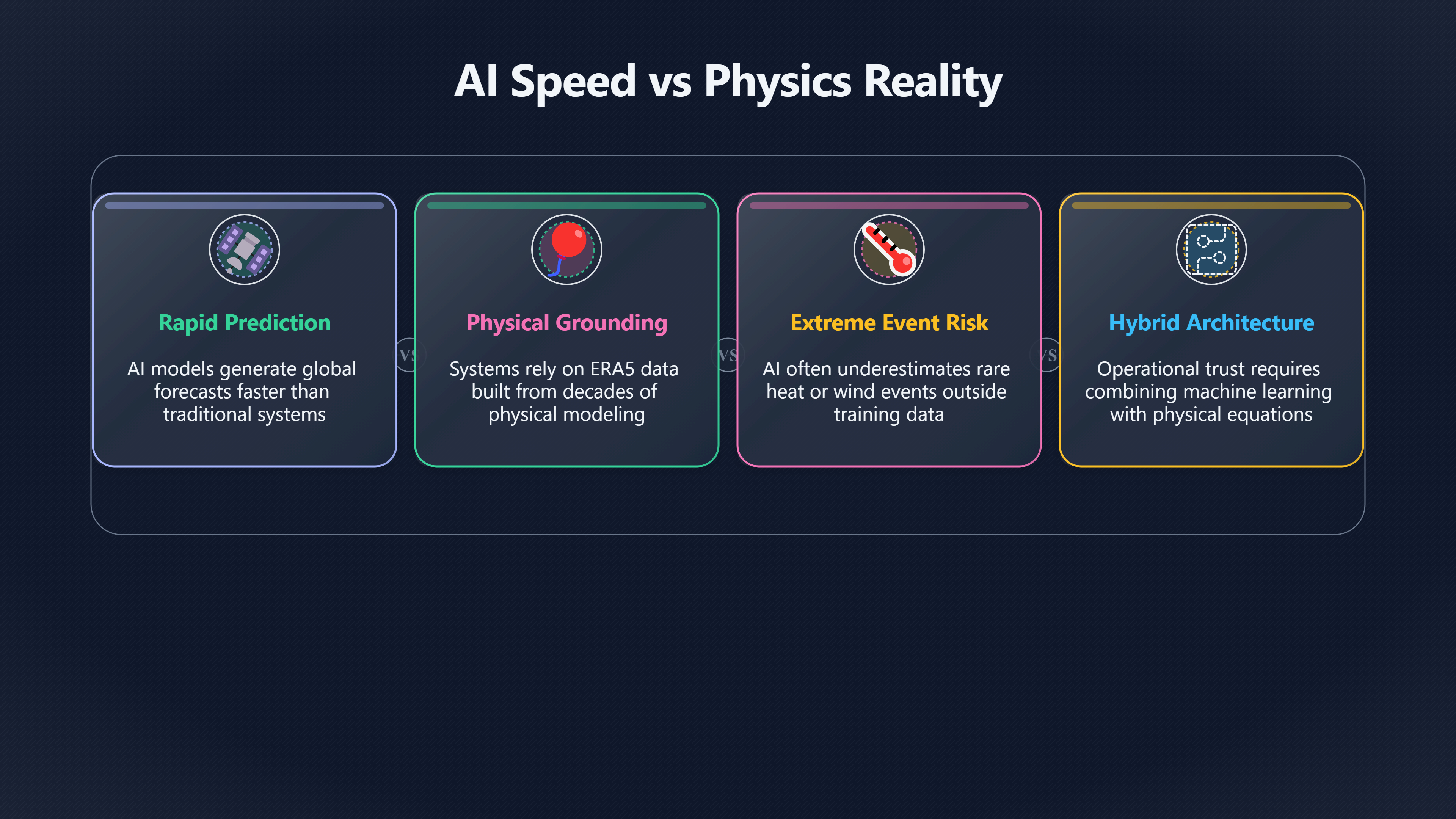
 But the success story has an important qualification. Operational forecasting agencies have not concluded that AI replaces meteorology, physics or forecasting institutions. In practice, the opposite lesson is emerging: the most trusted systems combine machine learning with physical equations, observational infrastructure, human expertise and long-standing forecasting procedures. AI forecasts still need physical grounding because weather is not merely a pattern-recognition problem. It is a real physical system whose behaviour can move outside historical experience, especially in a changing climate. [arXiv]arxiv.orgarXiv AIFS – ECMWF's data-driven forecasting systemarXiv AIFS – ECMWF's data-driven forecasting system [3ECMWF 3ECMWF]
Why operational forecasting cannot rely on accuracy scores alone
Weather forecasting is unusually unforgiving because mistakes have direct public consequences. Forecasts shape evacuation orders, flood preparation, aviation routing, electricity-grid balancing, shipping decisions and emergency planning. A model that looks impressive on average benchmark metrics may still fail in precisely the rare situations that matter most.
That creates a different standard from many consumer AI applications. A forecasting agency does not merely want a model that is often right. It needs a system whose failure modes are understood, monitored and constrained. Meteorologists need to know when a forecast is likely to be unreliable, when unusual atmospheric conditions may break past assumptions, and how to cross-check results against physical expectations.
Traditional numerical weather prediction systems achieve this partly because they are built around explicit physical equations governing atmospheric motion, thermodynamics and fluid dynamics. Even when those systems make errors, forecasters can often trace why. AI systems are more opaque. A neural network may produce an accurate answer without offering a transparent physical explanation for how it arrived there.
This is one reason agencies such as ECMWF are running AI systems alongside conventional Integrated Forecasting System models rather than replacing them outright. ECMWF’s operational strategy increasingly treats machine learning as a complement to physics-based forecasting infrastructure rather than a clean substitute. [ECMWF]ecmwf.intECMWFData-driven ensemble forecasting with the AIFSIn this article, we describe two training approaches for data-driven forecast models t… [ECMWF]ecmwf.ints ai forecasts become operationalECMWFECMWF's AI forecasts become operational25 Feb 2025 — The AIFS is the first fully operational weather prediction open model using mac…
The distinction matters for the broader scientific acceleration debate. AI may dramatically increase the speed of prediction and experimentation, but high-stakes scientific systems still require institutional trust, interpretability and physical validation. Faster prediction alone is not enough.
Training-data blind spots and physically inconsistent forecasts
The biggest conceptual weakness in current AI weather forecasting is that machine-learning systems learn from historical atmospheric data rather than directly reasoning from physical laws.
That works extremely well when future weather resembles the statistical patterns contained in training datasets. But weather systems increasingly encounter conditions that are rare, unprecedented or shifting because of climate change. In these situations, AI models can struggle to extrapolate beyond their historical experience.
Research comparing AI systems with traditional numerical weather prediction has found that AI models often underestimate the severity or frequency of record-breaking events. One recent study concluded that conventional physics-based models still outperform leading AI systems when forecasting unprecedented extremes such as record heat, cold and wind events. The authors argued that AI models tend to pull predictions back toward historically familiar conditions instead of fully representing extremes outside the training distribution. [arXiv]arxiv.orgarXiv AIFS – ECMWF's data-driven forecasting systemarXiv AIFS – ECMWF's data-driven forecasting system
This limitation is especially important because the most socially valuable forecasts are often the rare ones: the once-in-a-decade flood, the unexpected hurricane turn, the heatwave that breaks infrastructure assumptions, or the cascading weather event that triggers agricultural or energy disruption.
Researchers have also identified deeper stability problems. Some AI weather systems can become physically inconsistent over longer forecasting horizons, producing unrealistic atmospheric dynamics or unstable behaviour. One analysis compared this tendency to the way large language models sometimes “hallucinate”. The issue is not identical, but the analogy captures an important point: pattern-learning systems can drift away from physically plausible states when pushed beyond the situations they learned from. [arXiv]arxiv.orgarXiv AIFS – ECMWF's data-driven forecasting systemarXiv AIFS – ECMWF's data-driven forecasting system
These weaknesses do not mean AI forecasting has failed. On many operational metrics, modern AI systems are extremely impressive. But they show why forecasting agencies remain cautious about handing full authority to purely data-driven systems.
Physics is not optional because the atmosphere is not optional
A common misunderstanding is that AI weather systems somehow eliminated the need for physical science. In reality, modern AI forecasting depends heavily on decades of physical modelling infrastructure.
Most leading systems are trained on datasets produced through traditional meteorology, especially ECMWF’s ERA5 reanalysis data. Those datasets are themselves built from enormous physical forecasting systems combined with satellite observations, weather balloons, aircraft measurements, ocean buoys and data-assimilation pipelines developed over decades. [ECMWF]ecmwf.intECMWFMachine learning for numerical weather predictionThe first focuses on hybrid combinations of machine learning and physics, as champi…
In other words, the “intelligence” inside AI forecasting systems partly reflects accumulated physical knowledge embedded in the datasets they learn from.
This dependency becomes clearer when observational systems weaken. Meteorologists have warned that reductions in weather-data collection could damage AI forecasting performance because machine-learning systems rely heavily on high-quality inputs and historical records. Without continuous streams of accurate observational data, even sophisticated AI systems degrade. [The Guardian]theguardian.comweather forecasts, particularly during a time of increasing extreme weather. Despite a slight funding boost to the National Weather Servi…
That creates an important lesson for scientific acceleration more broadly. AI often appears most powerful when attached to strong institutional and scientific foundations rather than when operating independently of them. Scientific progress may accelerate fastest where machine learning amplifies existing measurement systems, physical theory and expert communities.
Hybrid systems are becoming the operational model
The emerging direction in forecasting is not “AI versus physics” but hybrid systems combining both approaches.
ECMWF’s AIFS illustrates this transition. The organisation has developed machine-learning forecasting systems while simultaneously emphasising hybrid architectures, ensemble forecasting and operational coexistence with traditional numerical models. [ECMWF]ecmwf.ints ensemble ai forecasts become operationalECMWF's ensemble AI forecasts become operational1 Jul 2025 — ECMWF has taken the ensemble version of the Artificial Intelligence Forecast… [ECMWF]ecmwf.inthow ai models are transforming weather forecasting showcase dataThis summer, we focused on analysing Huawei's Pangu-Weather…Read more… [ECMWF]ecmwf.intAIFS: a new ECMWF forecasting systemThe first incarnation of the AIFS shows very promising results, replicating the rapid progress that h…
One reason hybrid approaches are attractive is that different systems fail differently. AI models may capture broad atmospheric evolution quickly and efficiently, while physics-based systems may better preserve local physical consistency or handle unprecedented extremes. Combining them can improve robustness.
Recent research on “spectral nudging” hybrid systems demonstrates this logic directly. In these systems, large-scale atmospheric structures are guided by machine-learned forecasts while smaller-scale atmospheric behaviour remains governed by conventional physical models. Researchers reported improved forecasting skill without sacrificing physical realism in key mesoscale processes. [arXiv]arxiv.orgarXiv AIFS – ECMWF's data-driven forecasting systemarXiv AIFS – ECMWF's data-driven forecasting system
Operational trust also depends on ensembles rather than single forecasts. Meteorologists increasingly care not only about the most likely outcome but about uncertainty ranges and alternative trajectories. ECMWF’s work on ensemble AI forecasting reflects this requirement. [ECMWF]ecmwf.intWe are both a research institute and a 24/7 operational service, producing global numerical… [ECMWF]ecmwf.intOpen source on ecmwf.int.
This matters because civilisation-scale resilience depends on uncertainty management as much as raw predictive power. Governments preparing for hurricanes or power-grid failures need probability distributions, confidence estimates and stress-tested scenarios, not just one elegant forecast image.
Why this matters for the wider AI bloom argument
The need for physical grounding does not weaken the broader case that AI could accelerate science enormously. In some ways, it strengthens it by clarifying what real scientific acceleration looks like.
The optimistic vision around AI abundance and long-term human flourishing is sometimes caricatured as a world where machine learning simply replaces existing expertise. Weather forecasting points toward a more complicated and probably more realistic future. AI appears most transformative when it becomes part of a larger scientific system that includes theory, instrumentation, institutions, verification loops and human judgement.
That pattern may generalise far beyond meteorology.
Drug discovery still requires biology, clinical trials and manufacturing. Materials science still requires laboratories and measurement systems. Fusion research still requires reactors and engineering constraints. AI may dramatically compress experimentation cycles and help humans navigate overwhelming complexity, but reality still imposes physical tests.
Weather forecasting is therefore valuable not just because forecasts are improving, but because it shows a plausible model for AI-assisted science overall:
- machine learning accelerates prediction and exploration [ecmwf.int]ecmwf.ints ai forecasts become operationalECMWFECMWF's AI forecasts become operational25 Feb 2025 — The AIFS is the first fully operational weather prediction open model using mac…
- physical models constrain unrealistic outputs
- observational systems continually correct drift
- institutions monitor reliability and failure modes
- humans remain responsible for high-stakes judgement
That hybrid structure may ultimately prove more durable than visions of fully autonomous scientific intelligence detached from empirical grounding.
Faster science still depends on contact with reality
One of the most important themes in the wider AI bloom discussion is whether intelligence can become vastly more abundant. AI weather forecasting suggests the answer may partly be yes. Machine-learning systems can already compress forecasting workloads that once demanded enormous supercomputing resources. That is a genuine acceleration in humanity’s ability to model part of the physical world.
But the same field also demonstrates a constraint that may apply across advanced AI more broadly: intelligence becomes most reliable when tightly coupled to reality-testing systems.
Forecasting models succeed because they face constant correction from the atmosphere itself. Every forecast is checked against observable outcomes. Errors are rapidly exposed. Institutions revise models continuously. Physical reality acts as an unforgiving feedback mechanism.
That may be one reason weather forecasting has become such an important early indicator for the broader future of AI-assisted science. It shows both sides of the story at once:
- AI can dramatically accelerate complex scientific work.
- Physical grounding remains essential for trust, robustness and real-world reliability.
For advocates of long-term human flourishing, this is not merely a cautionary detail. It is part of what makes the optimistic case credible. The strongest path toward scientific abundance may not involve escaping physics, but learning to combine machine intelligence with humanity’s existing scientific foundations in ways that let civilisation understand reality faster, more accurately and at larger scales than before.
Endnotes
-
Source: ecmwf.int
Link: https://www.ecmwf.int/en/newsletter/181/earth-system-science/data-driven-ensemble-forecasting-aifsSource snippet
ECMWFData-driven ensemble forecasting with the AIFSIn this article, we describe two training approaches for data-driven forecast models t...
-
Source: ecmwf.int
Title: s ai forecasts become operational
Link: https://www.ecmwf.int/en/about/media-centre/news/2025/ecmwfs-ai-forecasts-become-operationalSource snippet
ECMWFECMWF's AI forecasts become operational25 Feb 2025 — The AIFS is the first fully operational weather prediction open model using mac...
-
Source: arxiv.org
Title: arXiv AIFS – ECMWF’s data-driven forecasting system
Link: https://arxiv.org/abs/2406.01465 -
Source: arxiv.org
Link: https://arxiv.org/abs/2508.15724 -
Source: ecmwf.int
Link: https://www.ecmwf.int/sites/default/files/elibrary/81699-machine-learning-for-numerical-weather-prediction.pdfSource snippet
ECMWFMachine learning for numerical weather predictionThe first focuses on hybrid combinations of machine learning and physics, as champi...
-
Source: ecmwf.int
Title: s ensemble ai forecasts become operational
Link: https://www.ecmwf.int/en/about/media-centre/news/2025/ecmwfs-ensemble-ai-forecasts-become-operationalSource snippet
ECMWF's ensemble AI forecasts become operational1 Jul 2025 — ECMWF has taken the ensemble version of the Artificial Intelligence Forecast...
-
Source: arxiv.org
Link: https://arxiv.org/abs/2304.07029Source snippet
arXivChallenges of learning multi-scale dynamics with AI weather models: Implications for stability and one solutionApril 14, 2023...
Published: April 14, 2023
-
Source: ecmwf.int
Title: how ai models are transforming weather forecasting showcase data
Link: https://www.ecmwf.int/en/about/media-centre/news/2023/how-ai-models-are-transforming-weather-forecasting-showcase-dataSource snippet
This summer, we focused on analysing Huawei's Pangu-Weather...Read more...
-
Source: ecmwf.int
Link: https://www.ecmwf.int/en/newsletter/178/news/aifs-new-ecmwf-forecasting-systemSource snippet
AIFS: a new ECMWF forecasting systemThe first incarnation of the AIFS shows very promising results, replicating the rapid progress that h...
-
Source: arxiv.org
Link: https://arxiv.org/abs/2603.05570Source snippet
arXivHybrid ensemble forecasting combining physics-based and machine-learning predictions through spectral nudgingMarch 5, 2026...
Published: March 5, 2026
-
Source: ecmwf.int
Link: https://www.ecmwf.int/Source snippet
We are both a research institute and a 24/7 operational service, producing global numerical...
-
Source: ecmwf.int
Link: https://www.ecmwf.int/en/about/who-we-are/staff-profiles/jesper-dramsch -
Source: ecmwf.int
Link: https://www.ecmwf.int/en/about/media-centre/aifs-blog/2026/farewell-external-ai-modelsSource snippet
ompting a discontinuation of their real-time use...
-
Source: ecmwf.int
Link: https://www.ecmwf.int/en/newsletter/182/earth-system-science/update-ai-dop-skilful-weather-forecasts-produced-directlySource snippet
based models designed for the AIFS (Alexe et al., 2024), which will make it...Read more...
-
Source: events.ecmwf.int
Title: AS2025 Chantry
Link: https://events.ecmwf.int/event/418/contributions/4800/attachments/2952/5041/AS2025_Chantry.pdfSource snippet
• Includes interactive notebook on how to run from ECMWF open data, can...Read more...
-
Source: arxiv.org
Link: https://arxiv.org/html/2603.05570Source snippet
Hybrid ensemble forecasting combining physics-based...5 Mar 2026 — The AIFS-ENS-ML was initially trained on ERA5 reanalysis data spannin...
-
Source: arxiv.org
Link: https://arxiv.org/html/2508.15724v1Source snippet
Numerical models outperform AI weather forecasts of...21 Aug 2025 — Restricting the RMSE to record-breaking events, the numerical HRES m...
-
Source: theguardian.com
Link: https://www.theguardian.com/us-news/2026/may/18/trump-cuts-ai-weather-prediction-forecastsSource snippet
weather forecasts, particularly during a time of increasing extreme weather. Despite a slight funding boost to the National Weather Servi...
-
Source: github.com
Link: https://github.com/ecmwf-lab/ai-modelsSource snippet
models need to be installed independently.Read more...
-
Source: metoffice.gov.uk
Title: andy brown ecmwf strategy
Link: https://www.metoffice.gov.uk/binaries/content/assets/metofficegovuk/pdf/research/approach/collaboration/global-seamless-modelling-workshop/andy-brown—ecmwf-strategy.pdfSource snippet
ECMWF strategy and research directions4 Jun 2025 — If you want to have competitive scores with IFS, you need to nudge it to AIFS. And we...
-
Source: Wikipedia
Title: Artificial intelligence
Link: https://en.wikipedia.org/wiki/Artificial_intelligenceSource snippet
Artificial intelligenceArtificial intelligence (AI) is the capability of computational systems to perform tasks typically associated w...
-
Source: linkedin.com
Link: https://www.linkedin.com/posts/jandutton_today-european-centre-for-medium-range-weather-activity-7460081639814176768-T5w2Source snippet
ECMWF Upgrades IFS and AIFS Forecasting SystemsToday European Centre for Medium-Range Weather Forecasts - ECMWF upgraded both the traditi...
-
Source: luckgrib.com
Title: ai forecasting
Link: https://luckgrib.com/tutorials/2026/02/06/ai-forecasting.htmlSource snippet
Machine learning (AI) forecasting6 Feb 2026 — Since mid-2024, ECMWF has been providing their own ML-based model, AIFS.... For the vast m...
Additional References
-
Source: quillbot.com
Link: https://quillbot.com/ai-chatSource snippet
AI ChatUnlock your potential with QuillBot's free AI chat! Brainstorm, draft content, get instant research & overcome writer's block. Try...
-
Source: github.com
Link: https://github.com/google-deepmind/graphcastSource snippet
Google DeepMind GraphCast and GenCastThis package contains example code to run and train the weather models used in the research papers G...
-
Source: facebook.com
Link: https://www.facebook.com/groups/290537574397934/posts/9892943294157266/Source snippet
Limitations of AI-powered weather forecasting for...Our results show GraphCast is more accurate than ECMWF's deterministic operational f...
-
Source: deepmind.google
Title: graphcast ai model for faster and more accurate global weather forecasting
Link: https://deepmind.google/blog/graphcast-ai-model-for-faster-and-more-accurate-global-weather-forecasting/Source snippet
GraphCast: AI model for faster and more accurate global...14 Nov 2023 — GraphCast predicts weather conditions up to 10 days in advance m...
-
Source: articsledge.com
Title: Explore how Graph Cast, Pangu-Weather, and AIFS work, their real
Link: https://www.articsledge.com/post/ai-weather-forecastingSource snippet
AI Weather Forecasting 2026: Models, Accuracy & Results6 days ago — AI weather forecasting now outperforms traditional models on 90% of m...
-
Source: researchgate.net
Link: https://www.researchgate.net/publication/381428063_On_Some_Limitations_of_Current_Machine_Learning_Weather_Prediction_ModelsSource snippet
sub‐synoptic and mesoscale weather phenomena and lack the fidelity and physical...Read more...
-
Source: britannica.com
Link: https://www.britannica.com/technology/artificial-intelligenceSource snippet
r-controlled robot to perform tasks commonly associated with intelligent beings.Read more...
-
Source: attrecto.com
Link: https://attrecto.com/ai/introduction-the-exponential-impact-of-ai-weather-models/Source snippet
Introduction: The Exponential Impact of AI Weather Models4 Apr 2025 — Notably, Google DeepMind's GraphCast model and ECMWF's Artificial I...
-
Source: dexterenergy.ai
Title: weather models in renewable energy forecasting
Link: https://dexterenergy.ai/news/weather-models-in-renewable-energy-forecasting/Source snippet
The role of traditional and AI weather models in the future...3 Oct 2024 — A review of weather models, exploring their strengths and wea...
-
Source: ibm.com
Link: https://www.ibm.com/think/topics/artificial-intelligenceSource snippet
lem solving, decision making, creativity and autonomy.Read more...
Amazon book picks
Further Reading
Books and field guides related to AI needs physics. Use these as the next step if you want deeper reading beyond the article.

Evidence-Based Climate Science
Evidence-Based Climate Science: Data Opposing CO2 Emissions as the Primary Source of Global Warming, Second Edition, includes updated dat...

Meteorology today
First published 1982. Subjects: Meteorology, Textbooks, Meteorologia, Meteorologie, Météorologie.
Meteorology
First published 2006. Subjects: Textbooks, Atmosphere, Meteorology, Nature/Ecology, Nature.

Dynamic Meteorology
First published 1998. Subjects: Meteorology, Dynamic meteorology, DYNAMIC CHARACTERISTICS, GEOPHYSICS.
eBay marketplace picks
Marketplace Samples
Example marketplace items related to this page. Use the search link to explore similar finds on eBay.

Example eBay listing
A.I. Artificial Intelligence Original Movie Poster Signed By Jude Law
USD 125.00 | Shipping USD 25.00 | US

Example eBay listing
Artificial Intelligence D/S Original Movie Poster - 27 x 40"
USD 19.50 | Shipping USD 13.65 | US

Example eBay listing
612388 Artificial Intelligence Movie Science Fiction Drama Wall Print Poster
USD 22.95 | Shipping USD 12.95 | JP

Example eBay listing
Companion - Artificial Intelligence Dark Comedy Cinema Film - POSTER 20"x30"
USD 23.99 | Free shipping | US

Example eBay listing
A.I. Artificial Intelligence Movie Film Poster Art Print
GBP 4.99 | Free shipping | GB

Example eBay listing
A I Artificial Intelligence 6 Movie Poster Art Print Print Classic Rare Gallery
GBP 49.00 | Free shipping | GB

Example eBay listing
AI - Artificial Intelligence (Poster + Slipcase) Blu-Ray
GBP 10.49 | Free shipping | GB

Example eBay listing
A. I. Artificial Intelligence. Jude Law. Original UK Video Poster.
GBP 8.11 | Shipping GBP 3.38 | GB
Topic Tree