Within Robots and Work
Robot Safety Gaps
Many robot risks appear when people enter machine spaces for repair, testing or adjustment rather than during normal operation.
On this page
- Why non routine work is dangerous
- Crushing, trapping and struck by hazards
- Designing safeguards around real maintenance
Page outline Jump by section
Introduction
Robot accidents often happen at the exact moment when a machine is supposed to be “safe”. Industrial robots are usually heavily guarded during normal production, with fences, light curtains, sensors and programmed movement zones. But maintenance, setup, troubleshooting and testing temporarily break those protections. Workers enter the robot’s space, bypass safeguards, jog machines manually, clear jams, recalibrate sensors or restart systems after faults. That is where many serious injuries occur. OSHA has repeatedly warned that robot accidents frequently happen during non-routine operations such as programming, maintenance, testing and adjustment rather than ordinary automated production. [OSHA]osha.govOSHARobotics - Overview | Occupational Safety and Health…Studies indicate that many robot accidents occur during non-routine operating… [OSHA]osha.govGuidelines For Robotics SafetySep 21, 1987 — This instruction provides guidelines to OSHA compliance officers, employers, and employees f…
 This matters far beyond factory compliance paperwork. One of the strongest arguments for robotics in an AI-enabled future is that machines could remove people from dangerous, degrading and physically punishing work. But if automation merely relocates danger into maintenance bays and emergency interventions, the promise becomes weaker and more uneven. A humane robotics transition depends not only on what robots can do autonomously, but on whether real workplaces remain safe during the messy, human parts of operation.
Why non-routine work becomes dangerous
A robot on a production line is often predictable. Its movements are mapped, repeated and isolated. The danger grows when something unusual happens.
Maintenance work changes the entire safety logic of an automated system:
- Guards may be opened.
- Lockouts may be bypassed temporarily.
- Multiple workers may enter the robot cell.
- The machine may operate in “teach” or “jog” mode.
- Sensors may be disabled for calibration.
- Fault recovery may require physical contact with machinery.
- Production pressure may encourage shortcuts.
This creates a paradox. The robot is safest when humans are far away and the system behaves normally. But factories still require humans for inspection, adjustment, repair, cleaning and recovery from unexpected conditions.
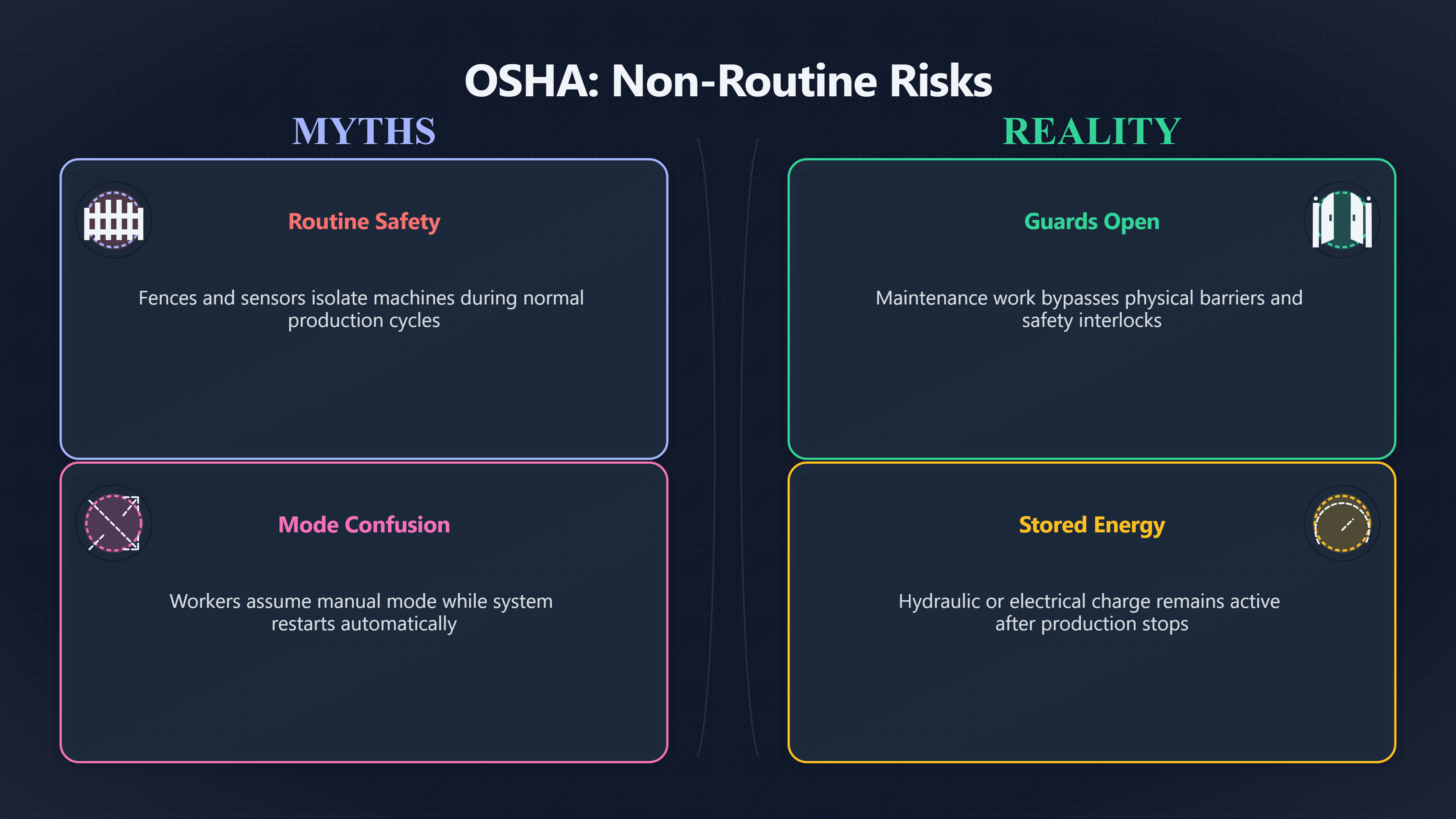
OSHA guidance repeatedly notes that workers are often injured when they temporarily enter a robot’s “working envelope” during these interventions. [OSHA]osha.govTechnical Manual (OTMOSHAOSHA Technical Manual (OTM) - Section IV: Chapter 4This chapter is intended as a guide to robot systems found in industrial applicati… [OSHA]osha.govHazard RecognitionHazards are present in every work environment. Being unaware of them when dealing with robotics can be fatal. The follo… The machine may suddenly restart, complete an interrupted cycle, release stored energy or move in a way the worker did not expect.
Researchers studying industrial robot maintenance found that many maintenance tasks involved workers entering hazardous robot spaces while drive power remained available. Unexpected motion was a central risk. [CDC Stacks]stacks.cdc.govStacksUnexpected motion hazard exposures on a large robotic…by J Etherton · 1989 · Cited by 4 — Description: To assess the degree of u…
The underlying problem is not usually that robots become evil or uncontrollable. It is that complex automated systems are difficult to place into a truly safe state while still allowing diagnosis, calibration and repair.
Crushing, trapping and struck-by hazards
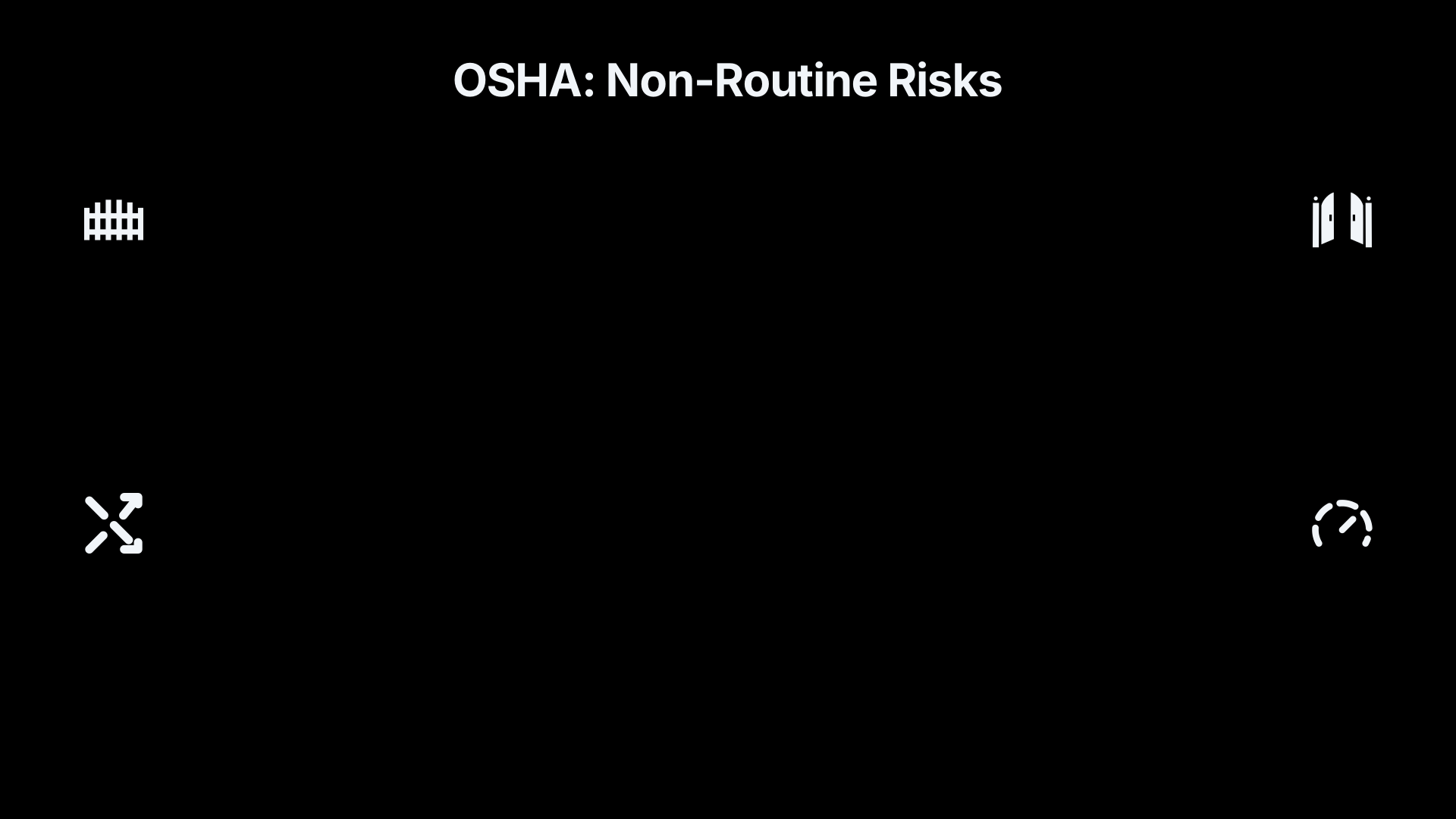
Robot maintenance injuries are often brutally physical. NIOSH and OSHA repeatedly identify crushing, trapping and struck-by incidents as core hazards in robot workplaces. [CDC]stacks.cdc.govStacksUnexpected motion hazard exposures on a large robotic…by J Etherton · 1989 · Cited by 4 — Description: To assess the degree of u… [OSHA]obis.osha.gov4. industrial robots and robot system safetyThis instruction includes safety considerations necessary to operate the robot properly and u…
Crushing between robot and structure
Many industrial robots are large, fast and extremely strong. A worker standing between a robotic arm and a fixed object may have little chance to escape if the machine moves unexpectedly.
One widely cited fatal case involved a die-cast operator pinned by a robot arm. [CDC]cdc.govCDCRobotics in the Workplace: An OverviewFeb 9, 2024 — Hazards to workers might include: Struck-by or caught-between hazards; Crushing an… More recent incidents continue to show similar patterns. NIOSH described construction workers seriously injured after becoming trapped between a demolition robot and a solid structure. [CDC]cdc.govFatal accident summary report: die cast operator pinned by robot. FACE Report 84-020, 1984. CDC. Electrocution of a truck…Read more…
These accidents are especially dangerous because robots do not react like humans. A person who bumps into someone may stop instinctively. A robot following programmed motion can continue applying force until an emergency stop activates or power is removed.
Unexpected restart and stored energy
Maintenance workers often assume a machine is inactive because production has halted. But industrial systems can retain dangerous energy sources:
- electrical charge
- hydraulic pressure
- pneumatic pressure
- gravitational load
- programmed restart sequences
- remote control signals
A jammed mechanism may suddenly release. A robot paused mid-cycle may continue movement when a fault clears. Another linked machine in the production cell may activate automatically.
This is one reason lockout-tagout procedures — physically isolating equipment from power sources before maintenance — are so important in industrial safety. Yet real factories often operate under intense pressure to minimise downtime, creating incentives for partial shutdowns instead of complete isolation.
Human attention narrows under production pressure
Maintenance work is cognitively demanding. Technicians diagnose faults, interpret alarms, test motion systems and coordinate with operators, often while managers push to restart production quickly.
That combination increases the likelihood of human error:
- entering the wrong zone
- assuming power is isolated
- forgetting a second robot in the cell
- misunderstanding machine state
- bypassing an interlock temporarily and forgetting to restore it
Robot systems also create “mode confusion”. A worker may believe the machine is in manual mode while another operator switches it back to automatic operation elsewhere in the system.
Modern factories can contain interconnected robots, conveyors, machine tools and software systems. The danger no longer comes from one isolated machine alone, but from the interactions between systems.
The hidden danger of “safe” collaborative robots
Collaborative robots, or cobots, are often marketed as safer because they are designed to work near humans. They may include force-limiting systems, collision detection and slower operating modes.
But “safer” does not mean harmless.
Maintenance and setup remain risky even with collaborative systems because:
- end effectors can still pinch or cut
- payloads can fall
- multiple robots may interact unpredictably
- software faults can produce unintended movement
- workers may trust the system too much
As robot systems become easier to deploy, smaller firms without deep safety engineering expertise may adopt them rapidly. That can widen the gap between technical capability and safe integration.
The newer ISO 10218 revisions increasingly emphasise system-level safety rather than treating the robot alone as the safety boundary. [ISO]iso.orgISOISO 10218-1:2025 - Robotics — Safety requirementsISO 10218-1 establishes guidelines for the safety requirements specific to industrial… [Automate]automate.orgupdated iso 10218 faqUpdated ISO 10218 | Answers to Frequently Asked…Mar 20, 2025 — ISO 10218 is the foundational safety standard for industrial robots, pr… That shift reflects a growing recognition that accidents often emerge from the whole work environment: software, tooling, maintenance practice, access control and human behaviour together.
Why automation can shift danger instead of removing it
The optimistic vision of robotics is compelling because it promises liberation from drudgery. AI-guided machines could eventually handle mining, waste sorting, dangerous manufacturing, toxic clean-up, disaster response and other harmful work.
But maintenance failures reveal an important truth about technological progress: risk is often redistributed before it is eliminated.
Historically, industrial automation reduced many repetitive injuries and some direct hazards. Yet it also created new categories of work:
- systems maintenance
- sensor calibration
- emergency troubleshooting
- software supervision
- robotic inspection
- high-voltage diagnostics
These jobs are usually less physically repetitive than assembly-line labour, but they can involve concentrated bursts of severe danger.
This creates an uneven labour pattern. Most workers may become safer overall, while a smaller group of technicians absorbs highly technical and potentially catastrophic risks.
An AI-rich economy could intensify this divide if society treats maintenance labour as invisible infrastructure rather than skilled safety-critical work deserving strong protections, training and bargaining power.
Designing safeguards around real maintenance
The central lesson from robot safety research is simple: systems must be designed around actual human behaviour during maintenance, not idealised procedures on paper.
Effective safeguards usually combine several layers
Single protections fail surprisingly often. Modern robot safety therefore relies on overlapping systems:
- physical barriers and fencing
- interlocked access gates
- emergency stop systems [* lockout-tagout procedures]sorarobotic.comsafety standards in robotic automation what you need to know about iso 10218 1 2What You Need to Know About ISO 10218-1/225 Mar 2026 — The EN ISO 14118 standard requires the LOTO (Lockout/Tagout) system to prevent the… [* reduced-speed maintenance modes]linkedin.comiso 10218 22025 setting new standard robot safety kidman ph d qlzpeISO 10218-2:2025 - Setting a new standard in robot safetyOperators and maintenance staff must understand and be familiar with: Safe state…
- pressure-sensitive mats
- light curtains and presence sensors
- clear visual indicators of machine state
- mandatory restart confirmation procedures
ISO safety frameworks increasingly stress that robot applications should default toward safe states and predictable stopping behaviour. Gt-Engineering [Automate]automate.orgrobot safety everything but routineIndustry Insights: Robot Safety, Everything But RoutineAug 20, 2015 — Many robot accidents occur during non-routine tasks. “It's very unl…
The “maintenance reality” problem
Many safety systems work perfectly during audits yet fail under production conditions.
Common real-world problems include:
- operators bypassing sensors to reduce delays
- temporary fixes becoming permanent
- inadequate training for contractors
- poorly labelled restart procedures
- confusing software interfaces
- maintenance staffing shortages
- pressure to restore production rapidly
A system that is technically compliant may still be dangerous if workers cannot realistically follow procedures under time pressure.
This is one reason researchers increasingly treat robot safety as an organisational and economic issue, not merely an engineering one.
AI could improve safety — or complicate it
Advanced AI systems may eventually make robots more adaptive and situationally aware. In principle, that could improve safety:
- detecting human presence more reliably
- predicting hazardous interactions
- monitoring unsafe maintenance patterns
- identifying equipment degradation before failure
- simulating dangerous procedures in advance
But greater autonomy also creates new difficulties. Machine-learning systems can behave less predictably than fixed industrial programs. Networked robots introduce cybersecurity risks. Complex adaptive systems may become harder for workers to interpret during emergencies.
Recent safety standards are beginning to address these issues by integrating cybersecurity, access control and software integrity into robot safety frameworks. [MITSUBISHI ELECTRIC Europe]emea.mitsubishielectric.comMITSUBISHI ELECTRIC EuropeAvoid Safety Risks in AutomationNov 3, 2025 — The latest version of ISO 10218 introduces a requirement for prot… [ScienceDirect]sciencedirect.com2025)…by D Hartmann · 2026 — The ISO 10218-1:2025 standard represents the third edition of the foundational document specifying safety…
The deeper challenge is that human workers must still understand what the machine is doing. A robot that cannot explain its state clearly during troubleshooting may become harder, not easier, to repair safely.
What robot maintenance failures reveal about the future of labour
Robot safety failures during maintenance expose a broader truth about technological optimism. Abundance is not just about capability. It is about system design, incentives and power.
A society with advanced robotics could genuinely reduce dangerous labour on a historic scale. Fewer people might spend decades lifting heavy loads, breathing industrial dust, cleaning toxic sites or performing exhausting repetitive tasks. That remains one of the strongest practical arguments for AI-enabled automation.
But safer work does not emerge automatically from more intelligent machines. It depends on whether productivity gains are used to slow work down where necessary, train workers properly, maintain staffing levels and invest in robust safeguards rather than treating safety systems as obstacles to efficiency.
Maintenance accidents show where the optimistic story can fail. The machine may remove visible drudgery while leaving hidden technical danger concentrated among a smaller class of workers under intense operational pressure.
The long-term “AI bloom” question is therefore not only whether robots become more capable. It is whether civilisation becomes wise enough to deploy that capability in ways that genuinely enlarge human flourishing rather than merely shifting risk into harder-to-see corners of industrial life.
Endnotes
-
Source: osha.gov
Link: https://www.osha.gov/roboticsSource snippet
OSHARobotics - Overview | Occupational Safety and Health...Studies indicate that many robot accidents occur during non-routine operating...
-
Source: osha.gov
Link: https://www.osha.gov/enforcement/directives/std-01-12-002Source snippet
Guidelines For Robotics SafetySep 21, 1987 — This instruction provides guidelines to OSHA compliance officers, employers, and employees f...
-
Source: osha.gov
Title: Technical Manual (OTM)
Link: https://www.osha.gov/otm/section-4-safety-hazards/chapter-4Source snippet
OSHAOSHA Technical Manual (OTM) - Section IV: Chapter 4This chapter is intended as a guide to robot systems found in industrial applicati...
-
Source: stacks.cdc.gov
Link: https://stacks.cdc.gov/view/cdc/180227Source snippet
StacksUnexpected motion hazard exposures on a large robotic...by J Etherton · 1989 · Cited by 4 — Description: To assess the degree of u...
-
Source: cdc.gov
Link: https://www.cdc.gov/niosh/robotics/about/index.htmlSource snippet
CDCRobotics in the Workplace: An OverviewFeb 9, 2024 — Hazards to workers might include: Struck-by or caught-between hazards; Crushing an...
-
Source: osha.gov
Link: https://www.osha.gov/robotics/hazardsSource snippet
Hazard RecognitionHazards are present in every work environment. Being unaware of them when dealing with robotics can be fatal. The follo...
-
Source: cdc.gov
Link: https://www.cdc.gov/mmwr/preview/mmwrhtml/00000505.htmSource snippet
Fatal accident summary report: die cast operator pinned by robot. FACE Report 84-020, 1984. CDC. Electrocution of a truck...Read more...
-
Source: cdc.gov
Link: https://www.cdc.gov/niosh/bulletin/2024/construction-robotics.htmlSource snippet
CDCTransforming Construction: Automation and Robotics for a...Nov 12, 2024 — Both workers survived, but it is apparent that research is...
-
Source: iso.org
Link: https://www.iso.org/standard/73933.htmlSource snippet
ISOISO 10218-1:2025 - Robotics — Safety requirementsISO 10218-1 establishes guidelines for the safety requirements specific to industrial...
-
Source: automate.org
Title: updated iso 10218 faq
Link: https://www.automate.org/robotics/blogs/updated-iso-10218-faqSource snippet
Updated ISO 10218 | Answers to Frequently Asked...Mar 20, 2025 — ISO 10218 is the foundational safety standard for industrial robots, pr...
-
Source: gt-engineering.it
Title: 5 5 robot stopping functions
Link: https://www.gt-engineering.it/en/technical-standards/en-iso-standards/en-iso-10218-1-safety-requirements-for-industrial-robots/5-5-robot-stopping-functions/Source snippet
Gt-Engineering5.4 - Robot stopping functions[ISO 10218-1: 2025] Every robot shall have: a normal stop function whereby the robot can be b...
-
Source: sciencedirect.com
Link: https://www.sciencedirect.com/science/article/pii/S2590123026015203Source snippet
2025)...by D Hartmann · 2026 — The ISO 10218-1:2025 standard represents the third edition of the foundational document specifying safety...
-
Source: cdc.gov
Link: https://www.cdc.gov/niosh/index.html -
Source: cdc.gov
Link: https://www.cdc.gov/niosh/bulletin/2015/robots.htmlSource snippet
A Robot May Not Injure a Worker: Working safely with robotsNov 20, 2015 — Summary: NIOSH is well poised to initiate a program assessing p...
-
Source: obis.osha.gov
Link: https://obis.osha.gov/dts/osta/otm/otm_iv/otm_iv_4.htmlSource snippet
4. industrial robots and robot system safetyThis instruction includes safety considerations necessary to operate the robot properly and u...
-
Source: osha.gov
Link: https://www.osha.gov/robotics/hazard-evaluation-solutionsSource snippet
Hazard Evaluation and SolutionsThe following references aid in evaluating hazards and possible solutions to controlling robotic hazards i...
-
Source: osha.gov
Link: https://www.osha.gov/robotics/standardsSource snippet
Standards | Occupational Safety and Health...There are currently no specific OSHA standards for the robotics industry. This section high...
-
Source: automate.org
Title: robot safety everything but routine
Link: https://www.automate.org/robotics/industry-insights/robot-safety-everything-but-routineSource snippet
Industry Insights: Robot Safety, Everything But RoutineAug 20, 2015 — Many robot accidents occur during non-routine tasks. “It's very unl...
-
Source: iso.org
Link: https://www.iso.org/obp/ui/en/Source snippet
For safety of the integration and commissioning of industrial robot applications, ISO 10218-2:2025...Read more...
-
Source: sciencedirect.com
Link: https://www.sciencedirect.com/science/article/abs/pii/S0003687024001017Source snippet
Of these, 54 involved stationary robots, resulting in 66 injuries, mainly finger amputations and...Read m...
-
Source: robots.com
Link: https://www.robots.com/articles/education-training-and-awareness-are-mandatory-for-industrial-robot-safetySource snippet
botic system that is integrated onto a production floor.Read more...
-
Source: robot-safety.net
Title: Restricted space
Link: https://robot-safety.net/en/restricted-space/Source snippet
Robot-SafetyThe robot motion shall be restricted either by a sufficient strength of the fence (eg by mechanical enforcement) or by a rest...
-
Source: blog.ansi.org
Title: iso 10218 1 2025 robots and robotic devices safety
Link: https://blog.ansi.org/ansi/iso-10218-1-2025-robots-and-robotic-devices-safety/Source snippet
The ANSI BlogISO 10218-1:2025—Robots And Robotic Devices SafetyISO 10218-1:2025 specifies requirements and guidelines for the inherent sa...
-
Source: emea.mitsubishielectric.com
Link: https://emea.mitsubishielectric.com/fa/news/blog/avoid-getting-into-trouble-with-safetySource snippet
MITSUBISHI ELECTRIC EuropeAvoid Safety Risks in AutomationNov 3, 2025 — The latest version of ISO 10218 introduces a requirement for prot...
-
Source: scribd.com
Link: https://www.scribd.com/document/909438013/Robot-SafetySource snippet
s very unlikely for serious injuries...
-
Source: scribd.com
Title: BS en ISO 10218 1 2025 Robotics Safety Requirements Industrial Robots
Link: https://www.scribd.com/document/939146661/BS-en-ISO-10218-1-2025-Robotics-Safety-Requirements-Industrial-RobotsSource snippet
ISO 10218-1:2025 Safety Standards for Robots | PDFBS EN ISO 10218-1:2025 outlines safety requirements for industrial robots and is the UK...
Additional References
-
Source: usabotics.com
Link: https://www.usabotics.com/osha-safety-standards.htmSource snippet
Industrial Robot Safety Standards and GuidelinesThis instruction provides guidelines to OSHA compliance officers, employers, and employee...
-
Source: conversiontechnology.com
Link: https://www.conversiontechnology.com/robot-safety-resources/Source snippet
Robot Safety ResourcesStudies indicate that many robot accidents occur during non-routine operating conditions, such as programming, main...
-
Source: ilearnengineering.com
Link: https://www.ilearnengineering.com/electronical-and-electronic/safety-challenges-in-industrial-roboticsSource snippet
Safety Challenges in Industrial RoboticsAccording to OSHA, the most common hazards involving robots in the workplace often occur during n...
-
Source: concentra.com
Link: https://www.concentra.com/resource-center/articles/safely-incorporating-advancing-robotics-technologies-into-your-workplaceSource snippet
Safety considerations when working alongside robotsEight primary robot application hazards are recognized by OSHA, including: Impact, col...
-
Source: ehs.vt.edu
Link: https://ehs.vt.edu/programs/occupational-safety/robotics-safety.html -
Source: sorarobotic.com
Title: safety standards in robotic automation what you need to know about iso 10218 1 2
Link: https://sorarobotic.com/en/safety-standards-in-robotic-automation-what-you-need-to-know-about-iso-10218-1-2/Source snippet
What You Need to Know About ISO 10218-1/225 Mar 2026 — The EN ISO 14118 standard requires the LOTO (Lockout/Tagout) system to prevent the...
-
Source: linkedin.com
Title: iso 10218 22025 setting new standard robot safety kidman ph d qlzpe
Link: https://www.linkedin.com/pulse/iso-10218-22025-setting-new-standard-robot-safety-kidman-ph-d–qlzpeSource snippet
ISO 10218-2:2025 - Setting a new standard in robot safetyOperators and maintenance staff must understand and be familiar with: Safe state...
-
Source: cobotsonline.co.uk
Title: collaborative robot safety understanding iso 10218 2025
Link: https://cobotsonline.co.uk/blog/collaborative-robot-safety-understanding-iso-10218-2025Source snippet
Understanding ISO 10218:202514 Nov 2025 — Learn how ISO 10218:2025 redefines safety in manufacturing, brings new classification rules, an...
-
Source: amdmachines.com
Title: robot safety standards iso 10218 and ts 15066 explained
Link: https://amdmachines.com/blog/robot-safety-standards-iso-10218-and-ts-15066-explained/Source snippet
ISO 10218 & ISO/TS 15066 Explained: Robot Safety...Jan 10, 2026 — ISO 10218-1:2011 defines the safety requirements that robot manufactur...
-
Source: sickconnect.com
Title: what you need to know about the iso 102182025 standard
Link: https://sickconnect.com/what-you-need-to-know-about-the-iso-102182025-standard/Source snippet
What You Need to Know about the ISO 10218:2025 StandardSep 29, 2025 — The standard now places clearer requirements on the reduced speed...
Amazon book picks
Further Reading
Books and field guides related to Robot Safety Gaps. Use these as the next step if you want deeper reading beyond the article.
Industrial safety and health management
First published 1984. Subjects: Accidents, Occupational, Industrial hygiene, Industrial safety, Occupational Accidents, Occupational dise...
Practical Guide to Industrial Safety
A practical guide to industrial safety. It seeks to assist specialists in managing operations in industrial settings, including high-risk...
Industrial Safety and Risk Management
The industrial workplace should be an environmentally sound and reliable operation with established safety and health policies and practi...
Topic Tree