Within Long Future
Beyond GDP
A richer economy can still leave people unhealthy, insecure, isolated, or unable to shape their own lives.
On this page
- What GDP counts and misses
- Capabilities as the real abundance test
- False progress signals in an AI economy
Page outline Jump by section
Introduction
An AI-enabled age of abundance could make the global economy vastly larger. But a richer economy is not the same thing as a flourishing civilisation. Gross domestic product, or GDP, measures the market value of goods and services produced. It does not directly measure whether people are healthier, freer, safer, wiser, more connected, or more able to shape their own lives.
 That distinction matters for the strongest versions of the AI bloom idea. If advanced AI eventually makes expertise cheap, automates dangerous labour, accelerates science, and expands access to medicine and education, the most important gains may appear only partly inside traditional economic statistics. Equally, an AI economy could produce spectacular GDP growth while leaving many people isolated, politically powerless, precarious, or excluded from the benefits.
For decades, economists and development researchers have argued that GDP is an incomplete measure of progress. The debate has intensified again as AI systems begin affecting work, education, healthcare, creativity, and public services. The central question is not only whether AI makes economies bigger, but whether it expands human capabilities: the real freedoms and opportunities people possess. [Human Development Reports]hdr.undp.orghuman development report 2025Human Development ReportsHuman Development Report 20256 May 2025 — The 2025 Human Development Report explores the implications of artific… [European Commission]ec.europa.euStiglitz Sen Fitoussi Commission reportCommission's aim has been to identify the limits of GDP as an indicator of economic performance and social progress, including the proble…
What GDP counts and misses
GDP was designed to track economic production, not the full quality of human life. It is useful for measuring market activity, industrial output, consumption, and economic cycles. But it struggles to capture many of the things that matter most in a future shaped by AI.
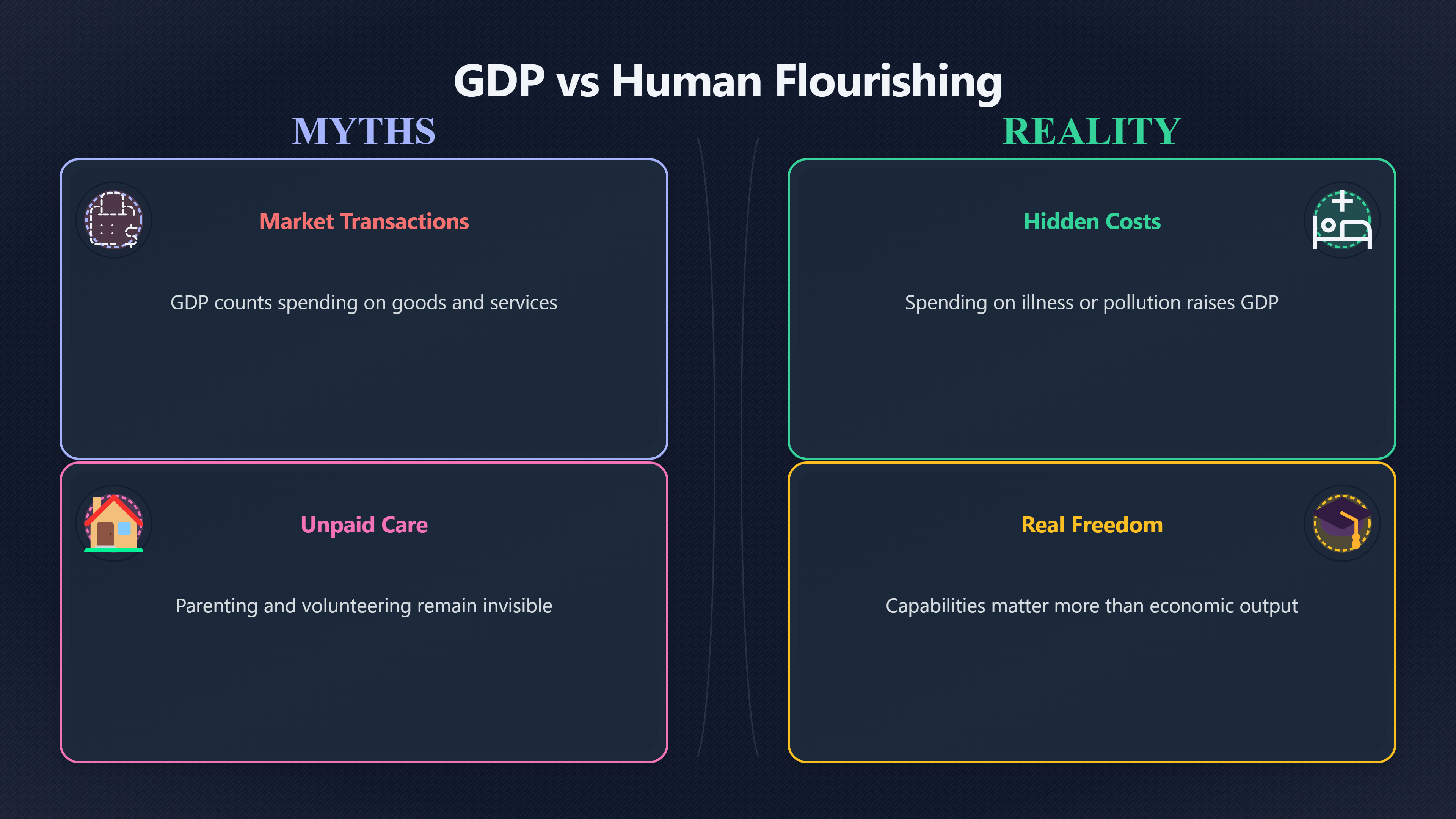
The classic criticism is simple: GDP counts transactions, not outcomes. A country can spend more money dealing with illness, cybercrime, pollution, burnout, or social fragmentation, and GDP may rise even if life becomes worse. The Stiglitz-Sen-Fitoussi Commission, one of the most influential “beyond GDP” efforts of the past two decades, argued that economic statistics often fail to measure social progress, inequality, sustainability, and lived wellbeing. [European Commission]ec.europa.euStiglitz Sen Fitoussi Commission reportCommission's aim has been to identify the limits of GDP as an indicator of economic performance and social progress, including the proble… [OECD]oecd.orgbeyond gdp g1g98ae6OECDBeyond GDPby JE Stiglitz · 2018 · Cited by 846 — Metrics matter for policy and policy matters for well-being. In this report, the co…
That problem becomes sharper in an AI economy because many of the most valuable effects of AI may involve:
- Lower costs rather than higher spending
- Better access to knowledge rather than more consumption
- Time savings rather than new purchases
- Prevention rather than repair
- Non-market collaboration and creativity
- Expanded capability rather than expanded output alone
If an AI tutor gives millions of people near-free access to high-quality education, GDP may increase only modestly even while human capability changes enormously. If AI systems help prevent disease before expensive hospital treatment is needed, GDP growth could actually slow despite genuine improvements in health.
This is not a new issue. Economists have long noted that unpaid care work, parenting, volunteering, and informal social support contribute hugely to human wellbeing while remaining partly invisible to GDP. AI may widen this mismatch because digital intelligence can create enormous value at very low marginal cost.
Search engines, open-source software, translation tools, navigation systems, and free online education already illustrate the problem. They provide large consumer benefits that are difficult to measure fully through market prices alone. Advanced AI systems could magnify this pattern dramatically.
Capabilities as the real abundance test
One alternative to GDP-centred thinking comes from the “capability approach” associated with economist and philosopher Amartya Sen and later developed in the UN Human Development framework. The core idea is that development should be judged by what people are genuinely able to do and become, not merely by the volume of economic transactions. [ScienceDirect]sciencedirect.comScienceDirectBeyond GDP: a review and conceptual framework for…by A Jansen · 2024 · Cited by 109 — The capability approach defines wel… [Human Development Reports]hdr.undp.orghuman development report 2025Human Development ReportsHuman Development Report 20256 May 2025 — The 2025 Human Development Report explores the implications of artific…
From this perspective, AI abundance is meaningful only if it expands real human capabilities such as:
- Living longer and healthier lives
- Accessing education and expertise
- Participating in society and politics
- Creating art, businesses, and scientific knowledge
- Escaping degrading or dangerous labour
- Maintaining autonomy and dignity
- Building stable relationships and communities
- Having time for family, learning, and exploration
The UNDP’s 2025 Human Development Report places this idea at the centre of its AI analysis. It argues that the future impact of AI depends less on technical capability alone and more on whether societies use AI to expand human choices and freedoms. [Human Development Reports]hdr.undp.orghuman development report 2025Human Development ReportsHuman Development Report 20256 May 2025 — The 2025 Human Development Report explores the implications of artific… [Human Development Reports]hdr.undp.orghuman development report 2025Human Development ReportsHuman Development Report 20256 May 2025 — The 2025 Human Development Report explores the implications of artific…
This changes how abundance itself is understood.
A world with advanced AI assistants everywhere could still fail the abundance test if most people lack housing security, healthcare access, political voice, or control over their work. Equally, a society with moderate GDP growth but dramatic improvements in health, education, safety, and free time might represent a much deeper form of abundance.
The distinction matters because AI optimism is sometimes presented as a story of “infinite economic growth” alone. But human flourishing depends on how that growth changes lived experience.
Why time and attention matter
One of the least appreciated limits of GDP is that it says little about time.
An AI system that reduces bureaucracy, automates repetitive administration, or accelerates scientific work may create extraordinary human value by freeing hours of life. Parents may gain more time with children. Doctors may spend more time with patients instead of paperwork. Researchers may move faster through routine analysis.
Yet GDP records these improvements imperfectly.
This matters because many modern forms of scarcity are actually scarcity of attention, cognition, coordination, and time. AI could potentially reduce those bottlenecks more than it increases material consumption.
A society where people work fewer dangerous hours, face less administrative friction, and gain easier access to expertise might feel radically more abundant even without explosive increases in consumer spending.
False progress signals in an AI economy
GDP can also produce misleading signals about whether AI is improving civilisation.
Automation can raise output while weakening security
Suppose AI dramatically increases productivity but concentrates ownership in a small number of firms controlling compute infrastructure, robotics, and data. GDP might rise rapidly while labour bargaining power weakens and insecurity spreads.
People could become materially dependent on systems they do not control. Access to education, communication, or even cognitive assistance might depend on subscription platforms or corporate gatekeepers.
In this scenario, headline economic growth would obscure declining autonomy.
This is one reason many critics of techno-optimist visions focus on governance, ownership, and distribution rather than capability growth alone. The key question is not merely whether AI systems become powerful, but who benefits from that power and under what institutional rules.
AI could increase measured growth by creating problems
GDP often rises when societies spend money fixing damage.
If AI systems generate misinformation floods, cybercrime, addictive engagement systems, or mass surveillance, the spending required to manage those harms may itself increase economic activity. Security industries, legal disputes, mental health treatment, and compliance systems all add to GDP.
But defensive expenditure is not the same thing as flourishing.
The same issue applies environmentally. Data centres, chip manufacturing, and robotics infrastructure require energy, water, minerals, and industrial capacity. If AI expansion intensifies ecological damage or resource conflict, GDP alone may conceal worsening long-term sustainability. [UNSCEB]unsceb.orgUNSCEBValuing What Counts - UN System-wide Contribution on…January 17, 2023 — Valuing what counts the most for wellbeing and progress…
Hyper-personalised consumption is not necessarily abundance
An AI economy may become extremely good at delivering personalised entertainment, synthetic media, targeted advertising, and frictionless digital services. Consumption could become cheaper and more immersive while social trust, civic participation, and mental wellbeing deteriorate.
GDP would largely register the economic activity, not the deeper social effects.
This possibility complicates simplistic ideas of post-scarcity. A civilisation flooded with cheap digital stimulation but marked by loneliness, dependence, and declining agency would not clearly represent human bloom.
The measurement problem becomes bigger as intelligence becomes cheaper
AI may expose a deeper flaw in industrial-era economic measurement: GDP was built for a world where scarcity mainly involved physical production.
In an economy where intelligence itself becomes abundant, many valuable things may stop looking economically scarce at all.
If advanced AI systems can provide:
- Instant translation
- Near-free tutoring
- Legal assistance
- Coding support
- Scientific analysis
- Medical triage
- Creative collaboration
- Personalised learning
then huge amounts of formerly expensive expertise could become widely available at very low cost.
That may improve lives enormously without generating proportional increases in measured economic output.
Economists already see hints of this in digital goods with near-zero replication costs. A free AI tool may create massive consumer benefit while adding relatively little directly to GDP because users pay little or nothing for it.
Paradoxically, a civilisation approaching genuine capability abundance might sometimes look statistically less impressive than expected if more valuable services become cheap or free.
Why distribution matters more in AI abundance debates
The strongest critique of GDP in the AI era is not simply technical measurement error. It is political economy.
A society can become richer overall while many people lose resilience, bargaining power, or social status. Average output can rise while opportunity becomes more unequal.
The UNDP’s AI-focused human development work repeatedly stresses this point: AI outcomes depend on institutions, inclusion, education, infrastructure, and public choices, not only on technical capability. [Human Development Reports]hdr.undp.orghuman development report 2025Human Development ReportsHuman Development Report 20256 May 2025 — The 2025 Human Development Report explores the implications of artific… [UNDP]hdr.undp.orghuman development report 2025Human Development ReportsHuman Development Report 20256 May 2025 — The 2025 Human Development Report explores the implications of artific…
This matters because advanced AI may create winner-take-most dynamics around:
- Compute infrastructure
- Semiconductor supply chains
- Data ownership
- Intellectual property
- Cloud platforms
- Robotics networks
- Energy access
- Talent concentration
GDP can rise strongly in such systems while broad human capability stagnates or fractures.
The central abundance question therefore becomes distributive as much as technological. Does AI make intelligence, health, education, and opportunity broadly available? Or does it merely amplify the leverage of already-powerful institutions?
A genuinely flourishing future would probably require both technological abundance and institutional abundance: wider access to power, coordination, and opportunity.
Beyond GDP does not mean ignoring growth
Critics of GDP are not usually arguing that economic growth is meaningless.
Growth matters enormously. Wealthier societies often achieve better healthcare, sanitation, education, infrastructure, scientific research, and resilience. AI-driven productivity growth could help fund medical breakthroughs, climate adaptation, clean energy systems, and large-scale public goods.
The problem is treating GDP as the final score rather than one instrument among many.
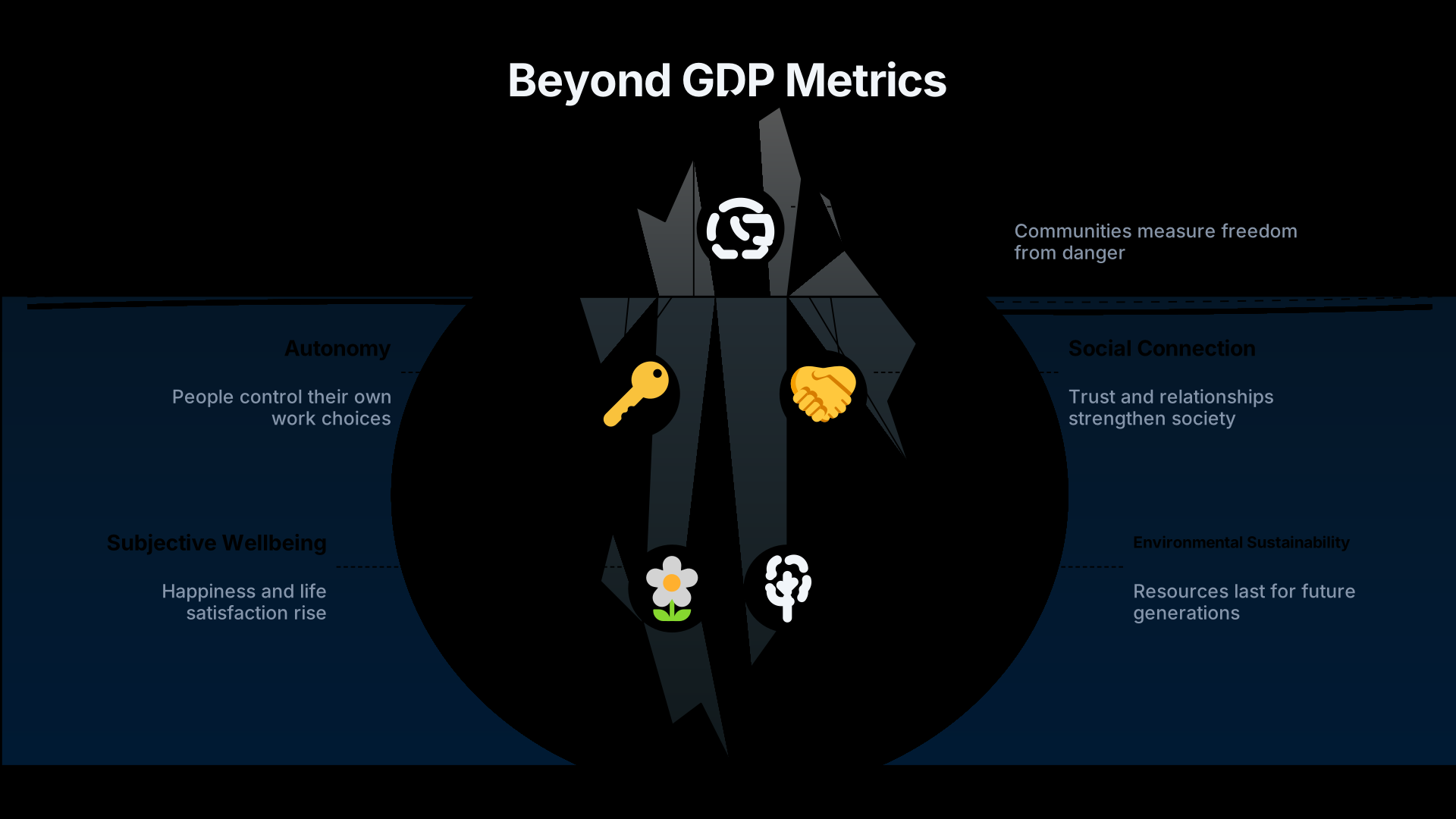
The “beyond GDP” tradition argues that societies should measure multiple dimensions together:
- Health
- Education * Inequality(#endnote-9 “Snippet: Angola remains in the medium…Read more”) [undp.org]undp.orgAngola remains in the medium…Read more…
- Environmental sustainability
- Institutional trust
- Safety
- Autonomy
- Social connection
- Subjective wellbeing
- Long-term resilience
The Human Development Index, OECD wellbeing frameworks, and other “beyond GDP” systems emerged from this recognition. OECD [Human Development Reports]hdr.undp.orghuman development report 2025Human Development ReportsHuman Development Report 20256 May 2025 — The 2025 Human Development Report explores the implications of artific…
AI bloom sharpens the importance of those measures because advanced AI may transform civilisation in ways that are only partly economic.
The deepest form of abundance is not infinite shopping. It is a world in which more people have the capability to live healthy, meaningful, creative, secure, and self-directed lives across a stable long-term civilisation. GDP can illuminate part of that story, but it cannot tell the whole of it.
Endnotes
-
Source: hdr.undp.org
Title: human development report 2025
Link: https://hdr.undp.org/content/human-development-report-2025Source snippet
Human Development ReportsHuman Development Report 20256 May 2025 — The 2025 Human Development Report explores the implications of artific...
Published: May 2025
-
Source: oecd.org
Title: beyond gdp g1g98ae6
Link: https://www.oecd.org/en/publications/2018/11/beyond-gdp_g1g98ae6.htmlSource snippet
OECDBeyond GDPby JE Stiglitz · 2018 · Cited by 846 — Metrics matter for policy and policy matters for well-being. In this report, the co...
-
Source: sciencedirect.com
Link: https://www.sciencedirect.com/science/article/pii/S2542519624001475Source snippet
ScienceDirectBeyond GDP: a review and conceptual framework for...by A Jansen · 2024 · Cited by 109 — The capability approach defines wel...
-
Source: hdr.undp.org
Link: https://hdr.undp.org/Source snippet
Human Development ReportsHuman Development Reports - United Nations Development...2025 Global Survey on AI and Human Development · Human...
-
Source: hdr.undp.org
Link: https://hdr.undp.org/system/files/documents/global-report-document/hdr2025reporten.pdfSource snippet
The 2025 Human Development Report. The cover and chapter images in the report feature portraits in the artistic styles of...Read more...
-
Source: unsceb.org
Link: https://unsceb.org/sites/default/files/2023-01/Valuing%20What%20Counts%20-%20UN%20System-wide%20Contribution%20on%20Beyond%20GDP%20%28advance%20unedited%29.pdfSource snippet
UNSCEBValuing What Counts - UN System-wide Contribution on...January 17, 2023 — Valuing what counts the most for wellbeing and progress...
Published: January 17, 2023
-
Source: undp.org
Title: human development report 2025
Link: https://www.undp.org/africa/publications/human-development-report-2025Source snippet
13 May 2025 — This year's Human Development Report asks what choices can be made so that new development pathways for all countries dot t...
Published: May 2025
-
Source: undp.org
Link: https://www.undp.org/cambodia/speeches/launch-2025-human-development-report-cambodia-matter-choice-people-and-possibilities-age-aiSource snippet
Launch of the 2025 Human Development Report in...19 Jun 2025 — We invite you to explore how AI can help us map vulnerabilities, improve...
-
Source: undp.org
Link: https://www.undp.org/angola/news/inequality-and-artificial-intelligence-highlighted-new-human-development-report-presented-undpSource snippet
Angola remains in the medium...Read more...
-
Source: hdr.undp.org
Title: 2025 global survey ai and human development
Link: https://hdr.undp.org/data-center/2025-global-survey-ai-and-human-developmentSource snippet
undp.org2025 Global Survey on AI and Human DevelopmentUNDP conducted a global public opinion survey to provide data-driven insights and i...
-
Source: undp.org
Link: https://www.undp.org/kyrgyzstan/blog/undp-human-development-report-2025-people-and-possibilities-age-ai-what-ai-means-kyrgyzstanSource snippet
UNDP Human Development Report 2025 - People and...21 Apr 2026 — Panel Session on Artificial Intelligence, Design Decisions and Human Dev...
-
Source: undp.org
Title: human development and ai paradox 35 year low new horizons ghana
Link: https://www.undp.org/ghana/press-releases/human-development-and-ai-paradox-35-year-low-new-horizons-ghanaSource snippet
A 35-Year Low with New Horizons for Ghana9 Jul 2025 — The 2025 Human Development Report “A matter of choice: people and possibilities in...
-
Source: hdr.undp.org
Title: 2025 global survey ai and human development main findings
Link: https://hdr.undp.org/2025-global-survey-ai-and-human-development-main-findingsSource snippet
undp.org2025 Global Survey on AI and Human DevelopmentTwo-Thirds in Low to High HDI Countries Expect to use AI within One Year. AI is bec...
-
Source: undp.org
Title: KE Y MESSAGES
Link: https://www.undp.org/sites/g/files/zskgke326/files/2025-05/hdr2025_key_messages_english_1.pdfSource snippet
KEY MESSAGES - The 2025 Human Development Report12 May 2025 — The promise of AI is also strongly felt in developing countries. • In low a...
Published: May 2025
-
Source: oecd.org
Link: https://www.oecd.org/en/publications/for-good-measure_9789264307278-en.htmlSource snippet
For Good MeasureA complementary report by the HLEG Chairs (J.E. Stiglitz, J.-P. Fitoussi and M. Durand, Beyond GDP: Measuring What Counts...
-
Source: ec.europa.eu
Title: Stiglitz Sen Fitoussi Commission report
Link: https://ec.europa.eu/eurostat/documents/8131721/8131772/Stiglitz-Sen-Fitoussi-Commission-report.pdfSource snippet
Commission's aim has been to identify the limits of GDP as an indicator of economic performance and social progress, including the proble...
-
Source: eeb.org
Link: https://eeb.org/wp-content/uploads/2022/06/WWF-Beyond-GDP-v05-FINAL-PRINT.pdfSource snippet
nce of measurement, more policy...Read more...
Additional References
-
Source: researchgate.net
Link: https://www.researchgate.net/publication/239807184_On_the_measurement_of_social_progress_and_well_being_some_further_thoughtsSource snippet
(PDF) On the measurement of social progress and well beingThere would be little sense in pursuing policies aimed at increasing some widel...
-
Source: sciencespo.hal.science
Link: https://sciencespo.hal.science/hal-03393119/file/2018-stiglitz-fitoussi-durand-beyond-gdp-measuring-what-counts-for-economic-and-social-performance.pdfSource snippet
GDPby J Stiglitz · 2018 · Cited by 831 — The Stiglitz, Sen and Fitoussi report emphasised not only the importance of inequalities in inco...
-
Source: aarhusclearinghouse.unece.org
Link: https://aarhusclearinghouse.unece.org/resources/report-commission-measurement-economicperformance-and-social-progressSource snippet
Aarhus ClearinghouseReport by the Commission on the Measurement of...GDP is an inadequate metric to gauge well-being over time particula...
-
Source: staff.ncl.ac.uk
Link: https://www.staff.ncl.ac.uk/david.harvey/MKT3008/IntDev/CMEPSPoverview.pdfSource snippet
Commission's aim has been to identify the limits of GDP as an indicator of economic performance and social progress, including the proble...
-
Source: facebook.com
Link: https://www.facebook.com/UNDPZambia/posts/the-2025-human-development-report-is-outhdr2025-explores-how-ai-affects-people-a/1107645878063730/Source snippet
The 2025 Human Development Report is out. #HDR2025...#HDR2025 explores how AI affects people at different stages of their lives, and how...
-
Source: linkedin.com
Title: un two zero undp human development report 2025 activity 7398368230181859328 JMSq
Link: https://www.linkedin.com/posts/un-two-zero_undp-human-development-report-2025-activity-7398368230181859328-JMSqSource snippet
Human Development Report 2025 | UN 2.0 | United NationsUNDP warns AI divides nations. Your strategy must adapt. The recent UN report on t...
-
Source: Wikipedia
Title: Commission on the Measurement of Economic Performance and Social Progress
Link: https://en.wikipedia.org/wiki/Commission_on_the_Measurement_of_Economic_Performance_and_Social_ProgressSource snippet
Commission on the Measurement of Economic...The inquiry examined how the wealth and social progress of a nation could be measured, wi...
-
Source: sdg.iisd.org
Title: human development report 2025 shows ais potential to reignite development
Link: https://sdg.iisd.org/news/human-development-report-2025-shows-ais-potential-to-reignite-development/Source snippet
SDG Knowledge HubHuman Development Report 2025 Shows AI's Potential to...13 May 2025 — The Human Development Report 2025 reveals stalled...
Published: May 2025
-
Source: researchgate.net
Title: 304625821 Limitations of the GDP as a measure of progress and well being
Link: https://www.researchgate.net/publication/304625821_Limitations_of_the_GDP_as_a_measure_of_progress_and_well-beingSource snippet
(PDF) Limitations of the GDP as a measure of progress and...Jun 30, 2016 — The subject of this paper is the gross domestic product that...
-
Source: linkedin.com
Title: emreorhan hdr2025 humandevelopment ai activity 7325403796715520001 laS7
Link: https://www.linkedin.com/posts/emreorhan-_hdr2025-humandevelopment-ai-activity-7325403796715520001-laS7Source snippet
UNDP's HDR 2025: AI and human development5 May 2025 — The UNDP's Human Development Report 2025 is here! “A matter of choice: People and p...
Published: May 2025
Amazon book picks
Further Reading
Books and field guides related to Beyond GDP. Use these as the next step if you want deeper reading beyond the article.

The Cultural Nature of Human Development
Three-year-old Kwara'ae children in Oceania act as caregivers of their younger siblings, but in the UK, it is an offense to leave a child...
Artificial Intelligence in Economics and Finance Theories
As Artificial Intelligence (AI) seizes all aspects of human life, there is a fundamental shift in the way in which humans are thinking of...
Human development
First published 1978. Subjects: Developmental psychology, Developmental psychobiology, Human biology, Psychologie du développement, Devel...

Human Development
First published 1996. Subjects: Textbooks, Developmental psychology, Manuels d'enseignement superieur, Psychologie du developpement, Chil...
eBay marketplace picks
Marketplace Samples
Example marketplace items related to this page. Use the search link to explore similar finds on eBay.

Example eBay listing
A.I. Artificial Intelligence Original Movie Poster Signed By Jude Law
USD 125.00 | Shipping USD 25.00 | US

Example eBay listing
Artificial Intelligence D/S Original Movie Poster - 27 x 40"
USD 19.50 | Shipping USD 13.65 | US

Example eBay listing
612388 Artificial Intelligence Movie Science Fiction Drama Wall Print Poster
USD 22.95 | Shipping USD 12.95 | JP

Example eBay listing
Companion - Artificial Intelligence Dark Comedy Cinema Film - POSTER 20"x30"
USD 23.99 | Free shipping | US
Topic Tree