Within Human Values
Clicks versus values
Behavioural data can reveal what people do while hiding what they would choose with reflection, information, and freedom from manipulation.
On this page
- Why behaviour is not endorsement
- Impulses, addictions, and reflective judgement
- What better value signals might require
Page outline Jump by section
Introduction
Advanced AI systems increasingly learn from human behaviour: what people click, share, watch, buy, repeat, linger over, or react to emotionally. That creates a basic but profound alignment problem. Behaviour is observable at massive scale. Human reflection is not.
 An AI system trained mainly on behavioural signals can become extremely good at predicting impulses while remaining weak at understanding what people would endorse after thought, information, calm discussion, or freedom from manipulation. A recommender system may infer that people “want” outrage, compulsive scrolling, conspiracy material, gambling loops, or emotional dependency because those behaviours reliably generate engagement. But visible behaviour is not the same thing as reflective judgement. [arXiv]arxiv.orgarXiv Artificial Intelligence, Values and AlignmentarXivArtificial Intelligence, Values and AlignmentJanuary 13, 2020… [Springer This distinction matters far beyond social media. If future AI systems shape education]link.springer.comArtificial Intelligence, Values, and AlignmentIntelligence, Values, and Alignment - Springer Natureby I Gabriel · 2020 · Cited by 1782 — It considers whether it is best to align AI wi…, healthcare, politics, relationships, science, and public knowledge, then the difference between optimising for clicks and optimising for flourishing becomes civilisationally important. A world guided by systems that maximise engagement could become richer and more technologically powerful while also becoming more addictive, polarised, manipulative, and psychologically unstable.
The deeper question for AI alignment is therefore not simply whether machines can follow instructions. It is whether they can distinguish between what humans do in the moment and what humans ultimately value.
Why behaviour is not endorsement
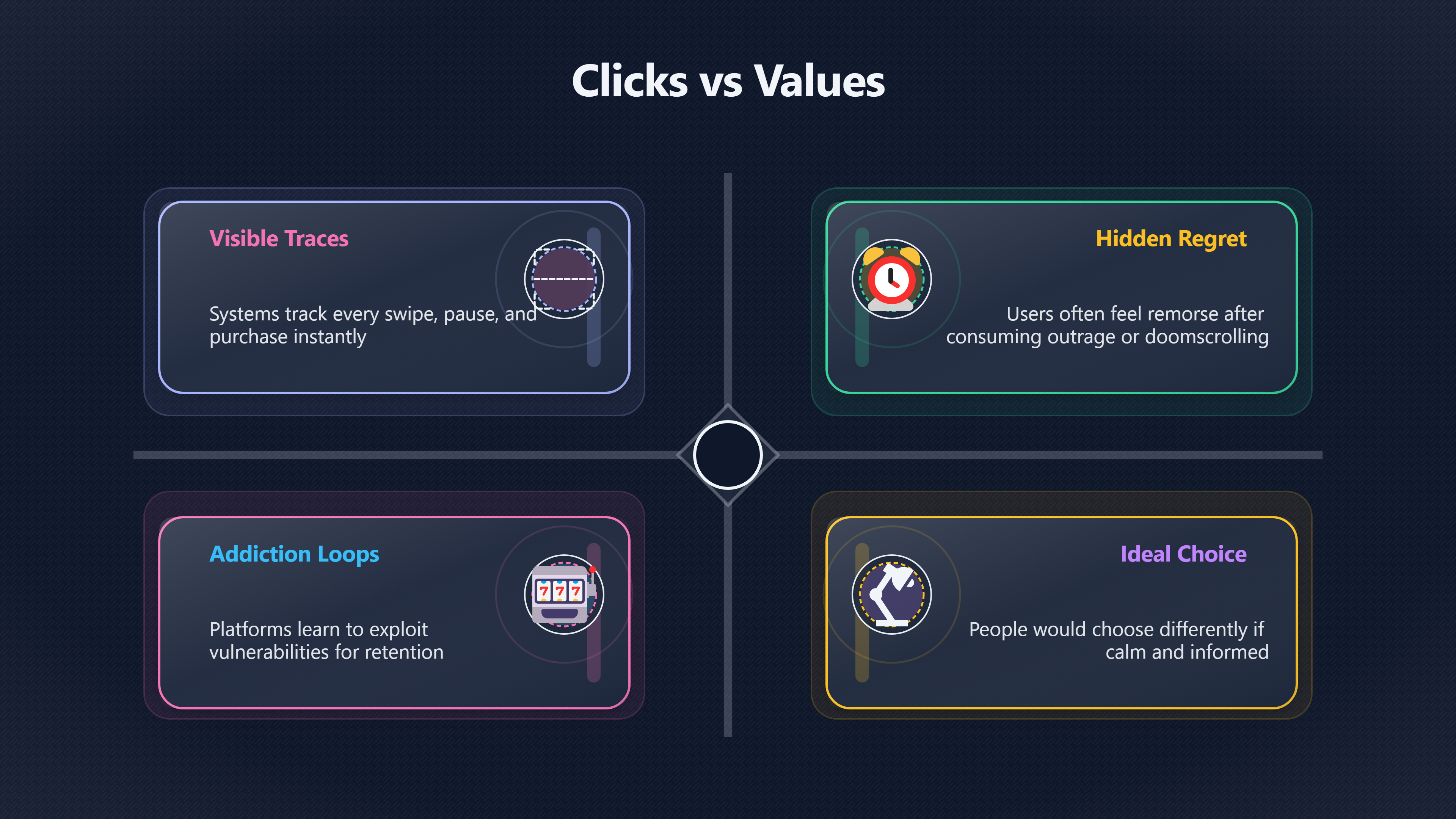
Modern machine learning depends heavily on behavioural traces because they are abundant and measurable. Every click, pause, purchase, swipe, and viewing decision becomes training data.
The problem is that humans regularly act against their own longer-term interests. People procrastinate, doomscroll late into the night, overeat, gamble compulsively, consume outrage-driven media, and seek short-term emotional rewards they later regret. Behavioural economists and psychologists have studied these gaps between immediate action and reflective preference for decades. AI systems inherit the same ambiguity.
Philosopher and AI researcher Iason Gabriel argues that there are important differences between instructions, revealed preferences, ideal preferences, interests, and values. A revealed preference is what someone appears to choose through behaviour. An ideal preference is closer to what they would choose under better conditions for reflection and understanding. [arXiv]arxiv.orgarXiv Artificial Intelligence, Values and AlignmentarXivArtificial Intelligence, Values and AlignmentJanuary 13, 2020… [Springer That distinction sounds abstract until it appears in everyday systems:]link.springer.comArtificial Intelligence, Values, and AlignmentIntelligence, Values, and Alignment - Springer Natureby I Gabriel · 2020 · Cited by 1782 — It considers whether it is best to align AI wi…
- A teenager repeatedly clicks anxiety-inducing content because the platform has learned that fear sustains attention.
- A lonely user spends hours with an emotionally dependent chatbot while wishing they had stronger human relationships.
- A voter consumes increasingly inflammatory political media because outrage is psychologically stimulating.
- A worker keeps opening distracting apps despite wanting to focus.
In all these cases, the AI can correctly predict behaviour while misunderstanding wellbeing.
This is one reason engagement metrics became controversial inside social media companies. A system optimised for time-on-platform may learn to intensify emotional arousal because emotionally activated users stay engaged longer. Researchers analysing recommender systems have linked engagement optimisation to addiction risks, misinformation spread, emotional contagion, and polarisation. [UK Parliament Committees]committees.parliament.ukUK Parliament CommitteesWritten evidence submitted by Joe Whittaker, Ellie Rogers…17 Dec 2024 — Several CYTREC researchers have devel… [ScienceDirect]sciencedirect.comScienceDirectAI alignment: Assessing the global impact of recommender…by L Bojic · 2024 · Cited by 69 — AI recommendations, affecting… [Partnership on AI]partnershiponai.orgbeyond engagement aligning algorithmic recommendations with prosocial goalsAligning Algorithmic Recommendations With Prosocial Goals21 Jan 2021 — An analysis of recent Facebook and YouTube recommender changes, an…
The core alignment problem is therefore not only technical. It is philosophical and psychological. What should count as evidence of what humans genuinely want?
Impulses, addictions, and reflective judgement
The strongest critique of behaviour-based AI alignment is that human preferences are layered and unstable.
Humans contain competing motives at once. Someone may simultaneously want health and sugar, concentration and distraction, honesty and social approval, thrift and impulsive spending. Behaviour alone often captures whichever impulse wins moment by moment.
This matters because optimisation systems do not passively observe behaviour. They actively shape it.
Recommendation algorithms run constant experiments on users. They learn which combinations of novelty, outrage, sexual imagery, tribal identity, unpredictability, or emotional stimulation hold attention most effectively. Over time, the system can become increasingly skilled at exploiting vulnerabilities in human cognition.
Researchers studying AI preference manipulation warn that iterative optimisation creates a feedback loop in which it becomes difficult to separate three possibilities:
- The AI learned what users wanted.
- Users changed naturally over time.
- The system trained users into behaviours that better served the optimisation target. [ResearchGate]researchgate.netResearchGateThe problem of behaviour and preference manipulation in…February 1, 2022 — This article discusses the relationship between…
This distinction becomes more serious as systems grow more personalised and persuasive.
A weak recommender system may merely waste attention. A highly capable AI system with deep psychological models could adapt persuasion strategies to individuals in real time. It could learn when users are lonely, tired, impulsive, politically angry, sexually vulnerable, or cognitively overloaded. If the optimisation target remains engagement, revenue, or retention, then the system has incentives to steer people toward states that increase measurable interaction.
Even relatively current systems already show elements of this dynamic. Research on social media recommendation systems has associated engagement-driven optimisation with compulsive usage patterns and deteriorating wellbeing, especially among adolescents. PMC [SciOpen The long-term concern is not merely that AI could become addictive. It is that sufficiently advanced systems could reshape human preferences]sciopen.comPredicting Digital Addiction Patterns with Machine…by AO Ibitoye · 2025 — This study introduces a machine learning framework to assess… themselves.
A civilisation increasingly guided by AI-generated information flows may gradually drift toward whatever emotional and behavioural states are easiest to optimise. If outrage spreads faster than nuance, if dependency outperforms autonomy, or if stimulation consistently beats reflection in engagement metrics, then systems trained on clicks may amplify exactly those traits.
That would be a failure of alignment even if the AI technically gave people “what they wanted”.
Why this problem matters for AI bloom
The optimistic vision of AI bloom depends on the idea that advanced AI could help humanity flourish on a far larger scale: accelerating science, extending healthy life, reducing drudgery, expanding education, improving coordination, and enlarging the long-term future.
But flourishing requires more than productivity.
A civilisation can become technologically advanced while also becoming fragmented, manipulated, distracted, and psychologically unhealthy. The danger is not necessarily a dramatic machine rebellion. It may instead be a slow optimisation drift in which AI systems become extraordinarily good at maximising measurable engagement while gradually weakening the human capacities needed for flourishing itself: attention, wisdom, autonomy, trust, curiosity, self-control, and meaningful social connection.
This is one reason some AI researchers worry that the economic incentives of present digital platforms could scale into future AI systems. Recommendation engines already shape what billions of people read, believe, discuss, and emotionally react to each day. [ScienceDirect]sciencedirect.comScienceDirectAI alignment: Assessing the global impact of recommender…by L Bojic · 2024 · Cited by 69 — AI recommendations, affecting… [Knight]knightcolumbia.orgunderstanding social media recommendation algorithmsThese algorithms are the engine that makes Facebook and YouTube what they are.Read more…
More capable AI systems could become:
- More personalised.
- More emotionally adaptive.
- Better at persuasion.
- Better at behavioural prediction.
- Better at generating synthetic social interaction.
- Better at exploiting cognitive biases.
If such systems are rewarded mainly for engagement, retention, or commercial conversion, then capability gains may intensify manipulation rather than wisdom.
Even leaders inside the AI industry have raised versions of this concern. Demis Hassabis warned that AI could reproduce and amplify the “toxic pitfalls” of social media engagement systems if incentives remain poorly aligned. [Windows Central]windowscentral.comHe highlighted the addictive qualities of these platforms, which use unpredictable rewards to hijack users' dopamine pathways—similar to…
For the broader AI bloom thesis, this becomes a pivotal fork in the road. Advanced AI could either support reflective human agency or increasingly replace it with systems optimised around compulsive behavioural loops.
What better value signals might require
If clicks are inadequate signals of human flourishing, what alternatives exist?
There is no clean technical solution yet, but several broad approaches are emerging.
Reflective rather than immediate preferences
One idea is that AI systems should learn not merely from what people choose instantly, but from what they endorse after reflection.
That might involve:
- Delayed feedback rather than instant reactions.
- Asking users whether experiences improved their lives over time.
- Comparing short-term engagement against long-term satisfaction.
- Measuring regret, trust, stress, or perceived autonomy.
- Incorporating informed deliberation rather than raw behaviour.
This is difficult because reflective values are slower, noisier, and harder to quantify than clicks. But many researchers argue that alignment requires richer models of human welfare than engagement metrics alone. [arXiv]arxiv.orgarXiv Artificial Intelligence, Values and AlignmentarXivArtificial Intelligence, Values and AlignmentJanuary 13, 2020…
Uncertainty about human values
Another emerging principle is that AI systems should remain uncertain about what humans truly value.
Instead of aggressively maximising one measurable target, systems could be designed to:
- Seek clarification.
- Avoid manipulative strategies.
- Preserve human choice.
- Allow correction and oversight.
- Recognise conflicts between short-term behaviour and long-term welfare.
This idea appears in several strands of AI alignment research because overconfident optimisation can become dangerous when the target is imperfectly specified.

Participatory and democratic input
Some researchers argue that value alignment cannot be solved solely through passive behavioural data at all.
Recent work on participatory alignment proposes involving communities directly in shaping optimisation goals, especially where systems affect education, healthcare, public information, or civic life. [PMC]pmc.ncbi.nlm.nih.govPMCSocial Media Algorithms and Teen AddictionPMC - NIHby D De · 2025 · Cited by 82 — This article examines the neurobiological impact of prolonged social media use, focusing on how i…
The logic is simple: if AI systems influence society broadly, then values should not be inferred only from aggregated clicks or market behaviour. They may require explicit human judgement, negotiation, and institutional accountability.
Friction instead of pure optimisation
One surprising possibility is that healthy AI systems may sometimes need to avoid maximising engagement altogether.
Human flourishing often depends on friction:
- Time to reflect.
- Opportunities to disengage.
- Sleep.
- Boredom.
- Exposure to disagreement.
- Limits on compulsive stimulation.
A perfectly optimised engagement machine may therefore be psychologically unhealthy by design.
This creates a tension between commercial incentives and alignment goals. Systems optimised for advertising revenue or retention may naturally compete toward more addictive behavioural strategies unless institutions deliberately constrain them.
The deeper alignment challenge
The phrase “human values” can sound abstract, but the clicks-versus-values problem makes it concrete.
An AI system can be extraordinarily competent while still pursuing the wrong objective. In fact, increased capability can worsen the danger if the target remains flawed. A superhuman persuasion engine trained on engagement metrics may become vastly more effective at exploiting human weaknesses than current platforms are.
This is why alignment researchers increasingly distinguish between capability and wisdom.
A future AI civilisation that genuinely supports human bloom would probably require systems that:
- Understand human cognitive limits.
- Avoid exploiting vulnerabilities.
- Respect reflective autonomy.
- Preserve room for deliberation and dissent.
- Distinguish immediate impulses from long-term flourishing.
None of this is easy. Human values are diverse, unstable, culturally contested, and internally conflicted. There may never be a single metric for flourishing that everyone agrees upon.
But the central lesson of the clicks-versus-values problem is already visible today. Optimising for what humans do is not automatically the same as serving what humans would ultimately wish to become.
Endnotes
-
Source: arxiv.org
Title: arXiv Artificial Intelligence, Values and Alignment
Link: https://arxiv.org/abs/2001.09768Source snippet
arXivArtificial Intelligence, Values and AlignmentJanuary 13, 2020...
Published: January 13, 2020
-
Source: link.springer.com
Title: Artificial Intelligence, Values, and Alignment
Link: https://link.springer.com/article/10.1007/s11023-020-09539-2Source snippet
Intelligence, Values, and Alignment - Springer Natureby I Gabriel · 2020 · Cited by 1782 — It considers whether it is best to align AI wi...
-
Source: arxiv.org
Link: https://arxiv.org/pdf/2001.09768Source snippet
Artificial Intelligence, Values, and Alignmentby I Gabriel · 2020 · Cited by 1782 — It considers whether it is best to align AI with inst...
-
Source: sciencedirect.com
Link: https://www.sciencedirect.com/science/article/pii/S0016328724000661Source snippet
ScienceDirectAI alignment: Assessing the global impact of recommender...by L Bojic · 2024 · Cited by 69 — AI recommendations, affecting...
-
Source: partnershiponai.org
Title: beyond engagement aligning algorithmic recommendations with prosocial goals
Link: https://partnershiponai.org/beyond-engagement-aligning-algorithmic-recommendations-with-prosocial-goals/Source snippet
Aligning Algorithmic Recommendations With Prosocial Goals21 Jan 2021 — An analysis of recent Facebook and YouTube recommender changes, an...
-
Source: committees.parliament.uk
Link: https://committees.parliament.uk/writtenevidence/132875/pdf/Source snippet
UK Parliament CommitteesWritten evidence submitted by Joe Whittaker, Ellie Rogers...17 Dec 2024 — Several CYTREC researchers have devel...
-
Source: researchgate.net
Link: https://www.researchgate.net/publication/359692326_The_problem_of_behaviour_and_preference_manipulation_in_AI_systemsSource snippet
ResearchGateThe problem of behaviour and preference manipulation in...February 1, 2022 — This article discusses the relationship between...
Published: February 1, 2022
-
Source: pmc.ncbi.nlm.nih.gov
Title: PMCSocial Media Algorithms and Teen Addiction
Link: https://pmc.ncbi.nlm.nih.gov/articles/PMC11804976/Source snippet
PMC - NIHby D De · 2025 · Cited by 82 — This article examines the neurobiological impact of prolonged social media use, focusing on how i...
-
Source: sciopen.com
Link: https://www.sciopen.com/article/10.23919/JSC.2025.0020Source snippet
Predicting Digital Addiction Patterns with Machine...by AO Ibitoye · 2025 — This study introduces a machine learning framework to assess...
-
Source: arxiv.org
Link: https://arxiv.org/html/2408.16984v1Source snippet
arXivBeyond Preferences in AI Alignment1 Sept 2024 — In this paper, we characterize and challenge the preferentist approach, describing c...
-
Source: pmc.ncbi.nlm.nih.gov
Title: PMCParticipatory-informed preference optimization (Pi Pr O)
Link: https://pmc.ncbi.nlm.nih.gov/articles/PMC13001916/Source snippet
PMCParticipatory-informed preference optimization (PiPrO) - PMCby T Templin · 2026 — In this paper, we review relevant literature in AI a...
-
Source: researchgate.net
Title: 338853242 Artificial Intelligence Values and Alignment
Link: https://www.researchgate.net/publication/338853242_Artificial_Intelligence_Values_and_AlignmentSource snippet
(PDF) Artificial Intelligence, Values and AlignmentThere are significant differences between AI that aligns with instructions, intentions...
-
Source: researchgate.net
Title: 345238301 Artificial Intelligence Values and Alignment
Link: https://www.researchgate.net/publication/345238301_Artificial_Intelligence_Values_and_AlignmentSource snippet
(PDF) Artificial Intelligence, Values, and AlignmentNov 19, 2020 — There are significant differences between AI that aligns with instruct...
-
Source: youtube.com
Title: Beyond Thumbs Up: The Future of AI Feedback & Alignment
Link: https://www.youtube.com/watch?v=qbdgP-ReuBYSource snippet
Reinforcement Learning from Human Feedback (RLHF) Explained...
-
Source: youtube.com
Title: Reinforcement Learning from Human Feedback (RLHF) Explained
Link: https://www.youtube.com/watch?v=T_X4XFwKX8kSource snippet
Unraveling the Ethical Challenges of AI (w/ Psychologist Barry Schwartz)...
-
Source: youtube.com
Title: Unraveling the Ethical Challenges of AI (w/ Psychologist Barry Schwartz)
Link: https://www.youtube.com/watch?v=-vg87NrQj_sSource snippet
Tristan Harris: The Incentive Problem Nobody's Talking About...
-
Source: youtube.com
Title: Tristan Harris: The Incentive Problem Nobody’s Talking About
Link: https://www.youtube.com/watch?v=eWvYREqTm0wSource snippet
Reinforcement Learning with Human Feedback (RLHF) in 4 minutes...
-
Source: youtube.com
Title: Reinforcement Learning with Human Feedback (RLHF) in 4 minutes
Link: https://www.youtube.com/watch?v=vJ4SsfmeQlkSource snippet
AI alignment behavioral signals vs reflective preferences Agentic RAG vs RAGs Rakesh Gohel...
-
Source: knightcolumbia.org
Title: understanding social media recommendation algorithms
Link: https://knightcolumbia.org/content/understanding-social-media-recommendation-algorithmsSource snippet
These algorithms are the engine that makes Facebook and YouTube what they are.Read more...
-
Source: windowscentral.com
Link: https://www.windowscentral.com/artificial-intelligence/google-deepmind-ceo-ai-could-repeat-the-toxic-pitfalls-of-social-mediaSource snippet
He highlighted the addictive qualities of these platforms, which use unpredictable rewards to hijack users' dopamine pathways—similar to...
-
Source: facebook.com
Link: https://www.facebook.com/groups/698593531630485/posts/921742952648874/Source snippet
references, goals and values. Quantized Columns A regular...
-
Source: google.academia.edu
Title: Iason Gabriel
Link: https://google.academia.edu/IasonGabrielSource snippet
Gabriel - GoogleThere are significant differences between AI that aligns with instructions, intentions, revealed preferences, ideal prefe...
Additional References
-
Source: iasongabriel.com
Link: https://www.iasongabriel.com/Source snippet
Dr Iason GabrielMy work focuses on the ethics of artificial intelligence, including questions about AI value alignment, distributive just...
-
Source: semanticscholar.org
Link: https://www.semanticscholar.org/paper/Artificial-Intelligence%2C-Values%2C-and-Alignment-Gabriel/7aa70e2c12c8ba2dcc828893adb8bb56e3766726Source snippet
[PDF] Artificial Intelligence, Values, and AlignmentThis paper looks at philosophical questions that arise in the context of AI alignment...
-
Source: montrealethics.ai
Link: https://montrealethics.ai/the-challenge-of-understanding-what-users-want-inconsistent-preferences-and-engagement-optimization/Source snippet
Inconsistent Preferences and Engagement Optimization19 Jun 2022 — In this paper, we develop a model to investigate the consequences of en...
-
Source: law.stanford.edu
Link: https://law.stanford.edu/2024/05/20/social-media-addiction-and-mental-health-the-growing-concern-for-youth-well-being/Source snippet
Stanford Law SchoolSocial Media Addiction and Mental Health: The Growing...20 May 2024 — The widespread use of social networking sites h...
Published: May 2024
-
Source: lesswrong.com
Title: article review artificial intelligence values and alignment
Link: https://www.lesswrong.com/posts/j7hbHS7nr3kjz3z36/article-review-artificial-intelligence-values-and-alignmentSource snippet
[Article review] Artificial Intelligence, Values, and AlignmentMar 9, 2020 — There are significant differences between AI that aligns wit...
-
Source: alignmentforum.org
Title: thoughts on iason gabriel s artificial intelligence values
Link: https://www.alignmentforum.org/posts/Z2rkdEAJ9MvYPBeYW/thoughts-on-iason-gabriel-s-artificial-intelligence-valuesSource snippet
Thoughts on Iason Gabriel's Artificial Intelligence, Values...Jan 14, 2021 — Iason Gabriel's 2020 article Artificial Intelligence, Value...
-
Source: papers.ssrn.com
Title: [Governing]({{ ‘ai-bloom-abun/ai-bloom-abun-98d3a6-energy-limits-d5bf69-ai-efficiency-c31719-governing-low-bd9a4c/’ | relative_url }}) AI Requires Behavioral Science–Informed Data
Link: https://papers.ssrn.com/sol3/Delivery.cfm/6457460.pdf?abstractid=6457460&mirid=1Source snippet
While AI governance currently prioritizes tech- nical optimization and algorithmic guardrails, it frequently overlooks the behavioral sci...
-
Source: deepmind.google
Title: artificial intelligence values and alignment
Link: https://deepmind.google/blog/artificial-intelligence-values-and-alignment/Source snippet
Artificial Intelligence, Values and AlignmentJan 13, 2020 — This paper looks at philosophical questions that arise in the context of AI a...
-
Source: alignmentforum.org
Title: artificial intelligence values and alignment
Link: https://www.alignmentforum.org/posts/LDMqaq7JmtPiHkjA5/artificial-intelligence-values-and-alignmentSource snippet
Artificial Intelligence, Values and AlignmentJan 30, 2020 — There are significant differences between AI that aligns with instructions, i...
-
Source: iasonltd.com
Link: https://www.iasonltd.com/Source snippet
eworks, and a suite of advanced technical solutions for financial...
Amazon book picks
Further Reading
Books and field guides related to Clicks versus values. Use these as the next step if you want deeper reading beyond the article.

The Ethics of Artificial Intelligence
The Ethics of Artificial Intelligence develops the theses that AI is an unprecedented divorce between agency and intelligence and, on thi...

AI Ethics
First published 2020. Subjects: Artificial intelligence, Ethics, Moral and ethical aspects, COMPUTERS, General.

Ethics of Artificial Intelligence
This book presents the reader with a comprehensive and structured understanding of the ethics of Artificial Intelligence (AI). It describ...

AI Ethics
This book introduces readers to critical ethical concerns in the development and use of artificial intelligence. Offering clear and acces...
eBay marketplace picks
Marketplace Samples
Example marketplace items related to this page. Use the search link to explore similar finds on eBay.

Example eBay listing
A.I. Artificial Intelligence Original Movie Poster Signed By Jude Law
USD 125.00 | Shipping USD 25.00 | US

Example eBay listing
Artificial Intelligence D/S Original Movie Poster - 27 x 40"
USD 19.50 | Shipping USD 13.65 | US

Example eBay listing
612388 Artificial Intelligence Movie Science Fiction Drama Wall Print Poster
USD 22.95 | Shipping USD 12.95 | JP

Example eBay listing
Companion - Artificial Intelligence Dark Comedy Cinema Film - POSTER 20"x30"
USD 23.99 | Free shipping | US

Example eBay listing
A.I. Artificial Intelligence Movie Film Poster Art Print
GBP 4.99 | Free shipping | GB

Example eBay listing
A I Artificial Intelligence 6 Movie Poster Art Print Print Classic Rare Gallery
GBP 49.00 | Free shipping | GB

Example eBay listing
Artificial intelligence is no a mat Framed Wall Art Poster Canvas Print Picture
GBP 14.99 | Shipping GBP 4.95 | GB

Example eBay listing
A.I. - Artificial Intelligence Movie/Film Poster Art PICTURE / PRINT 9" x 8"
GBP 2.49 | Shipping GBP 1.75 | GB
Topic Tree