Within Know how
AI Tutors and Learning Gaps
AI tutors could make patient, personalised help widely available, but weak systems may teach errors or deepen inequality.
On this page
- What personalised AI tutoring can already do
- Where AI tutors may help adults and underserved learners
- Errors, overreliance and unequal access
Page outline Jump by section
Introduction
AI tutors may become one of the clearest examples of how advanced AI could spread valuable expertise far beyond wealthy classrooms and private coaching. Millions of students struggle not because they lack ability, but because they get stuck, fall behind, and cannot access patient one-to-one help at the right moment. Human tutoring works remarkably well, yet it is expensive and difficult to scale. AI systems promise something different: near-instant explanations, personalised practice, and unlimited repetition at very low cost.
 The optimistic case is not simply about convenience. If reliable AI tutoring became broadly available, it could reduce educational inequality, help adults retrain throughout life, and make advanced knowledge easier to access across countries and income levels. But the risks are also real. Weak systems can confidently teach errors, encourage shallow learning, or widen inequalities if only affluent schools gain access to high-quality tools and oversight. The central question is therefore not whether AI tutors are impressive demos, but whether they can improve learning safely and consistently in the real world.
Why tutoring matters so much
Educational research has long shown that individual tutoring can dramatically improve outcomes. In 1984, educational psychologist Benjamin Bloom described the famous “2 Sigma Problem”: students receiving one-to-one tutoring often performed far better than those in conventional classrooms. [Massachusetts Institute of Technology]web.mit.eduMassachusetts Institute of TechnologyThe 2 Sigma Problemby BS BLOOM · 1984 · Cited by 6105 — The 2 Sigma Problem: The Search for Methods…
The importance of this finding is easy to miss. Bloom was not claiming that tutors possess magical teaching methods. Rather, tutoring changes the structure of learning itself. A tutor notices confusion immediately, adapts explanations to the learner, slows down when necessary, and keeps students engaged instead of allowing misunderstandings to accumulate silently over months.
Most school systems cannot provide this level of attention. Even excellent teachers may manage classes of 25 to 40 pupils with widely varying abilities. Students who fall behind often remain behind.
This is why AI tutoring attracts so much attention within the broader idea of AI-enabled human flourishing. If advanced systems could provide effective educational guidance at scale, they might loosen one of civilisation’s oldest bottlenecks: the scarcity of skilled teaching attention.
What personalised AI tutoring can already do
Current AI tutors are still limited, but they already demonstrate capabilities that ordinary educational software struggled to achieve.
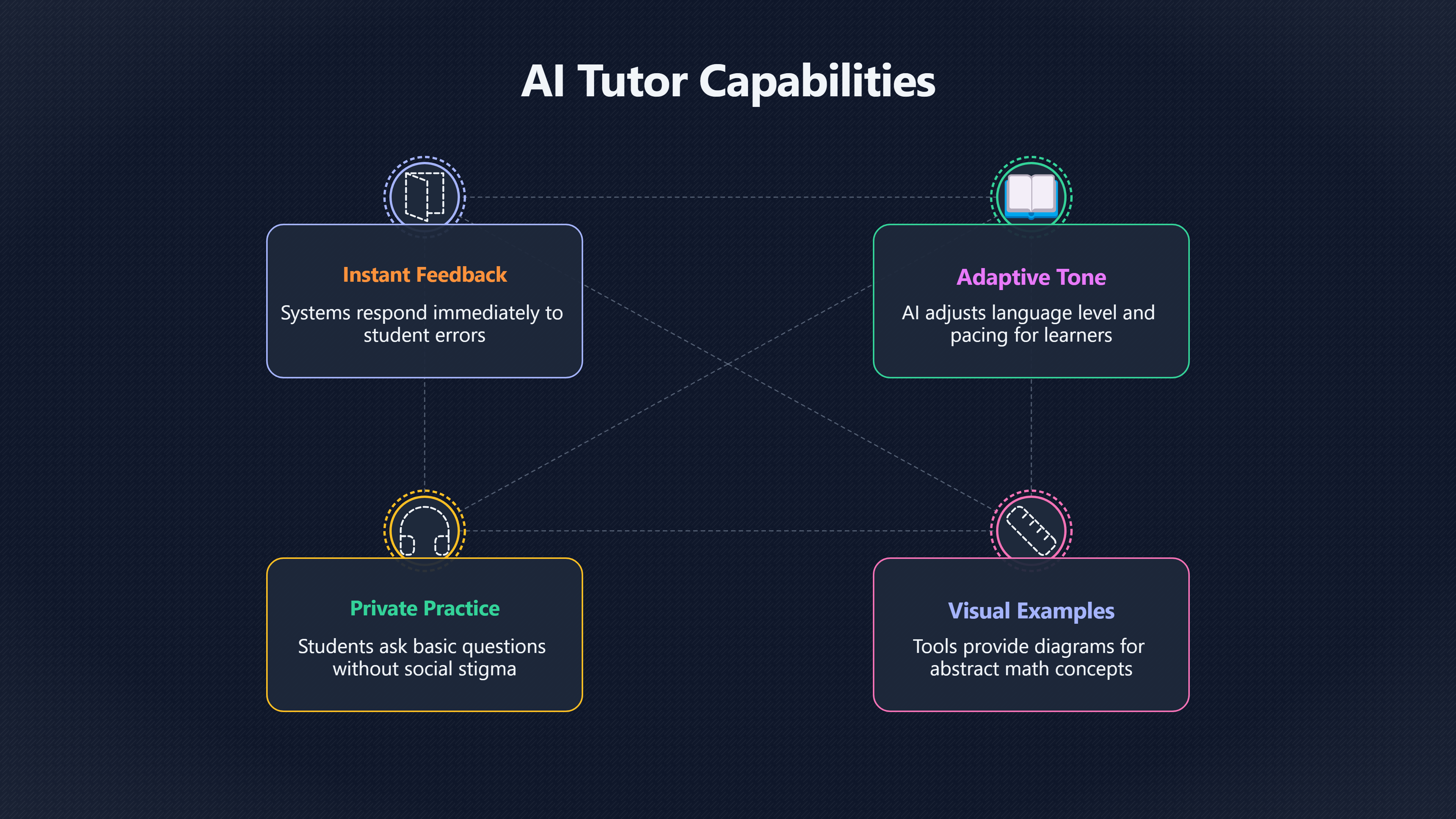
Unlike older systems that followed rigid scripts, large language models can hold interactive conversations, explain concepts in different ways, ask follow-up questions, and adapt to the learner’s pace. They can simulate parts of what good tutors do conversationally rather than merely marking answers right or wrong.
Continuous feedback and explanation
One major advantage is immediacy. Many students abandon difficult work because feedback arrives too late. AI tutors can respond instantly, allowing learners to experiment, fail, and try again without embarrassment or delay.
Systems such as Khan Academy’s Khanmigo attempt to guide students through questions rather than simply reveal answers. Khan Academy argues this “Socratic” approach encourages reasoning instead of passive copying. [Khan Academy Blog]blog.khanacademy.orgKhan Academy Blog Harnessing GPT-4 so that all students benefitA nonprofit…Mar 14, 2023 — When GPT-4 is carefully adapted to a learning environment like Khan Academy, it has enormous potential. It… [Khanmigo This matters because learning is not merely information transfer. Students need repeated practice in thinking through problems themselves.]khanmigo.aie on prep, tackle homework challenges, and get personalized tutoring…
Personalisation at large scale
AI tutors can also adapt explanations to individual learners in ways traditional classrooms often cannot.
A student struggling with fractions may need visual examples, while another benefits from algebraic notation or real-world analogies. AI systems can rapidly vary tone, pacing, difficulty, language level, and examples.
For multilingual learners or adults returning to education after years away, this flexibility may be especially valuable. Instead of navigating intimidating formal instruction, learners can ask repeated “basic” questions privately and without social stigma.
Evidence from early studies
The evidence base remains early and mixed, but some studies show promising results.
A 2024 randomised controlled trial found that GPT-4-based interactive homework support improved student engagement and some learning outcomes among secondary-school English learners. [arXiv]arxiv.orgarXivGPT-4 as a Homework Tutor can Improve Student Engagement and Learning OutcomesSeptember 24, 2024…
A 2025 exploratory UK trial involving 165 students across five secondary schools tested an AI tutoring system supervised by expert tutors. Researchers reported that students receiving AI-assisted support performed at least as well as students working only with human tutors, while tutors approved most AI-generated tutoring prompts with minimal editing. [arXiv]arxiv.orgarXivGPT-4 as a Homework Tutor can Improve Student Engagement and Learning OutcomesSeptember 24, 2024…
Other hybrid tutoring studies in lower-income schools found evidence that combining human tutors with AI support improved engagement and proficiency, particularly for lower-achieving students. [arXiv]arxiv.orgarXivGPT-4 as a Homework Tutor can Improve Student Engagement and Learning OutcomesSeptember 24, 2024…
These studies do not prove that AI tutors match skilled human teachers across all contexts. Most are small-scale, recent, or supervised. But they suggest that carefully designed systems may already provide meaningful educational support under certain conditions.
Where AI tutors may help adults and underserved learners
The strongest case for AI tutoring may not initially be elite schools. It may be places where good educational support barely exists today.
Students who currently receive little individual help
In many regions, classrooms are overcrowded and specialist tutoring is unaffordable. Even modest improvements in personalised guidance could therefore have large effects.
A child with weak literacy skills may currently receive almost no one-to-one feedback at all. An AI tutor that reliably provides reading practice, pronunciation help, or mathematical guidance could still represent a substantial improvement over educational neglect.
This is one reason AI tutoring fits into the wider “AI bloom” vision of expanding access to human capability. The technology matters less because it produces elite performance than because it could raise the floor for millions of learners.
Adult retraining and lifelong learning
AI tutors may also matter outside formal schooling.
Modern economies increasingly require adults to learn new skills throughout life: coding, healthcare procedures, technical maintenance, accounting systems, languages, or regulatory knowledge. Many adults avoid retraining because formal courses are expensive, rigid, or intimidating.
Conversational AI systems can provide flexible support at odd hours, explain concepts repeatedly without judgement, and adapt to fragmented schedules. Someone learning electrical engineering basics after work at midnight may benefit from on-demand tutoring that no human institution could economically provide.
If advanced AI substantially accelerates science and economic change, this kind of continuous educational support could become essential for social stability. Workers displaced by automation may need affordable, personalised retraining rather than occasional classroom courses.
Accessibility and disability support
AI tutoring may also help learners with disabilities.
Speech interfaces, real-time translation, simplified explanations, adaptive pacing, and multimodal interaction could improve access for students with dyslexia, hearing impairments, mobility limitations, or attention-related difficulties.
Some of these capabilities already exist in limited forms. More advanced systems could become highly customised cognitive support tools rather than merely digital textbooks.
The long-term significance is broader than education alone. If AI systems become reliable “cognitive scaffolding” for large populations, they may expand who can participate effectively in science, administration, technical work, and creative production.
Why many educators remain cautious
The strongest criticisms of AI tutoring are not reactionary fears about technology replacing teachers. They concern whether students are actually learning.
Confidently teaching wrong information
Large language models still hallucinate: they sometimes produce false explanations with misleading confidence.
This is especially dangerous in education because novices often cannot recognise errors. A student learning algebra, chemistry, or history may absorb mistakes as authoritative knowledge.
Even systems designed specifically for education continue to require careful monitoring and constrained prompting. Khan Academy itself emphasises that educational safeguards and structured design are necessary because general-purpose chatbots remain unreliable for unsupervised tutoring. [Khan Academy Blog]blog.khanacademy.orgKhan Academy Blog Harnessing GPT-4 so that all students benefitA nonprofit…Mar 14, 2023 — When GPT-4 is carefully adapted to a learning environment like Khan Academy, it has enormous potential. It… [Khan Academy Blog]blog.khanacademy.orgKhan Academy Blog Harnessing GPT-4 so that all students benefitA nonprofit…Mar 14, 2023 — When GPT-4 is carefully adapted to a learning environment like Khan Academy, it has enormous potential. It…
The danger increases in poorly regulated educational markets where low-quality tutoring systems may spread rapidly because they are cheap and persuasive.
“False mastery” and shallow learning
Another concern is that AI may simulate competence without building durable understanding.
The OECD and other education researchers increasingly warn about “false mastery”: students producing polished answers with AI assistance while failing to develop underlying reasoning skills. [The Australian]theaustralian.com.auThe Australian AI chatbots creating 'false mastery' in students, OECD warnsThe report highlights concerns that GenAI fosters a deceptive sense of mastery among students by generating high-quality outputs that mas…
This problem already appears in some classroom studies. Students using AI support can sometimes perform better during assisted practice but worse during independent testing later. [Axios]axios.comDespite concerns about generative AI's accuracy and its controversial role in education, Khan argues GPT-4 can assist students by offerin…
Educationally, this distinction is crucial. Genuine learning requires effortful retrieval, error correction, and mental struggle. Systems that remove too much cognitive effort may weaken long-term understanding even while improving short-term productivity.
The best educational AI systems therefore aim to scaffold thinking rather than replace it. Instead of solving the problem immediately, they try to ask guiding questions, encourage reflection, and keep students cognitively engaged.
Dependence and motivation
There are also concerns about dependency.
If students become accustomed to constant AI assistance, they may struggle with persistence, uncertainty, or independent reasoning. Some educators fear a generation of learners trained to outsource difficult thinking immediately rather than wrestle with problems themselves.
This issue matters far beyond schooling. A civilisation increasingly dependent on AI-generated cognition may become more productive while simultaneously losing human expertise and resilience.
The challenge is not unique to AI. Calculators, search engines, and spellcheckers produced similar debates. But generative AI is far more capable and conversational, making the trade-offs sharper.
Unequal access could widen gaps instead of closing them
AI tutoring could reduce inequality, but it could also deepen it.
The quality divide
Not all AI tutors are equal. Wealthier schools and families may gain access to better models, safer implementations, human oversight, and stronger infrastructure.
Poorer communities may instead rely on free or minimally supervised systems with weaker safeguards and lower accuracy.
This creates the risk of a two-tier educational system:
- affluent students receiving high-quality hybrid human-AI tutoring;
- disadvantaged students receiving mostly automated instruction with limited human support.
If that occurs, AI could widen educational stratification instead of narrowing it.
Language and cultural imbalance
Many leading AI systems still perform best in English and on material heavily shaped by wealthy-country educational norms.
Students in underrepresented languages or educational systems may receive poorer tutoring quality, weaker cultural alignment, or inaccurate explanations.
This matters globally because the promise of educational abundance depends on broad accessibility, not merely technical capability in already privileged regions.
Infrastructure constraints
Reliable AI tutoring also depends on electricity, internet access, devices, and digital literacy.
In some low-income regions, these constraints remain more limiting than the software itself. A theoretically brilliant AI tutor provides little benefit to learners who lack stable connectivity or affordable hardware.
This is why educational transformation depends not only on models, but also on institutions, infrastructure, and political choices.

What safe and useful AI tutoring probably looks like
The evidence increasingly suggests that the safest path is not fully autonomous AI education, but hybrid systems where humans remain central.
Teachers as orchestrators, not replacements
Many researchers now see the most realistic near-term role for AI tutors as assisting teachers rather than replacing them.
AI can help provide:
- additional practice;
- personalised explanations;
- administrative support;
- progress tracking;
- after-hours help;
- targeted remediation.
Human educators still provide motivation, emotional understanding, classroom culture, social development, and professional judgement.
This division of labour matters because education is not merely content delivery. Good teachers shape attention, confidence, discipline, curiosity, and interpersonal development in ways current AI systems cannot reliably replicate.
Purpose-built educational systems
UNESCO and other organisations increasingly argue that education requires specialised AI systems with explicit pedagogical safeguards rather than unrestricted chatbots. UNESCO [Table Media]wp.table.mediaTable MediaGuidance for generative AI in education and researchby F Miao · 2023 · Cited by 1225 — UNESCO's first global guidance on GenAI…
Safer systems may include:
- constrained subject domains;
- curriculum alignment;
- citation and verification tools;
- teacher oversight;
- age-appropriate safeguards;
- transparency about uncertainty;
- protections for student data.
The long-term educational value of AI may depend less on raw model intelligence than on institutional design choices.
Measuring real learning
One unresolved challenge is evaluation.
Educational technology has a long history of exaggerated claims. Short-term engagement metrics often look impressive while long-term learning gains remain modest.
For AI tutoring, the key question is not whether students enjoy the system or produce better homework. It is whether they retain knowledge, transfer skills to new situations, and reason independently later.
That requires careful long-term testing rather than promotional demos.
Why this debate matters to the broader AI future
AI tutoring is a relatively narrow educational question, but it points toward a much larger civilisational issue: whether advanced AI can make high-quality cognitive support broadly available without weakening human agency.
If successful, AI tutors could become part of a world where expertise is less geographically concentrated and less tied to wealth. More people could gain access to advanced mathematics, scientific reasoning, technical skills, languages, and creative mentorship. That possibility connects directly to the broader vision of AI helping humanity flourish by expanding who can participate in knowledge creation and problem-solving.
But education also reveals the limits of simple technological optimism.
Learning is not just information access. It involves motivation, trust, social relationships, discipline, and the slow formation of human judgement. Systems that maximise convenience without preserving these deeper elements may produce superficial competence instead of genuine empowerment.
The future impact of AI tutoring will therefore depend on choices made now:
- whether educational systems prioritise deep learning over automation;
- whether high-quality tools remain broadly accessible;
- whether teachers are strengthened rather than discarded;
- whether safeguards and evidence standards keep pace with deployment;
- and whether societies treat education as a public good rather than merely a software market.
AI tutors may eventually become one of the most important ways advanced intelligence spreads through society. But whether they help humanity become more capable, more equal, and more intellectually resilient remains an open question rather than a solved one.
Endnotes
-
Source: khanmigo.ai
Link: https://www.khanmigo.ai/Source snippet
e on prep, tackle homework challenges, and get personalized tutoring...
-
Source: axios.com
Link: https://www.axios.com/2023/04/07/sal-khan-chatgpt-gpt4-tutorSource snippet
Despite concerns about generative AI's accuracy and its controversial role in education, Khan argues GPT-4 can assist students by offerin...
-
Source: arxiv.org
Link: https://arxiv.org/abs/2409.15981Source snippet
arXivGPT-4 as a Homework Tutor can Improve Student Engagement and Learning OutcomesSeptember 24, 2024...
Published: September 24, 2024
-
Source: arxiv.org
Link: https://arxiv.org/abs/2512.23633Source snippet
arXivAI tutoring can safely and effectively support students: An exploratory RCT in UK classroomsDecember 29, 2025...
Published: December 29, 2025
-
Source: arxiv.org
Link: https://arxiv.org/abs/2312.11274Source snippet
arXivImproving Student Learning with Hybrid Human-AI Tutoring: A Three-Study Quasi-Experimental InvestigationDecember 18, 2023...
Published: December 18, 2023
-
Source: axios.com
Link: https://www.axios.com/2024/08/15/ai-tutors-learning-education-khan-academy-whartonSource snippet
This challenges the optimistic vision of AI as a "personal tutor for every student." Although genAI, like Khan Academy’s experimental Kha...
-
Source: unesco.org
Link: https://www.unesco.org/en/articles/generation-ai-navigating-opportunities-and-risks-artificial-intelligence-educationSource snippet
UNESCOGeneration AI: Navigating the opportunities and risks of...Jul 22, 2024 — This morning, I will outline some of the challenges, ris...
-
Source: wp.table.media
Link: https://wp.table.media/wp-content/uploads/2023/09/386693eng.pdfSource snippet
Table MediaGuidance for generative AI in education and researchby F Miao · 2023 · Cited by 1225 — UNESCO's first global guidance on GenAI...
-
Source: unesco.org
Link: https://www.unesco.org/en/articles/unesco-survey-two-thirds-higher-education-institutions-have-or-are-developing-guidance-ai-useSource snippet
Two-thirds of higher education institutions have or areSep 2, 2025 — UNESCO survey: Two-thirds of higher education institutions have or a...
-
Source: unesco.org
Title: Artificial intelligence in education
Link: https://www.unesco.org/en/digital-education/artificial-intelligenceSource snippet
AIUNESCO AI in Education guides the ethical use of artificial intelligence to enhance learning, teaching, and assessment globally...
-
Source: unesco.org
Title: ai and future education disruptions dilemmas and directions
Link: https://www.unesco.org/en/articles/ai-and-future-education-disruptions-dilemmas-and-directionsSource snippet
AI and the future of education. Disruptions, dilemmas and...Jan 16, 2026 — This anthology explores the philosophical, ethical and pedago...
-
Source: arxiv.org
Link: https://arxiv.org/html/2512.23633v1Source snippet
AI tutoring can safely and effectively support studentsHere we report the results of an exploratory randomized controlled trial (RCT) wit...
-
Source: web.mit.edu
Link: https://web.mit.edu/5.95/readings/bloom-two-sigma.pdfSource snippet
Massachusetts Institute of TechnologyThe 2 Sigma Problemby BS BLOOM · 1984 · Cited by 6105 — The 2 Sigma Problem: The Search for Methods...
-
Source: blog.khanacademy.org
Title: Khan Academy Blog Harnessing GPT-4 so that all students benefit
Link: https://blog.khanacademy.org/harnessing-ai-so-that-all-students-benefit-a-nonprofit-approach-for-equal-access/Source snippet
A nonprofit...Mar 14, 2023 — When GPT-4 is carefully adapted to a learning environment like Khan Academy, it has enormous potential. It...
-
Source: blog.khanacademy.org
Title: khanmigo math computation and tutoring updates
Link: https://blog.khanacademy.org/khanmigo-math-computation-and-tutoring-updates/Source snippet
Khan Academy BlogKhanmigo Math Computation and Tutoring UpdatesFeb 26, 2025 — Most recently, we moved Khanmigo math tutoring from GPT-4 T...
-
Source: theaustralian.com.au
Title: The Australian AI chatbots creating ‘false mastery’ in students, OECD warns
Link: https://www.theaustralian.com.au/higher-education/student-reliance-on-ai-is-a-shortcut-that-masks-a-failure-to-learn-the-oecd-warns/news-story/868d0c5769c42446ba140807e8de8fd4Source snippet
The report highlights concerns that GenAI fosters a deceptive sense of mastery among students by generating high-quality outputs that mas...
-
Source: Wikipedia
Link: https://en.wikipedia.org/wiki/BenjaminSource snippet
BenjaminBenjamin was the younger of the two sons of Jacob and Rachel, and Jacob's twelfth and youngest son overall in Jewish, Christia...
-
Source: blog.khanacademy.org
Title: khan academy efficacy results november 2024
Link: https://blog.khanacademy.org/khan-academy-efficacy-results-november-2024/Source snippet
Academy Efficacy Results, November 2024Dec 6, 2024 — Efficacy study results inform our product improvements and implementation guidelines...
Published: november 2024
-
Source: blog.khanacademy.org
Link: https://blog.khanacademy.org/why-were-deeply-invested-in-making-ai-better-at-math-tutoring-and-what-weve-been-up-to-lately/Source snippet
We're Deeply Invested in Making AI Better at Math...17 May 2024 — We unveiled Khanmigo, our pilot AI tutor and teaching assistant, last...
Published: May 2024
-
Source: blog.khanacademy.org
Link: https://blog.khanacademy.org/research/Source snippet
on how Khan Academy drives learning outcomesA growing body of research indicates the impact that Khan Academy's personalized mastery lear...
-
Source: blog.khanacademy.org
Title: how generative ai is transforming student assessment at khan academy
Link: https://blog.khanacademy.org/how-generative-ai-is-transforming-student-assessment-at-khan-academy/Source snippet
How to Improve Assessment with AI27 Oct 2025 — Generative AI opens new ways to design assessments that better reflect what we actually wa...
Additional References
-
Source: researchgate.net
Link: https://www.researchgate.net/publication/385105010_UNESCO_Proposal_for_the_use_of_Generative_AI_in_Education_Eight_Challenges_and_Seven_ActionsSource snippet
UNESCO Proposal for the use of Generative AI in EducationOct 31, 2024 — This proposal explores the integration of Generative Artificial I...
-
Source: povertyactionlab.org
Link: https://www.povertyactionlab.org/initiative-project/ai-powered-tutoring-unleashing-full-potential-personalized-learning-khanmigoSource snippet
AI-Powered Tutoring: Unleashing the Full Potential of...A recent evaluation of this approach, called "Khoaching with Khan Academy" demon...
-
Source: aimspress.com
Link: https://www.aimspress.com/aimspress-data/steme/2026/1/PDF/steme-06-01-004.pdfSource snippet
A simulation of the capability of ChatGPT, Wolfram GPT andby S Nikolic — This study provides foundational insights for the future integra...
-
Source: linkedin.com
Link: https://www.linkedin.com/posts/jacobeffron_when-khan-academy-launched-khanmigo-sal-activity-7322984057808519170-SxSiSource snippet
How Khan Academy's AI tools are changing educationWhen Khan Academy launched Khanmigo, Sal Khan thought they might reach 100k students by...
-
Source: sjtylr.net
Link: https://sjtylr.net/wp-content/uploads/2024/09/taylors_edd_-policy_unescogenai.pdfSource snippet
The rapid development of generative AI (GenAI) technology is having a wide-ranging, often unpredictable impact on education, presenting a...
-
Source: educationnext.org
Link: https://www.educationnext.org/wp-content/uploads/2024/03/ednext_XIV_2_von_hippel.pdfSource snippet
Two-Sigma TutoringBenjamin Bloom's essay “The 2 Sigma. Problem,” featuring his famous hand- drawn Figure 1 showing the supposed immense b...
-
Source: unesco.org.uk
Link: https://unesco.org.uk/resources/guidance-for-generative-ai-in-education-and-researchSource snippet
UNESCO in the UKGuidance for generative AI in education and researchThe publication offers concrete recommendations for policy-makers and...
-
Source: jtl.uwindsor.ca
Link: https://jtl.uwindsor.ca/index.php/jtl/article/download/10052/6124/34125Source snippet
“Khanmigo” Generative AI-Powered Tool for...This mixed-methods study investigated the effectiveness of Generative AI (GenAI) powered int...
-
Source: researchgate.net
Link: https://www.researchgate.net/publication/396808798_Leveraging_Khanmigo_Generative_AI-Powered_Tool_for_Personalized_Tutoring_to_Learn_Scientific_Concepts -
Source: medium.com
Title: the 2 sigma problem was never about teaching it was about scale 80c846b3e5b5
Link: https://medium.com/%40lern360_official/the-2-sigma-problem-was-never-about-teaching-it-was-about-scale-80c846b3e5b5Source snippet
The 2-Sigma Problem Was Never About Teaching. It...In 1984, Benjamin Bloom published research showing that students who received one-to...
Amazon book picks
Further Reading
Books and field guides related to AI Tutors and Learning Gaps. Use these as the next step if you want deeper reading beyond the article.
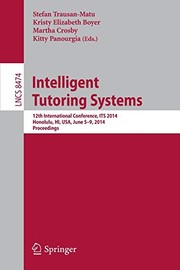
Intelligent Tutoring Systems
First published 2014. Subjects: Computer-assisted instruction, Artificial Intelligence (incl. Robotics), Multimedia systems, Computer sci...

Artificial Intelligence in Education
This work reports on research into intelligent systems, models, and architectures for educational computing applications. It covers a wid...
Advances in intelligent tutoring systems
First published 2010. Subjects: Educational applications, Artificial intelligence, Intelligent tutoring systems, Computer-assisted instru...
Intelligent Tutoring Systems
ITS 2000 is the fifth international conference on Intelligent Tutoring Systems. The preceding conferences were organized in Montreal in 1...
eBay marketplace picks
Marketplace Samples
Example marketplace items related to this page. Use the search link to explore similar finds on eBay.
Example eBay listing
A.I. Artificial Intelligence Original Movie Poster Signed By Jude Law
USD 125.00 | Shipping USD 25.00 | US
Example eBay listing
Artificial Intelligence D/S Original Movie Poster - 27 x 40"
USD 19.50 | Shipping USD 13.65 | US
Example eBay listing
612388 Artificial Intelligence Movie Science Fiction Drama Wall Print Poster
USD 22.95 | Shipping USD 12.95 | JP

Example eBay listing
Companion - Artificial Intelligence Dark Comedy Cinema Film - POSTER 20"x30"
USD 23.99 | Free shipping | US
Topic Tree