Within Public Compute
Europe’s AI factories
Europe’s AI factories are meant to give researchers, start-ups, industry, and public services an alternative to dependence on foreign cloud giants.
On this page
- Why Europe wants domestic AI infrastructure
- Who gets access to AI factory compute
- The limits of sovereignty without chips, energy, and talent
Page outline Jump by section
Introduction
Europe’s “AI factories” are an attempt to answer a difficult question before advanced AI infrastructure becomes permanently concentrated elsewhere: can a region still shape its own technological future if the underlying compute, chips, cloud platforms, and models are controlled abroad?
 The European Union increasingly treats AI infrastructure as strategic infrastructure, closer to energy grids or telecoms networks than ordinary software. Through the EuroHPC programme and wider “AI Continent” strategy, the EU is funding a network of AI factories and future “AI gigafactories” intended to give researchers, start-ups, industry, and public services access to large-scale computing without relying entirely on American cloud giants. [Digital Strategy]digital-strategy.ec.europa.euDigital Strategy AI FactoriesDigital StrategyAI Factories - Shaping Europe's digital future - European UnionOct 30, 2025 — In October 2025, the EuroHPC JU announced t… [Council of the European Union]consilium.europa.euCouncil of the European UnionArtificial intelligence: Council paves the way for the creation of…Jan 16, 2026 — The amended regulation…
But Europe’s sovereignty problem is deeper than simply building more data centres. Most frontier AI chips still come from Nvidia in the United States. The largest cloud platforms remain American. Energy constraints are growing. European capital markets are fragmented. Even some of Europe’s most successful AI firms still depend heavily on U.S. infrastructure providers. The result is that Europe may gain more bargaining power and resilience without achieving full technological independence.
The real question is therefore not whether Europe can become completely autonomous in AI. It is whether public compute can give Europe enough control, capability, and negotiating leverage to avoid becoming merely a customer in an AI-driven world.
Why Europe wants domestic AI infrastructure
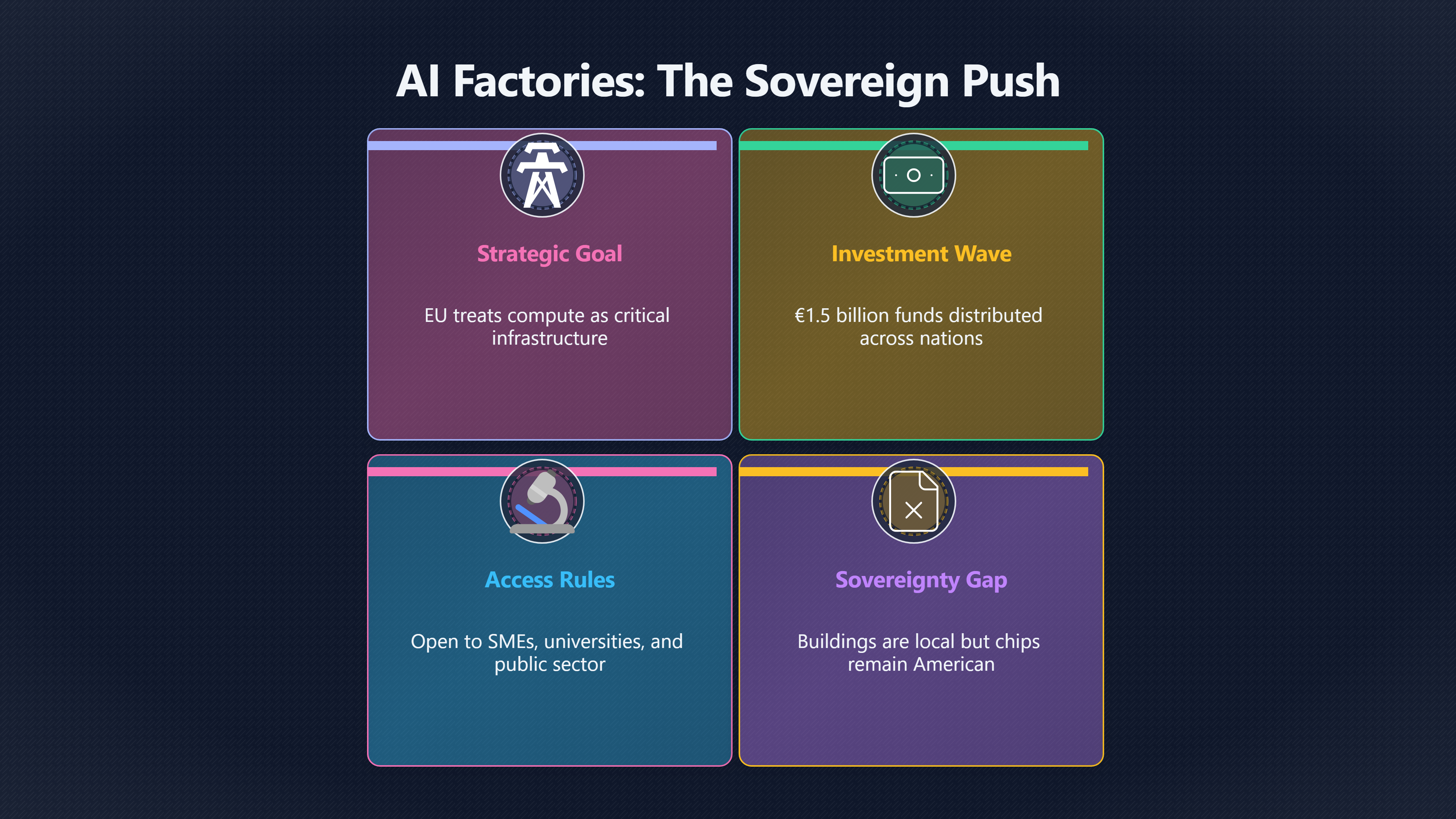
Europe’s push for AI factories comes from a growing fear that intelligence infrastructure could become a geopolitical dependency.
For years, European policymakers worried about reliance on foreign energy, semiconductors, and cloud providers. Generative AI intensified those concerns because the technology increasingly depends on massive computing clusters, specialised chips, and hyperscale data centres owned by a small number of firms. If future medicine, manufacturing, logistics, defence, science, and public administration all rely on AI systems, then dependence on external infrastructure starts to look strategically risky rather than merely commercial.
The European Commission’s AI strategy now openly frames compute capacity as part of “technological sovereignty”. The EU’s “AI Continent” plan calls for at least 19 AI factories linked to Europe’s supercomputing network to support start-ups, researchers, and industry. [European Commission]commission.europa.euEuropean Commission AI continentEuropean CommissionAI continent - European CommissionBuilding a large-scale AI computing infrastructure · setting up at least 19 AI facto…
The concept of “sovereign AI” has also spread quickly through European politics and industry. Nvidia chief executive Jensen Huang has repeatedly argued that nations will want AI systems rooted in their own languages, institutions, and legal systems rather than relying entirely on foreign platforms. European governments have become increasingly receptive to that argument. [Reuters]reuters.comNvidia's pitch for sovereign AI resonates with EU leadersReutersNvidia's pitch for sovereign AI resonates with EU leadersJune 16, 2025 — 16 Jun 2025 — Nvidia CEO Jensen Huang has been pitching t…
This is partly about economics. European leaders fear that if AI becomes the central productivity technology of the next few decades, the largest gains could flow toward whoever owns the infrastructure layer. Europe already missed much of the platform economy created by smartphones, social media, and hyperscale cloud computing. Many policymakers see AI as a final chance to avoid becoming structurally dependent on foreign digital monopolies.
But the concern is also political.
European governments worry about several overlapping risks:
- Public-sector data being processed primarily through foreign infrastructure.
- European companies becoming locked into U.S. cloud ecosystems.
- AI pricing power concentrating in a few firms.
- Export controls or geopolitical disputes limiting compute access.
- Strategic sectors losing bargaining power if advanced models remain externally controlled.
Those fears intensified after the United States tightened export controls on advanced chips to China, demonstrating how compute access can become a geopolitical weapon. Even though Europe is allied with the U.S., policymakers increasingly recognise that dependencies matter long before alliances break down.
The broader AI bloom question sits underneath all of this. If advanced AI genuinely accelerates science, medicine, engineering, and economic output, then access to large-scale compute may shape who participates in that future. Europe’s AI factories are an attempt to prevent the infrastructure of abundance from becoming entirely external.
What Europe’s AI factories actually are
The phrase “AI factory” sounds futuristic, but the initiative is mostly an attempt to adapt Europe’s existing supercomputing infrastructure for AI development.
The programme is run through the EuroHPC Joint Undertaking, the EU body originally created to strengthen European high-performance computing. Rather than building a single giant European AI laboratory, the EU is creating a distributed network of compute centres across member states. [EuroHPC]eurohpc-ju.europa.euEuroHPCEuroHPC JU Selects AI Factory Antennas to Broaden the AI…13 Oct 2025 — The newly selected AI Factory Antennas are established t…
The first wave of AI factories announced in 2024 involved around €1.5 billion in combined EU and national investment. Additional sites were later added across countries including Spain, Poland, the Netherlands, Lithuania, Romania, and the Czech Republic. [European Commission]commission.europa.euEuropean Commission AI continentEuropean CommissionAI continent - European CommissionBuilding a large-scale AI computing infrastructure · setting up at least 19 AI facto… [EuroHPC The model combines several goals at once:]eurohpc-ju.europa.euEuroHPCEuroHPC JU Selects AI Factory Antennas to Broaden the AI…13 Oct 2025 — The newly selected AI Factory Antennas are established t…
- AI-optimised supercomputers.
- Shared access for start-ups and researchers.
- Technical support and training.
- Data and model infrastructure. [reuters.com]reuters.comEurope risks falling behind US, China on AI data centre build-up, Nokia CEO saysDespite some positive initiatives from the European Union, such as the development of AI gigafactories, Hotard pointed out that Europe st…
- Links to universities and industrial ecosystems.
- Compliance with European privacy and regulatory standards.
The EU increasingly describes these facilities as public-interest infrastructure rather than ordinary commercial cloud services. EuroHPC documents repeatedly emphasise access for SMEs, universities, public research, and “trustworthy AI” development. [EuroHPC]eurohpc-ju.europa.euEuroHPCEuroHPC JU Selects AI Factory Antennas to Broaden the AI…13 Oct 2025 — The newly selected AI Factory Antennas are established t… [Digital Strategy]digital-strategy.ec.europa.euDigital Strategy AI FactoriesDigital StrategyAI Factories - Shaping Europe's digital future - European UnionOct 30, 2025 — In October 2025, the EuroHPC JU announced t…
This matters because many smaller European firms cannot afford frontier-scale compute on commercial hyperscaler platforms. The largest training runs now cost tens or hundreds of millions of euros. Without shared infrastructure, many researchers and start-ups would simply be excluded from competing.
In that sense, AI factories resemble publicly funded scientific infrastructure more than conventional industrial policy. Europe is effectively trying to build AI equivalents of shared laboratories, particle accelerators, or national research networks.
The initiative also reflects a specifically European political instinct: that critical infrastructure should not be entirely governed by market concentration alone.
Who gets access to AI factory compute
The politics of access may matter as much as the hardware itself.
One of the strongest arguments for public compute is that frontier AI increasingly rewards whoever already has enormous capital. Without intervention, the AI economy could consolidate around a handful of giant firms able to finance huge compute clusters and negotiate privileged access to scarce chips.
Europe’s AI factories are intended to widen participation before those advantages become irreversible.
Official EU documents consistently stress access for:
- Universities and public researchers.
- Small and medium-sized enterprises.
- Industrial firms adopting AI.
- Public-sector organisations.
- Start-ups building models or applications. EuroHPC+2Digital Strategy [digital-strategy.ec.europa.eu]digital-strategy.ec.europa.euDigital Strategy AI FactoriesDigital StrategyAI Factories - Shaping Europe's digital future - European UnionOct 30, 2025 — In October 2025, the EuroHPC JU announced t…
This matters for the broader AI bloom debate because abundance is not only about whether AI capabilities exist. It is also about who can experiment with them.
A world where only a few American or Chinese firms can afford frontier compute could still produce extraordinary technological progress. But it would narrow who shapes the trajectory of that progress. Public compute is an attempt to keep scientific and industrial participation broader.
There is already evidence that infrastructure access influences innovation geography. Mistral, one of Europe’s most visible AI companies, has repeatedly argued that Europe needs its own compute base to avoid strategic dependence. Its chief executive recently warned that Europe risks becoming an American “vassal state” in AI if it fails to build domestic infrastructure quickly enough. [Business Insider]businessinsider.comtech giants. Mensch emphasized the urgent need for Europe to gain autonomy over AI models and the computing and energy infrastructure beh…
The AI factory model also tries to avoid a pure winner-takes-all dynamic inside Europe itself. Smaller countries that could never finance frontier AI infrastructure alone can connect into a wider European network through “AI Factory Antennas”, which extend access beyond the largest member states. [EuroHPC]eurohpc-ju.europa.euEuroHPCEuroHPC JU Selects AI Factory Antennas to Broaden the AI…13 Oct 2025 — The newly selected AI Factory Antennas are established t…
In theory, this could help distribute AI capability more broadly across the continent rather than concentrating it entirely in Paris, London, Berlin, or Amsterdam.
The sovereignty problem hidden inside the hardware
The biggest weakness in Europe’s sovereignty project is that much of the underlying stack remains foreign.
Many European AI factories depend heavily on Nvidia systems. Germany’s planned HammerHAI supercomputer, for example, is based on Nvidia’s GB200 architecture and built by HPE, an American company. [EuroHPC]eurohpc-ju.europa.euEuroHPCEuroHPC JU Selects AI Factory Antennas to Broaden the AI…13 Oct 2025 — The newly selected AI Factory Antennas are established t…
This creates an uncomfortable reality: Europe may own the buildings and fund the infrastructure while still depending on external suppliers for the most strategically important components.
That dependence extends beyond chips.
Europe still relies heavily on American hyperscale cloud providers including Amazon Web Services, Microsoft Azure, and Google Cloud. Even when European firms seek “sovereign” infrastructure, they often partner with U.S. companies because the technical and financial barriers to building entirely separate ecosystems are enormous.
Recent debates around European cloud sovereignty illustrate the tension clearly. Thales and Google recently announced a Germany-based sovereign cloud initiative intended to create operational and legal separation from Google itself. [Reuters]reuters.comThe initiative aims to create a cloud platform that is both operationally and legally independent from Google itself. This move aligns wi… Yet the partnership simultaneously demonstrates how difficult it remains to avoid dependence on American technology firms altogether.
The same contradiction appears across Europe’s AI sector.
European companies increasingly want sovereignty, but many still need:
- Nvidia chips.
- U.S. cloud tooling.
- American software ecosystems.
- Foreign investment capital.
- Access to global AI talent markets.
That does not make the sovereignty project meaningless. Partial dependence is not the same as total dependence. But it changes what success realistically looks like.
Europe is probably not building a fully independent AI stack comparable to the United States or China. It is instead trying to secure enough domestic capability to preserve strategic choice and reduce vulnerability.
Chips, energy, and talent are the real bottlenecks
The hardest constraints on AI sovereignty may not be political at all.
They are physical.
Advanced AI infrastructure requires three things at enormous scale:
- High-end chips.
- Vast electricity supply.
- Specialist engineering talent.
Europe remains constrained on all three.
Chips
The semiconductor problem is especially severe. Europe has strengths in some parts of the chip supply chain, particularly through ASML in the Netherlands, whose lithography systems are essential to advanced semiconductor manufacturing. But Europe lacks large-scale frontier GPU production comparable to Nvidia.
As a result, even publicly funded European AI systems still rely heavily on imported accelerators.
[That creates several risks:]reuters.comEurope risks falling behind US, China on AI data centre build-up, Nokia CEO saysDespite some positive initiatives from the European Union, such as the development of AI gigafactories, Hotard pointed out that Europe st…
- Supply shortages.
- Exposure to export controls.
- Price dependency.
- Delayed deployment schedules.
- Reduced bargaining power.
Some European sovereignty advocates therefore argue that AI factories alone are insufficient without a broader semiconductor strategy.
Energy
AI infrastructure is increasingly an energy problem disguised as a computing problem.
Training and operating advanced models requires enormous electricity capacity, cooling systems, and grid access. Europe already faces higher energy costs than the United States in many regions, and grid bottlenecks are slowing data-centre expansion. Reuters recently reported warnings from Nokia’s chief executive that Europe risks falling behind the U.S. and China partly because of infrastructure and electricity constraints. [Reuters]reuters.comEurope risks falling behind US, China on AI data centre build-up, Nokia CEO saysDespite some positive initiatives from the European Union, such as the development of AI gigafactories, Hotard pointed out that Europe st…
This matters because future AI competition may increasingly reward whoever can rapidly deploy gigawatt-scale compute clusters.
The AI bloom perspective often assumes AI could dramatically accelerate scientific progress and productivity. But those gains still depend on material infrastructure. Intelligence may become abundant only where electricity, cooling, land, and industrial capacity can support it.
Talent
Europe also faces a talent challenge.
Many leading European AI researchers continue to move toward American firms because frontier salaries, capital access, and compute resources remain much larger in the United States.
Public compute can help narrow that gap by giving researchers access to stronger infrastructure locally. But retaining top talent requires more than hardware. It also requires competitive financing, entrepreneurial ecosystems, and the ability to scale globally.
This is one reason why some critics worry Europe may overemphasise regulation while underinvesting in capability.
Can public compute actually compete with hyperscalers?
The central sceptical argument is simple: can publicly coordinated infrastructure really keep pace with companies spending tens of billions annually on AI compute?
American hyperscalers already operate at extraordinary scale. Microsoft, Amazon, Google, and Meta can finance infrastructure build-outs faster than most governments. Their cloud systems are deeply integrated, globally distributed, and commercially mature.
Europe’s AI factories may therefore face a structural speed problem.
There is also a usability issue.
Traditional supercomputers were designed mainly for scientific simulation rather than modern AI workflows. Researchers behind a recent paper on AI factories argued that Europe’s high-performance computing systems are often poorly aligned with the cloud-native tooling AI developers expect. [arXiv]arxiv.orgarXiv AI Factories: It's time to rethink the Cloud-HPC dividearXivAI Factories: It's time to rethink the Cloud-HPC divideSeptember 16, 2025…
If access is bureaucratic, fragmented, or technically awkward, start-ups may still default toward commercial cloud providers even when public compute exists.
This creates a danger that AI factories become politically symbolic but economically secondary.
Yet the sceptical case can also be overstated.
Europe does not necessarily need to dominate frontier AI globally for the strategy to matter. Even partial domestic capability could still provide important benefits:
- More bargaining power with foreign providers.
- Better resilience during supply shocks.
- Shared infrastructure for universities and SMEs.
- Greater control over public-sector deployments.
- Stronger local AI ecosystems.
- Reduced dependence for sensitive applications.
In practice, sovereignty often means leverage rather than autarky.
What success would actually look like
Europe is unlikely to achieve complete AI independence in the foreseeable future.
The more realistic question is whether it can avoid strategic irrelevance.
A successful AI factory strategy would probably not mean replacing Silicon Valley. It would mean ensuring Europe retains meaningful capacity to:
- Train and deploy important AI systems domestically.
- Support its own research and industrial base.
- Negotiate with global providers from a stronger position.
- Maintain public-sector and defence autonomy where necessary.
- Preserve competition and interoperability.
- Keep part of the long-term AI value chain inside Europe.
That matters for the broader AI bloom vision because the distribution of intelligence infrastructure may shape how widely the benefits of advanced AI spread.
If only a few corporations or states control advanced compute, AI-driven abundance could still arrive alongside extreme concentration of power. Europe’s public-compute strategy is partly an attempt to resist that outcome by treating intelligence infrastructure as something closer to a public capability than a purely private platform.
Whether it succeeds depends less on rhetoric about sovereignty than on difficult practical questions:
- Can Europe secure enough energy?
- Can it finance infrastructure at sufficient scale?
- Can it retain top researchers?
- Can public systems remain usable and competitive?
- Can European firms grow without being absorbed into foreign ecosystems?
- Can sovereignty coexist with global collaboration rather than isolation?
The answer may ultimately be mixed. Europe’s AI factories are unlikely to deliver full technological independence. But they could still matter enormously if they prevent AI capability from becoming completely centralised elsewhere.
In a future where advanced AI shapes science, medicine, education, industry, and governance, even partial control over compute infrastructure may prove far more important than it appears today.
Endnotes
-
Source: reuters.com
Title: Nvidia’s pitch for sovereign AI resonates with EU leaders
Link: https://www.reuters.com/business/media-telecom/nvidias-pitch-sovereign-ai-resonates-with-eu-leaders-2025-06-16/Source snippet
ReutersNvidia's pitch for sovereign AI resonates with EU leadersJune 16, 2025 — 16 Jun 2025 — Nvidia CEO Jensen Huang has been pitching t...
Published: June 16, 2025
-
Source: reuters.com
Link: https://www.reuters.com/business/aerospace-defense/thales-inks-deal-with-google-homegrown-german-cloud-provider-2026-05-20/Source snippet
The initiative aims to create a cloud platform that is both operationally and legally independent from Google itself. This move aligns wi...
-
Source: reuters.com
Title: Europe risks falling behind US, China on AI data centre build-up, Nokia CEO says
Link: https://www.reuters.com/business/media-telecom/europe-risks-falling-behind-us-china-ai-data-centre-build-up-nokia-ceo-says-2026-04-23/Source snippet
Despite some positive initiatives from the European Union, such as the development of AI gigafactories, Hotard pointed out that Europe st...
-
Source: arxiv.org
Title: arXiv AI Factories: It’s time to rethink the Cloud-HPC divide
Link: https://arxiv.org/abs/2509.12849Source snippet
arXivAI Factories: It's time to rethink the Cloud-HPC divideSeptember 16, 2025...
Published: September 16, 2025
-
Source: nvidianews.nvidia.com
Title: europe ai infrastructure
Link: https://nvidianews.nvidia.com/news/europe-ai-infrastructureSource snippet
Builds AI Infrastructure With NVIDIA to Fuel...Jun 11, 2025 — In France, Mistral AI is working with NVIDIA to build an end-to-end cloud...
-
Source: investor.nvidia.com
Link: https://investor.nvidia.com/news/press-release-details/2025/Europe-Builds-AI-Infrastructure-With-NVIDIA-to-Fuel-Regions-Next-Industrial-Transformation/default.aspxSource snippet
Builds AI Infrastructure With NVIDIA to Fuel...Jun 11, 2025 — These deployments will deliver more than 3,000 exaflops of NVIDIA Blackwel...
-
Source: bundeswirtschaftsministerium.de
Title: This is
Link: https://www.bundeswirtschaftsministerium.de/Redaktion/EN/Dossier/ipcei-cic.htmlSource snippet
IPCEI Compute Infrastructure Continuum | BMWEAt the beginning of 2025, several member states decided to jointly establish a sovereign dis...
-
Source: digital-strategy.ec.europa.eu
Title: Digital Strategy AI Factories
Link: https://digital-strategy.ec.europa.eu/en/policies/ai-factoriesSource snippet
Digital StrategyAI Factories - Shaping Europe's digital future - European UnionOct 30, 2025 — In October 2025, the EuroHPC JU announced t...
Published: October 2025
-
Source: consilium.europa.eu
Link: https://www.consilium.europa.eu/en/press/press-releases/2026/01/16/artificial-intelligence-council-paves-the-way-for-the-creation-of-ai-gigafactories/Source snippet
Council of the European UnionArtificial intelligence: Council paves the way for the creation of...Jan 16, 2026 — The amended regulation...
-
Source: commission.europa.eu
Title: European Commission AI continent
Link: https://commission.europa.eu/topics/competitiveness/ai-continent_enSource snippet
European CommissionAI continent - European CommissionBuilding a large-scale AI computing infrastructure · setting up at least 19 AI facto...
-
Source: digital-strategy.ec.europa.eu
Title: european approach artificial intelligence
Link: https://digital-strategy.ec.europa.eu/en/policies/european-approach-artificial-intelligenceSource snippet
Digital StrategyEuropean approach to artificial intelligenceStrengthening previous initiatives, the April 2025 AI Continent Action Plan a...
Published: April 2025
-
Source: eurohpc-ju.europa.eu
Title: Euro HPCAI Factories
Link: https://www.eurohpc-ju.europa.eu/ai-factories_enSource snippet
EuroHPCAI Factories - EuroHPC JU - European UnionLitAI Factory aims to transform Lithuania's HPC capabilities into a sovereign AI optimis...
-
Source: ec.europa.eu
Link: https://ec.europa.eu/commission/presscorner/detail/en/ip_24_6302Source snippet
European CommissionSeven consortia selected to establish AI factoriesDec 9, 2024 — The first AI Factories will represent a €1.5 billion i...
-
Source: eurohpc-ju.europa.eu
Link: https://www.eurohpc-ju.europa.eu/eurohpc-ju-selects-six-additional-ai-factories-expand-europes-ai-capabilities-2025-10-10_enSource snippet
EuroHPC JU Selects Six Additional AI Factories to...10 Oct 2025 — The EuroHPC Joint Undertaking (EuroHPC JU) has selected six new sites...
-
Source: eurohpc-ju.europa.eu
Link: https://www.eurohpc-ju.europa.eu/eurohpc-ju-launches-call-proposals-strengthen-european-ai-ecosystem-2026-04-28_enSource snippet
EuroHPCEuroHPC JU Launches Call for Proposals to Strengthen...28 Apr 2026 — This initiative will build a unified approach to AI developm...
-
Source: digital-strategy.ec.europa.eu
Title: ai innovation package
Link: https://digital-strategy.ec.europa.eu/en/factpages/ai-innovation-packageSource snippet
Digital StrategyAI Innovation Package | Shaping Europe's digital future25 Jul 2024 — The AI Innovation Package is to support European sta...
-
Source: eurohpc-ju.europa.eu
Title: eurohpc ju signs contract boost ai capabilities it4lia ai factory 2026 04 22 en
Link: https://www.eurohpc-ju.europa.eu/eurohpc-ju-signs-contract-boost-ai-capabilities-it4lia-ai-factory-2026-04-22_enSource snippet
JU Signs Contract to Boost AI Capabilities with...Apr 22, 2026 — IT4LIA will support the development of a secure and sovereign AI infras...
-
Source: businessinsider.com
Link: https://www.businessinsider.com/mistral-ceo-warns-europe-2-years-avoid-us-ai-dependence-2026-5Source snippet
tech giants. Mensch emphasized the urgent need for Europe to gain autonomy over AI models and the computing and energy infrastructure beh...
-
Source: eurohpc-ju.europa.eu
Link: https://www.eurohpc-ju.europa.eu/eurohpc-ju-selects-ai-factory-antennas-broaden-ai-factories-initiative-2025-10-13_enSource snippet
EuroHPCEuroHPC JU Selects AI Factory Antennas to Broaden the AI...13 Oct 2025 — The newly selected AI Factory Antennas are established t...
-
Source: linkedin.com
Link: https://www.linkedin.com/posts/european-commission_the-eus-ambitious-ai-continent-strategy-activity-7386664612517281792-kEMWSource snippet
European Commission's PostBy 2025-2026, at least 15 AI Factories and several Antennas will be operational, with nine new AI-optimized sup...
-
Source: eurohpc-ju.europa.eu
Title: Euro HPCGermany
Link: https://www.eurohpc-ju.europa.eu/ai-factories/germany_enSource snippet
EuroHPCGermany - AI Factories - EuroHPC JU - European UnionThe HammerHAI supercomputer will be manufactured and installed by HPE, based o...
-
Source: eurohpc-ju.europa.eu
Title: eurohpc ju signs contract deploy ai supercomputer hammerhai 2026 03 16 en
Link: https://www.eurohpc-ju.europa.eu/eurohpc-ju-signs-contract-deploy-ai-supercomputer-hammerhai-2026-03-16_enSource snippet
JU Signs Contract to Deploy AI Supercomputer...Mar 16, 2026 — Delivery of the HammerHAI supercomputer is scheduled for the second quarte...
-
Source: eurohpc-ju.europa.eu
Title: advancing european sovereignty hpc risc v 2025 03 06 en
Link: https://www.eurohpc-ju.europa.eu/advancing-european-sovereignty-hpc-risc-v-2025-03-06_enSource snippet
European Sovereignty in HPC with RISC-V6 Mar 2025 — In December 2024, the EuroHPC JU selected the sites that will host the first European...
Published: December 2024
-
Source: digital-strategy.ec.europa.eu
Link: https://digital-strategy.ec.europa.eu/en/policies/apply-aiSource snippet
It aims...Read more...
-
Source: digital-strategy.ec.europa.eu
Title: ai office
Link: https://digital-strategy.ec.europa.eu/en/policies/ai-officeSource snippet
| Shaping Europe's digital futureIn January 2024, the Commission has announced an AI innovation package to support startups and SMEs in d...
Published: January 2024
-
Source: eurohpc-ju.europa.eu
Link: https://www.eurohpc-ju.europa.eu/document/download/47492db7-592e-4ad8-b672-9c822f94afa0_en?filename=AI+GIGAFACTORIES+CONSULTATION.pdfSource snippet
for expression of interest in AI Gigafactories (AIGFs)Apr 9, 2025 — So far, 13 AI Factories have been selected bringing together 17 EU Me...
-
Source: digital-strategy.ec.europa.eu
Title: ai continent action plan
Link: https://digital-strategy.ec.europa.eu/en/factpages/ai-continent-action-planSource snippet
Continent Action Plan | Shaping Europe's digital future7 May 2025 — AI-driven [automation]({{ 'ai-bloom-abun/ai-bloom-abun-98d3a6-ai-medicine-l-7c4177-clinical-seco-8e7b35-automation-bi-6899ab/' | relative_url }}), op...
Published: May 2025
-
Source: eurohpc-ju.europa.eu
Title: eu International Cooperation on Artificial Intelligence
Link: https://www.eurohpc-ju.europa.eu/international-cooperation-artificial-intelligence_enSource snippet
Cooperation on Artificial Intelligence - EuroHPC JU4 Mar 2025 — This initiative aims to guide and prepare European HPC for the convergenc...
-
Source: Wikipedia
Title: European Union
Link: https://en.wikipedia.org/wiki/European_UnionSource snippet
European UnionThe European Union (EU) is a political and economic union of 27 member states that are located primarily in Europe. A su...
-
Source: Wikipedia
Link: https://en.wikipedia.org/wiki/EuropeSource snippet
EuropeEurope is a continent [t] located entirely in the Northern Hemisphere and mostly in the Eastern Hemisphere. It is bordered by th...
-
Source: interface-eu.org
Title: ai factories
Link: https://www.interface-eu.org/publications/ai-factories -
Source: cliffordchance.com
Title: data centres and ai compute infrastructure insights 2026
Link: https://www.cliffordchance.com/insights/thought_leadership/trends/2026/data-centres-and-ai-compute-infrastructure-insights-2026.htmlSource snippet
Data Centres & AI Compute Infrastructure Insights 2026A number of countries and blocs will place growing emphasis on promoting domestic f...
-
Source: data-en-maatschappij.ai
Title: europese commissie invest ai
Link: https://data-en-maatschappij.ai/en/publications/europese-commissie-invest-aiSource snippet
European Commission – Invest AI initiative14 May 2025 — A public-private initiative that will mobilize €200 billion for AI across the EU...
Published: May 2025
-
Source: britannica.com
Link: https://www.britannica.com/place/EuropeSource snippet
Europe | History, Countries, Map, & FactsEurope is the second smallest of the world's continents, composed of the westward-projecting pen...
Additional References
-
Source: timesofindia.indiatimes.com
Link: https://timesofindia.indiatimes.com/technology/tech-news/ceo-of-europes-14-billion-ai-startup-has-an-american-dependency-warning-once-supply-is-monopolised-/articleshow/131152408.cmsSource snippet
He emphasized that the AI race is increasingly becoming about infrastructure control rather than just model development. Mistral's CEO wa...
-
Source: elysee.fr
Link: https://www.elysee.fr/en/emmanuel-macron/2025/11/18/germany-france-and-the-european-commission-launch-frontier-ai-initiative-at-the-summit-on-european-digital-sovereigntySource snippet
Germany, France and the European Commission launch...Nov 18, 2025 — Germany, France and the European Commission launch Frontier AI Initi...
-
Source: european-union.europa.eu
Link: https://european-union.europa.eu/index_enSource snippet
Union: Your gateway to the EU, News, HighlightsDiscover how the EU functions, its principles, priorities; find out about its history and...
-
Source: babl.ai
Link: https://babl.ai/eu-greenlights-ai-gigafactories-in-push-for-strategic-compute-and-technological-sovereignty/Source snippet
EU Greenlights “AI Gigafactories” in Push for Strategic...Jan 20, 2026 — The amendment authorizes EuroHPC to fund, develop, and operate...
-
Source: facebook.com
Title: the eus ai continent ambition is officially in full gear six new ai factories ju
Link: https://www.facebook.com/EuropeanCommission/posts/the-eus-ai-continent-ambition-is-officially-in-full-gear-six-new-ai-factories-ju/1232993388865788/Source snippet
The EU's AI Continent ambition is officially in full...The first factories should be launched by 2025, and, by the end of the decade, wi...
-
Source: euronews.com
Title: germany unveils its first ai factory in boost for european digital sovereignty
Link: https://www.euronews.com/next/2026/02/05/germany-unveils-its-first-ai-factory-in-boost-for-european-digital-sovereigntySource snippet
Germany unveils its first AI factory in boost for European...Feb 5, 2026 — Germany unveils its first AI factory in boost for European di...
-
Source: visiteurope.com
Link: https://visiteurope.com/Source snippet
Plan your vacation to discover European culture, heritage, architecture, gastronomy and stunning landscapes...
-
Source: iapp.org
Title: how a hybrid approach to ai sovereignty is shaping eu digital policy
Link: https://iapp.org/news/a/how-a-hybrid-approach-to-ai-sovereignty-is-shaping-eu-digital-policySource snippet
How a hybrid approach to AI sovereignty is shaping EU...Feb 18, 2026 — In sum, the proposals loosen the EU's sovereign control over algo...
-
Source: thenextweb.com
Title: gpuaas is reinforcing the illusion of european ai sovereignty
Link: https://thenextweb.com/news/gpuaas-is-reinforcing-the-illusion-of-european-ai-sovereigntySource snippet
11 hours ago — As of 2026, Europe operates 14 supercomputers and 19 AI Factories under the EuroHPC JU (Joint Undertaking), backed by roug...
-
Source: sciencebusiness.net
Title: eu launches ai strategies boost competitiveness and science
Link: https://sciencebusiness.net/news/ai/eu-launches-ai-strategies-boost-competitiveness-and-scienceSource snippet
EU launches AI strategies to boost competitiveness and...Oct 9, 2025 — The European Commission has launched two strategies it hopes will...
Amazon book picks
Further Reading
Books and field guides related to Europe’s AI factories. Use these as the next step if you want deeper reading beyond the article.

Artificial Intelligence in Context of Digital Sovereignty
In a world increasingly shaped by technology, digital sovereignty is a critical need for nations and organizations to preserve their auto...

AI Governance and Liability in Europe
AI Governance and Liability in Europe: A Primer Edited by Ceyhun Necati Pehlivan, Nikolaus Forgó & Peggy Valcke In very short order, the...

The Oxford Handbook of AI Governance
As the capabilities of Artificial Intelligence (AI) have increased over recent years, so have the challenges of how to govern its usage....

Digital Sovereignty and the Green Transition
This book is the first investigation of the relationship between EU digital sovereignty and sustainability strategies. It maps the ambiti...
eBay marketplace picks
Marketplace Samples
Example marketplace items related to this page. Use the search link to explore similar finds on eBay.

Example eBay listing
A.I. Artificial Intelligence Original Movie Poster Signed By Jude Law
USD 125.00 | Shipping USD 25.00 | US

Example eBay listing
Artificial Intelligence D/S Original Movie Poster - 27 x 40"
USD 19.50 | Shipping USD 13.65 | US

Example eBay listing
612388 Artificial Intelligence Movie Science Fiction Drama Wall Print Poster
USD 22.95 | Shipping USD 12.95 | JP

Example eBay listing
Companion - Artificial Intelligence Dark Comedy Cinema Film - POSTER 20"x30"
USD 23.99 | Free shipping | US

Example eBay listing
A.I. Artificial Intelligence Movie Film Poster Art Print
GBP 4.99 | Free shipping | GB

Example eBay listing
A I Artificial Intelligence 6 Movie Poster Art Print Print Classic Rare Gallery
GBP 49.00 | Free shipping | GB

Example eBay listing
AI - Artificial Intelligence (Poster + Slipcase) Blu-Ray
GBP 10.49 | Free shipping | GB

Example eBay listing
A. I. Artificial Intelligence. Jude Law. Original UK Video Poster.
GBP 8.11 | Shipping GBP 3.38 | GB
Topic Tree