Within Efficiency Rebound
Useful Electricity Growth
More electricity use is not always waste if AI enables medicine, robotics, cleaner industry and other valuable work.
On this page
- The difference between wasteful and valuable new demand
- AI uses that could justify more electricity
- How to judge welfare gains against grid pressure
Page outline Jump by section
Introduction
More efficient AI does not necessarily mean lower electricity use. A richer, more technologically capable civilisation may end up consuming far more electricity precisely because it is doing more valuable things. The important question is not simply whether AI increases power demand, but whether the new demand creates enough human benefit to justify the strain on grids, energy systems and the environment.
 This distinction matters for the wider idea of AI-enabled abundance. If advanced AI helps accelerate medicine, robotics, scientific research, clean manufacturing and climate adaptation, then higher electricity use may reflect expanding human capability rather than pure waste. Industrial history already contains many examples where societies consumed more energy because they became healthier, wealthier and more productive. The challenge is judging when AI-driven electricity growth represents genuine flourishing and when it represents inefficient escalation, speculative overbuilding or unequal concentration of resources.
The difference between wasteful and valuable new demand
Electricity demand is not automatically good or bad. Modern civilisation already treats some forms of energy growth as socially valuable. Hospitals, sanitation systems, refrigeration, public transport and digital communications all increased electricity consumption, but they also improved health, productivity and quality of life.
The same logic may apply to AI.
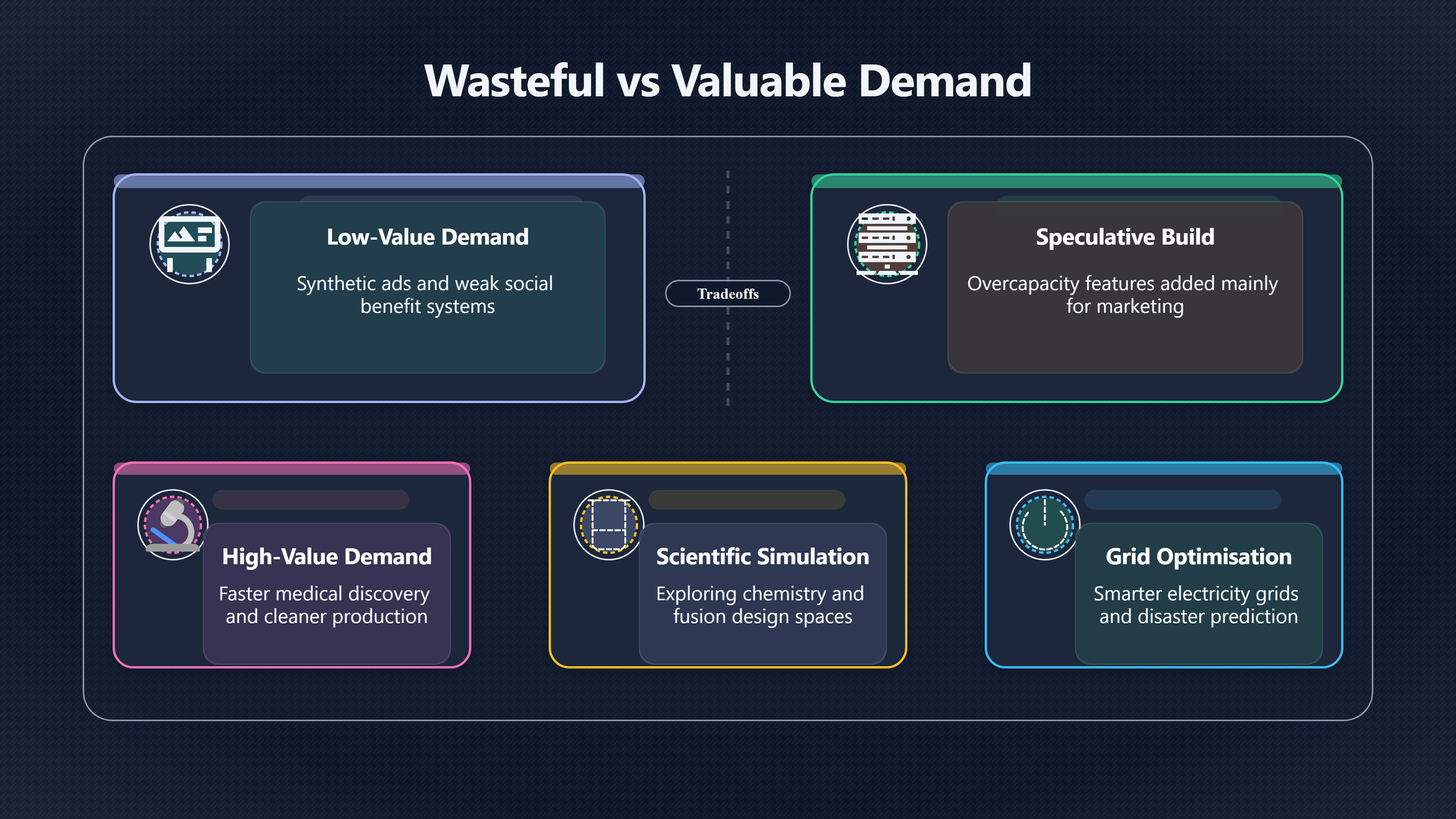
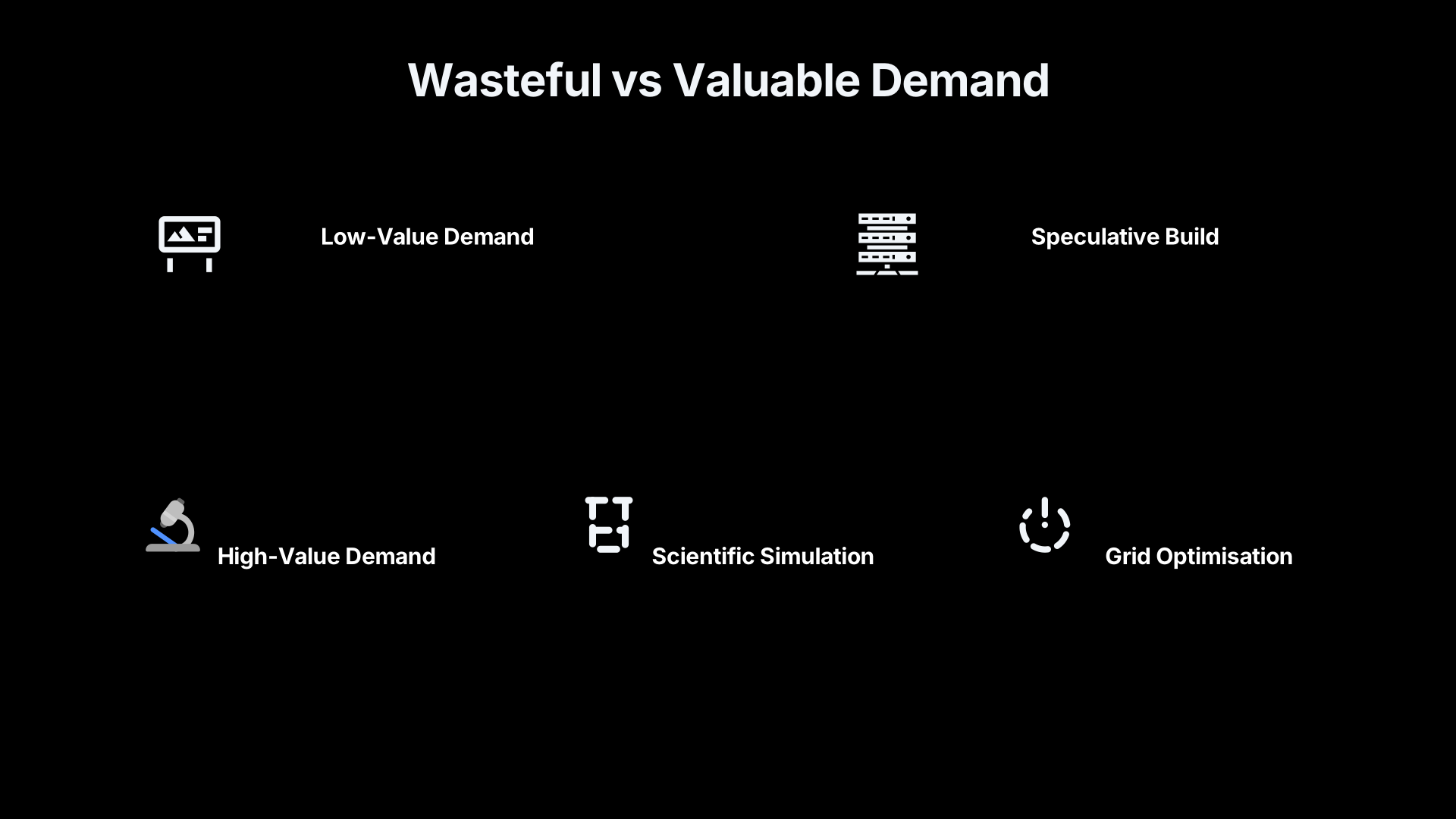
A useful distinction is between low-value consumption and high-value capability expansion.
Low-value demand includes things like:
- Endless duplication of synthetic advertising content
- AI features added mainly for marketing reasons
- Speculative data-centre overcapacity [iea.org]iea.orgIEAExecutive summary – Energy and AI – AnalysisElectricity demand for data centres more than doubles by 2030… Data centre electricity…
- Energy-intensive systems with weak social benefit
- Poorly optimised inference systems wasting computation
High-value demand looks different:
- Faster medical discovery
- Cleaner industrial production
- Scientific simulation
- Advanced robotics
- Smarter electricity grids
- Better disaster prediction
- Productivity gains that reduce material waste
- Expanded access to education and expertise
The broader electrification trend already points in this direction. The International Energy Agency (IEA) describes the world as entering a new “Age of Electricity”, driven not only by AI but by electric vehicles, heat pumps, industry and digital infrastructure. [IEA]iea.orgIEADemand – Electricity 2025 – AnalysisElectricity consumption rose by an estimated 4.3% yoy in 2024, up from 2.5% in 2023, with growth e… [IEA]iea.orgIEAElectricity – Global Energy Review 2025 – AnalysisGlobal electricity demand increased by 4.3% in 2024, a step change from the 2.5% gro…
This matters because electricity is often replacing dirtier or less efficient systems. A factory using more electricity but dramatically less coal or oil may still reduce total energy waste and emissions overall. Research on electrification and digitalisation finds that electricity demand can rise while total energy consumption falls because electric systems are often intrinsically more efficient than combustion-based ones. [ScienceDirect]sciencedirect.comScienceDirectElectrification and digitalization effects on sectoral energy…by X Li · 2023 · Cited by 93 — The results show that: (1) t…
In that sense, rising electricity demand can be a sign of technological upgrading rather than regression.
AI uses that could justify more electricity
The strongest argument for “useful electricity growth” is that advanced AI may unlock activities with unusually high social returns.
Medicine and biological research
Drug discovery, protein modelling, genomic analysis and medical imaging all require substantial computation. Systems inspired by projects like AlphaFold have already demonstrated that AI can compress parts of biological research that once took years into days or hours.
If future AI systems substantially accelerate treatments for cancer, dementia, infectious disease or ageing itself, then the electricity used by large-scale computing may look economically and morally worthwhile relative to the gains in healthy life years.
This does not mean unlimited power consumption is justified. But societies already devote enormous energy resources to healthcare infrastructure because the welfare gains are considered exceptionally high.
AI could push this further by enabling:
- Large-scale biological simulation
- Personalised medicine
- Faster clinical trial analysis
- Continuous diagnostic systems
- Automated laboratory robotics
These are electricity-intensive activities, but they may also increase human capability far beyond their energy cost.
Scientific acceleration
One of the central claims behind AI bloom is that machine intelligence could accelerate science itself.
Scientific progress is often bottlenecked by limited human attention and slow experimentation cycles. AI systems may help researchers explore vastly larger design spaces in chemistry, materials science, fusion engineering and climate modelling.
This could produce indirect energy benefits as well:
- Better batteries
- More efficient solar cells
- Improved grid optimisation
- Advanced geothermal systems
- New industrial materials requiring less heat or waste
The World Economic Forum and other energy analysts increasingly argue that AI may simultaneously increase electricity demand while also helping optimise renewable grids and energy systems. [World Economic Forum]reports.weforum.orgWorld Economic Forum Artificial Intelligence's Energy ParadoxWorld Economic ForumArtificial Intelligence's Energy ParadoxJanuary 30, 2025 — In renewable power generation, AI can enhance forecasting…
That creates a paradoxical possibility: AI could become a major electricity consumer while also becoming one of the tools helping civilisation build larger clean-energy systems.
Robotics and industrial automation
A highly automated economy is likely to use far more electricity than today’s economy because robots, autonomous vehicles and machine-controlled industrial systems require continuous power.
But this may also produce substantial welfare gains.
Electric robots can replace dangerous mining work, repetitive warehouse labour or hazardous industrial tasks. AI-guided manufacturing may reduce defects, waste and material losses. Automated agriculture may lower fertiliser and water use.
An AI-enabled industrial system could therefore consume more electricity while using fewer raw materials overall.
This distinction matters because many people instinctively equate higher electricity demand with environmental decline. Historically, however, advanced economies often become more electricity-intensive while simultaneously becoming cleaner, safer and more efficient in other dimensions.
Why richer civilisations usually use more electricity
One reason the “AI will reduce electricity use” argument may fail is that prosperity itself tends to increase energy demand.
As societies become richer, they usually expand:
- Computation
- Climate control
- Transport
- healthcare
- communication
- manufacturing precision
- research infrastructure
Even apparently “digital” wealth often depends on enormous physical systems underneath.
Modern data centres already consume large amounts of electricity, and the IEA expects their electricity demand to more than double by 2030, reaching roughly 945 terawatt-hours globally. [IEA]iea.orgIEAExecutive summary – Electricity 2024 – AnalysisData centres are significant drivers of growth in electricity demand in many regions…
Yet even this rapid growth still represents less than 10% of projected global electricity-demand growth over the period, according to the IEA. Electrification of transport, industry, cooling and buildings remains even larger. [IEA]iea.orgIEAExecutive summary – Energy and AI – AnalysisElectricity demand for data centres more than doubles by 2030… Data centre electricity…
This broader context is important. AI is not arriving in a static economy. It is arriving during a long transition toward electrically powered civilisation.
An advanced AI civilisation might therefore consume vastly more electricity than today while also delivering:
- Lower pollution
- Greater productivity
- Longer healthy lives
- Higher material abundance
- Better resilience to climate stress
- Expanded scientific capability
Historically, abundant energy has usually correlated with broader human capability. The key issue is whether the energy system itself becomes cleaner, cheaper and more scalable.

The risk that “valuable demand” becomes an excuse
The optimistic case has genuine weaknesses.
“High-value electricity growth” can easily become a vague justification for uncontrolled expansion. Companies naturally frame their own energy use as socially beneficial, even when the benefits are uncertain or concentrated.
Several concerns matter here.
Local grid pressure
AI data centres create highly concentrated electricity demand. Some regions are already struggling with transmission bottlenecks, water usage and grid instability linked to rapid data-centre growth.
These costs are often local even when the economic gains are global.
Residents near large facilities may face:
- Higher electricity prices [iea.org]iea.orgsummary – Electricity 2025 – AnalysisThe modest growth of 1.4% in 2024 was supported by the residential and commercial sectors, led by in…
- Delayed grid connections
- Increased water stress
- Noise and land-use conflicts
- Pollution from backup generation [iea.org]iea.orgenergy supply for aiIEAEnergy supply for AIGlobal electricity generation to supply data centres is projected to grow from 460 TWh in 2024 to over 1 000 TWh i…
In some regions, AI growth has already delayed retirement of fossil-fuel “peaker” plants designed for emergency use. [Reuters]reuters.comAI data centers are forcing dirty 'peaker' power plants back into serviceThese plants, like the eight-unit petroleum-fired Fisk plant in Chicago, are designed to operate only during high demand but are now bein…
That creates a serious challenge for the abundance narrative. A civilisation cannot plausibly claim technological flourishing while simply shifting environmental and financial burdens onto vulnerable communities.
Who captures the gains?
Another key question is distribution.
If AI-driven electricity growth mainly benefits a handful of technology firms while ordinary households absorb rising infrastructure costs, then the “high-value demand” argument weakens substantially.
Some analysts already warn that rapid AI expansion could raise electricity prices for households and small businesses if grid upgrades are socialised while profits remain concentrated. [Tom's Hardware]tomshardware.comTom's Hardware U.SAI boom is completely upending the electricity market - small businesses and households could foot the bill as industry watchers warn of…
The political economy therefore matters as much as the technology itself.
A genuinely flourishing outcome would probably require:
- Faster grid expansion
- Massive clean-energy investment [arxiv.org]arxiv.orgarXiv Power Couple? AI Growth and Renewable Energy InvestmentarXivPower Couple? AI Growth and Renewable Energy InvestmentMarch 8, 2026…
- Better transmission systems
- Fair cost allocation
- Competition and broad access
- Public investment in infrastructure
- Strong incentives for efficiency
Without these conditions, AI electricity growth could deepen inequality rather than expand shared abundance.
How to judge welfare gains against grid pressure
The hardest question is not technical but civilisational: how should societies evaluate whether new electricity demand is worthwhile?
Several criteria help.
Does AI replace more wasteful systems?
An AI system using large amounts of electricity may still reduce total resource use if it replaces:
- Fossil-fuel-heavy processes
- Transport-intensive services
- Material waste
- Human error
- Idle infrastructure
For example, electrified and AI-optimised logistics systems may use more computation but less fuel overall.
Are the gains broadly distributed?
Electricity growth tied to medical access, industrial productivity or cheaper clean energy is easier to justify socially than growth tied mainly to speculative financial activity or advertising optimisation.
The broader the gains, the stronger the case.
Does the electricity come from scalable low-carbon sources?
The climate implications matter enormously.
The IEA projects that renewables will provide nearly half of additional electricity generation for data-centre demand through 2030, with nuclear also expected to grow later in the decade. [IEA]iea.orgIEAEnergy demand from AIDespite the strong increase, data centre electricity demand growth accounts for less than 10% of global electrici…
But outcomes remain uncertain. In some regions, AI growth may accelerate clean-energy investment. In others, it may prolong fossil-fuel dependence if grids cannot expand fast enough. [arXiv]arxiv.orgarXiv Power Couple? AI Growth and Renewable Energy InvestmentarXivPower Couple? AI Growth and Renewable Energy InvestmentMarch 8, 2026…
Does the activity expand long-term human capability?
This is the deepest “AI bloom” question.
A future civilisation performing vastly more scientific research, education, simulation, medicine and creative work may naturally consume more electricity than today. If AI helps humanity become healthier, wiser, more resilient and more capable over centuries, then higher electricity use may represent expansion of civilisation rather than mere excess.
The important metric is not simply watts consumed. It is what those watts make possible.
Useful electricity growth may become a defining political question
The debate over AI electricity use is often framed too narrowly as a conflict between efficiency and consumption. In reality, advanced societies frequently increase electricity demand while simultaneously improving welfare and reducing other forms of waste.
AI could intensify that pattern dramatically.
The most optimistic vision is not a world where intelligence becomes free and energy use disappears. It is a world where abundant intelligence helps humanity build cleaner energy systems, automate dangerous work, accelerate science and expand human flourishing enough that larger electricity systems become both manageable and worthwhile.
But that outcome is not automatic.
If AI-driven electricity growth mainly fuels speculation, inequality, fossil dependence or low-value digital excess, then rising demand may look less like civilisation blooming and more like another resource race. The distinction will depend on infrastructure choices, governance, energy policy and whether the gains from advanced AI become genuinely broad-based rather than narrowly captured.
Endnotes
-
Source: iea.org
Link: https://www.iea.org/reports/electricity-2025/demandSource snippet
IEADemand – Electricity 2025 – AnalysisElectricity consumption rose by an estimated 4.3% yoy in 2024, up from 2.5% in 2023, with growth e...
-
Source: iea.org
Link: https://www.iea.org/reports/global-energy-review-2025/electricitySource snippet
IEAElectricity – Global Energy Review 2025 – AnalysisGlobal electricity demand increased by 4.3% in 2024, a step change from the 2.5% gro...
-
Source: iea.org
Link: https://www.iea.org/reports/electricity-2024/executive-summarySource snippet
IEAExecutive summary – Electricity 2024 – AnalysisData centres are significant drivers of growth in electricity demand in many regions...
-
Source: sciencedirect.com
Link: https://www.sciencedirect.com/science/article/pii/S0360544223013865Source snippet
ScienceDirectElectrification and digitalization effects on sectoral energy...by X Li · 2023 · Cited by 93 — The results show that: (1) t...
-
Source: iea.org
Link: https://www.iea.org/reports/energy-and-ai/executive-summarySource snippet
IEAExecutive summary – Energy and AI – AnalysisElectricity demand for data centres more than doubles by 2030... Data centre electricity...
-
Source: iea.org
Link: https://www.iea.org/reports/energy-and-ai/energy-demand-from-aiSource snippet
IEAEnergy demand from AIDespite the strong increase, data centre electricity demand growth accounts for less than 10% of global electrici...
-
Source: reuters.com
Title: AI data centers are forcing dirty ‘peaker’ power plants back into service
Link: https://www.reuters.com/business/energy/ai-data-centers-are-forcing-obsolete-peaker-power-plants-back-into-service-2025-12-23/Source snippet
These plants, like the eight-unit petroleum-fired Fisk plant in Chicago, are designed to operate only during high demand but are now bein...
-
Source: iea.org
Title: energy supply for ai
Link: https://www.iea.org/reports/energy-and-ai/energy-supply-for-aiSource snippet
IEAEnergy supply for AIGlobal electricity generation to supply data centres is projected to grow from 460 TWh in 2024 to over 1 000 TWh i...
-
Source: arxiv.org
Title: arXiv Power Couple? AI Growth and Renewable Energy Investment
Link: https://arxiv.org/abs/2603.26678Source snippet
arXivPower Couple? AI Growth and Renewable Energy InvestmentMarch 8, 2026...
Published: March 8, 2026
-
Source: sciencedirect.com
Link: https://www.sciencedirect.com/science/article/pii/S266679242500037XSource snippet
Advances and challenges in energy and climate alignment...by A Lal · 2025 · Cited by 21 — The rapid growth of artificial intelligence (A...
-
Source: iea.org
Title: growth in global energy demand surged in 2024 to almost twice its recent average
Link: https://www.iea.org/news/growth-in-global-energy-demand-surged-in-2024-to-almost-twice-its-recent-averageSource snippet
Growth in global energy demand surged in 2024 to almost...Mar 24, 2025 — Global energy demand grew at a faster-than-average pace in 2024...
-
Source: iea.org
Title: global ev outlook 2024
Link: https://www.iea.org/reports/global-ev-outlook-2024Source snippet
AnalysisApr 23, 2024 — The Global EV Outlook is an annual publication that identifies and assesses recent developments in electric mobili...
-
Source: iea.org
Title: electricity 2024
Link: https://www.iea.org/reports/electricity-2024Source snippet
Analysis24 Jan 2024 — It offers a deep and comprehensive analysis of recent policies and market developments, and provides forecasts thro...
-
Source: iea.org
Title: energy efficiency 2024
Link: https://www.iea.org/reports/energy-efficiency-2024Source snippet
AnalysisNov 7, 2024 — Energy Efficiency 2024 is the IEA's primary annual analysis on global energy efficiency developments, showing recen...
-
Source: iea.org
Link: https://www.iea.org/reports/electricity-2025/executive-summarySource snippet
summary – Electricity 2025 – AnalysisThe modest growth of 1.4% in 2024 was supported by the residential and commercial sectors, led by in...
-
Source: iea.org
Title: share of electricity consumption by data centre and equipment type 2024
Link: https://www.iea.org/data-and-statistics/charts/share-of-electricity-consumption-by-data-centre-and-equipment-type-2024Source snippet
Share of electricity consumption by data centre and...9 Apr 2025 — Share of electricity consumption by data centre and equipment type, 2...
-
Source: arxiv.org
Link: https://arxiv.org/html/2509.07218v3Source snippet
Electricity Demand and Grid Impacts of AI Data Centers29 Sept 2025 — In AI data centers, the share of electricity consumed by IT equipmen...
-
Source: reports.weforum.org
Title: World Economic Forum Artificial Intelligence’s Energy Paradox
Link: https://reports.weforum.org/docs/WEF_Artificial_Intelligences_Energy_Paradox_2025.pdfSource snippet
World Economic ForumArtificial Intelligence's Energy ParadoxJanuary 30, 2025 — In renewable power generation, AI can enhance forecasting...
Published: January 30, 2025
-
Source: tomshardware.com
Title: Tom’s Hardware U.S
Link: https://www.tomshardware.com/tech-industry/artificial-intelligence/u-s-ai-boom-is-completely-upending-the-electricity-market-small-businesses-and-households-could-foot-the-bill-as-industry-watchers-warn-of-sharp-price-increasesSource snippet
AI boom is completely upending the electricity market - small businesses and households could foot the bill as industry watchers warn of...
Additional References
-
Source: linkedin.com
Link: https://www.linkedin.com/posts/michael-barnard-42446_ai-electricity-demand-spike-already-drooping-activity-7289674800124297217-f5P5Source snippet
AI Electricity Demand Spike Already Drooping Due To...AI Data Centers Turn to Self-Built Power Plants Amid Electricity... Fuelled by AI...
-
Source: europarl.europa.eu
Link: https://www.europarl.europa.eu/RegData/etudes/BRIE/2019/637967/EPRS_BRI%282019%29637967_EN.pdfSource snippet
impacts of artificial intelligence (AI)Artificial intelligence plays an increasingly important role in our lives and economy and is alrea...
-
Source: sustainableviews.com
Title: data centres using more electricity than electric vehicles iea says a8a0d2fa
Link: https://www.sustainableviews.com/data-centres-using-more-electricity-than-electric-vehicles-iea-says-a8a0d2fa/Source snippet
Data centres using more electricity than electric vehicles...19 Jul 2024 — The IEA estimates that data centres accounted for between 1...
-
Source: balkangreenenergynews.com
Link: https://balkangreenenergynews.com/ieas-global-energy-review-electricity-use-is-growing-rapidly-driven-by-heatwaves-electrification-data-centers-ai/Source snippet
The increase was led by the electricity sector, driven by extremely high temperatures...Read more...
-
Source: innovationnewsnetwork.com
Title: global electricity demand to skyrocket in 2024 and 2025 says iea
Link: https://www.innovationnewsnetwork.com/global-electricity-demand-to-skyrocket-in-2024-and-2025-says-iea/49442/Source snippet
Global electricity demand to skyrocket in 2024 and 2025...Jul 19, 2024 — Global electricity demand is expected to grow by around 4% in...
-
Source: cpram.com
Title: ia what ai demand means for electricity and industrial markets
Link: https://cpram.com/fra/en/individual/publications/megatrends/ia-what-ai-demand-means-for-electricity-and-industrial-marketsSource snippet
What AI demand means for electricity and industrial markets?3 Oct 2024 — AI and the resulting increased demand for electricity, particula...
-
Source: nationalacademies.org
Link: https://www.nationalacademies.org/event/43750_11-2024_implications-of-artificial-intelligence-related-data-center-electricity-use-and-emissions-a-workshopSource snippet
main source of uptick in data center construction and investment in recent years...Read more...
-
Source: brookings.edu
Title: global energy demands within the ai regulatory landscape
Link: https://www.brookings.edu/articles/global-energy-demands-within-the-ai-regulatory-landscape/Source snippet
data center electricity consumption in 2024. The IEA estimates that data center demand for energy in the U.S. will increase by 130% by 20...
-
Source: iea-4e.org
Title: These large household appliances can empower consumers
Link: https://www.iea-4e.org/edna/Source snippet
Efficient, Demand Flexible Networked Appliances (EDNA)In 2024 EDNA changed its name to reflect an increased focus on 'demand flexible net...
-
Source: the-guild.eu
Title: can artificial intelligence foster sustainable eco
Link: https://www.the-guild.eu/news-and-blog/blog/can-artificial-intelligence-foster-sustainable-eco.htmlSource snippet
nomic...14 Apr 2026 — AI can enable better matching of supply and demand, predictive maintenance instead of replacement, digital service...
Amazon book picks
Further Reading
Books and field guides related to Useful Electricity Growth. Use these as the next step if you want deeper reading beyond the article.

Artificial Intelligence in Economics and Finance Theories
As Artificial Intelligence (AI) seizes all aspects of human life, there is a fundamental shift in the way in which humans are thinking of...

Urban Energy Transition
This compendium of 29 chapters from 18 countries contains both fundamental and advanced insight into the inevitable shift from cities dom...

Artificial intelligence
First published 1994. Subjects: problem solving, constraint satisfaction, knowledge, reasoning, planning.

Artificial Intelligence and Global Society
In the constant battle between human intelligence and machine intelligence, machines are close to surpassing human intelligence. The unre...
eBay marketplace picks
Marketplace Samples
Example marketplace items related to this page. Use the search link to explore similar finds on eBay.

Example eBay listing
A.I. Artificial Intelligence Original Movie Poster Signed By Jude Law
USD 125.00 | Shipping USD 25.00 | US

Example eBay listing
Artificial Intelligence D/S Original Movie Poster - 27 x 40"
USD 19.50 | Shipping USD 13.65 | US

Example eBay listing
612388 Artificial Intelligence Movie Science Fiction Drama Wall Print Poster
USD 22.95 | Shipping USD 12.95 | JP

Example eBay listing
Companion - Artificial Intelligence Dark Comedy Cinema Film - POSTER 20"x30"
USD 23.99 | Free shipping | US

Example eBay listing
A.I. Artificial Intelligence Movie Film Poster Art Print
GBP 4.99 | Free shipping | GB

Example eBay listing
A I Artificial Intelligence 6 Movie Poster Art Print Print Classic Rare Gallery
GBP 49.00 | Free shipping | GB

Example eBay listing
AI - Artificial Intelligence (Poster + Slipcase) Blu-Ray
GBP 10.49 | Free shipping | GB

Example eBay listing
A. I. Artificial Intelligence. Jude Law. Original UK Video Poster.
GBP 8.11 | Shipping GBP 3.38 | GB
Topic Tree