Within Safety Gaps
Unexpected robot motion
Crushing and trapping injuries often happen when a paused, jammed or manually jogged robot moves in a way the worker did not expect.
On this page
- Why paused robots can still become dangerous
- Crushing, trapping and struck by injury patterns
- What maintenance modes must do to limit movement
Page outline Jump by section
Introduction
Industrial robots are often safest during ordinary production, when every movement is repetitive and fenced off from people. The danger rises during maintenance, fault recovery and setup, when workers enter the robot’s space to clear jams, test sensors, adjust tooling or restart systems after an interruption. In these moments, a robot that appeared paused or predictable can suddenly move in ways the worker did not expect. That unexpected motion is one of the most common paths to crushing, trapping and struck-by injuries in robot cells. OSHA and NIOSH guidance repeatedly identify maintenance and troubleshooting as unusually hazardous periods because workers are inside the machine envelope while drive power, stored energy or restart capability may still exist. [Restored CDC]restoredcdc.orgPreventing the Injury of Workers by Robots (85-103) | NIOSHNIOSH offers the following recommendations regarding the design of robotic sys… [3OSHA 3OSHA]
 This matters to the broader promise of AI-driven automation. One argument for advanced robotics is that dangerous industrial work could increasingly be delegated to machines. But that promise weakens if humans remain exposed during the messy edges of automation: repairs, calibration, software resets and emergency interventions. Safe abundance depends not only on robots replacing hazardous labour, but on making the entire maintenance cycle predictable enough that workers are not trapped by unexpected motion.
Why paused robots can still become dangerous
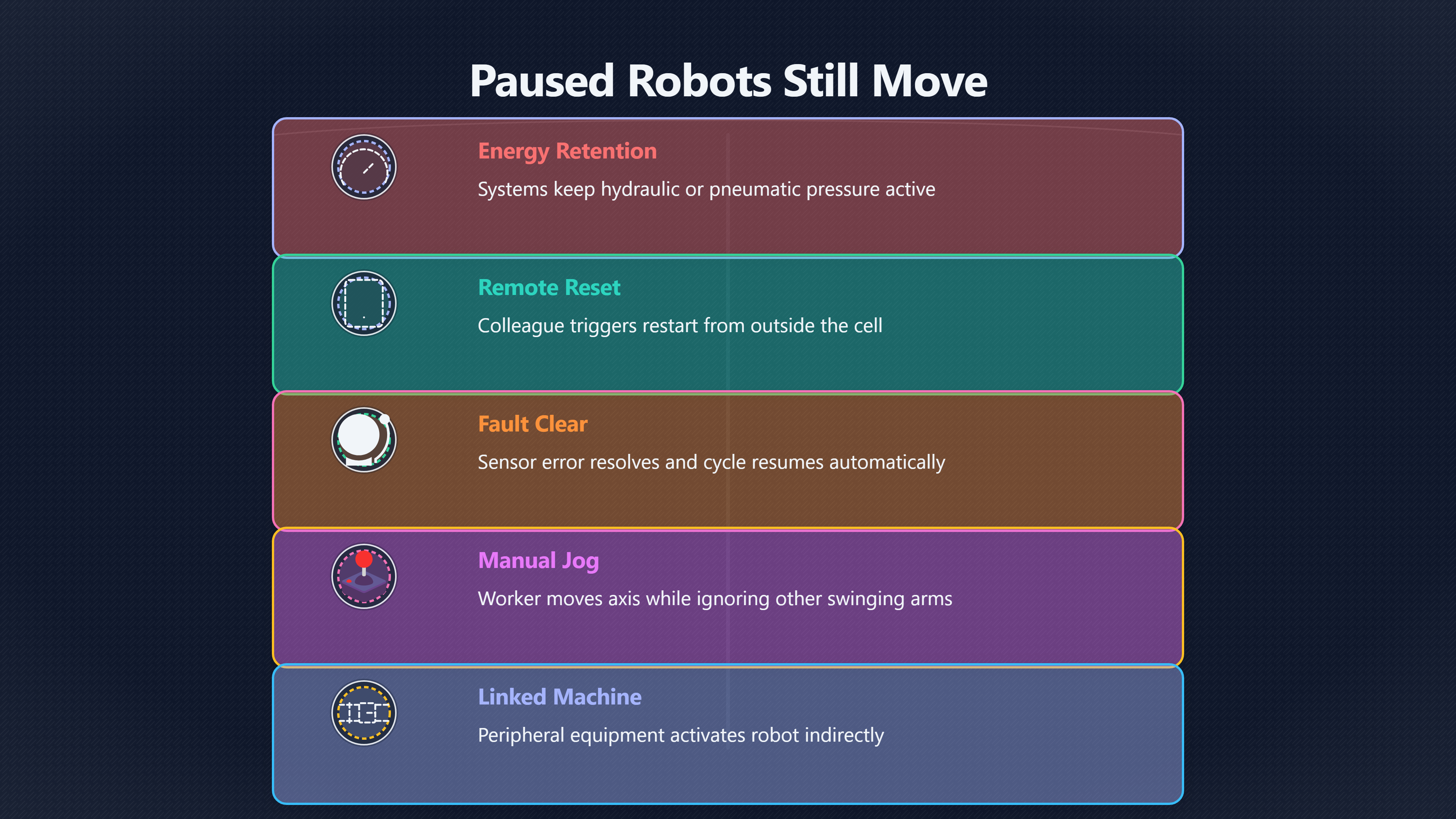
A robot that looks inactive is not necessarily safe. Industrial robotic systems often retain multiple forms of energy and multiple pathways back into motion. During maintenance, workers may assume a robot is “stopped” because the production cycle halted or an access gate opened. In reality, the control system may still permit movement under certain conditions.
Several mechanisms repeatedly appear in accident investigations:
- A co-worker resets the machine remotely while someone is still inside the cell.
- A robot resumes an interrupted cycle after a fault clears.
- A jam suddenly releases mechanical tension.
- A maintenance worker manually jogs an axis and misjudges the robot’s reach.
- Another linked machine activates automatically and moves the robot indirectly.
- Software or sensor faults generate unplanned motion.
- Stored hydraulic, pneumatic or gravitational energy releases unexpectedly.
OSHA guidance warns that workers can become trapped between a robot arm, tooling, workpieces or surrounding structures when motion occurs unexpectedly. [OSHA]osha.govTechnical Manual (OTMOSHAOSHA Technical Manual (OTM) - Section IV: Chapter 4Similar to above, a worker's limb or other body part can be trapped within or betw… [OSHA]osha.govGuidelines For Robotics Safety21 Sept 1987 — This instruction provides guidelines to OSHA compliance officers, employers, and employees f… NIOSH research into robot maintenance work found that many servicing tasks involved employees entering hazardous robot envelopes while drive power remained available, creating exposure to unexpected motion hazards. [CDC Stacks]stacks.cdc.govStacksUnexpected motion hazard exposures on a large robotic…by J Etherton · 1989 · Cited by 4 — Description: To assess the degree of u…
A key problem is that maintenance requires partial functionality. A machine completely disconnected from power may be safe, but impossible to diagnose or recalibrate. Technicians therefore often work in intermediate states where some movement remains enabled. This creates a difficult balance between operability and safety.
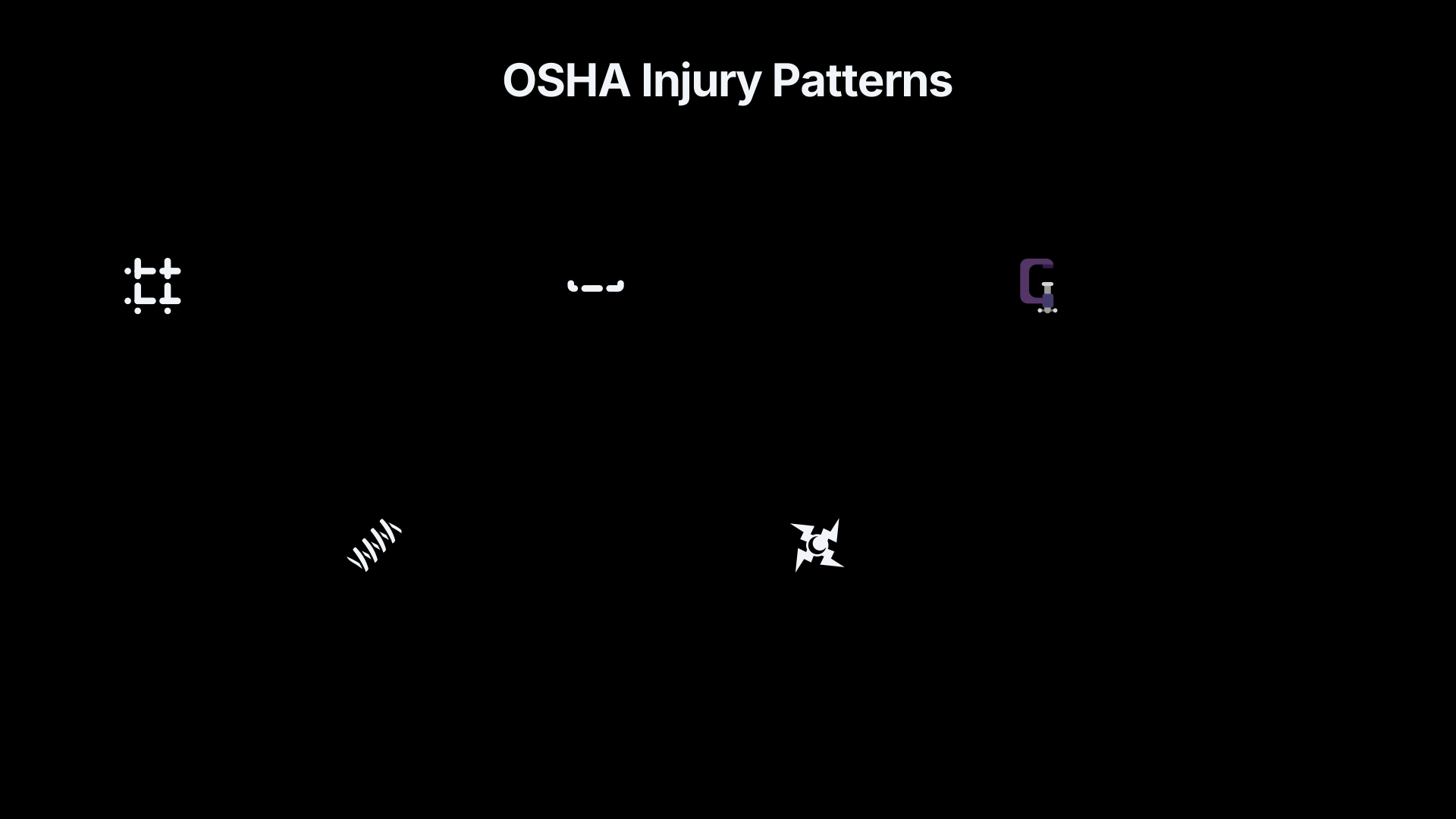
Crushing, trapping and struck-by injury patterns
Unexpected robot motion tends to injure workers in a small number of brutally physical ways. Unlike many industrial hazards, robot accidents are often not subtle. They involve force, momentum and confinement.
Trapped between robot and fixed structure
One of the most dangerous situations occurs when a worker stands between a robot arm and a rigid object such as a fence, machine frame, conveyor or fixture. If the robot moves unexpectedly, the worker may have little or no escape path.
OSHA accident records include multiple fatal incidents in which workers entered robot cells during troubleshooting or maintenance and were crushed between moving robotic equipment and surrounding structures. [OSHA]osha.govHazard Evaluation and SolutionsThe following references aid in evaluating hazards and possible solutions to controlling robotic hazards i… In one 2024 incident documented by OSHA, a worker cleaning a sensor inside a robotic enclosure was struck after a colleague reset the machine from outside the cell, reportedly lifting and placing the worker onto nearby equipment. [OSHA]osha.govAccident Search.searchOSHAAccident Search Results | Occupational Safety and Health…0552652, X, 3465, 336370, Robot Crushes And Kills Worker Inside Robot Wor…
These injuries are especially severe because industrial robots are designed for strength and positional accuracy, not instinctive avoidance. A human operator may reflexively stop pushing against another person. A programmed robot can continue applying force until a stop signal interrupts the sequence.
Entrapment during manual jogging and teaching
Maintenance staff often use “teach”, “jog” or reduced-speed modes to reposition robotic arms manually. These modes are intended to be safer than automatic operation, but they still involve live motion.
The danger comes from several factors:
- Workers may focus on one robot axis while another swings unexpectedly.
- Large articulated arms can pivot behind the worker.
- Reduced speed does not eliminate crushing force.
- Nearby robots or peripheral equipment may still move.
- The worker may be inside a narrowing space without realising it.
Research and safety guidance repeatedly note that people are injured not only by full-speed autonomous operation, but also during low-speed setup and calibration. [PMC]pmc.ncbi.nlm.nih.govPMCWorking Safely with Robot Workers: Recommendations for the…by V Murashov · 2016 · Cited by 207 — This paper describes the increasin… [Wikipedia]WikipediaWorkplace robotics safetyWorkplace robotics safetyTypes of accidents include collisions, crushing, and injuries from mechanical parts. Hazard controls include…
Restart after interruption
Modern robot cells are often interconnected systems rather than isolated machines. Conveyor systems, machine vision, programmable logic controllers and remote supervisory software may all influence movement.
This means a robot can restart because of actions elsewhere in the system:
- a sensor state changes
- a queued command resumes
- a production reset clears a fault
- another machine requests synchronised movement
The worker inside the cell may not see or hear the trigger. OSHA and ISO guidance therefore place heavy emphasis on preventing “unexpected start-up” during maintenance. [Unique Safety Products]uniquesafetyproducts.comUnique Safety ProductsHow to prevent unexpected machine starts with “full body…ISO 10218-2: 2011 provides very clear guidelines to pre… [Sora Robotics]sorarobotic.comsafety standards in robotic automation what you need to know about iso 10218 1 2Sora RoboticsWhat You Need to Know About ISO 10218-1/225 Mar 2026 — The EN ISO 14118 standard requires the LOTO (Lockout/Tagout) system t…
Why humans misread robot motion
A common misunderstanding is that robot accidents mainly happen because machines become random or uncontrollable. In reality, many dangerous movements are technically correct from the machine’s perspective. The problem is that humans and automation often interpret system state differently.
Humans tend to use social assumptions when reading movement:
- If something pauses, people assume it has stopped intentionally.
- If a machine is behind a gate, workers may assume it cannot restart.
- If another worker can see them, they assume the restart will not occur.
- If motion is slow, they assume escape is possible.
Industrial robots do not share those assumptions. They follow logic conditions, sensor states and queued instructions. A robot paused for safety may simply be waiting for a reset signal. A fault-cleared sequence may continue exactly where it left off.
This gap between human expectation and machine state becomes more important as robotic systems grow more autonomous and interconnected. AI-enabled factories could eventually coordinate thousands of devices dynamically, rerouting workflows and adapting production in real time. That may improve efficiency and reduce dangerous manual labour overall, but it also risks making machine behaviour harder for workers to predict intuitively.
Unexpected motion hazards therefore expose a deeper challenge in AI-enabled industry: systems can become operationally intelligent before they become legible to nearby humans.
What maintenance modes must do to limit movement
Robot safety systems increasingly recognise that maintenance and recovery modes require their own protections, not just weaker versions of production mode.
International robot safety standards such as ISO 10218 place growing emphasis on preventing unexpected restart, limiting movement during servicing and ensuring workers inside robot cells remain protected. ISO [Help Center]en.doc.safetics.ioHelp Center Safetics InsightHelp CenterSafetics Insight - ISO 10218-2:2025 Revision GuideWhen the 2011 industrial robot safety… Interlocks for energy restoration… Effective maintenance safeguards usually combine several layers rather than relying on a single emergency stop.
Positive energy isolation
Lockout-tagout procedures are designed to disconnect machines from hazardous energy sources physically and visibly. The principle is simple: if a worker is inside the danger zone, another person should not be able to restore power casually.
This matters because software stops alone may fail if:
- the control system resets
- a communication fault clears
- remote commands arrive
- stored energy remains active
Standards and safety guidance increasingly stress protection against “unexpected start-up” specifically because ordinary stop commands are not always enough. [Sora Robotics]sorarobotic.comsafety standards in robotic automation what you need to know about iso 10218 1 2Sora RoboticsWhat You Need to Know About ISO 10218-1/225 Mar 2026 — The EN ISO 14118 standard requires the LOTO (Lockout/Tagout) system t… [OSHA]osha.govThe gates into the work…Read more…

Reduced-speed and hold-to-run controls
When movement must remain available for calibration or testing, safer maintenance modes usually restrict robot speed and require continuous deliberate human input.
Common features include:
- hold-to-run enabling switches
- dead-man controls
- reduced-speed operation
- single-axis movement restrictions
- limited workspace zones
- visible indication that maintenance mode is active
The goal is not merely slower motion, but motion that is harder to trigger accidentally and easier for the worker to anticipate.
Presence detection and trapped-worker protection
Modern robot cells increasingly use systems intended to prevent restart while someone remains inside the protected area.
These can include:
- interlocked gates
- trapped-key systems
- area scanners
- pressure-sensitive mats
- presence sensors
- restart acknowledgement stations inside the cell
ISO guidance on full-body access areas stresses that a system should not simply restart because a gate closes again. [Unique Safety Products]uniquesafetyproducts.comUnique Safety ProductsHow to prevent unexpected machine starts with “full body…ISO 10218-2: 2011 provides very clear guidelines to pre… The machine must verify that workers have exited safely and consciously authorise restart procedures.
The larger implication for AI-enabled industry
Unexpected robot motion is a narrow technical problem, but it reveals a wider truth about automation. The hardest part of replacing dangerous labour is often not the repetitive task itself. It is the unpredictable edge cases: recovery, maintenance, adaptation and human intervention.
A future of AI abundance and highly automated industry could reduce many traditional workplace hazards. Robots do not tire, inhale toxic fumes or suffer repetitive strain injuries. But advanced automation also creates environments where a single misunderstanding between human and machine can become fatal within seconds.
The lesson from maintenance injuries is not that robotics should be abandoned. It is that safe automation depends on making machine intent understandable, restart logic controllable and hazardous motion genuinely predictable to the humans still required at the edge of the system. As factories become more autonomous and more AI-coordinated, that human-centred predictability may become just as important as raw robotic capability.
Endnotes
-
Source: osha.gov
Title: Technical Manual (OTM)
Link: https://www.osha.gov/otm/section-4-safety-hazards/chapter-4Source snippet
OSHAOSHA Technical Manual (OTM) - Section IV: Chapter 4Similar to above, a worker's limb or other body part can be trapped within or betw...
-
Source: osha.gov
Link: https://www.osha.gov/enforcement/directives/std-01-12-002Source snippet
Guidelines For Robotics Safety21 Sept 1987 — This instruction provides guidelines to OSHA compliance officers, employers, and employees f...
-
Source: stacks.cdc.gov
Link: https://stacks.cdc.gov/view/cdc/180227Source snippet
StacksUnexpected motion hazard exposures on a large robotic...by J Etherton · 1989 · Cited by 4 — Description: To assess the degree of u...
-
Source: restoredcdc.org
Link: https://restoredcdc.org/www.cdc.gov/niosh/docs/85-103/Source snippet
Preventing the Injury of Workers by Robots (85-103) | NIOSHNIOSH offers the following recommendations regarding the design of robotic sys...
-
Source: osha.gov
Link: https://www.osha.gov/robotics/hazard-evaluation-solutionsSource snippet
Hazard Evaluation and SolutionsThe following references aid in evaluating hazards and possible solutions to controlling robotic hazards i...
-
Source: osha.gov
Title: Accident Search.search
Link: https://www.osha.gov/ords/imis/AccidentSearch.search?Fatal=fatal&acc_keyword=%22Robot%22&keyword_list=onSource snippet
OSHAAccident Search Results | Occupational Safety and Health...0552652, X, 3465, 336370, Robot Crushes And Kills Worker Inside Robot Wor...
-
Source: osha.gov
Link: https://www.osha.gov/ords/imis/accidentsearch.accident_detail?id=202075727Source snippet
The gates into the work...Read more...
-
Source: osha.gov
Link: https://www.osha.gov/ords/imis/accidentsearch.accident_detail?id=172270.015Source snippet
OSHAAccident Report Detail | Occupational Safety and Health...The robotic arm activated and struck Employee #1, reportedly lifting and p...
-
Source: pmc.ncbi.nlm.nih.gov
Link: https://pmc.ncbi.nlm.nih.gov/articles/PMC4779796/Source snippet
PMCWorking Safely with Robot Workers: Recommendations for the...by V Murashov · 2016 · Cited by 207 — This paper describes the increasin...
-
Source: Wikipedia
Title: Workplace robotics safety
Link: https://en.wikipedia.org/wiki/Workplace_robotics_safetySource snippet
Workplace robotics safetyTypes of accidents include collisions, crushing, and injuries from mechanical parts. Hazard controls include...
-
Source: iso.org
Link: https://www.iso.org/obp/ui/en/Source snippet
For safety of the integration and commissioning of industrial robot applications, ISO 10218-2:2025...Read more...
-
Source: osha.gov
Link: https://www.osha.gov/roboticsSource snippet
Occupational Safety and Health AdministrationDuring many of these operations the worker may temporarily be within the robot's working env...
-
Source: osha.gov
Link: https://www.osha.gov/Source snippet
Home | Occupational Safety and Health AdministrationOSHA · Learn more about the National Safety Stand-Down to Prevent Falls in Constructi...
-
Source: cdc.gov
Link: https://www.cdc.gov/niosh/robotics/about/index.htmlSource snippet
Robotics in the Workplace: An OverviewFeb 9, 2024 — Hazards to workers might include: Struck-by or caught-between hazards; Crushing and t...
-
Source: cdc.gov
Link: https://www.cdc.gov/niosh/index.html -
Source: cdc.gov
Link: https://www.cdc.gov/niosh/bulletin/2015/robots.htmlSource snippet
A Robot May Not Injure a Worker: Working safely with robotsNov 20, 2015 — Summary: NIOSH is well poised to initiate a program assessing p...
-
Source: Wikipedia
Title: Occupational Safety and Health Administration
Link: https://en.wikipedia.org/wiki/Occupational_Safety_and_Health_AdministrationSource snippet
Occupational Safety and Health AdministrationOSHA's mission is to assure safe and healthy working conditions for working men and women...
-
Source: iso.org
Link: https://www.iso.org/obp/uiSource snippet
ISO/DIS 10218-1.2(en), Robotics — Safety requirementsThis ISO document specifies requirements for the inherently safe design, protective...
-
Source: uniquesafetyproducts.com
Link: https://uniquesafetyproducts.com/how-to-prevent-unexpected-machine-starts-with-full-body-access-in-robot-streets/Source snippet
Unique Safety ProductsHow to prevent unexpected machine starts with “full body...ISO 10218-2: 2011 provides very clear guidelines to pre...
-
Source: sorarobotic.com
Title: safety standards in robotic automation what you need to know about iso 10218 1 2
Link: https://sorarobotic.com/en/safety-standards-in-robotic-automation-what-you-need-to-know-about-iso-10218-1-2/Source snippet
Sora RoboticsWhat You Need to Know About ISO 10218-1/225 Mar 2026 — The EN ISO 14118 standard requires the LOTO (Lockout/Tagout) system t...
-
Source: en.doc.safetics.io
Title: Help Center Safetics Insight
Link: https://en.doc.safetics.io/insight-10218-2/Source snippet
Help CenterSafetics Insight - ISO 10218-2:2025 Revision GuideWhen the 2011 industrial robot safety... Interlocks for energy restoration...
-
Source: restoredcdc.org
Link: https://restoredcdc.org/www.cdc.gov/niosh/machine-safety/about/index.htmlSource snippet
Machine Safety in the WorkplaceJan 24, 2024 — Learn about machine related injuries and fatalities and how to stay safe at work...
Additional References
-
Source: researchgate.net
Link: https://www.researchgate.net/publication/382358180_Robot-related_injuries_in_the_workplace_An_analysis_of_OSHA_Severe_Injury_ReportsSource snippet
An analysis of OSHA Severe Injury Reports(2024) reviewed OSHA Severe Injury Reports and found that 77 robot-related accidents occurred be...
-
Source: fanuc.eu
Link: https://www.fanuc.eu/~/media/files/pdf/products/robots/educational%20cell/safety%20manual%20for%20fanuc%20educational%20cell.pdf?la=enSource snippet
FANUC Robot SAFETY HANDBOOKThe robot system must be designed to avoid trapping and collision between the moving parts of the robot and ot...
-
Source: ilearnengineering.com
Link: https://www.ilearnengineering.com/electronical-and-electronic/safety-challenges-in-industrial-roboticsSource snippet
Safety Challenges in Industrial RoboticsDiscover the top safety challenges in industrial robotics, from collisions to system malfunctions...
-
Source: concentra.com
Link: https://www.concentra.com/resource-center/articles/safely-incorporating-advancing-robotics-technologies-into-your-workplaceSource snippet
Safety considerations when working alongside robotsEight primary robot application hazards are recognized by OSHA, including: Impact, col...
-
Source: scribd.com
Title: BS en ISO 10218 1 2025 Robotics Safety Requirements Industrial Robots
Link: https://www.scribd.com/document/939146661/BS-en-ISO-10218-1-2025-Robotics-Safety-Requirements-Industrial-RobotsSource snippet
The start/restart interlock is intended to prevent hazardous situations like the unexpected start — after the energy supply is...Read more...
-
Source: safetymattersweekly.com
Title: weekly safety meeting preventing the injury of workers by robots
Link: https://safetymattersweekly.com/weekly-safety-meeting-preventing-the-injury-of-workers-by-robots/Source snippet
Preventing the Injury of Workers by Robots28 Jan 2024 — NIOSH offers the following recommendations regarding the design of robotic system...
-
Source: futureemployer.com
Title: robotics automation and employee safety for the future employer
Link: https://www.futureemployer.com/blog/2018/5/11/robotics-automation-and-employee-safety-for-the-future-employerSource snippet
Robotics, Automation, and Employee Safety for the Future...11 May 2018 — Unexpected movements, component malfunctions, or unpredicted pr...
Published: May 2018
-
Source: blog.creativesafetysupply.com
Title: robots automation and workplace safety 7 common hazards
Link: https://blog.creativesafetysupply.com/robots-automation-and-workplace-safety-7-common-hazards/Source snippet
Creative Safety Supply BlogRobots, Automation, and Workplace Safety: 7 Common...21 Jan 2020 — Impact or Collision Accidents: Component m...
-
Source: foxbusiness.com
Title: man crushed death industrial robot confused box police
Link: https://www.foxbusiness.com/fox-news-world/man-crushed-death-industrial-robot-confused-box-policeSource snippet
Man crushed to death by industrial robot that confused him...Nov 9, 2023 — A man in South Korea died Tuesday after a robot was said to h...
-
Source: develop-llc.com
Title: robot safety tools guarding and strategies
Link: https://develop-llc.com/insights/robot-safety-tools-guarding-and-strategies/Source snippet
Robot Safety and Guarding Strategies10 July 2024 — This guide will look into the fundamental principles of industrial robot safety that y...
Published: July 2024
Amazon book picks
Further Reading
Books and field guides related to Unexpected robot motion. Use these as the next step if you want deeper reading beyond the article.
Handbook of Industrial Robotics
About the Handbook of Industrial Robotics, Second Edition: "Once again, the Handbook of Industrial Robotics, in its Second Edition, expla...
Industrial Robotics Handbook
Presents information obtained from a variety of knowledgeable sources. Provides an extensive list of various robotics systems, and the po...
Robot Reliability and Safety
First published 1991. Subjects: Engineering, Engineering economy, Robotics, Robots.
Topic Tree