Within Abundant Intelligence
Affordable AI Tutoring
AI tutoring could widen access to personalised help, but only if it is designed for real classrooms and unequal learners.
On this page
- Why one to one tutoring is scarce
- What controlled AI tutor trials suggest
- Where classroom design and inequality matter
Page outline Jump by section
Introduction
One-to-one tutoring is one of the most effective forms of education ever studied. Students who receive sustained personalised tutoring often learn dramatically faster than pupils in standard classrooms. The problem is cost. A human tutor for every child is far beyond the budget of most schools and families, especially in poorer regions and overstretched public systems.
 That is why AI tutoring matters to the wider idea of AI-enabled abundance. If advanced AI can spread high-quality intellectual support far beyond elite schools and wealthy households, it could make one of humanity’s scarcest resources — patient expert attention — much more widely available. The optimistic case is not that chatbots will replace teachers or schools. It is that carefully designed AI systems could make some parts of personalised learning cheap enough to scale, giving millions more learners regular feedback, explanation, encouragement, and practice. The harder question is whether those gains will be real, durable, and broadly shared rather than unevenly distributed.
Why one-to-one tutoring is scarce
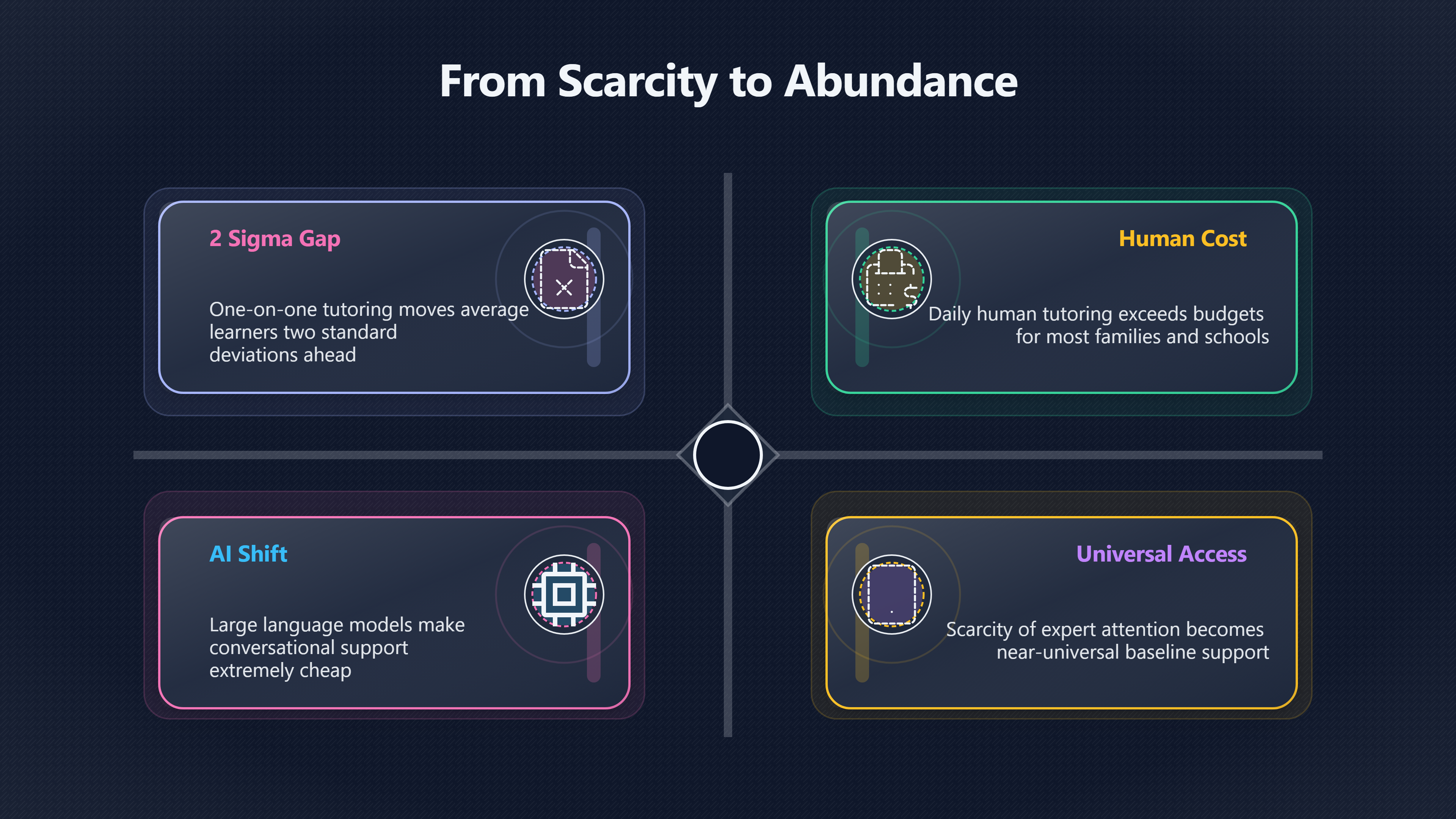
Educational psychologist Benjamin Bloom famously described the “2 sigma problem” in 1984. Students taught with one-to-one tutoring and mastery learning often performed around two standard deviations better than conventional classroom groups — enough to move an average learner towards top-tier performance. [Sage Journals]journals.sagepub.comBENJAMIN S. BLOOMView all authors and affiliations.Read moreSage JournalsThe Search for Methods of Group Instruction as Effective…by BS BLOOM · 1984 · Cited by 6208 — The 2 Sigma Problem: The Se…
The finding became influential because it exposed a painful reality about education systems. Personalised teaching works well partly because it adapts continuously:
- learners can ask questions immediately
- mistakes are corrected before they harden into confusion
- pacing changes from student to student
- motivation and confidence receive attention
- practice can continue until mastery is reached
Traditional classrooms struggle to provide this because one teacher may handle 25 to 35 pupils simultaneously. Even wealthy education systems cannot normally fund daily human tutoring for everyone. Private tutoring therefore becomes concentrated among families with money, spare time, and educational confidence.
This scarcity has large long-term consequences. Educational inequality compounds over decades. Students who fall behind in literacy or mathematics often lose confidence, receive less advanced instruction later, and face narrower economic opportunities. In that sense, affordable tutoring is not merely an education issue. It is connected to broader questions about whether AI could widen human capability across society instead of concentrating advantages among elites.
What makes AI tutoring different from older education software
Educational technology has promised “personalised learning” for decades, but most systems were limited. Earlier intelligent tutoring systems could adapt exercises and provide feedback, yet they were often rigid, narrow, and expensive to build for each subject.
Large language models changed the landscape because they can conduct open-ended dialogue. A modern AI tutor can:
- explain concepts in different ways
- respond conversationally
- generate new examples instantly
- translate or simplify explanations
- adjust pacing
- quiz learners dynamically
- simulate Socratic questioning
- remain available at almost zero marginal cost
The key economic shift is not that AI becomes a perfect teacher. It is that once a capable tutoring model exists, serving another learner becomes extremely cheap compared with hiring another human tutor.
This creates the possibility of moving from scarce educational attention to near-universal baseline support. A child struggling with algebra at 9pm, a rural learner with limited school resources, or an adult retraining mid-career could all receive some form of responsive assistance without waiting for scarce human availability.
But this only matters if the systems genuinely improve learning rather than merely producing plausible conversation.
What controlled AI tutor trials suggest
The evidence is still early, but several recent studies suggest that carefully designed AI tutors can improve learning outcomes under some conditions.
A 2025 randomised controlled trial involving university physics students found that learners using a custom AI tutor learned significantly more in less time than students receiving in-class active learning instruction. Students using the tutor also reported greater engagement and motivation. Importantly, the system was not simply an unrestricted chatbot. The tutor was designed around established pedagogical practices rather than answer generation alone. Nature [PubMed A separate exploratory trial in UK secondary schools examined a mathematics tutoring system built on Google’s pedagogically tuned LearnLM mod]journals.sagepub.comBENJAMIN S. BLOOMView all authors and affiliations.Read moreSage JournalsThe Search for Methods of Group Instruction as Effective…by BS BLOOM · 1984 · Cited by 6208 — The 2 Sigma Problem: The Se… el integrated into the Eedi platform. Human tutors supervised the AI outputs. Researchers found that students supported by the AI-assisted system performed at least as well as those working with human tutors alone, and in some measures slightly better on novel problem-solving tasks. Tutors also reported that the AI generated strong Socratic prompts that encouraged reflection rather than answer copying. [arXiv]arxiv.orgarXivAI tutoring can safely and effectively support students: An exploratory RCT in UK classroomsDecember 29, 2025…
Broader reviews remain more cautious. A 2025 systematic review of AI-driven intelligent tutoring systems in schools concluded that evidence for learning gains exists, but experimental quality remains uneven and many studies are still small or highly controlled. [Nature]nature.comNatureAI tutoring outperforms in-class active learningby G Kestin · 2025 · Cited by 145 — We find that students learn significantly more…
A 2026 meta-analysis examining ChatGPT-related educational studies found moderately positive effects overall, especially for engagement and cognitive support, though outcomes varied heavily depending on implementation and instructional design. [Nature]nature.comNatureA systematic review of AI-driven intelligent tutoring systems…by A Létourneau · 2025 · Cited by 118 — This systematic review aim…
The pattern emerging from the literature is important. The strongest results do not come from giving students unrestricted chatbot access and hoping for the best. They come from systems with:
- constrained educational goals
- structured curricula
- teacher oversight
- guided questioning
- scaffolding
- progress monitoring
- protections against shortcutting and answer dumping
In other words, the evidence increasingly points towards AI tutoring as an augmentation system embedded inside education, not a magical autonomous replacement for schools.
The Khanmigo experiment and the politics of access
Khan Academy has become one of the most visible attempts to build large-scale AI tutoring for public education through its Khanmigo system. The organisation frames the project explicitly around widening access to personalised support rather than replacing teachers. [khanmigo.ai]khanmigo.aie on prep, tackle homework challenges, and get personalized tutoring…
Several pilot programmes offer hints about both the promise and the complexity of deployment.
A Newark Public Schools partnership with Khan Academy reported substantial mathematics gains among students heavily using the platform, including improvements above state averages. [Khan Academy]khanacademy.orgKhan AcademyNewark Public Schools partners with Khan Academy to…A three-year study shows Newark students using Khan Academy and Khanmi…
An equity-focused pilot study involving Khanmigo examined how students and teachers in underserved settings interacted with the system. Researchers found enthusiasm for personalised support and multilingual assistance, but also highlighted implementation challenges including uneven digital access, teacher training burdens, and concerns about overreliance. [Digital Promise]digitalpromise.orgDigital PromiseEstudia Khanmigo: An equity-focused pilot exploration of…The following is a report on the result of a pilot study exami…
These details matter because educational inequality is not simply a software problem. AI tutoring can only become genuinely abundance-enhancing if learners have:
- devices
- connectivity
- time to use the systems
- literacy support
- safe learning environments
- teachers capable of integrating the tools well
Otherwise the systems may mostly amplify advantages already enjoyed by well-resourced schools.
The economics are also unresolved. Many AI tutoring systems remain dependent on expensive foundation models and cloud infrastructure. Some nonprofit providers subsidise access, while commercial systems increasingly target schools able to pay subscription costs. Whether AI tutoring becomes a universal public good or another premium educational layer remains an open political and economic question.
Why classroom design matters more than chatbot cleverness
One common misconception is that educational success mainly depends on how intelligent the model appears. In practice, pedagogy matters at least as much.
Poorly designed AI tutors can encourage shallow learning. Students may copy answers, rely on autocomplete thinking, or mistake fluency for understanding. Researchers studying educational AI systems repeatedly warn that models can produce persuasive but incorrect explanations or encourage passive consumption. [arXiv]arxiv.orgarXivAI tutoring can safely and effectively support students: An exploratory RCT in UK classroomsDecember 29, 2025…
Good tutoring systems instead try to reproduce some behaviours associated with effective human tutoring:
- asking guiding questions
- identifying misconceptions
- encouraging retrieval practice
- pacing difficulty carefully
- prompting explanation rather than copying
- sustaining learner confidence without removing productive struggle
This distinction is central to whether AI tutoring contributes to long-term human flourishing or merely automates educational shortcuts.
There is also evidence that human relationships remain essential. Students often learn partly because teachers motivate them, notice emotional distress, manage social dynamics, and create accountability. AI systems still struggle with these dimensions. Even strong supporters of AI tutoring generally describe it as complementing teachers rather than replacing them outright. [WIRED]wired.comDeveloped by Satya Nitta, Origin integrates AI to help with summoning educational resources and answering student queries quickly and acc…
That may ultimately be the more realistic abundance model: teachers supported by AI systems that handle repetitive explanation, adaptive exercises, translation, and administrative work, freeing humans to focus on mentorship, judgement, motivation, and complex intervention.
Where AI tutoring could matter most
The biggest long-run impact may not come from elite schools but from places where educational scarcity is most severe.
Potential high-impact areas include:
- regions with teacher shortages
- overcrowded classrooms
- adult retraining during labour-market disruption
- language translation for migrant learners
- support for disabled students [arxiv.org]arxiv.orgarXivAI tutoring can safely and effectively support students: An exploratory RCT in UK classroomsDecember 29, 2025…
- after-hours homework help
- remedial mathematics and literacy
- personalised pacing for students who are either struggling or advancing rapidly
The World Bank and UNESCO have repeatedly warned about global “learning poverty”: many children attend school but fail to acquire foundational literacy and numeracy. AI tutoring does not solve weak institutions, underfunded schools, or poverty itself. But if it can provide even modestly effective personalised support at scale, the aggregate effect over decades could be large.
The broader AI bloom argument appears here in miniature. Human civilisation is constrained not only by physical scarcity, but by limited access to skilled cognitive guidance. If AI reduces the cost of explanation, coaching, and learning support, more people may gain the capacity to participate in science, engineering, medicine, entrepreneurship, and creative work.
That does not guarantee equality or flourishing. It merely enlarges the range of what becomes possible.
The strongest objections
Sceptics of AI tutoring raise several serious concerns, many of which remain unresolved.
Hallucinations and accuracy
Language models can confidently provide wrong answers or misleading explanations. In education, repeated subtle errors can damage understanding over time. The danger is especially high for younger learners who cannot independently verify information.
Dependency and reduced effort
Some educators worry students may outsource thinking itself. If AI systems make difficult tasks frictionless, learners may practise less reasoning, writing, and memory formation.
Surveillance and data extraction
Educational platforms collect large quantities of behavioural data from children. Questions about privacy, commercial incentives, and profiling become more important as AI tutoring systems expand.
Unequal deployment
Wealthier schools may gain access to better AI systems, stronger teacher integration, and more supervision, while poorer schools receive cheaper automated substitutes. In that scenario AI could widen educational inequality rather than reduce it.
The human relationship problem
Teaching is partly emotional and social. Students often work harder for people who believe in them. AI systems may simulate empathy, but simulation is not the same as genuine human care or long-term mentorship.
These criticisms do not eliminate the case for AI tutoring. But they do weaken simplistic narratives that software alone can solve education.
Can AI tutors really make one-to-one learning affordable?
In a narrow economic sense, probably yes. AI already makes conversational educational support dramatically cheaper than traditional tutoring. The cost difference between a human tutor hour and a marginal AI interaction is enormous, and model capabilities continue improving.
The harder question is whether affordable AI tutoring can produce the deeper benefits associated with excellent human teaching.
So far, the evidence suggests a cautious but meaningful answer: sometimes, under the right conditions. Well-designed systems appear capable of improving engagement, speeding practice, and providing scalable personalised support. The strongest trials increasingly show real learning gains rather than novelty effects alone. Nature [Brookings But affordability is not enough. Educational abundance depends on implementation]brookings.eduwhat the research shows about generative ai in tutoringJan 27, 2026 — Students using the supervised AI tutor performed slightly better than those who texted human tutors and were able to solve…, pedagogy, governance, and distribution. An AI tutor that merely generates answers is less valuable than one that helps learners think. A system available only to affluent schools does not create broad cognitive abundance. And no current evidence suggests that schools, teachers, or human mentorship become obsolete.
The most plausible future is neither fully automated education nor unchanged classrooms. It is a hybrid world in which AI systems make personalised educational support vastly more available, while human teachers remain central to motivation, trust, judgement, discipline, and social development.
If that balance can be achieved at global scale, AI tutoring could become one of the clearest early examples of AI making an important form of expertise less scarce — not by replacing human intelligence, but by helping more people access and develop it.
Endnotes
-
Source: nature.com
Link: https://www.nature.com/articles/s41598-025-97652-6Source snippet
NatureAI tutoring outperforms in-class active learningby G Kestin · 2025 · Cited by 145 — We find that students learn significantly more...
-
Source: arxiv.org
Link: https://arxiv.org/abs/2512.23633Source snippet
arXivAI tutoring can safely and effectively support students: An exploratory RCT in UK classroomsDecember 29, 2025...
Published: December 29, 2025
-
Source: nature.com
Link: https://www.nature.com/articles/s41539-025-00320-7Source snippet
NatureA systematic review of AI-driven intelligent tutoring systems...by A Létourneau · 2025 · Cited by 118 — This systematic review aim...
-
Source: nature.com
Link: https://www.nature.com/articles/s41599-026-07019-zSource snippet
NatureChatGPT's impact on student learning outcomes: a meta-...by X Wu · 2026 · Cited by 1 — The results indicated a moderately positive...
-
Source: khanmigo.ai
Link: https://www.khanmigo.ai/Source snippet
e on prep, tackle homework challenges, and get personalized tutoring...
-
Source: khanmigo.ai
Link: https://www.khanmigo.ai/teachersSource snippet
Free, AI-powered teacher assistant by Khan AcademyKhan Academy's AI-powered teacher tool streamlines your prep giving you more energy for...
-
Source: arxiv.org
Link: https://arxiv.org/abs/2603.03512Source snippet
arXivBaseline Performance of AI Tools in Classifying Cognitive Demand of Mathematical TasksMarch 3, 2026...
Published: March 3, 2026
-
Source: wired.com
Link: https://www.wired.com/story/what-aspects-of-teaching-should-remain-humanSource snippet
Developed by Satya Nitta, Origin integrates AI to help with summoning educational resources and answering student queries quickly and acc...
-
Source: brookings.edu
Title: what the research shows about generative ai in tutoring
Link: https://www.brookings.edu/articles/what-the-research-shows-about-generative-ai-in-tutoring/Source snippet
Jan 27, 2026 — Students using the supervised AI tutor performed slightly better than those who texted human tutors and were able to solve...
-
Source: arxiv.org
Link: https://arxiv.org/html/2512.23633v1Source snippet
AI tutoring can safely and effectively support studentsHere we report the results of an exploratory randomized controlled trial (RCT) wit...
-
Source: arxiv.org
Link: https://arxiv.org/html/2503.02885v2Source snippet
Positive perceptions included learning support...Read more...
-
Source: automated.education
Title: what research says about ai tutoring
Link: https://automated.education/en-gb/blog/2024/11/08/what-research-says-about-ai-tutoring/Source snippet
8 Nov 2024 — Khan Academy's Khanmigo is one of the most visible LLM-based tutors in schools. It uses a large language model constrained b...
-
Source: khanmigo.ai
Link: https://www.khanmigo.ai/learnersSource snippet
Khanmigo for learners: Always-available tutor, powered by AIDiscover a new way to learn, powered by AI. Khanmigo is your always-available...
-
Source: nature.com
Link: https://www.nature.com/articles/s41599-026-06692-4Source snippet
Art and design teachers' acceptance of AI-generated...by Z Zhu · 2026 — AI tutoring outperforms in-class active learning: an RCT introdu...
-
Source: nature.com
Link: https://www.nature.com/articles/s41746-025-02022-1Source snippet
A generative AI teaching assistant for personalized...by T Thesen · 2025 · Cited by 9 — This study investigated how medical students int...
-
Source: nature.com
Link: https://www.nature.com/collections/jcejfhfjicSource snippet
AI in EducationAI tutoring outperforms in-class active learning: an RCT introducing a novel research-based design in an authentic educati...
-
Source: journals.sagepub.com
Title: BENJAMIN S. BLOOMView all authors and affiliations.Read more
Link: https://journals.sagepub.com/doi/10.3102/0013189X013006004Source snippet
Sage JournalsThe Search for Methods of Group Instruction as Effective...by BS BLOOM · 1984 · Cited by 6208 — The 2 Sigma Problem: The Se...
-
Source: pubmed.ncbi.nlm.nih.gov
Title: They also feel more engaged
Link: https://pubmed.ncbi.nlm.nih.gov/40537565/Source snippet
PubMedAI tutoring outperforms in-class active learningby G Kestin · 2025 · Cited by 175 — We find that students learn significantly more...
-
Source: khanacademy.org
Link: https://www.khanacademy.org/schools/case-studies/newark-public-schoolsSource snippet
Khan AcademyNewark Public Schools partners with Khan Academy to...A three-year study shows Newark students using Khan Academy and Khanmi...
-
Source: digitalpromise.org
Link: https://digitalpromise.org/wp-content/uploads/2024/09/SRM-Gates-Khanmigo-Report-Final.pdfSource snippet
Digital PromiseEstudia Khanmigo: An equity-focused pilot exploration of...The following is a report on the result of a pilot study exami...
-
Source: Wikipedia
Link: https://en.wikipedia.org/wiki/TeachingSource snippet
Teaching - WikipediaMastery learning - WikipediaBloom's 2 sigma problem - Wikipedia...
-
Source: globalsociety.earth
Link: https://www.globalsociety.earth/post/khan-academy-rolls-out-ai-powered-teaching-tools-as-school-districts-scale-up-adoptionSource snippet
Khan Academy rolls out AI-powered teaching tools as...Sep 29, 2025 — Khanmigo first emerged in 2023 as an experiment in AI tutoring, des...
-
Source: blog.khanacademy.org
Title: how khan academy is building a better ai tutor our most recent learnings
Link: https://blog.khanacademy.org/how-khan-academy-is-building-a-better-ai-tutor-our-most-recent-learnings/Source snippet
Khan Academy Is Building a Better AI Tutor: Our Most...1 May 2026 — Khan Academy shares how it improved its AI tutor Khanmigo with faste...
Published: May 2026
-
Source: bloomapp.com
Link: https://bloomapp.com/Source snippet
Learn to InvestBloom offers zero-commission stock investing for young investors aged 13+. With built-in parental controls, education modu...
-
Source: socialscienceregistry.org
Link: https://www.socialscienceregistry.org/trials/13519Source snippet
AI-Powered Tutoring: Unleashing the Full Potential of...9 May 2024 — A recent evaluation of this approach, called "Khoaching with Khan A...
Published: May 2024
-
Source: cbsnews.com
Link: https://www.cbsnews.com/news/khanmigo-ai-powered-tutor-teaching-assistant-tested-at-schools-60-minutes-transcript/Source snippet
AI-powered tutor tested as a way to help educators and...Dec 8, 2024 — It's an online tutor powered by artificial intelligence designed...
Additional References
-
Source: researchgate.net
Link: https://www.researchgate.net/publication/396808798_Leveraging_Khanmigo_Generative_AI-Powered_Tool_for_Personalized_Tutoring_to_Learn_Scientific_ConceptsSource snippet
(PDF) Leveraging “Khanmigo” Generative AI-Powered Tool...The study's findings suggest that while GenAI-powered tutoring systems can effe...
-
Source: linkedin.com
Link: https://www.linkedin.com/posts/kate-fisher-4882901b5_aiusecaseshighereducationhandbook-activity-7445630528617205760-f1RmSource snippet
AI in Education: Harvard Study on Tutoring EffectivenessThe AI group achieved double the learning gains, in less time, with higher engage...
-
Source: povertyactionlab.org
Link: https://www.povertyactionlab.org/initiative-project/ai-powered-tutoring-unleashing-full-potential-personalized-learning-khanmigoSource snippet
AI-Powered Tutoring: Unleashing the Full Potential of...The KWiK program will leverage Khanmigo, an AI-powered virtual assistant develop...
-
Source: reddit.com
Link: https://www.reddit.com/r/slatestarcodex/comments/8pk7jx/blooms_2_sigma_problem_wikipedia/Source snippet
Bloom's 2 Sigma Problem (Wikipedia): r/slatestarcodexBloom found that the average student tutored one-to-one using mastery learning tech...
-
Source: pnas.org
Link: https://www.pnas.org/doi/10.1073/pnas.2422633122Source snippet
Generative AI without guardrails can harm learningFor instance, recent evidence suggests that “co-pilots” that work with a human tutor in...
-
Source: linkedin.com
Link: https://www.linkedin.com/posts/jared-cooney-horvath_blooms-2-sigma-problem-debunked-one-to-one-activity-7418061759477104640-2lJLSource snippet
Jared Cooney Horvath, PhD, MEd's PostBloom's 2 Sigma Problem Debunked: One-to-One Tutoring Isn't Going to Save Education (Here's Why). ht...
-
Source: medium.com
Link: https://medium.com/%40adnanmasood/the-quiet-math-of-edtech-can-ai-tutors-really-teach-737195005abf -
Source: linkedin.com
Link: https://www.linkedin.com/posts/steve-grubbs_recent-research-is-beginning-to-confirm-the-activity-7437536940746395649-RFUlSource snippet
Steve Grubbs' PostA 2025 randomized controlled study published in Nature Scientific Reports found that students learning with a carefully...
-
Source: reddit.com
Link: https://www.reddit.com/r/psychology/comments/1ouyxd8/ai_tutoring_outperforms_inclass_active_learning/ -
Source: linkedin.com
Link: https://www.linkedin.com/posts/joseantoniobowen_ai-tutoring-outperforms-in-class-active-learning-activity-7363250307910291456-i8yy
Amazon book picks
Further Reading
Books and field guides related to Affordable AI Tutoring. Use these as the next step if you want deeper reading beyond the article.

Artificial Intelligence in Education. Posters and Late Breaki...
This volume constitutes poster papers and late breaking results presented during the 24th International Conference on Artificial Intellig...

Artificial Intelligence in Education
This work reports on research into intelligent systems, models, and architectures for educational computing applications. It covers a wid...
Advances in intelligent tutoring systems
First published 2010. Subjects: Educational applications, Artificial intelligence, Intelligent tutoring systems, Computer-assisted instru...
Intelligent Tutoring Systems
ITS 2000 is the fifth international conference on Intelligent Tutoring Systems. The preceding conferences were organized in Montreal in 1...
Topic Tree