Within AI Bloom Futures
Machine Speed Discovery
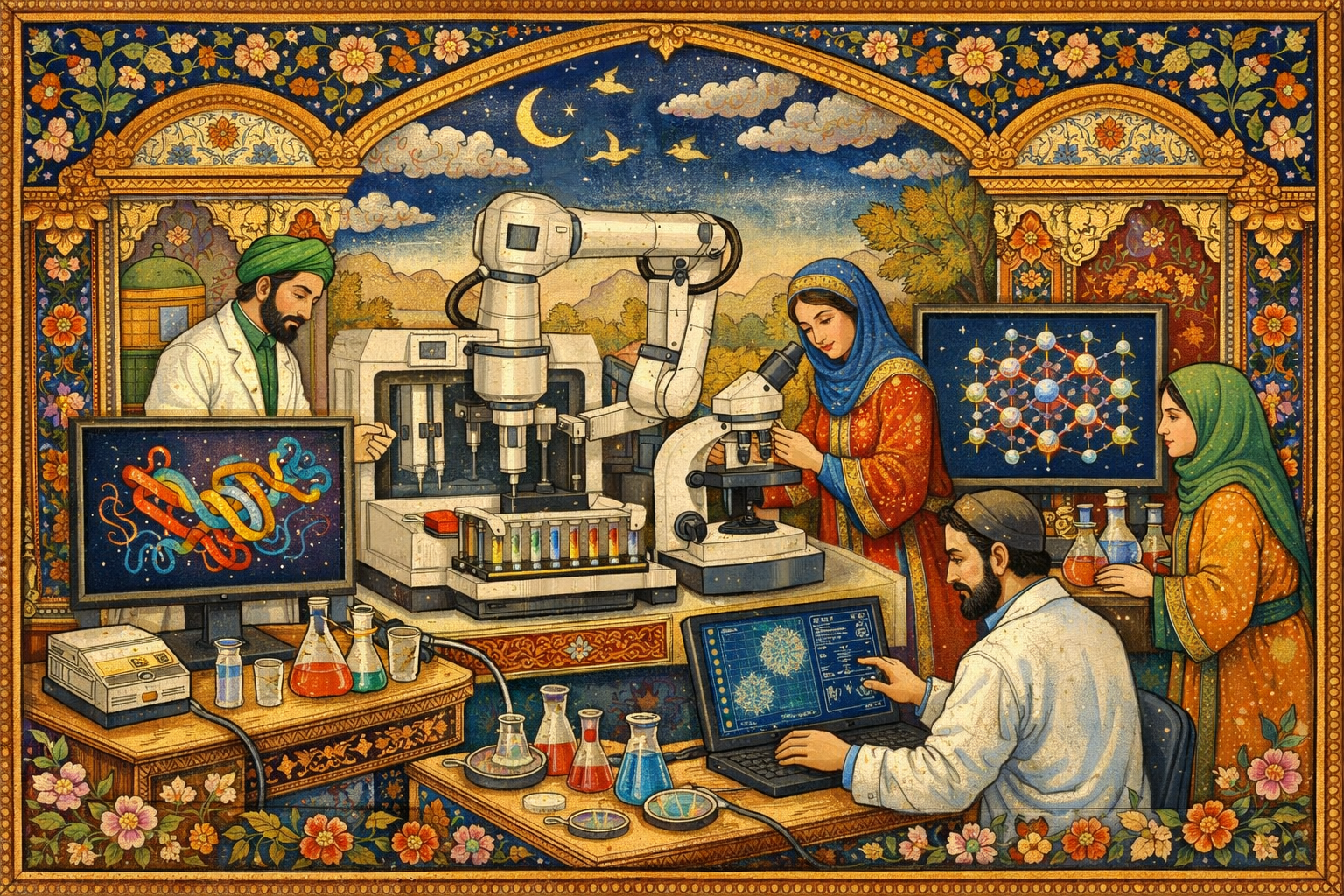
Protein folding, materials prediction, and forecasting show how AI can shorten discovery loops without replacing experiments.
On this page
- Protein science as an early signal
- Materials discovery and automated labs
- Why testing still matters
Page outline Jump by section
Introduction
AI’s clearest contribution to a possible human bloom is not that it can write fluent text, but that it can shorten the loop between question, hypothesis, prediction, experiment and revision. In protein science, materials discovery and forecasting, AI is already helping researchers search enormous possibility spaces faster than human intuition or manual trial and error can manage. The promise is not “science without scientists”. It is science with better maps, stronger candidate lists, cheaper simulations and more automated testing. That could matter enormously for medicine, clean energy, climate resilience and long-term human flourishing — but only if predictions are treated as starting points for real-world validation, not as discoveries by themselves.
Why machine-speed discovery changes the bloom case
Scientific progress is often slow because nature has too many possibilities to test directly. A useful drug molecule may be one candidate among billions. A better battery material may sit inside a chemical space far larger than any laboratory can explore by hand. A weather system evolves through interacting physical processes that are hard to simulate quickly. AI helps when it can learn patterns from existing data, propose plausible candidates, rank them, and let researchers spend scarce laboratory time on the most promising options.
That is why scientific acceleration is more central to AI abundance than many consumer uses of AI. If advanced AI helps discover cheaper catalysts, better solar materials, new antibiotics, more resilient crops, or ways to repair damaged tissues, the downstream effects could compound for decades. It could loosen physical constraints, not merely make paperwork faster. The strongest evidence so far is concentrated in domains where the problem can be partly formalised: structures, sequences, crystals, simulations, measurements and repeatable experimental feedback.
The caveat is just as important. A prediction is not the same thing as a working medicine, a manufactured battery, or a validated theory. AI can move discovery from “try things blindly” towards “test the most plausible things first”, but the world still has to answer back through experiments, clinical trials, engineering, regulation and deployment. Machine-speed discovery is therefore best understood as a faster scientific flywheel, not a magic replacement for science.
Protein science as an early signal
Protein folding became the emblem of AI for science because it showed a dramatic compression of a once-slow task. Proteins are chains of amino acids whose three-dimensional shapes strongly influence what they do in cells. For decades, determining those shapes experimentally could require specialist equipment, time and luck. AlphaFold changed the practical landscape by predicting protein structures from amino-acid sequences with high accuracy in many cases, and the AlphaFold Protein Structure Database now provides open access to more than 200 million predicted structures across much of UniProt, a major protein-sequence repository. [alphafold.ebi.ac.uk]alphafold.ebi.ac.ukAlpha Fold Protein Structure DatabaseAlpha Fold Protein Structure Database
The scale matters. Open access means a researcher working on a neglected tropical disease, a crop pathogen, an enzyme for recycling, or a basic cell-biology question can begin with a structural hypothesis rather than a blank page. EMBL-EBI reported that the expanded AlphaFold database covered nearly all catalogued proteins known to science and was used by researchers in more than 190 countries soon after launch. That does not remove the need for wet-lab biology, but it changes who can ask structural questions and how quickly they can begin. [embl.org]embl.orgalphafold 200 millionalphafold 200 million
The 2024 Nobel Prize in Chemistry marked how quickly this shift entered mainstream science. David Baker was recognised for computational protein design, while Demis Hassabis and John Jumper were recognised for protein structure prediction. The prize is significant for the AI bloom argument because it joins prediction and design: not only reading nature’s existing molecular machinery, but also learning how to build new proteins with useful functions. [NobelPrize.org]nobelprize.orgSource details in endnotes.
AlphaFold 3 extended the ambition from individual protein structures towards biomolecular interactions: proteins with DNA, RNA, small molecules, ions and modified residues. That matters because life depends not only on the shape of isolated molecules but on how they bind, switch, catalyse, block and cooperate. In drug discovery, for example, the practical question is often whether a candidate molecule binds to the right target in the right way. AlphaFold 3 is therefore a move from static maps towards more useful models of molecular relationships. [Nature]nature.comOpen source on nature.com.
The limits are real. Protein function depends on motion, cellular context, concentration, temperature, disorder, binding partners and evolutionary history. Some proteins change shape; others include intrinsically disordered regions that do not settle into one neat structure. Studies have found that AlphaFold-style predictions can struggle with fold-switching or flexible regions, and independent benchmarking of AlphaFold 3 has warned that some complex predictions can contain large errors not fully captured by confidence metrics. [Nature]nature.comOpen source on nature.com.
The right lesson is not that AlphaFold “solved biology”. It solved, or sharply reduced, a major bottleneck inside biology. That is exactly what machine-speed discovery is likely to look like in practice: not one grand automatic breakthrough, but the removal of repeated friction from thousands of research projects.
Materials discovery and automated labs
Materials science is another strong test of the bloom thesis because future abundance depends on matter, not just information. Better batteries, solar cells, semiconductors, catalysts, carbon-capture systems and medical devices all require materials with specific properties. The difficulty is that possible inorganic crystals and compounds vastly outnumber the materials humans have synthesised and tested.
Google DeepMind’s GNoME system showed how AI can widen the front end of that search. DeepMind reported 2.2 million new crystal predictions, including 380,000 predicted stable materials that could be candidates for future technologies. The claim is not that all of these are useful or easy to make. It is that the list of plausible targets becomes much larger and better ranked, giving researchers more promising starting points than traditional discovery alone. [Google DeepMind]deepmind.googleSource details in endnotes.
The more important development is the connection between prediction and robotic testing. The A-Lab at Lawrence Berkeley National Laboratory was designed to close the gap between computational screening and experimental realisation. In a Nature paper, researchers described an autonomous lab that used computations, literature-derived synthesis recipes, machine learning, active learning and robotics to plan and interpret experiments. Over 17 days of continuous operation, it performed 353 experiments and realised 36 compounds from 57 targets. [Nature]nature.comOpen source on nature.com.
That result is a concrete example of “machine speed” without pretending the machine replaces the whole scientific enterprise. The human researchers chose the broad problem, built the instruments, designed the software, interpreted the failures and judged the importance of the results. The automated system accelerated the repetitive loop: propose a recipe, make a sample, characterise it, learn from failure, try again. This is the kind of loop that could matter for energy abundance if it becomes cheaper, more reliable and easier for many labs to use.
Materials discovery also shows why testing still dominates the real bottleneck. A crystal may be stable in a model but hard to synthesise, unstable under operating conditions, dependent on rare elements, too expensive to manufacture, toxic, brittle, or simply not useful for the intended application. Reporting on GNoME and A-Lab captured the central tension well: AI can dream up many more possible materials, but the next challenge is making them and discovering what they are actually good for. [WIRED]wired.comSource details in endnotes.
For AI bloom, the stakes are large but conditional. If AI-guided materials discovery yields better solid-state batteries, lower-cost solar materials, efficient catalysts or cleaner industrial processes, it could help turn cognitive abundance into physical abundance. If the pipeline remains concentrated in a few corporate or national labs, or if discoveries are locked behind restrictive access, the bloom effect will be narrower.
Forecasting as a discovery tool, not just prediction
Forecasting may sound separate from scientific discovery, but it belongs in the same family of accelerated feedback. A good forecast is a model that makes risky, testable claims about the world before the world reveals the answer. Weather forecasting is the clearest example: it combines enormous datasets, physical systems, uncertainty and practical consequences for crops, energy grids, transport and disaster response.
Machine-learning weather models have advanced rapidly. GraphCast, developed by Google DeepMind, was described as producing 10-day global forecasts in under a minute while outperforming a leading deterministic operational forecasting system on most evaluated targets. GenCast later moved further towards probabilistic forecasting, generating 15-day ensemble forecasts at 0.25° resolution for more than 80 surface and atmospheric variables in around eight minutes, and outperforming ECMWF’s ENS system on 97.2% of evaluated targets in a Nature study. [ECMWF Events (Indico]events.ecmwf.intSource details in endnotes.
This matters for human flourishing in two ways. First, better forecasts can save lives and resources directly: earlier warnings for storms, heat, floods, crop risks and energy-demand shocks. Second, the same pattern appears across science: train on rich records, predict many possible futures, compare against reality, and improve. The discovery loop becomes faster because feedback arrives continuously.
The limitation is that forecasting models can be brittle outside the conditions they have learned from. Extreme events, shifting climate patterns and rare combinations of variables test whether a model has learned physical regularities or merely familiar patterns. Research on AI forecasts of the unprecedented 2024 Dubai rainfall event found both promise and limits: GraphCast forecast the event eight days ahead, but the authors argued its success came from learning dynamically similar events in other regions rather than true extrapolation beyond the global training distribution. [arXiv]arxiv.orgSource details in endnotes.
That distinction is useful across AI science. AI may be extremely powerful at transposing patterns from one region of knowledge to another. It is less clear when it can reliably reason beyond the support of data. For a bloom future, the most valuable systems will not merely interpolate; they will flag uncertainty, invite tests, and help scientists find where current knowledge breaks.

Why testing still matters
The most common misunderstanding is that AI discovery means replacing experiments with predictions. In reality, the best current examples make experiments more valuable by choosing them better. AlphaFold gives a structural hypothesis; a biologist still tests function. GNoME proposes stable crystals; a lab still has to make and characterise them. GenCast forecasts weather; the atmosphere still provides the verdict.
There are several reasons testing remains central.
Models inherit the limits of their data. AlphaFold benefited from decades of structural biology and the Protein Data Bank; modern materials models depend on computed and experimental databases; AI weather models learn from reanalysis data. These are achievements of human science encoded into machine-learnable form, not evidence that machines can discover from nothing. The US National Science Foundation explicitly linked the Nobel-recognised protein breakthroughs to long-running public support for the Protein Data Bank and related infrastructure. [NSF - U.S. National Science Foundation]nsf.govnsf congratulates laureates 2024 nobel prize chemistrynsf congratulates laureates 2024 nobel prize chemistry
Prediction confidence is not the same as truth. AI systems can be confidently wrong, especially in edge cases. In protein science, flexible regions, disorder and molecular dynamics can undermine static structure predictions. In materials science, thermodynamic stability does not guarantee manufacturability or usefulness. In forecasting, rare events and changing distributions expose the difference between pattern recognition and robust understanding. [Nature]nature.comOpen source on nature.com. [arXiv]arxiv.orgOpen source on arxiv.org.
Science is social and interpretive. Choosing which questions matter, deciding what counts as a good explanation, judging trade-offs, and connecting results to human needs are not just optimisation problems. A 2025 Scientific Reports article testing generative AI in a molecular genetics discovery setting argued that current generative AI lacks the human creativity needed for scientific discovery from scratch, especially across hypothesis origin, experimental design and interpretation. [Nature]nature.comProbabilistic weather forecasting with machine learning | NatureProbabilistic weather forecasting with machine learning | Nature
Implementation is often the hard part. A 2025 position paper on AI scientists argued that the bottleneck for autonomous scientific systems is not merely idea generation but the ability to execute rigorous verification procedures. This matches the pattern in natural science: the value comes when AI is connected to reliable instruments, clean data, reproducible workflows and human judgement. [arXiv]arxiv.orgSource details in endnotes.
The optimistic view survives these caveats because the goal is not total automation. If AI reduces wasted experiments, finds non-obvious candidates, improves measurement interpretation and helps small teams use tools once reserved for elite institutions, science can accelerate while remaining empirical.
What would make the gains broad rather than captured?
Machine-speed discovery could widen access to science, but it could also concentrate power. The same systems that help a university lab screen proteins or materials could give large firms and states an even bigger advantage if compute, data, instruments and proprietary platforms remain tightly controlled.
Open resources are therefore not a side issue. AlphaFold’s public database is powerful partly because it is freely available to researchers worldwide. DeepMind’s later AlphaFold 3 release initially raised access concerns, but the Nature addendum noted free non-commercial server access and later release of inference code. The direction of travel matters: scientific acceleration has a larger bloom effect when researchers in poorer countries, neglected-disease fields and public-interest institutions can use the tools, not just wealthy incumbents. [alphafold.ebi.ac.uk]alphafold.ebi.ac.ukAlpha Fold Protein Structure DatabaseAlpha Fold Protein Structure Database
Automated labs raise a different distribution question. Robotic synthesis platforms are expensive, technically demanding and dependent on specialised supply chains. If only a handful of labs can run closed-loop discovery, the world may get faster innovation but not necessarily fairer innovation. A broader bloom pathway would involve shared research infrastructure, public datasets, reproducibility standards, open benchmarks and funding for problems with high human value but weak commercial incentives.
There is also a governance question about what gets optimised. A system designed to find profitable drug candidates may not prioritise neglected diseases. A materials platform may search for high-margin electronics rather than low-cost clean-water technologies. Faster discovery amplifies the goals we give it. Human flourishing requires institutions that steer scientific acceleration towards health, resilience, sustainability and broad access.
The honest bottom line
Scientific discovery at machine speed is one of the strongest evidence-backed pillars of the AI bloom case. Protein structure prediction has already changed biology’s starting point. AI-guided materials discovery is beginning to connect large-scale prediction with robotic synthesis. AI weather forecasting shows how learned models can make fast, testable predictions in complex physical systems. Together, these examples show a repeatable pattern: AI can compress discovery loops.
But the evidence supports a disciplined optimism, not a blank cheque. The hard parts of science remain hard: experimental validation, causal understanding, reproducibility, safety, manufacturing, regulation, and fair distribution. The machine can propose; reality must dispose. The bloom case becomes credible when AI is used to make that encounter with reality faster, cheaper, more open and more useful to human needs.
If this pattern scales, the long-term implications are large. Faster science could mean medicines discovered earlier, clean-energy technologies improved sooner, climate risks forecast more accurately, and material constraints loosened over time. That is not ordinary productivity growth. It is the possibility that humanity becomes much better at learning how the world works — and at turning that knowledge into conditions for longer, healthier, freer and more abundant lives.
Endnotes
-
Source: alphafold.ebi.ac.uk
Title: Alpha Fold Protein Structure Database
Link: https://www.alphafold.ebi.ac.uk/ -
Source: alphafold.ebi.ac.uk
Title: Alpha Fold Protein Structure Database
Link: https://www.alphafold.ebi.ac.uk/about -
Source: embl.org
Title: alphafold 200 million
Link: https://www.embl.org/news/science/alphafold-200-million/ -
Source: ebi.ac.uk
Link: https://www.ebi.ac.uk/about/news/technology-and-innovation/alphafold-200-million -
Source: nobelprize.org
Link: https://www.nobelprize.org/prizes/chemistry/2024/summary/-/ -
Source: nsf.gov
Title: nsf congratulates laureates 2024 nobel prize chemistry
Link: https://www.nsf.gov/news/nsf-congratulates-laureates-2024-nobel-prize-chemistry -
Source: nature.com
Link: https://www.nature.com/articles/s41586-024-07487-w -
Source: nature.com
Link: https://www.nature.com/articles/s41586-024-08416-7 -
Source: nature.com
Link: https://www.nature.com/articles/s41467-024-51801-z -
Source: arxiv.org
Link: https://arxiv.org/abs/2406.03979 -
Source: deepmind.google
Link: https://deepmind.google/discover/blog/millions-of-new-materials-discovered-with-deep-learning/ -
Source: time.com
Link: https://time.com/6340681/deepmind-gnome-ai-materials/ -
Source: nature.com
Link: https://www.nature.com/articles/s41586-023-06734-w -
Source: wired.com
Link: https://www.wired.com/story/an-ai-dreamed-up-380000-new-materials-the-next-challenge-is-making-them -
Source: events.ecmwf.int
Link: https://events.ecmwf.int/event/343/ -
Source: nature.com
Title: Probabilistic weather forecasting with machine learning | Nature
Link: https://www.nature.com/articles/s41586-024-08252-9 -
Source: arxiv.org
Link: https://arxiv.org/abs/2505.10241 -
Source: nature.com
Link: https://www.nature.com/articles/s41598-025-93794-9 -
Source: arxiv.org
Title: arXiv AI Scientists Fail Without Strong Implementation Capability
Link: https://arxiv.org/abs/2506.01372 -
Source: nature.com
Link: https://www.nature.com/articles/s42005-026-02676-7 -
Source: nature.com
Link: https://www.nature.com/articles/s43246-026-01105-0 -
Source: ecmwf.int
Title: ai dop update medium range forecast scores
Link: https://www.ecmwf.int/en/newsletter/186/earth-system-science/ai-dop-update-medium-range-forecast-scores -
Source: nature.com
Link: https://www.nature.com/articles/s41586-025-09922-y -
Source: nature.com
Link: https://www.nature.com/articles/s41598-025-32366-3 -
Source: nature.com
Title: Generative AI for crystal structures: a review | npj Computational Materials
Link: https://www.nature.com/articles/s41524-025-01881-2 -
Source: nature.com
Title: A I-driven protein design | Nature Reviews Bioengineering
Link: https://www.nature.com/articles/s44222-025-00349-8 -
Source: nature.com
Link: https://www.nature.com/articles/s44387-025-00018-6 -
Source: nature.com
Link: https://www.nature.com/articles/s44387-025-00019-5 -
Source: ecmwf.int
Title: update ai dop skilful weather forecasts produced directly
Link: https://www.ecmwf.int/en/newsletter/182/earth-system-science/update-ai-dop-skilful-weather-forecasts-produced-directly -
Source: nature.com
Title: Alpha Fold gets an upgrade (and a Nobel) | Nature Medicine
Link: https://www.nature.com/articles/s41591-024-03392-x -
Source: deepmind.google
Link: https://deepmind.google/en/blog/gencast-predicts-weather-and-the-risks-of-extreme-conditions-with-sota-accuracy/ -
Source: nature.com
Title: Deep Mind AI weather forecaster beats world-class system
Link: https://www.nature.com/articles/d41586-024-03957-3 -
Source: nature.com
Link: https://www.nature.com/articles/s44160-024-00649-8 -
Source: nobelprize.org
Title: press release
Link: https://www.nobelprize.org/prizes/chemistry/2024/press-release/?sfnsn=scwspmo -
Source: embl.org
Title: alphafold wins nobel prize chemistry 2024
Link: https://www.embl.org/news/science-technology/alphafold-wins-nobel-prize-chemistry-2024/ -
Source: destine.ecmwf.int
Title: int A I-based weather models: preprint paper available | Destination Earth
Link: https://destine.ecmwf.int/news/ai-based-weather-models-promising-future-supporting-climate-science/ -
Source: nature.com
Link: https://www.nature.com/articles/s41422-024-00991-8 -
Source: nature.com
Link: https://www.nature.com/nature/volumes/630/issues/8016 -
Source: nature.com
Title: Alpha Fold3 — why did Nature publish it without its code?
Link: https://www.nature.com/articles/d41586-024-01463-0 -
Source: deepmind.google
Title: Alpha Fold — Google Deep Mind
Link: https://deepmind.google/science/alphafold/ -
Source: deepmind.google
Title: Alpha Fold
Link: https://deepmind.google/alphafold -
Source: deepmind.google
Title: Alpha Fold
Link: https://deepmind.google/science/alphafold/impact-stories/designing-more-effective-drugs/ -
Source: nature.com
Title: Alphafold 3.0: the AI protein predictor gets an upgrade
Link: https://www.nature.com/articles/d41586-024-01385-x -
Source: nature.com
Link: https://www.nature.com/articles/s41612-024-00638-w -
Source: nature.com
Title: Sparks of function by de novo protein design | Nature Biotechnology
Link: https://www.nature.com/articles/s41587-024-02133-2 -
Source: nature.com
Link: https://www.nature.com/articles/s41592-024-02174-0 -
Source: ecmwf.int
Title: red sky night producing weather forecasts directly
Link: https://www.ecmwf.int/en/newsletter/178/earth-system-science/red-sky-night-producing-weather-forecasts-directly -
Source: ecmwf.int
Title: aifs new ecmwf forecasting system
Link: https://www.ecmwf.int/en/newsletter/178/news/aifs-new-ecmwf-forecasting-system -
Source: deepmind.google
Link: https://deepmind.google/research/publications/gencast-learning-skillful-ensemble-forecasting-of-medium-range-weather/ -
Source: nature.com
Title: Robot chemist sparks row with claim it created new materials
Link: https://www.nature.com/articles/d41586-023-03956-w -
Source: nature.com
Title: Google AI and robots join forces to build new materials
Link: https://www.nature.com/articles/d41586-023-03745-5 -
Source: nature.com
Title: Scaling deep learning for materials discovery | Nature
Link: https://www.nature.com/articles/s41586-023-06735-9 -
Source: nature.com
Link: https://www.nature.com/articles/s41612-023-00512-1 -
Source: deepmind.google
Title: Graph Cast: Learned Global Weather Forecasting — Google Deep Mind
Link: https://deepmind.google/research/publications/22598/ -
Source: ecmwf.int
Title: how ai models are transforming weather forecasting showcase data
Link: https://www.ecmwf.int/en/about/media-centre/news/2023/how-ai-models-are-transforming-weather-forecasting-showcase-data -
Source: ecmwf.int
Title: machine learning model data
Link: https://www.ecmwf.int/en/forecasts/dataset/machine-learning-model-data -
Source: nature.com
Title: Autonomous experiments using active learning and AI | Nature Reviews Materials
Link: https://www.nature.com/articles/s41578-023-00588-4 -
Source: nature.com
Link: https://www.nature.com/articles/s41586-023-06185-3 -
Source: nature.com
Link: https://www.nature.com/articles/s41467-023-37139-y -
Source: embl.org
Title: alphafold using open data and ai to discover the 3d protein universe
Link: https://www.embl.org/news/science/alphafold-using-open-data-and-ai-to-discover-the-3d-protein-universe/ -
Source: nature.com
Link: https://www.nature.com/articles/s44160-022-00231-0 -
Source: embl.org
Title: alphafold database launch
Link: https://www.embl.org/news/science/alphafold-database-launch/ -
Source: nature.com
Title: Highly accurate protein structure prediction with Alpha Fold | Nature
Link: https://www.nature.com/articles/s41586-021-03819-2 -
Source: deepmind.google
Title: Alpha Fold
Link: https://deepmind.google/technologies/alphafold/alphafold-server/ -
Source: deepmind.google
Title: Alpha Fold
Link: https://deepmind.google/science/alphafold/impact-stories/tracing-proteins-back-to-origins-of-life/ -
Source: nature.com
Link: https://www.nature.com/articles/d42473-025-00161-3 -
Source: ebi.ac.uk
Link: https://www.ebi.ac.uk/training/online/courses/alphafold/accessing-and-predicting-protein-structures-with-alphafold/accessing-predicted-protein-structures-in-the-alphafold-database/ -
Source: alphafold.ebi.ac.uk
Link: https://alphafold.ebi.ac.uk/?pStoreID=epp%3Fjumpid -
Source: alphafold.ebi.ac.uk
Link: https://alphafold.ebi.ac.uk/download -
Source: alphafold.ebi.ac.uk
Link: https://alphafold.ebi.ac.uk/?pStoreID=techsoup%2F1000 -
Source: ebi.ac.uk
Link: https://www.ebi.ac.uk/training/online/courses/alphafold/alphafold-3-and-alphafold-server/introducing-alphafold-3/what-alphafold-3-struggles-with/ -
Source: ebi.ac.uk
Link: https://www.ebi.ac.uk/training/online/courses/alphafold/alphafold-3-and-alphafold-server/introducing-alphafold-3/ -
Source: nobelprize.org
Link: https://www.nobelprize.org/prizes/chemistry/2024/jumper/facts/?from=nobelpress.org -
Source: nobelprize.org
Link: https://www.nobelprize.org/prizes/chemistry/2024/summary/?sfnsn=scwspmo -
Source: nobelprize.org
Link: https://www.nobelprize.org/prizes/chemistry/2024/summary/?hss_channel=fbp-112978290507628 -
Source: jpost.com
Link: https://www.jpost.com/science/science-around-the-world/article-832262 -
Source: gigazine.net
Link: https://gigazine.net/gsc_news/en/20241205-google-deepmind-gencast/ -
Source: gigazine.net
Title: Google Deep Mindが最大15日先までの天気予報をより迅速かつ正確に提供するAIモデル「Gen Cast」を発表
Link: https://gigazine.net/news/20241205-google-deepmind-gencast -
Source: sfist.com
Link: https://sfist.com/2024/12/05/google-deepmind-says-they-have-an-ai-weather-model-that-outperforms-all-existing-models-at-15-day-forecasts/ -
Source: axial.acs.org
Title: 2024 nobel prize in chemistry
Link: https://axial.acs.org/biology-and-biological-chemistry/2024-nobel-prize-in-chemistry -
Source: aip.org
Title: 2024 nobel prize in chemistry
Link: https://www.aip.org/aip/2024-nobel-prize-in-chemistry -
Source: gigazine.net
Link: https://gigazine.net/gsc_news/en/20240509-google-deepmind-alphafold-3/ -
Source: blog.google
Title: Google Deep Mind and Isomorphic Labs introduce Alpha Fold 3 AI model
Link: https://blog.google/technology/ai/google-deepmind-isomorphic-alphafold-3-ai-model/ -
Source: notebookcheck.net
Link: https://www.notebookcheck.net/Google-DeepMind-s-new-AI-has-developed-over-700-materials-for-EV-batteries-solar-cells-and-more.784486.0.html -
Source: natureasia.com
Title: Nature ハイライト:新規材料を合成する自律型実験室 | Nature | Nature Portfolio
Link: https://www.natureasia.com/index.php/ja-jp/nature/highlights/111088 -
Source: natureasia.com
Title: Nature ハイライト:新規材料を合成する自律型実験室 | Nature | Nature Portfolio
Link: https://www.natureasia.com/ja-jp/nature/highlights/111088 -
Source: astrobiology.com
Link: https://astrobiology.com/2023/12/google-deepmind-adds-nearly-400000-new-compounds-to-berkeley-labs-materials-project.html -
Source: notebookcheck.net
Link: https://www.notebookcheck.net/Google-DeepMind-finds-in-just-one-year-2-2-million-new-materials-of-which-381-000-are-stable.776003.0.html -
Source: itechpost.com
Title: Google Deep Mind Discovers 2.2 Million New Crystals
Link: https://www.itechpost.com/articles/119964/20231130/google-deepmind-discovers-2-million-new-crystals.htm -
Source: newscenter.lbl.gov
Title: google deepmind new compounds materials project
Link: https://newscenter.lbl.gov/2023/11/29/google-deepmind-new-compounds-materials-project/ -
Source: venturebeat.com
Link: https://venturebeat.com/ai/google-deepminds-materials-ai-has-already-discovered-2-2-million-new-crystals -
Source: phys.org
Title: Google Deep Mind adds nearly 400,000 new compounds to open-access database
Link: https://phys.org/news/2023-11-google-deepmind-compounds-open-access-database.html -
Source: ardeshir.io
Link: https://ardeshir.io/models
Additional References
-
Source: osti.gov
Link: https://www.osti.gov/pages/biblio/2551914 -
Source: youtube.com
Title: Dr Demis Hassabis: Using AI to Accelerate Scientific Discovery
Link: https://www.youtube.com/watch?v=AU6HuhrC65kSource snippet
Accelerating Scientific Discovery with AI...
-
Source: youtube.com
Title: AI+Science: Accelerating Discovery
Link: https://www.youtube.com/watch?v=dBFm3zm_3l8Source snippet
There Is No AlphaFold for Materials — AI for Materials Discovery with Heather Kulik...
-
Source: researchgate.net
Link: https://www.researchgate.net/publication/389281144_Artificial_Intelligence_Meets_Laboratory_Automation_in_Discovery_and_Synthesis_of_Metal-Organic_Frameworks_A_Review -
Source: researchgate.net
Link: [https://www.researchgate.net/publication/395597607Machine_learning-driven_materials_discovery_Unlocking_next-generation_functional_materials-A_review](https://www.researchgate.net/publication/395597607_Machine_learning-driven_materials_discovery_Unlocking_next-generation_functional_materials-_A_review) -
Source: scientificamerican.com
Link: https://www.scientificamerican.com/article/ai-program-finds-thousands-of-possible-psychedelics-will-they-lead-to-new-drugs/ -
Source: sciencedirect.com
Link: https://www.sciencedirect.com/science/article/pii/S0167739X25002195 -
Source: eulerfold.com
Link: https://www.eulerfold.com/research-decoded/alphafold-3-unified-biology -
Source: sciencedirect.com
Link: https://www.sciencedirect.com/science/article/pii/S0263822325005847 -
Source: sciencedirect.com
Link: https://www.sciencedirect.com/science/article/pii/S0958166925001247
Amazon book picks
Further Reading
Books and field guides related to Machine Speed Discovery. Use these as the next step if you want deeper reading beyond the article.
Artificial Intelligence for Science (AI4S)
This book presents a comprehensive framework for analyzing, evaluating, and guiding AI for Sciences (AI4Sci) research, offering a unified...
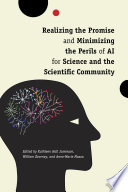
Realizing the Promise and Minimizing the Perils of AI for Sci...
Recommendations from the scientific community to ensure that the development and use of AI honors scientific norms In late 2022, OpenAI r...
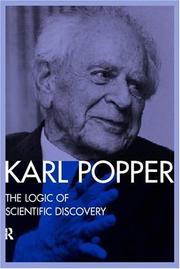
The Logic of Scientific Discovery
First published 1935. Subjects: Science, Methodology, Logic, Research Design, Sciences.
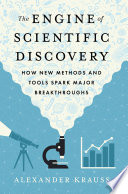
The Engine of Scientific Discovery
Many believe that discoveries arise by chance or serendipity. The Engine of Scientific Discovery illustrates, for the first time, how we...
eBay marketplace picks
Marketplace Samples
Example marketplace items related to this page. Use the search link to explore similar finds on eBay.

Example eBay listing
A.I. Artificial Intelligence Original Movie Poster Signed By Jude Law
USD 125.00 | Shipping USD 25.00 | US

Example eBay listing
Artificial Intelligence D/S Original Movie Poster - 27 x 40"
USD 19.50 | Shipping USD 13.65 | US

Example eBay listing
612388 Artificial Intelligence Movie Science Fiction Drama Wall Print Poster
USD 22.95 | Shipping USD 12.95 | JP

Example eBay listing
Companion - Artificial Intelligence Dark Comedy Cinema Film - POSTER 20"x30"
USD 23.99 | Free shipping | US

Example eBay listing
A.I. Artificial Intelligence Movie Film Poster Art Print
GBP 4.99 | Free shipping | GB

Example eBay listing
A I Artificial Intelligence 6 Movie Poster Art Print Print Classic Rare Gallery
GBP 49.00 | Free shipping | GB

Example eBay listing
AI - Artificial Intelligence (Poster + Slipcase) Blu-Ray
GBP 10.49 | Free shipping | GB

Example eBay listing
A. I. Artificial Intelligence. Jude Law. Original UK Video Poster.
GBP 8.11 | Shipping GBP 3.38 | GB
Topic Tree
Follow this branch
Parent topic
AI Bloom FuturesRelated pages 9
- Abundant Intelligence
- AI Medicine
- AI Tutors
- Coordination
- Energy Limits
- Long Future
- Robots and Work
- Shared Gains
- +1 more in sidebar