Within Beyond GDP
Preventive AI and GDP
AI health systems may create real abundance by preventing illness before expensive treatment is needed.
On this page
- Why prevention can look smaller in economic statistics
- Health capability as a better measure of progress
- Access, trust, privacy and unequal benefit
Page outline Jump by section
Introduction
A healthier society is not always a higher-spending society. One of the most important ways AI could challenge traditional measures of progress is by helping people avoid illness before expensive treatment is needed. If advanced diagnostic systems, personalised prevention tools, and AI-assisted public health reduce heart attacks, strokes, diabetic complications, cancers, or severe infections, then some forms of economic activity may actually shrink. Fewer emergency admissions, fewer invasive procedures, and shorter hospital stays can mean slower growth in measured healthcare spending even while people live longer, healthier, and more capable lives.
 That creates a tension at the heart of the wider AI abundance debate. GDP measures market transactions. It does not directly measure how many years people remain healthy, how much pain is avoided, or how much human potential is preserved. Preventive AI raises the possibility that one of the most important forms of future abundance could appear partly as “missing” economic activity: costs and crises that never happen in the first place. [OPHI]ophi.org.ukrather than unidimensional and of intrinsic…Read more… [PMC]pmc.ncbi.nlm.nih.govPMCApplications of the Capability Approach in the Health Fieldby PM Mitchell · 2016 · Cited by 144 — The capability approach is a broad n…
Why prevention can look smaller in economic statistics
Modern economies often count repair more easily than prevention. A complicated surgery, months of intensive cancer treatment, or long hospitalisation all add to GDP because they involve paid services, equipment, labour, and insurance spending. By contrast, a disease that never develops produces far fewer visible transactions.
This is not unique to AI. Vaccination campaigns, anti-smoking measures, clean water systems, and blood-pressure screening have long improved health partly by preventing future spending. But AI could push this logic much further because it can process patterns across enormous datasets, personalise risk prediction, and monitor health continuously at relatively low marginal cost.
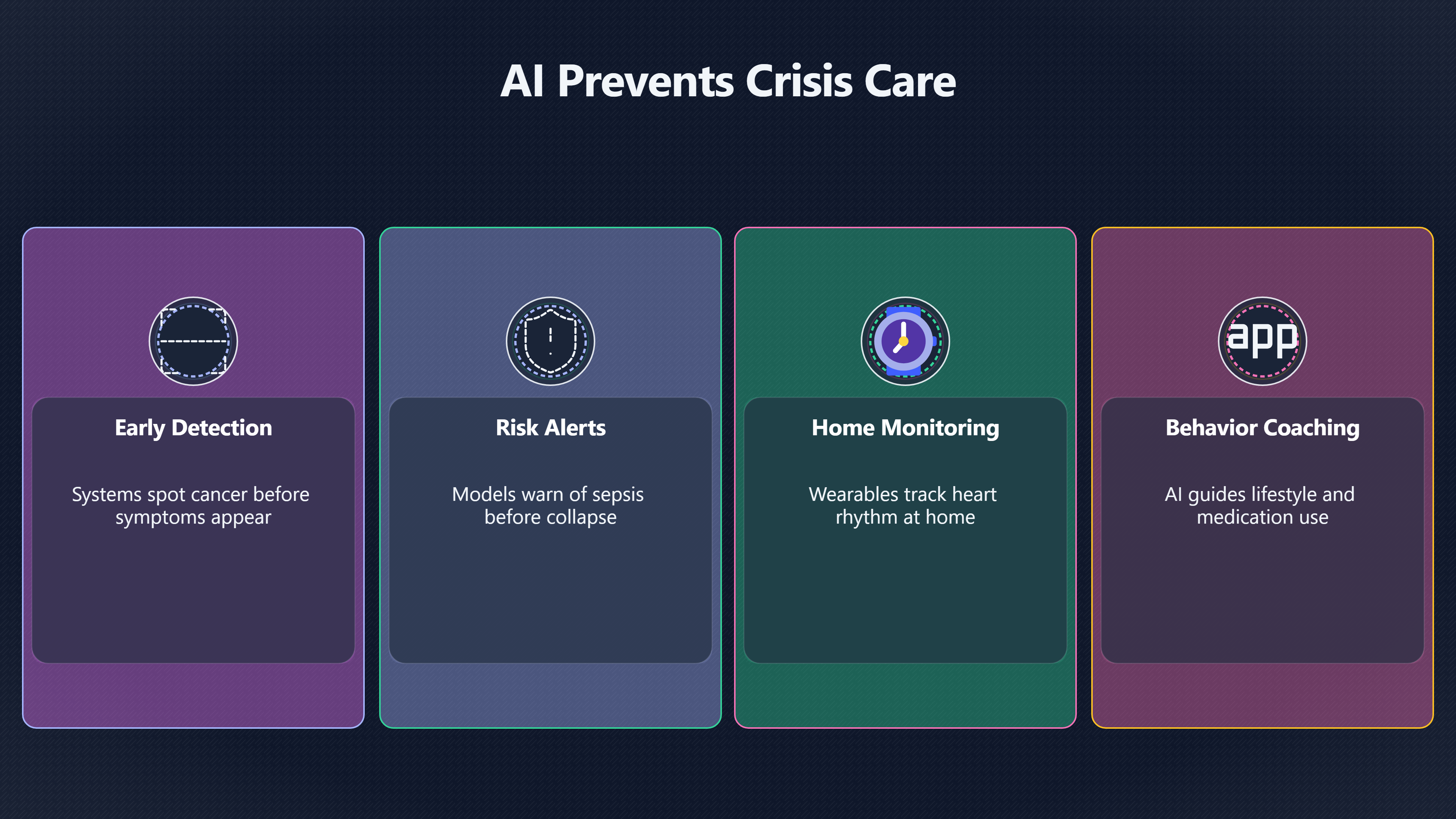
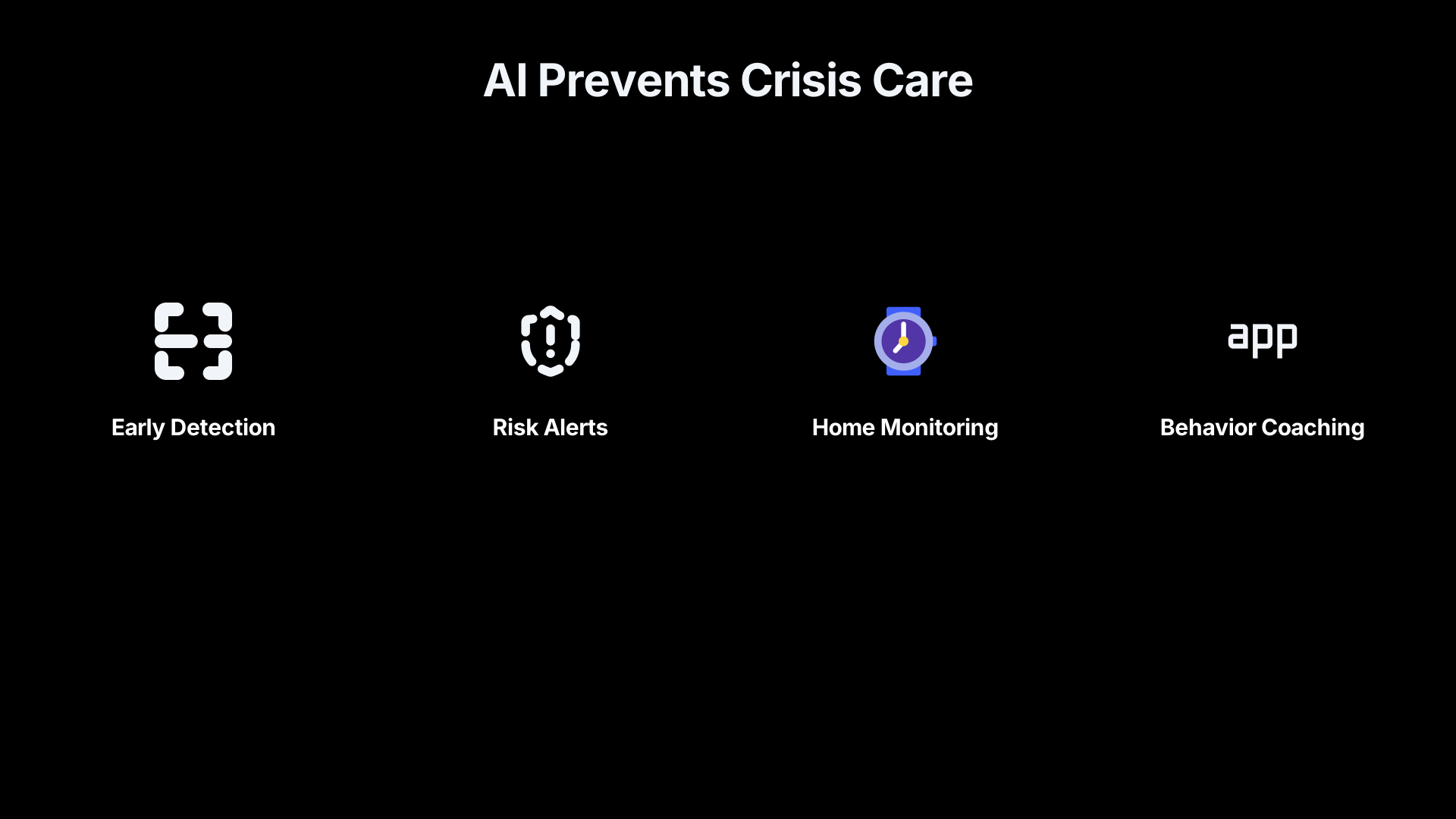
Several emerging AI applications point in this direction:
- AI systems analysing medical images to identify cancers earlier, when treatment is cheaper and survival rates are higher.
- Predictive models identifying patients at risk of sepsis, kidney failure, or heart deterioration before acute collapse.
- Wearables and home monitoring systems detecting dangerous changes without hospital admission.
- Personalised behavioural coaching that improves medication adherence or lifestyle management.
- AI-assisted triage and screening that shifts care earlier into primary and community settings.
Research and policy reviews increasingly describe this shift as movement from reactive medicine toward predictive and preventive care. [Diagnostics]diagnostics.roche.comDiagnostics AI in medical diagnostics: Early detection and preventionDiagnosticsAI in medical diagnostics: Early detection and preventionFebruary 5, 2026 — by M Hartmann — A healthcare model that provides p… [OECD]oecd.orgai in healthcare 7e518d41Emerging applications demonstrate how AI can support early detection of diseases through advanced medical…Read more…
The economic paradox is straightforward. If prevention succeeds, some categories of spending fall:
- Fewer emergency admissions
- Less late-stage treatment
- Lower long-term disability costs
- Reduced need for complex interventions
- Less time lost to illness
In ordinary human terms, this is success. In GDP terms, however, part of the measured economic activity disappears.
This helps explain why GDP can become a misleading guide to abundance in an AI-enabled health system. A country with rising healthcare expenditure is not necessarily becoming healthier. In some cases, it may simply be paying more to manage preventable chronic disease.
Economists have long recognised this ambiguity. Studies of preventive health spending show complicated relationships between economic growth and health expenditure because prevention can improve productivity and wellbeing while simultaneously reducing some forms of medical consumption. [Springer]link.springer.comSpringerempirical evidences from OECD countries | Health Economics…by F Wang · 2021 · Cited by 55 — The influence of prevention on eco…
The same logic already appears in other parts of digital life. Navigation apps reduce wasted journeys. Search engines reduce time spent finding information. Open-source software provides valuable services at low cost. AI prevention could extend this pattern into health itself: large gains in human capability with surprisingly modest increases in measured economic output.
Preventive AI could shift medicine from repair to maintenance
For most of human history, medicine has been episodic and reactive. People seek help after symptoms become severe. Hospitals are designed around acute crisis management. Healthcare systems earn much of their revenue from intervention after damage has already occurred.
AI may gradually favour a different model: continuous maintenance.
This would not mean that hospitals disappear or that disease becomes rare. Ageing, accidents, genetics, and biological complexity will continue to matter. But advanced predictive systems could move large parts of healthcare upstream.
Earlier detection changes the economics of disease
The strongest near-term evidence comes from screening and diagnostics. Many diseases become dramatically more expensive once symptoms are advanced.
For example:
- Stage 1 cancer treatment is usually cheaper and less destructive than stage 4 treatment.
- Earlier diabetes management reduces kidney failure, blindness, and amputations.
- Predicting heart-failure deterioration early can prevent costly emergency admissions.
- Detecting infections sooner reduces intensive care usage.
AI systems are increasingly being tested in imaging, pathology, cardiovascular monitoring, and risk stratification precisely because they may detect patterns too subtle for routine human screening alone. [Diagnostics]diagnostics.roche.comDiagnostics AI in medical diagnostics: Early detection and preventionDiagnosticsAI in medical diagnostics: Early detection and preventionFebruary 5, 2026 — by M Hartmann — A healthcare model that provides p… [OECD]oecd.orghealth expenditure on prevention and primary healthcare e65bf24aHealth expenditure on prevention and primary healthcare13 Nov 2025 — Strengthening PHC has been identified as an effective way to improve…
If these systems become reliable and broadly deployed, the macroeconomic result could look unusual. Societies may spend less treating catastrophic disease while enjoying healthier populations with more years of productive and fulfilling life.
That distinction matters for the broader AI bloom idea. Human flourishing is not only about producing more goods and services. It is also about preserving health, energy, cognition, independence, and time.
Continuous health management could become normal
The more ambitious version of preventive AI goes beyond diagnosis. It imagines health systems that continuously adapt around individuals.
Already, smartphones and wearables can monitor sleep, activity, heart rhythm, blood glucose, or medication use. Future systems could integrate:
- Genomic risk profiles
- Real-time biomarkers
- Environmental exposure data
- Personal medical history
- Behavioural patterns
- Population-scale epidemiology
An AI assistant might eventually warn someone that their stress patterns resemble pre-cardiac deterioration, suggest dietary changes tailored to their metabolism, or recommend medical review before symptoms become obvious.
In this model, medicine becomes less episodic and more infrastructural: a background system constantly trying to maintain healthy function.
From a GDP perspective, this may look surprisingly “small” if software-based prevention avoids large downstream treatment costs. But from a capability perspective, it could be enormous.
Health capability may matter more than healthcare spending
The deeper philosophical issue is whether economic activity is the right measure of progress in the first place.
The capability approach associated with economist and philosopher Amartya Sen argues that development should be judged by what people are genuinely able to do and become, not simply by income or output. Health matters not only because it supports productivity, but because being able to live a long, active, autonomous life is intrinsically valuable. [OPHI]ophi.org.ukrather than unidimensional and of intrinsic…Read more… [PMC]pmc.ncbi.nlm.nih.govIt has been shown before the cost saving due to AI in treatment is more effective as compared…Read more…
Preventive AI fits naturally into this framework.
If AI systems allow millions more people to:
- avoid disabling disease,
- maintain cognitive function into old age,
- remain mobile and independent,
- spend less time in pain,
- care for family members longer,
- or extend healthy lifespan,
then society may be becoming richer in a human sense even if some conventional economic indicators grow more slowly.
This becomes especially important in ageing societies. Much healthcare spending today is concentrated in late-life chronic disease management. A future where people remain healthier for longer could reduce parts of this expenditure while increasing social participation and quality of life.
The gains might appear more clearly in measures such as:
- healthy life expectancy,
- disability-adjusted life years,
- functional independence,
- educational attainment,
- workforce participation,
- or subjective wellbeing,
than in raw GDP growth alone.
That does not mean GDP becomes useless. Economic output still matters for infrastructure, research, housing, energy, and public finance. But preventive AI highlights how a civilisation can become healthier without necessarily becoming more transaction-heavy.

The paradox of abundance through lower spending
One reason this topic matters to the wider AI abundance debate is that modern economies often assume value comes from scarcity and intervention.
A healthcare system built around crisis treatment can generate enormous economic activity:
- pharmaceuticals,
- hospital construction,
- specialist procedures,
- insurance administration,
- long-term care,
- and emergency services.
But from the perspective of human flourishing, much of this activity reflects failure or suffering.
An AI system that quietly prevents thousands of strokes may create less visible market activity than the strokes themselves would have generated. Yet the human benefit is vastly larger.
This is one reason some economists argue that digital and AI-driven societies may systematically understate real welfare gains. If intelligence becomes cheap and prevention becomes scalable, more value may appear as avoided cost rather than expanded spending.
The paradox becomes even sharper if advanced AI eventually accelerates biomedical science itself. Faster drug discovery, protein modelling, automated research, and personalised medicine could reduce disease burdens over decades while simultaneously making some medical services cheaper and more efficient. [PMC]pmc.ncbi.nlm.nih.govPMCApplications of the Capability Approach in the Health Fieldby PM Mitchell · 2016 · Cited by 144 — The capability approach is a broad n… [OECD]oecd.orgai in healthcare 7e518d41Emerging applications demonstrate how AI can support early detection of diseases through advanced medical…Read more…
A civilisation with radically lower disease burden might therefore show:
- slower growth in certain healthcare sectors,
- lower emergency treatment costs, [chesshealthsolutions.com]chesshealthsolutions.comHow AI Can Help Lower Costs Without Sacrificing Care12 Mar 2026 — AI in healthcare can help reduce healthcare costs when aligned with cli…
- reduced disability expenditure,
- and lower time lost to illness,
while still becoming dramatically more capable and prosperous in a broader sense.
Access, trust, privacy and unequal benefit
None of this happens automatically. Preventive AI could improve health while worsening inequality if access remains uneven or incentives become distorted.
The data problem
Preventive systems depend heavily on data:
- medical histories,
- imaging,
- genetic information,
- behavioural signals,
- and population-level health records.
This raises major privacy and governance concerns. Many people may reasonably resist continuous monitoring if insurers, employers, advertisers, or governments can misuse health data.
Trust is especially fragile in healthcare because mistakes carry serious consequences. A flawed recommendation engine in entertainment is annoying. A flawed medical risk model can cost lives.
Bias and unequal coverage
AI systems can also inherit inequalities from training data. Studies have already shown that some healthcare algorithms perform worse for women, minority populations, or poorer patients because historical data reflects unequal treatment patterns. [arXiv]arxiv.orgarXiv Quantifying Health Inequalities Induced by Data and AI ModelsarXivQuantifying Health Inequalities Induced by Data and AI ModelsApril 24, 2022…
If preventive AI is trained mainly on wealthy populations with strong healthcare access, benefits may concentrate among those already healthiest.
This could create a divided system:
- affluent populations receiving continuous personalised prevention,
- poorer populations remaining trapped in reactive emergency care.
The wider AI bloom vision depends heavily on avoiding this outcome. Human flourishing at civilisational scale requires broad diffusion, not merely elite optimisation.
Incentives may resist prevention
Healthcare systems themselves may resist some preventive transitions.
Many systems are financially structured around treatment volume:
- hospitals are paid for procedures,
- insurers reimburse interventions,
- pharmaceutical revenue often depends on chronic management,
- and political systems reward visible crisis response more easily than invisible prevention.
A genuinely preventive system may threaten established revenue models even if it improves public health overall.
This creates a broader political economy question for AI abundance. Technologies that reduce suffering do not automatically spread if existing institutions profit from repair rather than prevention.
The long-term significance for AI abundance
Preventive AI matters beyond healthcare budgets because it illustrates a larger possibility: advanced AI could create forms of abundance that traditional economics measures poorly.
The optimistic long-run argument is not simply that AI will increase productivity. It is that intelligence itself may become abundant enough to reduce many forms of waste, delay, and preventable harm across civilisation.
In health, that could mean:
- catching disease earlier,
- reducing diagnostic error,
- personalising treatment,
- accelerating biomedical discovery,
- extending healthy lifespan,
- and shifting medicine toward maintenance rather than crisis management.
If that future emerges, one of the clearest signs may be strangely quiet economic statistics in some sectors. Hospitals may become less overloaded. Catastrophic illnesses may become less common. Emergency interventions may decline.
GDP growth alone would not fully capture what had changed.
The more meaningful transformation would be human: more years lived in good health, more cognitive capacity preserved into old age, more freedom from pain and disability, and more time available for relationships, learning, creativity, and participation in society.
That is why preventive AI sits naturally within the larger question of AI bloom. The deepest promise is not merely producing more economic activity. It is expanding the range of lives human beings are actually able to live.
Endnotes
-
Source: ophi.org.uk
Link: https://ophi.org.uk/research/amartya-sen-and-ophiSource snippet
rather than unidimensional and of intrinsic...Read more...
-
Source: pmc.ncbi.nlm.nih.gov
Link: https://pmc.ncbi.nlm.nih.gov/articles/PMC5511308/Source snippet
PMCApplications of the Capability Approach in the Health Fieldby PM Mitchell · 2016 · Cited by 144 — The capability approach is a broad n...
-
Source: oecd.org
Title: ai in healthcare 7e518d41
Link: https://www.oecd.org/en/publications/progress-in-implementing-the-european-union-coordinated-plan-on-artificial-intelligence-volume-2_3ac96d41-en/full-report/ai-in-healthcare_7e518d41.htmlSource snippet
Emerging applications demonstrate how AI can support early detection of diseases through advanced medical...Read more...
-
Source: link.springer.com
Link: https://link.springer.com/article/10.1186/s13561-021-00321-3Source snippet
Springerempirical evidences from OECD countries | Health Economics...by F Wang · 2021 · Cited by 55 — The influence of prevention on eco...
-
Source: pmc.ncbi.nlm.nih.gov
Link: https://pmc.ncbi.nlm.nih.gov/articles/PMC9777836/Source snippet
It has been shown before the cost saving due to AI in treatment is more effective as compared...Read more...
-
Source: arxiv.org
Title: arXiv Quantifying Health Inequalities Induced by Data and AI Models
Link: https://arxiv.org/abs/2205.01066Source snippet
arXivQuantifying Health Inequalities Induced by Data and AI ModelsApril 24, 2022...
Published: April 24, 2022
-
Source: oecd.org
Title: health expenditure on prevention and primary healthcare e65bf24a
Link: https://www.oecd.org/en/publications/2025/11/health-at-a-glance-2025_a894f72e/full-report/health-expenditure-on-prevention-and-primary-healthcare_e65bf24a.htmlSource snippet
Health expenditure on prevention and primary healthcare13 Nov 2025 — Strengthening PHC has been identified as an effective way to improve...
-
Source: diagnostics.roche.com
Title: Diagnostics AI in medical diagnostics: Early detection and prevention
Link: https://diagnostics.roche.com/global/en/healthcare-transformers/article/ai-preventive-healthcare.htmlSource snippet
DiagnosticsAI in medical diagnostics: Early detection and preventionFebruary 5, 2026 — by M Hartmann — A healthcare model that provides p...
Published: February 5, 2026
-
Source: chesshealthsolutions.com
Link: https://www.chesshealthsolutions.com/2026/03/12/how-ai-and-technology-can-help-health-systems-lower-costs-without-sacrificing-care/Source snippet
How AI Can Help Lower Costs Without Sacrificing Care12 Mar 2026 — AI in healthcare can help reduce healthcare costs when aligned with cli...
-
Source: probius.bio
Title: ai in healthcare
Link: https://www.probius.bio/ai-in-healthcare/Source snippet
The Economic Impact of AI in Healthcare15 Sept 2023 — In this article, we explore the potential economic impact of AI in the healthcare i...
Additional References
-
Source: businessatoecd.org
Link: https://www.businessatoecd.org/hubfs/Policy%20Groups/20.%20Health/FIN-2025-03%20Health%20as%20an%20Economic%20Imperative%20-%20Business%20at%20OECD%20%28BIAC%29%20Health%20Forum%202024%20Synthesis%20report.pdfSource snippet
Health as an Economic ImperativePreventing even one-third of these costs could boost economic growth by approximately 1.3 to. 1.7%, under...
-
Source: linkedin.com
Link: https://www.linkedin.com/pulse/ai-healthcare-reducing-costs-improving-outcomes-fxl5cSource snippet
AI in Healthcare: Reducing Costs, Improving OutcomesAI is revolutionizing healthcare by reducing costs and improving patient outcomes. Fr...
-
Source: bennettschool.cam.ac.uk
Link: https://bennettschool.cam.ac.uk/wp-content/uploads/2024/03/The-case-for-an-AI-driven-personalised-prevention-platform.pdfSource snippet
60% of a patient's healthcare outcomes are driven by their behaviour and only 10% by their clinical care (with the remaining 30%...Read...
-
Source: paragoninstitute.org
Title: lowering health care costs through ai the possibilities and barriers
Link: https://paragoninstitute.org/private-health/lowering-health-care-costs-through-ai-the-possibilities-and-barriers/Source snippet
Lowering Health Care Costs Through AI31 Jul 2024 — This paper explores AI's potential to cut healthcare costs, improve quality, and recom...
-
Source: institute.global
Title: the macroeconomic case for investing in preventative health care UK
Link: https://institute.global/insights/economic-prosperity/the-macroeconomic-case-for-investing-in-preventative-health-care-UKSource snippet
Tony Blair InstituteProsperity Through Health: The Macroeconomic Case for...9 Jul 2024 — Through modelling these connections, we demonst...
-
Source: researchgate.net
Link: https://www.researchgate.net/publication/267104011_Amartya_Sen%27s_Capability_Approach_A_Framework_for_Well-Being_Evaluation_and_Policy_AnalysisSource snippet
pment, underscoring its role in expanding individual freedoms and social equity (...Read more...
-
Source: socialissuesindia.wordpress.com
Title: why should the world listen to nobel laureate amartya sen
Link: https://socialissuesindia.wordpress.com/2025/11/08/why-should-the-world-listen-to-nobel-laureate-amartya-sen/Source snippet
Sen – Development Beyond GDP8 Nov 2025 — The GDP measures the resources (means) available, but the Capability Approach focuses on how peo...
-
Source: kuangaliablog.wordpress.com
Title: amartya kumar sen development as freedombookfi
Link: https://kuangaliablog.wordpress.com/wp-content/uploads/2017/07/amartya_kumar_sen_development_as_freedombookfi.pdfSource snippet
as FreedomTHIS IS A BORZOI BOOK. PUBLISHED BY ALFRED A. KNOPF, INC. Copyright© 1999 by Amartya Sen. All rights rese ved under Internation...
-
Source: blog.hettshow.co.uk
Link: https://blog.hettshow.co.uk/how-does-ai-reduce-costs-in-healthcareSource snippet
Personalised Treatment Plans: AI analyses vast amounts of...Read more...
-
Source: weforum.org
Title: Health spending takes up 10% of global GDP
Link: https://www.weforum.org/stories/2024/08/healthcare-costs-digital-tech/Source snippet
Can tech...5 Aug 2024 — Health spending takes up 10% of the global economy: How can tech help reduce costs and improve lives? · How data...
Amazon book picks
Further Reading
Books and field guides related to Preventive AI and GDP. Use these as the next step if you want deeper reading beyond the article.
How AI Can Democratize Healthcare
First published 2022. Subjects: Health, Technology, Artificial intelligence.
Transforming Healthcare Sector Through Artificial Intelligenc...
This book explores the intersection of artificial intelligence (AI) and sustainability in healthcare, focusing on how AI technologies are...

Rose 's strategy of preventive medicine
First published 2008. Subjects: Methods, Preventive Medicine, Health systems & services, Public health & preventive medicine, Social welf...
eBay marketplace picks
Marketplace Samples
Example marketplace items related to this page. Use the search link to explore similar finds on eBay.

Example eBay listing
A.I. Artificial Intelligence Original Movie Poster Signed By Jude Law
USD 125.00 | Shipping USD 25.00 | US

Example eBay listing
Artificial Intelligence D/S Original Movie Poster - 27 x 40"
USD 19.50 | Shipping USD 13.65 | US

Example eBay listing
612388 Artificial Intelligence Movie Science Fiction Drama Wall Print Poster
USD 22.95 | Shipping USD 12.95 | JP

Example eBay listing
Companion - Artificial Intelligence Dark Comedy Cinema Film - POSTER 20"x30"
USD 23.99 | Free shipping | US

Example eBay listing
A.I. Artificial Intelligence Movie Film Poster Art Print
GBP 4.99 | Free shipping | GB

Example eBay listing
A I Artificial Intelligence 6 Movie Poster Art Print Print Classic Rare Gallery
GBP 49.00 | Free shipping | GB

Example eBay listing
AI - Artificial Intelligence (Poster + Slipcase) Blu-Ray
GBP 10.49 | Free shipping | GB

Example eBay listing
A. I. Artificial Intelligence. Jude Law. Original UK Video Poster.
GBP 8.11 | Shipping GBP 3.38 | GB
Topic Tree