Within Warehouse Pace
The injury tradeoff
Warehouse robots can reduce heavy-lifting injuries while creating new risks from repetitive, faster-paced work.
On this page
- What severe injuries automation may reduce
- Why repetitive strain can rise after robots arrive
- How to read injury data without oversimplifying it
Page outline Jump by section
Introduction
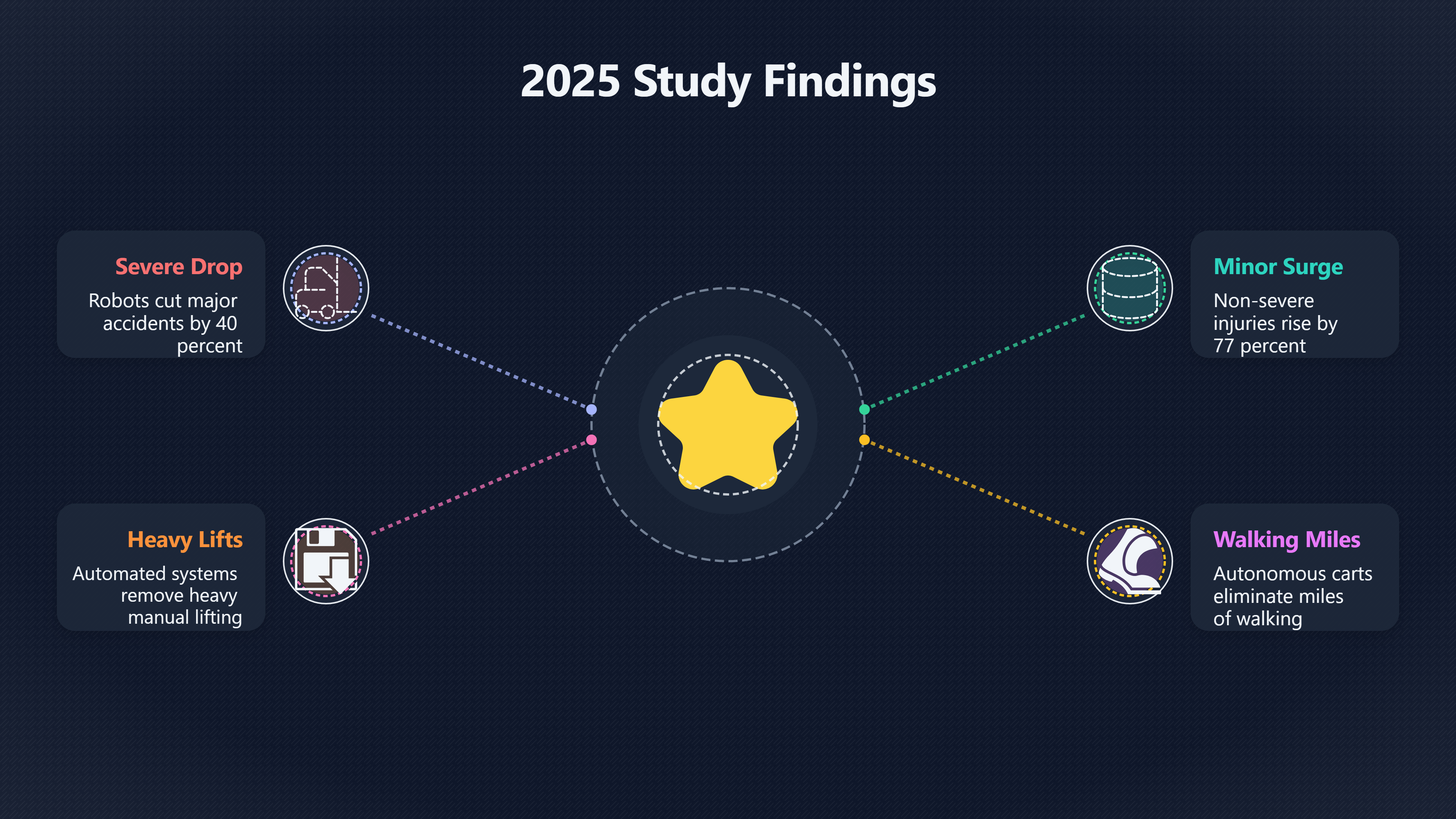
Warehouse robots do appear to reduce some of the worst kinds of physical harm. Automated carts can eliminate miles of walking. Robotic pallet systems can reduce heavy lifting. “Goods-to-person” systems mean workers no longer need to drag shelves or climb repeatedly to reach stock. In warehouses where musculoskeletal strain and acute accidents have long been common, those changes matter.
 But the evidence increasingly suggests that automation often shifts injury patterns rather than simply removing them. Severe injuries linked to transport, lifting, or collisions may fall, while repetitive strain, overuse injuries, and pace-related stress rise. In practice, robots can make warehouse work less brutally physical yet more tightly timed, repetitive, and continuously monitored. The key question is therefore not whether warehouse robots improve safety at all, but which injuries decline, which new pressures emerge, and who captures the productivity gains.
This matters beyond logistics. Warehouses are one of the clearest real-world tests of a broader AI-enabled future: whether automation can genuinely reduce degrading labour, or whether efficiency gains mainly become tools for accelerating human work.
The injury tradeoff
The strongest recent evidence for the “shift rather than eliminate” argument comes from a 2025 study in Industrial and Labor Relations Review examining robotic fulfilment centres. The researchers found that warehouse robotics were associated with roughly a 40% reduction in severe injuries but a 77% increase in non-severe injuries. Their explanation was not that robots failed technically, but that they changed the structure and pace of remaining human work. [Sage Journals]journals.sagepub.comSage JournalsWarehouse Robotics and Worker Safetyby G Burtch · 2025 · Cited by 14 — Findings provide evidence of both effects: Warehouse… [Sage Journals]journals.sagepub.comSage JournalsWarehouse Robotics and Worker Safetyby G Burtch · 2025 · Cited by 14 — Findings provide evidence of both effects: Warehouse…
That pattern fits what many warehouse ergonomics specialists have warned for years. Automation often removes highly variable movement — walking, carrying, lifting, repositioning — and replaces it with concentrated high-frequency motions. A picker standing at a robotic station may perform the same wrist, shoulder, or torso movements thousands of times per shift with fewer natural breaks or task changes.
This is an important distinction. Traditional warehouses produced many injuries from brute-force labour. Automated warehouses can produce injuries from intensity, repetition, and throughput pressure.
The debate is therefore not “robots good” versus “robots bad”. It is about whether automation is designed around human wellbeing or around extracting more output from the same number of workers.
What severe injuries automation may reduce
Some warehouse hazards are genuinely well suited to automation.
Heavy lifting and transport
Warehousing has long exposed workers to back strain, shoulder injuries, falls, and crush incidents from moving heavy goods. The US Occupational Safety and Health Administration (OSHA) identifies repetitive lifting, awkward postures, and manual material handling as major warehouse ergonomic risks. [OSHA]osha.govOSHAWarehousing - Hazards and SolutionsErgonomics and Musculoskeletal Disorders… There are many automated tools in the warehouse such…
Robotic systems can reduce exposure to several of these hazards:
- Autonomous mobile robots transport shelves instead of requiring workers to push carts long distances.
- Automated pallet systems reduce repeated heavy lifting.
- Conveyor and sortation systems reduce carrying and twisting motions.
- Inventory robots reduce climbing and reaching in high shelving systems.
In practical terms, many workers in robotic fulfilment centres report less exhaustion from walking and hauling inventory across massive buildings. In older warehouse layouts, workers could walk more than ten miles in a shift. Goods-to-person systems drastically cut that distance.
The reduction in severe injuries found in the 2025 warehouse robotics study likely reflects exactly these kinds of changes. Fewer forklift interactions, fewer heavy manual lifts, and less transport labour mean fewer catastrophic accidents. [Sage Journals]journals.sagepub.comSage JournalsWarehouse Robotics and Worker Safetyby G Burtch · 2025 · Cited by 14 — Findings provide evidence of both effects: Warehouse…
Dangerous environments
Automation can also reduce human exposure to especially hazardous warehouse environments:
- freezer warehouses
- high-rack storage areas
- heavy pallet zones
- repetitive loading docks
- collision-prone transport corridors
This is one reason warehouse automation remains important to the larger AI bloom argument. If advanced robotics eventually removes people from genuinely damaging or dangerous forms of labour, the long-run gains for human health and quality of life could be substantial.
But current systems show that removing one category of strain does not automatically produce humane work overall.
Why repetitive strain can rise after robots arrive
The paradox of many automated warehouses is simple: when robots save time, management often uses the saved time to increase output targets.
Faster systems can compress human recovery time
In manual warehouses, walking between tasks created unavoidable pauses. Automated systems remove those pauses. Workers may now stand at fixed stations processing a continuous stream of items delivered by robots.
From a productivity perspective, this is highly efficient.
From an ergonomic perspective, it can create intense repetition:
- identical scanning motions
- repeated wrist rotations
- constant reaching
- uninterrupted picking cycles
- fewer opportunities for posture variation
The 2025 warehouse robotics study linked increased non-severe injuries partly to reduced task variety and accelerated work pace. [Sage Journals]journals.sagepub.comSage JournalsWarehouse Robotics and Worker Safetyby G Burtch · 2025 · Cited by 14 — Findings provide evidence of both effects: Warehouse…
Those “non-severe” injuries still matter. Repetitive strain injuries, tendon inflammation, chronic shoulder pain, and nerve compression can accumulate over years and permanently limit a worker’s physical capacity.
Algorithmic pacing changes the labour experience
Warehouse robotics rarely operate alone. They are usually integrated with software systems that measure throughput continuously.
Workers may receive:
- real-time productivity scoring
- countdown timing systems
- automated rate targets
- behavioural tracking
- alerts for “idle time”
This can create a workplace where the robot sets the tempo and humans adapt to machine rhythm.
A 2024 investigation into Australian warehouse conditions described workers being timed continuously against “100% efficiency” standards. Some workers reported rushing, skipping recovery pauses, and fearing injury if they failed to maintain pace. [The Guardian]theguardian.comThis monitoring involves tracking workers via headsets, timing their tasks, and measuring their productivity, wit…
That pressure matters because musculoskeletal injuries are not caused only by weight. They are also caused by frequency, fatigue, and insufficient recovery time.
In effect, warehouse automation can replace “heavy and slow” work with “lighter but relentless” work.
Why injury statistics are easy to misread
One reason this debate becomes politically charged is that different sides can point to different injury metrics and both appear partly correct.

Falling severe injuries are real
Companies highlighting reduced severe injuries are not necessarily manipulating data. If robotics reduce crush incidents, falls, or major lifting injuries, that is a meaningful improvement.
A warehouse with fewer hospitalisations or disabling back injuries is genuinely safer in some respects.
But “non-severe” does not mean unimportant
At the same time, categorising injuries as non-severe can understate cumulative harm.
[A repetitive strain injury may:]apexwarehousesystems.comErgonomic Order Picking Is Faster, Safer & AccurateImplementing best practices to support proper ergonomic working conditions helps to mi…
- begin as soreness
- worsen gradually over months
- reduce long-term earning ability
- force workers into pain management or surgery
- never appear in headline safety statistics
This creates a measurement problem. Acute injuries are easier to count than chronic deterioration.
The distinction also affects incentives. A company focused on reducing headline injury rates may prioritise avoiding catastrophic incidents while tolerating high levels of repetitive strain and burnout.
Peak demand periods matter
Several analyses of robotic fulfilment centres found injury pressures worsened during peak periods such as holiday seasons or major online sales events. [Tech Xplore]techxplore.com2025 08 warehouse automation hasnt workers saferTech XploreWarehouse automation hasn't made workers safer—it's just…Aug 28, 2025 — The robotic fulfillment centers experienced a 40% d…
That matters because automated logistics systems are often built around maximising throughput during surges. Workers may therefore experience the harshest pace pressures precisely when demand spikes.
In practice, the injury question is inseparable from staffing models, scheduling, quotas, and management strategy.
Robots create some entirely new hazards
The injury debate is not only about repetitive strain. Human-robot environments also introduce new categories of risk.
The US National Institute for Occupational Safety and Health (NIOSH) warns that robots working near humans can create hazards through unexpected movement, distraction, maintenance failures, or unsafe interaction zones. [CDC]cdc.govCDCRobotics in the Workplace: An Overview9 Feb 2024 — Emerging risks · Injure workers through unexpected contact · Distract workers from… [CDC]cdc.govA Robot May Not Injure a Worker: Working safely with robotsNov 20, 2015 — Summary: NIOSH is well poised to initiate a program assessing p…
Research analysing OSHA severe injury reports identified dozens of robot-related workplace accidents between 2015 and 2022, including fractures, amputations, and crush injuries. [ResearchGate]researchgate.netOf the 77 accidents, 54 injuries involved…Read more…
[Importantly, many robot injuries occur during:]concentra.comSource details in endnotes.
- maintenance
- testing
- troubleshooting
- cleaning
- system recovery after jams or malfunctions
In other words, automation changes the technical nature of workplace risk. Warehouses may see fewer injuries from ordinary transport work while creating specialised risks around maintaining complex robotic systems.
This again illustrates a broader lesson for AI-enabled labour systems: technological progress can redistribute hazards rather than simply erase them.

The deeper question: who benefits from the productivity gain?
The warehouse debate ultimately turns into a political and organisational question, not just a technical one.
If automation increases productivity, the gains can theoretically be used in several ways:
- shorter shifts
- slower pace requirements
- higher pay
- more recovery time
- safer staffing ratios
- reduced exposure to dangerous tasks
But companies can also use the same productivity gains to:
- intensify quotas
- reduce headcount
- tighten surveillance
- compress downtime
- increase throughput expectations
The technology itself does not decide between these outcomes.
This is why some research on robotics and workplace safety finds that institutions matter. Analyses discussed by the International Federation of Robotics suggest the injury-reducing effects of automation are stronger where workers have more representation and influence over workplace conditions. [IFR International Federation of Robotics]ifr.orgdo robots save lives and prevent workplace injuriesIFR International Federation of RoboticsDo robots save lives and prevent workplace injuries?Apr 22, 2026 — The reduction of fatal and non…
That point connects warehouse automation directly to the broader AI bloom debate. A future with more capable AI and robotics could indeed eliminate vast amounts of dangerous, exhausting labour. But whether that translates into human flourishing depends heavily on governance, bargaining power, and how productivity gains are distributed.
What warehouses reveal about an AI-enabled future
Warehouses are often treated as a narrow industrial case study, but they are actually an early stress test for the wider promise of AI abundance.
The optimistic vision is clear enough:
- machines handle drudgery
- humans suffer fewer injuries
- productivity rises
- goods become cheaper
- physical labour becomes less punishing
Some of that is already happening.
Yet warehouses also show a recurring pattern in technological history: efficiency gains alone do not guarantee gentler work. Without deliberate design choices, automation can transform labour into something less visibly dangerous but more psychologically and physically relentless.
That does not invalidate the larger case for AI-assisted abundance. It does, however, suggest that humane outcomes require more than technical capability. They require institutions willing to treat reduced drudgery as a social goal rather than merely a productivity opportunity.
Warehouse robotics therefore offer both evidence for and caution about the AI bloom thesis. They show that advanced systems really can remove some forms of bodily wear and tear. But they also show that if economic incentives reward speed above all else, the burden on human workers may simply reappear in a different form.
Endnotes
-
Source: osha.gov
Link: https://www.osha.gov/warehousing/hazards-solutionsSource snippet
OSHAWarehousing - Hazards and SolutionsErgonomics and Musculoskeletal Disorders... There are many automated tools in the warehouse such...
-
Source: osha.gov
Link: https://www.osha.gov/ergonomicsSource snippet
Overview | Occupational Safety and Health...Ergonomics --- fitting a job to a person --- helps lessen muscle fatigue, increases producti...
-
Source: cdc.gov
Link: https://www.cdc.gov/niosh/robotics/about/index.htmlSource snippet
CDCRobotics in the Workplace: An Overview9 Feb 2024 — Emerging risks · Injure workers through unexpected contact · Distract workers from...
-
Source: cdc.gov
Link: https://www.cdc.gov/niosh/bulletin/2015/robots.htmlSource snippet
A Robot May Not Injure a Worker: Working safely with robotsNov 20, 2015 — Summary: NIOSH is well poised to initiate a program assessing p...
-
Source: archive.cdc.gov
Title: robotics workplace safety
Link: https://archive.cdc.gov/www_cdc_gov/niosh/newsroom/feature/robotics-workplace-safety.htmlSource snippet
CDC ArchiveRobotics and Workplace Safety | NIOSHMar 30, 2021 — Evaluating the potential for robotics technologies to prevent worker injur...
-
Source: researchgate.net
Link: https://www.researchgate.net/publication/382358180_Robot-related_injuries_in_the_workplace_An_analysis_of_OSHA_Severe_Injury_ReportsSource snippet
Of the 77 accidents, 54 injuries involved...Read more...
-
Source: ifr.org
Title: do robots save lives and prevent workplace injuries
Link: https://ifr.org/post/do-robots-save-lives-and-prevent-workplace-injuriesSource snippet
IFR International Federation of RoboticsDo robots save lives and prevent workplace injuries?Apr 22, 2026 — The reduction of fatal and non...
-
Source: cdc.gov
Link: https://www.cdc.gov/niosh/docs/85-103/default.htmlSource snippet
tems, the training of workers, and their supervision...
-
Source: cdc.gov
Title: construction robotics
Link: https://www.cdc.gov/niosh/bulletin/2024/construction-robotics.htmlSource snippet
Transforming Construction: Automation and Robotics for a...Nov 12, 2024 — This is advantageous in construction because it can boost prod...
-
Source: cdc.gov
Title: construction robotics
Link: https://www.cdc.gov/niosh/blogs/2024/construction-robotics.htmlSource snippet
Transforming Construction: Automation and Robotics for a...Nov 12, 2024 — In this blog, we will discuss how NIOSH and other research ent...
-
Source: researchgate.net
Link: https://www.researchgate.net/publication/391040766_Lucy_and_the_Chocolate_Factory_Warehouse_Robotics_and_Worker_SafetySource snippet
Warehouse Robotics and Worker SafetyFindings provide evidence of both effects: Warehouse robotics are associated with a 40% decrease in s...
-
Source: researchgate.net
Link: https://www.researchgate.net/publication/283685239_Working_Safely_with_Robot_Workers_Recommendations_for_the_New_WorkplaceSource snippet
Working Safely with Robot Workers: Recommendations for...This study conducts a scoping review to identify and analyze safety risks assoc...
-
Source: journals.sagepub.com
Link: https://journals.sagepub.com/doi/abs/10.1177/00197939251333754Source snippet
Sage JournalsWarehouse Robotics and Worker Safetyby G Burtch · 2025 · Cited by 14 — Findings provide evidence of both effects: Warehouse...
-
Source: journals.sagepub.com
Link: https://journals.sagepub.com/doi/10.1177/00197939251333754Source snippet
Sage JournalsWarehouse Robotics and Worker Safety22 Apr 2025 — Warehouse robotics are associated with a 40% decrease in severe injuries b...
-
Source: theguardian.com
Link: https://www.theguardian.com/business/2024/oct/23/woolworths-staff-efficiency-productivity-crackdown-timedSource snippet
This [monitoring]({{ 'ai-bloom-abun/ai-bloom-abun-98d3a6-ai-coordinati-e1e5d8-ai-peace-medi-f1e1df-ai-ceasefire-cf9e0a/' | relative_url }}) involves tracking workers via headsets, timing their tasks, and measuring the...
-
Source: techxplore.com
Title: 2025 08 warehouse automation hasnt workers safer
Link: https://techxplore.com/news/2025-08-warehouse-automation-hasnt-workers-safer.htmlSource snippet
Tech XploreWarehouse automation hasn't made workers safer—it's just...Aug 28, 2025 — The robotic fulfillment centers experienced a 40% d...
Additional References
-
Source: apexwarehousesystems.com
Link: https://www.apexwarehousesystems.com/3-best-practices-for-productivity-enhancing-warehouse-ergonomics/Source snippet
Ergonomic Order Picking Is Faster, Safer & AccurateImplementing best practices to support proper ergonomic working conditions helps to mi...
-
Source: linkedin.com
Link: https://www.linkedin.com/pulse/importance-ergonomics-warehouse-enhancing-worker-safety-uwz6cSource snippet
The Importance of Ergonomics in the WarehouseThis article delves into the transformative impact of ergonomic design in warehouses, highli...
-
Source: insights.bu.edu
Link: https://insights.bu.edu/warehouse-automation-hasnt-made-workers-safer-its-just-reshuffled-the-risk-say-researchers/Source snippet
automation hasn't made workers safer—it's just...28 Aug 2025 — The study finds that warehouse robots shift risk rather than eliminate it...
-
Source: concentra.com
Link: https://www.concentra.com/resource-center/articles/safely-incorporating-advancing-robotics-technologies-into-your-workplace -
Source: papers.ssrn.com
Link: https://papers.ssrn.com/sol3/Delivery.cfm/SSRN_ID4738477_code1334789.pdf?abstractid=4389032&mirid=1Source snippet
Robotics and Worker SafetyOur findings provide evidence of both effects: warehouse robotics are associated with a 40% decrease in severe...
-
Source: safetyandhealthmagazine.com
Title: 25025 niosh exploring how construction workers and robots can safely coexist
Link: https://www.safetyandhealthmagazine.com/25025-niosh-exploring-how-construction-workers-and-robots-can-safely-coexist/Source snippet
NIOSH exploring how construction workers and robots can...Feb 7, 2024 — NIOSH will continue to research how construction sites that use...
-
Source: business.gmu.edu
Title: warehouse automation hasnt made workers safer its just reshuffled risk
Link: https://business.gmu.edu/news/2025-08/warehouse-automation-hasnt-made-workers-safer-its-just-reshuffled-riskSource snippet
automation hasn't made workers safer26 Aug 2025 — The robotic fulfillment centers experienced a 40% decrease in severe injuries but a 77%...
-
Source: frontiersin.org
Link: https://www.frontiersin.org/journals/built-environment/articles/10.3389/fbuil.2025.1653188/fullSource snippet
nd mobile robots, injury risk and exposures may increase (Liang and Cheng, 2023)...Read more...
-
Source: engineeringness.com
Title: how robotics is changing worker safety in modern warehouses
Link: https://engineeringness.com/how-robotics-is-changing-worker-safety-in-modern-warehouses/Source snippet
How Robotics is Changing Worker Safety in Modern...9 Sept 2025 — The researchers found that robotic fulfillment centers experienced a 40...
-
Source: materialhandlingsafety.org
Title: warehouse ergonomics a must for osha nep compliance part 1
Link: https://materialhandlingsafety.org/warehouse-ergonomics-a-must-for-osha-nep-compliance-part-1/Source snippet
Warehouse Ergonomics: A Must For OSHA NEP Compliance...15 Aug 2024 — Using ergonomic equipment helps ensure your warehouse is OSHA compl...
Amazon book picks
Further Reading
Books and field guides related to The injury tradeoff. Use these as the next step if you want deeper reading beyond the article.
Warehouse Safety
Because warehouses typically contain no dangerous machines or high-risk operations, employers and employees often develop a false sense o...
Your Boss Is an Algorithm
What effect do robots, algorithms, and online platforms have on the world of work? Using case studies and examples from across the EU, th...
AI and Work
AI and Work Understanding How Artificial Intelligence Is Changing the AI Future of Jobs, Skills, and Employment As artificial intelligenc...
AI and the Future of Work
AI and the Future of Work: How Automation is Reshaping Jobs and Careers is your essential guide to understanding how artificial intellige...
Topic Tree