Within Platform Lock in
AI bundling rules
Regulators are asking whether cloud giants can use AI assistants, APIs, and enterprise contracts to extend dominance across markets.
On this page
- How cloud, software, and AI distribution reinforce each other
- What the FTC and CMA worry about in platform ecosystems
- Which interoperability and competition remedies could matter most
Page outline Jump by section
Introduction
Regulators probably cannot fully stop AI platform bundling, but they may still shape how powerful and closed the emerging AI ecosystem becomes. The fight is not only about who builds the best models. It is increasingly about who controls the surrounding infrastructure: cloud computing, office software, operating systems, app stores, enterprise contracts, identity systems, and the channels through which AI reaches governments, companies, and ordinary users.
 That matters because advanced AI could become a general layer of civilisation, embedded in medicine, science, education, logistics, public administration, robotics, and research itself. If a handful of firms control the routes through which intelligence is delivered, they may gain durable influence over how the benefits of AI abundance spread. Regulators in the United States, Britain, and the European Union are therefore asking whether today’s AI partnerships are creating ordinary commercial integration or a new generation of digital gatekeepers. The answer could shape whether AI-driven progress remains broadly contestable or becomes locked into a few giant ecosystems. [arXiv]arxiv.orgarXiv Market Concentration Implications of Foundation ModelsarXiv Market Concentration Implications of Foundation Models [Federal Trade Commission]ftc.govFederal Trade CommissionPartnerships Between Cloud Service Providers and AI…4.5.1 - The partnerships offer CSP partners the ability to… [GOV.UK]GOV.UKcma outlines growing concerns in markets for ai foundation modelsoutlines growing concerns in markets for AI…Apr 11, 2024 — The CMA has outlined 3 key risks to effective competition on AI Foundation…
How cloud, software, and AI distribution reinforce each other
The central regulatory concern is vertical reinforcement. A company that already dominates one layer of digital infrastructure can use AI to strengthen the others.
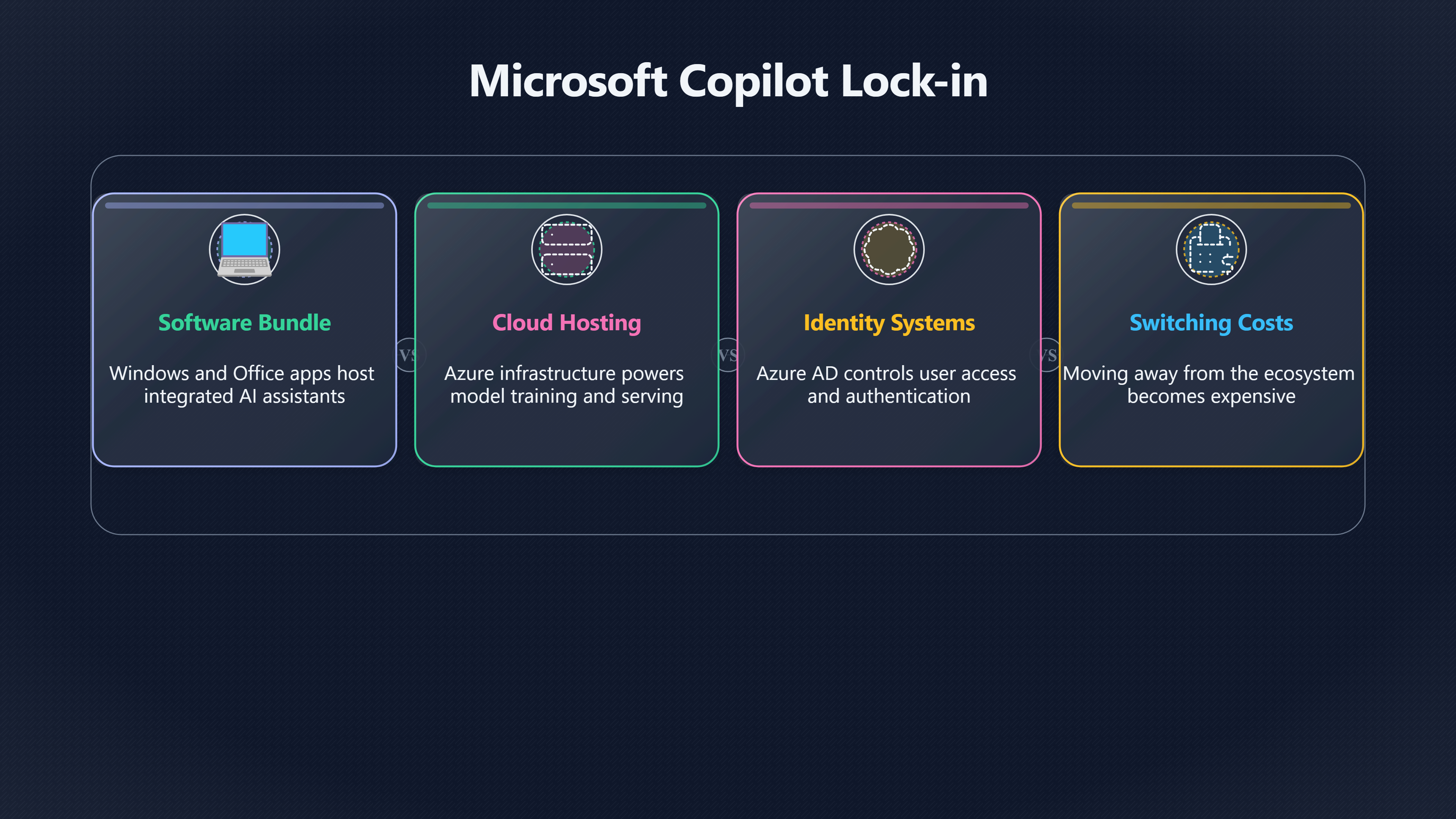
Microsoft provides the clearest example. It already controls widely used business software through Windows, Office, Teams, and Azure cloud services. Adding Copilot AI assistants across those products can make the whole bundle more attractive together than separately. A company that adopts Microsoft AI tools may also become more dependent on Microsoft cloud hosting, identity systems, data storage, and productivity software. Rival AI providers then face a difficult problem: even if they build strong models, they may struggle to reach customers already embedded inside another company’s ecosystem. Reuters [Windows Central]windowscentral.comWindows Central Microsoft's growing AI influence is under scrutiny in the UKHowever, the CMA is initiating a new Strategic Market Status (SMS) investigation into Microsoft’s broader software offerings, including W…
This is not unique to Microsoft. Amazon can combine AWS cloud services with AI hosting and enterprise tooling. Google can integrate Gemini into Search, Android, Workspace, and cloud infrastructure. Apple can connect on-device AI to its hardware ecosystem. Meta can use social platforms and messaging networks as AI distribution channels.
Regulators worry especially about three reinforcing loops.
First, compute dependence. Frontier AI requires enormous computing resources. Cloud providers already own much of the infrastructure and advanced networking needed to train and serve models. If major AI developers become economically tied to a few cloud firms, rivals may struggle to obtain equivalent scale or financing. The U.S. Federal Trade Commission’s study of AI partnerships highlighted concerns around preferential access, information sharing, and rising switching costs between AI developers and cloud providers. [Federal Trade Commission]ftc.govFederal Trade CommissionPartnerships Between Cloud Service Providers and AI…4.5.1 - The partnerships offer CSP partners the ability to… [Federal Trade Commission]ftc.govFederal Trade CommissionPartnerships Between Cloud Service Providers and AI…4.5.1 - The partnerships offer CSP partners the ability to…
Second, enterprise lock-in. AI assistants work best when connected to calendars, documents, emails, databases, and internal workflows. Large incumbents already control many of those systems. Once an organisation builds processes around one AI ecosystem, moving away becomes expensive and disruptive.
Third, distribution advantage. AI products are easier to scale when they arrive pre-installed inside software people already use daily. An integrated AI assistant inside Office or Google Workspace can instantly reach hundreds of millions of users without persuading them to adopt a separate platform.
From a business perspective, this integration is often efficient and convenient. Customers may genuinely prefer systems that work smoothly together. But regulators fear that convenience today could produce structural dependence tomorrow.
What the FTC and CMA worry about in platform ecosystems
American and British regulators are increasingly explicit that the issue is broader than AI models alone.
The FTC’s 2025 report on major AI partnerships examined relationships involving Microsoft and OpenAI, Amazon and Anthropic, and Google and Anthropic. The agency warned that cloud providers can gain privileged access to technical information, influence over strategic decisions, and leverage through infrastructure dependence. The report also highlighted contractual provisions that may increase switching costs or reduce independence for AI developers. [Federal Trade Commission]ftc.govFederal Trade CommissionPartnerships Between Cloud Service Providers and AI…4.5.1 - The partnerships offer CSP partners the ability to… [Federal Trade Commission]ftc.govFederal Trade CommissionPartnerships Between Cloud Service Providers and AI…4.5.1 - The partnerships offer CSP partners the ability to…
Britain’s Competition and Markets Authority has gone even further in analysing ecosystem concentration. Its AI foundation model review identified risks that dominant firms could control critical inputs, distort downstream markets, or extend market power through partnerships. The CMA repeatedly warned that incumbents may use existing strength in cloud, software, mobile platforms, or consumer services to shape AI markets before competitors mature. [www.hoganlovells.com]hoganlovells.comuk cma publishes ai foundation models update paperCMA publishes AI Foundation Models update paperApr 22, 2024 — The Update Paper provides an overview of latest developments, identifies th… [3GOV.UK 3GOV.UK]
The CMA’s more recent scrutiny of Microsoft reflects how quickly AI bundling concerns are becoming concrete rather than theoretical. The regulator is investigating whether Microsoft’s integration of Copilot and related services into business software could reinforce dominance across cloud and productivity markets. Concerns include interoperability limits, licensing practices, and the ability of customers to use competing AI services effectively within Microsoft-heavy environments. [TechRadar]techradar.comThis inquiry aims to evaluate whether Microsoft holds excessive market power in the UK, particularly in light of its more than 15 million… [Reuters Cloud economics intensify these fears. The UK cloud market is already heavily concentrated around Microsoft and Amazon. Critics argue that da]reuters.comBritain investigates Microsoft over business software dominanceThe probe—part of the CMA's broader "strategic market status" (SMS) framework—will assess whether Microsoft's bundling of products like W… ta transfer fees, licensing terms, and compatibility barriers discourage customers from switching providers or operating across multiple clouds. If AI capabilities become deeply embedded inside those ecosystems, moving away may become even harder. [TechRadar]techradar.comThis inquiry aims to evaluate whether Microsoft holds excessive market power in the UK, particularly in light of its more than 15 million…
For AI bloom advocates, the stakes extend beyond ordinary antitrust debates. If advanced AI eventually accelerates medicine, scientific research, automation, and education on a civilisational scale, then concentrated control over AI distribution could shape access to those gains. The fear is not simply high prices. It is that the infrastructure of intelligence itself becomes gated.
Why regulators may struggle to stop bundling entirely
Even aggressive regulators face structural limits.
Integrated products are often genuinely useful
The hardest problem is that bundling is not automatically anti-competitive. Sometimes integration improves products.
An AI assistant connected to documents, meetings, databases, and workflows can be dramatically more useful than a standalone chatbot. Customers may actively prefer unified ecosystems because they reduce friction, improve security management, and simplify procurement.
That makes enforcement difficult. Regulators must distinguish between integration that benefits users and integration primarily designed to exclude rivals. The line is often blurry.
AI markets move faster than legal systems
Competition cases usually unfold over years. AI markets evolve over months.
By the time regulators complete investigations, ecosystems may already be entrenched. Developers build applications around dominant APIs. Companies retrain staff around particular tools. Governments standardise procurement around specific platforms. Network effects then become self-reinforcing.
This timing problem partly explains why regulators increasingly favour “ex ante” rules: obligations imposed before monopoly behaviour is fully established.
Scale may matter technically
There is also a deeper economic challenge. Frontier AI may naturally favour large-scale operators because training advanced systems requires massive capital investment, specialised chips, global infrastructure, and engineering expertise.
Some economists argue that parts of the frontier model market may trend toward oligopoly or even quasi-natural monopoly. If so, regulators may be able to preserve competition at the edges while still failing to prevent concentration at the core. [arXiv]arxiv.orgarXiv Market Concentration Implications of Foundation ModelsarXiv Market Concentration Implications of Foundation Models
Governments also depend on big platforms
States themselves increasingly rely on the same cloud firms they regulate. Public agencies use Microsoft software, Amazon infrastructure, and Google services extensively. That dependence can weaken political appetite for disruptive intervention, especially when governments simultaneously want rapid AI adoption for productivity and national competitiveness.
Which interoperability and competition remedies could matter most
Regulators may have more success limiting harmful lock-in than preventing concentration outright.

Interoperability requirements
One major approach is forcing dominant platforms to work more smoothly with rivals.
The EU’s Digital Markets Act already includes interoperability and anti-self-preferencing obligations for designated “gatekeepers”. Policymakers are now debating how those rules should apply to AI assistants and AI-enabled services. Current discussions include whether gatekeepers should provide fair operating-system access to third-party AI tools, avoid privileging their own assistants in rankings or defaults, and permit easier movement of data between services. [arXiv]arxiv.orgarXiv Market Concentration Implications of Foundation ModelsarXiv Market Concentration Implications of Foundation Models [3Digital Markets Act (DMA]digital-markets-act.ec.europa.euDigital Markets Act (DMA)DMA designated GatekeepersDigital Markets ActEuropean Commission designated for the first time six gatekeepers - Alphabet, Amazon, Apple, ByteDance, Meta, Microsof… [3Digital Markets Act (DMA]digital-markets-act.ec.europa.euDigital Markets Act (DMA)DMA designated GatekeepersDigital Markets ActEuropean Commission designated for the first time six gatekeepers - Alphabet, Amazon, Apple, ByteDance, Meta, Microsof…
In practical terms, interoperability could mean:
- allowing competing AI assistants to integrate into dominant office software
- reducing barriers to exporting organisational data
- standardising interfaces for AI agents
- preventing platforms from degrading rival AI performance
- making identity and authentication systems portable across providers
These measures do not break up firms, but they may reduce ecosystem lock-in.
Limits on self-preferencing
Another strategy targets self-preferencing: platforms giving unfair advantage to their own AI services.
For example, regulators could restrict a cloud provider from making rival AI systems more expensive or less functional on its infrastructure. They could also challenge defaults that automatically steer users toward in-house assistants over competitors.
The DMA explicitly addresses self-preferencing concerns, and European policymakers increasingly view AI as a likely next battleground. [Hausfeld]hausfeld.comHausfeldBetween the EU Digital Markets Act and competition lawMar 9, 2026 — [1] Designated gatekeepers providing core platform services h… [2Digital Markets Act (DMA]digital-markets-act.ec.europa.euDigital Markets Act (DMA)DMA designated GatekeepersDigital Markets ActEuropean Commission designated for the first time six gatekeepers - Alphabet, Amazon, Apple, ByteDance, Meta, Microsof…
Data portability and open standards
Data portability may become one of the most important long-term remedies.
If organisations can move documents, embeddings, workflows, AI-generated artefacts, and training data between systems relatively easily, platform power weakens. Open technical standards can also reduce dependence on any single provider.
This matters for the broader AI bloom vision because scientific and educational acceleration may depend heavily on open knowledge flows. Closed ecosystems could slow diffusion even if frontier capabilities continue improving.
Cloud market intervention
Some regulators are also considering direct cloud remedies.
The CMA has examined issues including egress fees, licensing restrictions, and barriers to multi-cloud adoption. If cloud dependence remains central to AI deployment, regulators may treat cloud competition policy as indirectly shaping AI competition too. [TechRadar]techradar.comThis inquiry aims to evaluate whether Microsoft holds excessive market power in the UK, particularly in light of its more than 15 million…
Potential interventions include:
- restrictions on punitive data-transfer charges
- fairer software licensing across rival clouds
- requirements supporting multi-cloud deployment
- transparency obligations around AI hosting contracts
Structural separation remains unlikely
The most aggressive option would involve forcing separations between infrastructure, cloud hosting, and AI distribution businesses.
At present, that looks politically and legally difficult in most Western countries. Regulators have generally preferred conduct remedies over break-ups in AI markets so far. But if ecosystem dominance hardens substantially, pressure for stronger intervention could grow.
Could regulation preserve an open AI ecosystem?
The optimistic case for AI abundance assumes that intelligence becomes broadly accessible: cheap enough, open enough, and widely distributed enough to accelerate human flourishing across medicine, science, education, and production.
Platform bundling complicates that vision.
A future with highly capable AI could still produce extraordinary gains while leaving governments, researchers, schools, hospitals, and businesses dependent on a narrow group of gatekeepers. The danger is not only economic concentration. It is that a civilisation-shaping technology becomes governed through private platform leverage rather than broadly contestable institutions.
Yet the opposite risk also exists. Overly rigid intervention could slow deployment, reduce investment incentives, or fragment systems that genuinely work better when integrated.
That tension explains why regulators increasingly focus on preserving contestability rather than trying to stop scale itself. The emerging policy goal is often not to prevent large AI ecosystems from existing, but to stop them from becoming closed worlds that users cannot realistically leave.
Whether that succeeds may depend less on any single antitrust case than on a wider set of choices made early:
- whether interoperability becomes normal
- whether open models remain competitive
- whether switching between AI providers stays feasible
- whether cloud infrastructure remains contestable
- whether governments avoid deep procurement dependence on one ecosystem
- whether AI capabilities spread broadly enough to support innovation outside incumbent platforms
Those choices could influence whether advanced AI becomes more like the open internet, where many firms could build on shared foundations, or more like tightly controlled mobile ecosystems dominated by a few global platforms.
Endnotes
-
Source: ftc.gov
Link: https://www.ftc.gov/system/files/ftc_gov/pdf/p246201_aipartnerships6breport_redacted_0.pdfSource snippet
Federal Trade CommissionPartnerships Between Cloud Service Providers and AI...4.5.1 - The partnerships offer CSP partners the ability to...
-
Source: assets.publishing.service.gov.uk
Title: Update Paper 1
Link: [https://assets.publishing.service.gov.uk/media/661941a6c1d297c6ad1dfeed/Update_Paper__1.pdf](https://assets.publishing.service.gov.uk/media/661941a6c1d297c6ad1dfeed/Update_Paper__1.pdf)Source snippet
Foundation Models: Update PaperApr 11, 2024 — In the report, we considered potential impacts on competition and consumer protection and p...
-
Source: GOV.UK
Title: cma outlines growing concerns in markets for ai foundation models
Link: https://www.gov.uk/government/news/cma-outlines-growing-concerns-in-markets-for-ai-foundation-modelsSource snippet
outlines growing concerns in markets for AI...Apr 11, 2024 — The CMA has outlined 3 key risks to effective competition on AI Foundation...
-
Source: arxiv.org
Title: arXiv Market Concentration Implications of Foundation Models
Link: https://arxiv.org/abs/2311.01550 -
Source: reuters.com
Title: Britain investigates Microsoft over business software dominance
Link: https://www.reuters.com/legal/litigation/uk-opens-antitrust-probe-into-microsofts-business-software-2026-05-14/Source snippet
The probe—part of the CMA's broader "strategic market status" (SMS) framework—will assess whether Microsoft's bundling of products like W...
-
Source: ftc.gov
Title: behind ftcs 6b report large ai partnerships investments
Link: https://www.ftc.gov/policy/advocacy-research/tech-at-ftc/2025/01/behind-ftcs-6b-report-large-ai-partnerships-investmentsSource snippet
Federal Trade CommissionBehind the FTC's 6(b) Report on Large AI Partnerships &...17 Jan 2025 — Today, the FTC released a staff report w...
-
Source: ftc.gov
Link: https://www.ftc.gov/reports/ftc-staff-report-ai-partnerships-investments-6b-studySource snippet
Federal Trade CommissionFTC Staff Report on AI Partnerships & Investments 6(b) StudyOur mission is protecting the public from deceptive o...
-
Source: GOV.UK
Title: ai foundation models update paper
Link: https://www.gov.uk/government/publications/ai-foundation-models-update-paperSource snippet
Foundation Models: Update paperApr 11, 2024 — Update paper as part of the CMA's AI Foundation Models: initial review, following initial r...
-
Source: hoganlovells.com
Title: uk cma publishes ai foundation models update paper
Link: https://www.hoganlovells.com/en/publications/uk-cma-publishes-ai-foundation-models-update-paperSource snippet
CMA publishes AI Foundation Models update paperApr 22, 2024 — The Update Paper provides an overview of latest developments, identifies th...
-
Source: techradar.com
Link: https://www.techradar.com/pro/uk-opens-antitrust-enquiry-into-microsoft-dominance-of-business-softwareSource snippet
This inquiry aims to evaluate whether Microsoft holds excessive market power in the UK, particularly in light of its more than 15 million...
-
Source: techradar.com
Title: Tech Radar UK looks to stop “harmful” cloud domination by AWS, Microsoft
Link: https://www.techradar.com/pro/uk-looks-to-stop-harmful-cloud-domination-by-aws-microsoft-but-the-tech-giants-are-hitting-backSource snippet
The CMA highlights low customer switching rates, rare multicloud usage (especially among SMEs), high data egress fees, incompatible servi...
-
Source: arxiv.org
Link: https://arxiv.org/abs/2308.02033 -
Source: hausfeld.com
Link: https://www.hausfeld.com/what-we-think/competition-bulletin/regulating-artificial-intelligence-between-the-eu-digital-markets-act-and-competition-lawSource snippet
HausfeldBetween the EU Digital Markets Act and competition lawMar 9, 2026 — [1] Designated gatekeepers providing core platform services h...
-
Source: ftc.gov
Title: January 17,
Link: https://www.ftc.gov/news-events/news/press-releases/2025/01/ftc-issues-staff-report-ai-partnerships-investments-studySource snippet
FTC Issues Staff Report on AI Partnerships & Investments...Report details dynamics of partnerships formed by cloud service providers Alp...
-
Source: GOV.UK
Title: ai foundation models initial review
Link: https://www.gov.uk/cma-cases/ai-foundation-models-initial-reviewSource snippet
Foundation Models: initial review4 May 2023 — This initial review will help create an early understanding of the market for foundation mo...
Published: May 2023
-
Source: GOV.UK
Link: https://www.gov.uk/Source snippet
to GOV.UKServices and information, benefits, includes eligibility, appeals, tax credits and Universal Credit, births, deaths, marriages a...
-
Source: reuters.com
Link: https://www.reuters.com/legal/litigation/us-ftc-ramps-up-scrutiny-microsoft-over-ai-cloud-practices-questions-rivals-2026-02-13/Source snippet
US FTC ramps up scrutiny of Microsoft over AI, cloud...Feb 13, 2026 — The FTC is also seeking information about Microsoft's bundling of...
-
Source: assets.publishing.service.gov.uk
Title: publishing.service.gov.uk A I Foundation Models
Link: https://assets.publishing.service.gov.uk/media/661e5a4c7469198185bd3d62/AI_Foundation_Models_technical_update_report.pdfSource snippet
Foundation Models - Technical update reportApr 16, 2024 — 1.14 We set out in this report the underlying principles we consider as necessa...
-
Source: windowscentral.com
Title: Windows Central Microsoft’s growing AI influence is under scrutiny in the UK
Link: https://www.windowscentral.com/microsoft/microsoft-faces-a-uk-regulator-probe-ai-and-interoperability-concernsSource snippet
However, the CMA is initiating a new Strategic Market Status (SMS) investigation into Microsoft’s broader software offerings, including W...
-
Source: digital-markets-act.ec.europa.eu
Title: Digital Markets Act (DMA)DMA designated Gatekeepers
Link: https://digital-markets-act.ec.europa.eu/gatekeepers-portal_enSource snippet
Digital Markets ActEuropean Commission designated for the first time six gatekeepers - Alphabet, Amazon, Apple, ByteDance, Meta, Microsof...
-
Source: digital-markets-act.ec.europa.eu
Title: Digital Markets Act (DMA)DMA Review Q&A
Link: https://digital-markets-act.ec.europa.eu/about-dma/dma-review-qa_enSource snippet
Review Q&A - Digital Markets Act - European Union4 days ago — Self-preferencing – more favourable treatment of gatekeepers' own AI servic...
-
Source: concurrences.com
Title: Part VIII
Link: https://www.concurrences.com/en/review/issues/no-8-2025/on-topic/cloud-and-competition-policy/cloud-and-competition-policy-part-viii-cloud-service-ai-partnerships-the-ftc-sSource snippet
Federal Trade Commission's Section 6(b) Report investigated three partnerships between major cloud service providers...
-
Source: digital.nemko.com
Title: digital markets act dma regulation
Link: https://digital.nemko.com/regulations/digital-markets-act-dma-regulationSource snippet
Markets Act (DMA): What It Means for Gatekeepers...The Digital Markets Act is the EU rulebook designed to make digital markets fairer an...
-
Source: troutman.com
Link: https://www.troutman.com/insights/cloud-and-competition-policy-part-viii-cloud-service-ai-partnerships-the-ftcs-section-6b-report-and-its-antitrust-implications-in-the-trump-20-administration/Source snippet
Federal Trade Commission's Section 6(b) Report investigated three partnerships between major cloud service providers (Alphabet/Google, Am...
-
Source: Wikipedia
Title: Digital Markets Act
Link: https://en.wikipedia.org/wiki/Digital_Markets_ActSource snippet
Digital Markets ActThis regulation targets the largest digital platforms operating in the European Union. They are also known as "gate...
-
Source: cookiehub.com
Link: https://www.cookiehub.com/digital-markets-actSource snippet
w users to uninstall pre-installed apps that are part of gatekeepers' platforms...Read more...
Additional References
-
Source: warren.senate.gov
Link: https://www.warren.senate.gov/imo/media/doc/letter_from_senators_warren_wyden_to_anthropic_and_google_on_anticompetitive_ai_partnerships.pdfSource snippet
from Senators Warren, Wyden to Anthropic and Google...7 Apr 2025 — The recent boom in generative AI technology has produced new partners...
-
Source: itpro.com
Link: https://www.itpro.com/cloud/cloud-computing/misses-the-mark-microsoft-aws-hit-out-at-cma-cloud-competition-reportSource snippet
The report found that both firms hold significant market power, with each controlling 30-40% of the IaaS market in 2024, and Microsoft ho...
-
Source: businessinsider.com
Link: https://www.businessinsider.com/ftc-hints-ai-partnerships-antitrust-scrutiny-microsoft-openai-amazon-anthropic-2025-1Source snippet
FTC Hints That AI Partnerships May Be Subject to Antitrust...20 Jan 2025 — FTC points at partnerships between AI leaders and cloud servi...
-
Source: drcf.org.uk
Title: harnessing innovation and growth opportunities from ai foundation models
Link: https://www.drcf.org.uk/publications/blogs/harnessing-innovation-and-growth-opportunities-from-ai-foundation-modelsSource snippet
Harnessing Innovation and Growth Opportunities from AI...Mar 25, 2025 — How UK data protection, competition and consumer protection laws...
-
Source: bruegel.org
Title: how implement self preferencing ban european unions digital markets act
Link: https://www.bruegel.org/policy-brief/how-implement-self-preferencing-ban-european-unions-digital-markets-actSource snippet
How to implement the self-preferencing ban in...2 Dec 2022 — The European Union's Digital Markets Act (DMA), which entered into force in...
-
Source: Tech Policy Press
Title: what regulators should do about the ai industrys hidden financial loop
Link: https://www.techpolicy.press/what-regulators-should-do-about-the-ai-industrys-hidden-financial-loop-/Source snippet
What Regulators Should Do About The AI Industry's...13 Apr 2026 — A January 2025 report by the Federal Trade Commission on AI partnershi...
Published: January 2025
-
Source: techcrunch.com
Title: ftc says partnerships like [microsoft openai]({{ ‘ai-bloom-abun/ai-bloom-abun-98d3a6-shared-ai-gai-89312d-ai-platform-l-e1f9a1-microsoft-ope-846027/’ | relative_url }}) raise antitrust concerns
Link: https://techcrunch.com/2025/01/18/ftc-says-partnerships-like-microsoft-openai-raise-antitrust-concerns/Source snippet
FTC says partnerships like Microsoft-OpenAI raise antitrust...18 Jan 2025 — The report focuses on the roles of Microsoft, Amazon, and Go...
-
Source: scidaproject.com
Title: dma compliance reports in year three reading between the many lines
Link: https://scidaproject.com/2026/04/02/dma-compliance-reports-in-year-three-reading-between-the-many-lines/Source snippet
DMA Compliance Reports in Year ThreeApr 2, 2026 — Most recently, in January 2026, the Commission initiated two specification proceedings...
Published: January 2026
-
Source: techzine.eu
Title: accelerated investigation into microsofts cloud and ai monopoly
Link: https://www.techzine.eu/news/privacy-compliance/138815/accelerated-investigation-into-microsofts-cloud-and-ai-monopoly/Source snippet
Accelerated investigation into Microsoft's cloud and AI...Feb 16, 2026 — FTC accelerates investigation into Microsoft's cloud and AI pra...
-
Source: pymnts.com
Title: ftc openai microsoft pact could bring competition implications
Link: https://www.pymnts.com/artificial-intelligence-2/2025/ftc-openai-microsoft-pact-could-bring-competition-implications/Source snippet
FTC Issues Staff Report on AI Partnerships19 Jan 2025 — The Federal Trade Commission (FTC) has issued a report examining the partnerships...
Amazon book picks
Further Reading
Books and field guides related to AI bundling rules. Use these as the next step if you want deeper reading beyond the article.

Regulatory Insights on Artificial Intelligence
This provocative book investigates the relationship between law and artificial intelligence (AI) governance, and the need for new and inn...

Handbook on Public Policy and Artificial Intelligence
This timely Handbook explores the relationship between public policy and artificial intelligence (AI) technologies across a broad range o...

Natural Monopolies in Digital Platform Markets
Competition policy debates on digital platform markets are often premised on the idea that market fragmentation and the standard forces o...
eBay marketplace picks
Marketplace Samples
Example marketplace items related to this page. Use the search link to explore similar finds on eBay.

Example eBay listing
A.I. Artificial Intelligence Original Movie Poster Signed By Jude Law
USD 125.00 | Shipping USD 25.00 | US

Example eBay listing
Artificial Intelligence D/S Original Movie Poster - 27 x 40"
USD 19.50 | Shipping USD 13.65 | US

Example eBay listing
612388 Artificial Intelligence Movie Science Fiction Drama Wall Print Poster
USD 22.95 | Shipping USD 12.95 | JP

Example eBay listing
Companion - Artificial Intelligence Dark Comedy Cinema Film - POSTER 20"x30"
USD 23.99 | Free shipping | US
Topic Tree