Within Hard Limits
Why prime places stay scarce
Even with cheap construction and remote work, the most desirable climates, coastlines, cities and stable regions cannot be copied.
On this page
- Why geography still creates rivalry
- Climate resilience and future land value
- How access to desirable places could be shared or restricted
Page outline Jump by section
Introduction
A post-scarcity world could make many things dramatically cheaper. Advanced AI and robotics may reduce the cost of construction, energy, transport, manufacturing, healthcare, and even some forms of expertise. But abundance does not erase geography. Some places remain scarce because they are physically limited, climatically favourable, politically stable, culturally important, or simply beautiful in ways that cannot be copied at scale.
 This matters for the wider AI bloom debate because it changes what competition looks like after basic material shortages ease. If food, consumer goods, and routine services become abundant, people may care even more about access to exceptional environments: safe coastal cities, temperate climates, clean ecosystems, historic neighbourhoods, resilient infrastructure, and socially vibrant regions. In that sense, abundance can intensify rivalry over prime places rather than dissolve it.
The future politics of flourishing may therefore centre less on who can afford basic necessities and more on who gets access to the most desirable locations, especially as climate change reshapes which regions remain comfortable, secure, and ecologically stable.
Why geography still creates rivalry
Economists have long argued that some goods remain scarce even in rich societies because their value depends on position, exclusivity, or limited physical supply. Fred Hirsch described these as “positional goods”: things whose desirability partly depends on the fact that not everyone can have them. [Cambridge University Press & Assessment]cambridge.orgUniversity Press & Assessment What is a positional good?Recovering Hirsch's insightsby JJ Tyssedal · Cited by 3 — Given that Hirsch intends his term 'positional goods' to cover goods subject to… [Wikipedia Prime geography is one of the clearest examples.]WikipediaPositional goodPositional goodPositional goods are goods valued only by how they are distributed among the population, not by how many of them there…
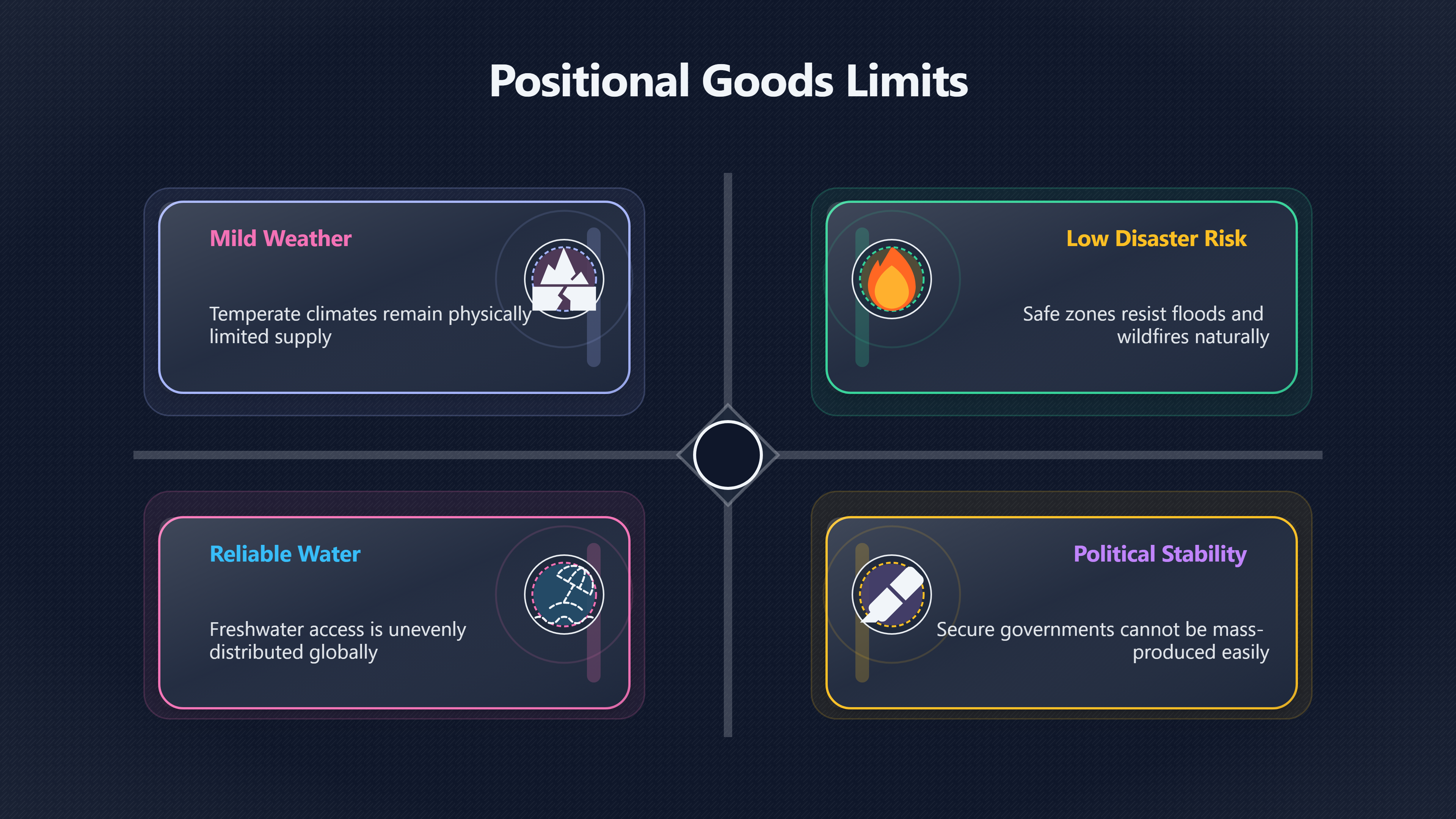
There is only so much land with all of the following at once:
- Mild weather
- Low disaster risk
- Reliable water
- Attractive landscapes
- Economic opportunity
- Political stability
- Strong institutions
- Cultural prestige
- Existing infrastructure
- Social networks and amenities
A world with abundant automated construction still cannot create unlimited Mediterranean coastlines, alpine lakes, historic city centres, or temperate islands with stable governments. AI may help build excellent new cities, but it cannot fully reproduce the accumulated geography and history that make some places uniquely valued.
This is already visible today. Wealthy global cities remain expensive despite decades of technological progress. Digital communication did not eliminate demand for London, New York, Singapore, or Tokyo. In many cases, technology increased the rewards for clustering talented people together.
Economists call this the “agglomeration effect”: the productivity gains that arise when skilled workers, institutions, investors, universities, and industries concentrate geographically. Research on remote work suggests these forces weaken somewhat when digital collaboration improves, but they do not disappear. [Munich Personal RePEc Archive]mpra.ub.uni-muenchen.deMunich Personal RePEc ArchiveThe Effect of Working from Home on the Agglomeration…May 24, 2022 — by S Liu · 2022 · Cited by 49 — We an… [City Journal]city-journal.orgremote work and urban wages14 Oct 2022 — Glaeser has explained, cities offer agglomeration effects that boost productivity, and thereby wages, as people and ideas c…
Even if AI systems handle much knowledge work, humans may still prefer dense cultural and social environments where opportunity, prestige, creativity, and relationships cluster together.
Remote work changes geography less than many expected
During the pandemic, many observers predicted that remote work would permanently dissolve superstar cities. Some movement away from expensive urban centres did occur, especially toward suburbs and smaller regional cities. But evidence suggests that most migration remained geographically close to major metropolitan hubs rather than dispersing evenly across entire countries. [Economics Online]economicsonline.co.ukEconomics Online The Geography of Remote Work: Are Cities Losing TheirEconomics OnlineThe Geography of Remote Work: Are Cities Losing Their…December 19, 2025 — 19 Dec 2025 — Many remote workers who moved… [WBR]wesleyanbusinessreview.comWBRAgglomeration: A Defense of the Remote Worker — WBR9 Dec 2025 — The rise of remote work has transformed not only firms but also urban…
That pattern matters for post-scarcity futures.
If even a large shift toward online work did not fully dissolve the attraction of high-opportunity regions, a more automated economy may still preserve strong geographic hierarchies. People may no longer need to live near factories or offices, but they may still compete for:
- Beautiful natural surroundings
- Elite educational ecosystems
- Social prestige
- Cultural scenes
- Safety and governance quality
- Climate resilience
- Access to influential networks
In fact, as work consumes less of life, location quality may become more important rather than less important. A civilisation with more leisure, longer lifespans, and greater material abundance could place greater emphasis on where people actually spend their lives.
Prime environments may become more valuable in a warming world
Climate change may increase the scarcity of desirable land rather than reduce it.
Many regions already face intensifying heat, drought, wildfire, flooding, water stress, sea-level rise, or insurance instability. Climate researchers and real-estate analysts increasingly treat location-specific resilience as a major long-term economic factor. Savills Impacts 3OECD [UNEP Finance Initiative]unepfi.orgUNEP Finance InitiativeClimate Risks in the Real Estate SectorThis brief provides a baseline understanding of the key physical and transi…
That creates a new category of positional advantage: climate resilience.
In a future where advanced AI helps societies adapt to environmental pressures, some regions will still remain naturally easier, safer, or cheaper to protect than others. Places with moderate temperatures, abundant freshwater, lower disaster exposure, and strong infrastructure may attract growing demand.
The idea of “climate havens” reflects this emerging logic. Discussions around the Great Lakes region in North America, parts of northern Europe, elevated inland cities, and cooler coastal zones all reflect the expectation that future migration could increasingly follow environmental stability. [Hate The Game]hatethegame.substack.comHate The GameThe Climate Haven Theory: Is the Great Lakes Region the…March 23, 2026 — The Climate Haven Theory: Is the Great Lakes Reg… [Russell Max Simon]russellmaxsimon.comRussell Max SimonHow to find a climate haven - by Russell Max Simon14 Oct 2022 — A climate haven is a sustaining property, in a resilient…
Importantly, this does not mean climate collapse makes most land uninhabitable. Human societies are highly adaptive. Wealthy regions can use engineering, cooling systems, water infrastructure, and AI-assisted planning to remain functional under difficult conditions. But adaptation costs are uneven.
A city requiring massive flood barriers, expensive cooling, wildfire defence, desalination, and insurance subsidies is fundamentally different from one that remains naturally temperate and water-secure.
The result may be a widening premium on naturally resilient geography.
AI could both soften and sharpen these pressures
Advanced AI could reduce some geographic inequality by:
- Improving climate forecasting
- Optimising water systems
- Designing resilient buildings
- Accelerating clean energy deployment
- Enhancing disaster response
- Making harsh environments more habitable
But these same tools may also make prime places more obviously valuable.
Better prediction systems could identify long-term safe zones earlier. Wealthy investors and governments may compete aggressively for stable land, freshwater access, and strategically resilient regions. Insurance markets may increasingly differentiate between high-risk and low-risk areas. Some vulnerable regions could face declining investment as capital shifts toward safer territory.
Evidence from climate-risk modelling already suggests that housing affordability and insurance pressures are becoming entangled with environmental risk. [The Guardian]theguardian.comThe study, which modeled two decades of public housing data under various climate outcomes, found that vulnerable groups—especially rente… [Savills Impacts]impacts.savills.comSavills ImpactsAdaptation or obsolescence: real estate on the front line of…Climate change makes buildings more expensive to operate a…
In other words, AI abundance does not necessarily flatten geography. It may instead make geographic quality more economically legible and therefore more contested.
Some places are valuable because history cannot be automated
Not all scarcity is environmental. Some places are scarce because they embody accumulated human history.
A medieval district in Florence, a Kyoto temple district, or a centuries-old London neighbourhood cannot simply be mass-produced by advanced manufacturing. Their value comes partly from continuity, symbolism, memory, architecture, and cultural concentration.
Even if virtual reality becomes extremely immersive, many people will still want physical presence in culturally important locations. Tourism already demonstrates this. Digital images of Venice did not eliminate demand to physically visit Venice.
This creates another important feature of post-scarcity rivalry: authenticity.
People often value experiences more when they are tied to real places, traditions, and communities rather than infinitely reproducible simulations. A civilisation flooded with artificial abundance may place higher value on things perceived as irreplaceable, rooted, or historically continuous.
That may increase preservation pressures:
- Historic districts may become more protected
- Environmental conservation may intensify
- Access restrictions may grow
- Tourism quotas may expand
- Land-use conflicts may sharpen
The paradox is that technological abundance can increase appreciation for the non-replicable.
Scarcity after abundance may become more political than technical
In a highly productive AI economy, the central question may not be whether enough housing can physically be built. It may instead be who gets access to the best locations.
That shifts scarcity from pure production toward governance.
Several different systems are possible.
Open access and large-scale building
One possibility is that societies dramatically expand housing supply around desirable areas using AI-assisted planning and automated construction.
If building becomes extremely cheap, governments could:
- Upzone high-demand cities
- Build dense transit infrastructure
- Create new garden cities
- Expand coastal protection
- Develop high-quality public housing
- Reduce artificial zoning constraints
In this scenario, abundance partially diffuses prime-location privilege by increasing access to desirable regions rather than treating scarcity as fixed.
This would still not eliminate competition entirely, but it could reduce exclusion.
Fortress geography
Another possibility is that wealthy individuals, corporations, or states increasingly restrict access to resilient and desirable territory.
[This could happen through:]oecd.orgmanaging climate related risks for resilient real estate fe6a5ab0Managing climate-related risks for resilient real estate24 Dec 2025 — This chapter explores how actors in the real estate sector manage c…
- Exclusionary zoning
- Gated communities
- Climate migration restrictions
- Foreign ownership controls
- Privatised infrastructure
- Algorithmic pricing systems
- Resource nationalism
In that world, AI-driven abundance for goods coexists with intensified inequality around land and location.
Some critics of techno-optimist futures worry this outcome is more likely than universal flourishing: material plenty combined with increasingly stratified access to safety, beauty, and stability.
Shared stewardship models
A third possibility involves treating prime environments more like protected commons.
Governments or international institutions could:
- Expand public coastal access
- Protect ecological reserves
- Limit speculative land capture
- Build universal housing systems
- Tax land value more aggressively
- Use sovereign wealth funds or public trusts
- Guarantee baseline geographic mobility
This approach draws partly on traditions of commons governance associated with scholars such as Elinor Ostrom, who argued that shared resources often require institutions, norms, and collective management rather than pure market allocation. The challenge is that attractive land becomes more politically sensitive as its scarcity increases.
Why this matters for the long-term future
The broader AI bloom vision imagines a civilisation where humanity transcends many historical limits: disease, extreme poverty, exhausting labour, and perhaps even biological ageing itself. But flourishing is not only about output or consumption. It is also about where and how people live.
Prime places remain scarce because humans are embodied beings living on a finite planet with uneven geography, ecosystems, climates, and histories.
Even if future technology allows:
- Near-zero marginal manufacturing costs
- Cheap clean energy
- Automated infrastructure
- AI tutors and doctors
- Radical scientific acceleration
…people will still compete for:
- The safest coasts
- The most beautiful valleys
- The most liveable cities
- The most stable climates
- The strongest institutions
- The richest cultural environments
That means post-scarcity politics may increasingly revolve around stewardship, access, migration, urban governance, environmental preservation, and land allocation.
The central lesson is not that abundance fails. It is that abundance changes what matters. When survival becomes easier, the remaining constraints become more visible. Geography is one of the deepest of those constraints because some forms of place cannot be copied, no matter how advanced civilisation becomes.
Endnotes
-
Source: cambridge.org
Title: University Press & Assessment What is a positional good?
Link: https://www.cambridge.org/core/journals/economics-and-philosophy/article/what-is-a-positional-good-recovering-hirschs-insights/044344084B37556691445494C779EC33Source snippet
Recovering Hirsch's insightsby JJ Tyssedal · Cited by 3 — Given that Hirsch intends his term 'positional goods' to cover goods subject to...
-
Source: Wikipedia
Title: Positional good
Link: https://en.wikipedia.org/wiki/Positional_goodSource snippet
Positional goodPositional goods are goods valued only by how they are distributed among the population, not by how many of them there...
-
Source: city-journal.org
Title: remote work and urban wages
Link: https://www.city-journal.org/article/remote-work-and-urban-wagesSource snippet
14 Oct 2022 — Glaeser has explained, cities offer agglomeration effects that boost productivity, and thereby wages, as people and ideas c...
-
Source: wesleyanbusinessreview.com
Link: https://www.wesleyanbusinessreview.com/issue-xi-finance-economics/Blog%20Post%20Title%20One-kct2p-mh7z4-7ad7n-cfkth-am5pgSource snippet
WBRAgglomeration: A Defense of the Remote Worker — WBR9 Dec 2025 — The rise of remote work has transformed not only firms but also urban...
-
Source: oecd.org
Link: https://www.oecd.org/en/publications/2025/11/future-proofing-real-estate-investment_f3d78bbb/full-report/the-state-of-play-climate-related-risks-in-real-estate_52c508a3.htmlSource snippet
OECDThe state of play: Climate-related risks in real estate: Future...24 Dec 2025 — This chapter establishes the central role of climate...
-
Source: impacts.savills.com
Link: https://impacts.savills.com/market-trends/adaptation-or-obsolescence-real-estate-on-the-front-line-of-climate-change.htmlSource snippet
Savills ImpactsAdaptation or obsolescence: real estate on the front line of...Climate change makes buildings more expensive to operate a...
-
Source: cambridge.org
Link: https://www.cambridge.org/core/services/aop-cambridge-core/content/view/4C5DCF54CBBA84F7B39B1258C2C38BDA/S0957042X00003126a.pdf/div-class-title-positional-goods-a-href-fn01-ref-type-fn-span-class-sup-1-span-a-div.pdfSource snippet
Positional GoodsIt emerges, I hope that Social Limits to Growth is a title which understates the scope of Hirsch's positional economy. Th...
-
Source: oecd.org
Title: managing climate related risks for resilient real estate fe6a5ab0
Link: https://www.oecd.org/en/publications/2025/11/future-proofing-real-estate-investment_f3d78bbb/full-report/managing-climate-related-risks-for-resilient-real-estate_fe6a5ab0.htmlSource snippet
Managing climate-related risks for resilient real estate24 Dec 2025 — This chapter explores how actors in the real estate sector manage c...
-
Source: mpra.ub.uni-muenchen.de
Link: https://mpra.ub.uni-muenchen.de/113108/1/MPRA_paper_113108.pdfSource snippet
Munich Personal RePEc ArchiveThe Effect of Working from Home on the Agglomeration...May 24, 2022 — by S Liu · 2022 · Cited by 49 — We an...
Published: May 24, 2022
-
Source: economicsonline.co.uk
Title: Economics Online The Geography of Remote Work: Are Cities Losing Their
Link: https://www.economicsonline.co.uk/all/the-geography-of-remote-work-are-cities-losing-their-agglomeration-advantage.html/Source snippet
Economics OnlineThe Geography of Remote Work: Are Cities Losing Their...December 19, 2025 — 19 Dec 2025 — Many remote workers who moved...
Published: December 19, 2025
-
Source: unepfi.org
Link: https://www.unepfi.org/themes/climate-change/climate-risks-in-the-real-estate-sector/Source snippet
UNEP Finance InitiativeClimate Risks in the Real Estate SectorThis brief provides a baseline understanding of the key physical and transi...
-
Source: hatethegame.substack.com
Link: https://hatethegame.substack.com/p/the-climate-haven-theory-is-the-greatSource snippet
Hate The GameThe Climate Haven Theory: Is the Great Lakes Region the...March 23, 2026 — The Climate Haven Theory: Is the Great Lakes Reg...
Published: March 23, 2026
-
Source: russellmaxsimon.com
Link: https://www.russellmaxsimon.com/p/how-to-find-a-climate-havenSource snippet
Russell Max SimonHow to find a climate haven - by Russell Max Simon14 Oct 2022 — A climate haven is a sustaining property, in a resilient...
-
Source: theguardian.com
Link: https://www.theguardian.com/environment/2026/may/15/australia-housing-affordability-homelessness-fossil-fuel-future-researchSource snippet
The study, which modeled two decades of public housing data under various climate outcomes, found that vulnerable groups—especially rente...
-
Source: sk.sagepub.com
Title: positional goods
Link: https://sk.sagepub.com/ency/edvol/download/consumerculture/chpt/positional-goods.pdfSource snippet
of Consumer CulturePositional goods were defined by Fred Hirsch as those goods whose value for the consumer who owns them depends more on...
Additional References
-
Source: gresb.com
Link: https://www.gresb.com/nl-en/future-proofing-real-estate-why-physical-climate-risk-and-resilience-should-be-integrated-across-all-stages-of-the-property-lifecycle/Source snippet
Future-proofing real estate: Why physical climate risk and...19 Sept 2025 — Discover how physical climate risk impacts real estate and w...
-
Source: blogs.ucl.ac.uk
Link: https://blogs.ucl.ac.uk/dpublog/2020/06/05/working-remotely-implications-on-the-fate-of-smaller-cities-towns-and-villages-in-the-new-economy/Source snippet
on the fate of smaller cities, towns and villages in...by NP Makarem — This article is about imagining the future of smaller cities, tow...
-
Source: youtube.com
Link: https://www.youtube.com/watch?v=9J2GjGixcQcSource snippet
Is the Great Lakes Region the Ultimate Climate Haven for...62% of US homes face high heat risk. Wildfires and floods put $15 trillion in...
-
Source: thestabilegroup.com
Link: https://www.thestabilegroup.com/the-newest-real-estate-demand-climate-resilient-properties/Source snippet
These areas are safer and more valuable, making them good investments for climate-...Read more...
-
Source: researchgate.net
Link: https://www.researchgate.net/publication/307811405_The_Nature_History_and_Significance_of_the_Concept_of_Positional_GoodsSource snippet
fixed or near-fixed in supply and argues for the usefulness of this concept.Read more...
-
Source: climate-x.com
Link: https://www.climate-x.com/articles/industry/climate-change-adaptation-in-real-estate-esg-resilience-strategiesSource snippet
e planning protects assets, reduces risk, and strengthens long-term...
-
Source: centreforcities.org
Title: the impact of covid 19 on agglomeration
Link: https://www.centreforcities.org/reader/office-politics/the-impact-of-covid-19-on-agglomeration/Source snippet
The impact of Covid-19 on agglomeration24 May 2023 — A study of UK workers found that the transition from office-based work to WFH (work...
Published: May 2023
-
Source: search.proquest.com
Link: https://search.proquest.com/openview/90c00b749ce654aeb2b1dc1a64765db6/1?cbl=1817076&pq-origsite=gscholarSource snippet
Limits to Growthby AN Shulsky · 1978 — Once their basic material needs are satisfied, individuals pursue what Hirsch calls "positional go...
-
Source: shaharit.org.il
Title: Social Limits to Growth Revisited
Link: https://www.shaharit.org.il/wp-content/uploads/2016/10/social_limits_to_growth.pdfSource snippet
Fred Hirsch spends roughly the first half of Social Limits to Growth attempting to explain why economic growth has had such...Read more...
-
Source: cusp.ac.uk
Title: CUSPSocial Limits To Growth
Link: https://cusp.ac.uk/themes/appg/cl-tj_social-limits-to-growth/Source snippet
Social Limits To Growth - Lessons for a post-crash economy23 Nov 2017 — But Fred Hirsch's main argument was that, even at the time, socie...
Amazon book picks
Further Reading
Books and field guides related to Why prime places stay scarce. Use these as the next step if you want deeper reading beyond the article.
Urban Geography
Urban Geography a comprehensive introduction to a variety of issues relating to contemporary urban geography, including patterns and proc...

Key Concepts in Urban Geography
"This extraordinary collage of sophisticated essays on key terms in urban geography both provides a conventional basis to and recasts inn...
An Introduction to Urban Geography
This book, first published in 1984, is an attempt to make students aware of the variety in the urban condition and to introduce them to s...
eBay marketplace picks
Marketplace Samples
Example marketplace items related to this page. Use the search link to explore similar finds on eBay.

Example eBay listing
A.I. Artificial Intelligence Original Movie Poster Signed By Jude Law
USD 125.00 | Shipping USD 25.00 | US

Example eBay listing
Artificial Intelligence D/S Original Movie Poster - 27 x 40"
USD 19.50 | Shipping USD 13.65 | US

Example eBay listing
612388 Artificial Intelligence Movie Science Fiction Drama Wall Print Poster
USD 22.95 | Shipping USD 12.95 | JP

Example eBay listing
Companion - Artificial Intelligence Dark Comedy Cinema Film - POSTER 20"x30"
USD 23.99 | Free shipping | US

Example eBay listing
A.I. Artificial Intelligence Movie Film Poster Art Print
GBP 4.99 | Free shipping | GB

Example eBay listing
A I Artificial Intelligence 6 Movie Poster Art Print Print Classic Rare Gallery
GBP 49.00 | Free shipping | GB

Example eBay listing
AI - Artificial Intelligence (Poster + Slipcase) Blu-Ray
GBP 10.49 | Free shipping | GB

Example eBay listing
A. I. Artificial Intelligence. Jude Law. Original UK Video Poster.
GBP 8.11 | Shipping GBP 3.38 | GB
Topic Tree