Within Shared Gains
Public Compute Access
Public compute could give researchers, schools, start-ups, and poorer countries access to advanced AI without depending entirely on dominant platforms.
On this page
- Why compute becomes a gatekeeper
- Public options for research and services
- Limits, costs, and capture risks
Page outline Jump by section
Introduction
If advanced AI becomes as economically important as electricity or the internet, access to computing power may determine who gets to participate in the next phase of civilisation. Training and running powerful AI systems already depends on scarce chips, enormous data centres, specialist engineering talent, and vast energy supplies. That raises a basic political question inside the broader AI bloom debate: will intelligence become a widely available public capability, or a private infrastructure controlled by a small number of firms and countries?
 “Public compute” is one proposed answer. The idea is that governments, universities, research networks, and public-interest institutions should provide shared AI infrastructure in the way societies already provide roads, libraries, scientific laboratories, and public universities. Supporters argue this could help prevent AI becoming a permanent toll road where researchers, schools, hospitals, start-ups, poorer countries, and civil society must rent access from a handful of dominant platforms. Critics argue that public systems may be too slow, too expensive, or too politically constrained to keep up with frontier commercial development.
The outcome matters far beyond the tech sector. If AI really does accelerate science, medicine, engineering, education, and economic productivity, then control over compute may shape who captures the gains from abundance itself.
Why compute becomes a gatekeeper
In earlier eras of computing, talented researchers could often compete from universities or garages. Frontier AI increasingly works differently. Large models require tens of thousands of advanced chips, high-bandwidth networking, sophisticated cooling systems, specialised software stacks, and large quantities of electricity. This infrastructure is expensive enough that only a small number of firms and states can build at the frontier.
That changes the political economy of AI. Instead of intelligence becoming naturally decentralised, the industry tends toward concentration around whoever controls the bottlenecks.
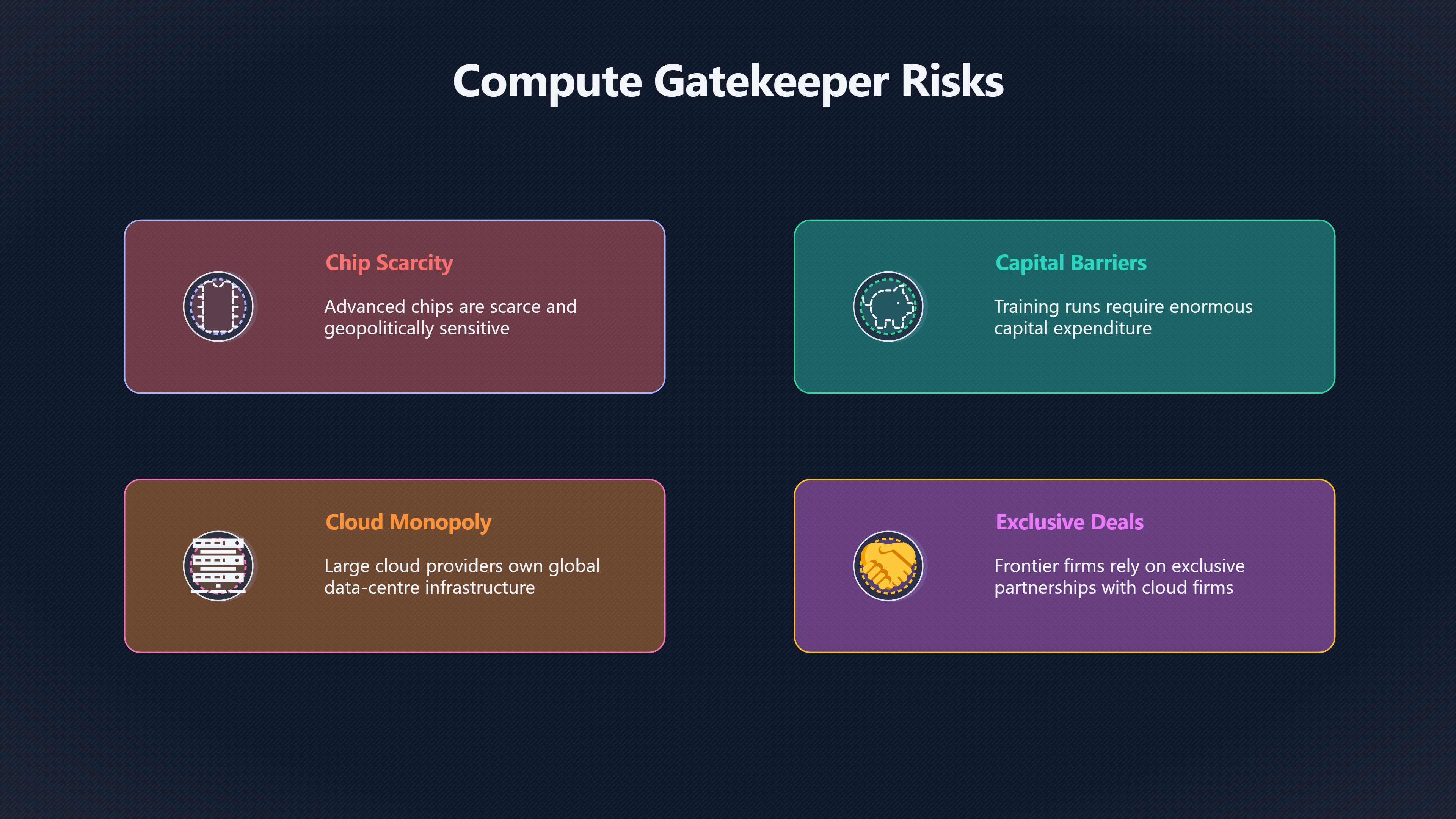
Several forces reinforce this:
- Advanced AI chips are scarce and geopolitically sensitive.
- Training runs require enormous capital expenditure.
- Large cloud providers already own global data-centre infrastructure.
- Frontier AI companies increasingly rely on exclusive partnerships with cloud firms.
- Once developers build around one ecosystem, switching providers becomes difficult.
The U.S. Federal Trade Commission warned that partnerships between cloud providers and AI developers can create dependency through revenue-sharing agreements, cloud-spending commitments, privileged access, and control rights. [Federal Trade Commission]ftc.govFederal Trade Commission Partnerships Between Cloud Service Providers and AIFederal Trade CommissionPartnerships Between Cloud Service Providers and AI…January 17, 2025 — 4.5.1 - The partnerships offer CSP part…
This matters because compute is not just another business input. If AI systems become essential for research, drug discovery, engineering, logistics, education, public administration, or scientific modelling, then compute access becomes a gatekeeping function for much of modern civilisation.
The comparison many analysts draw is with earlier infrastructure monopolies. Railroads, electricity grids, telecoms networks, and broadband internet all created periods where whoever controlled the infrastructure could extract rents from everyone else. The fear is that AI could repeat this pattern at a larger scale because intelligence itself may become an infrastructural dependency.
Within the AI bloom framework, that creates a tension. The optimistic vision imagines abundant intelligence spreading scientific capability and human potential widely. But abundance can still arrive through highly centralised systems. A world where millions rely on a few AI providers for medicine, education, law, engineering, and creative work could still become richer overall while leaving enormous power concentrated at the infrastructure layer.
What public compute is supposed to do
Public compute is an attempt to widen access before market concentration becomes irreversible.
The broad idea is simple: publicly supported infrastructure would provide researchers, universities, non-profits, smaller firms, and potentially entire countries with access to advanced AI systems without requiring dependence on dominant commercial providers.
In practice, “public compute” can mean several different things:
- National AI supercomputers
- Public cloud credits for researchers
- Shared university GPU clusters
- State-supported inference infrastructure
- Public-interest model hosting
- International compute cooperatives
- Public access to datasets, tools, and open models
- Sovereign AI infrastructure owned domestically rather than abroad
The strongest argument for public compute is that many socially valuable uses of AI are not the most commercially profitable ones.
A pharmaceutical company may be able to pay for massive AI training runs. A university climate-science department or a public hospital often cannot. If only commercial returns determine compute allocation, research with large public value but weaker immediate profits may struggle for access.
Supporters therefore frame public compute partly as scientific infrastructure. The U.S. National Artificial Intelligence Research Resource (NAIRR) pilot programme was explicitly created to broaden access to AI resources for researchers, educators, and students. [NSF - U.S. National Science Foundation]nsf.govNational Science FoundationNational Artificial Intelligence Research ResourceVisit nairrpilot.org to explore opportunities for researcher… [NSF - U.S. National Science Foundation]nsf.govNational Science FoundationNational Artificial Intelligence Research ResourceVisit nairrpilot.org to explore opportunities for researcher…
The logic resembles earlier public investments in physics laboratories, genome sequencing infrastructure, or publicly funded internet research. Many of the foundational technologies behind modern digital life emerged from systems that were initially state-supported or university-based rather than purely commercial.
Public compute advocates argue that AI may require a similar approach because frontier infrastructure costs are becoming too high for ordinary academic or civic participation.
Public compute as scientific infrastructure
The strongest practical case for public compute is not ideological opposition to private companies. It is the fear that frontier research itself narrows if access collapses into a few corporate labs.
Many academic researchers already report difficulty accessing sufficient GPU capacity for advanced experiments. Smaller universities and researchers in poorer countries face even larger barriers.
The NAIRR pilot in the United States was designed partly to address this problem by giving approved researchers access to computing resources, datasets, and models through public-private partnerships. [NSF - U.S. National Science Foundation]nsf.govNational Science FoundationNational Artificial Intelligence Research ResourceVisit nairrpilot.org to explore opportunities for researcher… [NSF - U.S. National Science Foundation]nsf.govnational artificial intelligence research resource nairrNational Science FoundationNational Artificial Intelligence Research Resource (NAIRR)…8 Mar 2024 — NSF and the Department of Energy ar…
Early projects included robotics, hospital computer vision, and scientific AI applications that may not otherwise have secured major commercial funding. [Stanford HAI]hai.stanford.eduai projects greenlighted national ai research resource pilotStanford HAIStanford AI Projects Greenlighted in National AI Research…17 May 2024 — Robotics and hospital computer vision projects rec…
This matters because some of the largest possible gains from AI bloom are scientific rather than consumer-facing:
- Faster materials discovery
- Drug development
- Climate modelling
- Protein design
- Fusion and energy research [nsf.gov]nsf.govnational artificial intelligence research resource nairrNational Science FoundationNational Artificial Intelligence Research Resource (NAIRR)…8 Mar 2024 — NSF and the Department of Energy ar…
- Agricultural optimisation
- Pandemic forecasting
- Scientific automation
If frontier compute is restricted mainly to advertising platforms, finance, defence, and large technology firms, then the direction of AI development may skew toward whichever applications maximise private returns rather than broad human flourishing.
Public compute therefore functions partly as research insurance: a way to preserve scientific diversity and experimentation outside a narrow corporate ecosystem.
Europe’s “AI factories” and the sovereignty push
Europe has become one of the clearest testing grounds for large-scale public compute policy.
The European Union’s EuroHPC programme is building “AI factories” around major supercomputing systems intended to support researchers, start-ups, industry, and public-sector users. [EuroHPC]eurohpc-ju.europa.euEuro HPCAI FactoriesEuroHPCAI Factories - EuroHPC JU - European UnionAI factories are hubs that use the supercomputing capacity of the EuroHPC Joint Undertak… [EuroHPC]eurohpc-ju.europa.euEuro HPCAI FactoriesEuroHPCAI Factories - EuroHPC JU - European UnionAI factories are hubs that use the supercomputing capacity of the EuroHPC Joint Undertak… [Digital Strategy]digital-strategy.ec.europa.euDigital Strategy AI FactoriesDigital StrategyAI Factories - Shaping Europe's digital future - European UnionAI Factories leverage the supercomputing capacity of the E…
These projects are not only about economic competitiveness. They are also about sovereignty.
European policymakers increasingly worry that dependence on U.S.-controlled cloud providers could leave Europe technologically subordinate in a future where AI systems shape finance, administration, healthcare, security, and industrial production.
That concern has intensified because much global AI infrastructure remains heavily concentrated in American firms. One recent study examining hundreds of non-U.S. data centres estimated that U.S. companies still operate a large share of global compute infrastructure outside the United States. [arXiv]arxiv.orgarXiv How Sovereign Is Sovereign Compute? A Review of 775 Non-U.S. Data CentersarXivHow Sovereign Is Sovereign Compute? A Review of 775 Non-U.S. Data CentersJuly 30, 2025…
The EU’s response combines several goals at once:
- Keep advanced AI infrastructure physically located in Europe
- Support local research and start-ups
- Reduce dependence on foreign cloud platforms
- Maintain stronger regulatory control
- Preserve data sovereignty
- Create broader public access pathways
The AI factories model also tries to bridge an important gap between traditional scientific supercomputers and modern AI development. Researchers have argued that classical high-performance computing systems are often difficult for ordinary AI developers to use because commercial AI increasingly depends on cloud-native tools and service layers. [arXiv]arxiv.orgarXiv How Sovereign Is Sovereign Compute? A Review of 775 Non-U.S. Data CentersarXivHow Sovereign Is Sovereign Compute? A Review of 775 Non-U.S. Data CentersJuly 30, 2025…
That may sound technical, but it matters politically. A public supercomputer that only elite specialists can access does not fully solve the accessibility problem. Public compute becomes much more meaningful if smaller firms, researchers, hospitals, and local governments can actually build useful systems on top of it.

Could public compute widen global access?
The global distribution question may be even more important than the domestic one.
Many poorer countries risk becoming permanent AI consumers rather than AI producers. If frontier AI capability requires infrastructure investments only the richest states can afford, the gap between technological leaders and followers could widen sharply.
This is one reason some analysts describe compute access as a new digital divide. [Tony Blair Institute]institute.globalstate of compute access 2024 how to navigate the new power paradoxTony Blair InstituteState of Compute Access 2024: How to Navigate the New…18 Nov 2024 — Our report, State of Compute Access: How to Br…
The stakes extend beyond economics. Countries that cannot train, adapt, or audit advanced AI systems may become dependent on foreign providers for critical infrastructure, education systems, healthcare tools, language models, and public administration.
Public or cooperative compute models could partially reduce this dependence through:
- Regional AI infrastructure partnerships
- Shared international research systems [cuit.columbia.edu]cuit.columbia.eduSo, Nair stands for the National Artificial Intelligence Research Resource, and it's a shared national research infrastructure…Read more…
- Open-access model hosting
- Public multilingual AI systems
- Federated research networks
- Shared scientific compute pools
In principle, this could allow more countries to participate in scientific acceleration rather than merely importing AI services designed elsewhere.
That matters for the broader bloom thesis because many of the potential gains from advanced AI — longer healthy lives, scientific acceleration, climate resilience, educational abundance, and reduced material scarcity — become far less transformative if only a small minority of countries can shape or access the underlying systems.
The biggest limitation: public compute may still depend on private firms
Public compute is not automatically independent compute.
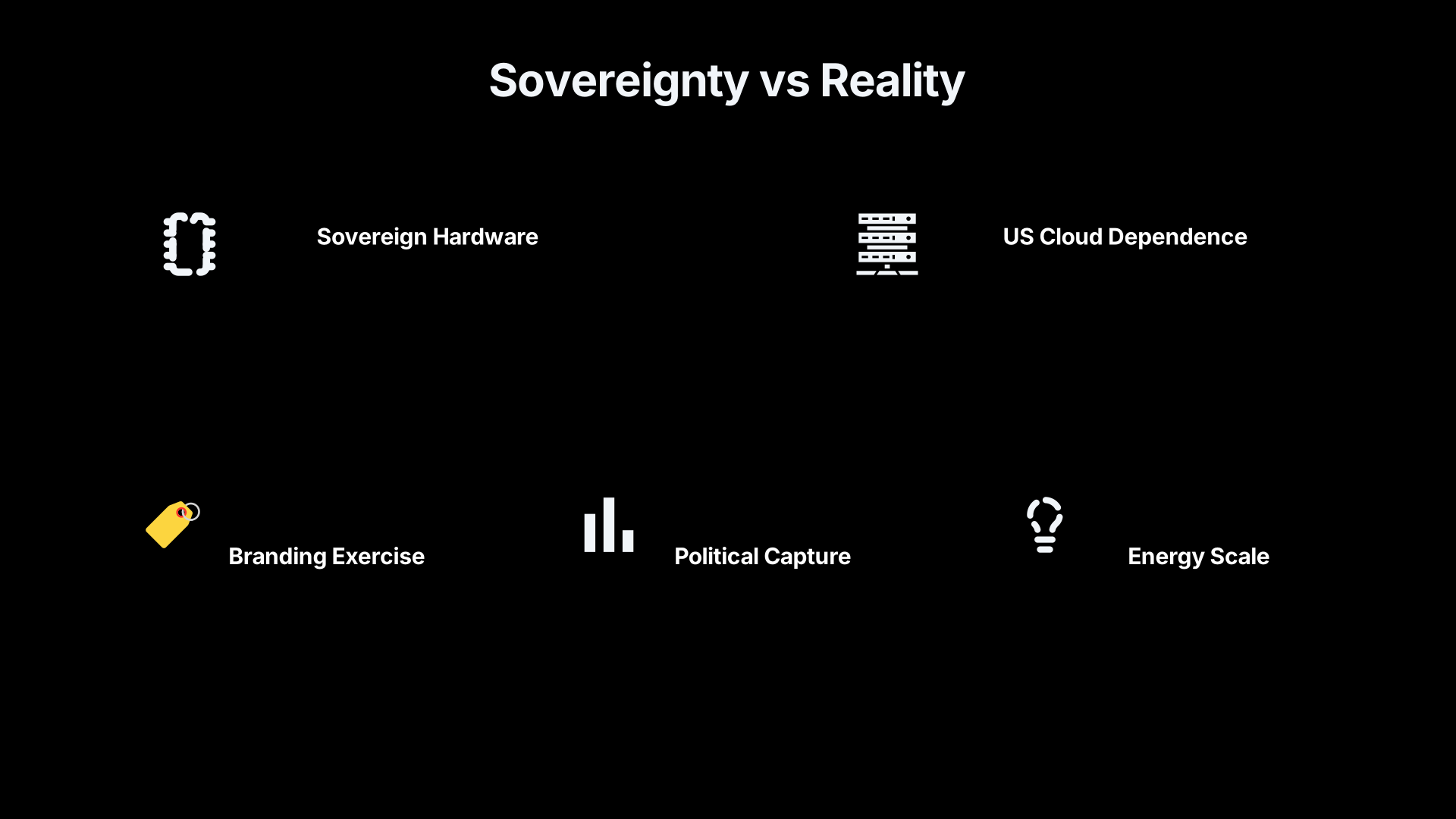
Many supposedly sovereign or public AI projects still rely heavily on Nvidia chips, U.S. cloud software, foreign operators, or commercial partnerships. Even state-backed systems often depend on the same global supply chains dominated by a few firms.
That creates a paradox. Governments may fund public compute while still reinforcing the underlying concentration they are trying to reduce.
Europe illustrates the tension clearly. Several European AI infrastructure initiatives continue to rely heavily on American chip technology and cloud ecosystems. [Le Monde.fr]lemonde.frThe collaboration marks a pivotal shift for Mistral, which launched in 2023 and has primarily focused on developing generative AI models…
The same issue appears in the United States. The NAIRR pilot itself relies partly on support from major technology companies. [Microsoft]microsoft.comMicrosoftNational AI Research Resource (NAIRR) PilotThe mission of the NAIRR pilot aligns with our commitment to broaden AI research and… Public access may therefore remain downstream from commercial infrastructure providers rather than genuinely independent of them.
This does not necessarily make public compute meaningless. Public universities also buy private hardware; public hospitals use commercial pharmaceuticals. The important question is whether public institutions retain meaningful bargaining power and independent capability.
Still, critics argue that many current “sovereign AI” projects risk becoming branding exercises rather than real alternatives to concentrated platform control.
Energy, cost, and the scale problem
Another challenge is sheer scale.
Training frontier AI models can cost hundreds of millions of pounds. Operating large inference systems for millions of users also consumes enormous energy and infrastructure resources.
Public compute therefore faces difficult trade-offs:
- Should governments fund frontier model training or mainly support access to existing open models?
- Is it better to subsidise universities or build national systems?
- Should compute be allocated competitively or universally?
- How much infrastructure duplication is economically sensible?
- Can public systems keep pace with rapidly advancing private labs?
These questions become sharper if AI capability growth accelerates.
A future intelligence explosion — where AI systems rapidly improve scientific and engineering capability — could make compute demand rise even faster than current forecasts. In that world, access bottlenecks might intensify rather than weaken.
Some sceptics therefore argue that public compute may struggle to match the pace of private capital expenditure. Commercial firms can move faster, attract top talent more easily, and tolerate higher levels of technical risk.
There is also the risk of political capture. Large infrastructure programmes can become subsidies for incumbents rather than genuine public alternatives. Recent controversy around UK AI infrastructure announcements has fuelled concern that governments may overstate public benefit while effectively underwriting private firms. [The Guardian]theguardian.comThe initiative, celebrated by both Conservative and Labour governments as a cornerstone of the UK’s economic transformation, is anchored…
Open models may matter as much as public hardware
Hardware access alone is not enough.
Even if public institutions possess compute resources, they still need useful models, datasets, software tools, and skilled people. A publicly owned cluster running entirely proprietary systems may leave users dependent on commercial gatekeepers anyway.
This is why many public compute advocates also support open-weight or open-source AI models.
Open models can reduce dependency in several ways:
- Researchers can inspect and modify systems directly.
- Smaller organisations can adapt models locally.
- Countries can fine-tune systems in local languages.
- Public institutions avoid permanent licensing dependence.
- Scientific work becomes easier to reproduce and audit.
The interaction between public compute and open models may therefore be crucial. Public compute without open ecosystems risks becoming rented infrastructure for commercial systems. Open models without compute access may remain unusable for many researchers or poorer countries.
The combination potentially matters more than either alone.
Can public compute actually stop AI becoming a toll road?
Probably not entirely. But it may still shape how concentrated the AI economy becomes.
Public compute is unlikely to eliminate commercial dominance at the frontier. Private firms currently possess major advantages in capital, engineering scale, data-centre deployment speed, and chip procurement. Frontier AI development may remain concentrated for years.
But the relevant question is not whether public compute fully replaces private infrastructure. It is whether it preserves meaningful alternatives.
A society with strong public compute systems could still differ dramatically from one without them:
- Universities might retain serious research capability.
- Public hospitals could build specialised systems.
- Start-ups might experiment without dependence on a few cloud providers.
- Smaller countries could participate more meaningfully in AI development.
- Open scientific work could remain viable.
- Governments might retain more leverage over infrastructure providers.
That may sound modest compared with the grandest AI bloom visions. Yet historically, seemingly technical infrastructure choices often shape who benefits from major technological revolutions.
The internet itself evolved through a mix of public research funding, university networks, open standards, and private commercialisation. AI may require a similarly hybrid settlement if its gains are to spread broadly rather than accumulating mainly to whoever owns the compute layer.
The deeper issue is that abundance alone does not dissolve power. A civilisation with enormously capable AI systems could still become economically and politically centralised if access to intelligence remains tightly controlled. Public compute is one attempt — incomplete, expensive, and politically contested — to stop that outcome becoming permanent.
Endnotes
-
Source: nsf.gov
Link: https://www.nsf.gov/focus-areas/ai/nairrSource snippet
National Science FoundationNational Artificial Intelligence Research ResourceVisit nairrpilot.org to explore opportunities for researcher...
-
Source: nsf.gov
Title: national artificial intelligence research resource nairr
Link: https://www.nsf.gov/geo/updates/national-artificial-intelligence-research-resource-nairrSource snippet
National Science FoundationNational Artificial Intelligence Research Resource (NAIRR)...8 Mar 2024 — NSF and the Department of Energy ar...
-
Source: nsf.gov
Link: https://www.nsf.gov/focus-areas/aiSource snippet
National Science FoundationArtificial IntelligenceExplore opportunities for researchers, educators and students, including AI-ready datas...
-
Source: hai.stanford.edu
Title: ai projects greenlighted national ai research resource pilot
Link: https://hai.stanford.edu/news/stanford-ai-projects-greenlighted-national-ai-research-resource-pilotSource snippet
Stanford HAIStanford AI Projects Greenlighted in National AI Research...17 May 2024 — Robotics and hospital computer vision projects rec...
Published: May 2024
-
Source: arxiv.org
Title: arXiv How Sovereign Is Sovereign Compute? A Review of 775 Non-U.S. Data Centers
Link: https://arxiv.org/abs/2508.00932Source snippet
arXivHow Sovereign Is Sovereign Compute? A Review of 775 Non-U.S. Data CentersJuly 30, 2025...
Published: July 30, 2025
-
Source: arxiv.org
Title: arXiv AI Factories: It’s time to rethink the Cloud-HPC divide
Link: https://arxiv.org/abs/2509.12849Source snippet
arXivAI Factories: It's time to rethink the Cloud-HPC divideSeptember 16, 2025...
Published: September 16, 2025
-
Source: institute.global
Title: state of compute access 2024 how to navigate the new power paradox
Link: https://institute.global/insights/tech-and-digitalisation/state-of-compute-access-2024-how-to-navigate-the-new-power-paradoxSource snippet
Tony Blair InstituteState of Compute Access 2024: How to Navigate the New...18 Nov 2024 — Our report, State of Compute Access: How to Br...
-
Source: microsoft.com
Link: https://www.microsoft.com/en-us/research/project/national-ai-research-resource-nairr-pilot/Source snippet
MicrosoftNational AI Research Resource (NAIRR) PilotThe mission of the NAIRR pilot aligns with our commitment to broaden AI research and...
-
Source: nsf.gov
Title: expanding national ai infrastructure new data systems
Link: https://www.nsf.gov/news/nsf-expanding-national-ai-infrastructure-new-data-systemsSource snippet
NSF expanding national AI infrastructure with new data...28 Aug 2025 — A robust data infrastructure is also critical to the success of t...
-
Source: nsf-gov-resources.nsf.gov
Title: NAIRR 2 Year Progress Update
Link: https://nsf-gov-resources.nsf.gov/files/NAIRR-2-Year-Progress-Update.pdfSource snippet
U.S. National Science Foundation in partnership with federal agencies, private-sector and.Read more...
-
Source: ftc.gov
Title: Federal Trade Commission Partnerships Between Cloud Service Providers and AI
Link: https://www.ftc.gov/system/files/ftc_gov/pdf/p246201_aipartnerships6breport_redacted_0.pdfSource snippet
Federal Trade CommissionPartnerships Between Cloud Service Providers and AI...January 17, 2025 — 4.5.1 - The partnerships offer CSP part...
Published: January 17, 2025
-
Source: eurohpc-ju.europa.eu
Title: Euro HPCAI Factories
Link: https://www.eurohpc-ju.europa.eu/ai-factories_enSource snippet
EuroHPCAI Factories - EuroHPC JU - European UnionAI factories are hubs that use the supercomputing capacity of the EuroHPC Joint Undertak...
-
Source: digital-strategy.ec.europa.eu
Title: Digital Strategy AI Factories
Link: https://digital-strategy.ec.europa.eu/en/policies/ai-factoriesSource snippet
Digital StrategyAI Factories - Shaping Europe's digital future - European UnionAI Factories leverage the supercomputing capacity of the E...
-
Source: eurohpc-ju.europa.eu
Link: https://www.eurohpc-ju.europa.eu/eurohpc-ju-selects-additional-ai-factories-strengthen-europes-ai-leadership-2025-03-12_enSource snippet
EuroHPC JU Selects Additional AI Factories to Strengthen...12 Mar 2025 — France and Germany will establish AI Factories, which operate a...
-
Source: eurohpc-ju.europa.eu
Link: https://www.eurohpc-ju.europa.eu/eurohpc-ju-launches-call-proposals-strengthen-european-ai-ecosystem-2026-04-28_enSource snippet
JU Launches Call for Proposals to Strengthen...Apr 28, 2026 — Currently, the EuroHPC JU is also overseeing the implementation of 19 AI f...
-
Source: lemonde.fr
Link: https://www.lemonde.fr/en/economy/article/2025/06/12/at-vivatech-emmanuel-macron-hails-historic-partnership-between-mistral-ai-and-nvidia_6742267_19.htmlSource snippet
The collaboration marks a pivotal shift for Mistral, which launched in 2023 and has primarily focused on developing generative AI models...
-
Source: theguardian.com
Link: https://www.theguardian.com/technology/2026/mar/09/revealed-uks-multibillion-ai-drive-is-built-on-phantom-investmentsSource snippet
The initiative, celebrated by both Conservative and Labour governments as a cornerstone of the UK’s economic transformation, is anchored...
-
Source: eurohpc-ju.europa.eu
Link: https://www.eurohpc-ju.europa.eu/eurohpc-ju-signs-contract-boost-ai-capabilities-it4lia-ai-factory-2026-04-22_enSource snippet
JU Signs Contract to Boost AI Capabilities with...6 days ago — IT4LIA will support the development of a secure and sovereign AI infrastr...
-
Source: eurohpc-ju.europa.eu
Link: https://www.eurohpc-ju.europa.eu/eurohpc-ju-selects-six-additional-ai-factories-expand-europes-ai-capabilities-2025-10-10_enSource snippet
EuroHPC JU Selects Six Additional AI Factories to...Oct 10, 2025 — The EuroHPC Joint Undertaking (EuroHPC JU) has selected six new sites...
-
Source: eurohpc-ju.europa.eu
Title: eu A I Factories Access Modes
Link: https://www.eurohpc-ju.europa.eu/ai-factories/ai-factories-access-modes_enSource snippet
Factories Access Modes - EuroHPC JU - European UnionAI for Industrial Innovation. The AI Factories Industrial Innovation track includes t...
-
Source: eurohpc-ju.europa.eu
Link: https://www.eurohpc-ju.europa.eu/eurohpc-ju-selects-ai-factory-antennas-broaden-ai-factories-initiative-2025-10-13_enSource snippet
JU Selects AI Factory Antennas to Broaden the AI...Oct 13, 2025 — The BE-AI Factory Antenna aims to build an AI ecosystem to support SME...
-
Source: eurohpc-ju.europa.eu
Title: eu A I Gigafactories
Link: https://www.eurohpc-ju.europa.eu/ai-gigafactories_enSource snippet
Gigafactories - EuroHPC JU - European UnionAI Gigafactories are large-scale facilities dedicated to the development and training of next...
-
Source: cuit.columbia.edu
Link: https://www.cuit.columbia.edu/rcs/training/nairrSource snippet
So, Nair stands for the National Artificial Intelligence Research Resource, and it's a shared national research infrastructure...Read more...
-
Source: interface-eu.org
Title: ai factories
Link: https://www.interface-eu.org/publications/ai-factories -
Source: hpcwire.com
Link: https://www.hpcwire.com/off-the-wire/eurohpc-launches-call-for-proposals-to-strengthen-european-ai-ecosystem/Source snippet
EuroHPC Launches Call for Proposals to Strengthen...4 hours ago — Currently, the EuroHPC JU is also overseeing the implementation of 19...
-
Source: innovationnewsnetwork.com
Title: eurohpc ju expands mandate on ai gigafactories quantum tech
Link: https://www.innovationnewsnetwork.com/eurohpc-ju-expands-mandate-on-ai-gigafactories-quantum-tech/65741/Source snippet
EuroHPC JU expands mandate on AI gigafactories and...22 Jan 2026 — The amended regulation allows for the development and operation of AI...
Additional References
-
Source: seglerconsulting.com
Link: https://www.seglerconsulting.com/europes-ai-gambit-an-in-depth-analysis-of-the-eurohpc-ai-factories-and-the-quest-for-digital-sovereigntySource snippet
Europe's AI Gambit: An In-Depth Analysis of the EuroHPC...EuroHPC Expands AI Infrastructure with Six New AI Factories Across Europe, acc...
-
Source: today.ucsd.edu
Link: https://today.ucsd.edu/story/national-ai-researchers-have-the-chance-to-access-san-diego-supercomputer-center-resources-through-nsf-nairr-pilotSource snippet
UC San Diego TodayNational AI Researchers Have the Chance to Access...7 May 2024 — The NSF has opened the next opportunity for researche...
Published: May 2024
-
Source: aifactory.lu
Link: https://aifactory.lu/about/why-ai-factoriesSource snippet
Why AI FactoriesLeveraging the supercomputing power of the EuroHPC Joint Undertaking, AI Factories enable the development of large-scale...
-
Source: community.amstat.org
Link: https://community.amstat.org/discussion/democratizing-the-future-of-ai-rd-nsf-to-launch-national-ai-research-resource-pilot-1Source snippet
to launch National AI Research Resource pilot24 Jan 2024 — The NAIRR pilot is a critical step in broadening the AI research community, fo...
-
Source: brookings.edu
Link: https://www.brookings.edu/articles/how-the-national-artificial-intelligence-research-resource-can-pilot-inclusive-ai/Source snippet
How the National Artificial Intelligence Research Resource...Jul 9, 2024 — The NAIRR is a proposed national initiative that aims to addr...
-
Source: euperspectives.eu
Title: E U AI Factories: Inside Brussels’ bet on sovereignty Funding the AI dream
Link: https://euperspectives.eu/2025/10/eu-ai-factories-inside-brussels-bet-on-sovereignty/Source snippet
For now, the factories are funded 50/50 by the EuroHPC Joint Undertaking and national governments. That model has kept the first wave...
-
Source: tomshardware.com
Title: Tom’s Hardware AMD and Eviden unveil Europe’s second exascale system
Link: https://www.tomshardware.com/tech-industry/supercomputers/amd-and-eviden-unveil-europes-second-exascale-system-epyc-venice-and-instinct-mi430x-power-system-breaks-the-exaflop-barrierSource snippet
Powered by AMD’s next-generation EPYC “Venice” CPUs with up to 256 cores, Instinct MI430X accelerators (featuring the CDNA 5 architecture...
-
Source: govtech.com
Title: 2 years into nairr pilot shared infrastructure boosts ai innovation
Link: https://www.govtech.com/education/higher-ed/2-years-into-nairr-pilot-shared-infrastructure-boosts-ai-innovationSource snippet
2 Years Into NAIRR Pilot, Shared Infrastructure Boosts AI...9 Dec 2025 — Providing shared computing power, AI tools and educational supp...
-
Source: thenextweb.com
Title: gpuaas is reinforcing the illusion of european ai sovereignty
Link: https://thenextweb.com/news/gpuaas-is-reinforcing-the-illusion-of-european-ai-sovereigntySource snippet
11 hours ago — As of 2026, Europe operates 14 supercomputers and 19 AI Factories under the EuroHPC JU (Joint Undertaking), backed by roug...
-
Source: oecd.ai
Title: national artificial intelligence research resource pilot 1037
Link: https://oecd.ai/en/dashboards/policy-initiatives/national-artificial-intelligence-research-resource-pilot-1037Source snippet
National Artificial Intelligence Research Resource PilotDec 31, 2025 — The NAIRR pilot brings together computational, data, software, mod...
Amazon book picks
Further Reading
Books and field guides related to Public Compute Access. Use these as the next step if you want deeper reading beyond the article.

Digital Public Infrastructure
In the 21st century, the digital economy has emerged as a powerful engine for societal transformation, economic growth, and inclusive dev...

The Oxford Handbook of AI Governance
As the capabilities of Artificial Intelligence (AI) have increased over recent years, so have the challenges of how to govern its usage....

Foundational Principles of AI Governance and Policy
This edited volume provides a structured analysis of AI governance principles, challenges, and implementation strategies. Drawing on inte...

Integrating Digital Public Infrastructure in Emerging Economies
Integrating digital public infrastructure (DPI) into emerging economies drives inclusive growth, enhances governance, and fosters innovat...
eBay marketplace picks
Marketplace Samples
Example marketplace items related to this page. Use the search link to explore similar finds on eBay.

Example eBay listing
A.I. Artificial Intelligence Original Movie Poster Signed By Jude Law
USD 125.00 | Shipping USD 25.00 | US

Example eBay listing
Artificial Intelligence D/S Original Movie Poster - 27 x 40"
USD 19.50 | Shipping USD 13.65 | US

Example eBay listing
612388 Artificial Intelligence Movie Science Fiction Drama Wall Print Poster
USD 22.95 | Shipping USD 12.95 | JP

Example eBay listing
Companion - Artificial Intelligence Dark Comedy Cinema Film - POSTER 20"x30"
USD 23.99 | Free shipping | US

Example eBay listing
The Worker Who Gets Drunk - 1930s Spanish Civil War Poster - 18x24
GBP 12.50 | Shipping GBP 13.78 | US

Example eBay listing
He Who Gets Slapped Poster - Lon Chaney Film Wall Art - 12X16/16X20/18X24/24X36
GBP 22.99 | Free shipping | GB

Example eBay listing
He Who Gets Slapped 1924 POSTER PRINT A5A1 Cult 20s Horror Cinema Film Wall Art
GBP 29.99 | Free shipping | GB

Example eBay listing
He Who Gets Slapped Poster Lon Chaney 1924 Old Movie Photo
GBP 5.41 | Shipping GBP 3.18 | AU
Topic Tree