Within AI Mammograms
Finding too much
More sensitive AI screening could save lives, but it could also increase false positives, biopsies and overdiagnosis if not carefully governed.
On this page
- False positives, recalls and patient anxiety
- DCIS and the overdiagnosis problem
- What long term follow up must measure
Page outline Jump by section
Introduction
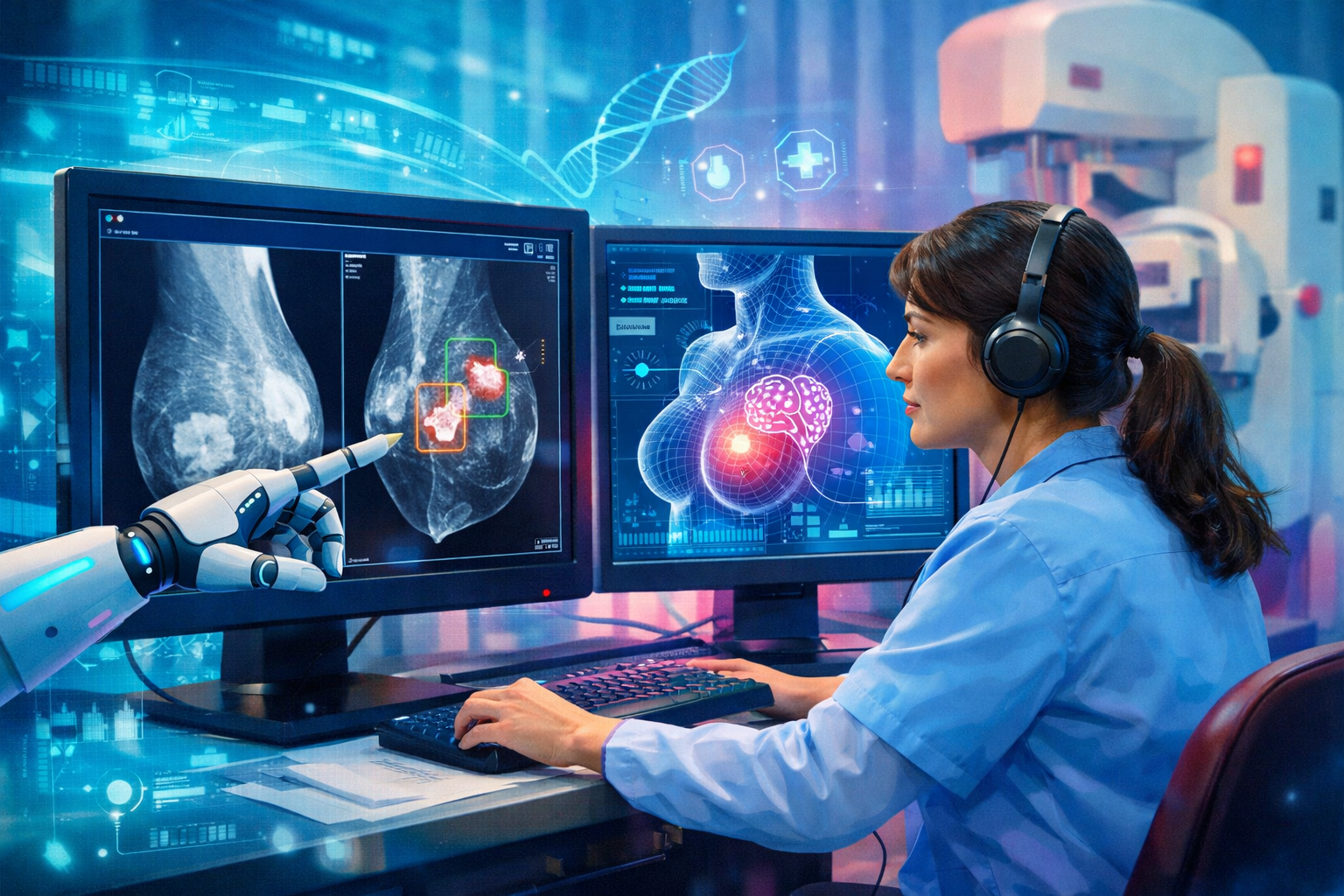
AI-assisted breast screening is often presented as a straightforward medical advance: better software finds cancers earlier, more lives are saved, and radiologists get help with growing workloads. But breast screening has always involved a harder question than “did the system find more abnormalities?” The real question is whether it improved the balance between benefit and harm.
That matters because screening can detect conditions that would never have become life-threatening. A woman may be recalled for extra scans, undergo biopsies, receive surgery or radiotherapy, and live for years with the psychological burden of a cancer diagnosis even though the abnormality might never have progressed. More sensitive AI systems could reduce dangerous missed cancers while also expanding this problem of overdiagnosis. The tension sits at the centre of the debate over whether AI mammography represents genuine medical progress or merely more intensive detection. Early evidence from large trials such as Sweden’s MASAI study is encouraging on false positives and interval cancers, but the most important questions require long-term follow-up measured over many years, not just headline detection rates. [ScienceDirect]sciencedirect.comScienceDirect Interval cancer, sensitivity, and specificity comparing AIScienceDirect Interval cancer, sensitivity, and specificity comparing AI [Nature]nature.comNatureNationwide real-world implementation of AI for cancer…by N Eisemann · 2025 · Cited by 174 — In the present study, the DCIS detec…
False positives, recalls and patient anxiety
For many women, the harms of screening begin long before any confirmed cancer diagnosis. A suspicious mammogram can trigger recalls for additional imaging, ultrasound examinations, MRI scans, or needle biopsies. Most recalled women do not ultimately have cancer.
This is one reason screening programmes are judged not simply by how many cancers they detect, but by their specificity: how often they correctly reassure healthy patients. A screening system that detects slightly more cancers while dramatically increasing false alarms may not improve overall patient welfare.
AI changes this balance in complicated ways. More sensitive image analysis can identify subtle patterns that human readers miss, especially in dense breast tissue. But highly sensitive systems can also flag harmless shadows, calcifications, or ambiguous structures that turn into unnecessary investigations.
Early retrospective studies raised concerns that AI-assisted mammography might flood clinics with extra recalls. Researchers and screening agencies warned that laboratory-style accuracy tests often fail to capture the realities of population screening, where even tiny increases in recall rates affect millions of women. [ScienceDirect]sciencedirect.comScienceDirect Interval cancer, sensitivity, and specificity comparing AIScienceDirect Interval cancer, sensitivity, and specificity comparing AI
The more recent evidence has been somewhat reassuring, though not definitive. The Swedish MASAI randomised trial found higher cancer detection and fewer interval cancers without a major increase in false positives or recall rates. Interim analyses reported similar false-positive rates between AI-supported screening and standard double reading by radiologists. Lund University [Oncology Nursing Society]ons.orgai mammography cancer detection rates equivalentOncology Nursing SocietyAI Mammography Cancer Detection Rates Equivalent to…Oct 18, 2023 — They found that AI and double screening det…
That does not mean the problem is solved. Several reasons for caution remain:
- Screening performance varies across populations, imaging equipment, and clinical workflows.
- AI systems trained on one healthcare system may behave differently elsewhere.
- Radiologists may react differently to AI prompts in real clinical environments than in controlled trials.
- Commercial pressure can reward systems that maximise detection metrics even when patient benefit is uncertain.
There is also a human factor that statistical summaries can obscure. Even a “false positive” that resolves within days can cause major anxiety. Studies of breast screening have repeatedly shown that recalls and biopsies can produce persistent psychological stress, altered self-perception, and fear of future scans. AI systems that slightly increase recalls at national scale could therefore impose substantial hidden costs even if formal accuracy metrics appear acceptable.
This creates a subtle challenge for the broader AI-in-medicine story. In the optimistic “AI abundance” vision, advanced systems make healthcare dramatically more capable and accessible. But screening demonstrates that better pattern recognition alone is not automatically equivalent to better human outcomes. In medicine, more information can sometimes create more intervention without proportionate benefit.
DCIS and the overdiagnosis problem
The hardest issue in breast screening is ductal carcinoma in situ, usually called DCIS.
DCIS consists of abnormal cells confined to the milk ducts. Some forms are aggressive precursors to invasive cancer. Others may grow extremely slowly or never become dangerous during a patient’s lifetime. The problem is that medicine still cannot reliably distinguish harmless cases from those likely to progress.
Because of that uncertainty, many women diagnosed with DCIS undergo surgery, radiotherapy, hormone treatment, or years of surveillance. Screening programmes therefore face a long-running criticism: they may detect and treat conditions that would never have caused illness or death.
AI could intensify this dilemma.
Large-scale implementation studies already suggest AI systems may increase detection of DCIS alongside invasive cancers. A nationwide study of AI-assisted screening found the DCIS detection rate rose from 0.8 to 1.4 cases per 1,000 women screened after AI deployment. Researchers explicitly warned that future work must determine whether the extra detected cases represent meaningful prevention or expanded overdiagnosis. [Nature]nature.comNatureDiagnostic accuracy, fairness and clinical implementation…by CJ Kelly · 2026 — Cancer detection rate increased from 7.54 to 9.33…
Other analyses from AI-supported screening trials have reported significant increases in detection of in situ cancers. Some investigators argue this may still be beneficial because high-grade DCIS can evolve into dangerous invasive disease. Others argue that screening technology repeatedly becomes more sensitive faster than medicine improves its understanding of which abnormalities truly matter. [cancernetwork.com]cancernetwork.comai assisted mammography screenings show preliminary detection improvementAI-Assisted Mammography Screenings Show Preliminary…Mar 9, 2025 — Further results showed AI-CAD detected an additional 6 cases of duct…
This is one reason debates around AI mammography often become philosophically difficult rather than purely technical. A system can be statistically more accurate while still expanding overtreatment.
Consider two different futures:
- In one future, AI identifies aggressive cancers earlier while helping clinicians avoid unnecessary biopsies and treatment.
- In another, AI steadily pushes screening towards ever-finer detection of uncertain abnormalities, increasing the number of women labelled as cancer patients without significantly reducing mortality.
Both futures are compatible with “higher detection rates”.
The distinction matters enormously for the broader case that AI could help humanity flourish through medical acceleration. If AI medicine mainly expands low-value intervention, administrative burden, and anxiety, then improved computation alone does not produce genuine health abundance. The real goal is not maximal detection. It is maximal healthy life with minimal unnecessary harm.
Why more detection is not automatically better medicine
Cancer screening produces a statistical illusion that can easily mislead the public.
When a tumour is discovered earlier, survival time after diagnosis often appears longer even if the patient dies at the same age they otherwise would have. This is known as lead-time bias. Similarly, screening can preferentially detect slower-growing tumours that already had relatively good prognoses.
That is why the key measures are not simply:
- cancers detected,
- earlier diagnosis,
- or five-year survival rates.
The more important questions are:
- Did fewer women develop advanced disease?
- Did mortality actually fall?
- Did patients avoid aggressive treatment?
- Did overall quality-adjusted life improve?
AI screening studies are only beginning to accumulate this kind of long-term evidence.
The strongest recent trials do suggest movement in the right direction. The final MASAI results indicated fewer interval cancers and fewer aggressive interval tumours in the AI-supported group. That is important because interval cancers are often associated with worse outcomes. [ScienceDirect]sciencedirect.comScienceDirect Interval cancer, sensitivity, and specificity comparing AIScienceDirect Interval cancer, sensitivity, and specificity comparing AI [PubMed But even these promising findings cannot yet fully resolve the overdiagnosis question. Researchers still need years of follow-up to determine]ecancer.orgAI-supported mammography screening results in fewer…30 Jan 2026 — Artificial intelligence (AI)-supported mammography identifies more c…:
- whether mortality changes meaningfully,
- whether treatment burdens rise,
- whether more low-risk lesions are being detected,
- and whether healthcare systems drift towards heavier intervention.
This is why some breast-screening researchers emphasise restraint despite optimism about AI. Screening programmes operate at enormous scale. Small shifts in thresholds can affect millions of healthy people.
What long-term follow-up must measure
The next phase of evidence will matter more than the first wave of AI headlines.
Early AI mammography studies focused heavily on immediate operational outcomes:
- cancer detection rates, [nature.com]nature.comNatureNationwide real-world implementation of AI for cancer…by N Eisemann · 2025 · Cited by 174 — In the present study, the DCIS detec…
- sensitivity,
- specificity,
- radiologist workload,
- and recall rates. [sciencedirect.com]sciencedirect.comScienceDirectArtificial intelligence for the real world of breast screeningby MG Wallis · 2021 · Cited by 13 — The harms of screening are…
Those metrics are useful, but they are not enough to determine whether AI screening genuinely improves public health.
Long-term follow-up needs to answer harder questions.
Does AI reduce advanced disease and mortality?
If AI mainly finds biologically important cancers earlier, rates of late-stage disease and breast-cancer mortality should eventually decline.
This is the strongest argument in favour of AI-supported screening. Early data suggesting fewer aggressive interval cancers point in this direction, but proving mortality benefit takes many years. [ScienceDirect]sciencedirect.comScienceDirect Interval cancer, sensitivity, and specificity comparing AIScienceDirect Interval cancer, sensitivity, and specificity comparing AI
Does AI increase overtreatment?
Researchers must track whether AI-supported screening leads to more surgeries, radiation courses, or hormonal treatments for lesions that would never have become dangerous.
This is especially important for DCIS and other borderline findings. Increased detection alone is not sufficient evidence of benefit.
Are some groups helped more than others?
Breast density, age, ethnicity, and access to follow-up care all affect screening outcomes. AI systems trained on limited populations may perform unevenly across demographic groups.
Fairness and implementation studies are therefore becoming increasingly important as screening AI moves from trials into national programmes. [Nature]nature.comNatureNationwide real-world implementation of AI for cancer…by N Eisemann · 2025 · Cited by 174 — In the present study, the DCIS detec…
Does AI reduce or expand healthcare strain?
One attraction of AI mammography is that it may relieve severe radiologist shortages. Several studies reported large reductions in reading workload. [EurekAlert!]eurekalert.orgnews releasesEurekAlert!The Lancet: AI-supported mammography screening results…29 Jan 2026 — The interim safety results of the MASAI trial
But if more sensitive systems also trigger more downstream imaging, biopsies, and surveillance, some of those gains could disappear elsewhere in the healthcare system.
Do patients actually feel better served?
Most screening studies measure technical outcomes more carefully than patient experience. Yet anxiety, confusion, trust, and informed consent matter deeply in preventive medicine.
A future in which AI medicine becomes vastly more powerful but also more psychologically intrusive would not clearly represent human flourishing, even if detection metrics improve.
The deeper lesson for AI-enabled medicine
Breast screening has become an unusually revealing test of the broader AI bloom thesis because it exposes both the promise and the limits of machine intelligence in healthcare.
The optimistic case is real. AI systems may help detect dangerous cancers earlier, reduce missed diagnoses, support overstretched clinicians, and eventually personalise screening far more effectively than today’s age-based systems. More capable medical intelligence could become one pathway towards longer and healthier human lives. [MDPI]mdpi.comMDPIArtificial Intelligence-Driven Personalization in Breast…by F Pesapane · 2025 · Cited by 7 — Breast cancer screening reduces morta…
But mammography also demonstrates that medical progress is not simply a race towards greater sensitivity or larger datasets. Human flourishing depends on judgment about which interventions genuinely improve lives.
An AI system that identifies every microscopic abnormality is not necessarily practising better medicine. The harder task is learning which findings matter, which treatments help, and which harms are being quietly created alongside the benefits.
That distinction may apply far beyond breast screening. As AI systems become increasingly powerful across medicine, science, and human decision-making, the central challenge may not be whether machines can detect more patterns. It may be whether societies can use that intelligence to produce wiser, more humane, and more proportionate forms of care.
Endnotes
-
Source: sciencedirect.com
Title: ScienceDirect Interval cancer, sensitivity, and specificity comparing AI
Link: https://www.sciencedirect.com/science/article/abs/pii/S014067362502464X -
Source: nature.com
Link: https://www.nature.com/articles/s41591-024-03408-6Source snippet
NatureNationwide real-world implementation of AI for cancer...by N Eisemann · 2025 · Cited by 174 — In the present study, the DCIS detec...
-
Source: sciencedirect.com
Link: https://www.sciencedirect.com/science/article/abs/pii/S147020452300298XSource snippet
Artificial intelligence-supported screen reading versus...by K Lång · 2023 · Cited by 616 — We aimed to assess the clinical safety of an...
-
Source: sciencedirect.com
Link: https://www.sciencedirect.com/science/article/abs/pii/S0720048X21001418Source snippet
ScienceDirectArtificial intelligence for the real world of breast screeningby MG Wallis · 2021 · Cited by 13 — The harms of screening are...
-
Source: cancernetwork.com
Title: ai assisted mammography screenings show preliminary detection improvement
Link: https://www.cancernetwork.com/view/ai-assisted-mammography-screenings-show-preliminary-detection-improvementSource snippet
AI-Assisted Mammography Screenings Show Preliminary...Mar 9, 2025 — Further results showed AI-CAD detected an additional 6 cases of duct...
-
Source: nature.com
Link: https://www.nature.com/articles/s43018-026-01127-0Source snippet
NatureDiagnostic accuracy, fairness and clinical implementation...by CJ Kelly · 2026 — Cancer detection rate increased from 7.54 to 9.33...
-
Source: eurekalert.org
Title: news releases
Link: https://www.eurekalert.org/news-releases/1114399Source snippet
EurekAlert!The Lancet: AI-supported mammography screening results...29 Jan 2026 — The interim safety results of the [MASAI trial]({{ 'ai-bloom-abun/ai-bloom-abun-98d3a6-ai-medicine-l-7c4177-ai-mammograms-733f4e-masai-trial-w-d8...
-
Source: mdpi.com
Link: https://www.mdpi.com/2072-6694/17/17/2901Source snippet
MDPIArtificial Intelligence-Driven Personalization in Breast...by F Pesapane · 2025 · Cited by 7 — Breast cancer screening reduces morta...
-
Source: sciencedirect.com
Title: Since its first weekly issue (
Link: https://www.sciencedirect.com/journal/the-lancetSource snippet
The Lancet | Journal | ScienceDirect.com by ElsevierThe Lancet is an independent, international general medical journal founded in 1823 b...
-
Source: cancernetwork.com
Title: study mammography results overdiagnosis no reduction advanced disease
Link: https://www.cancernetwork.com/view/study-mammography-results-overdiagnosis-no-reduction-advanced-diseaseSource snippet
Study: Mammography Results in Overdiagnosis, No...9 Jan 2017 — Breast cancer screening was not associated with any reduction in the inci...
-
Source: ons.org
Title: ai mammography cancer detection rates equivalent
Link: https://www.ons.org/publications-research/voice/news-views/10-2023/ai-mammography-cancer-detection-rates-equivalentSource snippet
Oncology Nursing SocietyAI Mammography Cancer Detection Rates Equivalent to...Oct 18, 2023 — They found that AI and double screening det...
Additional References
-
Source: ecancer.org
Link: https://ecancer.org/en/news/27721-ai-supported-mammography-screening-results-in-fewer-aggressive-and-advanced-breast-cancers-finds-full-results-from-first-randomised-controlled-trialSource snippet
AI-supported mammography screening results in fewer...30 Jan 2026 — Artificial intelligence (AI)-supported mammography identifies more c...
-
Source: facebook.com
Link: https://www.facebook.com/TheLancetMedicalJournal/posts/ai-supported-mammography-screening-results-in-fewer-aggressive-and-advanced-brea/1354958810009045/Source snippet
AI-supported mammography screening results in fewer...Many cancers are missed due to a screening test ordered for a Mammogram, which doe...
-
Source: linkedin.com
Link: https://www.linkedin.com/posts/jorge-m-mendes-182522251_interval-cancer-sensitivity-and-specificity-activity-7449608119040565248-tpe3Source snippet
Jorge M. Mendes' PostWhen AI helps find breast cancer earlier, what really changes is not the machine; it is the chance that a woman is s...
-
Source: assets.publishing.service.gov.uk
Link: [https://assets.publishing.service.gov.uk/media/6217bac58fa8f54916f45f51/UK_NSC_evidence_summary_-the_use_of_AI_for_mammographic_image_analysis_in_breast_cancer_screening.pdf](https://assets.publishing.service.gov.uk/media/6217bac58fa8f54916f45f51/UK_NSC_evidence_summary-_the_use_of_AI_for_mammographic_image_analysis_in_breast_cancer_screening.pdf)Source snippet
use of AI for mammographic image analysis in breast...by K Freeman · Cited by 6 — Cancer, where present, is more likely to be detected i...
-
Source: patientcareonline.com
Link: https://www.patientcareonline.com/view/ai-supported-mammography-screening-improves-cancer-detection-without-increasing-false-positivesSource snippet
AI-Assisted Mammography Boosts Breast Cancer...4 Feb 2025 — Notably, while cancer detection rates increased, AI screening did not signif...
-
Source: salutedomani.com
Link: https://www.salutedomani.com/2026/02/02/the-lancet-ai-supported-mammography-screening-results-in-fewer-aggressive-and-advanced-breast-cancers/Source snippet
The Lancet: AI-supported mammography screening results...2 Feb 2026 — During the two years follow up, there were 1.55 interval cancers p...
-
Source: prnewswire.com
Link: https://www.prnewswire.com/news-releases/the-lancet-publishes-final-results-from-the-first-randomized-controlled-trial-in-breast-ai-302675094.htmlSource snippet
AI could potentially benefit mammography screening by reducing the screen-reading workload and the number of interval cancers. Interval...
-
Source: ascopost.com
Link: https://ascopost.com/news/february-2026/randomized-trial-shows-ai-supported-mammography-improves-sensitivity-and-lowers-interval-cancer-rate/Source snippet
Randomized Trial Shows AI-Supported Mammography...2 Feb 2026 — Another analysis of the trial showed that 29% more cancers were detected...
-
Source: itnonline.com
Link: https://www.itnonline.com/content/ai-enhanced-mammography-screening-significantly-improves-breast-cancer-detection-reducesSource snippet
AI-Enhanced Mammography Screening Significantly...Feb 5, 2025 — Higher Detection Rate: The cancer detection rate was 6.4 per 1000 partic...
-
Source: sciencemediacentre.es
Link: https://sciencemediacentre.es/en/clinical-trial-involving-more-100000-women-shows-ai-improves-breast-cancer-screeningSource snippet
AI improves breast cancer screening30 Jan 2026 — AI-assisted screening identified more women with significant cancers without a higher ra...
Amazon book picks
Further Reading
Books and field guides related to Finding too much. Use these as the next step if you want deeper reading beyond the article.

European Guidelines for Quality Assurance in Breast Cancer Sc...
Breast cancer is the most frequent cause of cancer-related deaths in women in Europe, and demographic trends indicate a continuing increa...

Evaluation of cancer screening
First published 1995. Subjects: Mass Screening, Cancer, Program Evaluation, Neoplasms, Medical screening.

Breast cancer screening
First published 1988. Subjects: Breast, Breast Neoplasms, Cancer, Diagnosis, Medical screening.
Cancer screening
First published 1996. Subjects: Mass Screening, Medical screening, Diagnosis, Cancer, Prevention & control.
eBay marketplace picks
Marketplace Samples
Example marketplace items related to this page. Use the search link to explore similar finds on eBay.

Example eBay listing
A.I. Artificial Intelligence Original Movie Poster Signed By Jude Law
USD 125.00 | Shipping USD 25.00 | US
Example eBay listing
Artificial Intelligence D/S Original Movie Poster - 27 x 40"
USD 19.50 | Shipping USD 13.65 | US
Example eBay listing
612388 Artificial Intelligence Movie Science Fiction Drama Wall Print Poster
USD 22.95 | Shipping USD 12.95 | JP

Example eBay listing
Companion - Artificial Intelligence Dark Comedy Cinema Film - POSTER 20"x30"
USD 23.99 | Free shipping | US

Example eBay listing
A.I. Artificial Intelligence Movie Film Poster Art Print
GBP 4.99 | Free shipping | GB

Example eBay listing
A I Artificial Intelligence 6 Movie Poster Art Print Print Classic Rare Gallery
GBP 49.00 | Free shipping | GB

Example eBay listing
AI - Artificial Intelligence (Poster + Slipcase) Blu-Ray
GBP 10.49 | Free shipping | GB

Example eBay listing
A. I. Artificial Intelligence. Jude Law. Original UK Video Poster.
GBP 8.11 | Shipping GBP 3.38 | GB
Topic Tree