Within Abundant Intelligence
AI Access Gaps
Cheap models are not enough: real intelligence abundance depends on cost, language, connectivity, usability, and public institutions.
On this page
- Falling inference costs and why they matter
- The divides of income, age, region, and language
- Public interest deployment in schools, clinics, and services
Page outline Jump by section
Introduction
If AI really can make intelligence more abundant, one of the central questions is whether that abundance will reach most people or remain concentrated among already advantaged groups. Falling model costs and better software matter, but they are only part of the story. Access to AI expertise depends on electricity, internet access, affordable devices, local languages, education, trust, institutional capacity, and political choices about who gets served first.
 The danger is that AI becomes “universal” in theory while remaining unequal in practice: highly capable systems for wealthy firms, elite universities, and English-speaking professionals, while poorer regions receive slower, weaker, or less reliable tools. UNESCO has warned that the world risks moving from a digital divide to an “AI divide”, where unequal access to knowledge systems deepens existing inequalities rather than reducing them. [UNESCO]unesco.orgAI literacy and the new Digital DivideUNESCOAI literacy and the new Digital Divide - A Global Call for…6 Aug 2024 — This divide represents the unequal access, benefits, and…
The optimistic AI bloom vision depends not just on creating more intelligence, but on distributing it widely enough that ordinary people can use it to learn, solve problems, improve health, and participate more fully in economic and civic life. That turns questions of access and governance into core parts of the story, not side issues.
Falling inference costs and why they matter
One reason many technologists believe AI expertise could spread broadly is that the cost of running advanced models has fallen rapidly. Training frontier systems still requires enormous capital, but using already-trained models — often called inference — has become dramatically cheaper and more efficient. Stanford’s 2025 AI Index highlights falling inference costs and improving hardware efficiency as major drivers of wider deployment. [hai-production.s3.amazonaws.com]hai-production.s3.amazonaws.comArtificial Intelligence Index Report 2025Generative AI saw particularly strong momentum, attracting $33.9 billion globally in private inv… [Stanford HAI]hai.stanford.eduStanford HAIThe 2025 AI Index Report | Stanford HAIGenerative AI saw particularly strong momentum, attracting $33.9 billion globally in p…
This matters because expensive expertise has historically been scarce. A lawyer, specialist doctor, tutor, or software engineer can only help so many people at once. AI systems can potentially scale parts of that labour at near-zero marginal cost. A student asking for explanations, a nurse checking guidance, or a small business translating documents no longer necessarily requires a dedicated human expert every time.
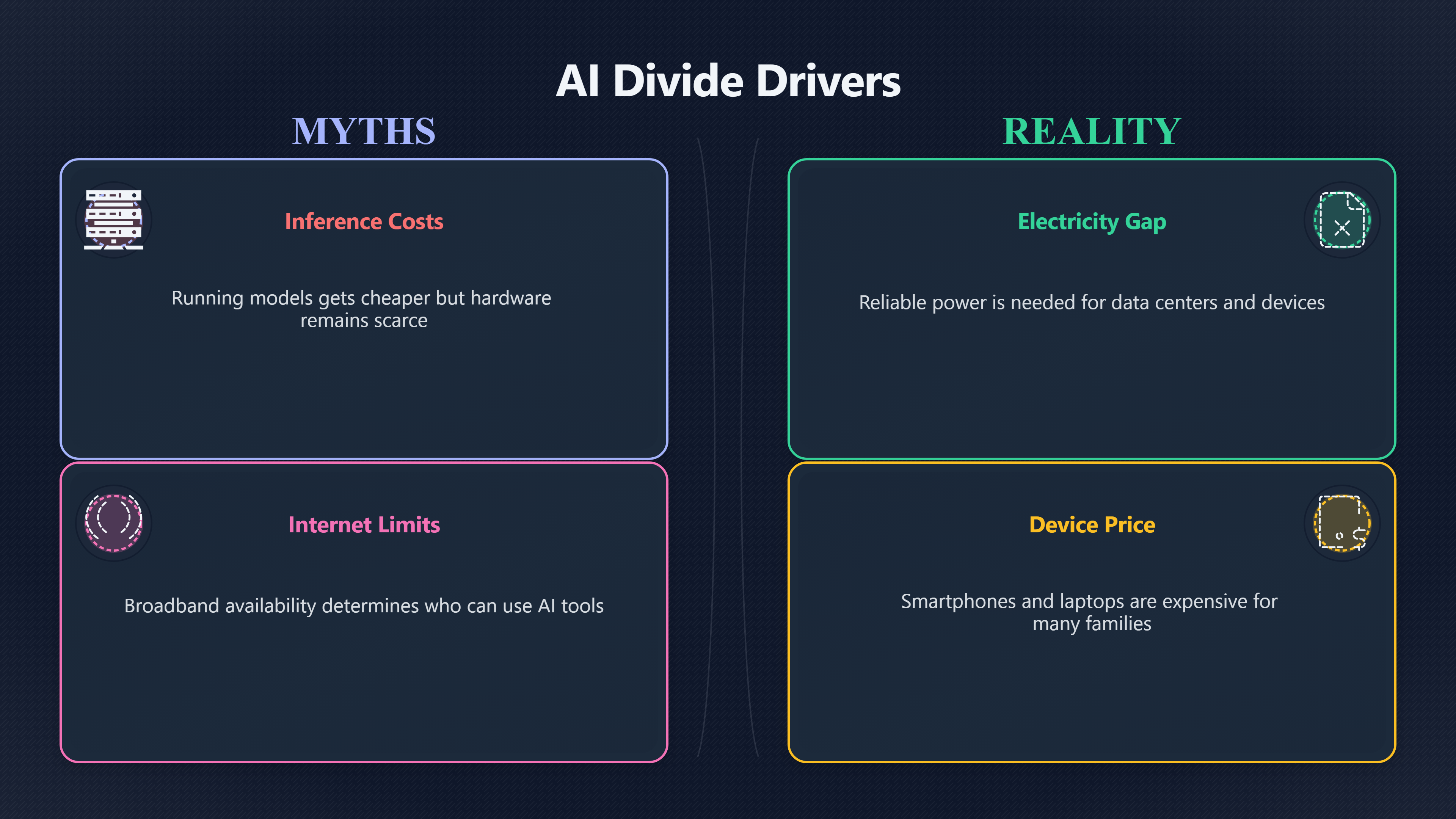
But lower inference costs alone do not guarantee equal access. Electricity became cheap in many countries long before everyone had reliable power. Internet bandwidth costs fell long before universal broadband access. AI may follow the same pattern: technically abundant, socially uneven.
Several bottlenecks remain stubbornly physical and institutional:
- Smartphones and laptops are still expensive for many households.
- Reliable internet access remains limited in parts of the world.
- Cloud-based AI systems depend on data centres concentrated in a small number of countries.
- Many leading models are controlled by a handful of firms with commercial incentives.
- Subscription pricing can exclude lower-income users even when “free” versions exist.
- Governments and schools often lack the money or expertise to deploy systems well.
The result is that AI capability can advance much faster than AI inclusion.
The divides of income, age, region, and language
The most obvious AI access gap is income. Wealthier individuals and organisations can buy better devices, faster internet, premium subscriptions, specialised tools, and training. They also tend to work in environments where AI adoption is encouraged and supported.
Stanford’s AI Index shows enormous concentration of investment and advanced AI development in a small group of countries, especially the United States and China. [Stanford HAI]hai.stanford.eduStanford HAIThe 2025 AI Index Report | Stanford HAIGenerative AI saw particularly strong momentum, attracting $33.9 billion globally in p… More recent research tracking AI usage across countries also finds that adoption is heavily skewed toward richer economies, even after adjusting for population size. [arXiv]arxiv.org2504.07139] Artificial Intelligence Index Report 2025by N Maslej · 2025 · Cited by 484 — New in this year's report are in-depth analyses… 2arXiv
This creates a compounding effect. Regions already rich in universities, technical talent, venture capital, and digital infrastructure gain access to better tools first, which can further accelerate productivity and innovation. Poorer regions risk falling further behind precisely because AI increasingly amplifies the value of existing knowledge and infrastructure.
Connectivity still limits cognitive abundance
Many discussions of AI assume permanent, high-speed connectivity. In reality, large parts of the world still experience unstable electricity, expensive mobile data, or limited broadband access. UNESCO has repeatedly warned that digital learning systems cannot become genuinely universal while basic infrastructure gaps persist. [UNESCO]unesco.orgspotlights how digital learning can promote equity low resource contextsUNESCOUNESCO spotlights how digital learning can promote…Apr 3, 2025 — UNESCO is leading global efforts to make digital learning acces… [UNESCO]unesco.orgStartling digital divides in distance learning emergeDisparities are particularly acute in low-income countries: in sub-Saharan Africa, 8…
This matters especially in education and healthcare, where AI could theoretically deliver large social gains. A sophisticated tutoring model is far less useful if pupils share a single device or cannot reliably connect to online services. AI-assisted healthcare systems depend on records infrastructure, connectivity, secure data systems, and trained staff.
The World Health Organization has stressed that digital health systems in low- and middle-income countries often face structural barriers including unreliable infrastructure, weak governance capacity, workforce shortages, and limited interoperability between systems. [World Health Organization]who.intWorld Health OrganizationDigital healthThe purpose of WHO's Global Strategy on Digital Health is to support countries in strengthening th… [Springer Link]link.springer.comSpringer LinkBarriers to digital health implementation in low- and middle…by QB Olayiwola · 2026 · Cited by 2 — Low- and middle-income…
This creates a paradox. The regions that could benefit most from scalable expertise often have the weakest foundations for deploying it.
Language inequality may become a knowledge inequality
Language is one of the least discussed but most important AI access barriers.
Most frontier AI systems perform best in English and a relatively small set of high-resource languages. Training data, benchmarks, documentation, and safety testing are heavily concentrated around those languages. Users speaking minority or low-resource languages may receive weaker answers, poorer translations, or fewer specialised services.
UNESCO has warned that linguistic inequality in digital systems risks marginalising entire communities and weakening cultural diversity. [UNESCO]unesco.orgUNESCOAI and technologies in educationUNESCO partners with countries and institutions on ideas, research, and evidence-informed digital l…
This problem is larger than convenience. If AI systems increasingly mediate access to education, government services, medicine, law, and economic opportunity, then weaker support for certain languages can become a structural disadvantage.
A rural farmer able to query crop disease information in a local language may gain real economic value from AI. A citizen unable to use government AI systems comfortably in their own language may become more excluded from public services rather than less.
The same issue appears inside wealthy countries. Immigrant communities, older people, and citizens with lower literacy levels often struggle with digital systems designed around highly educated users. AI interfaces may simplify some interactions through speech and translation, but poorly designed systems can also intensify exclusion.
Age and confidence gaps matter too
Access is not only technical. It is psychological and social.
Older adults often adopt new digital tools more slowly, especially when systems appear opaque or unreliable. People with lower digital confidence may avoid AI entirely even when access technically exists. Research on AI adoption patterns increasingly suggests that perceived trust, usefulness, and social legitimacy strongly shape who benefits from these tools. [arXiv]arxiv.org2504.07139] Artificial Intelligence Index Report 2025by N Maslej · 2025 · Cited by 484 — New in this year's report are in-depth analyses…
This matters because AI systems are not passive infrastructure like roads or water pipes. Users must actively engage with them, judge their outputs, and integrate them into work or learning. People with stronger educational backgrounds are often better positioned to spot mistakes, compare sources, and use AI critically.
In that sense, AI can magnify pre-existing educational inequality. A skilled user may become dramatically more productive with AI assistance, while a less confident user may struggle to evaluate misleading or fabricated answers.
Cheap access to a model is therefore not the same thing as meaningful cognitive empowerment.
Public-interest deployment may matter more than consumer apps
One of the biggest open questions in the AI bloom debate is whether AI access will mainly be organised through private consumer markets or through public institutions.
If access depends mostly on personal purchasing power, then inequalities are likely to persist. Wealthier households will simply buy better tools and more capable subscriptions. But if AI systems are integrated into schools, healthcare systems, libraries, welfare services, and public infrastructure, the distribution of benefits could look very different.
Historically, many technologies only became broadly empowering after institutional deployment. Literacy expanded through public education systems. Electricity spread through public infrastructure investment and regulation. Vaccination programmes required organised public-health capacity.
AI may follow a similar path.
Schools and universities
Education is one of the clearest examples where public-interest deployment could matter enormously.
AI tutoring systems may eventually provide personalised explanation, translation, practice, and feedback at scales previously impossible. But unequal implementation could widen educational divides instead of narrowing them. Wealthy schools may gain advanced tutoring systems, teacher support tools, and customised curricula long before underfunded schools do.
UNESCO’s education work increasingly focuses on avoiding exactly this outcome: ensuring AI systems support inclusion rather than creating a new hierarchy between digitally rich and digitally poor learners. [UNESCO]unesco.organd g20 promote linguistic diversity digital ageUNESCOUNESCO and G20 promote Linguistic Diversity in Digital Age21 Nov 2025 — Nearly half of the world's 7,000 languages are now at risk… [UNESCO]unesco.orgArtificial intelligence in educationAIUNESCO AI in Education guides the ethical use of artificial intelligence to enhance learning, teaching, and assessment globally…
The quality of implementation matters as much as the technology itself. Simply giving pupils unrestricted chatbot access is not the same as building well-designed educational systems with teacher oversight, curriculum alignment, and safeguards against misinformation.
Clinics and healthcare systems
Healthcare shows both the promise and the risks of AI deployment.
In theory, AI could help address shortages in medical expertise through triage support, translation, record summarisation, diagnostics assistance, and administrative automation. WHO continues to emphasise that workforce shortages are especially severe in lower-income countries. [World Health Organization]who.intWorld Health OrganizationDigital healthThe purpose of WHO's Global Strategy on Digital Health is to support countries in strengthening th…
But healthcare also demonstrates how badly unequal or poorly governed AI deployment can fail.
Recent reporting on Kenya’s AI-linked health reforms showed how opaque algorithmic systems can end up harming poorer citizens when implemented without transparency, accountability, or adequate safeguards. [The Guardian]theguardian.comIntended to replace the outdated national insurance scheme and extend affordable care to the informal sector, the reform uses a machine-l… The issue was not simply “bad technology”. It reflected deeper problems involving governance, incentives, institutional capacity, and weak public oversight.
This is likely to become a recurring theme in AI deployment more broadly. Systems intended to widen access can instead reinforce exclusion if they are built around flawed assumptions, poor data, or cost-cutting priorities.
Libraries, local government, and civic infrastructure
Some of the most important AI access decisions may happen outside headline technology companies altogether.
Public libraries, municipal governments, universities, and community organisations could become critical intermediaries. They can provide trusted access points, training, translation, verification, and human support for people who might otherwise struggle to use AI systems effectively.
That institutional layer matters because abundant intelligence is not merely a technical condition. It is also a social capability. People need ways to verify information, contest decisions, learn safely, and combine AI assistance with human judgement.
Without those supporting institutions, AI can become another system that rewards already advantaged users while leaving others overwhelmed or excluded.

Why openness alone will not solve the problem
Open-source and open-weight AI models are often presented as the answer to unequal access. There is some truth in this. Freely available models can reduce dependence on a few large firms and allow local adaptation for different languages, cultures, and use cases.
Open models may prove especially important for lower-income countries, universities, researchers, and public-interest organisations that cannot afford expensive commercial systems.
But openness is not enough on its own.
Running powerful models still requires hardware, electricity, technical expertise, maintenance, cybersecurity, and organisational capacity. Even open systems can end up concentrated among institutions with sufficient computing resources and skilled personnel.
There is also a risk that countries without strong domestic AI ecosystems become permanently dependent on external infrastructure providers. If advanced AI services are controlled abroad, then local governments may have limited influence over pricing, privacy, censorship, reliability, or strategic priorities.
This is one reason debates about compute infrastructure, semiconductor supply chains, and national AI capacity increasingly matter for development policy, not just industrial competition.
The deeper question behind AI access gaps
The central issue is not whether AI systems will exist almost everywhere. They probably will.
The harder question is whether people will gain meaningful agency from them.
A future where billions of people occasionally use basic chatbots is not the same as a future where high-quality cognitive assistance genuinely expands human capability across society. The latter requires reliability, education, trust, institutional support, linguistic inclusion, and broad economic access.
The optimistic version of AI abundance imagines something historically unusual: expertise becoming widely available rather than remaining concentrated among elites. That could improve education, healthcare, scientific participation, entrepreneurship, and democratic participation on a very large scale.
But history gives reasons for caution. Many transformative technologies spread unevenly at first, often reinforcing existing hierarchies before broader access arrived. AI may do the same unless governments, schools, public institutions, and civil society actively shape how the technology is distributed.
The bloom case therefore depends not only on building more capable systems, but on whether societies choose to treat access to cognitive tools as a broadly shared public good rather than merely a commercial product for those already best positioned to benefit.
Endnotes
-
Source: unesco.org
Title: AI literacy and the new Digital Divide
Link: https://www.unesco.org/ethics-ai/en/articles/ai-literacy-and-new-digital-divide-global-call-actionSource snippet
UNESCOAI literacy and the new Digital Divide - A Global Call for...6 Aug 2024 — This divide represents the unequal access, benefits, and...
-
Source: hai-production.s3.amazonaws.com
Link: https://hai-production.s3.amazonaws.com/files/hai_ai_index_report_2025.pdfSource snippet
Artificial Intelligence Index Report 2025Generative AI saw particularly strong momentum, attracting $33.9 billion globally in private inv...
-
Source: hai.stanford.edu
Title: ai index 2025 state of ai in 10 charts
Link: https://hai.stanford.edu/news/ai-index-2025-state-of-ai-in-10-chartsSource snippet
Stanford HAIAI Index 2025: State of AI in 10 Charts | Stanford HAI7 Apr 2025 — The new AI Index Report shows a maturing field, improvemen...
-
Source: arxiv.org
Link: https://arxiv.org/abs/2504.07139Source snippet
[2504.07139] Artificial Intelligence Index Report 2025by N Maslej · 2025 · Cited by 484 — New in this year's report are in-depth analyses...
-
Source: hai.stanford.edu
Link: https://hai.stanford.edu/ai-index/2025-ai-index-reportSource snippet
Stanford HAIThe 2025 AI Index Report | Stanford HAIGenerative AI saw particularly strong momentum, attracting $33.9 billion globally in p...
-
Source: arxiv.org
Link: https://arxiv.org/abs/2511.02781Source snippet
arXivMeasuring AI Diffusion: A Population-Normalized Metric for Tracking Global AI UsageNovember 4, 2025...
Published: November 4, 2025
-
Source: arxiv.org
Link: https://arxiv.org/abs/2511.15080 -
Source: unesco.org
Title: spotlights how digital learning can promote equity low resource contexts
Link: https://www.unesco.org/en/articles/unesco-spotlights-how-digital-learning-can-promote-equity-low-resource-contextsSource snippet
UNESCOUNESCO spotlights how digital learning can promote...Apr 3, 2025 — UNESCO is leading global efforts to make digital learning acces...
-
Source: unesco.org
Link: https://www.unesco.org/en/articles/startling-digital-divides-distance-learning-emergeSource snippet
Startling digital divides in distance learning emergeDisparities are particularly acute in low-income countries: in sub-Saharan Africa, 8...
-
Source: unesco.org
Link: https://www.unesco.org/en/digital-educationSource snippet
UNESCOAI and technologies in educationUNESCO partners with countries and institutions on ideas, research, and evidence-informed digital l...
-
Source: who.int
Link: https://www.who.int/health-topics/digital-healthSource snippet
World Health OrganizationDigital healthThe purpose of WHO's Global Strategy on Digital Health is to support countries in strengthening th...
-
Source: link.springer.com
Link: https://link.springer.com/article/10.1186/s12982-026-01875-5Source snippet
Springer LinkBarriers to digital health implementation in low- and middle...by QB Olayiwola · 2026 · Cited by 2 — Low- and middle-income...
-
Source: unesco.org
Title: and g20 promote linguistic diversity digital age
Link: https://www.unesco.org/en/articles/unesco-and-g20-promote-linguistic-diversity-digital-ageSource snippet
UNESCOUNESCO and G20 promote Linguistic Diversity in Digital Age21 Nov 2025 — Nearly half of the world's 7,000 languages are now at risk...
-
Source: arxiv.org
Link: https://arxiv.org/abs/2601.03880Source snippet
arXivWomen Worry, Men Adopt: How Gendered Perceptions Shape the Use of Generative AIJanuary 7, 2026...
Published: January 7, 2026
-
Source: unesco.org
Title: Artificial intelligence in education
Link: https://www.unesco.org/en/digital-education/artificial-intelligenceSource snippet
AIUNESCO AI in Education guides the ethical use of artificial intelligence to enhance learning, teaching, and assessment globally...
-
Source: unesco.org
Title: what you need know about ai and right education
Link: https://www.unesco.org/en/articles/what-you-need-know-about-ai-and-right-educationSource snippet
What you need to know about AI and the right to education25 Sept 2025 — During Digital Learning Week 2025, UNESCO released a new report “...
-
Source: who.int
Title: health workforce
Link: https://www.who.int/health-topics/health-workforceSource snippet
World Health OrganizationHealth workforceWHO estimates a projected shortfall of 11 million health workers by 2030, mostly in low- and low...
-
Source: who.int
Link: https://www.who.int/teams/health-ethics-governance/emerging-technologies/big-data-and-artificial-intelligenceSource snippet
Big data and artificial intelligenceEthics and governance of artificial intelligence for health: WHO guidance Executive...... low- and m...
-
Source: cdn.who.int
Link: https://cdn.who.int/media/docs/default-source/bulletin/online-first/blt.24.291643.pdfSource snippet
of health care in low- and middle-income...by B Dugani — The data centre allowed the expansion of more sustainable, reliable and afforda...
-
Source: who.int
Link: https://www.who.int/ -
Source: who.int
Link: https://www.who.int/europe/news/item/17-03-2026-digital-health-equity-gaps-remain–but-solutions-are-becoming-clearer–new-report-showsSource snippet
Digital health equity gaps remain, but solutions are...17 Mar 2026 — A 2022 study by WHO/Europe and Public Health Wales had already esta...
-
Source: who.int
Link: https://www.who.int/teams/digital-health-and-innovation/harnessing-artificial-intelligence-for-health -
Source: stanford.edu
Link: https://www.stanford.edu/Source snippet
Stanford UniversityAt Stanford, our mission of discovery and learning is energized by a spirit of optimism and possibility that dates to...
-
Source: hai.stanford.edu
Title: hai ai index report 2025 chapter4 final
Link: https://hai.stanford.edu/assets/files/hai_ai-index-report-2025_chapter4_final.pdfSource snippet
4: Economy17 Oct 2024 — Artificial Intelligence. Index Report 2025. Chapter 4 Preview. Highlight: Measuring AI's Current Economic Integra...
-
Source: hai.stanford.edu
Title: ai index
Link: https://hai.stanford.edu/ai-indexSource snippet
Index | Stanford HAI"The 2026 Stanford AI Index Report, released this month, highlights a sharp increase in AI adoption in medicine. It n...
-
Source: hai.stanford.edu
Title: closing the digital divide in ai
Link: https://hai.stanford.edu/news/closing-the-digital-divide-in-aiSource snippet
the Digital Divide in AI | Stanford HAIMay 19, 2025 — Scholars find that large language models suffer a digital divide: The ChatGPTs and...
Published: May 19, 2025
-
Source: cdh.stanford.edu
Title: ai for health in lmics roundtable discussion
Link: https://cdh.stanford.edu/sites/g/files/sbiybj29486/files/media/file/ai_for_health_in_lmics_roundtable_discussion_summary-final.pdfSource snippet
for Health in Low- and Middle- Income CountriesBuilding on the publication in March 2025 of a white paper scoping the use of generative A...
Published: March 2025
-
Source: hai.stanford.edu
Link: https://hai.stanford.edu/ai-index/2025-ai-index-report/economySource snippet
Corporate AI investment reached $252.3 billion in 2024, with private investment climbing...Read more...
-
Source: unesco.org
Title: digital divide
Link: https://www.unesco.org/en/gender-equality/education/digital-divideSource snippet
Closing the digital divide for women and girls in Africa...Aug 4, 2025 — This UNESCO-led project, in partnership with Beijing Normal Uni...
-
Source: unesco.org
Title: mainstreaming accessibility and inclusivity ai and digital technologies
Link: https://www.unesco.org/en/articles/mainstreaming-accessibility-and-inclusivity-ai-and-digital-technologiesSource snippet
Mainstreaming accessibility and inclusivity in AI and digital30 Jul 2024 — UNESCO's Information for All Programme (IFAP) advocates for ac...
-
Source: unesco.org
Link: https://www.unesco.org/gem-report/sites/default/files/medias/fichiers/2023/07/Summary_v5.pdfSource snippet
ernet; 85% of countries have policies to...Read more...
-
Source: unesco.org
Link: https://www.unesco.org/en/right-education/digitalizationSource snippet
Bridging the digital divide and ensuring online protection1 Dec 2025 — UNESCO is seeking to bring greater clarity about how the right to...
-
Source: arxiv.org
Link: https://arxiv.org/pdf/2504.07139Source snippet
Artificial Intelligence Index Report 2025by N Maslej · 2025 · Cited by 418 — The number of newly funded generative AI startups nearly tri...
-
Source: theguardian.com
Link: https://www.theguardian.com/global-development/2026/may/04/kenya-ai-healthcare-reforms-driving-up-costs-for-poorSource snippet
Intended to replace the outdated national insurance scheme and extend affordable care to the informal sector, the reform uses a machine-l...
-
Source: discuss.pytorch.kr
Title: stanford hai the 2025 ai index report pdf 456p
Link: https://discuss.pytorch.kr/t/stanford-hai-the-2025-ai-index-report-pdf-456p/6812Source snippet
HAI 연구소에서 발간한 The 2025 AI Index Report...Apr 19, 2025 — 이번 AI Index Report 2025년 여덟번째로 발간된 AI Index Report로, 지금까지 발표된 것들 중 가장 포괄적인 보고서입니...
-
Source: linkedin.com
Link: https://www.linkedin.com/posts/cija-augustus-89811a13_globaleducation-educationequity-digitaldivide-activity-7378191151079518208-3Dk6Source snippet
UNESCO report: AI widens digital divide in educationSep 28, 2025 — The digital divide in education is no longer just about access to devi...
-
Source: slideshare.net
Link: https://www.slideshare.net/slideshow/unesco-itu-overcoming-the-digital-divide1pdf/267250776Source snippet
UNESCO ITU Overcoming the Digital Divide(1).pdfIt highlights ongoing disparities in internet access and usage, particularly in rural area...
Additional References
-
Source: aflatoun.org
Link: https://aflatoun.org/latest/news/ai-in-education-an-ally-for-inclusion-not-a-driver-of-division/Source snippet
AI in Education- An ally for inclusion, not a driver of divisionAI in Education- An ally for inclusion, not a driver of division · From D...
-
Source: axios.com
Link: https://www.axios.com/2025/09/15/anthropic-economic-index-2025Source snippet
The data indicates faster-than-usual uptake compared to past technologies, yet highlights disparities that could exacerbate existing ineq...
-
Source: populationmedicine.eu
Link: https://www.populationmedicine.eu/Data-sharing-barriers-and-enablers-for-healthcare-Artificial-Intelligence-AI-in-Low%2C165334%2C0%2C2.htmlSource snippet
Data sharing barriers and enablers for healthcare Artificial...by C Barcellona · 2023 — This systematic review identified barriers to an...
-
Source: linkedin.com
Link: https://www.linkedin.com/posts/fintech-association-of-kenya_aiindex2025-generativeai-responsibleai-activity-7315194655413821440-zgciSource snippet
Stanford AI Index 2025: Global AI investment hits $252.3BGlobal AI Investment Hits Record $252.3 Billion as US Dominance Widens Over Chin...
-
Source: cecyt17.ipn.mx
Link: https://www.cecyt17.ipn.mx/assets/files/cecyt17/docs/inicio/unescoia.pdfSource snippet
and educationUnder the right conditions, digital technologies in education can help in overcoming the challenges facing vulnerable groups...
-
Source: joghr.org
Link: https://www.joghr.org/article/120508-digital-health-interventions-in-primary-care-in-low-and-middle-income-countries-a-systematic-scoping-review-protocolSource snippet
Digital health interventions in primary care in low- and...by JJ Nathan · 2024 · Cited by 9 — Compared to high-income countries (HICs)...
-
Source: linkedin.com
Title: ai literacy new digital divide global call action myriam bahri emba 04dve
Link: https://www.linkedin.com/pulse/ai-literacy-new-digital-divide-global-call-action-myriam-bahri-emba-04dveSource snippet
AI Literacy and the New Digital Divide – A Global Call to...UNESCO concludes with a clear warning: without global action, the AI divide...
-
Source: breakthroughpursuit.com
Link: https://www.breakthroughpursuit.com/ai-and-the-digital-divide-ensuring-every-child-benefits-not-just-the-privileged-few/Source snippet
AI and the Digital Divide: Ensuring Every Child Benefits, Not...24 Sept 2025 — AI promises to transform education, yet nearly half of UK...
-
Source: youtube.com
Link: https://www.youtube.com/stanfordSource snippet
StanfordWith world-class scholars and seven schools located together on a single campus, Stanford offers academic excellence across the b...
-
Source: frontiersin.org
Link: https://www.frontiersin.org/journals/digital-health/articles/10.3389/fdgth.2026.1743634/fullSource snippet
access, messy or incomplete data, limited familiarity with AI among healthcare workers, and a lack...Read more...
Amazon book picks
Further Reading
Books and field guides related to AI Access Gaps. Use these as the next step if you want deeper reading beyond the article.

The Oxford Handbook of AI Governance
As the capabilities of Artificial Intelligence (AI) have increased over recent years, so have the challenges of how to govern its usage....

Foundational Principles of AI Governance and Policy
This edited volume provides a structured analysis of AI governance principles, challenges, and implementation strategies. Drawing on inte...

Digital Divide
First published 2020. Subjects: Computer literacy, Equality, Digital divide, Internet literacy, Digitale Spaltung.

Third Digital Divide
First published 2017. Subjects: Weber, max, 1864-1920, Equality, Marginality, social, Digital divide, Information society.
Topic Tree