Within Safety Gaps
Lockout failures in robot cells
Lockout-tagout is meant to make repair work safe, but robot cells can hide energy, linked machines and restart paths that defeat partial shutdowns.
On this page
- What lockout tagout is supposed to prevent
- Hidden energy and linked machine restart risks
- Why downtime pressure leads to unsafe partial shutdowns
Page outline Jump by section
Introduction
Lockout-tagout, usually shortened to LOTO, is supposed to be one of the clearest ideas in industrial safety: before anyone repairs or enters dangerous machinery, every hazardous energy source is isolated, locked and verified as safe. In robot cells, however, that simple principle often breaks down in practice. Modern robotic systems rarely consist of one machine with one power switch. They are networks of robots, conveyors, sensors, programmable controllers, pneumatic systems and remote restart logic that can remain partly alive even after a worker believes the system is “off”. OSHA and NIOSH have repeatedly warned that many robot injuries happen during maintenance, setup and troubleshooting rather than ordinary automated production. [OSHA]osha.govOSHARobotics - OverviewStudies indicate that many robot accidents occur during non-routine operating conditions, such as programming, mai… [OSHA]osha.govOSHAOSHA Technical Manual (OTM) - Section IV: Chapter 4This chapter is intended as a guide to robot systems found in industrial applications…
 This problem matters well beyond factory compliance. One promise of advanced robotics and AI-enabled industry is that dangerous labour could increasingly be delegated to machines. But robot maintenance reveals a harder truth: removing humans from routine production does not automatically remove them from danger. If high-speed automated systems still depend on humans entering partially energised cells under production pressure, the benefits of automation become more uneven and morally complicated than optimistic narratives sometimes assume.
What lockout-tagout is supposed to prevent
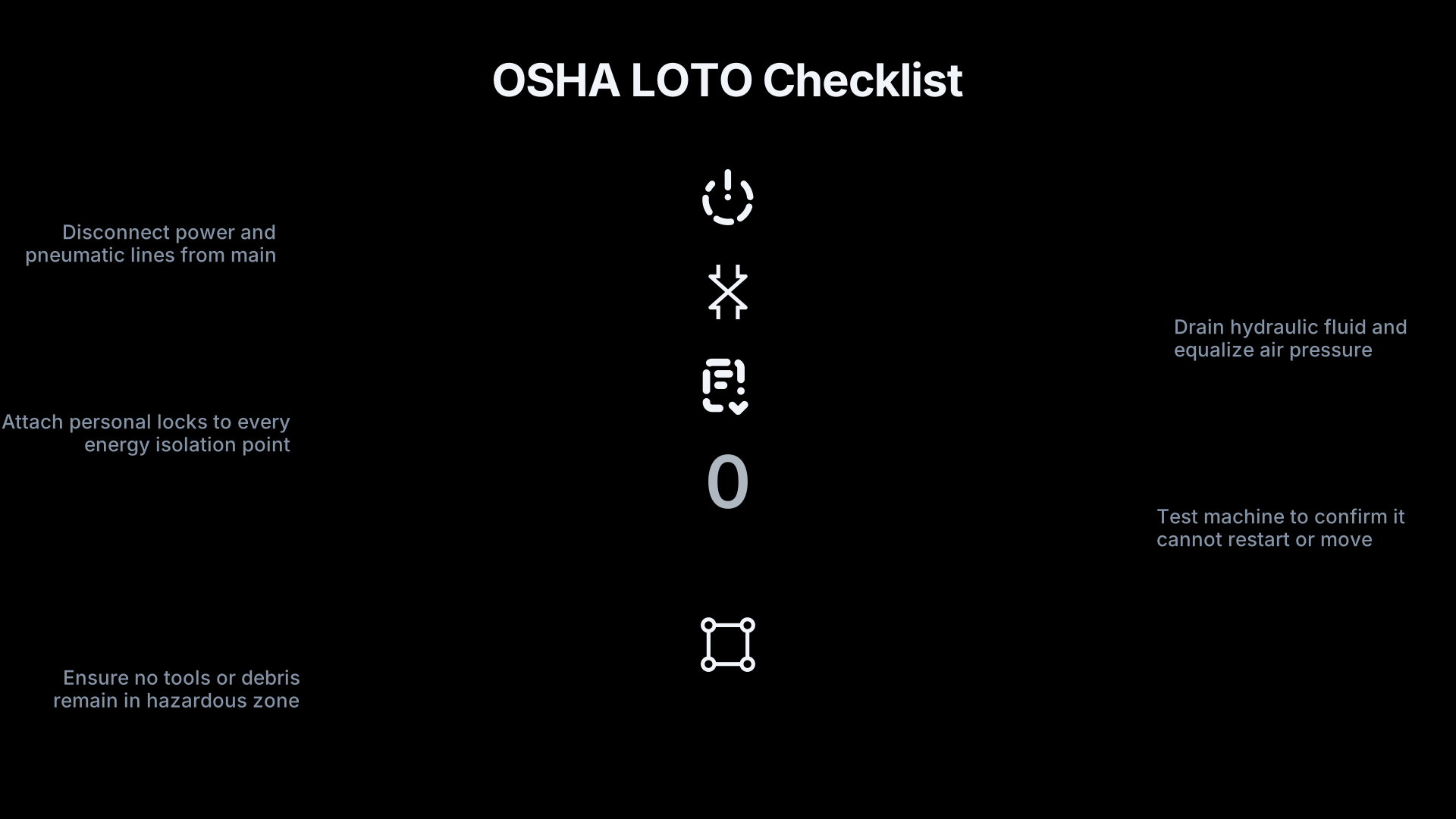
LOTO exists to stop “unexpected energisation” — machinery restarting, moving or releasing stored energy while someone is inside a hazardous area. OSHA’s hazardous energy standard requires employers to isolate machines from energy sources before servicing and maintenance because unexpected startup can crush, trap, amputate or kill workers. [OSHA]osha.govOSHA1910.147 - The control of hazardous energy (lockout/tagout).This standard covers the servicing and maintenance of machines and equipm…
In a traditional standalone machine, the logic is relatively straightforward:
- shut down the equipment [ilearnengineering.com]ilearnengineering.comSafety Challenges in Industrial RoboticsThe Lockout Tagout (LOTO) process is a critical safety procedure used to ensure that machinery an…
- disconnect power
- isolate hydraulic or pneumatic energy
- apply personal locks and warning tags
- verify the machine cannot restart
Robot cells complicate every step of that sequence.
An industrial robot system may include:
- multiple robots sharing a workspace
- conveyors feeding parts into the cell
- automated tooling
- pneumatic grippers
- stored electrical charge in drives and capacitors
- remote programmable logic controllers
- vision systems and sensors
- linked upstream and downstream machinery
A worker may isolate the visible robot arm while another connected system still has authority to move tooling or restart part of the cell. OSHA guidance specifically warns that interconnected machines require coordinated hazardous-energy procedures across the entire linked system, not merely the robot itself. [OSHA]osha.govControl of Hazardous Energy (Lockout/TagoutOverviewOSHA's Lockout/Tagout Fact Sheet describes the practices and procedures necessary to disable machinery or equipment to prevent ha…
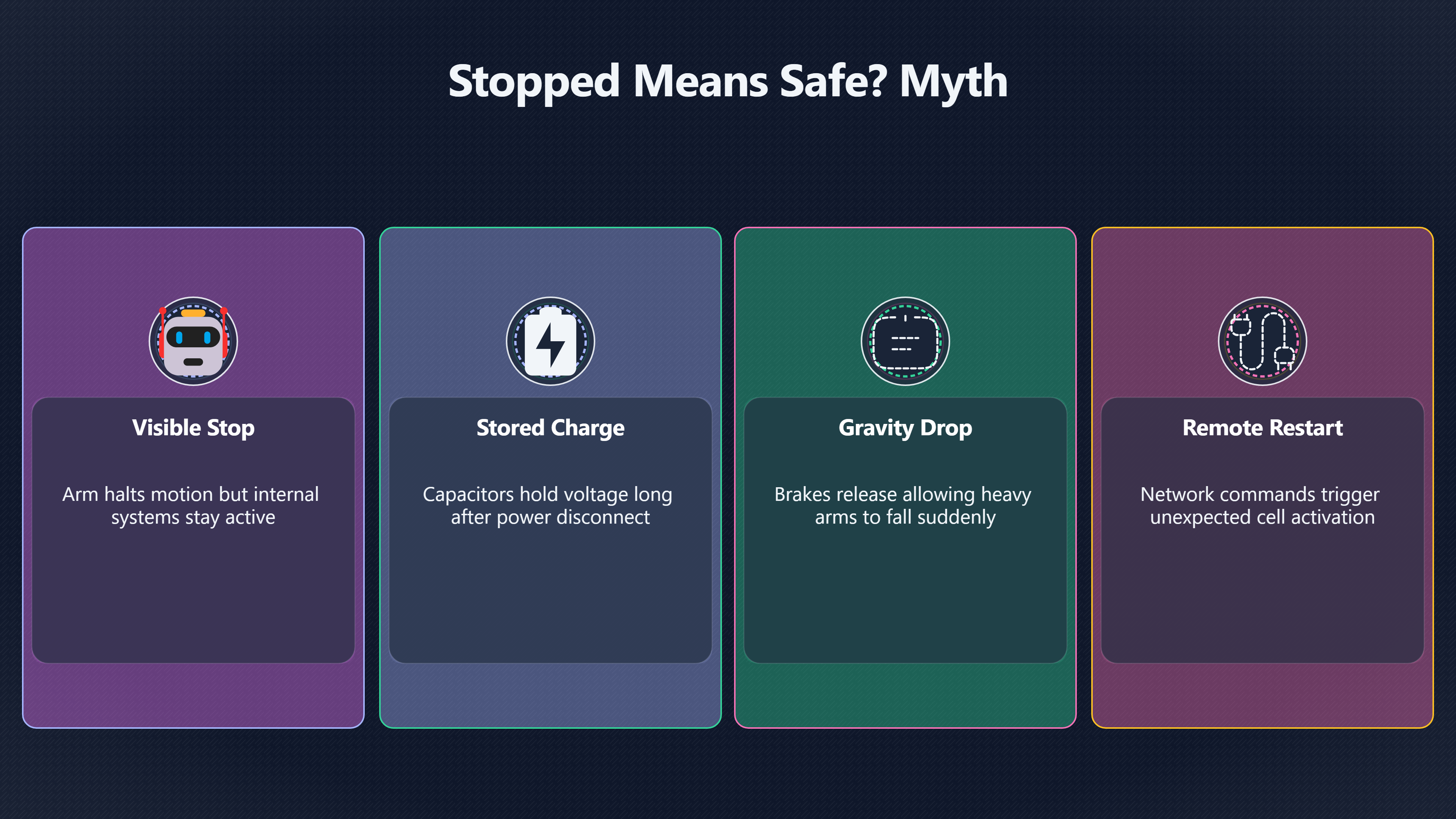
The dangerous misconception is that “stopped” means “safe”. In robotics, a paused machine can still be energised, pressurised or capable of automatic recovery.
Hidden energy inside robot cells
The most serious LOTO failures often happen because workers isolate one obvious energy source while overlooking others.
Stored energy remains after shutdown
Robot systems can retain hazardous energy long after visible motion stops. Servo drives may hold electrical charge. Pneumatic systems may remain pressurised. Gravity-loaded robot arms may drift or drop after brake release. Hydraulic accumulators can suddenly release force.
OSHA’s robotics guidance and lockout standards repeatedly stress that stored or residual energy must also be controlled, not merely incoming electrical power. [Automate]automate.orgAn OSHA View on Robot SafetyAutomateAn OSHA View on Robot SafetySeptember 28, 2022 — stored energy. 29 CFR 1910.147(b). Page 27. LOTO Applies When. Service and… L…
This creates a maintenance trap. A technician may believe a robot is safely disabled because the arm has stopped moving, while internal systems remain capable of sudden motion. Unexpected movement can occur when:
- air pressure equalises
- a jam clears
- brakes disengage
- capacitors discharge
- software completes an interrupted sequence
- another machine reactivates the cell
Robot arms are particularly dangerous because they combine speed, reach and force. A small unexpected motion can pin a worker against fencing, tooling or another machine before escape is possible.
Linked machinery creates restart paths
Robot cells are increasingly integrated into larger automated lines. A worker may isolate the robot itself while upstream or downstream equipment remains active.
OSHA specifically warns that hazardous energy procedures must cover “all interconnected machines or pieces of equipment” if unexpected startup remains possible. [OSHA]osha.gove Tool: Lockout-TagoutOSHAeTool: Lockout-Tagout - Hot Topics - Multiple Energy…If an authorized employee is exposed to the unexpected energization, start u…
In practice, that is harder than it sounds.
A robotic welding cell, for example, may interact with:
- conveyors delivering components [cdc.gov]cdc.govUsing Lockout and Tagout Procedures to Prevent Injury…NIOSH recommends develop- ing and implementing a haz- ardous energy control prog…
- automated clamps
- rotating positioners
- pallet systems
- machine vision
- safety PLCs controlling the whole line
Shutting off only one subsystem can leave others operational. A conveyor restart may move tooling unexpectedly. A reset command from another workstation may reactivate the cell. Remote software may clear a fault condition and resume movement automatically.
This is one reason robot accidents often confuse outsiders. Investigations frequently reveal that workers did not simply “forget” safety rules. They believed the system was isolated when, technically, it was not.
Why downtime pressure encourages unsafe partial shutdowns
Robot maintenance rarely happens in calm conditions. Most interventions occur because something has already gone wrong: a jam, misalignment, sensor failure or production stoppage. Every minute of downtime costs money.
That pressure pushes workers and supervisors toward partial shutdowns instead of full lockout.
The temptation to keep some systems alive
Many maintenance and troubleshooting tasks are difficult or impossible if the entire robot cell is fully de-energised.
Technicians may need to:
- jog a robot slowly to diagnose alignment
- test sensors live
- recalibrate tooling
- clear faults while software remains active
- observe motion sequences
- recover production without lengthy restart procedures
OSHA has long recognised that servicing during production creates special hazards when guards are bypassed or workers enter danger zones. [Automate]automate.orgrobot safety everything but routineIndustry Insights: Robot Safety, Everything But RoutineAug 20, 2015 — Basically, lockout/tagout requires that you remove the hazardous en…
Factories therefore drift toward “temporary” compromises:
- opening gates while drives remain powered
- using teach mode instead of full isolation
- bypassing interlocks
- relying on emergency stops instead of true isolation
- allowing one worker inside while another operates controls
These shortcuts may appear manageable for months or years until timing, communication or software behaviour changes slightly.
Restart procedures are costly and slow
Complex robot systems often require lengthy startup sequences after full lockout:
- recalibration
- homing procedures
- safety checks
- line synchronisation
- software validation
- production warm-up
Workers under production pressure may therefore avoid full lockout unless they believe danger is extreme.
This creates a structural safety problem rather than merely an individual behavioural one. A procedure that dramatically slows production will often be bypassed in real industrial environments unless the system is redesigned around maintainability and safe recovery.
The Wall Street Journal documented multiple fatal incidents linked to lockout failures across American industry, including cases where workers entered machinery without complete shutdown because companies prioritised keeping lines moving. [The Wall Street Journal]wsj.comWayne Rothering, a worker at a Wisconsin furniture factory, was killed when a board propelled by a machine he was fixing struck him. The…
Robot software creates new kinds of lockout failure
Traditional LOTO evolved around relatively simple machinery. Modern robot cells increasingly involve software-driven coordination, remote diagnostics and automated recovery logic.
That changes the meaning of “off”.
Control signals can restart systems remotely
Older machines were often isolated physically at a disconnect switch. Modern robot systems may respond to:
- network commands
- remote HMIs (human-machine interfaces)
- programmable controllers
- automated recovery routines
- cloud-connected diagnostics
- integrated production management systems
OSHA has acknowledged that robotics and advanced control systems are pressuring older hazardous-energy standards and may require regulatory modernisation. [OSHA Law Blog]oshalawblog.com1910.147 regulates the control of exposure to unexpected energization during service and…Read more…
The danger is not science-fiction AI rebellion. The danger is ordinary automation complexity.
A robot cell may behave unpredictably from the worker’s perspective because:
- fault recovery sequences are opaque
- multiple systems share authority
- restart conditions are software-defined
- maintenance personnel do not fully understand all control dependencies
As factories become more connected and autonomous, proving a machine is genuinely in a “zero-energy state” becomes technically harder.

Safety systems themselves can become confusing
Modern robotic cells often include layered safeguards:
- area scanners
- interlocked gates
- safe-speed modes
- collaborative operation zones
- programmable safety controllers
These systems can reduce injuries substantially when properly designed. But they also increase procedural complexity.
Workers may misunderstand:
- which mode the robot is in
- whether safe-speed mode still permits motion
- whether another worker can restart the system
- whether safety overrides are active
- whether the emergency stop fully isolates energy
Research into robot accidents increasingly points toward system-level interaction failures rather than single obvious mistakes. [ResearchGate]researchgate.netResearch Gate Errors in Human-Robot Interaction Accidents: A TaxonomyResearchGateErrors in Human-Robot Interaction Accidents: A Taxonomy…August 4, 2024 — 4 Aug 2024 — This study develops a comprehensive…
Why training alone does not solve the problem
After serious incidents, organisations often respond with retraining. Training matters, but robot-cell lockout failures are usually deeper than ignorance alone.
Procedures may be unrealistic
Some official procedures are written around ideal conditions rather than real maintenance work.
A lockout policy may assume:
- unlimited downtime
- perfect staffing
- complete documentation
- fully labelled energy sources
- no production urgency
- flawless communication
Real factories often operate differently:
- faults occur during active production
- contractors and operators overlap
- systems evolve faster than documentation
- maintenance crews improvise around ageing equipment
- temporary modifications accumulate over years
Workers then develop unofficial workarounds because official procedures are too slow or impractical.
Complexity exceeds human memory
A modern automated production cell may contain dozens of energy isolation points and multiple interacting systems. Human beings are poor at reliably managing invisible complexity under time pressure.
This matters for the larger AI and robotics debate because it challenges a common assumption: that automation automatically reduces human error. In reality, automation can replace routine physical labour while increasing the cognitive complexity of maintenance and supervision.
The human role shifts from direct production into high-consequence exception handling — exactly the situations where misunderstanding and overconfidence become most dangerous.
The broader lesson for an AI-enabled industrial future
Robot maintenance failures expose an uncomfortable tension inside technological optimism.
Advanced robotics may indeed eliminate large amounts of repetitive and physically punishing labour. Automated systems already reduce human exposure to welding fumes, toxic chemicals, crushing hazards and dangerous environments in many industries. Over time, AI-assisted robotics could make mining, heavy manufacturing, waste handling and infrastructure repair dramatically safer overall.
But the maintenance problem shows that technological progress does not automatically remove risk. It often redistributes risk into narrower, more technical and less visible forms.
A highly automated future may depend on relatively small groups of technicians, engineers and contractors managing systems whose internal behaviour is difficult to observe directly. When failures occur, humans are reintroduced precisely at the most dangerous moments:
- fault recovery
- emergency repair
- debugging
- calibration
- system integration
- unexpected edge cases
That creates an important test for the broader idea of AI-enabled human flourishing. A civilisation with vastly more powerful automation still needs institutions, engineering standards and workplace incentives that keep humans genuinely safe when systems fail.
The optimistic vision of AI abundance depends not only on making machines more capable, but on designing industrial systems where safety survives real economic pressure, software complexity and imperfect human behaviour. Without that, dangerous labour is not abolished so much as concentrated into smaller groups of workers operating inside increasingly opaque technological environments.
Endnotes
-
Source: osha.gov
Link: https://www.osha.gov/roboticsSource snippet
OSHARobotics - OverviewStudies indicate that many robot accidents occur during non-routine operating conditions, such as programming, mai...
-
Source: osha.gov
Link: https://www.osha.gov/otm/section-4-safety-hazards/chapter-4Source snippet
OSHAOSHA Technical Manual (OTM) - Section IV: Chapter 4This chapter is intended as a guide to robot systems found in industrial applications...
-
Source: osha.gov
Link: https://www.osha.gov/laws-regs/regulations/standardnumber/1910/1910.147Source snippet
OSHA1910.147 - The control of hazardous energy (lockout/tagout).This standard covers the servicing and maintenance of machines and equipm...
-
Source: osha.gov
Title: Control of Hazardous Energy (Lockout/Tagout)
Link: https://www.osha.gov/control-hazardous-energySource snippet
OverviewOSHA's Lockout/Tagout Fact Sheet describes the practices and procedures necessary to disable machinery or equipment to prevent ha...
-
Source: osha.gov
Title: e Tool: Lockout-Tagout
Link: https://www.osha.gov/etools/lockout-tagout/hot-topics/multiple-energy-sources/hazardous-energySource snippet
OSHAeTool: Lockout-Tagout - Hot Topics - Multiple Energy...If an authorized employee is exposed to the unexpected energization, start u...
-
Source: obis.osha.gov
Link: https://obis.osha.gov/dts/osta/lototraining/hottopics/ht-mengergy-4-2.htmlSource snippet
or nearby machines or equipmentIf an authorized employee is exposed to the unexpected energization, start up, or release of stored energy...
-
Source: automate.org
Title: An OSHA View on Robot Safety
Link: https://www.automate.org/userAssets/a3/events/file/17%20-%20Hazen%20Price%20-%20OSHA%20Presentation%20Day%201.pdfSource snippet
AutomateAn OSHA View on Robot SafetySeptember 28, 2022 — stored energy. 29 CFR 1910.147(b). Page 27. LOTO Applies When. Service and... L...
Published: September 28, 2022
-
Source: researchgate.net
Title: Research Gate Errors in Human-Robot Interaction Accidents: A Taxonomy
Link: https://www.researchgate.net/publication/382853489_Errors_in_Human-Robot_Interaction_Accidents_A_Taxonomy_and_Network_AnalysisSource snippet
ResearchGateErrors in Human-Robot Interaction Accidents: A Taxonomy...August 4, 2024 — 4 Aug 2024 — This study develops a comprehensive...
Published: August 4, 2024
-
Source: osha.gov
Title: e Tool: Lockout-Tagout
Link: https://www.osha.gov/etools/lockout-tagout/case-studies/automotive-lubrication-roboticsSource snippet
eTool: Lockout-Tagout - Case StudiesThe startup procedure would take some time and the person inside the robot area would be aware of th...
-
Source: osha.gov
Link: https://www.osha.gov/enforcement/directives/std-01-12-002Source snippet
Guidelines For Robotics SafetySep 21, 1987 — This instruction provides guidelines to OSHA compliance officers, employers, and employees f...
-
Source: osha.gov
Title: e Tool: Lockout-Tagout
Link: https://www.osha.gov/etools/lockout-tagout/tutorialSource snippet
eTool: Lockout-Tagout - TutorialThis tutorial is intended to guide the user in understanding aspects of the Lockout/Tagout standard. It...
-
Source: obis.osha.gov
Link: https://obis.osha.gov/dts/osta/lototraining/case/cs2-3y.htmlSource snippet
Lockout/Tagout standard covers servicing and/or maintenance activities... unexpected energization, start up, or release of hazardous ene...
-
Source: automate.org
Title: robot safety everything but routine
Link: https://www.automate.org/robotics/industry-insights/robot-safety-everything-but-routineSource snippet
Industry Insights: Robot Safety, Everything But RoutineAug 20, 2015 — Basically, lockout/tagout requires that you remove the hazardous en...
-
Source: osha.com
Title: lockout tagout safety
Link: https://www.osha.com/blog/lockout-tagout-safetySource snippet
LOTO: A Guide to Lockout Tagout29 May 2025 — LOTO is a safety practice used to make sure that dangerous machinery is safely shut off and...
Published: May 2025
-
Source: wsj.com
Link: https://www.wsj.com/business/machine-lockout-rules-are-being-violated-its-killing-workers-ac50059fSource snippet
Wayne Rothering, a worker at a Wisconsin furniture factory, was killed when a board propelled by a machine he was fixing struck him. The...
-
Source: oshalawblog.com
Link: https://www.oshalawblog.com/2019/05/articles/osha-requests-information-on-potential-changes-to-lockout-tagout-standard-including-addressing-robotic-technology/Source snippet
1910.147 regulates the control of exposure to unexpected energization during service and...Read more...
-
Source: oshainfo.gatech.edu
Title: LOTOCaseStudy Handout 122020.docx
Link: https://oshainfo.gatech.edu/wp-content/uploads/2025/06/LOTOCaseStudy_Handout_122020.docxSource snippet
gatech.eduLOTOCaseStudy_Handout_1220...Question 2: Were the employees performing a servicing and/or maintenance operation that was subjec...
Additional References
-
Source: cdc.gov
Link: https://www.cdc.gov/niosh/docs/wp-solutions/2011-156/pdfs/2011-156.pdfSource snippet
Using Lockout and Tagout Procedures to Prevent Injury...NIOSH recommends develop- ing and implementing a haz- ardous energy control prog...
-
Source: motioncontrolsrobotics.com
Link: https://motioncontrolsrobotics.com/resources/tech-talk-articles/lockout-tagout-for-robot-systems/Source snippet
Lockout Tagout for Robot SystemsWhen working inside the robot cell, all equipment and/or circuits must be locked out to protect against a...
-
Source: visionify.ai
Link: https://visionify.ai/machine-guardingSource snippet
Machine Guarding & LOTO MonitoringProtect workers from dangerous machinery with AI that ensures guards remain in place and lockout/tagout...
-
Source: ilearnengineering.com
Link: https://www.ilearnengineering.com/electronical-and-electronic/safety-challenges-in-industrial-roboticsSource snippet
Safety Challenges in Industrial RoboticsThe Lockout Tagout (LOTO) process is a critical safety procedure used to ensure that machinery an...
-
Source: workplacepub.com
Link: https://www.workplacepub.com/workplace-safety/construction/control-of-hazardous-energy-lockout-tagout-general-industry-regulation-29-cfr-1910-147-2/Source snippet
Control of Hazardous Energy (Lockout/Tagout) General...12 Sept 2023 — Workers are at risk of severe injury and death during equipment or...
-
Source: shrm.org
Title: robotic systems compel osha to consider revising lockout tagout standard
Link: https://www.shrm.org/topics-tools/employment-law-compliance/robotic-systems-compel-osha-to-consider-revising-lockout-tagout-standardSource snippet
Robotic Systems Compel OSHA to Consider Revising...31 Mar 2023 — OSHA's lockout/tagout standard regulates the control of exposure to une...
-
Source: controleng.com
Title: industrial robot safety considerations standards and best practices to consider
Link: https://www.controleng.com/industrial-robot-safety-considerations-standards-and-best-practices-to-consider/Source snippet
Industrial robots, especially those with complex programming, can make unexpected movements. These unpredictable...Read more...
-
Source: plantengineering.com
Title: preventing injury and death with lockout tagout procedures
Link: https://www.plantengineering.com/preventing-injury-and-death-with-lockout-tagout-procedures/Source snippet
Preventing injury and death with lockout/tagout procedures1 Oct 2006 — According to the NIOSH Alert, one must lockout or tagout all forms...
-
Source: safetynetinc.com
Title: osha loto impact plant managers robotics
Link: https://www.safetynetinc.com/safteynet-blog/osha-loto-impact-plant-managers-roboticsSource snippet
How OSHA Lockout/Tagout Impacts Plant Managers...OSHA's Lockout/Tagout standard (29 CFR 1910.147) demands zero tolerance for unexpected...
-
Source: nainllc.com
Link: https://nainllc.com/blog-lockout-tagout-modernization-controlling-hazardous-energy-for-robotics-automationSource snippet
Lockout/Tagout for Robotics: 2024–2025 Employer...Bottom line: robotics don't eliminate lockout—they demand smarter, task-based control...
Amazon book picks
Further Reading
Books and field guides related to Lockout failures in robot cells. Use these as the next step if you want deeper reading beyond the article.

Robot Reliability and Safety
Robots are increasingly being used in industry to perform various types of tasks. Some of the tasks performed by robots in industry are s...

Industrial safety and health management
First published 1984. Subjects: Accidents, Occupational, Industrial hygiene, Industrial safety, Occupational Accidents, Occupational dise...

Practical Guide to Industrial Safety
A practical guide to industrial safety. It seeks to assist specialists in managing operations in industrial settings, including high-risk...

Topic Tree