Within Novice Workers
Tacit workplace knowledge
AI assistants may help beginners by surfacing the hidden tricks, phrasing, and pattern recognition that experienced workers rarely write down.
On this page
- What tacit knowledge means at work
- How AI turns past examples into live guidance
- Where this transfer works best and where it breaks

Page outline Jump by section
Introduction
Many jobs rely on knowledge that almost nobody writes down properly. An experienced nurse notices when a patient “doesn’t look right” before the numbers change. A skilled sales worker knows how to calm an angry customer without sounding scripted. A factory technician hears a slight change in machine noise and checks a component before it fails.
This kind of practical know-how is often called tacit knowledge: knowledge gained through experience, repetition, pattern recognition, and social learning rather than formal manuals. One of the most important claims about workplace AI assistants is that they may help spread this hidden expertise more widely and more quickly, especially to newer workers.
That possibility matters well beyond office productivity. If AI systems can genuinely transfer useful know-how at scale, they could reduce some of the bottlenecks that slow learning, limit opportunity, and concentrate expertise inside elite firms or experienced groups. In the broader “AI bloom” vision, this is one plausible pathway toward more abundant access to practical intelligence: not replacing human judgement entirely, but making competent guidance easier to obtain across much larger parts of society. The evidence so far suggests this effect is real in some settings, but also narrower, messier, and more fragile than optimistic marketing often implies. [NBER]nber.orgNBERNBER WORKING PAPER SERIES GENERATIVE AI AT…by E Brynjolfsson · 2023 · Cited by 2743 — Our results suggest that access to generativ… [NBER]nber.orgNBERGenerative AI at Workby E Brynjolfsson · 2023 · Cited by 3143 — Customer support agents using an AI tool to guide their conversations…
What tacit knowledge means at work
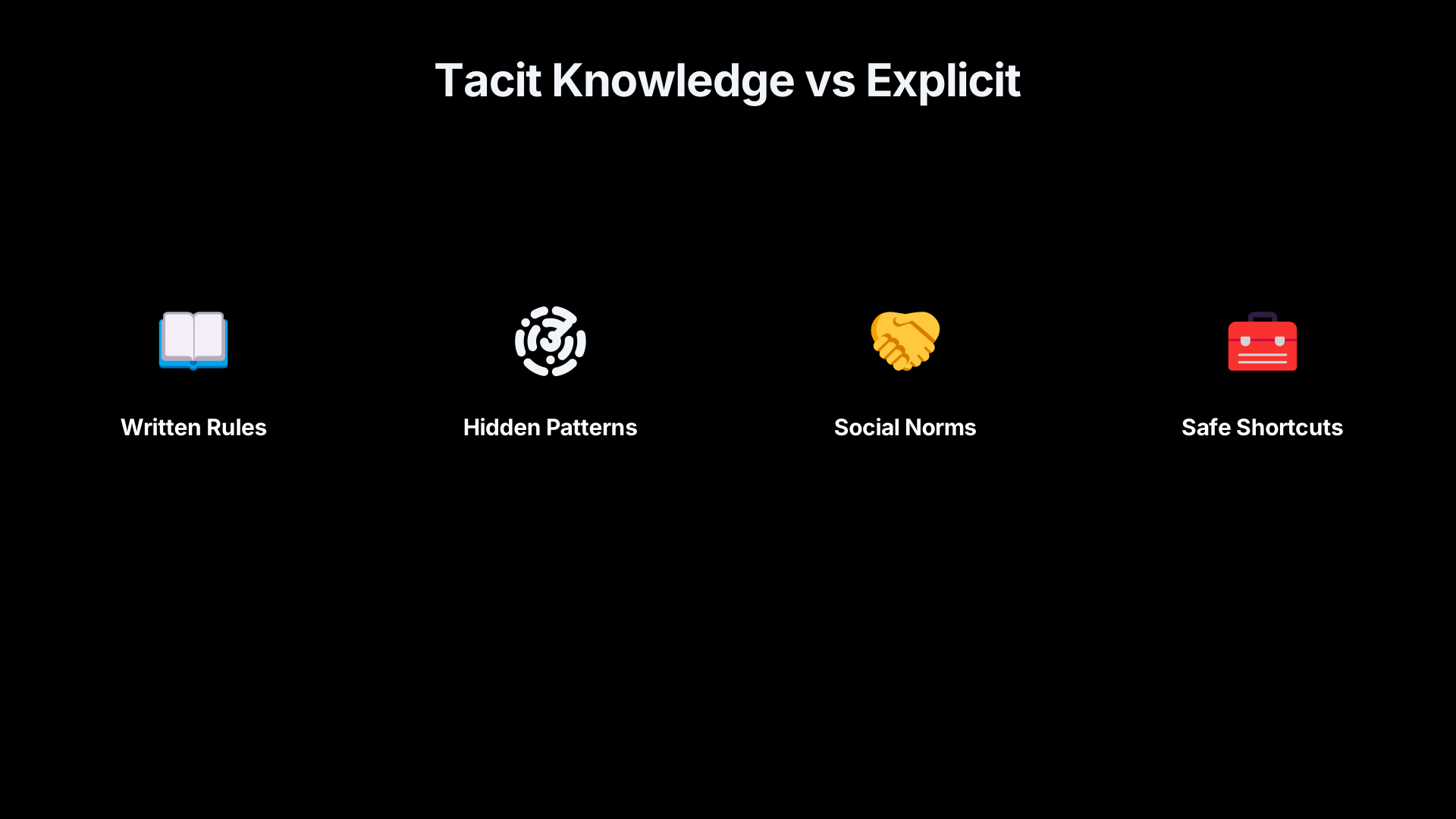
Tacit knowledge is usually contrasted with explicit knowledge. Explicit knowledge can be written down relatively cleanly: instructions, policies, checklists, formulas, operating procedures, and training slides. Tacit knowledge is different. It often includes:
- recognising subtle patterns
- choosing the right tone in uncertain situations
- knowing which shortcuts are safe
- sensing which exceptions matter
- understanding workplace norms
- deciding when rules should bend
- noticing weak signals before problems escalate
Management researchers have discussed tacit knowledge for decades because many organisations depend on it while struggling to preserve it. Workers frequently “know more than they can tell”, especially in fast-moving or socially complex jobs. LinkedIn [2blog.smart-tribune.com]blog.smart-tribune.comtacit knowledgeWhat is Tacit Knowledge & How to Capture and Share It at Work5 Jun 2024 — Tacit knowledge is the deep-rooted, intuitive understanding and…
Historically, tacit knowledge spread mainly through apprenticeship-like mechanisms:
- shadowing experienced colleagues
- informal mentoring
- repeated observation
- learning from mistakes
- listening to workplace stories
- gradual immersion in a team’s habits
That process works, but it is slow and uneven. Some beginners happen to sit near excellent mentors. Others do not. Expertise can also disappear when experienced workers retire, leave, or become overloaded. Many firms already worry about “knowledge drain” as older workers exit specialised industries. [eGain]egain.comcapturing tacit knowledge from the great retirement cohort using genaieGainCapturing Tacit Knowledge from the Great Retirement…Apr 9, 2025 — The eGain AI Knowledge Hub serves as the central nervous system…
This is where AI assistants potentially change the equation. Large language models can analyse enormous collections of past workplace interactions — support chats, software tickets, troubleshooting logs, internal documents, coding patterns, medical notes, and workflow histories — and identify statistical patterns associated with successful outcomes. They can then surface those patterns in real time while someone is doing the job.
The key point is that the AI often does not “understand” expertise in a human sense. Instead, it acts as a pattern-compression system for accumulated organisational behaviour.
How AI turns past examples into live guidance
The strongest evidence for this mechanism still comes from the widely discussed customer-support study by Erik Brynjolfsson, Danielle Li, and Lindsey Raymond. Researchers examined more than 5,000 support agents at a Fortune 500 software company using a generative AI assistant during customer chats. [NBER]nber.orgErik Brynjolfsson The Economics of Transformative AI. BookErik BrynjolfssonThe Economics of Transformative AI. Book - Conference Volume. editors - Ajay K. Agrawal, Erik Brynjolfsson & Anton Korin… [NBER]nber.orgNBERNBER WORKING PAPER SERIES GENERATIVE AI AT…by E Brynjolfsson · 2023 · Cited by 2743 — Our results suggest that access to generativ…
The system suggested replies, troubleshooting approaches, and conversational strategies while workers handled live problems. Productivity increased by roughly 14% overall, but the gains were much larger for novice and lower-skilled workers. Experienced top performers improved little. NBER [MIT Sloan]mitsloan.mit.eduworkers less experience gain most generative aiMIT SloanWorkers with less experience gain the most from…Jun 26, 2023 — Workers with the least experience can quickly improve at their…
The interesting part was the proposed mechanism. The researchers argued that the AI appeared to disseminate the tacit knowledge of stronger workers. In other words, the system learned from huge numbers of successful interactions and then reproduced useful patterns for less experienced staff. [ResearchGate]researchgate.net370227920 Generative AI at WorkResearchGate(PDF) Generative AI at WorkApr 25, 2023 — We provide suggestive evidence that the AI model disseminates the potentially tacit… [SSRN]papers.ssrn.comAI at Work by Erik Brynjolfsson, Danielle…by E Brynjolfsson · 2023 · Cited by 2623 — We provide suggestive evidence that the AI model…
That guidance included things such as:
- which troubleshooting paths resolved issues fastest
- which explanations reduced customer frustration
- how to phrase difficult messages more effectively
- when to escalate problems
- which details experienced workers checked first
Importantly, many of these behaviours had never been formalised in manuals. The AI inferred them statistically from accumulated examples. Brynjolfsson described the system as capturing patterns from millions of interactions and passing them to less experienced workers. [Time]time.comHow to Make AI Work for You, at WorkShe pursued this interest by taking the Elements of AI, an online course by MinnaLearn and the University of Helsinki, which enhanced her…
This helps explain why beginners often benefit more than experts. Experienced workers already possess many of the patterns internally. Beginners lack them. AI can therefore narrow part of the experience gap by providing “just-in-time” guidance during real tasks rather than through detached classroom training.
A similar dynamic has appeared in studies of AI coding assistants. Research discussed by MIT Sloan found that less-experienced developers often showed higher adoption rates and larger productivity gains from coding copilots than senior engineers. [MIT Sloan]mitsloan.mit.eduworkers less experience gain most generative aiMIT SloanWorkers with less experience gain the most from…Jun 26, 2023 — Workers with the least experience can quickly improve at their…
Again, the likely mechanism is not magic automation. Junior workers are often blocked by uncertainty, missing context, and incomplete mental models. AI systems can reduce friction by exposing common patterns earlier in the learning curve.
Why this matters beyond efficiency
The optimistic interpretation is not simply “workers become faster”. The larger implication is that practical capability could become more widely distributed.
In many industries, expertise functions as a scarce resource because learning is slow, mentorship capacity is limited, and institutional knowledge remains fragmented. If AI assistants can reliably spread portions of tacit knowledge, several broader effects become possible.
Faster onboarding and skill diffusion
Many workplaces spend months or years turning beginners into competent independent workers. AI assistance may compress part of that timeline.
That does not necessarily create instant experts. But it can reduce the period where workers repeatedly make avoidable mistakes because they lack access to accumulated organisational memory.
In sectors facing labour shortages — healthcare, skilled trades, technical support, software engineering, education, logistics — even partial acceleration could matter economically and socially.
Reduced dependence on elite gatekeepers
Tacit knowledge is often unevenly distributed. Workers at prestigious firms or near strong mentors gain access to richer learning environments than equally capable workers elsewhere.
AI systems potentially weaken some of that advantage by making practical guidance more portable. A smaller organisation may gain partial access to patterns previously concentrated inside larger firms with deep experience pools.
In the broadest AI bloom framing, this contributes to the idea of “intelligence abundance”: useful cognitive support becoming cheaper and more widely accessible rather than remaining scarce and exclusive.
Preservation of institutional memory
Organisations frequently lose expertise when experienced workers leave. AI systems trained on historical workflows may help preserve fragments of operational memory that would otherwise disappear.
This possibility is especially attractive in ageing industries where retirements threaten knowledge continuity. Manufacturing firms, utilities, aerospace organisations, and healthcare systems have all explored AI-supported knowledge management partly for this reason. [eGain]egain.comcapturing tacit knowledge from the great retirement cohort using genaieGainCapturing Tacit Knowledge from the Great Retirement…Apr 9, 2025 — The eGain AI Knowledge Hub serves as the central nervous system… [Augmentir]augmentir.coms gain through hands-on practice, intuition, and personal insights.Read more…
Cognitive accessibility
Some workers struggle not because they lack intelligence, but because workplaces hide unwritten expectations and norms. AI assistants can sometimes make these hidden rules more legible.
That may particularly help:
- first-generation professionals
- workers changing industries
- people without strong informal networks
- non-native speakers
- employees returning after career breaks
In principle, AI could function partly as a continuously available workplace coach rather than a tool reserved for elite experts.
Where tacit knowledge transfer works best
The evidence suggests AI-assisted tacit knowledge transfer works best under fairly specific conditions.
Pattern-rich jobs with large historical datasets
Customer support works unusually well because organisations often possess millions of labelled interactions with measurable outcomes. The AI can compare successful and unsuccessful cases at large scale.
Other promising areas include:
- software debugging
- IT support
- claims processing
- routine legal drafting
- standardised medical administration
- logistics coordination
These environments generate repeated patterns that machine-learning systems can learn from.
Work with clear feedback loops
AI improves more easily when success is measurable:
- Was the issue resolved?
- Did the customer escalate?
- Did the code compile?
- Did the workflow finish faster?
Where feedback is immediate and abundant, systems can identify which behaviours correlate with success.
Environments where expertise is socially transmitted
Tacit knowledge matters most where workers normally learn by watching experienced colleagues rather than reading manuals. AI assistants can partially imitate that mentorship function by surfacing context-sensitive suggestions during tasks.
This is why the gains often appear larger in real-time assistance systems than in static knowledge databases.
Where the mechanism breaks down
The optimistic story has important limits.
Much tacit knowledge is embodied, social, or physical
Some expertise cannot easily be extracted from text histories.
A master electrician’s judgement, an experienced surgeon’s touch, or a skilled negotiator’s reading of a room may depend heavily on sensory cues, bodily experience, emotional perception, or deep contextual awareness.
Language models are strongest where tacit knowledge leaves a digital trace. They struggle more when expertise depends on physical embodiment or subtle social dynamics.
AI can spread bad habits too
AI systems learn from historical behaviour, including flawed behaviour. If workplace norms contain biases, unsafe shortcuts, manipulative sales tactics, or discriminatory patterns, the system may reproduce them at scale.
A company may accidentally convert local bad habits into organisation-wide defaults.
This is especially risky when:
- historical data reflects biased decisions
- workers solved problems by bypassing formal safeguards
- productivity metrics rewarded the wrong behaviours
The same mechanism that spreads expertise can also spread dysfunction.
Workers may become dependent
A recurring criticism is that AI assistance can produce shallow competence rather than deep understanding.
If beginners constantly rely on AI prompts, they may complete tasks successfully without fully internalising why particular decisions work. That creates the possibility of “automation dependency”: workers functioning well while assistance is available but struggling independently.
MIT Sloan researchers discussing AI-assisted development tools have warned that firms must ensure workers are still genuinely learning foundational skills rather than merely outsourcing cognition to software. [MIT Sloan]mitsloan.mit.eduworkers less experience gain most generative aiMIT SloanWorkers with less experience gain the most from…Jun 26, 2023 — Workers with the least experience can quickly improve at their…
This tension matters enormously for long-term human flourishing. A civilisation that augments human capability is different from one that gradually erodes human competence beneath automated systems.
Some learning requires struggle
Part of expertise formation comes from wrestling with ambiguity, failure, and repeated exposure to edge cases. AI systems that constantly smooth difficulty may accidentally weaken deeper skill development.
There is therefore a genuine trade-off:
- AI can accelerate access to useful patterns
- but too much assistance may reduce independent judgement formation
The ideal balance remains unclear.
Tacit knowledge and the long-term AI bloom vision
The larger significance of tacit knowledge transfer is not that chatbots can help customer-service agents write friendlier messages. The deeper question is whether advanced AI systems could make practical intelligence far more abundant across civilisation.
Historically, many forms of expertise remained scarce because human mentoring does not scale easily. Training excellent teachers, doctors, engineers, managers, or technicians takes years of interaction with other skilled humans.
If AI systems become increasingly capable of preserving, compressing, and distributing useful practical knowledge, some forms of expertise may become easier to access globally. That could support:
- faster education
- broader professional competence
- more effective institutions
- improved healthcare delivery
- accelerated scientific collaboration
- wider participation in complex work
In the most optimistic AI bloom scenarios, this contributes to a civilisation where access to guidance, explanation, and accumulated knowledge becomes dramatically cheaper and more universal.
But this outcome is not automatic.
The same systems could also:
- centralise organisational power
- intensify worker surveillance
- eliminate entry-level learning pathways
- weaken independent expertise
- concentrate control of institutional knowledge inside a few technology firms
Much depends on governance, incentives, workplace design, and whether AI systems are used to expand human capability or mainly to reduce labour costs.
The evidence so far supports a modest but important conclusion: AI assistants can sometimes spread fragments of tacit workplace knowledge, especially in digital, pattern-rich environments where large histories of successful behaviour exist. That is a real mechanism, not just marketing language. But it remains partial, context-dependent, and far from equivalent to full human expertise.
The strongest version of the optimistic case is therefore not that AI instantly replaces experience. It is that advanced systems may increasingly help ordinary people gain access to pieces of accumulated human know-how that were previously slow, local, and difficult to share. arXiv 3NBER [ResearchGate]researchgate.net370227920 Generative AI at WorkResearchGate(PDF) Generative AI at WorkApr 25, 2023 — We provide suggestive evidence that the AI model disseminates the potentially tacit…
Endnotes
-
Source: nber.org
Link: https://www.nber.org/system/files/working_papers/w31161/w31161.pdfSource snippet
NBERNBER WORKING PAPER SERIES GENERATIVE AI AT...by E Brynjolfsson · 2023 · Cited by 2743 — Our results suggest that access to generativ...
-
Source: nber.org
Link: https://www.nber.org/papers/w31161Source snippet
NBERGenerative AI at Workby E Brynjolfsson · 2023 · Cited by 3143 — Customer support agents using an AI tool to guide their conversations...
-
Source: linkedin.com
Link: https://www.linkedin.com/pulse/talent-patterns-tacit-knowledge-future-work-mike-walshSource snippet
LinkedInTalent patterns, tacit knowledge and the future of workAugust 10, 2020 — The challenging thing about talent patterns is that they...
Published: August 10, 2020
-
Source: blog.smart-tribune.com
Title: tacit knowledge
Link: https://blog.smart-tribune.com/en/tacit-knowledgeSource snippet
What is Tacit Knowledge & How to Capture and Share It at Work5 Jun 2024 — Tacit knowledge is the deep-rooted, intuitive understanding and...
-
Source: augmentir.com
Link: https://www.augmentir.com/glossary/tacit-knowledgeSource snippet
s gain through hands-on practice, intuition, and personal insights.Read more...
-
Source: egain.com
Title: capturing tacit knowledge from the great retirement cohort using genai
Link: https://www.egain.com/blog/capturing-tacit-knowledge-from-the-great-retirement-cohort-using-genai/Source snippet
eGainCapturing Tacit Knowledge from the Great Retirement...Apr 9, 2025 — The eGain AI Knowledge Hub serves as the central nervous system...
-
Source: mitsloan.mit.edu
Title: workers less experience gain most generative ai
Link: https://mitsloan.mit.edu/ideas-made-to-matter/workers-less-experience-gain-most-generative-aiSource snippet
MIT SloanWorkers with less experience gain the most from...Jun 26, 2023 — Workers with the least experience can quickly improve at their...
-
Source: arxiv.org
Link: https://arxiv.org/pdf/2304.11771Source snippet
Generative AI at Workby E Brynjolfsson · 2023 · Cited by 2743 — We study the staggered introduction of a generative AI-based conversation...
-
Source: researchgate.net
Title: 370227920 Generative AI at Work
Link: https://www.researchgate.net/publication/370227920_Generative_AI_at_WorkSource snippet
ResearchGate(PDF) Generative AI at WorkApr 25, 2023 — We provide suggestive evidence that the AI model disseminates the potentially tacit...
-
Source: papers.ssrn.com
Link: https://papers.ssrn.com/sol3/papers.cfm?abstract_id=4426942Source snippet
AI at Work by Erik Brynjolfsson, Danielle...by E Brynjolfsson · 2023 · Cited by 2623 — We provide suggestive evidence that the AI model...
-
Source: arxiv.org
Link: https://arxiv.org/abs/2304.11771Source snippet
arXiv[2304.11771] Generative AI at Workby E Brynjolfsson · 2023 · Cited by 2743 — View a PDF of the paper titled Generative AI at Work, b...
-
Source: time.com
Title: How to Make AI Work for You, at Work
Link: https://time.com/6302984/ai-jobs-career/Source snippet
She pursued this interest by taking the Elements of AI, an online course by MinnaLearn and the University of Helsinki, which enhanced her...
-
Source: mitsloan.mit.edu
Title: how generative ai affects highly skilled workers
Link: https://mitsloan.mit.edu/ideas-made-to-matter/how-generative-ai-affects-highly-skilled-workersSource snippet
MIT SloanHow generative AI affects highly skilled workersNov 4, 2024 — The researchers found that introducing a generative AI tool to sof...
-
Source: mitsloan.mit.edu
Title: generative ai changes how employees spend their time
Link: https://mitsloan.mit.edu/ideas-made-to-matter/generative-ai-changes-how-employees-spend-their-timeSource snippet
MIT SloanGenerative AI changes how employees spend their timeMar 10, 2026 — What you'll learn: Developers with access to GitHub Copilot i...
-
Source: mitsloan.mit.edu
Title: how generative ai can boost highly skilled workers productivity
Link: https://mitsloan.mit.edu/ideas-made-to-matter/how-generative-ai-can-boost-highly-skilled-workers-productivitySource snippet
MIT SloanHow generative AI can boost highly skilled workers...Oct 19, 2023 — Generative AI can boost worker productivity, but organizati...
-
Source: arxiv.org
Link: https://arxiv.org/abs/2603.21866Source snippet
Tacit Knowledge Management with Generative AIby N Uchihira · 2026 — Generative AI has the potential to address the limitations of convent...
-
Source: nber.org
Title: Erik Brynjolfsson The Economics of Transformative AI. Book
Link: https://www.nber.org/people/erik_brynjolfssonSource snippet
Erik BrynjolfssonThe Economics of Transformative AI. Book - Conference Volume. editors - Ajay K. Agrawal, Erik Brynjolfsson & Anton Korin...
-
Source: mitsloan.mit.edu
Link: https://mitsloan.mit.edu/ideas-made-to-matter/how-ai-reshaping-workflows-and-redefining-jobsSource snippet
AI is reshaping workflows and redefining jobsApr 22, 2026 — Agentic AI, explained 5 'heavy lifts' of deploying AI agents Generative AI ch...
-
Source: news.mit.edu
Title: how some skills become second nature 0304
Link: https://news.mit.edu/2026/how-some-skills-become-second-nature-0304Source snippet
some skills become second natureMar 4, 2026 — A new study by MIT researchers directly shows that visual [attention]({{ 'ai-bloom-abun/ai-bloom-abun-98d3a6-long-future-b-29cc56-post-scarcity-42fd70-attention-aft-3204c3/' | relat...
-
Source: mitsloan.mit.edu
Title: top 10 mit sloan ideas made to matter articles 2025
Link: https://mitsloan.mit.edu/ideas-made-to-matter/top-10-mit-sloan-ideas-made-to-matter-articles-2025Source snippet
AI workloads have sent data center...Read more...
-
Source: mitsloan.mit.edu
Title: Bringing Worker Voice into Generative AI 12 21 2023
Link: https://mitsloan.mit.edu/sites/default/files/2024-01/Bringing%20Worker%20Voice%20into%20Generative%20AI%2012%2021%202023.pdfSource snippet
Kochanby TA Kochan · 2023 · Cited by 17 — The purpose of this paper is to identify ways to bring workers' voices into the development and...
-
Source: mitsloan.mit.edu
Link: https://mitsloan.mit.edu/ideas-made-to-matter/how-organizations-can-achieve-big-value-smaller-ai-effortsSource snippet
anizations can achieve big value with smaller AI...Dec 17, 2025 — Summary: Organizations are using generative artificial intelligence...
-
Source: professional.mit.edu
Title: leadership ai age driving digital transformation competitive advantage
Link: https://professional.mit.edu/course-catalog/leadership-ai-age-driving-digital-transformation-competitive-advantageSource snippet
for the AI Age: Driving Digital Transformation...This comprehensive online course, led by renowned MIT Instructors, equips professionals...
-
Source: brynjolfsson.com
Link: https://www.brynjolfsson.com/Source snippet
Erik BrynjolfssonErik Brynjolfsson is the Jerry Yang and Akiko Yamazaki Professor and Senior Fellow at the Stanford Institute for Human-C...
-
Source: linkedin.com
Link: https://www.linkedin.com/posts/mit-sloan-management-review_global-companies-making-real-headway-with-activity-7412472177842798594-YGKFSource snippet
Companies Leverage Generative AI for Knowledge SharingGlobal companies making real headway with generative AI use it to surface and conne...
-
Source: linkedin.com
Title: Erik Brynjolfsson
Link: https://www.linkedin.com/in/erikbrynjolfssonSource snippet
Stanford UniversityErik Brynjolfsson. Stanford University Massachusetts Institute of Technology. Stanford, California, United States. 38K...
-
Source: Wikipedia
Title: Erik Brynjolfsson
Link: https://en.wikipedia.org/wiki/Erik_BrynjolfssonSource snippet
Erik BrynjolfssonErik Brynjolfsson is an American academic, author and inventor. He is the Jerry Yang and Akiko Yamazaki Professor and...
-
Source: economics.stanford.edu
Title: erik brynjolfsson
Link: https://economics.stanford.edu/people/erik-brynjolfssonSource snippet
is the Jerry Yang and Akiko Yamazaki Professor and Senior Fellow at the Stanford Institute for Human-Centered AI (HAI), and Director of...
-
Source: jp.weforum.org
Title: erik brynjolfsson
Link: https://jp.weforum.org/stories/authors/erik-brynjolfsson/Source snippet
Brynjolfsson | 世界経済フォーラムErik Brynjolfsson... Co-founder, Workhelix, Inc. which provides large organizations with actionable plans for as...
Additional References
-
Source: clearpeople.com
Link: https://www.clearpeople.com/blog/capturing-tacit-knowledge-in-organizationsSource snippet
The New Competitive Advantage: Capturing Tacit KnowledgeHow capturing tacit knowledge, the hidden expertise in employees' minds, can driv...
-
Source: youtube.com
Link: https://www.youtube.com/watch?v=5MmrCOfWDjM -
Source: actionsync.ai
Title: different types of knowledge implicit tacit and explicit explained
Link: https://actionsync.ai/blog/different-types-of-knowledge-implicit-tacit-and-explicit-explainedSource snippet
Different Types of Knowledge: Implicit, Tacit, and Explicit...9 Feb 2026 — Understand the three core types of knowledge—implicit, tacit...
-
Source: hai.stanford.edu
Title: HAIWill Generative AI Make You More Productive at Work?
Link: https://hai.stanford.edu/news/will-generative-ai-make-you-more-productive-work-yes-only-if-youre-not-already-great-your-jobSource snippet
24, 2023 — They found that access to AI assistance increased agent productivity by 14%, with the biggest impact on less experi...
-
Source: stravito.com
Link: https://www.stravito.com/resources/tacit-knowledgeSource snippet
ct insights while still relying on experts to review, refine, and apply...Read more...
-
Source: medium.com
Link: https://medium.com/%40leonpalafox/the-vanishing-first-job-ai-and-the-new-reality-for-young-workers-2ec9a6581a31Source snippet
k Brynjolfsson and his colleagues, revealed a subtle but seismic...Read more...
-
Source: cmr.berkeley.edu
Title: tacit knowledge is your next competitive moat
Link: https://cmr.berkeley.edu/2026/03/tacit-knowledge-is-your-next-competitive-moat/Source snippet
Knowledge Is Your Next Competitive Moat16 Mar 2026 — The first step in bringing tacit knowledge into AI systems involves understanding wh...
-
Source: uplandsoftware.com
Link: https://uplandsoftware.com/articles/contact-center/what-is-ai-knowledge-management/Source snippet
AI knowledge management systems simplify back-end...Read more...
-
Source: gosearch.ai
Title: types of knowledge in the workplace
Link: https://www.gosearch.ai/blog/types-of-knowledge-in-the-workplace/Source snippet
+ Management...28 Jun 2024 — Tacit knowledge, being personal and experience-based, helps in making intuitive decisions and solving compl...
-
Source: studocu.vn
Title: We study the impact of generative
Link: https://www.studocu.vn/vn/document/truong-dai-hoc-mo-thanh-pho-ho-chi-minh/ke-toan-quan-tri/gen-ai-at-work-tai-lieu-tham-khao/114634634Source snippet
NBER Working Paper 31161: Impacts of Generative AI on...The use of ML tools may therefore expose lower-skill workers to new skills and l...
Amazon book picks
Further Reading
Books and field guides related to Tacit workplace knowledge. Use these as the next step if you want deeper reading beyond the article.

Knowledge Management
Aimed at students and practitioners in knowledge management across a range of sectors, this book addresses the problems of managing knowl...
Artificial Intelligence for Knowledge Management
First published 2014. Subjects: Artificial intelligence, Knowledge management, Artificial Intelligence (incl. Robotics), Computer science...
Knowledge Management
First published 2008. Subjects: Knowledge management, Information technology, Electronic data processing, Gestion des connaissances, Tech...
Topic Tree