Within Worker Gains
AI and novice workers
AI wage gains are strongest when tools spread expert know-how to less experienced workers instead of replacing entry-level roles.
On this page
- Why weaker and newer workers often gain most
- What the customer support evidence shows
- When faster training becomes higher pay
Page outline Jump by section
Introduction
One of the strongest early signs that AI could raise wages rather than simply eliminate jobs is that the biggest gains often appear among weaker, newer, or less specialised workers. In several real-world studies, AI assistants did not mainly turn top experts into superstars. Instead, they helped novices perform more like experienced staff.
 That matters because modern economies are full of bottlenecks created by uneven access to expertise. Many jobs take years to learn not because the underlying tasks are impossible, but because the useful knowledge is scattered across experienced workers, undocumented habits, internal systems, and hard-earned judgement. If AI systems can capture and distribute some of that know-how cheaply and widely, they may reduce skill gaps, speed up training, and make more workers economically valuable sooner.
For the broader “AI bloom” vision, this is important well beyond customer service or office software. A civilisation where intelligence and expertise become easier to access could potentially widen participation in medicine, engineering, science, education, administration, and creative work. But the same tools could also deskill jobs, weaken career ladders, or justify cutting entry-level hiring. The outcome depends heavily on how organisations deploy them.
Why weaker and newer workers often gain most
The basic economic pattern has now appeared in multiple studies: the less experience workers have, the larger the gains from AI assistance tend to be. The leading explanation is that AI systems can compress part of the learning curve.
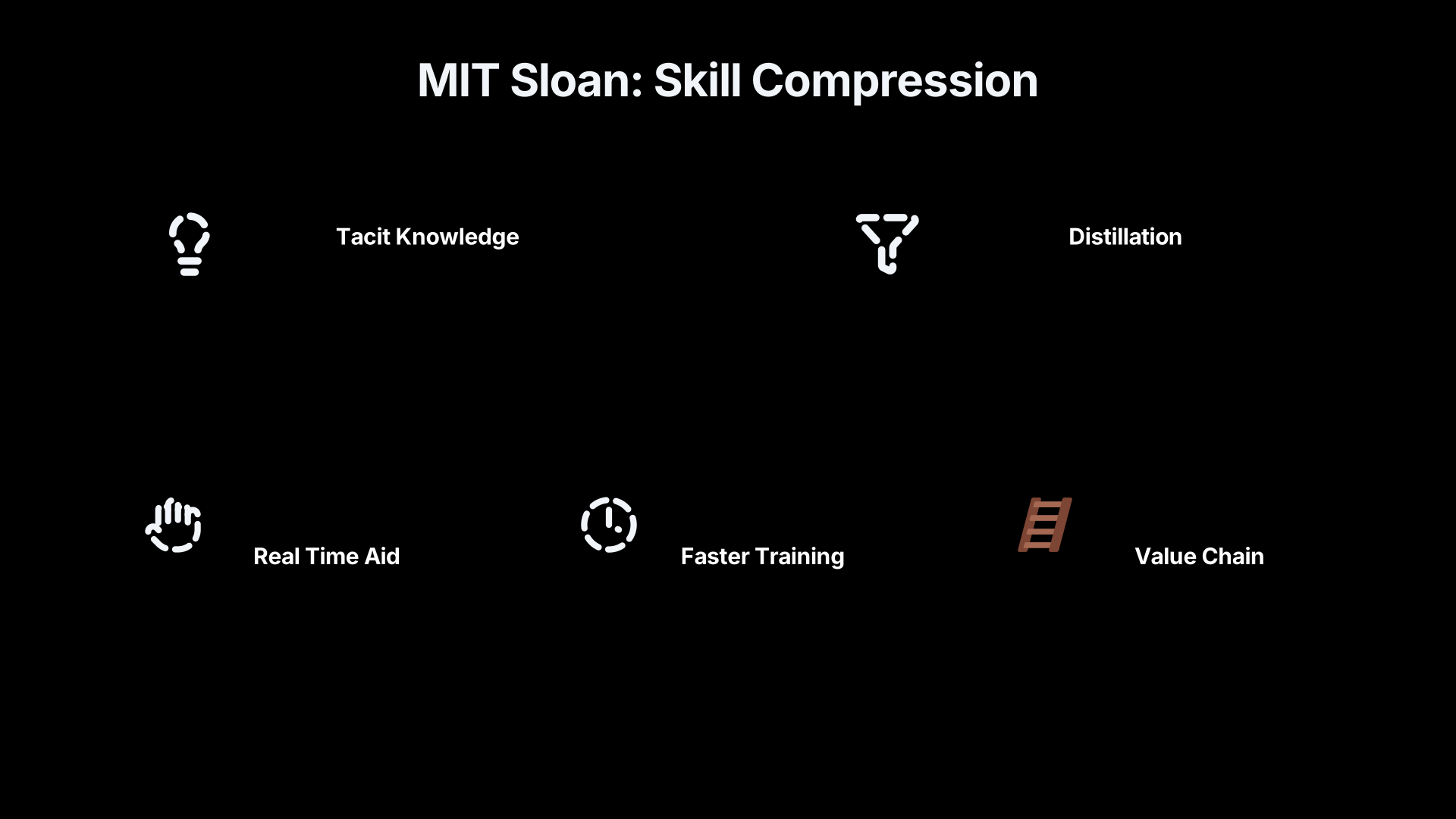
In many workplaces, top performers rely on tacit knowledge: small habits, patterns, shortcuts, phrasing choices, diagnostic instincts, and situational judgement that are rarely written down clearly. Traditionally, newer workers learned these skills slowly through observation, mentoring, mistakes, and repetition.
Large language models can sometimes act as “knowledge distillation” systems. By analysing huge numbers of past interactions, they identify patterns associated with successful outcomes and surface them in real time.
That changes the structure of work in several ways:
- New workers receive guidance during the task itself instead of only during formal training.
- Organisations can spread best practices more consistently.
- Workers can attempt more complex tasks earlier in their careers.
- Firms may need fewer years of experience before someone becomes productive.
- Language and communication barriers can shrink.
This differs from classic industrial automation. A machine replacing a worker removes labour from production. An AI assistant that helps a junior employee perform at a higher level can instead increase the value of that worker’s labour.
Economists sometimes describe this as AI creating “task complementarities”: systems that increase the productivity of human work instead of eliminating it outright. The distinction matters because productivity gains only become wage gains when workers remain economically important. [MIT Sloan]mitsloan.mit.eduMIT SloanNew MIT Sloan research suggests that AI is more likely to…Mar 17, 2025 — AI is more likely to complement human workers than r… [NBER]nber.orgeconomics generative aiThe Economics of Generative AIApr 24, 2024 — In research with Lindsey Raymond, we analyze the effects of generative AI on worker producti…
There is also a distributional implication. If AI mostly boosts elite experts, inequality could widen sharply. If it disproportionately helps average workers catch up, the technology may diffuse capability more broadly across society.
That possibility is one reason the novice-worker findings attracted so much attention among labour economists.
What the customer-support evidence shows
The most influential evidence so far comes from a large field study of more than 5,000 customer-support agents using a generative AI assistant. Researchers Erik Brynjolfsson, Danielle Li, and Lindsey Raymond examined what happened after workers gained access to a system that suggested responses, troubleshooting steps, and communication strategies during customer interactions. NBER [OUP Academic]academic.oup.comOUP AcademicGenerative AI at Work* | The Quarterly Journal of Economicsby E Brynjolfsson · 2025 · Cited by 3306 — We find that access to…
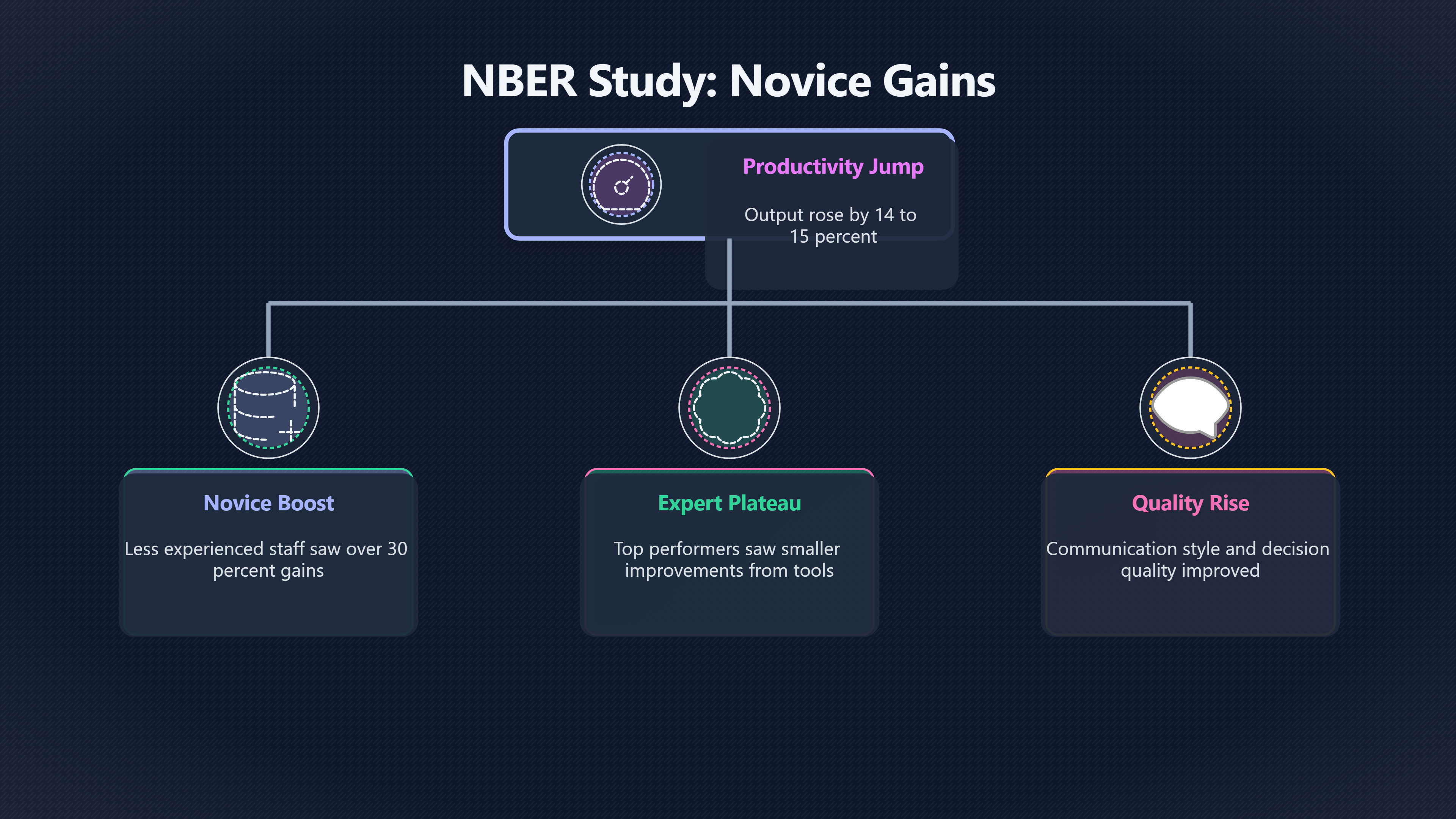
The headline result was notable enough on its own: productivity increased by roughly 14–15% overall. But the more important finding was where the gains came from.
The biggest improvements were concentrated among novice and lower-skilled workers. In some cases, productivity gains for less experienced workers exceeded 30%, while highly experienced staff saw much smaller improvements. NBER [OUP Academic]academic.oup.comOUP AcademicGenerative AI at Work* | The Quarterly Journal of Economicsby E Brynjolfsson · 2025 · Cited by 3306 — We find that access to…
The researchers argue that the AI system effectively captured the practices of top-performing agents and distributed them to everyone else. Text analysis suggested that newer workers began communicating more like successful experienced workers once assisted by the model. NBER [SIEPR Several details from the study matter for understanding the broader implications.]siepr.stanford.eduAuthor(s). Erik Brynjolfsson.Read moreSIEPRGenerative AI at Work | Stanford Institute for Economic Policy…Our results suggest that access to generative AI can increase prod…
The AI did not merely speed up typing
The gains were not just about drafting messages faster. The assistant appeared to improve decision quality, communication style, and problem-solving approaches.
Agents using the system resolved more issues per hour while also improving customer satisfaction measures. Customers became less likely to request managers, and conversations tended to become more polite. [arXiv]arxiv.orgarXiv Generative AI at WorkarXiv Generative AI at Work
That suggests the system was transferring behavioural patterns and practical judgement, not merely automating clerical work.
The assistant helped with rare problems
One surprising finding was that gains were especially strong for unusual or less familiar customer problems. [arXiv]arxiv.orgarXiv Generative AI at WorkarXiv Generative AI at Work
That matters because rare edge cases are often where inexperienced workers struggle most. Human organisations normally solve this through escalation: the junior worker asks a senior colleague for help.
AI systems may partially flatten that hierarchy by making accumulated institutional knowledge available immediately.
In principle, similar dynamics could apply in many professions:
- junior nurses consulting diagnostic support systems;
- trainee lawyers using drafting and research assistants;
- apprentice technicians receiving repair guidance;
- early-career programmers using coding copilots;
- teachers accessing lesson-generation and tutoring support.
The important point is not that the AI becomes the professional. It is that the minimum experience required to operate effectively may fall.
The learning effect may matter more than the immediate productivity gain
The researchers also found evidence that workers learned from repeated AI interaction. [SIEPR]siepr.stanford.eduAuthor(s). Erik Brynjolfsson.Read moreSIEPRGenerative AI at Work | Stanford Institute for Economic Policy…Our results suggest that access to generative AI can increase prod…
This may ultimately be more significant than the immediate efficiency boost.
If AI systems continuously expose workers to high-quality examples, recommended strategies, and corrective feedback, training periods could shrink dramatically. A worker who once needed several years to become fully effective might reach comparable competence far sooner.
At civilisational scale, that could matter enormously. One persistent constraint on economic development is the slow transmission of expertise. Skilled professionals require long educational pipelines, mentorship, and institutional accumulation. If AI reduces the friction of knowledge transfer, societies may be able to scale competence more rapidly across healthcare, engineering, administration, and research.
That possibility connects directly to larger “AI bloom” arguments about making intelligence itself more abundant.
When faster training becomes higher pay
Higher productivity does not automatically lead to higher wages. A company can simply pocket the gains.
But novice-oriented AI assistance creates several mechanisms through which workers may still benefit economically.
Workers become useful sooner
In many industries, firms hesitate to hire inexperienced staff because training costs are high and early productivity is low.
If AI reduces the cost of bringing workers up to speed, firms may become more willing to hire people with less formal experience. That can widen labour-market access for younger workers, career changers, immigrants, and workers without elite credentials.
The customer-support evidence hinted at this effect by showing that workers with only a few months of experience could perform more like much longer-tenured staff. [CFO Dive]cfodive.comai boosts productivity nber case study generative workforceCFO DiveAI boosts productivity 14%: NBER case study1 May 2023 — Generative AI improved customer service at a Fortune 500 company by promp…
In labour markets where experience barriers matter more than formal licensing, this could increase mobility and bargaining power.
Expertise may become less geographically concentrated
Historically, high-productivity work clustered around places with dense expert networks: major cities, elite firms, advanced hospitals, prestigious universities.
AI assistants could weaken some of those concentration effects by making parts of expert guidance available remotely and cheaply.
A junior worker in a poorer region may increasingly gain access to workflows, documentation, explanations, and troubleshooting support previously concentrated inside top institutions.
That does not eliminate the value of elite expertise. But it may broaden access to competent performance.
For developing economies, this possibility is particularly important. If AI systems help workers close capability gaps faster, countries may be able to participate in more advanced economic activities without waiting decades to build full expert infrastructures from scratch.
Some workers may move up the value chain
When routine support improves, workers can sometimes spend more time on higher-value activities.
Recent studies on software developers suggest that less experienced coders using AI assistance spend more time actively coding and less time stuck searching for solutions or debugging basic issues. [MIT Sloan]mitsloan.mit.eduMIT SloanNew MIT Sloan research suggests that AI is more likely to…Mar 17, 2025 — AI is more likely to complement human workers than r…
In principle, this could shift some jobs upward:
- junior analysts focus more on interpretation than formatting;
- nurses spend less time on documentation and more on patient interaction;
- teachers devote more effort to individual student support;
- technicians spend less time searching manuals and more time solving problems.
If workers become capable of handling more valuable tasks, wages can rise even without formal promotion.
The hidden tension: helping novices versus eliminating entry-level work
The optimistic interpretation is not the only plausible one.
The same systems that help novices may also reduce demand for traditional entry-level roles. If fewer junior workers are needed, firms may narrow the pipeline through which future experts are trained.
This is already becoming a concern in some white-collar professions.
Many entry-level jobs historically served two purposes at once:
- they produced economically useful output;
- they trained future experts.
Junior lawyers reviewed documents. Graduate programmers fixed small bugs. Junior consultants produced research summaries. Assistants drafted routine communications.
If AI automates too much of this beginner-level work, organisations may struggle to develop future senior staff. The ladder itself could weaken.
Some recent evidence already points to tension between productivity gains and reduced demand for novice labour in parts of the digital economy. A 2025 review of AI-and-work evidence found mild signs of declining demand for some novice-oriented tasks, even while productivity improved for workers who remained employed. [arXiv]arxiv.orgarXiv Generative AI at WorkarXiv Generative AI at Work
This creates a difficult transition problem.
An AI assistant that helps a junior worker perform like a mid-level employee can increase wages and opportunity. But a system that allows firms to skip hiring juniors altogether may instead hollow out career development.
The distinction depends heavily on deployment choices:
- Does the organisation expand output or cut headcount?
- Does AI support apprenticeship or replace it?
- Are workers encouraged to learn from the system or simply follow prompts mechanically?
- Do firms still invest in human development?
The answers are likely to vary by industry and institution.
Why this matters for the long-term AI future
The “AI bloom” argument is ultimately about expanding human capability at civilisational scale. The novice-worker evidence matters because it offers an early, concrete example of how AI may diffuse expertise rather than merely centralise it.
Historically, civilisation advanced partly by making specialised knowledge more accessible:
- printing widened access to literacy;
- public education widened access to numeracy and science;
- the internet widened access to information;
- industrial tools widened access to productive power.
AI assistants may widen access to practical cognitive capability itself.
That does not mean everyone instantly becomes an expert. Human judgement, social trust, creativity, responsibility, and deep domain understanding still matter enormously. Even the strongest augmentation studies show diminishing returns for highly experienced workers rather than universal transformation. [NBER]nber.orgNBERGenerative AI at Workby E Brynjolfsson · 2023 · Cited by 3306 — In this paper, we study the staggered introduction of a generative AI…
But if advanced AI systems increasingly function as widely available cognitive support infrastructure, they could alter one of the deepest constraints on human development: the scarcity of high-quality expertise.
In optimistic scenarios, that could eventually help societies train doctors faster, expand scientific research capacity, improve education quality globally, strengthen public administration, and make advanced technical work accessible to far larger populations.
In pessimistic scenarios, the same systems could become tools for tighter surveillance, work intensification, deskilling, and labour concentration.
The early evidence does not settle which future emerges. But it does suggest that one of the most economically important questions in AI may not be “Can machines replace workers?” It may be “Can AI make more humans capable?”
Endnotes
-
Source: mitsloan.mit.edu
Link: https://mitsloan.mit.edu/press/new-mit-sloan-research-suggests-ai-more-likely-to-complement-not-replace-human-workersSource snippet
MIT SloanNew MIT Sloan research suggests that AI is more likely to...Mar 17, 2025 — AI is more likely to complement human workers than r...
-
Source: nber.org
Title: economics generative ai
Link: https://www.nber.org/reporter/2024number1/economics-generative-aiSource snippet
The Economics of Generative AIApr 24, 2024 — In research with Lindsey Raymond, we analyze the effects of generative AI on worker producti...
-
Source: nber.org
Link: https://www.nber.org/papers/w31161Source snippet
NBERGenerative AI at Workby E Brynjolfsson · 2023 · Cited by 3306 — In this paper, we study the staggered introduction of a generative AI...
-
Source: academic.oup.com
Link: https://academic.oup.com/qje/article/140/2/889/7990658Source snippet
OUP AcademicGenerative AI at Work* | The Quarterly Journal of Economicsby E Brynjolfsson · 2025 · Cited by 3306 — We find that access to...
-
Source: arxiv.org
Title: arXiv Generative AI at Work
Link: https://arxiv.org/abs/2304.11771 -
Source: nber.org
Title: measuring productivity impact generative ai
Link: https://www.nber.org/digest/20236/measuring-productivity-impact-generative-aiSource snippet
NBERMeasuring the Productivity Impact of Generative AI1 June 2023 — The researchers suggest that newer and lower skilled workers may have...
Published: June 2023
-
Source: siepr.stanford.edu
Title: Author(s). Erik Brynjolfsson.Read more
Link: https://siepr.stanford.edu/publications/working-paper/generative-ai-workSource snippet
SIEPRGenerative AI at Work | Stanford Institute for Economic Policy...Our results suggest that access to generative AI can increase prod...
-
Source: mitsloan.mit.edu
Link: https://mitsloan.mit.edu/ideas-made-to-matter/generative-ai-changes-how-employees-spend-their-timeSource snippet
MIT SloanGenerative AI changes how employees spend their timeMar 10, 2026 — Less-experienced developers in the sample saw the biggest inc...
-
Source: arxiv.org
Title: arXiv AI and jobs. A review of theory, estimates, and evidence
Link: https://arxiv.org/abs/2509.15265Source snippet
arXivAI and jobs. A review of theory, estimates, and evidenceSeptember 18, 2025...
Published: September 18, 2025
-
Source: nber.org
Link: https://www.nber.org/Source snippet
NBER: National Bureau of Economic ResearchFounded in 1920, the NBER is a private, non-profit, non-partisan organization dedicated to cond...
-
Source: nber.org
Link: https://www.nber.org/system/files/working_papers/w31161/w31161.pdfSource snippet
NBER WORKING PAPER SERIES GENERATIVE AI AT...by E Brynjolfsson · 2023 · Cited by 2956 — AI assistance generates large gains in call hand...
-
Source: nber.org
Link: https://www.nber.org/system/files/working_papers/w32966/revisions/w32966.rev0.pdfSource snippet
The Rapid Adoption of Generative AIby A Bick · 2024 · Cited by 398 — 46 percent of workers who majored in science, technology, engineerin...
-
Source: nber.org
Link: https://www.nber.org/digest/202412/workplace-adoption-generative-aiSource snippet
Workplace Adoption of Generative AIDec 1, 2024 — The researchers found that 39.4 percent of respondents had used generative AI...
-
Source: nber.org
Title: Erik Brynjolfsson The Economics of Transformative AI. Book
Link: https://www.nber.org/people/erik_brynjolfssonSource snippet
Erik BrynjolfssonThe Economics of Transformative AI. Book - Conference Volume. editors - Ajay K. Agrawal, Erik Brynjolfsson & Anton Korin...
-
Source: nber.org
Link: https://www.nber.org/system/files/working_papers/w34781/w34781.pdfSource snippet
Enhancing Worker Productivity Without Automating Tasksby AK Agrawal · 2026 · Cited by 7 — Less experienced and lower-skilled workers show...
-
Source: mitsloan.mit.edu
Title: workers less experience gain most generative ai
Link: https://mitsloan.mit.edu/ideas-made-to-matter/workers-less-experience-gain-most-generative-aiSource snippet
with less experience gain the most from...Jun 26, 2023 — Workers with the least experience can quickly improve at their jobs with the he...
-
Source: mitsloan.mit.edu
Title: how artificial intelligence impacts us labor market
Link: https://mitsloan.mit.edu/ideas-made-to-matter/how-artificial-intelligence-impacts-us-labor-marketSource snippet
Lawrence Schmidt found that when AI can perform most of the tasks that make up a...Read more...
-
Source: mitsloan.mit.edu
Title: generative ai and worker productivity
Link: https://mitsloan.mit.edu/centers-initiatives/institute-work-and-employment-research/generative-ai-and-worker-productivitySource snippet
AI and Worker ProductivityApr 16, 2024 — Access to the new tool increased worker productivity by about 14% on average, with the productiv...
-
Source: mitsloan.mit.edu
Title: Sloan Workforce Intelligence digital
Link: https://mitsloan.mit.edu/sites/default/files/2025-09/MIT%20Sloan%20-%20Workforce%20Intelligence-digital.pdfSource snippet
INTELLIGENCE:The work tasks that AI is least likely to replace are those that depend on uniquely human capacities, such as empathy, judgm...
-
Source: brynjolfsson.com
Link: https://www.brynjolfsson.com/Source snippet
Erik BrynjolfssonErik Brynjolfsson is the Jerry Yang and Akiko Yamazaki Professor and Senior Fellow at the Stanford Institute for Human-C...
-
Source: ideas.repec.org
Link: https://ideas.repec.org/p/ecl/stabus/4141.htmlSource snippet
AI at Workby E Brynjolfsson · 2023 · Cited by 3143 — In this paper, we study the staggered introduction of a generative AI-based conversa...
-
Source: arxiv.org
Link: https://arxiv.org/pdf/2304.11771Source snippet
Generative AI at Workby E Brynjolfsson · 2023 · Cited by 3229 — We find that access to AI assistance increases the productivity of agents...
-
Source: youtube.com
Title: The Future of Work: How AI is Reskilling and Upskilling the Workforce
Link: https://www.youtube.com/watch?v=AitR08O8U5MSource snippet
MIT Sloan Professor Danielle Li on How Generative AI Impacts Productivity...
-
Source: youtube.com
Title: MIT Sloan Professor Danielle Li on How Generative AI Impacts Productivity
Link: https://www.youtube.com/watch?v=1F2rWf9YqXU -
Source: cfodive.com
Title: ai boosts productivity nber case study generative workforce
Link: https://www.cfodive.com/news/ai-boosts-productivity-nber-case-study-generative-workforce/649110/Source snippet
CFO DiveAI boosts productivity 14%: NBER case study1 May 2023 — Generative AI improved customer service at a Fortune 500 company by promp...
Published: May 2023
-
Source: Wikipedia
Title: Erik Brynjolfsson
Link: https://en.wikipedia.org/wiki/Erik_BrynjolfssonSource snippet
Erik BrynjolfssonErik Brynjolfsson is an American academic, author and inventor. He is the Jerry Yang and Akiko Yamazaki Professor and...
-
Source: economics.stanford.edu
Title: erik brynjolfsson
Link: https://economics.stanford.edu/people/erik-brynjolfssonSource snippet
is the Jerry Yang and Akiko Yamazaki Professor and Senior Fellow at the Stanford Institute for Human-Centered AI (HAI), and Director of...
-
Source: digitaleconomy.stanford.edu
Title: generative ai at work
Link: https://digitaleconomy.stanford.edu/publication/generative-ai-at-work/Source snippet
AI at Work - Stanford Digital Economy LabLess experienced and lower-skilled workers improve both the speed and quality of their output wh...
-
Source: gsb.stanford.edu
Link: https://www.gsb.stanford.edu/faculty-research/working-papers/generative-ai-workSource snippet
AI at Work - Stanford Graduate School of BusinessIn this paper, we study the staggered introduction of a generative AI-based conversation...
-
Source: hai.stanford.edu
Link: https://hai.stanford.edu/news/will-generative-ai-make-you-more-productive-work-yes-only-if-youre-not-already-great-your-jobSource snippet
Yes...24 Apr 2023 — They found that access to AI assistance increased agent productivity by 14%, with the biggest impact on less experie...
-
Source: youtube.com
Link: https://www.youtube.com/nbervideosSource snippet
NBERThe National Bureau of Economic Research (NBER) is a private, nonprofit, nonpartisan organization that facilitates cutting-edge inves...
-
Source: linkedin.com
Title: Erik Brynjolfsson
Link: https://www.linkedin.com/in/erikbrynjolfssonSource snippet
Professor, Writer, Speaker, InventorErik Brynjolfsson is the Jerry Yang and Akiko Yamazaki Professor and Senior Fellow at the Stanford In...
Additional References
-
Source: bitter-sweet.ai
Link: https://www.bitter-sweet.ai/articles/generative-ai-at-work-brynjolfsson-2023/Source snippet
14% Productivity Boost for Customer Service AgentsThe gains were largest for novice and low-skilled workers (34% improvement) — AI effect...
-
Source: sternstrategy.com
Link: https://sternstrategy.com/speakers/erik-brynjolfsson/Source snippet
Erik Brynjolfsson AI and Economist SpeakerErik Brynjolfsson, an optimistic economist, explores how technological advances, like AI, impac...
-
Source: analysisgroup.com
Link: https://www.analysisgroup.com/people/affiliated-experts/erik-brynjolfsson/ -
Source: revartis.com
Link: https://revartis.com/insight/how-generative-ai-is-transforming-customer-support-a-closer-look-at-recent-findings/Source snippet
How Generative AI is Transforming Customer SupportA very insightful study titled “Generative AI at Work” by Erik Brynjolfsson, Danielle L...
-
Source: researchgate.net
Link: https://www.researchgate.net/publication/390606078_Generative_AI_at_WorkSource snippet
(PDF) Generative AI at WorkLess experienced and lower-skilled workers improve both the speed and quality of their output, while the most...
-
Source: itif.org
Link: https://itif.org/publications/2023/07/10/customer-support-agents-using-ai-gpt-tool-saw-nearly-14-percent-increase-in-productivity/Source snippet
Fact of the Week: Customer Support Agents Using an AI...10 Jul 2023 — They found that customer support agents using the AI tool to guide...
-
Source: linkedin.com
Link: https://www.linkedin.com/posts/joemckendrick_great-analysis-of-the-nber-working-paper-activity-7056978668945842177-6AWvSource snippet
Joe McKendrick's PostApr 26, 2023 — Great analysis of the NBER working paper just released, which proclaims that AI is s productivity boo...
-
Source: cmswire.com
Title: can generative ai boost productivity attitude of customer service agents
Link: https://www.cmswire.com/contact-center/can-generative-ai-boost-productivity-attitude-of-customer-service-agents/Source snippet
Can Generative AI Boost Productivity, Attitude of Customer...14 June 2023 — A NBER Study reveals customer service agents achieve a big b...
Published: June 2023
-
Source: hrdive.com
Title: generative ai chatgpt increased customer service agent productivity
Link: https://www.hrdive.com/news/generative-ai-chatgpt-increased-customer-service-agent-productivity/648925/Source snippet
AI increased customer service agent productivity by 14%...28 Apr 2023 — However, the researchers said AI use “disproportionately” incre...
-
Source: x.com
Title: Erik Brynjolfsson (@erikbryn) / Posts / XErik Brynjolfsson (@erikbryn)
Link: https://x.com/erikbrynSource snippet
Posts - Director @DigEconLab Co-founder, @Workhelix @StanfordHAI @SIEPR @Stanford amazon.com/Sec... | X (formerly Twitter)...
Amazon book picks
Further Reading
Books and field guides related to AI and novice workers. Use these as the next step if you want deeper reading beyond the article.

Artificial Intelligence in Economics and Finance Theories
As Artificial Intelligence (AI) seizes all aspects of human life, there is a fundamental shift in the way in which humans are thinking of...
The Shift: The Future of Work is Already Here
An unhysterical look at the future of employment.

Shaping the Future of Work
First published 2015. Subjects: Business ethics, Labor, Organizational behavior, Personnel management, Labor policy.
Automation and the Future of Work
First published 2020. Subjects: Economic history, Automation, Social aspects, Economic aspects, Technological innovations.
eBay marketplace picks
Marketplace Samples
Example marketplace items related to this page. Use the search link to explore similar finds on eBay.

Example eBay listing
A.I. Artificial Intelligence Original Movie Poster Signed By Jude Law
USD 125.00 | Shipping USD 25.00 | US

Example eBay listing
Artificial Intelligence D/S Original Movie Poster - 27 x 40"
USD 19.50 | Shipping USD 13.65 | US

Example eBay listing
612388 Artificial Intelligence Movie Science Fiction Drama Wall Print Poster
USD 22.95 | Shipping USD 12.95 | JP

Example eBay listing
Companion - Artificial Intelligence Dark Comedy Cinema Film - POSTER 20"x30"
USD 23.99 | Free shipping | US

Example eBay listing
A.I. Artificial Intelligence Movie Film Poster Art Print
GBP 4.99 | Free shipping | GB

Example eBay listing
A I Artificial Intelligence 6 Movie Poster Art Print Print Classic Rare Gallery
GBP 49.00 | Free shipping | GB

Example eBay listing
AI - Artificial Intelligence (Poster + Slipcase) Blu-Ray
GBP 10.49 | Free shipping | GB

Example eBay listing
A. I. Artificial Intelligence. Jude Law. Original UK Video Poster.
GBP 8.11 | Shipping GBP 3.38 | GB
Topic Tree