Within Clean Power
AI demand and gas fallback
Utilities may turn to gas when AI load arrives faster than clean firm power, storage and transmission can be built.
On this page
- Why gas looks attractive to utilities under time pressure
- How fossil lock in could undermine AI abundance claims
- Clean alternatives for reliable round the clock power
Page outline Jump by section
Introduction
AI is making electricity demand grow faster in some regions than utilities expected even a few years ago. That is raising a difficult question for the optimistic vision of AI-enabled abundance: if advanced AI needs enormous amounts of reliable power before clean infrastructure is ready, will gas plants stay online for longer than planned?
 In many places, the answer is probably yes in the near term. Utilities and grid operators increasingly see natural gas as the fastest scalable way to provide round-the-clock electricity for large AI data centres. Existing coal and gas stations are having their retirements reconsidered, while new gas generation proposals are appearing around major data-centre hubs. The International Energy Agency (IEA) expects fossil fuels to supply a substantial share of additional data-centre electricity demand through 2030, largely because transmission lines, storage systems and clean firm power are not expanding quickly enough. [IEA]iea.orgIEAEnergy supply for AINatural gas and coal together are expected to meet over 40% of the additional electricity demand from data centres…
That does not mean AI automatically becomes a climate disaster, or that clean energy cannot eventually dominate. But it does mean the timing matters. If AI demand outruns grid upgrades, the path to an abundant AI future could pass through a politically and environmentally contentious period of prolonged fossil-fuel dependence.
Why gas looks attractive to utilities under time pressure
The core problem is not that renewables cannot produce large amounts of electricity. It is that AI infrastructure is arriving extremely quickly, while many electricity systems move slowly.
A hyperscale AI data centre may need as much electricity as a medium-sized city, and operators often want power within three to five years. New transmission lines can take a decade or more to permit and build. Nuclear projects usually take even longer. Batteries help with short-duration balancing but do not yet solve every multi-day reliability challenge at scale.
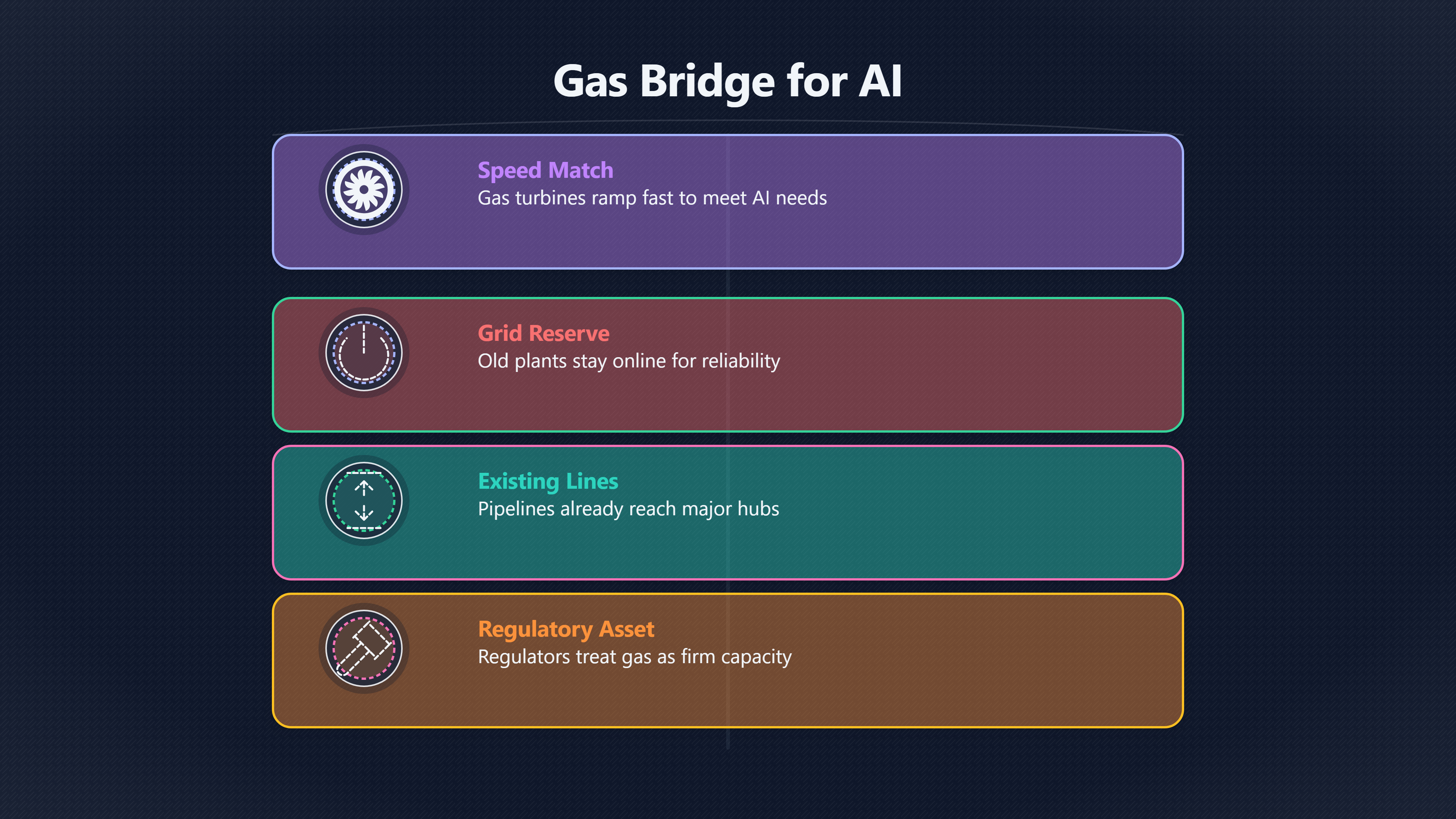
From the perspective of utilities, gas plants solve several immediate problems at once:
- They provide steady electricity day and night.
- They can ramp output up and down quickly.
- Gas infrastructure already exists across much of the United States.
- Turbine technology is mature and bankable.
- Regulators traditionally treat gas as a reliability asset.
This is especially visible in major AI growth corridors such as northern Virginia, Texas, Georgia and parts of the US Midwest. Utilities there are facing sudden forecasts for massive electricity growth driven largely by data centres. [Belfer Center]belfercenter.orgBelfer Center AI, Data Centers, and the U.SElectric Grid: A Watershed…10 Feb 2026 — Investors claim that massive investments in energy generation and grid infrastructure are nee…
Industry publications and utility analysts increasingly describe natural gas as the “bridge” fuel for the AI buildout. Data Center Dynamics reported in 2025 that gas had emerged as the only rapidly deployable large-scale power source many operators believed could match AI demand growth timelines. [DataCenterDynamics]datacenterdynamics.comwelcome to gas land how natural gas is powering the us ai boomDataCenterDynamicsHow natural gas is powering the US AI data center boom1 May 2025 — Natural gas has emerged as the only viable and rapid…
The IEA reached a similar conclusion in its 2025-26 work on energy and AI. It projected that natural gas and coal together could supply more than 40% of additional electricity demand from data centres through 2030. [IEA]iea.orgData centre electricity use surged in 2025, even with…16 Apr 2026 — Electricity demand from data centres soared by 17% in 2025, and th…
That does not necessarily mean utilities prefer fossil fuels in the abstract. In many cases, they simply do not believe clean alternatives can be deployed quickly enough to satisfy both reliability rules and investor expectations.
Existing gas plants become more valuable
AI demand does not only encourage construction of new gas capacity. It also changes the economics of plants that already exist.
Gas stations that once seemed likely to retire can suddenly become profitable again if nearby data-centre demand surges. Grid operators may decide they need those plants for reliability reserves, especially where transmission bottlenecks prevent electricity imports from cleaner regions.
In the PJM Interconnection region, which includes northern Virginia and is home to the world’s largest concentration of data centres, grid stress linked partly to rising demand has already increased payments to older fossil-fuel plants. Reuters reported in 2026 that PJM paid nearly $1 billion in special “uplift” payments in a single quarter to keep generators operating during reliability strains and high gas prices. [Reuters]reuters.combiggest us grid paid record 1 billion money losing power plants q1 2026 05 20electric grid, paid a record $990 million in uplift payments to power plants, surpassing the $764 million total for all of 2025. These pa…
Utilities are also delaying retirement schedules. Reporting from environmental and energy-policy groups has identified coal and gas units whose closures were postponed amid concerns about data-centre demand growth. [EESI]eesi.orgdata center buildout is hungry for fossil fuelsThe U.S. Department of…Read more… [Utility Dive]utilitydive.comfossil fuel gas coal climate data centersUtility DiveCoal- and gas-fired power plants have a new best friend25 Jul 2025 — Data centers are also delaying the retirement of fossil…
The result is a subtle but important shift. AI does not necessarily create entirely new fossil infrastructure everywhere. Sometimes it simply changes the incentive to shut old plants down.
How fossil lock-in could undermine AI abundance claims
The optimistic case for AI abundance often assumes that advanced AI accelerates clean-energy innovation, scientific discovery and efficient resource use. But if AI expansion instead produces a long fossil-fuel rebound, critics argue the environmental costs could weaken that narrative.
The concern is not only carbon emissions. Long-lived gas infrastructure creates political and financial lock-in.
A utility building a new combined-cycle gas plant today may expect it to operate for 25 to 40 years. Investors usually want predictable returns over decades. Pipelines, transmission upgrades and fuel contracts create additional inertia. Once these systems exist, utilities and local governments often resist early retirement because doing so can strand billions in assets.
That matters because climate targets depend heavily on retiring fossil infrastructure rather than merely slowing its growth.
AI could delay the decline of fossil generation
Several trends worry climate analysts:
- Coal retirements being postponed. [eesi.org]eesi.orgdata center buildout is hungry for fossil fuelsThe U.S. Department of…Read more…
- Gas plants receiving life extensions.
- New “peaker” or backup gas units justified by AI demand.
- Data centres pursuing dedicated on-site gas generation.
- Utilities arguing that reliability concerns require more fossil reserves.
The Energy and Environment Study Institute warned in 2026 that utilities were extending coal plant lifetimes and delaying retirements partly because of pressure from data-centre electricity growth. [EESI]eesi.orgdata center buildout is hungry for fossil fuelsThe U.S. Department of…Read more…
Utility Dive similarly reported that at least 17 fossil-fuel generators originally scheduled to close had delayed retirement decisions connected to data-centre growth pressures. [Utility Dive]utilitydive.comfossil fuel gas coal climate data centersUtility DiveCoal- and gas-fired power plants have a new best friend25 Jul 2025 — Data centers are also delaying the retirement of fossil…
The political economy matters here. AI companies often present themselves as climate-conscious and highly innovative, yet their electricity demand can indirectly strengthen incumbent fossil-energy systems. Critics argue this creates a contradiction at the heart of some “AI abundance” narratives: the same technology promising climate optimisation may simultaneously slow decarbonisation if deployed too quickly without matching infrastructure investment.
Local pollution and unequal burdens
The costs are not distributed evenly.
Data centres are frequently concentrated in specific corridors where land, fibre-optic connectivity and tax incentives align. Those same areas may experience increased air pollution, water use and grid strain if utilities rely more heavily on gas generation.
Communities near older fossil plants often already face elevated pollution burdens. Environmental justice advocates argue that extending fossil infrastructure for AI demand risks concentrating harms in poorer or historically marginalised areas while the economic gains flow elsewhere. [Utility Dive]utilitydive.comfossil fuel gas coal climate data centersUtility DiveCoal- and gas-fired power plants have a new best friend25 Jul 2025 — Data centers are also delaying the retirement of fossil…
This distribution question is central to whether AI contributes to broad human flourishing or merely to selective technological enrichment. A future in which AI dramatically improves productivity while externalising environmental costs onto vulnerable communities would look very different from the egalitarian “post-scarcity” visions often associated with AI bloom arguments.

The strongest argument for gas is reliability
Utilities defending gas expansion usually make a narrower argument than “fossil fuels are good”. Their claim is that reliability failures would be worse.
AI data centres cannot easily tolerate extended power interruptions. A sudden outage can disrupt cloud services, financial systems, healthcare platforms or industrial automation. Grid operators therefore prioritise firm capacity: electricity that is available when needed regardless of weather conditions.
This concern is intensified by the geographical clustering of AI infrastructure. Research published in 2026 warned that concentrated AI data-centre growth could create severe localised stress in regions such as Virginia and Oregon even if national electricity systems remain broadly adequate. [arXiv]arxiv.orgarXivConcentrated siting of AI data centers drives regional power-system stress under rising global compute demandMarch 13, 2026…
The fear inside utilities is not abstract. In 2024, a voltage disturbance in northern Virginia reportedly caused dozens of data centres to disconnect simultaneously, forcing emergency interventions to stabilise the regional grid. [Belfer Center]belfercenter.orgBelfer Center AI, Data Centers, and the U.SElectric Grid: A Watershed…10 Feb 2026 — Investors claim that massive investments in energy generation and grid infrastructure are nee…
From this perspective, gas acts as an insurance policy against blackouts and politically damaging reliability crises.
Why some utilities prefer gas over waiting for transmission
Transmission may be the most underrated bottleneck in the entire AI-energy debate.
A region can theoretically have abundant renewable electricity somewhere else while still lacking enough wires to deliver it reliably to data centres. Transmission queues in the United States and parts of Europe have become extremely congested. Renewable projects can wait years for grid connection approval.
Gas plants avoid some of these delays because they can be built nearer to demand centres and integrated into existing systems more easily.
That creates a powerful incentive structure:
- AI firms want rapid deployment.
- Utilities want reliability compliance.
- Regulators fear blackouts.
- Investors want predictable returns.
Under those pressures, gas often appears administratively easier than redesigning the grid around very high renewable penetration.
Clean alternatives for reliable round-the-clock power
The long-term picture is not necessarily dominated by gas. Several competing approaches could reduce or eventually reverse fossil dependence if deployed fast enough.
Solar, wind and batteries together are scaling rapidly
Renewables remain the cheapest source of new electricity generation in many regions, especially solar. Battery deployment is also accelerating quickly.
The key shift is that utilities increasingly think in terms of systems rather than individual technologies. Solar plus batteries plus transmission plus flexible demand can collectively provide reliability that once depended mainly on fossil plants.
Large technology firms are helping finance this buildout through long-term clean-energy procurement agreements. Some are also experimenting with “24/7 carbon-free” strategies that attempt to match local electricity use with hourly clean generation instead of annual offsets.
If grid expansion accelerates, renewables could eventually undercut gas economically as well as environmentally.
Nuclear is returning to the AI conversation
[Advanced nuclear power has re-entered energy debates partly because of AI demand.]iea.orgIEAEnergy demand from AIDespite the strong increase, data centre electricity demand growth accounts for less than 10% of global electrici…
Small modular reactors, often called SMRs, are attracting interest because they promise constant low-carbon electricity with a smaller footprint than traditional nuclear stations. Tech companies including Microsoft, Google and Amazon have all shown interest in nuclear partnerships or procurement arrangements.
The problem is timing. Most SMR projects remain commercially immature and unlikely to solve immediate shortages before the late 2020s or 2030s. The IEA expects nuclear to grow in importance later, but not fast enough to eliminate near-term fossil expansion pressures. [IEA]iea.orgIEAExecutive summary – Energy and AI – AnalysisData centres accounted for around 1.5% of the world's electricity consumption in 2024, or…
Geothermal and flexible computing loads
Some analysts think AI itself may eventually help solve the energy problem.
Potential examples include:
- AI-assisted grid balancing.
- Better renewable forecasting.
- Faster materials discovery for batteries.
- More efficient data-centre cooling. [iea.org]iea.orgIEAEnergy demand from AIDespite the strong increase, data centre electricity demand growth accounts for less than 10% of global electrici…
- Dynamic scheduling of compute tasks around renewable availability.
There is also growing interest in “flexible load” computing, where certain AI training tasks are shifted toward times and places with abundant renewable electricity.
If AI workloads become more geographically and temporally flexible, the argument for always-on fossil backup could weaken significantly.
The outcome depends more on infrastructure speed than on AI alone
The deepest question is not whether AI inherently requires fossil fuels. It is whether societies can build clean infrastructure as quickly as they are building AI infrastructure.
At a global level, data centres still represent a minority of total electricity demand growth. The IEA notes that electric vehicles, cooling, industrial electrification and broader economic development remain larger long-term drivers. [IEA]iea.orgIEAEnergy demand from AIDespite the strong increase, data centre electricity demand growth accounts for less than 10% of global electrici…
But AI demand is unusually concentrated, politically visible and time-sensitive. That combination can distort local electricity systems even if the global energy picture remains manageable.
If transmission, storage, advanced nuclear, geothermal and renewable deployment accelerate substantially, gas could function mainly as a temporary bridge. In that scenario, AI might still support a cleaner and more prosperous civilisation over the long run.
If those clean alternatives remain bottlenecked while AI investment races ahead, however, utilities may keep fossil infrastructure operating for far longer than climate planners expected. The danger is not simply higher emissions. It is that the world could become locked into a slower, more conflict-ridden transition precisely when AI advocates hope technological progress will enable abundance, resilience and long-term human flourishing.
Endnotes
-
Source: iea.org
Link: https://www.iea.org/reports/energy-and-ai/energy-supply-for-aiSource snippet
IEAEnergy supply for AINatural gas and coal together are expected to meet over 40% of the additional electricity demand from data centres...
-
Source: iea.org
Link: https://www.iea.org/news/data-centre-electricity-use-surged-in-2025-even-with-tightening-bottlenecks-driving-a-scramble-for-solutionsSource snippet
Data centre electricity use surged in 2025, even with...16 Apr 2026 — Electricity demand from data centres soared by 17% in 2025, and th...
-
Source: datacenterdynamics.com
Title: welcome to gas land how natural gas is powering the us ai boom
Link: https://www.datacenterdynamics.com/en/analysis/welcome-to-gas-land-how-natural-gas-is-powering-the-us-ai-boom/Source snippet
DataCenterDynamicsHow natural gas is powering the US AI data center boom1 May 2025 — Natural gas has emerged as the only viable and rapid...
Published: May 2025
-
Source: iea.org
Link: https://www.iea.org/reports/energy-and-ai/executive-summarySource snippet
IEAExecutive summary – Energy and AI – AnalysisData centres accounted for around 1.5% of the world's electricity consumption in 2024, or...
-
Source: reuters.com
Title: biggest us grid paid record 1 billion money losing power plants q1 2026 05 20
Link: https://www.reuters.com/legal/litigation/biggest-us-grid-paid-record-1-billion-money-losing-power-plants-q1-2026-05-20/Source snippet
electric grid, paid a record $990 million in uplift payments to power plants, surpassing the $764 million total for all of 2025. These pa...
-
Source: eesi.org
Title: data center buildout is hungry for fossil fuels
Link: https://www.eesi.org/articles/view/data-center-buildout-is-hungry-for-fossil-fuelsSource snippet
The U.S. Department of...Read more...
-
Source: arxiv.org
Link: https://arxiv.org/abs/2604.06198Source snippet
arXivConcentrated siting of AI data centers drives regional power-system stress under rising global compute demandMarch 13, 2026...
Published: March 13, 2026
-
Source: iea.org
Link: https://www.iea.org/reports/energy-and-ai/energy-demand-from-aiSource snippet
IEAEnergy demand from AIDespite the strong increase, data centre electricity demand growth accounts for less than 10% of global electrici...
-
Source: iea.org
Link: https://www.iea.org/reports/global-energy-review-2025/electricitySource snippet
IEAElectricity – Global Energy Review 2025 – AnalysisGlobal electricity demand increased by 4.3% in 2024, a step change from the 2.5% gro...
-
Source: iea.org
Link: https://www.iea.org/Source snippet
IEA – International Energy AgencyWe provide authoritative analysis, data, policy recommendations and solutions to ensure energy security...
-
Source: iea.org
Title: electricity 2024
Link: https://www.iea.org/reports/electricity-2024Source snippet
AnalysisJan 24, 2024 — In addition, this year's report features in-depth analysis on the drivers of recent declines in electricity demand...
-
Source: iea.org
Title: energy and ai observatory
Link: https://www.iea.org/data-and-statistics/data-tools/energy-and-ai-observatorySource snippet
Data ToolsJun 16, 2025 — AI is making data centres larger and more power-intensive, raising the importance of the availability of electri...
-
Source: reuters.com
Link: https://www.reuters.com/business/energy/iea-chief-birol-commercial-oil-inventories-depleting-rapidly-only-weeks-left-2026-05-18/ -
Source: energy.gov
Link: https://www.energy.gov/ia/international-energy-agency-ieaSource snippet
ized countries under the Organization for Economic Development and...Read more...
-
Source: datacenterdynamics.com
Title: iea data center energy consumption set to double by 2030 to 945twh
Link: https://www.datacenterdynamics.com/en/news/iea-data-center-energy-consumption-set-to-double-by-2030-to-945twh/Source snippet
IEA: Data center energy consumption set to double by...Apr 11, 2025 — The Energy and AI report projects that data center consumption glo...
-
Source: arxiv.org
Link: https://arxiv.org/html/2509.07218v3Source snippet
Electricity Demand and Grid Impacts of AI Data Centers29 Sept 2025 — According to the IEA report [8], global data centers consumed aroun...
-
Source: belfercenter.org
Title: Belfer Center AI, Data Centers, and the U.S
Link: https://www.belfercenter.org/research-analysis/ai-data-centers-us-electric-gridSource snippet
Electric Grid: A Watershed...10 Feb 2026 — Investors claim that massive investments in energy generation and grid infrastructure are nee...
-
Source: utilitydive.com
Title: fossil fuel gas coal climate data centers
Link: https://www.utilitydive.com/news/fossil-fuel-gas-coal-climate-data-centers/753565/Source snippet
Utility DiveCoal- and gas-fired power plants have a new best friend25 Jul 2025 — Data centers are also delaying the retirement of fossil...
-
Source: Wikipedia
Title: International Energy Agency
Link: https://en.wikipedia.org/wiki/International_Energy_AgencySource snippet
International Energy AgencyThe International Energy Agency (IEA) is a Paris-based autonomous intergovernmental organization, establish...
Additional References
-
Source: instagram.com
Link: https://www.instagram.com/reel/DXNdD9_jTso/Source snippet
AnewZ on Instagram: "A new report by the International...The IEA warns that growth is increasingly constrained by real world bottlenecks...
-
Source: linkedin.com
Link: https://www.linkedin.com/posts/dr-irene-di-martino-88481823_datacenters-ai-energyinfrastructure-activity-7425556038529155072-tORiSource snippet
IEA Report: Grid Can't Keep Up with AI DemandElectricity demand is surging for the first time in decades, mainly due to the critical role...
-
Source: facebook.com
Link: https://www.facebook.com/internationalenergyagency/Source snippet
International Energy Agency (IEA)The International Energy Agency works with countries around the world to shape energy policies for aRead...
-
Source: news.oilandgaswatch.org
Link: https://news.oilandgaswatch.org/post/u-s-data-center-boom-as-part-of-ai-race-brings-wave-of-new-gas-fired-power-plant-proposalsSource snippet
data center boom driving wave of new gas-fired power...23 Oct 2025 — The wave of new data centers and related gas plants are raising con...
-
Source: wsj.com
Link: https://www.wsj.com/business/energy-oil/ai-data-centers-desperate-for-electricity-are-building-their-own-power-plants-291f5c81Source snippet
AI Data Centers, Desperate for Electricity, Are Building...15 Oct 2025 — Developers plan to deliver fewer than 20 gigawatts of natural-g...
-
Source: enkiai.com
Link: https://enkiai.com/data-center/gas-to-power-boom-ai-drives-2026-on-site-energy-shift/Source snippet
Gas-to-Power Boom: AI Drives 2026 On-Site Energy ShiftIn 2026, grid constraints fuel a massive gas-to-power boom for AI data centers...
-
Source: theenergy.co
Title: ai data centres risk becoming victims of their own success iea warns
Link: https://theenergy.co/article/ai-data-centres-risk-becoming-victims-of-their-own-success-iea-warnsSource snippet
AI data centres risk becoming victims of their own success...19 Apr 2026 — These and other bottlenecks, the IEA said, “are reducing the...
-
Source: grist.org
Title: georgia was about to retire coal plants then came the data cen
Link: https://grist.org/energy/georgia-was-about-to-retire-coal-plants-then-came-the-data-cen/Source snippet
Data centers are pushing utilities back to fossil fuels. | Grist12 Feb 2025 — Georgia was going to retire its coal plants, but then the d...
-
Source: brookings.edu
Title: global energy demands within the ai regulatory landscape
Link: https://www.brookings.edu/articles/global-energy-demands-within-the-ai-regulatory-landscape/Source snippet
10 Apr 2026 — In 2024, global data center electricity consumption was approximately 415 terrawatt hours, representing about 1.5% of the w...
-
Source: facebook.com
Link: https://www.facebook.com/TexasOilandGasAssociation/posts/as-the-demand-for-artificial-intelligence-ai-and-data-centers-skyrockets-natural/1097196209249419/Source snippet
he next few years amid a race to meet enormous electrical demand...Read more...
Amazon book picks
Further Reading
Books and field guides related to AI demand and gas fallback. Use these as the next step if you want deeper reading beyond the article.

Artificial Intelligence in Energy and Renewable Energy Systems
This book presents state of the art applications of artificial intelligence in energy and renewable energy systems design and modelling....


Urban Energy Transition
This compendium of 29 chapters from 18 countries contains both fundamental and advanced insight into the inevitable shift from cities dom...

eBay marketplace picks
Marketplace Samples
Example marketplace items related to this page. Use the search link to explore similar finds on eBay.

Example eBay listing
A.I. Artificial Intelligence Original Movie Poster Signed By Jude Law
USD 125.00 | Shipping USD 25.00 | US

Example eBay listing
Artificial Intelligence D/S Original Movie Poster - 27 x 40"
USD 19.50 | Shipping USD 13.65 | US

Example eBay listing
612388 Artificial Intelligence Movie Science Fiction Drama Wall Print Poster
USD 22.95 | Shipping USD 12.95 | JP

Example eBay listing
Companion - Artificial Intelligence Dark Comedy Cinema Film - POSTER 20"x30"
USD 23.99 | Free shipping | US

Example eBay listing
A.I. Artificial Intelligence Movie Film Poster Art Print
GBP 4.99 | Free shipping | GB

Example eBay listing
A I Artificial Intelligence 6 Movie Poster Art Print Print Classic Rare Gallery
GBP 49.00 | Free shipping | GB

Example eBay listing
AI - Artificial Intelligence (Poster + Slipcase) Blu-Ray
GBP 10.49 | Free shipping | GB

Example eBay listing
A. I. Artificial Intelligence. Jude Law. Original UK Video Poster.
GBP 8.11 | Shipping GBP 3.38 | GB
Topic Tree