Within Energy Limits
Clean Power for AI
AI firms are buying huge amounts of renewable power, but clean-energy contracts do not always solve local grid constraints.
On this page
- How tech firms buy renewable electricity
- Why transmission limits still matter
- Whether gas expansion could slow decarbonisation
Page outline Jump by section
Introduction
Clean energy probably can keep up with rising AI electricity demand at a global level, but not automatically, not everywhere, and not on the same timetable as AI infrastructure itself. The key issue is less whether the world can generate enough renewable electricity in total, and more whether grids, transmission lines, storage systems and local planning can expand fast enough in the regions where AI data centres are actually being built.
 This matters because the environmental case for AI-enabled abundance depends heavily on energy. If advanced AI accelerates medicine, science, automation and economic growth while running mainly on low-carbon electricity, the technology could help support a far richer and cleaner civilisation. But if AI demand locks regions into decades of new gas generation, delays coal retirements, or overwhelms strained grids, the climate and political backlash could become severe.
The evidence so far points in both directions. Large technology firms are now among the world’s biggest buyers of renewable electricity, helping finance major new wind, solar and storage projects. At the same time, grid queues, transmission bottlenecks and the speed of AI expansion are pushing some utilities back toward fossil-fuel generation because it can be deployed more quickly and provide steady power around the clock. [The Union of Concerned Scientists]ucs.orgData Center Power Play report finalData Center Power Play report final [3IEA 3IEA]
How tech firms buy renewable electricity
The major AI companies are no longer small electricity consumers. Microsoft, Google, Amazon and Meta now procure power at scales previously associated with heavy industry or national utilities.
One important reason is that hyperscale data centres run continuously. Training and serving advanced AI models requires dense clusters of specialised chips operating day and night. That creates enormous demand for dependable electricity, especially in regions already attractive for cloud infrastructure such as Virginia, Oregon, Texas, Ireland and parts of northern Europe.
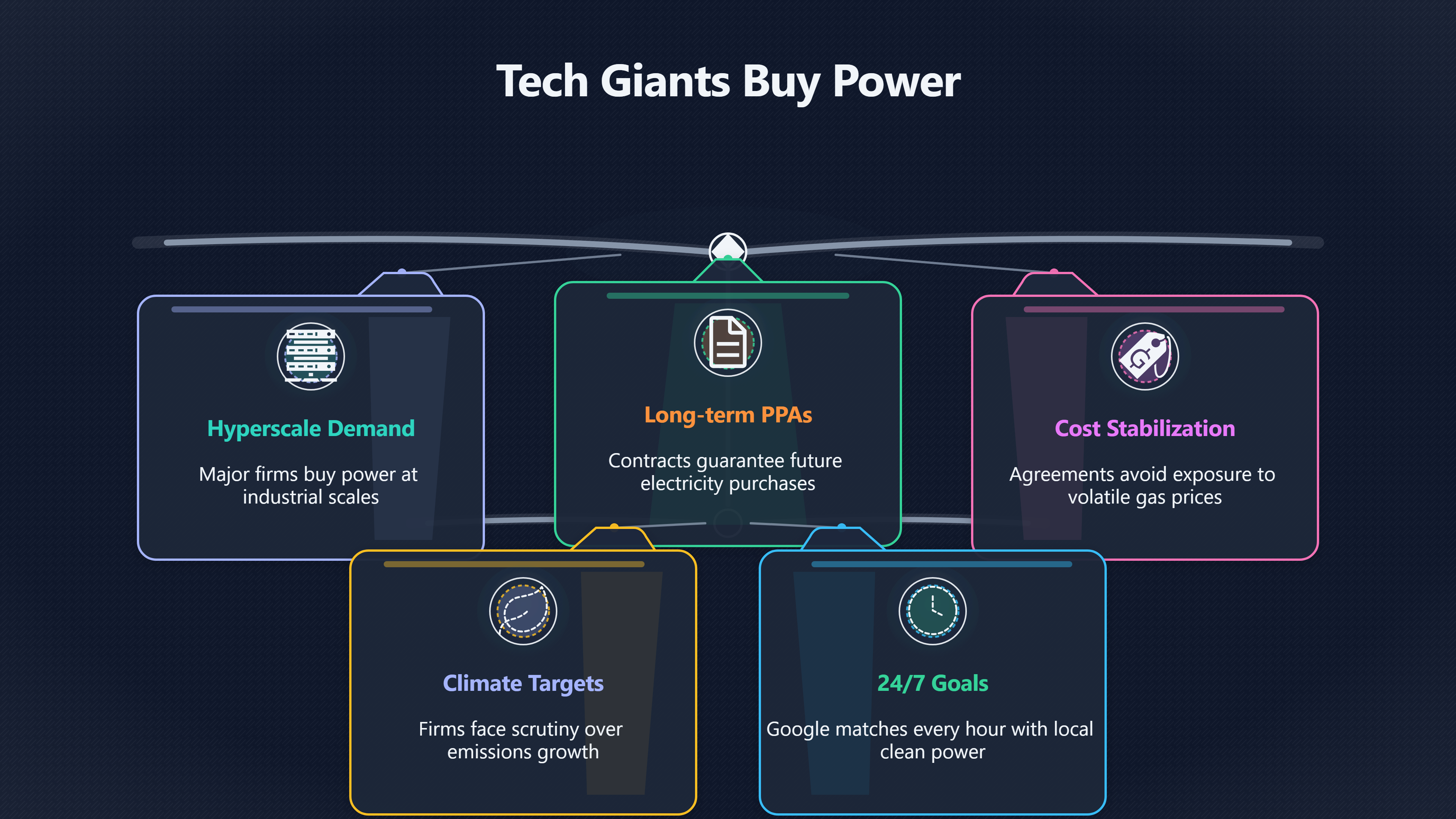
To manage both energy costs and climate commitments, tech firms increasingly use long-term power purchase agreements, usually called PPAs. These contracts allow companies to finance renewable projects by guaranteeing future electricity purchases over many years. In practice, this has turned big tech into one of the largest drivers of corporate clean-energy investment worldwide. Core Investments [2pv magazine USA]pv-magazine-usa.comdata centers lead global growth in corporate ppas14 Apr 2025 — Data centers continue to lead global corporate clean energy procurement efforts, with more than 17 GW of deals contracted i…
Amazon, Microsoft, Google and Meta collectively accounted for roughly half of global corporate clean-energy procurement deals in 2025 according to BloombergNEF reporting. [ESG Today]esgtoday.comESG TodayAmazon, Meta, Google, Microsoft Account for Half of Global…23 Feb 2026 — Amazon, Meta, Google, Microsoft Account for Half of…
That matters because AI demand is arriving during a broader global electrification push. Electric vehicles, heat pumps and industrial decarbonisation are already increasing demand for clean power. AI did not create the need for renewable expansion, but it is rapidly becoming one of the strongest accelerants.
Why renewable contracts matter
There are several reasons these contracts are important beyond public relations.
- They reduce financing risk for new projects. Wind farms, solar parks and battery installations become easier to fund when a major company guarantees long-term demand.
- They can stabilise electricity costs. Renewable PPAs help large computing firms avoid exposure to volatile gas prices.
- They create pressure for faster clean-energy deployment. Utilities and developers gain stronger incentives to build new capacity when hyperscalers are willing to sign multi-gigawatt deals.
- They support climate targets. AI firms increasingly face investor, regulatory and public scrutiny over emissions growth.
Some companies are also moving beyond annual renewable matching toward “24/7 carbon-free energy” goals. Google in particular has promoted the idea that every hour of data-centre operation should eventually be matched with local clean electricity rather than simply offset annually through certificates purchased elsewhere. [Introl]introl.comPower Purchase Agreements (PPAs) for AI Data CentersIntrolPower Purchase Agreements (PPAs) for AI Data Centers - IntrolMar 6, 2026 — Microsoft's landmark 10.5GW renewable energy PPAs, Googl…
This shift is important because it acknowledges a growing criticism of earlier renewable accounting systems.
Clean-energy claims do not always match local reality
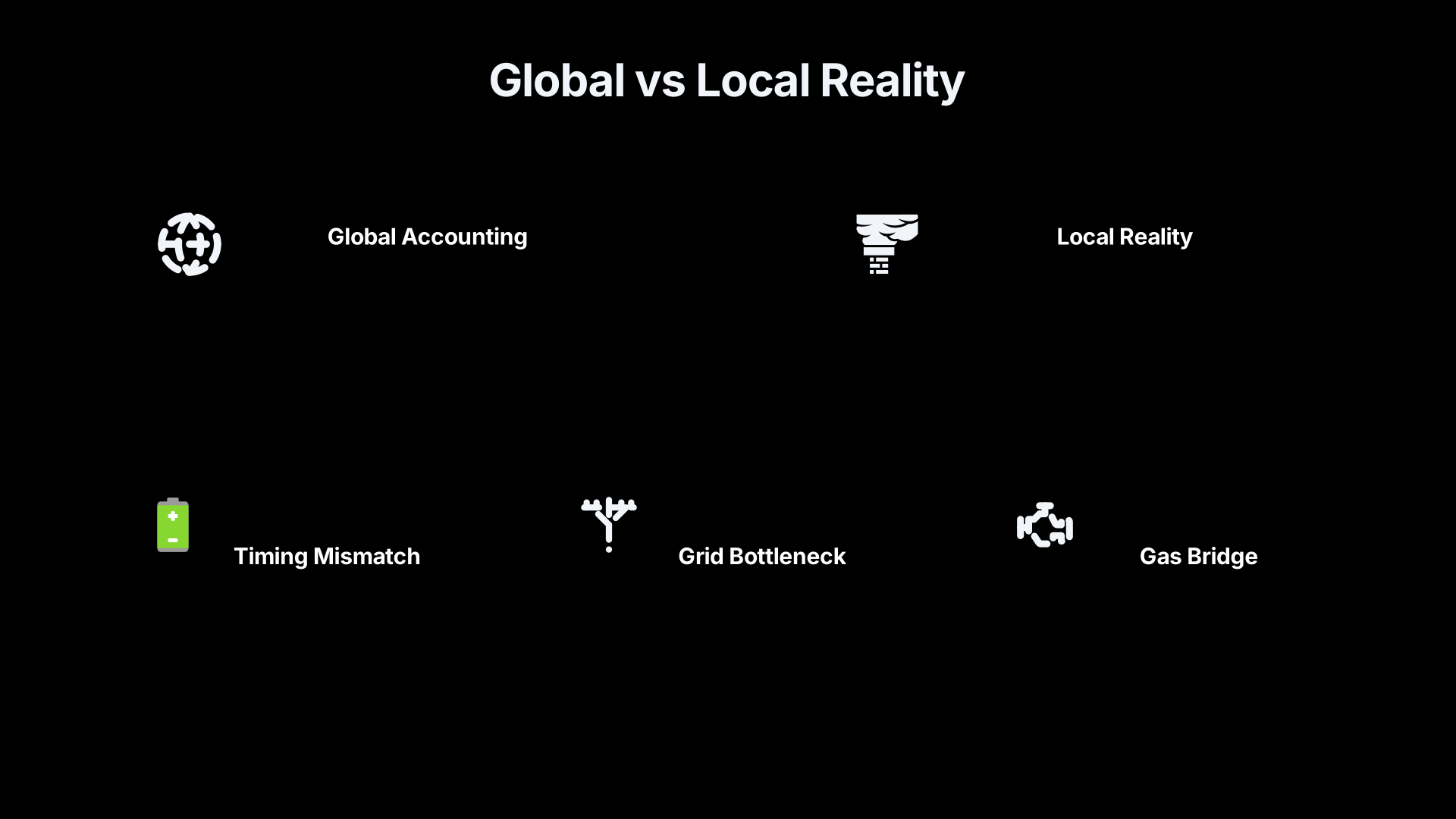
A major tension in AI energy debates is the difference between global accounting and physical electricity systems.
A technology company may claim its data centre runs on renewable energy because it has signed enough wind or solar contracts somewhere on the grid to match annual electricity use. But that does not necessarily mean the local grid serving the facility is clean at the moment the computers are operating.
A data centre in a coal-heavy or gas-heavy region can still increase fossil-fuel generation locally even if the company purchases renewable certificates from another state or country. Critics argue that this can make sustainability claims look stronger on paper than in operational reality. [Trellis]trellis.netstate ags challenge amazon google meta microsoft renewable claimsTrellisAmazon, Google, Meta and Microsoft renewable claims…9 Oct 2025 — 16 states challenge the tech companies' purchases of 'unbundle…
This distinction becomes especially important for AI because the newest facilities are extremely power-dense and often need reliable 24-hour electricity. Solar and wind generation are variable by nature. Without enough storage, transmission or flexible demand management, utilities may still rely on gas plants to maintain reliability during periods of low renewable output.
In other words, renewable procurement helps expand clean generation overall, but it does not automatically solve congestion, timing or local capacity problems.
The geography problem
The clean-energy challenge is highly regional.
The International Energy Agency projects that global data-centre electricity demand could rise to around 945 terawatt-hours by 2030, just under 3% of world electricity demand. Globally, this is large but manageable. [IEA]iea.orgenergy demand from aiIEAEnergy demand from AIFrom 2024 to 2030, data centre electricity consumption grows by around 15% per year, more than four times faster… [IEA]iea.orgIEAGrids – Electricity 2026 – AnalysisA lack of grid capacity is emerging as a critical bottleneck in many regions, driving higher levels…
The real pressure comes from concentration.
AI infrastructure tends to cluster near:
- existing cloud campuses
- fibre connections
- skilled labour
- tax incentives
- available land
- pre-existing grid access
That clustering can overwhelm local systems even when global electricity supply remains adequate.
A recent modelling study projected especially high local grid stress in places such as Virginia, Oregon and Ireland because AI data-centre growth is geographically concentrated rather than evenly distributed. [arXiv]arxiv.orgarXivConcentrated siting of AI data centers drives regional power-system stress under rising global compute demandMarch 13, 2026…
Northern Virginia illustrates the issue clearly. The region already hosts one of the world’s largest concentrations of data centres. Utilities there now face huge pressure to build transmission upgrades, substations and additional generation capacity fast enough to support continued AI expansion.
The bottleneck is often not renewable generation itself, but the infrastructure needed to move electricity where and when it is needed.
Why transmission limits still matter
Transmission lines are one of the least glamorous but most important constraints on AI-driven abundance.
Solar panels and wind farms can sometimes be built relatively quickly. High-voltage transmission projects often cannot. They require land agreements, environmental reviews, planning approvals and multi-jurisdiction coordination that may take many years.
The IEA warns that grid capacity shortages are becoming a major bottleneck globally, with interconnection queues for new electricity projects reaching record levels. [IEA]iea.orgIEAExecutive summary – Energy and AI – AnalysisElectricity demand for data centres more than doubles by 2030. Data centre electricity con…
This creates a mismatch in timelines:
- a data centre may be built in two or three years
- a transmission upgrade may take far longer
- a new nuclear plant may take a decade or more
- regional planning systems may move even slower
That mismatch has become one of the central infrastructure tensions in the AI boom.
The “stranded clean power” problem
Many renewable resources are far from the cities and industrial clusters demanding electricity.
Large solar projects may sit in deserts. Wind farms may be in remote plains or offshore regions. Without sufficient transmission, cheap clean electricity cannot always reach data-centre hubs.
This can lead to paradoxical outcomes:
- renewable projects wait years for grid connection
- data centres demand power immediately [iea.org]iea.orgIEAExecutive summary – Energy and AI – AnalysisElectricity demand for data centres more than doubles by 2030. Data centre electricity con…
- utilities fall back on nearby gas generation because it is dispatchable and faster to connect
The result is that clean electricity may exist in aggregate while local grids still become more fossil-dependent in practice.
Battery storage helps but does not fully solve the problem. Storage can smooth fluctuations and reduce peak demand, yet storage projects themselves face grid queues, permitting delays and supply-chain constraints. Reuters reported in 2026 that some US regions face data-centre connection delays of three to seven years despite rapid investment in battery systems. [Reuters]reuters.comare experiencing growing interest from AI data centers due to skyrocketing power demands. These battery energy storage systems—used to ba…
Whether gas expansion could slow decarbonisation
One of the biggest uncertainties is whether AI accelerates clean-energy investment faster than it accelerates fossil-fuel lock-in.
There are reasons for optimism. AI firms are helping finance unprecedented renewable deployment, and the economics of solar, wind and batteries have improved dramatically over the last decade. Some regions may ultimately build far more clean capacity because AI demand makes investment financially attractive.
But utilities and governments are also signalling renewed interest in gas-fired generation because it can provide stable electricity quickly.
A recent Union of Concerned Scientists analysis found that many utility plans cite data-centre growth as a reason to delay coal retirements or expand gas infrastructure. [The Union of Concerned Scientists]ucs.orgData Center Power Play report finalData Center Power Play report final
This is not purely ideological. Utilities face practical reliability obligations. AI facilities often want uninterrupted power and can impose sudden multi-gigawatt demand increases on local grids. Gas turbines remain one of the fastest ways to add firm generating capacity at scale.
Why this debate matters beyond emissions
The concern is not simply that AI might emit more carbon in the short term.
The deeper question is whether AI abundance becomes coupled to a durable clean-energy transition or whether it intensifies political conflict over electricity, land use and industrial expansion.
If households see:
- rising electricity bills
- delayed decarbonisation
- local environmental burdens
- scarce grid capacity diverted toward AI firms
then political resistance to both AI and clean-energy buildout may intensify together.
Recent polling and regional disputes already show growing backlash against data-centre expansion in some communities, especially where residents fear higher costs or strained infrastructure. [Tom's Hardware]tomshardware.compower grid—has identified AI data centers as the primary cause of a dramatic 75.5% increase in electricity prices in the region. Wholesal…
This matters for the broader AI bloom vision because long-term flourishing depends not only on technological capability, but also on social legitimacy and public consent.
Could AI eventually help solve the energy bottleneck?
There is a genuine possibility that advanced AI becomes part of the solution rather than merely a new source of demand.
The IEA argues that AI could improve electricity forecasting, grid balancing, industrial efficiency, materials discovery and clean-energy system optimisation. [IEA]iea.orgIEAAI is set to drive surging electricity demand from data…10 Apr 2025 — It projects that electricity demand from data centres worldwi…
Potential long-run effects include:
- faster discovery of battery chemistries
- improved nuclear engineering
- more efficient electricity markets [iea.org]iea.orgenergy demand from aiIEAEnergy demand from AIFrom 2024 to 2030, data centre electricity consumption grows by around 15% per year, more than four times faster…
- better transmission planning
- smarter demand management
- lower-cost fusion or geothermal development
- more efficient cooling systems and chip architectures
There are already signs of this dynamic. AI chip efficiency continues improving rapidly even as total demand rises. Researchers are also exploring ways to make data centres flexible loads that can adapt computational activity to periods of abundant renewable generation. [IEA]iea.orgIEAData centre electricity use surged in 2025, even with…16 Apr 2026 — As a result, electricity consumption from data centres is set t…
Some experimental work even examines whether waste heat from AI data centres could support carbon-removal systems or district heating networks. [arXiv]arxiv.orgarXivConcentrated siting of AI data centers drives regional power-system stress under rising global compute demandMarch 13, 2026…
Still, none of this removes the near-term infrastructure challenge. Efficiency gains help, but they may be outweighed by rapidly growing AI usage, larger models and more energy-intensive applications.
The likely outcome: strain, adaptation, then cleaner scaling
The most plausible medium-term outcome is neither effortless green abundance nor catastrophic energy collapse.
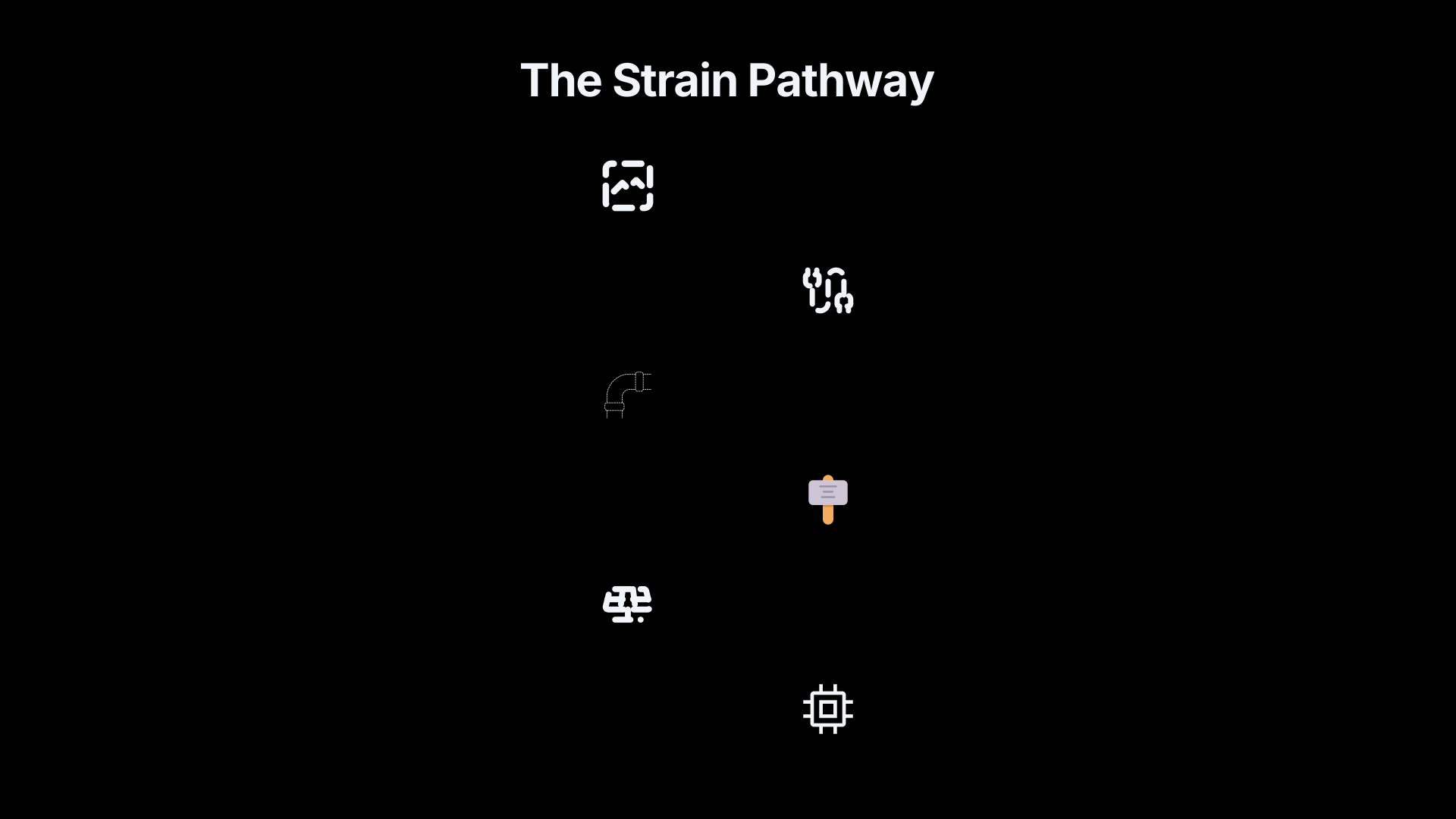
Instead, the evidence suggests a messy transition:
- AI sharply increases electricity demand in concentrated regions.
- Grids and transmission systems struggle to keep pace.
- Some areas expand gas generation to bridge reliability gaps.
- Renewable and storage investment accelerates further in response.
- Political conflict grows over who pays for infrastructure upgrades.
- Over time, cleaner systems gradually scale if permitting, transmission and storage improve.
Whether this becomes compatible with a flourishing long-term AI future depends heavily on policy and institutional choices made now.
The crucial variables are not only model capability or chip performance. They include:
- transmission reform
- faster grid permitting [* clean firm power deployment]mckinsey.comhow hyperscalers are fueling the race for 24 7 clean powerHow hyperscalers are fueling the race for 24/7 clean power18 Dec 2024 — 24/7 clean power purchase agreements are gaining global momentum… [* energy storage scaling]reuters.comare experiencing growing interest from AI data centers due to skyrocketing power demands. These battery energy storage systems—used to ba…
- regional planning
- public benefit-sharing
- electricity market design
- whether AI firms bear more infrastructure costs directly
If these systems evolve successfully, AI could become a major driver of clean-energy expansion and scientific acceleration at the same time. If they fail, electricity scarcity and political backlash may become one of the main constraints on any broader vision of AI-enabled abundance.
Endnotes
-
Source: iea.org
Title: energy demand from ai
Link: https://www.iea.org/reports/energy-and-ai/energy-demand-from-aiSource snippet
IEAEnergy demand from AIFrom 2024 to 2030, data centre electricity consumption grows by around 15% per year, more than four times faster...
-
Source: iea.org
Link: https://www.iea.org/reports/electricity-2026/gridsSource snippet
IEAGrids – Electricity 2026 – AnalysisA lack of grid capacity is emerging as a critical bottleneck in many regions, driving higher levels...
-
Source: pv-magazine-usa.com
Title: data centers lead global growth in corporate ppas
Link: https://pv-magazine-usa.com/2025/04/14/data-centers-lead-global-growth-in-corporate-ppas/Source snippet
14 Apr 2025 — Data centers continue to lead global corporate clean energy procurement efforts, with more than 17 GW of deals contracted i...
-
Source: introl.com
Title: Power Purchase Agreements (PPAs) for AI Data Centers
Link: https://introl.com/blog/power-purchase-agreements-ai-data-centers-renewable-energy-strategiesSource snippet
IntrolPower Purchase Agreements (PPAs) for AI Data Centers - IntrolMar 6, 2026 — Microsoft's landmark 10.5GW renewable energy PPAs, Googl...
-
Source: trellis.net
Title: state ags challenge amazon google meta microsoft renewable claims
Link: https://trellis.net/article/state-ags-challenge-amazon-google-meta-microsoft-renewable-claims/Source snippet
TrellisAmazon, Google, Meta and Microsoft renewable claims...9 Oct 2025 — 16 states challenge the tech companies' purchases of 'unbundle...
-
Source: iea.org
Link: https://www.iea.org/reports/energy-and-ai/executive-summarySource snippet
IEAExecutive summary – Energy and AI – AnalysisElectricity demand for data centres more than doubles by 2030. Data centre electricity con...
-
Source: iea.org
Link: https://www.iea.org/news/ai-is-set-to-drive-surging-electricity-demand-from-data-centres-while-offering-the-potential-to-transform-how-the-energy-sector-worksSource snippet
IEAAI is set to drive surging electricity demand from data...10 Apr 2025 — It projects that electricity demand from data centres worldwi...
-
Source: arxiv.org
Link: https://arxiv.org/abs/2604.06198Source snippet
arXivConcentrated siting of AI data centers drives regional power-system stress under rising global compute demandMarch 13, 2026...
Published: March 13, 2026
-
Source: reuters.com
Link: https://www.reuters.com/business/energy/battery-storage-firms-eye-ai-demand-face-grid-supply-hurdles-2026-05-18/Source snippet
are experiencing growing interest from AI data centers due to skyrocketing power demands. These battery energy storage systems—used to ba...
-
Source: iea.org
Link: https://www.iea.org/news/data-centre-electricity-use-surged-in-2025-even-with-tightening-bottlenecks-driving-a-scramble-for-solutionsSource snippet
IEAData centre electricity use surged in 2025, even with...16 Apr 2026 — As a result, electricity consumption from data centres is set t...
-
Source: arxiv.org
Title: arXiv Improving AI Efficiency in Data Centres by Power Dynamic Response
Link: https://arxiv.org/abs/2510.11119 -
Source: arxiv.org
Title: arXiv Recasting AI Data Centers as Engines for Carbon Removal
Link: https://arxiv.org/abs/2605.13114Source snippet
arXivRecasting AI Data Centers as Engines for Carbon RemovalMay 13, 2026...
Published: May 13, 2026
-
Source: iea.org
Link: https://www.iea.org/Source snippet
IEA – International Energy AgencyWe provide authoritative analysis, data, policy recommendations and solutions to ensure energy security...
-
Source: iea.org
Link: https://www.iea.org/data-and-statistics/charts/global-data-centre-capacity-additions-in-the-base-case-and-capacity-at-risk-of-connection-delay-due-to-grid-constraints-2025-2030Source snippet
of connection delay due to grid constraints, 2025-2030.Read more...
-
Source: news.microsoft.com
Title: 6 projects that helped microsoft meet its renewable energy goal
Link: https://news.microsoft.com/source/features/sustainability/6-projects-that-helped-microsoft-meet-its-renewable-energy-goal/Source snippet
microsoft.com6 projects that helped Microsoft meet its renewable energy...5 days ago — How Microsoft met its 2025 goal of matching 100%...
-
Source: arxiv.org
Link: https://arxiv.org/html/2509.07218v3Source snippet
Electricity Demand and Grid Impacts of AI Data Centers29 Sept 2025 — The rapid growth of artificial intelligence (AI) is driving an unpre...
-
Source: ucs.org
Title: Data Center Power Play report final
Link: https://www.ucs.org/sites/default/files/2026-01/Data-Center-Power-Play-report-final.pdf -
Source: esgtoday.com
Link: https://www.esgtoday.com/amazon-meta-google-microsoft-account-for-half-of-global-clean-energy-purchase-deals-in-2025-report/Source snippet
ESG TodayAmazon, Meta, Google, Microsoft Account for Half of Global...23 Feb 2026 — Amazon, Meta, Google, Microsoft Account for Half of...
-
Source: tomshardware.com
Link: https://www.tomshardware.com/tech-industry/ai-data-centers-trigger-massive-irreversible-76-percent-electricity-price-spike-in-largest-us-region-federal-watchdog-demands-tech-giants-pay-for-their-own-power-infrastructureSource snippet
power grid—has identified AI data centers as the primary cause of a dramatic 75.5% increase in electricity prices in the region. Wholesal...
-
Source: tomshardware.com
Link: https://www.tomshardware.com/tech-industry/big-tech/70-percent-of-americans-oppose-data-centers-near-their-homes-now-less-popular-than-nuclear-power-plants-opposition-towards-nearby-ai-infrastructure-heating-up-as-tech-companies-ramp-up-projects-to-acquire-more-computeSource snippet
Public backlash has intensified to the point where many Americans would prefer living near a nuclear power plant over a data center. Oppo...
-
Source: Wikipedia
Link: https://en.wikipedia.org/wiki/MicrosoftSource snippet
MicrosoftA Big Tech company, Microsoft is the largest software company by revenue, one of the most valuable public companies, and one...
-
Source: Wikipedia
Title: International Energy Agency
Link: https://en.wikipedia.org/wiki/International_Energy_AgencySource snippet
International Energy AgencyThe International Energy Agency (IEA) is a Paris-based autonomous intergovernmental organization, establish...
-
Source: opportunitygreen.org
Title: data centres
Link: https://opportunitygreen.org/data-centres/Source snippet
consumed around 1.5% of global electricity in 2024, according to The International Energy Agency (IEA). This figure could easily double b...
-
Source: mckinsey.com
Title: how hyperscalers are fueling the race for 24 7 clean power
Link: https://www.mckinsey.com/industries/electric-power-and-natural-gas/our-insights/how-hyperscalers-are-fueling-the-race-for-24-7-clean-powerSource snippet
How hyperscalers are fueling the race for 24/7 clean power18 Dec 2024 — 24/7 clean power purchase agreements are gaining global momentum...
Additional References
-
Source: merriam-webster.com
Link: https://www.merriam-webster.com/dictionary/dataSource snippet
DATA Definition & Meaning7 days ago — 1. factual information (such as measurements or statistics) used as a basis for reasoning, discussi...
-
Source: datacenterdynamics.com
Link: https://www.datacenterdynamics.com/en/news/big-tech-firms-account-for-49-of-corporate-clean-energy-deals-over-2025-report/Source snippet
Big tech firms account for 49% of corporate clean energy...4 days ago — Meta, Amazon, Google, and Microsoft dominate clean energy procur...
-
Source: iea-ebc.org
Link: https://www.iea-ebc.org/Source snippet
IEA EBC: International Energy Agency (IEA) Energy in...The IEA-EBC Programme is an international energy research and innovation programm...
-
Source: core.axa-im.com
Link: https://core.axa-im.com/responsible-investing/insights/leading-charge-surge-us-data-centre-growth-powering-renewable-energy-investment-opportunitiesSource snippet
Core InvestmentsSurge in US data centre growth is powering renewable energy...27 Sept 2024 — Amazon, Microsoft, Meta and Google are the...
-
Source: about.bnef.com
Title: corporate clean energy buying fell in 2025 after nearly a decade of growth
Link: https://about.bnef.com/insights/clean-energy/corporate-clean-energy-buying-fell-in-2025-after-nearly-a-decade-of-growth/Source snippet
BloombergNEFCorporate Clean Energy Buying Fell in 2025 After Nearly a...4 days ago — Our PPA database monitors offsite corporate clean e...
-
Source: theenergy.co
Title: ai data centres risk becoming victims of their own success iea warns
Link: https://theenergy.co/article/ai-data-centres-risk-becoming-victims-of-their-own-success-iea-warnsSource snippet
AI data centres risk becoming victims of their own success...19 Apr 2026 — “Though uncertainties are high,” the IEA concludes, around 15...
-
Source: spglobal.com
Title: 022825 data centers drive surge in clean energy procurement in 2024
Link: https://www.spglobal.com/energy/en/news-research/blog/energy-transition/022825-data-centers-drive-surge-in-clean-energy-procurement-in-2024Source snippet
Data centers drive surge in clean energy procurement...28 Feb 2025 — Google and Amazon signed long-term PPAs to source power from small...
-
Source: enainstitute.org
Title: artificial intelligence requires energy but under what conditions
Link: https://enainstitute.org/en/publication/artificial-intelligence-requires-energy-but-under-what-conditions/Source snippet
Artificial intelligence requires energy — but under what...30 Mar 2026 — In its central projection scenario, it estimates that global el...
-
Source: wwutilities.co.uk
Title: key role for gas networks in powering data centres of the future
Link: https://www.wwutilities.co.uk/news-and-blog/key-role-for-gas-networks-in-powering-data-centres-of-the-future/Source snippet
Key role for gas networks in powering data centres of the...30 Jun 2025 — Research suggests gas networks could accelerate the delivery o...
-
Source: nationalacademies.org
Link: https://www.nationalacademies.org/read/29101/chapter/7Source snippet
For decoupling the energy used for AI data centers from emissions, he said that each...Read more...
Amazon book picks
Further Reading
Books and field guides related to Clean Power for AI. Use these as the next step if you want deeper reading beyond the article.
Renewable Energy Transition: Strategies for Sustainable Syste...
Renewable Energy Transition: Strategies for Sustainable Systems, Clean Energy Policy, and Global Solutions offers an in-depth exploration...

The Clean Energy Transition
Is the goal of a transition to clean energy at all realistic? If so, how could it be accomplished? Climate change poses a formidable chal...

The Political Economy of Clean Energy Transitions
A volume on the political economy of clean energy transition in developed and developing regions, with a focus on the issues that differe...
eBay marketplace picks
Marketplace Samples
Example marketplace items related to this page. Use the search link to explore similar finds on eBay.

Example eBay listing
A.I. Artificial Intelligence Original Movie Poster Signed By Jude Law
USD 125.00 | Shipping USD 25.00 | US

Example eBay listing
Artificial Intelligence D/S Original Movie Poster - 27 x 40"
USD 19.50 | Shipping USD 13.65 | US

Example eBay listing
612388 Artificial Intelligence Movie Science Fiction Drama Wall Print Poster
USD 22.95 | Shipping USD 12.95 | JP

Example eBay listing
Companion - Artificial Intelligence Dark Comedy Cinema Film - POSTER 20"x30"
USD 23.99 | Free shipping | US

Example eBay listing
A.I. Artificial Intelligence Movie Film Poster Art Print
GBP 4.99 | Free shipping | GB

Example eBay listing
A I Artificial Intelligence 6 Movie Poster Art Print Print Classic Rare Gallery
GBP 49.00 | Free shipping | GB

Example eBay listing
AI - Artificial Intelligence (Poster + Slipcase) Blu-Ray
GBP 10.49 | Free shipping | GB

Example eBay listing
A. I. Artificial Intelligence. Jude Law. Original UK Video Poster.
GBP 8.11 | Shipping GBP 3.38 | GB
Topic Tree