Within AI Literacy
Homework Verification Routines
A small routine of checking sources, testing explanations and rewriting answers can turn chatbot use into active learning.
On this page
- A five step check before reusing AI output
- How to test whether an explanation is understood
- When to compare AI answers with human sources
Page outline Jump by section
Introduction
Students increasingly use chatbots to explain homework, generate summaries and draft essays. Used carefully, these systems can act like fast, always-available study partners. Used passively, they can create a dangerous illusion of understanding. The central problem is not simply cheating. It is whether students keep hold of judgement, verification and independent thinking while using tools that often sound more confident than they really are.
 Verification routines are one practical answer. A short habit of checking claims, testing explanations and comparing sources can turn chatbot use from passive copying into active learning. That matters immediately for schoolwork, but it also matters in a much larger sense. If advanced AI eventually becomes a major educational force in an age of AI abundance and cognitive empowerment, societies will need citizens who can work with machine intelligence without surrendering their ability to reason. The students who benefit most from AI are likely to be those who treat it as a tool for thinking, not a substitute for thinking.
Research increasingly supports this concern. Studies of student experiences with AI hallucinations repeatedly find fabricated citations, misleading explanations and overconfident answers that appear trustworthy at first glance. [arXiv]arxiv.orgarXiv AI Hallucination from Students' Perspective: A Thematic AnalysisarXivAI Hallucination from Students' Perspective: A Thematic AnalysisJanuary 11, 2026… 2arXiv UNESCO’s guidance on generative AI in education argues that critical thinking and human judgement must remain central as AI systems become more common in classrooms. UNESCO [UNESCO in the UK]unesco.org.ukUNESCO in the UKGuidance for generative AI in education and researchThe publication offers concrete recommendations for policy-makers and…
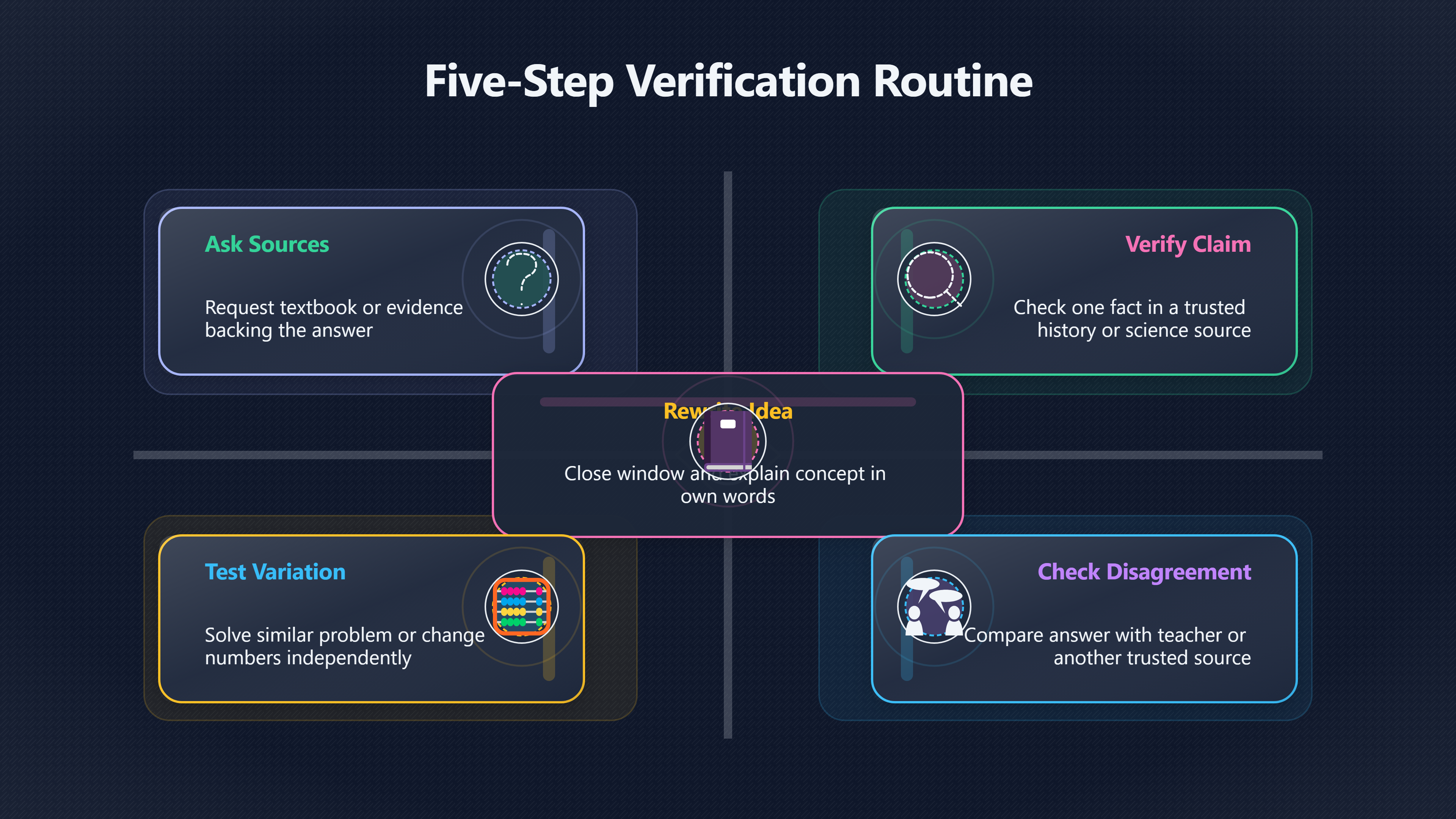
A five-step check before reusing AI output
A good verification routine should be quick enough that students actually use it. The aim is not perfection. It is to slow down automatic trust.
Step 1: Ask where the answer came from
Before copying anything into notes or homework, students should ask the chatbot to identify its sources, assumptions or reasoning path.
Useful prompts include:
- “Which textbook or source supports this?”
- “What evidence is this based on?”
- “Which parts are uncertain or debated?”
- “Can you give a direct quotation and page reference?”
This does not guarantee reliability. Chatbots can fabricate references that look authentic. Multiple studies have documented fake academic citations generated by large language models. [Nature]nature.comNatureFabrication and errors in the bibliographic citations…by WH Walters · 2023 · Cited by 504 — This study investigates one particul… [Nature]nature.comNatureHallucinated citations are polluting the scientific literature….Apr 1, 2026 — Tens of thousands of publications from 2025 might… But asking for sources forces the student to move from passive consumption to inspection.
A strong warning sign is specificity without traceability: precise statistics, quotations or journal references that cannot easily be found elsewhere. Researchers studying student encounters with AI hallucinations found fabricated citations were one of the most common problems learners reported. [arXiv]arxiv.orgarXiv AI Hallucination from Students' Perspective: A Thematic AnalysisarXivAI Hallucination from Students' Perspective: A Thematic AnalysisJanuary 11, 2026…
Step 2: Verify one concrete claim independently
Students do not need to fact-check every sentence. But they should independently verify at least one key factual claim in every substantial AI-generated answer.
For example:
- In history: check the date, quotation or event in a trusted history source.
- In science: compare the explanation with a class textbook or reputable educational site.
- In literature: confirm that quoted passages actually appear in the text.
- In mathematics: solve the problem independently or substitute values back into the equation.
This small habit creates an important psychological shift. The chatbot stops feeling like an authority and starts feeling like a draft assistant whose work must be reviewed.
The need for this is not hypothetical. Fabricated AI citations and invented references are now appearing not only in student work but also in professional and academic settings. Analyses in Nature, Retraction Watch and other outlets have documented growing numbers of hallucinated references entering scientific literature. Nature [Retraction Watch]retractionwatch.comOne in 277 PubMed-indexed papers in 2026 shows…6 days ago — Topaz's group located the sharpest increase in hallucinated references in…
Step 3: Rewrite the explanation in your own words
One of the simplest tests of understanding is translation into ordinary language.
After reading an AI explanation, students should close the chatbot window and explain the idea again from memory:
- as a short paragraph,
- as bullet points,
- or as if teaching a younger student.
If they cannot restate the concept clearly without looking back, they probably do not yet understand it.
This matters because fluent AI explanations can create “false mastery”: the feeling of understanding without the ability to apply knowledge independently. Educational researchers increasingly worry that students may confuse recognition with comprehension when reading polished AI summaries. [arXiv]arxiv.orgarXiv AI Hallucination from Students' Perspective: A Thematic AnalysisarXivAI Hallucination from Students' Perspective: A Thematic AnalysisJanuary 11, 2026…
Step 4: Test the answer with a variation
Real understanding survives changes in wording or context.
After getting help from AI, students should slightly alter the problem:
- change the numbers in a maths question,
- apply the scientific concept to a new example,
- ask for the opposite interpretation in an essay topic,
- or solve a similar problem without assistance.
If understanding collapses immediately, the student was probably following the chatbot mechanically rather than learning the underlying principle.
This is especially important because chatbots can produce explanations that sound coherent while containing subtle logical mistakes. Research involving novice medical learners found that misleading AI explanations reduced diagnostic accuracy, while correct explanations offered much smaller gains than many people expected. [Nature]nature.comNatureImpact of AI misinformation on diagnostic accuracy and…by D Teng · 2026 · Cited by 1 — Our results reveal a significant and prob… Plausible misinformation can therefore be educationally harmful even when it appears sophisticated.
Step 5: Check for disagreement
Students should occasionally ask a second source the same question.
That might mean:
- another chatbot,
- a teacher,
- a classmate,
- a textbook,
- or a reputable educational website.
The goal is not to average opinions mechanically. It is to notice disagreement. Contradictions are often the moment when critical thinking begins.
If two systems produce different answers, students are forced to ask:
- Which explanation has evidence?
- Which defines terms more clearly?
- Which acknowledges uncertainty?
- Which aligns with the course material?
This habit mirrors a deeper principle in science and scholarship: knowledge becomes stronger when claims survive comparison, criticism and replication.
How to test whether an explanation is actually understood
Many students judge understanding by familiarity. AI systems make this problem worse because they generate explanations that feel smooth and personalised.
A more reliable test is performance.
The “blank page” test
After reading the explanation, students should try to answer the original question from scratch without reopening the chatbot.
If they can only reproduce fragments or keywords, the knowledge has not stabilised.
This is uncomfortable but valuable. Learning often feels harder when it is working properly because the brain is actively reconstructing information rather than merely recognising it.
The “why” ladder
Students should ask “why?” repeatedly until they reach a point where they genuinely cannot explain the next step.
For example:
- Why does photosynthesis require sunlight?
- Why does sunlight matter to chlorophyll?
- Why does chlorophyll absorb certain wavelengths?
This method exposes shallow memorisation quickly. AI-generated summaries often compress causal chains so efficiently that students miss gaps in understanding.
The “wrong answer” exercise
One surprisingly effective method is to ask the chatbot for a deliberately flawed explanation and then identify the mistakes.
For example:
- “Give me an incorrect explanation of natural selection.”
- “Write a weak argument for this essay question.”
- “Show a common algebra mistake.”
This transforms AI into a tool for error detection rather than passive answer production. It also mirrors how experts often learn: by diagnosing mistakes, not merely reading correct solutions.
The delayed recall check
If students revisit the topic a day later and cannot explain the core idea, the original session probably produced temporary familiarity rather than durable learning.
Long-term retention matters more than immediate fluency. In an AI-rich educational future, memorising isolated facts may become less important, but the ability to build stable mental models will remain essential.
When to compare AI answers with human sources
Students do not need to verify every trivial homework question with a human expert. But some situations deserve stronger checking routines.
Compare with human sources when the topic is controversial
Chatbots often flatten disagreement into a single confident narrative. In politics, ethics, history and economics, this can hide genuine debate.
Students should compare AI summaries with:
- teacher guidance,
- academic articles,
- primary historical sources,
- or established educational materials.
This matters because large language models optimise for plausibility and helpfulness, not balanced scholarly interpretation.
Compare with humans when the stakes are high
University applications, coursework submissions, scientific reports and exam preparation deserve stronger verification than casual revision notes.
Professional failures already show why. Lawyers, consultants and researchers have repeatedly submitted AI-generated material containing fabricated references or false claims. [Financial Times]ft.comFinancial Times EY retracts study after researchers discover AI hallucinationsThe flawed document, used by EY Canada to promote its cybersecurity services, was removed following an investigation by research group GP… [San Francisco Chronicle]sfchronicle.comSan Francisco Chronicle California lawyers can't quit AIA recent example involves attorney Jessica Barsotti, who cited three nonexistent cases in defense of a fired officer in a lawsuit against… Even experts sometimes miss these errors.
Students are usually less equipped than professionals to detect subtle inaccuracies because they are still building foundational knowledge.
Compare with humans when the explanation feels “too easy”
A suspiciously smooth explanation can be a warning sign.
Real learning often includes friction:
- ambiguity,
- competing interpretations,
- exceptions,
- or unresolved questions.
If an AI explanation makes a difficult subject feel effortless immediately, students should pause and verify whether complexity has been oversimplified away.
Compare with humans when emotional or personal advice appears
Students increasingly use AI systems not only for homework but also for motivation, emotional reassurance and decision-making. Surveys suggest many young users place significant trust in AI systems even when they have received little formal guidance on evaluating them. Common Sense Media [Parents Teachers]parents.comare increasingly interacting with AI tools. The findings reveal that 65% of the girls using AI-powered voice assistants, such as Alexa or…, parents and mentors still matter because education is not merely information transfer. Human educators notice confusion, emotional context, motivation and misunderstanding in ways chatbots currently handle poorly.
Why verification routines matter beyond homework
At first glance, checking chatbot answers may seem like a narrow study skill. In reality, it is part of a larger cultural transition.
If advanced AI systems eventually provide billions of people with near-instant access to tutoring, research assistance and cognitive support, humanity could gain extraordinary educational leverage. Optimists argue this could contribute to a broader AI-enabled flourishing: wider scientific literacy, faster innovation, expanded creativity and more people able to participate in intellectual work once limited to elites.
But abundance of information does not automatically create wisdom.
A society flooded with persuasive machine-generated text could also produce new forms of confusion, dependency and manipulation. Verification routines are therefore not just classroom habits. They are early training in epistemic resilience: the ability to judge what is true, uncertain or misleading in an environment where synthetic information becomes cheap and ubiquitous.
The long-term value of AI in education may depend less on whether chatbots can answer questions and more on whether students learn to interrogate answers intelligently.
A practical routine students can remember
For everyday homework use, a compact routine is often enough:
- Ask the chatbot for sources or reasoning.
- Verify one important claim independently.
- Rewrite the idea in your own words.
- Solve a variation without help.
- Compare with a human or trusted source when the topic is important, controversial or suspiciously simple.
The goal is not to reject AI assistance. It is to preserve human judgement inside AI-assisted learning.
Students who build these habits now are not merely protecting themselves from hallucinations or fabricated citations. They are learning how to think in a world where intelligence itself may become increasingly abundant, automated and difficult to evaluate at a glance. UNESCO [2ibe.unesco.org]ibe.unesco.orgcritical thinking and generative artificial intelligence26 Mar 2024 — Critical thinking is a staple of a good education: it comes from the Greek word “criticos”, meaning to judge…
Endnotes
-
Source: arxiv.org
Title: arXiv AI Hallucination from Students’ Perspective: A Thematic Analysis
Link: https://arxiv.org/abs/2602.17671Source snippet
arXivAI Hallucination from Students' Perspective: A Thematic AnalysisJanuary 11, 2026...
Published: January 11, 2026
-
Source: arxiv.org
Link: https://arxiv.org/pdf/2602.17671Source snippet
AI Hallucination from Students' Perspective: A Thematic...by A Shoufan · 2026 · Cited by 1 — Hallucinations can manifest as fabricated c...
-
Source: nature.com
Link: https://www.nature.com/articles/s41598-023-41032-5Source snippet
NatureFabrication and errors in the bibliographic citations...by WH Walters · 2023 · Cited by 504 — This study investigates one particul...
-
Source: unesco.org
Title: guidance generative ai education and research
Link: https://www.unesco.org/en/articles/guidance-generative-ai-education-and-researchSource snippet
UNESCOGuidance for generative AI in education and researchJan 16, 2026 — UNESCO's first global guidance on GenAI in education aims to sup...
-
Source: unesco.org.uk
Link: https://unesco.org.uk/resources/guidance-for-generative-ai-in-education-and-researchSource snippet
UNESCO in the UKGuidance for generative AI in education and researchThe publication offers concrete recommendations for policy-makers and...
-
Source: ibe.unesco.org
Title: critical thinking and generative artificial intelligence
Link: https://www.ibe.unesco.org/en/articles/critical-thinking-and-generative-artificial-intelligenceSource snippet
26 Mar 2024 — Critical thinking is a staple of a good education: it comes from the Greek word “criticos”, meaning to judge...
-
Source: nature.com
Link: https://www.nature.com/articles/d41586-026-00969-zSource snippet
NatureHallucinated citations are polluting the scientific literature....Apr 1, 2026 — Tens of thousands of publications from 2025 might...
-
Source: arxiv.org
Link: https://arxiv.org/abs/2605.07723 -
Source: nature.com
Link: https://www.nature.com/articles/s41746-026-02547-zSource snippet
NatureImpact of AI misinformation on diagnostic accuracy and...by D Teng · 2026 · Cited by 1 — Our results reveal a significant and prob...
-
Source: parents.com
Link: https://www.parents.com/new-data-shows-some-girls-are-turning-to-ai-as-a-friend-11974723Source snippet
are increasingly interacting with AI tools. The findings reveal that 65% of the girls using AI-powered voice assistants, such as Alexa or...
-
Source: unesdoc.unesco.org
Link: https://unesdoc.unesco.org/ark%3A/48223/pf0000386693Source snippet
for generative AI in education and research...
-
Source: unesco.org
Title: What’s worth measuring?
Link: https://www.unesco.org/en/articles/whats-worth-measuring-future-assessment-ai-ageSource snippet
The future of assessment in...27 Oct 2025 — This think piece explores the implications of AI for assessment and argues that we must shif...
-
Source: neqmap.bangkok.unesco.org
Title: UNESCO Guidance and AI frameworks
Link: https://neqmap.bangkok.unesco.org/wp-content/uploads/2023/09/UNESCO-Guidance-and-AI-frameworks.pdfSource snippet
Automating output generation across all symbolic representations of human thinking: natural language, images, sounds, music, software cod...
-
Source: unesco.org
Title: Artificial intelligence in education
Link: https://www.unesco.org/en/digital-education/artificial-intelligenceSource snippet
AIUNESCO AI in Education guides the ethical use of artificial intelligence to enhance learning, teaching, and assessment globally...
-
Source: courier.unesco.org
Title: learning think ai era
Link: https://courier.unesco.org/en/articles/learning-think-ai-eraSource snippet
to think in the AI era7 Apr 2026 — If generative AI technologies can “write” essays, “solve” complex equations, and “code” better than mo...
-
Source: retractionwatch.com
Link: https://retractionwatch.com/2026/05/07/one-in-277-pubmed-indexed-papers-in-2026-shows-fabricated-references-says-analysis/Source snippet
One in 277 PubMed-indexed papers in 2026 shows...6 days ago — Topaz's group located the sharpest increase in hallucinated references in...
-
Source: ft.com
Title: Financial Times EY retracts study after researchers discover AI hallucinations
Link: https://www.ft.com/content/a61cbcae-95e4-4449-86e1-ef40fb306f4eSource snippet
The flawed document, used by EY Canada to promote its cybersecurity services, was removed following an investigation by research group GP...
Published: May 15, 2026
-
Source: sfchronicle.com
Title: San Francisco Chronicle California lawyers can’t quit AI
Link: https://www.sfchronicle.com/politics/article/lawyers-ai-22247802.phpSource snippet
A recent example involves attorney Jessica Barsotti, who cited three nonexistent cases in defense of a fired officer in a lawsuit against...
-
Source: commonsensemedia.org
Title: research brief teens trust and technology in the age of ai
Link: https://www.commonsensemedia.org/research/research-brief-teens-trust-and-technology-in-the-age-of-aiSource snippet
Common Sense MediaResearch Brief: Teens, Trust, and Technology in the Age of AI29 Jan 2025 — This new research brief examines how US teen...
-
Source: commonsensemedia.org
Link: https://www.commonsensemedia.org/press-releases/new-report-shows-students-are-embracing-artificial-intelligence-despite-lack-of-parent-awareness-andSource snippet
New Report Shows Students Are Embracing Artificial...18 Sept 2024 — Survey from Common Sense Media sheds light on how young people are u...
-
Source: commonsensemedia.org
Title: 2024 the dawn of the ai era final release for web
Link: https://www.commonsensemedia.org/sites/default/files/research/report/2024-the-dawn-of-the-ai-era_final-release-for-web.pdfSource snippet
March 15–April 20, 2024, with 1,045 young people age 13–18 and their parents. Noteworthy...Read more...
Published: April 20, 2024
-
Source: commonsensemedia.org
Link: https://www.commonsensemedia.org/research/the-dawn-of-the-ai-era-teens-parents-and-the-adoption-of-generative-ai-at-home-and-schoolSource snippet
The Dawn of the AI Era: Teens, Parents, and the Adoption...18 Sept 2024 — Young people are already using generative AI tools for fun and...
-
Source: commonsensemedia.org
Link: https://www.commonsensemedia.org/sites/default/files/research/report/commonsensemedia_generationai.pdfSource snippet
Generation AI: What Kids and Families Think About AITo better understand parents' and youths' experiences with and reactions to AI, Lake...
-
Source: commonsensemedia.org
Title: a new look at families attitudes on ai
Link: https://www.commonsensemedia.org/research/a-new-look-at-families-attitudes-on-aiSource snippet
A New Look at Families' Attitudes on AI9 Mar 2026 — Our brand-new report reveals that kids are more optimistic about AI than parents, but...
-
Source: commonsensemedia.org
Title: parents ultimate guide to generative ai
Link: https://www.commonsensemedia.org/articles/parents-ultimate-guide-to-generative-aiSource snippet
Parents' Ultimate Guide to Generative AI17 Sept 2024 — Whether it's helping with homework, creating art, or answering questions, gen AI i...
-
Source: commonsensemedia.org
Link: https://www.commonsensemedia.org/press-releases/new-report-uncovers-young-peoples-patterns-of-use-and-concerns-about-generative-aiSource snippet
New Report Uncovers Young People's Patterns of Use...Jun 3, 2024 — This study examines generative AI use by race and ethnicity, age, ge...
-
Source: unesco-asp.dk
Link: https://unesco-asp.dk/wp-content/uploads/2025/02/AI-Competency-framework-for-teachers_UNESCO_2024.pdfSource snippet
AI competency framework for teachersHowever, AI can pose significant risks to students, the teaching [community]({{ 'ai-bloom-abun/ai-bloom-abun-98d3a6-long-future-b-29cc56-abundant-know-ca00d9-community-hea-3d87fb/' | relative...
Additional References
-
Source: ai.google
Title: Google AI
Link: https://ai.google/Source snippet
How we're making AI helpful for everyoneDiscover how Google AI is committed to enriching knowledge, solving complex challenges and helpin...
-
Source: edweek.org
Title: teens say they should be able to use ai to complete assignments parents disagree
Link: https://www.edweek.org/technology/teens-say-they-should-be-able-to-use-ai-to-complete-assignments-parents-disagree/2026/03Source snippet
Teens Say They Should Be Able to Use AI to Complete...9 Mar 2026 — More than half of teens—52%—said using AI for school assignments is i...
-
Source: emerald.com
Link: https://www.emerald.com/ils/article/126/7-8/491/1268297/Guidelines-for-learning-design-and-assessment-forSource snippet
23, 2025 — Reforming both learning design and assessment in GenAI-enhanced learning environments is crucial not only fo...
-
Source: enago.com
Link: https://www.enago.com/articles/ai-hallucinations-research-citations/Source snippet
AI Hallucinations in Research: Why 40% of AI Citations Are...6 days ago — AI hallucinations occur when generative AI systems produce pla...
-
Source: school-education.ec.europa.eu
Title: guidance generative ai education and research
Link: https://school-education.ec.europa.eu/en/discover/publications/guidance-generative-ai-education-and-researchSource snippet
for generative AI in education and research5 Apr 2024 — UNESCO's first global guidance on generative artificial intelligence (GenAI) in e...
-
Source: inra.ai
Title: ai hallucinations
Link: https://www.inra.ai/blog/ai-hallucinationsSource snippet
in Research: What They Are & How to StopNov 1, 2025 — In academic research, AI hallucinations can lead to citing non-existent papers, pro...
-
Source: flagler.libguides.com
Link: https://flagler.libguides.com/c.php?g=1449135&p=11049371Source snippet
Hallucinations & The Imperative of VerificationApr 4, 2026 — Common examples of AI hallucinations include: Fabricated citations: Generati...
-
Source: redalyc.org
Link: https://www.redalyc.org/journal/3314/331481521024/html/Source snippet
Generative AI and critical thinking in online higher educationby CM Martínez · 2025 · Cited by 3 — GAI tools can enhance critical thinkin...
-
Source: researchgate.net
Link: https://www.researchgate.net/publication/395225908_Student_Perceptions_of_AI-Assisted_Writing_and_Academic_Integrity_Ethical_Concerns_Academic_Misconduct_and_Use_of_Generative_AI_in_Higher_EducationSource snippet
(PDF) Student Perceptions of AI-Assisted Writing and...Sep 5, 2025 — These findings suggest that many students do not treat AI use in le...
-
Source: researchgate.net
Link: https://www.researchgate.net/publication/385105010_UNESCO_Proposal_for_the_use_of_Generative_AI_in_Education_Eight_Challenges_and_Seven_ActionsSource snippet
UNESCO Proposal for the use of Generative AI in Education31 Oct 2024 — This proposal explores the integration of Generative Artificial In...
Amazon book picks
Further Reading
Books and field guides related to Homework Verification Routines. Use these as the next step if you want deeper reading beyond the article.
Study Skills for Successful Students
Studying successfully at high school, college or university requires more than discipline, diligence and determination. Students must als...
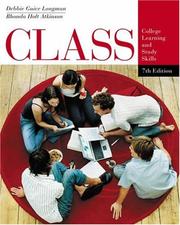
College learning and study skills
First published 1988. Subjects: Study skills, College student orientation, Active learning, Higher, Education / Teaching.
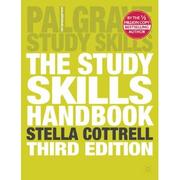
The study skills handbook
First published 1999. Subjects: Study skills, Test-taking skills, Handbooks, manuals, Research, Study & learning skills: general.
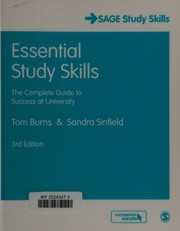
Essential Study Skills
First published 2008. Subjects: Study skills, Studium, Education, Lerntechnik, College student orientation.
eBay marketplace picks
Marketplace Samples
Example marketplace items related to this page. Use the search link to explore similar finds on eBay.
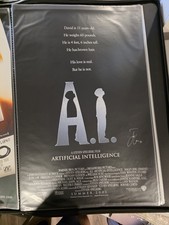
Example eBay listing
A.I. Artificial Intelligence Original Movie Poster Signed By Jude Law
USD 125.00 | Shipping USD 25.00 | US
Example eBay listing
Artificial Intelligence D/S Original Movie Poster - 27 x 40"
USD 19.50 | Shipping USD 13.65 | US
Example eBay listing
612388 Artificial Intelligence Movie Science Fiction Drama Wall Print Poster
USD 22.95 | Shipping USD 12.95 | JP

Example eBay listing
Companion - Artificial Intelligence Dark Comedy Cinema Film - POSTER 20"x30"
USD 23.99 | Free shipping | US
Topic Tree