Within Long Future
Medicine Still Scarce
AI may speed discovery, but drugs remain scarce when trials, manufacturing, pricing, and health systems fail to deliver them fairly.
On this page
- Discovery is not delivery
- Trials, factories, prices, and clinics
- What broad medical abundance would require
Page outline Jump by section
Introduction
A future of medical abundance would not simply mean discovering more drugs. It would mean that people can reliably obtain life-saving treatment regardless of where they live, how much money they have, or whether their health system functions well. That is a much harder problem than laboratory discovery alone.
 AI systems may help researchers identify promising molecules faster, predict protein structures, automate parts of clinical research, and personalise treatments. Pharmaceutical companies and research institutions are already using machine learning across drug discovery and manufacturing. [GOV.UK]GOV.UKLife Sciences Sector PlanSeptember 12, 2025 — 16 Jul 2025 — AI is revolutionising the Life Sciences sector across research, diagnostics, treatment, and manufactur… [GSK]gsk.comTechThrough the use of data, AI and machine learning, we can unravel the mysteries of disease to design our vaccines and medicines to opt… But even if AI sharply accelerates medical science, medicine can still remain scarce because scarcity is often created by institutions, supply chains, pricing systems, patents, regulation, manufacturing limits, and unequal healthcare infrastructure rather than by a lack of scientific knowledge.
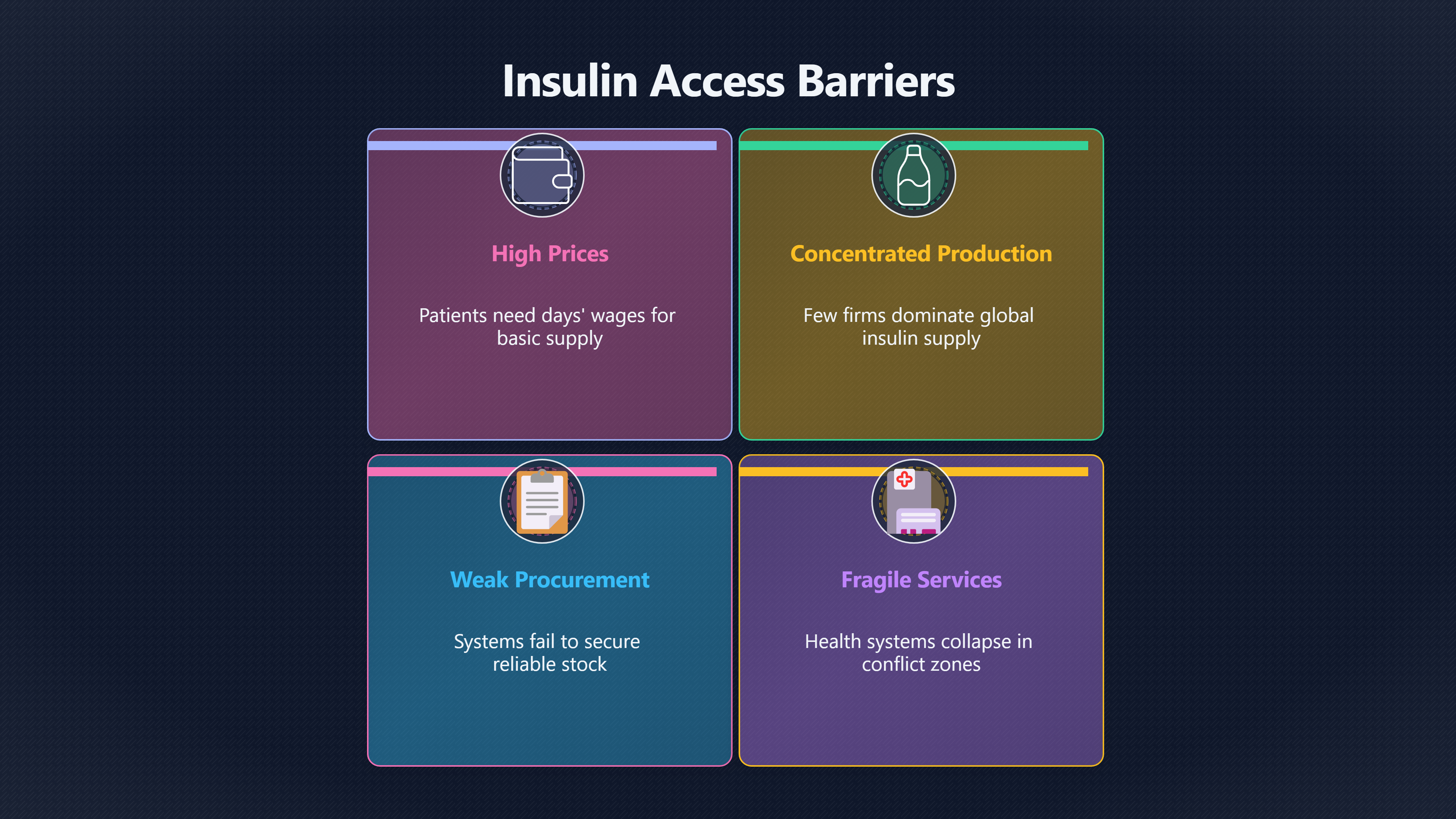
Insulin is one of the clearest examples. More than a century after its discovery, many patients in poorer countries still cannot reliably access it because of high prices, concentrated production, weak procurement systems, and fragile health services. BMJ Global Health [World Health Organization]who.intWorld Health OrganizationNew WHO report maps barriers to insulin availability and…12 Nov 2021 — A new report published by WHO in the l… [PMC]pmc.ncbi.nlm.nih.govPMCAdvancements and challenges in next-generation mRNA…by SH Seo · 2025 · Cited by 9 — This review evaluates the technical and economi… The lesson matters for the broader AI bloom debate. Scientific acceleration alone does not automatically produce broad human flourishing. Discovery is not the same thing as delivery.
Discovery is not delivery
One of the most common misunderstandings in discussions about AI and medicine is the assumption that once a cure or treatment exists, the scarcity problem is largely solved. In reality, discovery is only the beginning of a long and expensive chain.
A medicine typically passes through several stages before a patient receives it:
- basic scientific discovery
- preclinical testing
- multiple phases of human clinical trials
- regulatory approval
- large-scale manufacturing
- international distribution
- national procurement
- hospital and pharmacy delivery
- long-term monitoring and financing
AI may compress some parts of this pipeline, especially target identification, molecule screening, protein modelling, and parts of manufacturing optimisation. [Sanofi]sanofi.comDigital Transformation and Artificial IntelligenceDiscover how Sanofi's digital transformation accelerates drug discovery, clinical devel… [GOV.UK]GOV.UKLife Sciences Sector PlanSeptember 12, 2025 — 16 Jul 2025 — AI is revolutionising the Life Sciences sector across research, diagnostics, treatment, and manufactur… [GSK]gsk.comTechThrough the use of data, AI and machine learning, we can unravel the mysteries of disease to design our vaccines and medicines to opt… But the rest of the chain still depends on physical infrastructure, institutions, skilled workers, regulators, financing systems, and political coordination.
The COVID-19 pandemic demonstrated both sides of this reality at once. mRNA vaccines were designed with extraordinary speed, helped by decades of biotechnology research and computational tools. Yet access remained deeply unequal for years because production capacity, supply agreements, export controls, cold-chain logistics, and intellectual property arrangements concentrated supply in richer countries. WHO later launched an mRNA technology transfer programme partly because so much vaccine manufacturing capability was geographically concentrated. [World Health Organization]who.intWorld Health OrganizationNew WHO report maps barriers to insulin availability and…12 Nov 2021 — A new report published by WHO in the l…
This distinction between scientific capability and delivery capability runs through much of global medicine.
Trials, factories, prices, and clinics
Clinical trials are expensive and slow
Even promising therapies can fail to reach patients because clinical trials remain costly, risky, and bureaucratically demanding. Trials often require thousands of participants, years of follow-up, specialist staff, and regulatory compliance across multiple jurisdictions.
This creates several bottlenecks at once:
- small patient populations may struggle to recruit enough participants
- poorer countries may lack trial infrastructure
- treatments for rare or unprofitable diseases attract less investment
- older off-patent drugs may not generate enough commercial return to justify large trials
Some potentially valuable treatments are abandoned not because they look scientifically hopeless, but because no actor sees a viable financial path through the approval system. [The Guardian]theguardian.comThe Guardian Many life-saving drugs fail for lack of fundingBut there's a solution: desperate rich peopleMarch 11, 2025 — The article discusses the significant issue of abandoned life-saving drugs…
AI could reduce some costs by improving trial design, predicting side effects earlier, or identifying suitable patients faster. But unless approval systems, incentives, and public financing also evolve, many therapies may still stall between laboratory promise and widespread clinical use.
Manufacturing is a hidden source of scarcity
Medicines are not pure information. They are physical products that require factories, sterile environments, specialised chemicals, biological ingredients, quality control, refrigeration, transport networks, and reliable electricity.
Advanced biologic medicines are especially difficult to manufacture consistently. mRNA platforms, antibody therapies, and cell-based treatments may depend on highly specialised production systems concentrated in relatively few countries and companies. PMC [World Health Organization]who.intWorld Health OrganizationNew WHO report maps barriers to insulin availability and…12 Nov 2021 — A new report published by WHO in the l…
Even relatively old medicines can become scarce when supply chains fail. WHO assessments have repeatedly identified stockouts, weak distribution systems, and procurement failures as major barriers to medicine access. [BMJ Global Health]gh.bmj.comBMJ Global HealthInsulin prices, availability and affordability in 13 low-…by M Ewen · 2019 · Cited by 167 — Some LMICs are able to pr… [2WHO | Regional Office for Africa]afro.who.intafrica sets course affordable quality medicines new 10 year roadmapWHO | Regional Office for AfricaAfrica sets course for affordable, quality medicines with…3 Dec 2025 — A recent WHO assessment found t…
Scarcity therefore persists even in cases where the underlying scientific knowledge is mature. A treatment can be known, effective, and technically manufacturable while still remaining unavailable in practice.
Prices are partly political decisions
Drug pricing debates are often framed as a conflict between innovation and affordability. Pharmaceutical firms argue that high returns help finance risky research and development. Critics argue that monopoly pricing, patent extensions, and exclusivity rules can push life-saving medicines far beyond the reach of patients and health systems. LSE Blogs [Europe PMC]europepmc.orgEurope PMCDrug Prices, Patents and Access to Life-Saving Medicinesby O Gurgula · 2021 · Cited by 4 — When patented life-saving drugs are… [Pharmaceutical Accountability Foundation]pharmaceuticalaccountability.orgPharmaceutical Accountability FoundationIssue #2: Access ChallengesHigh prices of medicines, enabled by patent or SPC market exclusivity…
The reality is that prices are shaped not only by production cost but by legal and institutional structures:
- patent protections
- market exclusivity periods [pharmaceuticalaccountability.org]pharmaceuticalaccountability.orgPharmaceutical Accountability FoundationIssue #2: Access ChallengesHigh prices of medicines, enabled by patent or SPC market exclusivity…
- procurement rules
- trade agreements
- insurance systems
- public subsidies
- negotiation power between governments and manufacturers
The insulin market again offers a striking case. WHO reports have highlighted how a small number of firms dominate global insulin supply, contributing to persistent affordability problems. [World Health Organization]who.intWorld Health OrganizationNew WHO report maps barriers to insulin availability and…12 Nov 2021 — A new report published by WHO in the l… In some low-income countries, patients may need many days’ wages to purchase a basic supply of insulin. [BMJ Global Health]gh.bmj.comBMJ Global HealthInsulin prices, availability and affordability in 13 low-…by M Ewen · 2019 · Cited by 167 — Some LMICs are able to pr…
This is important for the broader AI abundance discussion because digital abundance does not automatically become material abundance. AI might make molecular design dramatically cheaper while final medicines remain expensive due to monopoly structures, regulation, or political bargaining.
Weak health systems can erase scientific gains
Even cheap medicines fail if healthcare systems cannot reliably deliver them.
WHO notes that medicines account for a large share of household spending in many developing countries, often requiring direct out-of-pocket payment. [World Health Organization]who.intWorld Health OrganizationNew WHO report maps barriers to insulin availability and…12 Nov 2021 — A new report published by WHO in the l… That means access depends not only on whether a treatment exists, but whether patients can travel to clinics, obtain diagnosis, afford consultation fees, and trust the system enough to seek care.
In fragile states or conflict zones, supply chains may collapse entirely. Refrigerated medicines may spoil during transport. Clinics may lack trained staff. Counterfeit or substandard drugs may enter the market when reliable distribution fails. BMJ Global Health [CIDRAP This creates a paradox central to the long-term future debate: humanity may possess unprecedented medical knowledge while millions still die]cidrap.umn.edureport low access insulin poor countries hinders diabetes careaccess to insulin in poor countries hinders diabetes care13 Oct 2022 — In LMICs, shortages of insulin and other essential medicines are e… from treatable diseases because institutional capacity remains uneven.

Why AI alone cannot solve medicine scarcity
The optimistic AI case is strongest when intelligence itself is the bottleneck. In medicine, intelligence clearly matters. Better prediction systems, automated research tools, synthetic biology platforms, and advanced simulations could greatly accelerate discovery.
But healthcare scarcity also emerges from constraints that are not purely cognitive:
BottleneckWhy AI helps only partiallyClinical regulationSafety trials still require human testing and oversightFactory capacityPhysical infrastructure takes time and capital to buildSupply chainsMedicines still need transport, refrigeration, and logisticsHealthcare staffingPatients need nurses, pharmacists, surgeons, and carersPolitical instabilityConflict and corruption disrupt access regardless of scientific progressPricing systemsGovernments and firms still negotiate over costs and patentsPublic trustVaccines and treatments fail if populations distrust institutions
This is why the strongest versions of the AI bloom argument increasingly focus not just on smarter science but on broader coordination capacity. The question becomes whether AI can help societies govern complexity better rather than simply invent new technologies faster.
A world with superhuman scientific capability but weak institutions could still produce extreme inequality in survival and longevity.
The tension between innovation and universal access
There is a genuine policy tension here, not merely a moral slogan.
Drug development is expensive and risky. Many candidate medicines fail during testing. Investors and firms often argue that patents and temporary monopolies are necessary to sustain innovation incentives. Without the possibility of significant profits, some kinds of research may receive far less funding.
At the same time, the present system often produces severe access inequalities:
- medicines launch first in wealthy markets
- poorer countries wait years for approval or supply
- high prices strain public health budgets
- diseases concentrated in poorer populations receive less research attention
- treatments may exist but remain financially inaccessible
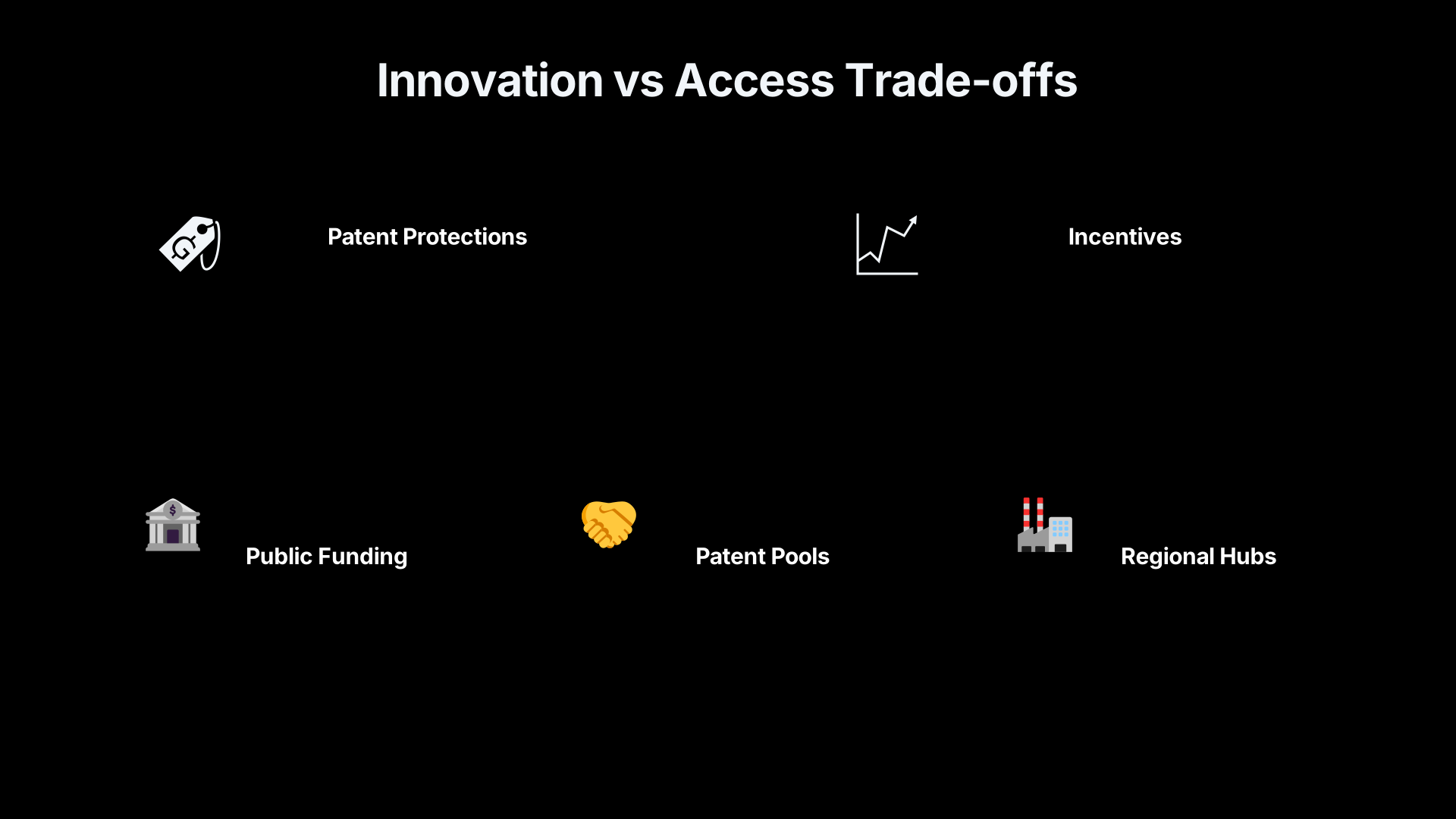
The debate is therefore not simply “profits versus compassion”. It is about designing systems that preserve scientific dynamism while avoiding permanent medical exclusion.
Different models attempt partial solutions:
- public funding for early-stage research
- patent pools and voluntary licensing
- generic manufacturing after exclusivity periods
- pooled international procurement
- advance market commitments
- nonprofit drug development [sanofi.com]sanofi.comDigital Transformation and Artificial IntelligenceDiscover how Sanofi's digital transformation accelerates drug discovery, clinical devel…
- open-science initiatives
- regional manufacturing hubs
The WHO mRNA technology transfer initiative reflects one attempt to spread manufacturing capability more broadly rather than concentrating it in a few firms and countries. [World Health Organization]who.intWorld Health OrganizationNew WHO report maps barriers to insulin availability and…12 Nov 2021 — A new report published by WHO in the l…
What broad medical abundance would require
A genuinely post-scarcity medical future would involve much more than accelerated discovery. It would likely require several systems advancing together.
Faster science
AI could significantly expand humanity’s ability to understand disease, design therapies, simulate biology, and personalise treatment. This may reduce the time and cost required to move from hypothesis to candidate drug.
Distributed manufacturing
Medical abundance becomes more plausible when production capacity is geographically distributed rather than concentrated in a few countries or corporations. Regional manufacturing reduces vulnerability to export bans, geopolitical shocks, and supply-chain failures.
Stronger public health systems
Cheap medicines are not enough without clinics, diagnostics, healthcare workers, sanitation, records systems, and stable procurement networks. Universal health coverage remains one of the core institutional requirements for broad medical access. [World Health Organization]who.intWorld Health OrganizationNew WHO report maps barriers to insulin availability and…12 Nov 2021 — A new report published by WHO in the l…
Better global coordination
Pandemics, antimicrobial resistance, and supply shortages are transnational problems. AI may help model risks and coordinate logistics, but political cooperation remains essential. WHO warnings about antibiotic resistance show how misuse and unequal access can interact destructively. [Taylor & Francis Online]tandfonline.comTaylor & Francis OnlineCurrent access, availability and use of antibiotics in primary…by Z Saleem · 2025 · Cited by 34 — Antimicrobial…
Governance that treats longevity as a shared good
One long-term risk in an AI-rich future is that radical medical advances become available first to wealthy individuals, firms, or states, widening biological inequality. If healthy lifespan extension becomes technically possible but socially restricted, humanity could enter a world where survival itself is increasingly stratified.
The strongest AI bloom visions therefore depend on medical capability becoming broadly diffused rather than permanently gated by wealth or geopolitical power.
Scarcity may persist even in a richer civilisation
The deeper lesson is that scarcity is often institutional before it is technical.
A society may possess:
- advanced AI systems
- automated laboratories
- sophisticated biological models
- powerful manufacturing technology [ppd.com]ppd.comfive challenges solutions mrna manufacturing processmRNA Manufacturing Process Solutions13 Sept 2022 — As mRNA (messenger RNA) technology expands, so do challenges in manufacturing mRNA vac…
and still fail to ensure reliable access to medicine because distribution systems, political priorities, and economic incentives remain misaligned.
This does not mean the optimistic case for AI-enabled flourishing is wrong. It means the optimistic case is incomplete if it focuses only on invention. A civilisation capable of extraordinary scientific breakthroughs may still struggle with fairness, coordination, and delivery.
The long future beyond scarcity therefore depends not just on making intelligence abundant, but on converting that intelligence into durable human capability at planetary scale. In medicine, that means the difference between discovering a cure and ensuring that ordinary people can actually receive it.
Endnotes
-
Source: GOV.UK
Title: Life Sciences Sector Plan
Link: https://www.gov.uk/government/publications/life-sciences-sector-plan/life-sciences-sector-planSource snippet
September 12, 2025 — 16 Jul 2025 — AI is revolutionising the Life Sciences sector across research, diagnostics, treatment, and manufactur...
Published: September 12, 2025
-
Source: gsk.com
Link: https://www.gsk.com/en-gb/innovation/technologies/Source snippet
TechThrough the use of data, AI and machine learning, we can unravel the mysteries of disease to design our vaccines and medicines to opt...
-
Source: sanofi.com
Link: https://www.sanofi.com/en/our-science/digital-artificial-intelligenceSource snippet
Digital Transformation and Artificial IntelligenceDiscover how Sanofi's digital transformation accelerates drug discovery, clinical devel...
-
Source: who.int
Link: https://www.who.int/news/item/12-11-2021-new-who-report-maps-barriers-to-insulin-availability-and-suggests-actions-to-promote-universal-accessSource snippet
World Health OrganizationNew WHO report maps barriers to insulin availability and...12 Nov 2021 — A new report published by WHO in the l...
-
Source: iris.who.int
Link: https://iris.who.int/bitstreams/0e4435c6-9f8c-4246-80e1-b2e61a6ae036/downloadSource snippet
IrisKeeping the 100-year-old promise: making insulin access...by World Health Organization · 2021 · Cited by 29 — In low- and middle-inc...
-
Source: gh.bmj.com
Link: https://gh.bmj.com/content/4/3/e001410Source snippet
BMJ Global HealthInsulin prices, availability and affordability in 13 low-...by M Ewen · 2019 · Cited by 167 — Some LMICs are able to pr...
-
Source: who.int
Link: https://www.who.int/initiatives/mrna-technology-transfer-%28mrna-tt%29-programmeSource snippet
World Health OrganizationmRNA Technology Transfer (mRNA TT) ProgrammeThe mRNA Technology Transfer (mRNA TT) Programme aims to build susta...
-
Source: pmc.ncbi.nlm.nih.gov
Link: https://pmc.ncbi.nlm.nih.gov/articles/PMC12599430/Source snippet
PMCAdvancements and challenges in next-generation mRNA...by SH Seo · 2025 · Cited by 9 — This review evaluates the technical and economi...
-
Source: gh.bmj.com
Link: https://gh.bmj.com/content/10/11/e019634Source snippet
BMJ Global HealthAvailability of essential medicines for non-communicable...by IR Joosse · 2025 · Cited by 2 — Factors associated with t...
-
Source: afro.who.int
Title: africa sets course affordable quality medicines new 10 year roadmap
Link: https://www.afro.who.int/news/africa-sets-course-affordable-quality-medicines-new-10-year-roadmapSource snippet
WHO | Regional Office for AfricaAfrica sets course for affordable, quality medicines with...3 Dec 2025 — A recent WHO assessment found t...
-
Source: pmc.ncbi.nlm.nih.gov
Link: https://pmc.ncbi.nlm.nih.gov/articles/PMC12877563/Source snippet
to Essential Medicines in Low- and Middle-Income...by I Herrera-Ramirez · 2026 · Cited by 1 — To conduct a systematic review to analyze...
-
Source: europepmc.org
Link: https://europepmc.org/article/ppr/ppr281412Source snippet
Europe PMCDrug Prices, Patents and Access to Life-Saving Medicinesby O Gurgula · 2021 · Cited by 4 — When patented life-saving drugs are...
-
Source: pmc.ncbi.nlm.nih.gov
Link: https://pmc.ncbi.nlm.nih.gov/articles/PMC9013034/Source snippet
is the impact of intellectual property rules on access to...by B Tenni · 2022 · Cited by 122 — It is widely accepted that intellectual p...
-
Source: who.int
Title: essential medicines
Link: https://www.who.int/news-room/fact-sheets/detail/essential-medicinesSource snippet
World Health OrganizationEssential medicines26 Jan 2026 — Medicines account for 20–60% of health spending in developing countries, with u...
-
Source: who.int
Link: https://www.who.int/health-topics/universal-health-coverageSource snippet
World Health OrganizationUniversal Health CoverageUniversal health coverage (UHC) means that all people have access to the full range of...
-
Source: cidrap.umn.edu
Title: report low access insulin poor countries hinders diabetes care
Link: https://www.cidrap.umn.edu/report-low-access-insulin-poor-countries-hinders-diabetes-careSource snippet
access to insulin in poor countries hinders diabetes care13 Oct 2022 — In LMICs, shortages of insulin and other essential medicines are e...
-
Source: who.int
Link: https://www.who.int/groups/expert-committee-on-selection-and-use-of-essential-medicines/essential-medicines-listsSource snippet
World Health OrganizationWHO Model Lists of Essential MedicinesThe WHO Model Lists of Essential Medicines are updated every two years by...
-
Source: who.int
Link: https://www.who.int/news/item/13-11-2019-who-launches-first-ever-insulin-prequalification-programme-to-expand-access-to-life-saving-treatment-for-diabetesSource snippet
WHO launches first-ever insulin prequalification...13 Nov 2019 — The World Health Organization (WHO) today announced the start of a pilo...
-
Source: extranet.who.int
Link: https://extranet.who.int/prequal/medicines/human-insulinSource snippet
Insulin | WHO - Prequalification of Medical...In spite of this, current insulin prices and availability pose a barrier to treatment in m...
-
Source: theguardian.com
Title: The Guardian Many life-saving drugs fail for lack of funding
Link: https://www.theguardian.com/news/2025/mar/11/plutocratic-proposal-life-saving-drugs-lack-of-funding-desparate-rich-peopleSource snippet
But there's a solution: desperate rich peopleMarch 11, 2025 — The article discusses the significant issue of abandoned life-saving drugs...
Published: March 11, 2025
-
Source: pharmaceuticalaccountability.org
Link: https://www.pharmaceuticalaccountability.org/issues/access-challenges/Source snippet
Pharmaceutical Accountability FoundationIssue #2: Access ChallengesHigh prices of medicines, enabled by patent or SPC market exclusivity...
-
Source: tandfonline.com
Link: https://www.tandfonline.com/doi/full/10.1080/14787210.2025.2477198Source snippet
Taylor & Francis OnlineCurrent access, availability and use of antibiotics in primary...by Z Saleem · 2025 · Cited by 34 — Antimicrobial...
Additional References
-
Source: linkedin.com
Link: https://www.linkedin.com/posts/davidpejoski_ai-wef26-unexpected-activity-7419672299194261505-hpSSSource snippet
AI in Drug Discovery: Advancements and Barriers at WEF26Many of the points around AI adoption, sociological barriers, and human-in-the-lo...
-
Source: i-mak.org
Link: https://www.i-mak.org/glp-1/Source snippet
The Heavy Price of GLP-1 DrugsThis brief examines the financialized business model of Novo Nordisk and Eli Lilly for the leading GLP-1 pr...
-
Source: mrnaexplainer.org
Link: https://mrnaexplainer.org/Source snippet
mRNA Revolution: A New Generation of MedicineThe report urges the industry to plan for the future roles, novel equipment, and capabilitie...
-
Source: newsroom.northumbria.ac.uk
Link: https://newsroom.northumbria.ac.uk/pressreleases/research-award-to-investigate-how-ai-can-be-used-to-speed-up-development-of-new-drugs-3363893Source snippet
award to investigate how AI can be used...14 Jan 2025 — A team of scientists will now use machine learning to find new ways to encapsula...
-
Source: pmc.ncbi.nlm.nih.gov
Title: PMCA global perspective on the issue of access to insulin
Link: https://pmc.ncbi.nlm.nih.gov/articles/PMC8012321/Source snippet
global perspective on the issue of access to insulin - PMCby D Beran · 2021 · Cited by 144 — A study in 13 low- and middle-income countri...
-
Source: pmc.ncbi.nlm.nih.gov
Link: https://pmc.ncbi.nlm.nih.gov/articles/PMC12677547/Source snippet
to essential medicines for noncommunicable diseases...by S Aljadeeah · 2025 · Cited by 2 — The findings indicate low medicine availabili...
-
Source: fip.org
Link: https://www.fip.org/file/6065Source snippet
However, the supply chain always begins with the research and development of medicines.Read more...
-
Source: haiweb.org
Title: analogue insulin on who model list of essential medicines
Link: https://haiweb.org/media-resource/analogue-insulin-on-who-model-list-of-essential-medicines/Source snippet
01 Oct 2021 — A ceiling price for analogue insulin in low- and middle-income countries (LMICs) commensurate with the $3 ceiling price for...
-
Source: sdc-health.ch
Link: https://www.sdc-health.ch/dam/en/sd-web/H7u-k9eYv3aj/H-NCDs-Insulin-NCDPolicyLab_EN.pdfSource snippet
Sources of insulin, oral medicines, and medical devices for...15 Apr 2024 — This commitment guarantees the supply of low-priced human in...
-
Source: ppd.com
Title: five challenges solutions mrna manufacturing process
Link: https://www.ppd.com/blog/five-challenges-solutions-mrna-manufacturing-process/Source snippet
mRNA Manufacturing Process Solutions13 Sept 2022 — As mRNA (messenger RNA) technology expands, so do challenges in manufacturing mRNA vac...
Amazon book picks
Further Reading
Books and field guides related to Medicine Still Scarce. Use these as the next step if you want deeper reading beyond the article.


Artificial Intelligence in Economics and Finance Theories
As Artificial Intelligence (AI) seizes all aspects of human life, there is a fundamental shift in the way in which humans are thinking of...
Drug Discovery and Evaluation: Pharmacological Assays
The new edition of this successful reference offers both cutting-edge and classic pharmacological methods. Thoroughly revised and expande...
eBay marketplace picks
Marketplace Samples
Example marketplace items related to this page. Use the search link to explore similar finds on eBay.

Example eBay listing
A.I. Artificial Intelligence Original Movie Poster Signed By Jude Law
USD 125.00 | Shipping USD 25.00 | US

Example eBay listing
Artificial Intelligence D/S Original Movie Poster - 27 x 40"
USD 19.50 | Shipping USD 13.65 | US

Example eBay listing
612388 Artificial Intelligence Movie Science Fiction Drama Wall Print Poster
USD 22.95 | Shipping USD 12.95 | JP

Example eBay listing
Companion - Artificial Intelligence Dark Comedy Cinema Film - POSTER 20"x30"
USD 23.99 | Free shipping | US

Example eBay listing
A.I. Artificial Intelligence Movie Film Poster Art Print
GBP 4.99 | Free shipping | GB

Example eBay listing
A I Artificial Intelligence 6 Movie Poster Art Print Print Classic Rare Gallery
GBP 49.00 | Free shipping | GB

Example eBay listing
AI - Artificial Intelligence (Poster + Slipcase) Blu-Ray
GBP 10.49 | Free shipping | GB

Example eBay listing
A. I. Artificial Intelligence. Jude Law. Original UK Video Poster.
GBP 8.11 | Shipping GBP 3.38 | GB
Topic Tree