Within Autonomous Labs
The A Lab novelty dispute
The A-Lab debate shows why making a compound is not the same as proving that science has discovered something new.
On this page
- What the A Lab originally reported
- Why critics challenged the novelty claims
- What the correction changed and why it matters
Page outline Jump by section
Introduction
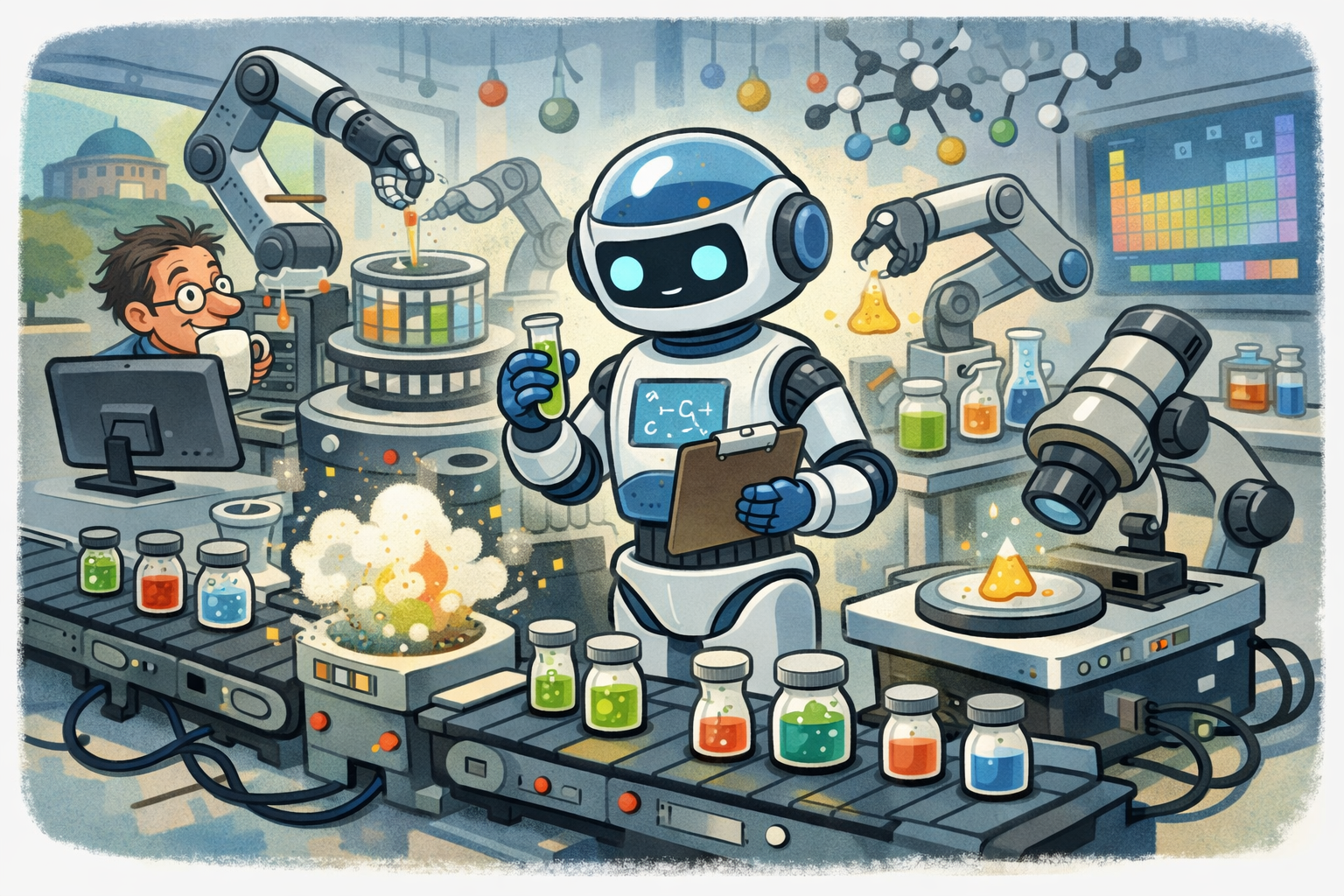
The A-Lab project at Lawrence Berkeley National Laboratory became one of the most widely discussed examples of an autonomous scientific laboratory because it appeared to show something unusually ambitious: an AI-guided robotic system not just proposing materials on a computer, but physically making dozens of supposedly new compounds with limited human intervention. For advocates of AI-driven scientific acceleration, this looked like an early glimpse of how autonomous labs might compress years of experimental work into days. But the excitement quickly turned into a dispute over a more basic scientific question: were the materials actually new? [Nature]nature.comNatureAn autonomous laboratory for the accelerated synthesis of…Nov 29, 2023 — We introduce the A-Lab, an autonomous laboratory for th… [Nature]nature.comNatureRobot chemist sparks row with claim it created new materials12 Dec 2023 — Researchers question whether an AI-controlled lab assista…
The controversy mattered because it exposed a central challenge for the broader AI bloom vision. Accelerating experimentation is valuable only if the system can also verify what it has produced accurately and communicate its results reliably. In other words, autonomous science is not judged merely by whether robots can synthesise powders in a laboratory. It is judged by whether the resulting claims survive expert scrutiny, especially when the claims concern discovery and novelty.
What the A-Lab originally reported
The original A-Lab paper, published in Nature in late 2023, described an autonomous workflow for inorganic materials synthesis. The system combined machine learning models, robotics, literature-trained synthesis planning and automated X-ray diffraction analysis into a continuous experimental pipeline. Over 17 days of operation, the lab attempted dozens of target compounds predicted from computational databases and reported successfully realising many of them. [Nature]nature.comWhile novelty preferences have been well-studied.Read more…
The paper’s most attention-grabbing claim was that the system had produced large numbers of “novel” materials. Depending on the version and reporting context, the number was commonly described as around 41 newly realised compounds. The work was closely linked in public discussion with Google DeepMind’s GNoME materials-prediction project, which had itself generated headlines by proposing hundreds of thousands of theoretically stable crystal structures. Nature [WIRED The combined narrative was powerful:]wired.comGoogle Deep Mind's AI Dreamed Up 380,000 New MaterialsThe Next Challenge Is Making ThemGoogle DeepMind developed an AI program, GNoME, which has predicted 380,000 new stable materials, expand…
- AI predicts huge numbers of candidate materials.
- Autonomous labs physically synthesise them.
- Scientific discovery accelerates dramatically.
For supporters of AI-enabled abundance, this looked like a possible template for speeding progress in batteries, catalysts, semiconductors and clean-energy technologies. If autonomous systems could continuously generate and validate new materials, scientific bottlenecks that normally slow industrial and technological development might loosen substantially.
But the novelty claim carried heavy weight because “discovering a new material” means more than producing a sample that roughly resembles a predicted crystal structure. It requires showing convincingly that the material:
- exists as claimed,
- is correctly identified,
- has not already been reported,
- and is distinguishable from known compounds.
That final step became the centre of the dispute.

Why critics challenged the novelty claims
The strongest criticism came from materials scientists who re-examined the published diffraction data and compared the reported compounds against existing databases and prior literature. Critics argued that many of the supposedly novel materials either had already been reported elsewhere or had not been convincingly synthesised in the first place. Nature [2chemistryworld.com]chemistryworld.comNew analysis raises doubts over autonomous lab's…Jan 16, 2024 — Experimental and computational issues flagged as researchers conclude…
A major focus of the criticism involved X-ray diffraction analysis, the standard technique used to identify crystalline materials. In powder diffraction experiments, scientists compare measured diffraction patterns against expected structures to determine what phases are actually present in a sample. This process can become difficult when samples contain impurities or mixed phases.
The A-Lab workflow used machine-learning-assisted refinement methods to automate this interpretation step. Critics argued that the automated analysis overstated confidence and sometimes identified target materials where the evidence was weak or ambiguous. [chemistryworld.com]chemistryworld.comNew analysis raises doubts over autonomous lab's…Jan 16, 2024 — Experimental and computational issues flagged as researchers conclude…
Some critics concluded that:
- several claimed compounds were already known in the literature,
- others were poorly supported by the diffraction data,
- and the paper blurred the distinction between “attempted synthesis”, “partial synthesis” and “confirmed discovery”. [chemistryworld.com]chemistryworld.comNew analysis raises doubts over autonomous lab's…Jan 16, 2024 — Experimental and computational issues flagged as researchers conclude… [Reddit One important nuance emerged during the debate. Some compounds judged]reddit.comRedditAutonomous lab did not synthesize any new materialsWe have now completed our analysis of new materials reported in the Google Deepm…“not novel” by critics may genuinely not have existed in the training data available to the A-Lab system at the time. Researchers involved with the project noted that their databases represented snapshots from earlier years, meaning the system sometimes independently arrived at compounds later reported elsewhere. [Reddit]reddit.comRedditAutonomous lab did not synthesize any new materialsWe have now completed our analysis of new materials reported in the Google Deepm…
That distinction mattered scientifically but did not fully resolve the criticism. Independent rediscovery is not normally counted as discovering a new material if the compound was already known by publication time. The dispute therefore became partly about terminology and standards:
- Was the achievement autonomous synthesis?
- Autonomous recipe generation?
- Independent rediscovery?
- Or genuine discovery of previously unknown materials?
Critics argued that public discussion and some headlines collapsed these distinctions into a stronger claim than the evidence justified. [Nature]nature.comNatureAn autonomous laboratory for the accelerated synthesis of…Nov 29, 2023 — We introduce the A-Lab, an autonomous laboratory for th…
The deeper issue: synthesis versus discovery
The controversy exposed a broader conceptual problem in autonomous science. Making a compound is not the same thing as proving novelty.
In traditional materials science, novelty claims involve several layers of verification:
- database searches,
- literature comparisons,
- careful structural refinement,
- reproducibility checks,
- and expert judgement about whether a structure is genuinely distinct.
Human researchers often spend substantial time resolving ambiguities before presenting a compound as new. Autonomous labs compress many steps into an integrated workflow, but that compression increases the risk that uncertain classifications are treated as definitive findings.
This matters because the public narrative around AI science often rewards large numbers:
- thousands of generated candidates,
- hundreds of “discoveries”,
- dramatic acceleration factors.
Yet the practical usefulness of scientific acceleration depends heavily on verification quality. A system that rapidly produces unreliable claims can create noise as well as progress.
Several researchers and commentators therefore treated the A-Lab episode as an early warning about evaluation standards for AI-driven discovery systems. ACS Publications [NIST]nist.govwhat missing autonomous discovery open challenges communityWhat is missing in autonomous discoveryby P Maffetone · 2023 · Cited by 48 — Self-driving labs (SDLs) leverage combinations of artificial…
The dispute also highlighted how difficult materials novelty actually is. Crystal structures can differ subtly. Databases are incomplete and constantly updated. Similar compounds may already exist under different naming conventions or slightly altered compositions. Autonomous systems operating at large scale will inevitably encounter duplicate or near-duplicate structures unless novelty checking becomes more rigorous and automated itself. [arXiv]arxiv.orgarXivNavigation maps of the material space for automated self-driving labs of the futureOctober 17, 2024…
In response to these problems, some researchers have proposed explicit “novelty metrics” and automated duplicate-detection systems for future self-driving laboratories. The fact that such tools are now being discussed illustrates how the A-Lab debate changed the field’s priorities from pure throughput toward trustworthy validation. [arXiv]arxiv.orgarXivNavigation maps of the material space for automated self-driving labs of the futureOctober 17, 2024…
What the correction changed and why it matters
The dispute did not end with online criticism. In 2026, Nature published an author correction related to the original A-Lab paper. Critics argued that the correction confirmed important weaknesses in the original novelty claims, although some remained dissatisfied with how fully the issues were addressed. [ResearchGate]researchgate.netResearchGate(PDF) Author Correction: An autonomous laboratory for the…January 19, 2026 — 19 Jan 2026 — An autonomous laboratory for th…
The correction mattered for several reasons.
First, it showed that autonomous-lab claims are now important enough to receive unusually intense scrutiny. The field is moving beyond proof-of-concept demonstrations into questions of reliability, standards and reproducibility.
Second, the correction clarified that scientific automation does not remove the need for human interpretation. Even if robotic systems can execute experiments continuously, expert judgement still plays a major role in validating difficult or ambiguous results.
Third, the episode demonstrated how easily public narratives about AI-driven discovery can become overstated. Many headlines treated the A-Lab project as evidence that AI systems were autonomously inventing large numbers of entirely new materials. The subsequent debate showed the situation was more complicated:
- some synthesis attempts succeeded,
- some compounds may have been independently rediscovered,
- some classifications were disputed,
- and novelty standards remained contested. Nature [2chemistryworld.com]chemistryworld.comNew analysis raises doubts over autonomous lab's…Jan 16, 2024 — Experimental and computational issues flagged as researchers conclude…
That does not mean the underlying achievement was trivial. Even critics generally acknowledged that the A-Lab represented a substantial engineering accomplishment in robotic experimentation and autonomous workflow integration. The dispute centred less on whether the system could operate autonomously and more on whether the scientific claims attached to its outputs were too strong. [chemistryworld.com]chemistryworld.comNew analysis raises doubts over autonomous lab's…Jan 16, 2024 — Experimental and computational issues flagged as researchers conclude…
Why the dispute matters for the AI bloom argument
For the wider debate about AI-enabled scientific acceleration, the A-Lab controversy is useful precisely because it is not a simple success-or-failure story.
The optimistic AI bloom case depends on the idea that advanced AI systems could dramatically expand humanity’s capacity to discover, test and deploy new knowledge. Autonomous laboratories are one plausible pathway toward that future. If scientific experimentation becomes faster, cheaper and more continuous, progress in energy, medicine, computing and climate technology could accelerate significantly over decades. [ACS Publications]pubs.acs.orgPublications Artificial Intelligence Driving Materials Discovery?AK Cheetham · 2024 · Cited by 166 — A Laboratory for the Accelerated Synthesis of Novel Materials. Nature 2023, 624, 86…
But the A-Lab dispute shows that acceleration alone is insufficient. Scientific progress depends on trustworthy validation systems as much as raw experimentation speed.
An autonomous lab that produces thousands of weakly verified claims could overwhelm researchers with false positives, duplication and ambiguous findings. A genuinely transformative system would need:
- rigorous novelty detection,
- reliable automated characterisation,
- reproducibility standards,
- transparent uncertainty estimates,
- and mechanisms for human oversight.
In that sense, the controversy may represent a normal stage in the maturation of autonomous science. Early systems often demonstrate capability before the surrounding standards, validation methods and governance practices fully catch up.
The most defensible conclusion from the A-Lab episode is therefore narrower than some of the original hype, but still important. Autonomous laboratories appear capable of meaningfully accelerating parts of experimental science. What remains unresolved is how quickly they can become reliable enough to support strong claims about genuine discovery without extensive human verification.
Endnotes
-
Source: nature.com
Link: https://www.nature.com/articles/s41586-023-06734-wSource snippet
NatureAn autonomous laboratory for the accelerated synthesis of...Nov 29, 2023 — We introduce the A-Lab, an autonomous laboratory for th...
-
Source: nature.com
Link: https://www.nature.com/articles/d41586-023-03956-wSource snippet
NatureRobot chemist sparks row with claim it created new materials12 Dec 2023 — Researchers question whether an AI-controlled lab assista...
-
Source: chemistryworld.com
Link: https://www.chemistryworld.com/news/new-analysis-raises-doubts-over-autonomous-labs-materials-discoveries/4018791.articleSource snippet
New analysis raises doubts over autonomous lab's...Jan 16, 2024 — Experimental and computational issues flagged as researchers conclude...
-
Source: wired.com
Title: Google Deep Mind’s AI Dreamed Up 380,000 New Materials
Link: https://www.wired.com/story/an-ai-dreamed-up-380000-new-materials-the-next-challenge-is-making-themSource snippet
The Next Challenge Is Making ThemGoogle DeepMind developed an AI program, GNoME, which has predicted 380,000 new stable materials, expand...
-
Source: reddit.com
Link: https://www.reddit.com/r/slatestarcodex/comments/1923p07/autonomous_lab_did_not_synthesize_any_new/Source snippet
RedditAutonomous lab did not synthesize any new materialsWe have now completed our analysis of new materials reported in the Google Deepm...
-
Source: pubs.acs.org
Title: Publications Artificial Intelligence Driving Materials Discovery?
Link: https://pubs.acs.org/doi/10.1021/acs.chemmater.4c00643Source snippet
AK Cheetham · 2024 · Cited by 166 — A Laboratory for the Accelerated Synthesis of Novel Materials. Nature 2023, 624, 86...
-
Source: nist.gov
Title: what missing autonomous discovery open challenges community
Link: https://www.nist.gov/publications/what-missing-autonomous-discovery-open-challenges-communitySource snippet
What is missing in autonomous discoveryby P Maffetone · 2023 · Cited by 48 — Self-driving labs (SDLs) leverage combinations of artificial...
-
Source: arxiv.org
Link: https://arxiv.org/abs/2410.13796Source snippet
arXivNavigation maps of the material space for automated self-driving labs of the futureOctober 17, 2024...
Published: October 17, 2024
-
Source: researchgate.net
Link: https://www.researchgate.net/publication/399899062_Author_Correction_An_autonomous_laboratory_for_the_accelerated_synthesis_of_inorganic_materialsSource snippet
ResearchGate(PDF) Author Correction: An autonomous laboratory for the...January 19, 2026 — 19 Jan 2026 — An autonomous laboratory for th...
Published: January 19, 2026
-
Source: cen.acs.org
Title: Chemical & Engineering News’Nature’ robot chemist paper corrected, but some
Link: https://cen.acs.org/research-integrity/Nature-robot-chemist-paper-corrected/104/web/2026/01Source snippet
C&ENJan 29, 2026 — The prominent scientific journal Nature has corrected a highly cited study about a robot designed to synthesize entire...
-
Source: pubs.acs.org
Link: https://pubs.acs.org/doi/10.1021/acs.chemrev.4c00055Source snippet
ACS PublicationsSelf-Driving Laboratories for Chemistry and Materials Scienceby G Tom · 2024 · Cited by 701 — A large number of examples...
-
Source: nature.com
Link: https://www.nature.com/articles/s41598-023-31953-6Source snippet
While novelty preferences have been well-studied.Read more...
-
Source: arxiv.org
Link: https://arxiv.org/html/2512.01080v1Source snippet
Building Trustworthy AI for Materials DiscoveryNov 30, 2025 — ABSTRACT. Accelerated material discovery increasingly relies on artificial...
-
Source: arxiv.org
Link: https://arxiv.org/html/2409.05890v1Source snippet
Automating the Practice of Science23 Aug 2024 — This article evaluates the scope of automation within scientific practice and assesses re...
-
Source: the-innovation.org
Title: j.xinn mater.2026.100178
Link: https://www.the-innovation.org/article/doi/10.59717/j.xinn-mater.2026.100178Source snippet
Nature 624:86−91. DOI:10.1038/s41586-023-06734-w. View in Article CrossRef Google...Read more...
-
Source: natureconservation.pensoft.net
Link: https://natureconservation.pensoft.net/aboutSource snippet
Nature Conservation - Pensoft PublishersNature Conservation is a peer-reviewed, open access, rapidly published online journal covering al...
Additional References
-
Source: facebook.com
Link: https://www.facebook.com/groups/techoptimism/posts/6977144122372354/Source snippet
AI and robotics accelerate new material discoveryThe role of the A-Lab is to synthesize novel materials that can be used to build a range...
-
Source: ft.com
Link: https://www.ft.com/content/ca7f67c5-6db7-4cbb-858b-67876d2c1e63Source snippet
Google DeepMind afirmó haber encontrado más de 2 millones de nuevos materiales cristalinos usando su herramienta de IA, un hecho inicialm...
-
Source: sciencesprings.wordpress.com
Link: https://sciencesprings.wordpress.com/2026/01/21/from-the-does-lawrence-berkeley-national-laboratory-berkeley-lab-researchers-evaluate-generative-ai-models-for-filling-scientific-imaging-gaps/Source snippet
Lab Researchers Evaluate Generative AI Models for...21 Jan 2026 — Now, researchers at Lawrence Berkeley National Laboratory (Berkeley La...
-
Source: mgi.gov
Link: https://www.mgi.gov/sites/mgi/files/MGI_Autonomous_Materials_Innovation_Infrastructure_Workshop_Report.pdfSource snippet
o Fully Autonomous Labs: Development of interoperable, autonomous laboratories for.Read more...
-
Source: perssongroup.lbl.gov
Link: https://perssongroup.lbl.gov/papers/szymanski_autonomous_laboratory_2023.pdfSource snippet
from a set of 58 targets including a variety of oxides and phosphates that were...Read more...
-
Source: 404media.co
Title: google says it discovered millions of new materials with ai human researchers
Link: https://www.404media.co/google-says-it-discovered-millions-of-new-materials-with-ai-human-researchers/Source snippet
Is Google's AI Actually Discovering 'Millions of New...11 Apr 2024 — The Berkeley paper, meanwhile, claimed that an “autonomous laborato...
-
Source: newswise.com
Title: qamp a with ornl s advincula on autonomous labs in materials research
Link: https://www.newswise.com/doescience/qamp-a-with-ornl-s-advincula-on-autonomous-labs-in-materials-researchSource snippet
Q&A with ORNL's Advincula on Autonomous Labs in...Mar 30, 2026 — Q: What challenges do you anticipate as the field moves toward more aut...
-
Source: theregister.com
Title: novel ai made materials not actually new study
Link: https://www.theregister.com/offbeat/2024/01/31/novel-ai-made-materials-not-actually-new-study/956058Source snippet
'Novel' AI-made materials not actually new – study31 Jan 2024 — "Unfortunately, we found that the central claim of the A-Lab paper, namel...
-
Source: springernature.com
Title: Editorial policies
Link: https://www.springernature.com/gp/policies/editorial-policiesSource snippet
Springer NatureThese policies underpin our commitment as a leading research publisher to editorial independence and supporting research e...
-
Source: facebook.com
Link: https://www.facebook.com/groups/reviewer2/posts/10161405566865469/Source snippet
rial that our workplace didn't end up permitting us to use.Read more...
Amazon book picks
Further Reading
Books and field guides related to The A Lab novelty dispute. Use these as the next step if you want deeper reading beyond the article.
Accelerated Materials Discovery
Typical timelines to go from discovery to impact in the advanced materials sector are between 10 to 30 years. Advances in robotics and ar...
Materials Discovery and Design
First published 2018. Subjects: Materials, Data mining, Machine learning.
Information Science for Materials Discovery and Design
First published 2015. Subjects: Materials.

Advances in Artificial Intelligence, Computation, and Data Sc...
Artificial intelligence (AI) has become pervasive in most areas of research and applications. While computation can significantly reduce...
eBay marketplace picks
Marketplace Samples
Example marketplace items related to this page. Use the search link to explore similar finds on eBay.
Example eBay listing
A.I. Artificial Intelligence Original Movie Poster Signed By Jude Law
USD 125.00 | Shipping USD 25.00 | US
Example eBay listing
Artificial Intelligence D/S Original Movie Poster - 27 x 40"
USD 19.50 | Shipping USD 13.65 | US

Example eBay listing
612388 Artificial Intelligence Movie Science Fiction Drama Wall Print Poster
USD 22.95 | Shipping USD 12.95 | JP

Example eBay listing
Companion - Artificial Intelligence Dark Comedy Cinema Film - POSTER 20"x30"
USD 23.99 | Free shipping | US

Example eBay listing
A.I. Artificial Intelligence Movie Film Poster Art Print
GBP 4.99 | Free shipping | GB

Example eBay listing
A I Artificial Intelligence 6 Movie Poster Art Print Print Classic Rare Gallery
GBP 49.00 | Free shipping | GB

Example eBay listing
AI - Artificial Intelligence (Poster + Slipcase) Blu-Ray
GBP 10.49 | Free shipping | GB

Example eBay listing
A. I. Artificial Intelligence. Jude Law. Original UK Video Poster.
GBP 8.11 | Shipping GBP 3.38 | GB
Topic Tree