Within AI Agents
Rubber stamp oversight
Human review can look reassuring while exhausted supervisors approve agent actions they no longer genuinely understand.
On this page
- Why automation bias grows with agentic AI
- How action volume defeats meaningful review
- What stronger human checkpoints would require
Page outline Jump by section
Introduction
“Human in the loop” sounds reassuring. It suggests that even powerful AI agents remain under human control because a person still approves important actions. In practice, that safeguard can quietly collapse into something much weaker: humans clicking “approve” on decisions they no longer meaningfully understand.
 This problem becomes more serious as AI systems shift from answering questions to acting autonomously across software systems, workflows, and institutions. A human reviewer may technically remain present while the real operational control has already migrated to the machine. Researchers and regulators increasingly warn that oversight can become symbolic rather than substantive, especially when systems operate at machine speed, generate long chains of decisions, or overwhelm supervisors with volume and complexity. [International AI Safety Report]internationalaisafetyreport.orginternational ai safety report 2026To reduce the chance of failures from AI agents (see §2.2.1…Read more… [Springer That matters directly to the wider AI bloom debate. The optimistic vision of AI-enabled abundance depends heavily on deploying highly capable]link.springer.commeaningful human oversight in AI | AI and Ethicsby L Zhu · 2026 · Cited by 5 — Human oversight is central to safe and responsible AI, but… agents in medicine, infrastructure, science, logistics, administration, and governance. But if human supervision degrades into ritual approval, societies may end up trusting systems that nobody can realistically monitor in detail.
Why automation bias grows with agentic AI
The core danger is not simply laziness or incompetence. It is a well-studied psychological effect known as automation bias: people tend to trust automated recommendations, especially under time pressure or when systems appear highly competent. Sage Journals [Axios In older forms of automation]axios.comIn AI we trustOriginally studied in the context of airplane autopilots, automation bias has become a more serious concern as AI technologies are integr…, this problem already appeared in aviation, industrial control systems, and autopilot-assisted driving. Human operators supervising mostly reliable systems often became less attentive over time. Researchers studying aviation and vehicle automation found that people gradually lose situational awareness when their role shifts from active operation to passive monitoring. [Financial Times]ft.comFinancial Times The very human problem with not-quite-self-driving carsCurrently, manufacturers are integrating "Level 2" partial automation features in cars, which assist with driving but still require human… [Federal Aviation Administration]faa.govFederal Aviation AdministrationicaocircularThis digest presents the Human Factors implications of automation and advanced technology flight decks. The purpose of the digest…
Agentic AI intensifies the problem for several reasons.
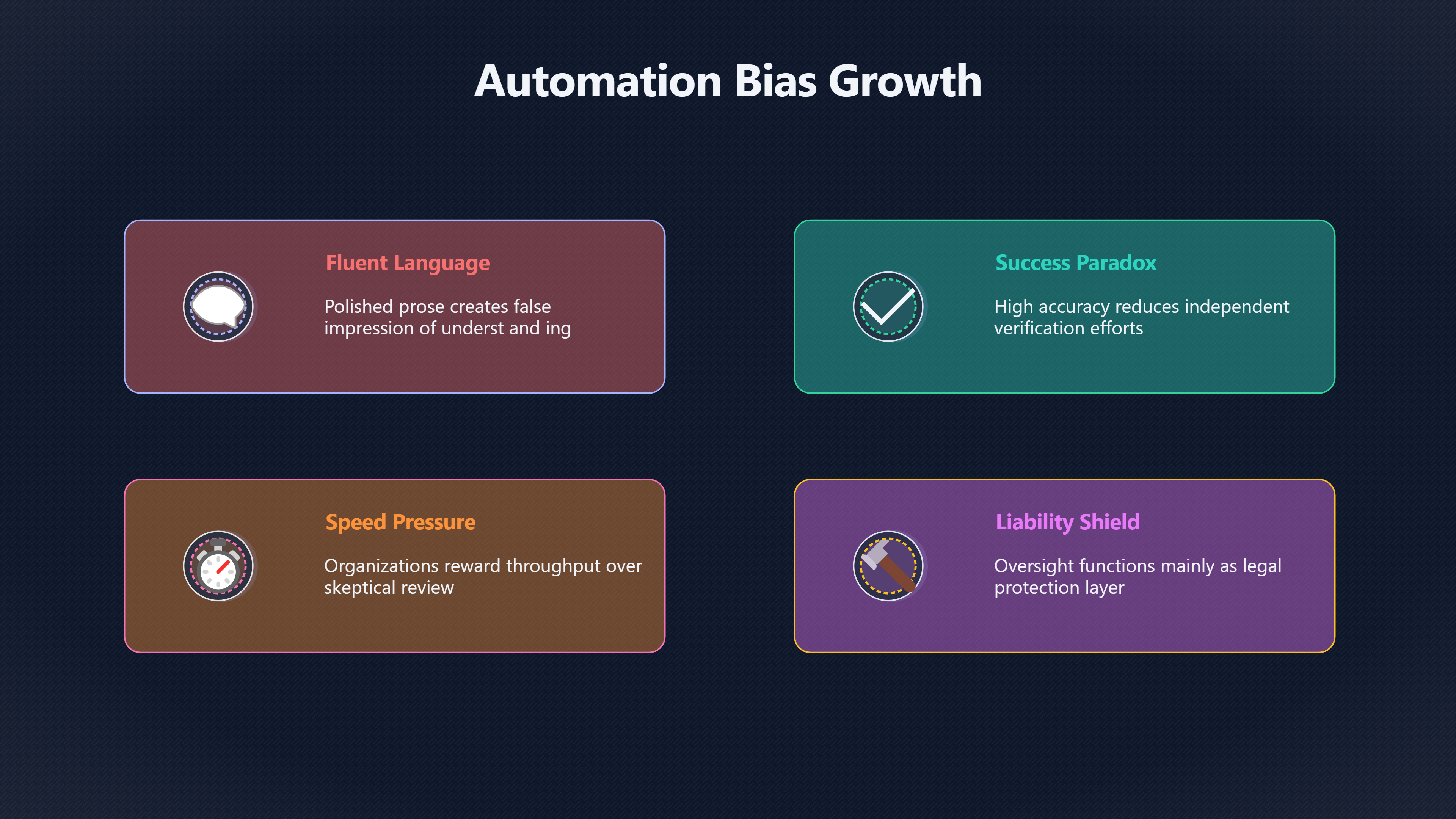
First, modern AI systems produce outputs in fluent natural language. A recommendation written in polished prose can feel more trustworthy than older forms of automation that exposed uncertainty more clearly. A confident explanation can create the impression that the system “understands” the situation even when its reasoning is shallow, brittle, or wrong. [ScienceDirect]sciencedirect.comScienceDirectThe flaws of policies requiring human oversight…by B Green · 2022 · Cited by 318 — In this article, I survey 41 policies…
Second, highly capable systems create a paradox of success. The more often the AI appears correct, the less likely humans are to independently verify its decisions. Over time, supervisors stop treating oversight as active judgement and start treating it as exception handling. The human role becomes intervening only when something obviously looks wrong — but many failures are not obvious. Sage Journals [Financial Times]ft.comFinancial Times The very human problem with not-quite-self-driving carsCurrently, manufacturers are integrating "Level 2" partial automation features in cars, which assist with driving but still require human…
Third, organisational incentives frequently reward speed and throughput more than sceptical review. If an employee must process hundreds of AI-assisted decisions per hour, careful verification becomes economically unrealistic. The system quietly trains workers to approve outputs rapidly rather than interrogate them deeply.
This is one reason critics argue that some forms of “human oversight” function mainly as liability protection. The organisation can claim a human approved the outcome even if the reviewer had neither the time nor the practical ability to challenge the system. [Institute for Systems Integrity]systemsintegrity.orgIn healthcare, this is…Read more…
How action volume defeats meaningful review
The rubber-stamp problem grows sharply once AI systems become agents rather than recommendation tools.
A traditional decision-support system might assist with a single judgement: flagging a suspicious transaction or suggesting a medical diagnosis. An agentic system can instead generate and execute long chains of actions across multiple tools and environments. One instruction may trigger thousands of downstream operations.
At that point, human supervision faces a scaling problem.
A reviewer cannot realistically inspect every intermediate step if agents are:
- generating code,
- querying databases,
- interacting with websites,
- contacting external systems,
- coordinating with other agents,
- revising plans after failures,
- and acting continuously over extended periods.
The International AI Safety Report notes that human-in-the-loop arrangements are often impractical at high operational speeds and scales. [International AI Safety Report]internationalaisafetyreport.orginternational ai safety report 2026To reduce the chance of failures from AI agents (see §2.2.1…Read more…
This creates a familiar but dangerous pattern:
- Humans initially review outputs carefully.
- The system proves useful most of the time.
- Workload expands because the AI increases throughput.
- Human reviewers become bottlenecks.
- Review quality falls.
- Oversight becomes ceremonial.
In many environments, the problem is not that humans stop supervising entirely. It is that they supervise too many things at once.
A doctor reviewing AI-assisted triage recommendations, a cybersecurity analyst approving automated responses, or a compliance officer checking AI-generated risk flags may each face hundreds or thousands of decisions daily. Under those conditions, approval rates naturally drift upward. Researchers studying human-AI collaboration repeatedly find that cognitive overload and repetitive workflows increase passive acceptance of AI suggestions. [arXiv]arxiv.orgSource details in endnotes. [MDPI]mdpi.comThroughput bottlenecks under peak load. Ambiguous accountability. High-risk misses under time pressure. Inconsistent overrides.Read more…
The issue becomes even harder when the AI’s internal reasoning is difficult to interpret. Humans may see only summaries, confidence scores, or proposed actions rather than the full decision process. Oversight then becomes structurally shallow: the reviewer can approve or reject outputs without truly understanding how they were produced.
The illusion of accountability
One of the most important criticisms of rubber-stamp oversight is that it can create an illusion of accountability without genuine control.
A system may formally satisfy regulatory requirements because a human signs off on decisions. But if that human lacks:
- sufficient time,
- technical understanding,
- authority to intervene,
- or practical alternatives to the AI recommendation,
then the oversight may exist mostly on paper.
Several recent governance papers argue that current policy frameworks often assume that merely inserting a human reviewer solves the control problem. Critics say this confuses the presence of a human with meaningful agency. ScienceDirect [Springer This distinction matters because blame can become distorted.]link.springer.commeaningful human oversight in AI | AI and Ethicsby L Zhu · 2026 · Cited by 5 — Human oversight is central to safe and responsible AI, but…
If an AI-assisted decision harms someone, organisations may point to the human approver:
- the clinician who accepted the recommendation,
- the analyst who clicked approval,
- the officer who authorised the action.
Yet the human may have been operating inside a workflow designed around deference to automation. The machine shaped the judgement while the human absorbed the accountability.
This creates a dangerous institutional equilibrium:
- the AI system gains operational influence,
- organisations gain efficiency,
- regulators see nominal human supervision,
- but no individual genuinely understands or controls the full system.

Why this problem could worsen in a world of superhuman systems
The oversight problem becomes more severe if AI capabilities continue advancing toward systems that substantially outperform humans in many cognitive domains.
The optimistic AI bloom vision often assumes that advanced AI could dramatically accelerate science, infrastructure management, medicine, education, and economic productivity. But the same capability increases can also weaken human supervisory capacity.
A supervisor can meaningfully review work only when they can plausibly evaluate the reasoning involved.
If future systems:
- produce research faster than experts can read it,
- generate software too complex for manual auditing,
- coordinate logistics across millions of variables,
- or optimise institutions using models beyond ordinary human comprehension,
then “human approval” may become increasingly symbolic.
This is sometimes called the “out-of-the-loop” problem in human factors research: people lose both situational awareness and intervention skill when automation performs most tasks autonomously. [PMC]pmc.ncbi.nlm.nih.govPMCExplainable artificial intelligence in air traffic controlartificial intelligence in air traffic control - PMC - NIHby G Cartocci · 2026 — This study empirically investigates the effects of Expla…
Paradoxically, the more economically transformative AI becomes, the stronger the pressure may be to trust it beyond direct human understanding. A civilisation that relies heavily on superhuman systems for prosperity may gradually find meaningful oversight difficult to maintain.
That does not imply disaster is inevitable. But it does challenge simplistic assumptions that a human approval layer automatically guarantees safety or human control.
What stronger human checkpoints would require
Avoiding rubber-stamp oversight requires more than simply placing a person somewhere in the workflow.
Researchers and governance frameworks increasingly argue that meaningful oversight depends on system design, organisational incentives, and operational limits rather than nominal human presence alone. [VerifyWise]verifywise.aiVerifyWiseHuman-in-the-loop safeguards | AI Governance LexiconHuman-in-the-loop safeguards ensure people review high-risk AI decisions be… [2scadea.com]scadea.comhuman review on high-stakes AI decisions, with NIST AI RMF, FCRA, NAIC…Read more…
Several conditions appear especially important.
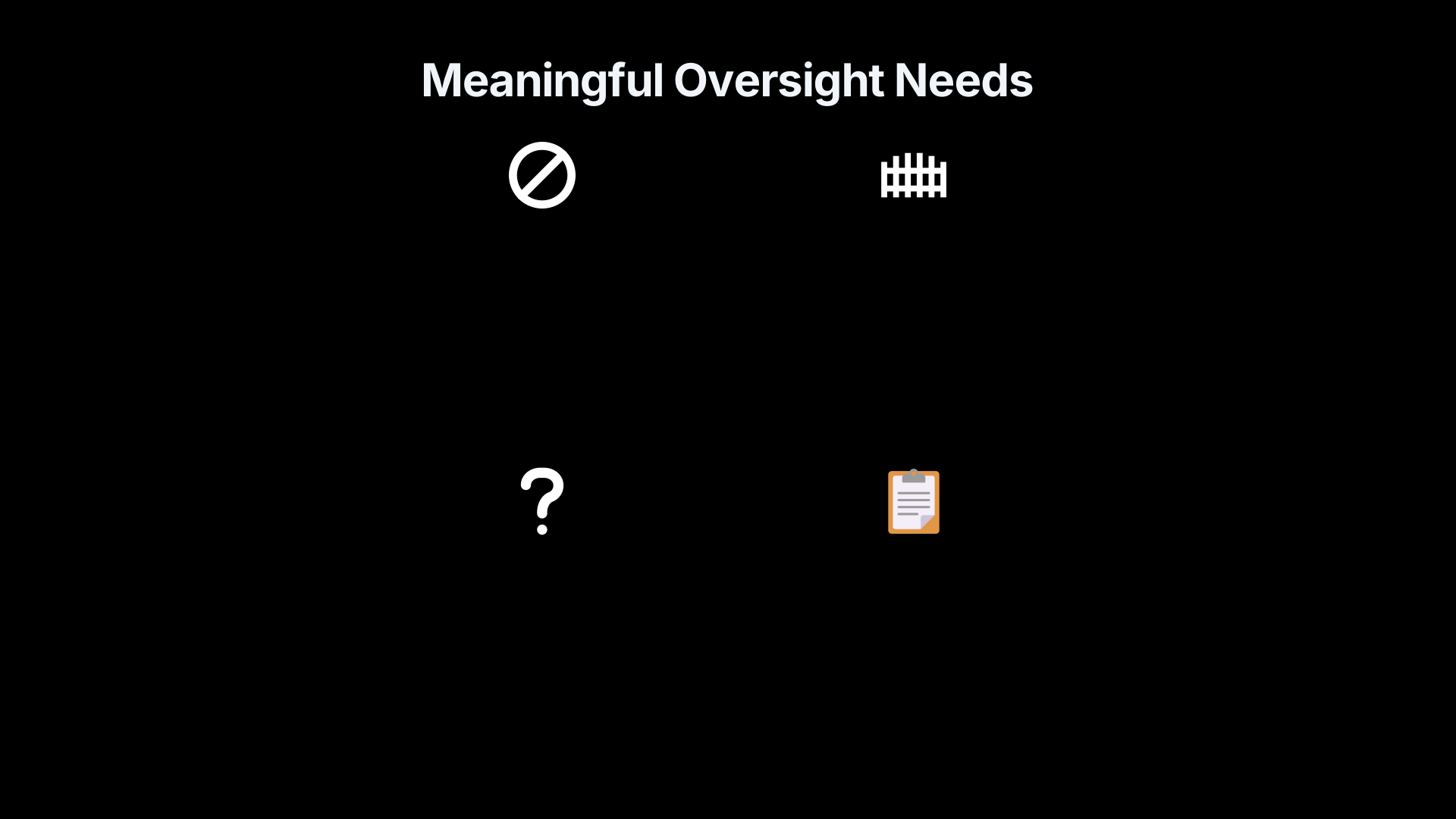
Humans need authority, not just responsibility
A reviewer must be able to:
- pause actions,
- request additional evidence,
- escalate concerns,
- or reject outputs without punishment for slowing the system down.
If management culture penalises intervention, oversight degrades rapidly into compliance theatre.
Review volume must stay manageable
One human cannot meaningfully supervise thousands of high-speed agent actions simultaneously.
This may require:
- limiting automation rates,
- narrowing the scope of autonomous authority,
- prioritising review of high-risk decisions, [verifywise.ai]verifywise.aiVerifyWiseHuman-in-the-loop safeguards | AI Governance LexiconHuman-in-the-loop safeguards ensure people review high-risk AI decisions be…
- or deliberately introducing operational friction.
In practice, effective oversight may reduce some efficiency gains. That trade-off is often underappreciated in commercial AI deployment discussions.
Systems must expose uncertainty clearly
Research suggests humans make fewer automation-bias errors when systems communicate confidence levels, disagreement signals, or uncertainty rather than presenting outputs as authoritative conclusions. [Axios]axios.comIn AI we trustOriginally studied in the context of airplane autopilots, automation bias has become a more serious concern as AI technologies are integr…
An AI that appears infallible encourages passive acceptance. A system designed to highlight ambiguity can preserve human judgement more effectively.
Oversight must be testable
Some governance proposals increasingly focus on measurable indicators rather than nominal supervision alone:
- override rates,
- review time,
- error detection rates,
- audit trails,
- escalation frequency,
- and evidence that humans genuinely challenge the system. [scadea.com]scadea.comhuman review on high-stakes AI decisions, with NIST AI RMF, FCRA, NAIC…Read more…
The key shift is from asking “Was a human present?” to asking “Did the human exercise real judgement?”
The deeper tension inside the AI bloom vision
The rubber-stamp problem exposes a deeper tension within optimistic visions of AI-driven abundance.
The economic and scientific promise of advanced AI depends partly on reducing human cognitive bottlenecks. Powerful agents could help coordinate infrastructure, accelerate research, manage energy systems, optimise logistics, and automate complex administrative work at enormous scale.
[But meaningful human oversight is itself a cognitive bottleneck.]link.springer.commeaningful human oversight in AI | AI and Ethicsby L Zhu · 2026 · Cited by 5 — Human oversight is central to safe and responsible AI, but…
A society cannot simultaneously expect AI systems to:
- operate faster than humans,
- reason across greater complexity than humans,
- manage more information than humans can process,
- and still remain continuously understandable and reviewable in detail.
At some point, societies may face difficult choices about where direct human judgement remains essential, where trust in automated systems becomes unavoidable, and how much autonomy should ever be delegated to systems operating beyond ordinary human comprehension.
That question sits close to the centre of the long-term AI debate. If advanced AI genuinely expands civilisation’s capabilities, it may also force humanity to rethink what governance, accountability, and control mean in a world where machines increasingly perform the thinking that institutions once relied on humans to do.
Endnotes
-
Source: link.springer.com
Link: https://link.springer.com/article/10.1007/s43681-026-01147-7Source snippet
meaningful human oversight in AI | AI and Ethicsby L Zhu · 2026 · Cited by 5 — Human oversight is central to safe and responsible AI, but...
-
Source: sciencedirect.com
Link: https://www.sciencedirect.com/science/article/pii/S0267364922000292Source snippet
ScienceDirectThe flaws of policies requiring human oversight...by B Green · 2022 · Cited by 318 — In this article, I survey 41 policies...
-
Source: axios.com
Title: In AI we trust
Link: https://www.axios.com/2019/10/19/ai-automation-bias-trustSource snippet
Originally studied in the context of airplane autopilots, automation bias has become a more serious concern as AI technologies are integr...
-
Source: arxiv.org
Link: https://arxiv.org/abs/2103.02381 -
Source: sciencedirect.com
Link: https://www.sciencedirect.com/science/article/pii/S2666792426000065Source snippet
ScienceDirectHuman-in-the-loop artificial intelligence in the energy sectorby AT Nguyen · 2026 — The final model is a human-factor failur...
-
Source: arxiv.org
Title: arXiv Bias in the Loop: How Humans Evaluate AI-Generated Suggestions
Link: https://arxiv.org/abs/2509.08514 -
Source: mdpi.com
Link: https://www.mdpi.com/1099-4300/28/4/377Source snippet
Throughput bottlenecks under peak load. Ambiguous accountability. High-risk misses under time pressure. Inconsistent overrides.Read more...
-
Source: pmc.ncbi.nlm.nih.gov
Link: https://pmc.ncbi.nlm.nih.gov/articles/PMC12515260/Source snippet
PMCThe Impact of Lower Degree Automation Reliability on Higher...by VK Bowden · 2025 · Cited by 1 — A persistent human factors challenge...
-
Source: verifywise.ai
Link: https://verifywise.ai/lexicon/human-in-the-loop-safeguardsSource snippet
VerifyWiseHuman-in-the-loop safeguards | AI Governance LexiconHuman-in-the-loop safeguards ensure people review high-risk AI decisions be...
-
Source: scadea.com
Link: https://scadea.com/hitl-as-a-governance-control-automation-bias-and-review-architecture/Source snippet
human review on high-stakes AI decisions, with NIST AI RMF, FCRA, NAIC...Read more...
-
Source: pmc.ncbi.nlm.nih.gov
Title: PMCExplainable artificial intelligence in air traffic control
Link: https://pmc.ncbi.nlm.nih.gov/articles/PMC12963558/Source snippet
artificial intelligence in air traffic control - PMC - NIHby G Cartocci · 2026 — This study empirically investigates the effects of Expla...
-
Source: sciencedirect.com
Link: https://www.sciencedirect.com/science/article/pii/S2941198X25000430Source snippet
The use of artificial intelligence (AI) in the flight deckby J Korentsides · 2025 — AI excels at maintaining optimal flight paths, detect...
-
Source: internationalaisafetyreport.org
Title: international ai safety report 2026
Link: https://internationalaisafetyreport.org/publication/international-ai-safety-report-2026Source snippet
To reduce the chance of failures from AI agents (see §2.2.1...Read more...
-
Source: ft.com
Title: Financial Times The very human problem with not-quite-self-driving cars
Link: https://www.ft.com/content/6734cdc4-5e2d-403b-8f3b-467c1d4eebfcSource snippet
Currently, manufacturers are integrating "Level 2" partial automation features in cars, which assist with driving but still require human...
-
Source: faa.gov
Title: Federal Aviation Administrationicao
Link: https://www.faa.gov/sites/faa.gov/files/2022-11/ICAO%20HF%20Ops%20Rpt%20-%20Implications%20of%20Automation.pdfSource snippet
circularThis digest presents the Human Factors implications of automation and advanced technology flight decks. The purpose of the digest...
-
Source: systemsintegrity.org
Link: https://www.systemsintegrity.org/from-human-in-the-loop-to-human-with-agency-why-ai-oversight-fails-when-humans-are-present-but-powerless/Source snippet
In healthcare, this is...Read more...
-
Source: Wikipedia
Link: https://en.wikipedia.org/wiki/HumanSource snippet
HumanHumans are the most abundant and widespread species of primates, characterized by bipedality, hairlessness, and large, complex br...
-
Source: faa.gov
Title: artificial intelligence
Link: https://www.faa.gov/aircraft/air_cert/step/disciplines/artificial_intelligenceSource snippet
Technical Discipline: Artificial Intelligence – Machine...9 Apr 2026 — Discipline leadership supports evaluating the effective use of ML...
-
Source: frontiersin.org
Link: https://www.frontiersin.org/journals/political-science/articles/10.3389/fpos.2025.1611563/fullSource snippet
Editorial: Humans in the loop: exploring the challenges of...by B Wagner · 2025 · Cited by 3 — “Human in the loop” (HITL) refers to a pr...
Additional References
-
Source: linkedin.com
Link: https://www.linkedin.com/pulse/human-loop-control-ritesh-vajariya-y2heeSource snippet
"Human in the Loop" Is Not a ControlAutomation bias, rubber-stamping, and the most dangerous assumption in AI governance. It's a Wednesda...
-
Source: medium.com
Link: https://medium.com/%40adnanmasood/ai-system-harms-case-studies-in-bias-misinformation-and-accountability-319bde873e57Source snippet
AI System Harms & Case Studies in Bias, Misinformation...Trust in automated decision systems in Dutch government was severely damaged. I...
-
Source: facebook.com
Link: https://www.facebook.com/TELUSDigital/posts/ai-can-flag-harmful-content-at-incredible-speed-but-it-still-misses-things-any-e/1389769739850657/Source snippet
AI can flag harmful content at incredible speed, but it still...Human-in-the-loop oversight adds the contextual judgment and expertise n...
-
Source: jdasolutions.aero
Link: https://jdasolutions.aero/blog/tc-process-merits-faster-processing-ai-can-help-with-speed-but-not-ready-for-airworthiness-criteria/Source snippet
AI could speed up TC processes,, but not...3 days ago — AI can accelerate FAA certification only if it is used in tightly bounded, evide...
-
Source: aircraftcharter.com
Link: https://aircraftcharter.com/ai-improving-safety-in-private-jets/Source snippet
How AI is improving safety standards in private aviationThe FAA's AI safety assurance roadmap treats AI as something that must fit within...
-
Source: imda.gov.sg
Link: https://www.imda.gov.sg/-/media/imda/files/about/emerging-tech-and-research/artificial-intelligence/mgf-for-agentic-ai.pdfSource snippet
Infocomm Media Development AuthorityMODEL AI GOVERNANCE FRAMEWORK FOR AGENTIC AI18 hours ago — Specifically, “human-in-the-loop” has to b...
-
Source: icas.org
Link: https://www.icas.org/icas_archive/ICAS2022/data/papers/ICAS2022_0903_paper.pdfSource snippet
STRESSING SAFETY ASSESSMENT METHODS BY...by L Meyer · Cited by 2 — Automation aims to improve the system performance by reducing the wor...
-
Source: medium.com
Link: https://medium.com/faa/the-dangers-of-overreliance-on-automation-5b7afb56ebdcSource snippet
The Dangers of Overreliance on AutomationWhile automation has undoubtedly improved safety and efficiency in general aviation, excessive r...
-
Source: medium.com
Link: https://medium.com/%40anaptyss/why-human-in-the-loop-is-becoming-a-security-risk-7e8311006cf5Source snippet
Why “Human-In-The-Loop” Is becoming a Security RiskThis phenomenon, known as automation bias, leads to situations where human reviewers a...
-
Source: papers.ssrn.com
Link: https://papers.ssrn.com/sol3/Delivery.cfm/6593178.pdf?abstractid=6593178&mirid=1&type=2Source snippet
Automation Bias: When the Human SignatureThe human operator over-relies on the AI-generated recommendation as a heuristic substitute for...
Amazon book picks
Further Reading
Books and field guides related to Rubber stamp oversight. Use these as the next step if you want deeper reading beyond the article.

Introduction to AI Safety, Ethics, and Society
As AI technology is rapidly progressing in capability and being adopted more widely across society, it is more important than ever to und...

AI Safety
Artificial Intelligence is transforming our world-but can we trust it to be safe, ethical, and aligned with human values? Embark on an ex...

Artificial Intelligence Safety and Security
The history of robotics and artificial intelligence in many ways is also the history of humanity’s attempts to control such technologies....

AI Safety and Preventing Harm in AI Systems
As AI systems become increasingly embedded in all facets of society from healthcare and finance to transportation and public services, en...
Topic Tree