Within AI Bloom Futures
Who Gets the Gains?
AI can widen inequality as easily as it can widen opportunity unless institutions spread power, income, and access.
On this page
- Concentration of firms and states
- Jobs, assets, and income distribution
- Policies for broad access
Page outline Jump by section
Introduction
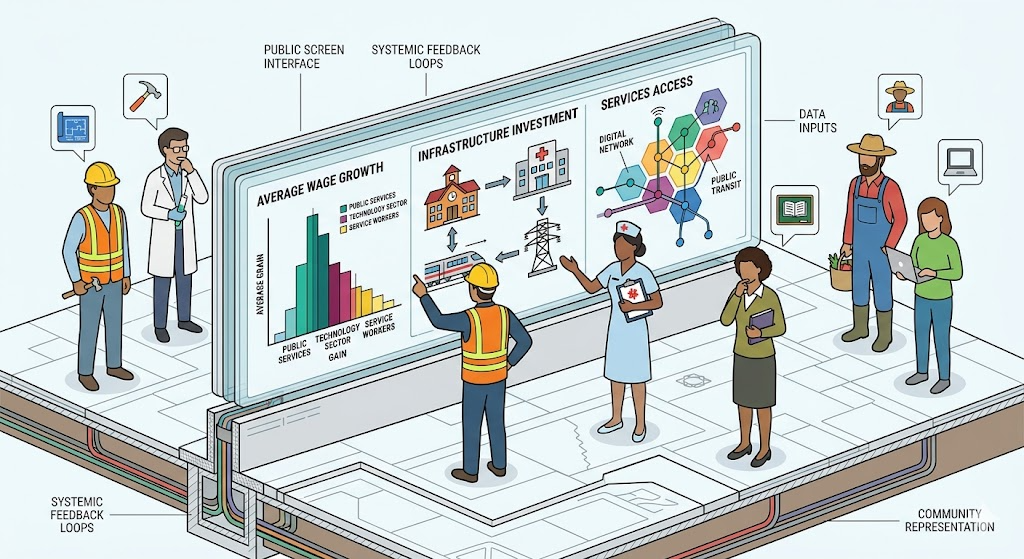
AI could help humanity bloom only if its gains are widely shared. The central distribution question is not whether advanced AI can create more wealth, knowledge, medicine, energy, and productive capacity; it is who has the power to turn those gains into income, ownership, public services, cheaper essentials, and real freedom for ordinary people. Left alone, AI may reward the owners of compute, data, cloud platforms, frontier models, distribution channels, and scarce technical talent. With better institutions, it could instead become a broad public capability: cheaper expertise, stronger science, better education, safer work, and more accessible services across countries and classes.
That makes “Who captures the gains from AI?” one of the core governance questions inside the AI bloom thesis. Abundance is not the same as justice. A society can become much richer while workers lose bargaining power, creators go unpaid, small firms depend on a few platforms, and poorer countries remain stuck outside the AI economy. The optimistic case therefore depends on deliberate choices: competition policy, labour protections, tax design, public compute, open research, affordable access, and institutions that spread power rather than merely celebrating productivity.
The gains start where power already sits
AI’s first large financial gains are likely to flow to the layers of the economy that are hardest to copy: advanced chips, cloud infrastructure, frontier model development, proprietary data, enterprise distribution, and the ability to integrate AI into existing products. That does not mean ordinary users gain nothing. A small business using AI to draft documents, a teacher adapting materials, or a doctor using AI-supported diagnostics may benefit directly. But the biggest early rents often go to whoever controls the bottleneck everyone else must pass through.
The infrastructure layer is the clearest example. Training and running powerful AI systems requires specialised chips, energy, data centres, networking, and software stacks. Nvidia’s recent financial results show how much value can concentrate in this layer: its data-centre revenue reached $75.2 billion in the first quarter of 2026, up 92% year on year, driven by AI infrastructure demand. [The Guardian]theguardian.comFor Q1 2026, Nvidia reported revenue of $81.62 billion—well above the projected $78.86 billion—and earnings of $1.87 per share, surpassin… That is not just a company success story; it is a sign that the “intelligence economy” begins with very physical scarcity.
Investment is also geographically concentrated. Stanford’s 2025 AI Index reports that U.S. private AI investment reached $109.1 billion in 2024, nearly 12 times China’s $9.3 billion and 24 times the UK’s $4.5 billion. It also reports that U.S.-based institutions produced 40 notable AI models in 2024, compared with 15 from China and three from Europe. [Stanford HAI]hai.stanford.edu2025 ai index report2025 ai index report If advanced AI becomes a general-purpose input into science, defence, education, medicine, finance, and government, that concentration may translate into geopolitical leverage as well as commercial profit.
Cloud partnerships deepen the issue. The U.S. Federal Trade Commission’s 2025 report on major AI partnerships examined Microsoft-OpenAI, Amazon-Anthropic, and Google-Anthropic, warning that such arrangements can involve equity rights, revenue-sharing, cloud-spending commitments, consultation or control rights, access to sensitive information, and potential switching costs. [Federal Trade Commission]ftc.govSource details in endnotes. The UK Competition and Markets Authority has similarly highlighted risks to “fair, open and effective competition” in foundation model markets. [GOV.UK]GOV.UKA I Foundation Models: Update paperA I Foundation Models: Update paper
The bloom-relevant point is simple: if AI becomes the cheapest route to expertise, discovery, and coordination, then whoever controls access to that route can charge tolls. A future of abundant intelligence can still be a future of concentrated power if the underlying platforms become gatekeepers.

Firm concentration can shape the whole AI economy
The phrase “AI firm concentration” can sound abstract, but it affects practical questions: who can build models, who gets priority access to chips, which start-ups survive, whether hospitals and schools can afford advanced tools, and whether small countries become AI rule-makers or AI customers.
Foundation models have features that can push towards concentration. The most capable systems require large fixed costs, specialised talent, huge datasets, compute access, and distribution. Once a firm has a widely used model, it may gain more user feedback, more enterprise integrations, more revenue to buy compute, and more influence over standards. Researchers Jai Vipra and Anton Korinek argue that the most capable foundation models may tend towards natural monopoly characteristics, while less-frontier models may face more intense competition. [arXiv]arxiv.orgarXiv Market Concentration Implications of Foundation ModelsarXiv Market Concentration Implications of Foundation Models
However, concentration is not inevitable in every layer. Open-weight models, smaller specialised models, university research, public compute programmes, and efficient inference can all push against lock-in. The important distinction is between “AI is expensive at the frontier” and “all useful AI must be controlled by a few frontier labs”. Many valuable AI applications will be local, narrow, fine-tuned, open, or embedded in public services. The policy question is whether the ecosystem remains contestable enough for those alternatives to flourish.
This matters for abundance. If AI drastically lowers the cost of legal help, tutoring, medical triage, engineering design, translation, coding, or business administration, the social gain depends on whether users can access those capabilities cheaply and safely. Competitive pressure can turn technical progress into lower prices. Monopoly power can turn the same progress into higher margins.
A healthy AI economy therefore needs more than “national champions”. It needs interoperability, data portability, procurement rules that avoid permanent lock-in, scrutiny of exclusivity deals, open standards, public-interest research access, and merger enforcement that treats compute, data, model access, and distribution as connected sources of power.
Jobs: the gains may come through workers, around workers, or against workers
The labour-market question is not simply “will AI take jobs?” The sharper question is whether AI raises workers’ productivity in ways that raise their pay and autonomy, or whether it lets firms replace, deskill, monitor, and bargain down workers while the surplus flows to capital owners.
The evidence is mixed because AI does different things in different jobs. The International Labour Organization’s global analysis found that generative AI is more likely, at least in the near term, to augment occupations than to automate them entirely, but with a strong exposure of clerical work and a gendered impact because clerical roles are an important source of female employment. [ilo.org]ilo.orgOpen source on ilo.org. The IMF similarly warns that AI exposure is high in advanced economies, that women and college-educated workers are more exposed, and that AI could increase labour-income inequality if it mainly complements already high-income workers while also raising returns to capital. [IMF]imf.orgGen-AI: Artificial Intelligence and the Future of WorkGen-AI: Artificial Intelligence and the Future of Work
The difference between augmentation and automation is crucial. If AI helps nurses reduce paperwork, teachers prepare better lessons, junior lawyers handle routine document review, or engineers test more designs, it can raise output without necessarily cutting jobs. If AI is used mainly to remove people from workflows, intensify surveillance, or convert skilled work into low-paid checking of machine output, the same technology can reduce bargaining power.
Research on earlier automation shows why this matters. Acemoglu and Restrepo’s work on automation and “rent dissipation” finds that automation can target jobs where workers had wage rents, amplifying wage losses and contributing substantially to between-group inequality in the United States since 1980. [nber.org]nber.orgOpen source on nber.org. Moll, Rachel, and Restrepo also show that automation can raise inequality through returns to wealth, not only through wages: owners of productive assets gain while wages at the bottom may stagnate. [nber.org]nber.orgUneven Growth: Automation's Impact on Income and Wealth Inequality | NBERUneven Growth: Automation's Impact on Income and Wealth Inequality | NBER
There is also a more optimistic labour channel. OECD work found no evidence that AI had increased wage inequality between occupations over 2014–2018 and some evidence that AI exposure was associated with lower wage inequality within occupations, possibly because lower-performing workers gained more from AI support. [OECD]oecd.orgartificial intelligence and wage inequality bf98a45c enartificial intelligence and wage inequality bf98a45c en That is one of the most hopeful distribution mechanisms: AI as a competence equaliser, not just a replacement tool.
The outcome depends on workplace power. Workers need access to tools, training, voice in deployment, fair monitoring rules, mobility into new tasks, and a share of productivity gains. Without that, even useful AI can make work more precarious: fewer entry-level routes, less autonomy, more algorithmic management, and weaker wage bargaining.
Asset ownership may matter more than wages
AI could widen inequality even if many people keep working. The reason is that huge gains may appear as capital income: profits, equity appreciation, intellectual property rents, cloud revenue, data-centre returns, and returns to scarce infrastructure. If ownership is narrow, the gains are narrow.
This is especially important for the long-term AI bloom vision. If advanced AI accelerates science, robotics, drug discovery, clean energy, and production, the value created may be enormous. But a large share could be capitalised into the market value of a small number of firms, data-centre operators, chipmakers, cloud providers, and platform owners. Households without savings, pensions, shares, or property would then benefit only indirectly through wages, cheaper goods, or public services — and only if those channels work.
The IMF’s analysis explicitly warns that capital returns from AI may increase wealth inequality, even while productivity gains could raise income levels for many workers if the gains are sufficiently large. [IMF]meetings.imf.orgThe Global Impact of AI Mind the Gap 566129The Global Impact of AI Mind the Gap 566129 That tension is the heart of the distribution problem: AI may grow the pie while changing who owns the pie-making machinery.
This suggests that broad gain-sharing cannot rely on reskilling alone. Skills matter, but they do not solve capital concentration. A society serious about shared AI gains would also consider wider asset ownership, stronger pension participation, employee ownership, sovereign or social wealth funds, taxation of excess rents, public stakes where public resources create private value, and public procurement that buys open access rather than closed dependency.
The point is not to punish successful firms for innovation. It is to recognise that when a general-purpose technology is built on public science, public data, publicly educated workers, energy grids, legal systems, and government procurement, some of the upside can legitimately return to the public.
Creators, data workers, and hidden contributors also have claims
AI systems are often presented as if they are built by labs alone. In reality, they depend on vast inputs from writers, artists, coders, photographers, translators, moderators, annotators, researchers, open-source communities, and ordinary internet users. Who captures AI gains partly depends on whether those contributors are recognised, paid, ignored, or litigated after the fact.
Copyright disputes show the conflict clearly. Reuters reported in May 2026 that a U.S. judge was reviewing Anthropic’s proposed $1.5 billion settlement with authors who alleged the company used pirated books to train Claude; earlier rulings had distinguished between potentially lawful training uses and alleged infringement from storing pirated books. [Reuters]reuters.comUS judge considers Anthropic's $1.5 billion settlement of authors' lawsuitUS judge considers Anthropic's $1.5 billion settlement of authors' lawsuit Comparative legal research finds that countries are wrestling with the same balance between control, compensation, transparency, and legal certainty in AI training. [Springer]link.springer.comOpen source on springer.com.
Data labour is another hidden layer. Partnership on AI has warned that data enrichment workers — people who label, clean, annotate, and evaluate data — are essential to AI development but often face low wages, unclear expectations, and inadequate support. [Partnership on AI]partnershiponai.orgPartnership on AIResponsible AI Starts with the Data Supply ChainPartnership on AIResponsible AI Starts with the Data Supply Chain A four-country study of data work in Venezuela, Brazil, Madagascar, and France argues that AI production relies on cross-country supply chains that can reproduce older patterns of dependency and informality. [arXiv]arxiv.orgarXiv Market Concentration Implications of Foundation ModelsarXiv Market Concentration Implications of Foundation Models
These issues matter because “shared gains” is not only about end users. It is also about upstream fairness. If AI companies capture value from cultural archives, public knowledge, underpaid labelling work, and open communities without consent or compensation, then abundance is built on extraction. Better approaches could include licensing markets, collective bargaining for creators, transparent data sourcing, minimum standards for data work, audit trails, and public datasets governed for public benefit.
Countries may split into AI makers and AI takers
Within-country inequality is only half the story. AI could also widen the gap between countries that build, host, regulate, and export AI systems and countries that merely import them.
The World Bank’s 2025 work on AI foundations describes stark global imbalances. High-income countries account for 87% of notable AI models, 86% of AI start-ups, and 91% of venture capital funding, while representing only 17% of the global population. They also host 77% of global co-location data-centre capacity, while low-income countries host less than 0.1%. [World Bank]worldbank.orgSource details in endnotes. The World Bank argues that developing countries need four foundations to benefit from AI: connectivity, compute, context, and competency. [World Bank]worldbank.orgSource details in endnotes.
That framework is useful because it avoids a simplistic “give everyone chatbots” view of inclusion. Connectivity means affordable internet and reliable electricity. Compute means access to cloud, chips, and data centres. Context means local languages, local data, and locally relevant tools. Competency means the skills to adapt AI rather than passively consume it.
The danger is a new dependency pattern. Poorer countries might supply raw data, low-paid annotation labour, and consumer markets while importing expensive models designed elsewhere. Their public sectors might become dependent on foreign AI systems for education, health, tax administration, translation, and security. Their local languages and local problems might remain under-served because they are less profitable.
The optimistic alternative is not that every country builds a frontier model. It is that many countries can build useful AI ecosystems: small models, public-interest datasets, local-language systems, regional compute hubs, digital public infrastructure, university capacity, and procurement rules that preserve sovereignty. AI bloom has to be global, or it risks becoming a richer-country acceleration story with humanitarian side benefits.
Broad access needs public infrastructure, not just cheap apps
Cheap AI apps can help, but they are not enough to guarantee shared gains. Many of the most important uses of AI — medical research, climate modelling, public-sector productivity, safety evaluation, language inclusion, disability support, and scientific discovery — need compute, data, expertise, and institutional trust. Markets may underprovide these where returns are uncertain or beneficiaries have little purchasing power.
Public compute is one response. The U.S. National Artificial Intelligence Research Resource, led by the National Science Foundation, is designed to give researchers and educators access to computing, data, software, models, training, and expertise. NSF says the NAIRR pilot, launched in 2024, has supported more than 600 research projects and 6,000 students across all 50 U.S. states, Washington, D.C., and Puerto Rico, with multiple federal and non-government partners. [NSF - U.S. National Science Foundation]nsf.govSource details in endnotes.
The broader principle applies beyond the United States. Public-interest AI infrastructure can help prevent the future of discovery from being limited to a handful of corporate labs. Universities, hospitals, public-health agencies, small firms, civil-society groups, and developing-country researchers need routes into AI capability that are not wholly dependent on commercial priorities.
Public access does not mean every model must be open or every dataset public. Some systems involve privacy, biosecurity, cybersecurity, or misuse risks. But a balanced ecosystem should include open models where safe, secure research environments where needed, shared benchmarks, public procurement of reusable tools, privacy-preserving data access, and funding for socially valuable work that will not be the most profitable product.
Policies for broad access
The gains from AI will not spread automatically. They need institutions that turn technical capability into shared capability. The most important policy levers are not exotic; they are familiar tools adapted to a more powerful technology.
Competition and anti-lock-in rules. Regulators should watch the full AI stack: chips, cloud, model access, app stores, enterprise software, data, and distribution. Exclusive compute deals, forced cloud commitments, self-preferencing, and acquisitions of key rivals can all shape who captures value. The FTC and CMA work on AI partnerships shows why competition agencies are already treating these relationships as structural, not merely contractual. [Federal Trade Commission]ftc.govSource details in endnotes.
Worker voice and transition support. AI deployment should involve workers before systems are imposed on them. Training, mobility support, fair redundancy rules, limits on intrusive monitoring, and collective bargaining can determine whether AI makes jobs better or simply more controlled. The ILO’s emphasis on dialogue, job quality, and adequate regulation is especially relevant here. [ilo.org]ilo.orgOpen source on ilo.org.
Tax and ownership reform. If AI raises returns to capital faster than wages, tax systems need to keep up. That may include stronger taxation of economic rents, better enforcement against profit shifting, broader employee ownership, public stakes in publicly supported infrastructure, and social wealth funds that let citizens share in capital income.
Public compute and open research capacity. Shared AI infrastructure can help universities, small firms, public agencies, and non-profits pursue socially valuable work. NAIRR-style programmes are an early example of using public-private partnerships to widen access to scarce AI resources. [NSF - U.S. National Science Foundation]nsf.govSource details in endnotes.
Creator and data-worker compensation. Copyright, licensing, transparency, and labour standards need to evolve so that AI systems do not absorb value from creative and data work without fair treatment. This is not only a legal issue; it affects whether AI development is seen as legitimate.
Global inclusion. Development policy should treat AI readiness as part of basic infrastructure: electricity, broadband, cloud access, local-language data, digital public services, and skills. The World Bank’s “four Cs” offer a practical starting point for avoiding an AI divide between countries. [World Bank]worldbank.orgSource details in endnotes.
Universal service in essential domains. If AI makes tutoring, medical triage, legal guidance, translation, accessibility support, or public administration cheaper, governments can use procurement and public services to ensure those benefits reach people who would not be attractive premium customers.

The real test: cheaper goods, stronger people, wider power
A genuine AI bloom would not be measured only by trillion-dollar valuations, benchmark scores, or faster model releases. It would show up in the lives of people who do not own AI companies: lower costs for essentials, better healthcare, more accessible education, safer work, more capable public services, shorter working hours where desired, greater disability inclusion, wider scientific participation, and stronger democratic control over powerful systems.
That is a harder standard than “AI increases GDP”. GDP can rise while power narrows. Productivity can rise while wages stagnate. Scientific progress can accelerate while access to its benefits remains unequal. Advanced AI can help humanity overcome scarcity, but it can also create new tollbooths around intelligence itself.
The question, then, is not whether AI gains will be captured. They will be. The question is by whom, through which institutions, and with what obligations attached. If the owners of compute, models, platforms, and capital capture nearly everything, AI bloom becomes a private boom with public side effects. If workers, creators, researchers, public institutions, poorer countries, and ordinary users gain real access and bargaining power, AI could become one of the great shared capabilities in human history.
Endnotes
-
Source: hai.stanford.edu
Title: 2025 ai index report
Link: https://hai.stanford.edu/ai-index/2025-ai-index-report -
Source: hai.stanford.edu
Link: https://hai.stanford.edu/ai-index/2025-ai-index-report/economy%C2%A0 -
Source: ftc.gov
Link: https://www.ftc.gov/news-events/news/press-releases/2025/01/ftc-issues-staff-report-ai-partnerships-investments-study -
Source: ftc.gov
Link: https://www.ftc.gov/policy/advocacy-research/tech-at-ftc/2025/01/behind-ftcs-6b-report-large-ai-partnerships-investments -
Source: GOV.UK
Title: A I Foundation Models: Update paper
Link: https://www.gov.uk/government/publications/ai-foundation-models-update-paper -
Source: GOV.UK
Title: A I Foundation Models: initial review
Link: https://www.gov.uk/cma-cases/ai-foundation-models-initial-review -
Source: arxiv.org
Title: arXiv Market Concentration Implications of Foundation Models
Link: https://arxiv.org/abs/2311.01550 -
Source: ilo.org
Link: https://www.ilo.org/publications/generative-ai-and-jobs-global-analysis-potential-effects-job-quantity-and -
Source: ilo.org
Link: https://www.ilo.org/resource/other/what-possible-effect-generative-ai-employment -
Source: imf.org
Title: Gen-AI: Artificial Intelligence and the Future of Work
Link: https://www.imf.org/en/publications/staff-discussion-notes/issues/2024/01/14/gen-ai-artificial-intelligence-and-the-future-of-work-542379 -
Source: nber.org
Link: https://www.nber.org/papers/w32536 -
Source: nber.org
Title: Uneven Growth: Automation’s Impact on Income and Wealth Inequality | NBER
Link: https://www.nber.org/papers/w28440 -
Source: oecd.org
Title: artificial intelligence and wage inequality bf98a45c en
Link: https://www.oecd.org/en/publications/artificial-intelligence-and-wage-inequality_bf98a45c-en.html -
Source: oecd.org
Title: What impact has AI had on wage inequality? | OECD
Link: https://www.oecd.org/en/publications/what-impact-has-ai-had-on-wage-inequality_7fb21f59-en.html -
Source: reuters.com
Title: US judge considers Anthropic’s $1.5 billion settlement of authors’ lawsuit
Link: https://www.reuters.com/legal/government/us-judge-considers-anthropics-15-billion-settlement-authors-lawsuit-2026-05-14/ -
Source: reuters.com
Link: https://www.reuters.com/legal/legalindustry/copyright-law-2025-courts-begin-draw-lines-around-ai-training-piracy-market-harm–pracin-2026-03-16/Source snippet
Other cases, like Andersen v. Stability AI and Tremblay v. OpenAI, focus on the distinction between training data and model outputs, with...
-
Source: link.springer.com
Link: https://link.springer.com/article/10.1007/s40319-025-01569-6 -
Source: partnershiponai.org
Title: Partnership on AIResponsible AI Starts with the Data Supply Chain
Link: https://partnershiponai.org/responsible-ai-starts-with-the-data-supply-chain/ -
Source: partnershiponai.org
Title: Partnership on AIResponsible Sourcing Across the Data Supply Line
Link: https://partnershiponai.org/workstream/responsible-sourcing/ -
Source: arxiv.org
Link: https://arxiv.org/abs/2410.14230 -
Source: nsf.gov
Link: https://www.nsf.gov/focus-areas/ai/nairr -
Source: nsf.gov
Link: https://www.nsf.gov/focus-areas/artificial-intelligence/nairr -
Source: oecd.ai
Title: National Artificial Intelligence Research Resource (NAIRR)
Link: https://oecd.ai/en/dashboards/policy-initiatives/national-artificial-intelligence-research-resource-nairr -
Source: GOV.UK
Title: www.gov.uk U K Compute Roadmap
Link: https://www.gov.uk/government/publications/uk-compute-roadmap/uk-compute-roadmap -
Source: GOV.UK
Title: www.gov.uk Report on Copyright and Artificial Intelligence
Link: https://www.gov.uk/government/publications/report-and-impact-assessment-on-copyright-and-artificial-intelligence/report-on-copyright-and-artificial-intelligence -
Source: oecd.org
Title: full report
Link: https://www.oecd.org/en/publications/venture-capital-investments-in-artificial-intelligence-through-2025_a13752f5-en/full-report.html -
Source: oecd.org
Title: component 5
Link: https://www.oecd.org/en/publications/competition-in-artificial-intelligence-infrastructure_623d1874-en/full-report/component-5.html -
Source: nber.org
Link: https://www.nber.org/papers/w34444 -
Source: oecd.org
Title: the impact of ai on the labour market 69793977
Link: https://www.oecd.org/en/publications/artificial-intelligence-and-the-labour-market-in-korea_68ab1a5a-en/full-report/the-impact-of-ai-on-the-labour-market_69793977.html -
Source: GOV.UK
Title: www.gov.uk A I Research Resource
Link: https://www.gov.uk/government/publications/ai-research-resource -
Source: oecd.ai
Title: National Artificial Intelligence Research Resource Pilot
Link: https://oecd.ai/en/dashboards/policy-initiatives/national-artificial-intelligence-research-resource-pilot-1037 -
Source: ilo.org
Title: generative ai and jobs 2025 update
Link: https://www.ilo.org/publications/generative-ai-and-jobs-2025-update -
Source: ilo.org
Link: https://www.ilo.org/resource/article/how-might-generative-ai-impact-different-occupations -
Source: meetings.imf.org
Title: The Global Impact of AI Mind the Gap 566129
Link: https://meetings.imf.org/en/IMF/Home/Publications/WP/Issues/2025/04/11/The-Global-Impact-of-AI-Mind-the-Gap-566129 -
Source: imf.org
Title: A I Adoption and Inequality
Link: https://www.imf.org/en/publications/wp/issues/2025/04/04/ai-adoption-and-inequality-565729 -
Source: meetings.imf.org
Title: AI Adoption and Inequality 565729
Link: https://meetings.imf.org/en/IMF/Home/Publications/WP/Issues/2025/04/04/AI-Adoption-and-Inequality-565729 -
Source: elibrary.imf.org
Title: article A001 en.xml
Link: https://www.elibrary.imf.org/abstract/journals/001/2025/068/article-A001-en.xml -
Source: link.springer.com
Link: https://link.springer.com/article/10.1007/s41027-024-00549-7 -
Source: GOV.UK
Link: https://www.gov.uk/government/news/cma-independent-inquiry-group-publishes-provisional-findings-in-cloud-services-market-investigation -
Source: competition.today
Title: U S FTC Report on AI Partnerships: Implications for Competition
Link: https://competition.today/2025/01/19/us-ftc-report-on-ai-partnerships-implications-for-competition/ -
Source: oecd.org
Title: component 7
Link: https://www.oecd.org/en/publications/job-creation-and-local-economic-development-2024_83325127-en/full-report/component-7.html -
Source: oecd.ai
Link: https://oecd.ai/en/wonk/global-deal -
Source: oecd.org
Title: component 7
Link: https://www.oecd.org/en/publications/megatrends-and-the-future-of-social-protection_6c9202e8-en/full-report/component-7.html -
Source: ftc.gov
Link: https://www.ftc.gov/legal-library/browse/joint-statement-competition-generative-ai-foundation-models-ai-products -
Source: GOV.UK
Link: https://www.gov.uk/government/publications/joint-statement-on-competition-in-generative-ai-foundation-models-and-ai-products -
Source: GOV.UK
Link: https://www.gov.uk/government/publications/joint-statement-on-competition-in-generative-ai-foundation-models-and-ai-products/joint-statement-on-competition-in-generative-ai-foundation-models-and-ai-products -
Source: meetings.imf.org
Title: fiscal policy can help broaden the gains of ai to humanity
Link: https://meetings.imf.org/en/IMF/Home/Blogs/Articles/2024/06/17/fiscal-policy-can-help-broaden-the-gains-of-ai-to-humanity -
Source: elibrary.imf.org
Title: article A001 en.xml
Link: https://www.elibrary.imf.org/view/journals/006/2024/002/article-A001-en.xml -
Source: nsf.gov
Link: https://www.nsf.gov/news/nsf-led-national-ai-research-resource-pilot-awards-first -
Source: GOV.UK
Title: www.gov.uk CM A AI strategic update
Link: https://www.gov.uk/government/publications/cma-ai-strategic-update/cma-ai-strategic-update -
Source: GOV.UK
Title: www.gov.uk CM A outlines growing concerns in markets for AI Foundation Models
Link: https://www.gov.uk/government/news/cma-outlines-growing-concerns-in-markets-for-ai-foundation-models -
Source: oecd.org
Title: using ai in the workplace 73d417f9 en
Link: https://www.oecd.org/en/publications/using-ai-in-the-workplace_73d417f9-en.html -
Source: nsf.gov
Title: National Artificial Intelligence Research Resource (NAIRR) pilot | NSF
Link: https://www.nsf.gov/geo/updates/national-artificial-intelligence-research-resource-nairr -
Source: blogs.microsoft.com
Title: ai access principles responsible mobile world congress
Link: https://blogs.microsoft.com/on-the-issues/2024/02/26/microsoft-ai-access-principles-responsible-mobile-world-congress/ -
Source: link.springer.com
Link: https://link.springer.com/article/10.1007/s00548-023-00904-8 -
Source: nsf.gov
Link: https://www.nsf.gov/news/democratizing-future-ai-rd-nsf-launch-national-ai-research -
Source: imf.org
Title: Gen-AI: Artificial Intelligence and the Future of Work
Link: https://www.imf.org/en/Publications/Staff-Discussion-Notes/Issues/2024/01/14/Gen-AI-Artificial-Intelligence-and-the-Future-of-Work-542379?cid=bl-com-SDNEA2024001 -
Source: elibrary.imf.org
Title: article A001 en.xml
Link: https://www.elibrary.imf.org/view/journals/006/2024/001/article-A001-en.xml -
Source: elibrary.imf.org
Title: 006.2024.issue 001 en.xml
Link: https://www.elibrary.imf.org/view/journals/006/2024/001/006.2024.issue-001-en.xml -
Source: elibrary.imf.org
Title: article A000 en.xml
Link: https://www.elibrary.imf.org/view/journals/006/2024/001/article-A000-en.xml -
Source: stg-bookstore.imf.org
Title: gen ai artificial intelligence and the future of work
Link: https://stg-bookstore.imf.org/books/gen-ai-artificial-intelligence-and-the-future-of-work -
Source: link.springer.com
Link: https://link.springer.com/article/10.1007/s00146-023-01824-9 -
Source: ilo.org
Link: https://www.ilo.org/publications/generative-ai-and-jobs-policies-manage-transition -
Source: imf.org
Link: https://www.imf.org/en/publications/wp/issues/2023/10/04/labor-market-exposure-to-ai-cross-country-differences-and-distributional-implications-539656 -
Source: GOV.UK
Link: https://www.gov.uk/government/news/proposed-principles-to-guide-competitive-ai-markets-and-protect-consumers -
Source: ilo.org
Link: https://www.ilo.org/resource/news/generative-ai-likely-augment-rather-destroy-jobs -
Source: ilo.org
Link: https://www.ilo.org/meetings-and-events/generative-ai-and-jobs-global-analysis-potential-effects-job-quantity-and -
Source: oecd.org
Title: artificial intelligence job quality and inclusiveness a713d0ad
Link: https://www.oecd.org/en/publications/2023/07/oecd-employment-outlook-2023_904bcef3/full-report/artificial-intelligence-job-quality-and-inclusiveness_a713d0ad.html -
Source: oecd.org
Title: artificial intelligence job quality and inclusiveness a713d0ad
Link: https://www.oecd.org/en/publications/oecd-employment-outlook-2023_08785bba-en/full-report/artificial-intelligence-job-quality-and-inclusiveness_a713d0ad.html -
Source: oecd.org
Link: https://www.oecd.org/en/publications/2023/07/oecd-employment-outlook-2023_904bcef3/full-report/social-dialogue-and-collective-bargaining-in-the-age-of-artificial-intelligence_5828691a.html -
Source: oecd.org
Link: https://www.oecd.org/en/publications/oecd-employment-outlook-2023_08785bba-en/full-report/social-dialogue-and-collective-bargaining-in-the-age-of-artificial-intelligence_5828691a.html -
Source: oecd.org
Link: https://www.oecd.org/en/publications/oecd-employment-outlook-2023_08785bba-en/full-report/ensuring-trustworthy-artificial-intelligence-in-the-workplace-countries-policy-action_c01b9e49.html -
Source: inequality.stanford.edu
Title: automation labor displacing productivity growth employment and labor
Link: https://inequality.stanford.edu/publications/media/details/automation-labor-displacing-productivity-growth-employment-and-labor -
Source: bookstore.imf.org
Title: gen ai artificial intelligence and the future of work
Link: https://www.bookstore.imf.org/books/gen-ai-artificial-intelligence-and-the-future-of-work -
Source: ftc.gov
Link: https://www.ftc.gov/news-events/news/press-releases/2024/01/ftc-launches-inquiry-generative-ai-investments-partnerships -
Source: nber.org
Link: https://www.nber.org/papers/w24871 -
Source: nber.org
Link: https://www.nber.org/papers/w32487 -
Source: nber.org
Link: https://www.nber.org/books-and-chapters/book-agra-5-stub/artificial-intelligence-competition-and-welfare -
Source: researchrepository.ilo.org
Title: Generative AI and jobs a global
Link: https://researchrepository.ilo.org/esploro/outputs/encyclopediaEntry/Generative-AI-and-jobs-a-global/995326516102676 -
Source: researchrepository.ilo.org
Link: https://researchrepository.ilo.org/esploro/outputs/encyclopediaEntry/Generative-AI-and-jobs-policies-to/995334493102676 -
Source: researchrepository.ilo.org
Title: encyclopedia Entry
Link: https://researchrepository.ilo.org/esploro/outputs/encyclopediaEntry/995334493102676 -
Source: hai.stanford.edu
Link: https://hai.stanford.edu/ai-index/2026-ai-index-report/economy -
Source: hai.stanford.edu
Title: 2025 ai index report
Link: https://hai.stanford.edu/ai-index/2025-ai-index-report?sf223786131=1 -
Source: hai.stanford.edu
Title: 2025 ai index report
Link: https://hai.stanford.edu/ai-index/2025-ai-index-report?mod=djemAI -
Source: microsoft.com
Title: National AI Research Resource (NAIRR) Pilot
Link: https://www.microsoft.com/en-us/research/project/national-ai-research-resource-nairr-pilot/ -
Source: oecd.ai
Title: The Future of Work
Link: https://oecd.ai/en/working-group-future-of-work -
Source: oecd.ai
Title: Labour markets
Link: https://oecd.ai/en/work-innovation-productivity-skills/key-themes/labour-markets -
Source: oecd.ai
Title: Labour markets
Link: https://oecd.ai/fr/work-innovation-productivity-skills/key-themes/labour-markets -
Source: oecd.ai
Link: https://oecd.ai/en/dashboards/ai-principles/P13 -
Source: oecd.org
Link: https://www.oecd.org/en/topics/ai-and-work.html -
Source: fair.work
Link: https://fair.work/en/fw/publications/fairwork-ai-ratings-2024-5-who-powers-ai-assessing-fairness-in-the-ai-supply-chain-humans-in-the-loop-as-a-case-study/ -
Source: theguardian.com
Link: https://www.theguardian.com/technology/2026/may/20/nvidia-revenue-ai-boomSource snippet
For Q1 2026, Nvidia reported revenue of $81.62 billion—well above the projected $78.86 billion—and earnings of $1.87 per share, surpassin...
-
Source: worldbank.org
Link: https://www.worldbank.org/en/news/factsheet/2025/11/21/strengthening-ai-foundations-emerging-opportunities-for-developing-countries -
Source: worldbank.org
Title: dptr2025 ai foundations
Link: https://www.worldbank.org/en/publication/dptr2025-ai-foundations -
Source: partnershiponai.org
Title: Responsible Sourcing Across the Data Supply Line Archives
Link: https://partnershiponai.org/workstream_tax/responsible-sourcing/ -
Source: journals.library.columbia.edu
Link: https://journals.library.columbia.edu/index.php/taxlaw/article/view/14478 -
Source: ojs.aaai.org
Link: https://ojs.aaai.org/index.php/AIES/article/view/36594 -
Source: businesswire.com
Link: https://www.businesswire.com/news/home/20250407539812/en/Stanford-HAIs-2025-AI-Index-Reveals-Record-Growth-in-AI-Capabilities-Investment-and-Regulation -
Source: reproducibility.worldbank.org
Link: https://reproducibility.worldbank.org/catalog/183 -
Source: partnershiponai.org
Link: https://partnershiponai.org/protecting-ais-essential-workers-introducing-our-vendor-engagement-guidance-transparency-template/ -
Source: partnershiponai.org
Link: https://partnershiponai.org/protecting-ais-essential-workers-a-pathway-to-responsible-data-enrichment-practices/ -
Source: theguardian.com
Link: https://www.theguardian.com/technology/article/2024/jul/06/mercy-anita-african-workers-ai-artificial-intelligence-exploitation-feeding-machine -
Source: accountability.worldbank.org
Title: Developing AI for development
Link: https://accountability.worldbank.org/en/news/2024/Developing-AI-for-development -
Source: worldbank.org
Title: Accelerated by COVID and AI, Global Digital Landscape Remains Uneven
Link: https://www.worldbank.org/en/news/press-release/2024/03/05/accelerated-by-covid-and-ai-global-digital-landscape-remains-uneven -
Source: partnershiponai.org
Link: https://partnershiponai.org/pai-and-deepmind-collaborate-to-develop-tools-for-sourcing-enriched-data-responsibly/ -
Source: data360.worldbank.org
Title: artificial intelligence
Link: https://data360.worldbank.org/en/int/atlas/artificial-intelligence -
Source: worldbank.org
Link: https://www.worldbank.org/ext/en/topic/digital-and-ai -
Source: worldbank.org
Link: https://www.worldbank.org/en/publication/dptr2025-ai-foundations/report -
Source: worldbank.org
Title: dptr2025 ai foundations
Link: https://www.worldbank.org/en/publication/dptr2025-ai-foundations?intcid=ecr_hp_sidekick1_en_ext -
Source: data360.worldbank.org
Title: internet access
Link: https://data360.worldbank.org/en/int/atlas/internet-access -
Source: live.worldbank.org
Title: artificial intelligence foundations agriculture from farms to future economies
Link: https://live.worldbank.org/en/event/2025/artificial-intelligence-foundations-agriculture-from-farms-to-future-economies -
Source: articsledge.com
Title: ai infrastructure
Link: https://www.articsledge.com/post/ai-infrastructure
Additional References
-
Source: youtube.com
Title: Who Owns AI Will Decide Who Gets Rich
Link: https://www.youtube.com/watch?v=oful9hVGNIcSource snippet
Here's Why AI Is Creating The Biggest Monopolies in History...
-
Source: youtube.com
Title: A Primer on the Economics of AI from Justin Wolfers
Link: https://www.youtube.com/watch?v=pdEgLS5XIQUSource snippet
Who Owns AI Will Decide Who Gets Rich - And Who Loses...
-
Source: researchgate.net
Link: https://www.researchgate.net/publication/385091584_Global_Inequalities_in_the_Production_of_Artificial_Intelligence_A_Four-Country_Study_on_Data_Work -
Source: cascale.org
Link: https://cascale.org/resources/press-news/press-releases/cascale-open-supply-hub-strategic-collaboration/ -
Source: frontier-economics.com
Link: https://www.frontier-economics.com/uk/en/news-and-insights/articles/article-i21406-ai-beyond-the-cloud-navigating-competition-innovation-and-regulation/ -
Source: clearyantitrustwatch.com
Link: https://www.clearyantitrustwatch.com/2024/04/cma-publishes-update-on-its-initial-review-into-ai-foundation-models/ -
Source: dlapiper.com
Link: https://www.dlapiper.com/en-eu/insights/publications/2026/04/ai-and-copyright-major-issues-and-direction-of-travel-in-the-uk-eu-and-china-in-q2-2026/can-ai-training-result-in-copyright-infringement -
Source: papers.ssrn.com
Link: https://papers.ssrn.com/sol3/papers.cfm?abstract_id=5021889 -
Source: brookings.edu
Link: https://www.brookings.edu/events/digital-transformation-and-artificial-intelligence-implications-for-inequality-and-global-economic-convergence/ -
Source: econstor.eu
Link: https://www.econstor.eu/handle/10419/313118
Amazon book picks
Further Reading
Books and field guides related to Who Gets the Gains?. Use these as the next step if you want deeper reading beyond the article.
The Shift: The Future of Work is Already Here
An unhysterical look at the future of employment.

Cutting Edge
The rapid expansion of laborless production systems creates enormous instability. Money previously paid in wages is spent on technology....

Cyber-Marx
In this highly readable and thought-provoking work, Nick Dyer-Witheford assesses the relevance of Marxism in our time and demonstrates ho...
Automation and the Future of Work
First published 2020. Subjects: Economic history, Automation, Social aspects, Economic aspects, Technological innovations.
eBay marketplace picks
Marketplace Samples
Example marketplace items related to this page. Use the search link to explore similar finds on eBay.

Example eBay listing
Mom Bruh Mug – Hilarious Gift for Mom Who Gets It Gifts for Mom 11 - 15 oz
USD 10.99 | Shipping USD 6.09 | US

Example eBay listing
"Let's Drink" He Who Drinks Gets Drunk Stein Mug Vintage Gold Trim
USD 15.00 | US

Example eBay listing
DEI 24 oz Red Ceramic Mug, "The only one who gets me is my dog", paw prints
USD 7.78 | US

Example eBay listing
A.I. Artificial Intelligence Movie Film Poster Art Print
GBP 4.99 | Free shipping | GB

Example eBay listing
A I Artificial Intelligence 6 Movie Poster Art Print Print Classic Rare Gallery
GBP 49.00 | Free shipping | GB

Example eBay listing
AI - Artificial Intelligence (Poster + Slipcase) Blu-Ray
GBP 10.49 | Free shipping | GB

Example eBay listing
A. I. Artificial Intelligence. Jude Law. Original UK Video Poster.
GBP 8.11 | Shipping GBP 3.38 | GB
Topic Tree
Follow this branch
Parent topic
AI Bloom FuturesRelated pages 9
- Abundant Intelligence
- AI Medicine
- AI Tutors
- Coordination
- Discovery
- Energy Limits
- Long Future
- Robots and Work
- +1 more in sidebar