Within Robots and Work
What Robots Should Do First
A humane robotics agenda starts with the tasks workers most want to escape: hazardous, repetitive, degrading or body-wearing work.
On this page
- Dull, dirty and dangerous work
- Listening to workers before automating
- Choosing tasks by harm reduction, not labour replacement
Page outline Jump by section
Introduction
If robots are going to automate work, the first priority should not be replacing the maximum number of workers as quickly as possible. It should be reducing the kinds of labour that most damage human bodies, consume family life, expose people to danger, or trap workers in exhausting repetition. A humane robotics agenda begins with harm reduction.
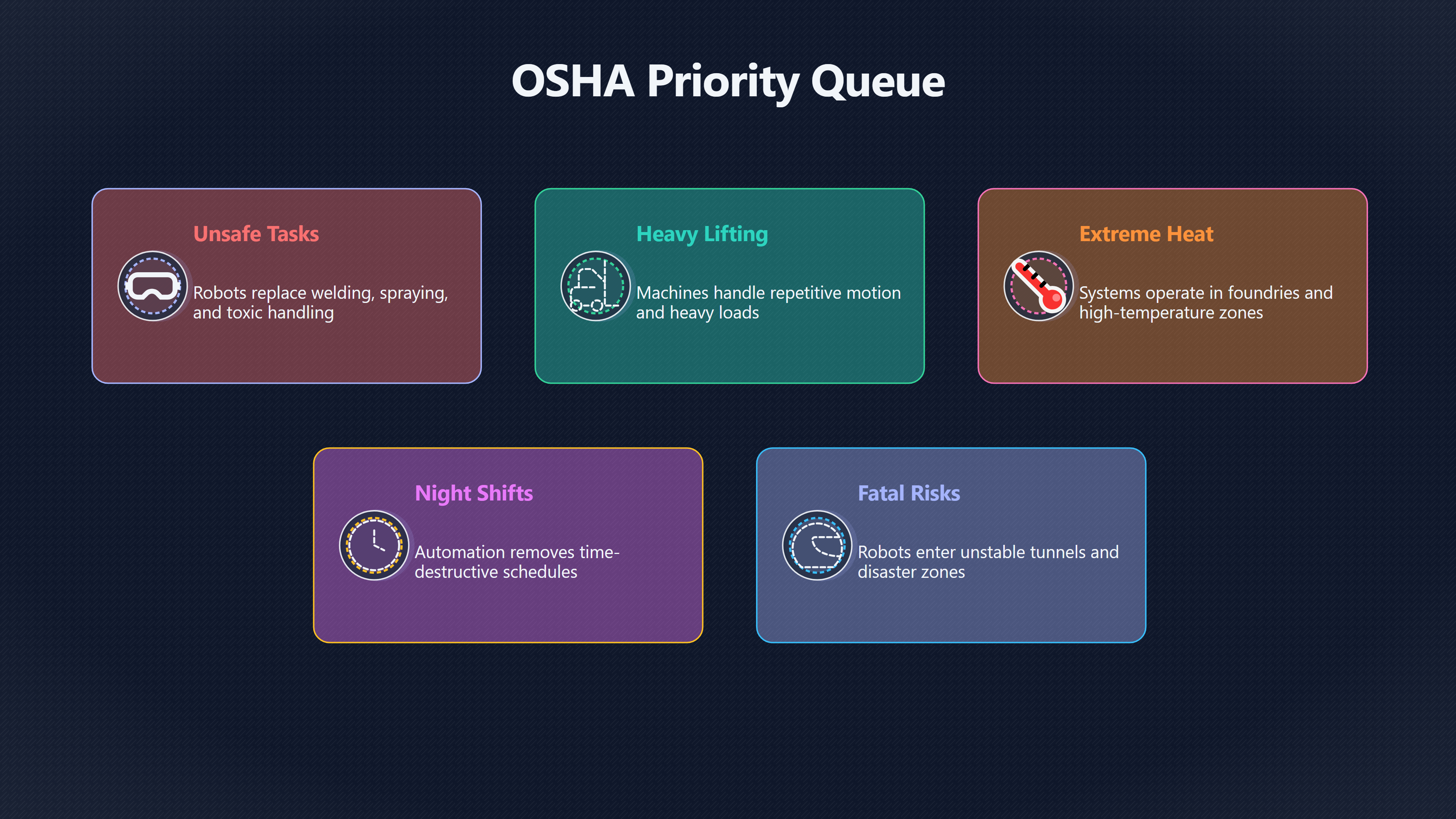
 That principle is older than the current AI boom. Industrial safety agencies have long described robots as tools for “unsafe, hazardous, highly repetitive, and unpleasant tasks” such as welding, spraying, heavy lifting, and toxic material handling. OSHA [OBIS]obis.osha.gov6Robots are used for replacing humans who were performing unsafe, hazardous, highly repetitive, and unpleasant tasks. They are utilized t… But advanced AI could expand that logic far beyond factory arms. Better perception, planning, and coordination may allow robots to work in messier environments: construction sites, farms, hospitals, waste facilities, disaster zones, ports, warehouses, and eventually homes.
The key question is not whether machines can technically do human work. It is which work society should most urgently want humans to escape. That shifts the conversation from labour replacement to human flourishing. In the broader AI bloom vision, robots matter most when they reduce drudgery and widen human freedom, not when they merely accelerate output statistics.
The clearest priority: dull, dirty and dangerous work
The strongest moral case for robotics is straightforward. Some work systematically injures people, shortens careers, degrades health, or leaves workers physically broken by middle age. These jobs should move to the front of the automation queue.
Occupational safety agencies across multiple countries consistently describe robotics as especially suitable for dangerous, repetitive, and unpleasant work. [EU-OSHA]osha.europa.euautomating tasks work safe manner new comparative case study reporttasks at work in a safe manner: new comparative…Jun 20, 2023 — The use of artificial intelligence (AI) and robotics to automate danger… [3OSHA 3OSHA] The principle sounds simple, but it points toward a real ordering of priorities.
The first candidates are usually tasks with one or more of these features:
- High rates of injury or chronic strain
- Exposure to toxins, heat, dust, fumes, pathogens, radiation, or extreme noise
- Heavy lifting and repetitive motion
- Psychological degradation or extreme monotony
- Unsafe environments where mistakes are frequently fatal
- Night-shift or time-destructive schedules
- High turnover because workers actively want to leave
That does not mean every unpleasant job should disappear immediately, or that automation is always practical. But it does suggest a social ranking. Replacing a miner entering unstable tunnels is more urgent than replacing a graphic designer. Automating sewer inspection matters more than automating a teacher’s conversation with children.
The “dull, dirty and dangerous” framework is valuable because it centres the human cost of labour rather than the prestige of technology.
The jobs workers most often want machines to take
Hazardous industrial labour
Heavy industry remains one of the clearest cases for early automation. Welding, foundry work, chemical handling, metal cutting, and high-temperature manufacturing expose workers to burns, fumes, noise, and repetitive strain.
Industrial robots already dominate some of these environments because machines tolerate conditions that slowly damage humans. Robotic welding systems, paint sprayers, and chemical-handling arms reduce direct exposure to carcinogens and dangerous particles. OSHA specifically lists welding, painting, spraying, and material handling among the common robotic applications in hazardous settings. [OSHA]osha.govOSHARobotics - Overview | Occupational Safety and Health…Robots are generally used to perform unsafe, hazardous, highly repetitive, an…
This is not futuristic speculation. It is already one of the largest real-world uses of robotics.
The International Federation of Robotics reported more than 542,000 industrial robot installations in 2024 alone, with global operational stock reaching roughly 4.66 million machines. [IFR International Federation of Robotics]ifr.orgglobal robot demand in factories doubles over 10 yearsIFR International Federation of RoboticsWorld Robotics 2025 report – INDUSTRIAL ROBOTS25 Sept 2025 — The new World Robotics 2025 statisti… Much of this deployment is concentrated in physically demanding manufacturing sectors because the economic and safety logic is already strong.
Waste, sanitation and sewage work
Some of the jobs with the highest social value are also among the least desirable. Waste sorting, sewer maintenance, biohazard cleaning, and industrial sanitation often combine health risks with low status and poor working conditions.
These are ideal candidates for robotics because the objective is not replacing meaningful human judgement. It is removing humans from contamination and dangerous environments where possible.
Autonomous inspection robots can already enter pipelines, hazardous tunnels, and contaminated facilities. Waste-sorting systems using machine vision increasingly separate recyclables in environments associated with repetitive strain and exposure risks. The more capable robots become, the more societies may decide that forcing humans into certain conditions is unnecessary.
A civilisation wealthy enough to automate sewage inspection but unwilling to do so begins to look less technologically limited and more morally indifferent.
Dangerous logistics and warehousing tasks
Warehouse automation is controversial because it often arrives alongside intense productivity surveillance. Yet some logistics work genuinely is punishing: repetitive lifting, overnight shifts, high walking distances, injury-heavy picking routines, and collision-prone transport tasks.
The important distinction is between automating the harmful part of the job and automating workers into irrelevance.
Robotic pallet movers, lifting systems, and autonomous transport vehicles can reduce musculoskeletal injuries and repetitive strain. Safety researchers have repeatedly noted that robots can help prevent cuts, lifting injuries, and repetitive-motion disorders. [Safety]ccohs.carobots cobotsSafety Hazards Robots and CobotsOct 7, 2022 — Robots offer considerable safety benefits by performing tasks that are dangerous or undesir… [Health Magazine]safetyandhealthmagazine.com16789 robots in the workplaceSafety+Health MagazineRobots in the workplace1 Apr 2018 — Robots can help prevent injuries or adverse health effects such as musculoskele…
But warehouses also show the danger of using automation primarily to intensify labour. If robots merely increase work pace while humans remain under algorithmic pressure, the gains may flow upward while stress remains on the workforce.
That is why “what should robots automate first?” cannot be separated from governance and workplace design.
Mining, disaster response and extreme environments
Robots are especially valuable where human access itself is dangerous.
Examples include:
- Underground mining
- Bomb disposal
- Fire response
- Radiation zones
- Offshore infrastructure inspection
- Disaster recovery after earthquakes or industrial accidents
In these environments, the alternative to robotics is often not dignified human work. It is serious injury or death risk.
The same principle may later apply to deep-sea infrastructure, polar operations, and eventually space construction. A long-term AI bloom future would likely depend heavily on machine labour in environments too hostile for routine human presence.
Body-wearing work should rank high too
Not all harmful work looks dramatic. Some of the most damaging jobs are simply repetitive enough to destroy the body slowly.
A warehouse picker lifting thousands of objects per shift may not face spectacular danger, but cumulative strain injuries can permanently reduce mobility and health. Agricultural workers performing repetitive harvesting motions in heat suffer similar wear. Nursing aides frequently develop back injuries from lifting patients.
These jobs often disappear statistically into phrases like “musculoskeletal disorders”, which can sound abstract. In reality they mean pain, reduced earning ability, early retirement, and chronic physical limitation.
Robots are especially well suited to repetitive physical assistance:
- Lifting support
- Transporting loads
- Precision repetitive movement
- Cleaning large surfaces
- Sorting and packing
- Assisted movement in hospitals and care facilities
This matters because the future of labour is not just about preventing catastrophic accidents. It is also about reducing the long accumulation of bodily damage that millions of workers absorb over decades.

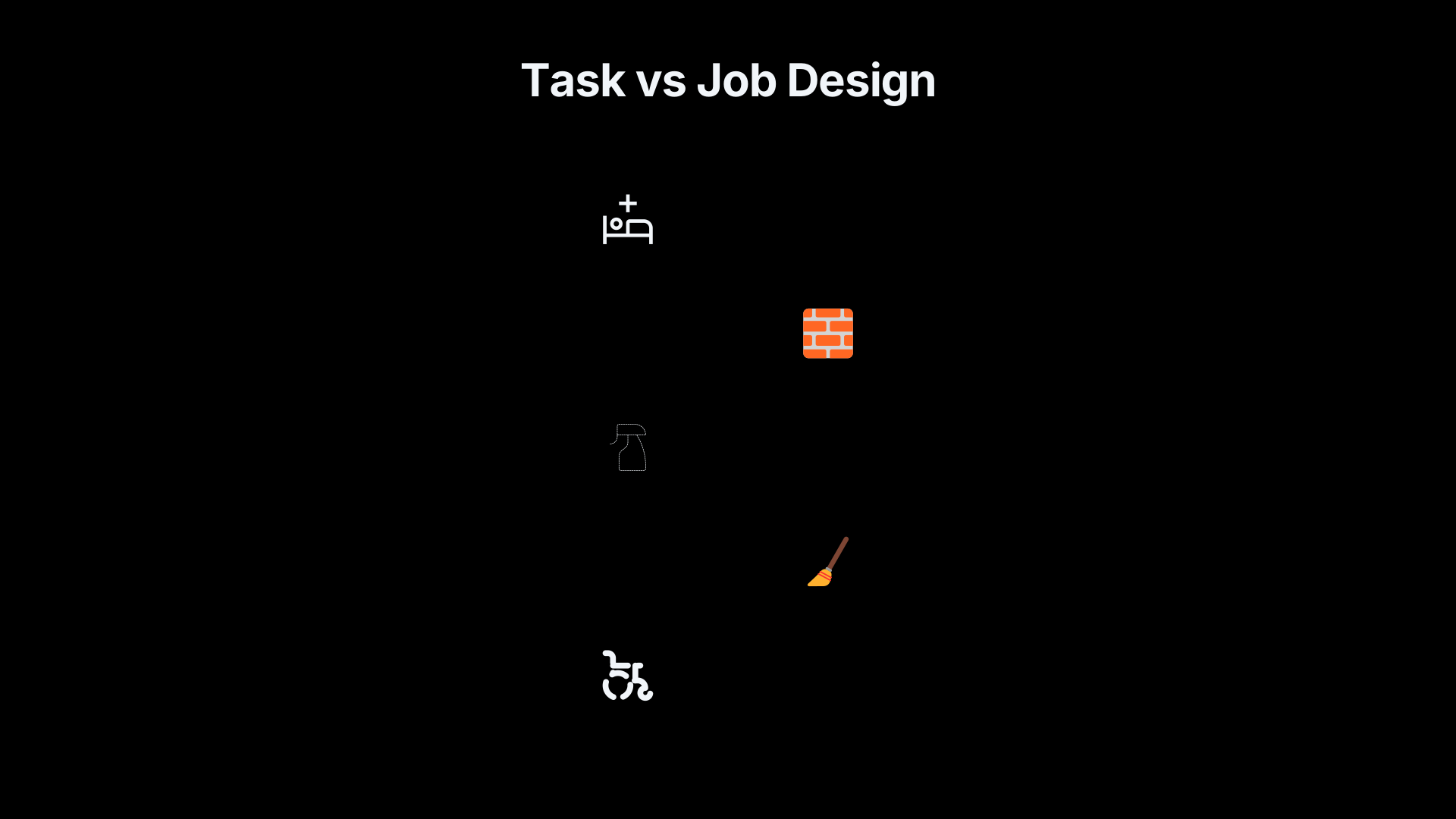
The best automation targets are often tasks, not whole jobs
One of the biggest mistakes in automation debates is treating occupations as indivisible units.
Most jobs combine:
- Repetitive physical tasks [osha.gov]osha.govOSHARobotics - Overview | Occupational Safety and Health…Robots are generally used to perform unsafe, hazardous, highly repetitive, an…
- Human judgement
- Social interaction
- Improvisation
- Emotional labour
- Coordination
- Responsibility
The most humane automation strategy often targets the worst parts first.
[For example:]ilearnengineering.comFor example, to access a dangerous area, the machine must first be powered down. Turning off…Read more…
- Nurses may want robots to transport supplies and lift patients, but not replace bedside care.
- Construction workers may welcome robotic brick transport or dangerous demolition support without wanting fully automated sites.
- Farm workers may value machines that reduce pesticide exposure while preserving skilled agricultural roles.
- Cleaners may want floor-scrubbing automation while keeping inspection and quality control human-led.
This “task-level” approach is important because it reframes robotics as augmentation before replacement.
In practice, many workers do not oppose automation in general. They oppose losing income, status, bargaining power, or meaningful work while owners capture the gains.
Listening to workers before automating
A robotics strategy designed entirely from management metrics can easily automate the wrong things first.
If the only question is “where can labour costs be reduced?”, companies may prioritise replacing visible headcount rather than reducing suffering. That can produce socially perverse outcomes:
- Automating enjoyable skilled work while retaining dangerous cleaning tasks
- Intensifying surveillance instead of reducing exhaustion
- Preserving low-status labour because workers are cheap
- Requiring humans to adapt to machine pace rather than vice versa
Workers themselves often understand best which tasks are most draining, unsafe, humiliating, or pointless.
That suggests a different implementation principle: ask workers what they most want removed from their day.
A humane robotics transition could include:
- Worker consultation before deployment
- Shared productivity gains
- Retraining guarantees
- Reduced hours rather than pure layoffs
- Injury reduction targets
- Worker ownership or profit-sharing models
- Strong safety oversight for human-robot collaboration [oxmaint.com]oxmaint.comworkplace safety fmcg plants human robot collaboration oshaHuman-Robot Collaboration & OSHA Compliance7 Mar 2026 — Every safety device in a human-robot cell requires periodic testing at documented…
Without these protections, even useful automation can increase insecurity.
Research on robot adoption reflects this tension. Some studies associate automation exposure with reduced physical strain but increased anxiety about job security and social displacement. [arXiv]arxiv.orgarXiv Pain or Anxiety? The Health Consequences of Rising Robot Adoption in ChinaarXivPain or Anxiety? The Health Consequences of Rising Robot Adoption in ChinaJanuary 25, 2023… The technology can improve bodies while worsening psychological stress if workers experience automation mainly as a threat.
Not every human task should be automated early
The jobs least suited to early robotic replacement are often the ones richest in trust, empathy, creativity, or human meaning.
That includes much of:
- Teaching
- Childcare
- Therapy
- Community care
- Mentoring
- Friendship-like interaction
- Artistic collaboration
- Civic leadership
This does not mean AI tools will have no role in these fields. They almost certainly will. But replacing emotionally meaningful human relationships is not the same kind of priority as removing people from toxic fumes or dangerous scaffolding.
The distinction matters because a healthy society is not merely one with less human labour. It is one where humans spend more of their lives on activities they value.
A robotics agenda that automates care before dangerous industrial work risks revealing distorted priorities.
Automation can remove danger — or relocate it
Robots do not eliminate risk automatically. They change where risk sits.
OSHA and NIOSH both warn that robotic systems create new hazards during maintenance, setup, adjustment, or human-robot interaction. OSHA [CDC]cdc.govRobotics in the Workplace: An Overview9 Feb 2024 — Robots working near people could: Injure workers through unexpected Many industrial accidents occur not during routine operation but when workers enter robotic spaces for servicing or troubleshooting.
Collaborative robots, or “cobots”, introduce additional complexity because humans and machines work in close proximity. [Plastech]plastech.bizAutomotive leads new installs IFR data for Europe and world 21294PlastechAutomotive leads new installs: IFR data for Europe and…Oct 9, 2025 — IFR: 542000 industrial robots were installed worldwide in… This can reduce physical burden while creating collision, distraction, or monitoring risks.
That means the first automation targets should also be the environments where safety engineering is mature enough to support deployment responsibly.
A badly implemented robot can become another source of injury rather than a path away from it.
The deeper AI bloom question
The long-term significance of robotics is not just higher productivity. It is the possibility that civilisation eventually decouples material prosperity from exhausting human labour.
Historically, societies required enormous amounts of repetitive physical work to build infrastructure, grow food, move goods, clean cities, and manufacture essentials. If increasingly capable robots can perform much of that labour safely and cheaply, human time may become less tied to physical survival work.
That does not automatically create a fair or flourishing society. Ownership, distribution, and political power still matter enormously. A robot-rich economy could produce broad leisure and security, or severe inequality and dependency.
But the humane path is clearer when automation priorities are chosen deliberately:
- Reduce injury first
- Remove degrading labour first
- Protect workers during transition
- Share productivity gains broadly
- Preserve meaningful human roles where people value them
The strongest argument for robotics is not that humans are obsolete. It is that many forms of drudgery should be.
Endnotes
-
Source: osha.gov
Link: https://www.osha.gov/roboticsSource snippet
OSHARobotics - Overview | Occupational Safety and Health...Robots are generally used to perform unsafe, hazardous, highly repetitive, an...
-
Source: obis.osha.gov
Link: https://obis.osha.gov/Publications/Mach_SafeGuard/chapt6.htmlSource snippet
6Robots are used for replacing humans who were performing unsafe, hazardous, highly repetitive, and unpleasant tasks. They are utilized t...
-
Source: osha.gov
Link: https://www.osha.gov/otm/section-4-safety-hazards/chapter-4Source snippet
OSHAOSHA Technical Manual (OTM) - Section IV: Chapter 4Industrial robots are used in place of a worker to perform dangerous or repetitive...
-
Source: osha.gov
Link: https://www.osha.gov/enforcement/directives/std-01-12-002Source snippet
OSHAGuidelines For Robotics SafetySep 21, 1987 — Industrial robots can be used to perform hazardous tasks but in doing so they can create...
-
Source: osha.europa.eu
Title: automating tasks work safe manner new comparative case study report
Link: https://osha.europa.eu/en/highlights/automating-tasks-work-safe-manner-new-comparative-case-study-reportSource snippet
tasks at work in a safe manner: new comparative...Jun 20, 2023 — The use of artificial intelligence (AI) and robotics to automate danger...
-
Source: obis.osha.gov
Link: https://obis.osha.gov/dts/osta/otm/otm_iv/otm_iv_4.htmlSource snippet
4. industrial robots and robot system safetyRobots are generally used to perform unsafe, hazardous, highly repetitive, and unpleasant tas...
-
Source: ifr.org
Title: global robot demand in factories doubles over 10 years
Link: https://ifr.org/ifr-press-releases/news/global-robot-demand-in-factories-doubles-over-10-yearsSource snippet
IFR International Federation of RoboticsWorld Robotics 2025 report – INDUSTRIAL ROBOTS25 Sept 2025 — The new World Robotics 2025 statisti...
-
Source: arxiv.org
Title: arXiv Pain or Anxiety? The Health Consequences of Rising Robot Adoption in China
Link: https://arxiv.org/abs/2301.10675Source snippet
arXivPain or Anxiety? The Health Consequences of Rising Robot Adoption in ChinaJanuary 25, 2023...
Published: January 25, 2023
-
Source: cdc.gov
Link: https://www.cdc.gov/niosh/robotics/about/index.htmlSource snippet
Robotics in the Workplace: An Overview9 Feb 2024 — Robots working near people could: Injure workers through [unexpected]({{ 'ai-bloom-abun/ai-bloom-abun-98d3a6-robots-labour-66ae30-robot-mainten-c5add9-unexpected-ro-4bc109/' |...
-
Source: osha.gov
Link: https://www.osha.gov/robotics/hazard-evaluation-solutionsSource snippet
Hazard Evaluation and SolutionsThe following references aid in evaluating hazards and possible solutions to controlling robotic hazards i...
-
Source: plastech.biz
Title: Automotive leads new installs IFR data for Europe and world 21294
Link: https://www.plastech.biz/en/news/Automotive-leads-new-installs-IFR-data-for-Europe-and-world-21294Source snippet
PlastechAutomotive leads new installs: IFR data for Europe and...Oct 9, 2025 — IFR: 542000 industrial robots were installed worldwide in...
-
Source: osha.gov
Title: OSH A Technical Manual (OTM)
Link: https://www.osha.gov/otm/section-3-health-hazards/chapter-6Source snippet
OSHA Technical Manual (OTM) - Section III: Chapter 6Potential hazards associated with compressed gases, cryogenic [materials]({{ 'ai-bloom-abun/ai-bloom-abun-98d3a6-machine-speed-f30c72-autonomous-ma-5d88c7-materials-val-3ca4e2...
-
Source: ifr.org
Link: https://ifr.org/img/worldrobotics/Executive_Summary_WR_2025_Industrial_Robots.pdfSource snippet
Industrial RobotsChina has been the world's largest industrial robot market since 2013 and accounted for. 54% of the total installations...
-
Source: ifr.org
Title: global robot demand in factories doubles over 10 years
Link: https://ifr.org/ifr-press-releases/global-robot-demand-in-factories-doubles-over-10-yearsSource snippet
Frankfurt, Sep 25, 2025 — The new World Robotics 2025 statistics on industrial robots showed 542,000 robots installed in 2024 - more than...
-
Source: automate.org
Link: https://www.automate.org/userAssets/a3/events/file/17%20-%20Hazen%20Price%20-%20OSHA%20Presentation%20Day%201.pdfSource snippet
An OSHA View on Robot SafetyHazards associated with industrial robot systems. ○. Safety Considerations for... “intended to eliminate dan...
-
Source: ccohs.ca
Title: robots cobots
Link: https://www.ccohs.ca/oshanswers/safety_haz/robots_cobots.pdfSource snippet
Safety Hazards Robots and CobotsOct 7, 2022 — Robots offer considerable safety benefits by performing tasks that are dangerous or undesir...
-
Source: all-about-industries.com
Link: https://www.all-about-industries.com/number-of-industrial-robots-has-doubled-in-ten-years-a-5f40dd03614d7567489c6391142b0b73/Source snippet
International Federation of Robotics (IFR), around 542,000 new robots were installed in 2024. This is more than twice as many as ten year...
-
Source: safetyandhealthmagazine.com
Title: 16789 robots in the workplace
Link: https://www.safetyandhealthmagazine.com/16789-robots-in-the-workplace/Source snippet
Safety+Health MagazineRobots in the workplace1 Apr 2018 — Robots can help prevent injuries or adverse health effects such as musculoskele...
-
Source: Wikipedia
Link: https://en.wikipedia.org/wiki/InternationalSource snippet
InternationalInternational is an adjective (also used as a noun) meaning "between nations". International may also refer to: Contents...
-
Source: ilearnengineering.com
Link: https://www.ilearnengineering.com/electronical-and-electronic/safety-challenges-in-industrial-roboticsSource snippet
For example, to access a dangerous area, the machine must first be powered down. Turning off...Read more...
-
Source: restoredcdc.org
Link: https://restoredcdc.org/www.cdc.gov/niosh/centers/robotics.htmlSource snippet
Center for Occupational Robotics Research | NIOSH25 Nov 2024 — Identify research needs and conduct research to improve the safety, health...
-
Source: en.pons.com
Link: https://en.pons.com/translate/english-german/internationalSource snippet
Translation from English into GermanLook up the English to German translation of INTERNATIONAL in the PONS online dictionary. Includes fr...
Additional References
-
Source: nsc.org
Link: https://www.nsc.org/getmedia/25023964-33a8-4c93-a906-d29702a6d931/wtz-robotics-wp.pdf?srsltid=AfmBOopcRJ1W30mSUzHYXSre_E3rWSJe1bfXoKBGjls8NPl3ayEYR55qSource snippet
Improving Workplace Safety with RoboticsThis white paper explores the use of robotics in environment, health and safety (EHS) application...
-
Source: facebook.com
Link: https://www.facebook.com/niosh/posts/niosh-has-been-at-the-forefront-of-efforts-to-understand-the-implications-of-art/1390937359738633/Source snippet
NIOSH National Institute for Occupational Safety and HealthThe report outlines several unfamiliar risks linked to the rise of AI and robo...
-
Source: conversiontechnology.com
Link: https://www.conversiontechnology.com/robot-safety-resources/Source snippet
Robot Safety ResourcesRobots are generally used to perform unsafe, hazardous, highly repetitive, and unpleasant tasks.... robot is not o...
-
Source: linkedin.com
Link: https://www.linkedin.com/posts/international-federation-of-robotics_facts-about-industrial-robots-world-robotics-activity-7274309278444797952-llVwSource snippet
World Robotics 2024 Report | International Federation of...The industrial robot rollout across the globe neared a record in 2024 with 54...
-
Source: linkedin.com
Link: https://www.linkedin.com/posts/supply-chain-xchange_is-the-rise-of-industrial-robots-taking-over-activity-7377386806922678273-xWM2Source snippet
Robot installations surge to 542000 in 2024, IFR reportsSep 26, 2025 — Statistics released today on factory automation show that 542,000...
-
Source: linkedin.com
Link: https://www.linkedin.com/posts/hisparob_the-new-world-robotics-2025-statistics-on-activity-7378315108424445952–aB_Source snippet
HispaRob's PostThe new World Robotics 2025 statistics on industrial robots showed 542,000 robots installed in 2024 – more than double the...
-
Source: pesmedia.com
Title: world robotics 2025 report global robot demand in factories doubles in a decade
Link: https://www.pesmedia.com/world-robotics-2025-report-global-robot-demand-in-factories-doubles-in-a-decadeSource snippet
World Robotics 2025 Report: global robot demand in...26 Sept 2025 — The new World Robotics 2025 statistics on industrial robots showed 5...
-
Source: dcvelocity.com
Title: 2024 factories installed more than 500000 robots for the fourth straight year
Link: https://www.dcvelocity.com/material-handling/robotics/2024-factories-installed-more-than-500000-robots-for-the-fourth-straight-yearSource snippet
Industrial Revolution: 500000+ Robots Installed in 2024Sep 25, 2025 — The total number of industrial robots in operational use worldwide...
-
Source: orr-reno.com
Title: Orr&Reno OSHA Updates the Safety Guidance for Industrial Robots
Link: https://orr-reno.com/osha-updates-the-safety-guidance-for-industrial-robots/Source snippet
OSHA Updates the Safety Guidance for Industrial RobotsMay 16, 2022 — Robots are now being designed, manufactured, and implemented to perf...
Published: May 16, 2022
-
Source: oxmaint.com
Title: workplace safety fmcg plants human robot collaboration osha
Link: https://oxmaint.com/industries/fmcg/workplace-safety-fmcg-plants-human-robot-collaboration-oshaSource snippet
Human-Robot Collaboration & OSHA Compliance7 Mar 2026 — Every safety device in a human-robot cell requires periodic testing at documented...
Amazon book picks
Further Reading
Books and field guides related to What Robots Should Do First. Use these as the next step if you want deeper reading beyond the article.
The Future of Work
Looking for ways to handle the transition to a digital economy Robots, artificial intelligence, and driverless cars are no longer things...

Robotization of Work?
In this timely book, Barbara Czarniawska and Bernward Joerges examine the hopes and fears around work and job security inspired by automa...
Robots at Work and Play (Robots and Robotics)
First published 2007. Subjects: Industrial Robots, Mechanical toys, Juvenile literature, Robots, Robots, juvenile literature.

How Robots Work (Robots and Robotics)
First published 2007. Subjects: Robotics, Juvenile literature, Robots, Robots, juvenile literature.
eBay marketplace picks
Marketplace Samples
Example marketplace items related to this page. Use the search link to explore similar finds on eBay.

Example eBay listing
artificial intelligence Framed Wall Art Poster Canvas Print Picture
USD 40.12 | GB

Example eBay listing
artificial intelligence Framed Wall Art Poster Canvas Print Picture
USD 40.12 | GB

Example eBay listing
Artificial intelligence Framed Wall Art Poster Canvas Print Picture
USD 40.12 | GB

Example eBay listing
A.I. Artificial Intelligence Movie Poster Print, Wall Art - Unframed
USD 17.95 | Free shipping | US
Topic Tree