Within Clean Power
AI’s transmission bottleneck
AI campuses can be built faster than the wires, substations and approvals needed to move clean power into crowded grid regions.
On this page
- Why clean power can be stranded far from demand
- Why grid upgrades take longer than data centres
- What faster planning could and could not solve
Page outline Jump by section
Introduction
Probably not at current speed. In many regions, AI data centres can be planned and built faster than the transmission lines, substations and grid upgrades needed to deliver large amounts of clean electricity to them. The result is a growing mismatch: solar, wind and storage projects may exist on paper, but the wires needed to move that power into major computing hubs are often delayed by years.
 This transmission problem matters because it shapes whether AI expansion strengthens or weakens the broader case for AI-enabled abundance. If advanced AI is powered mainly by clean electricity, it could support faster science, automation and economic growth without a proportional rise in emissions. But if grids cannot connect new clean power quickly enough, utilities may fall back on gas plants, diesel backup systems or slower decarbonisation pathways simply because they are easier to deploy near demand.
The bottleneck is not just about generating electricity. It is about moving it. In practice, the limiting factor for many AI projects is increasingly the physical and regulatory infrastructure between remote clean-energy regions and dense computing clusters.
Why clean power can be stranded far from demand
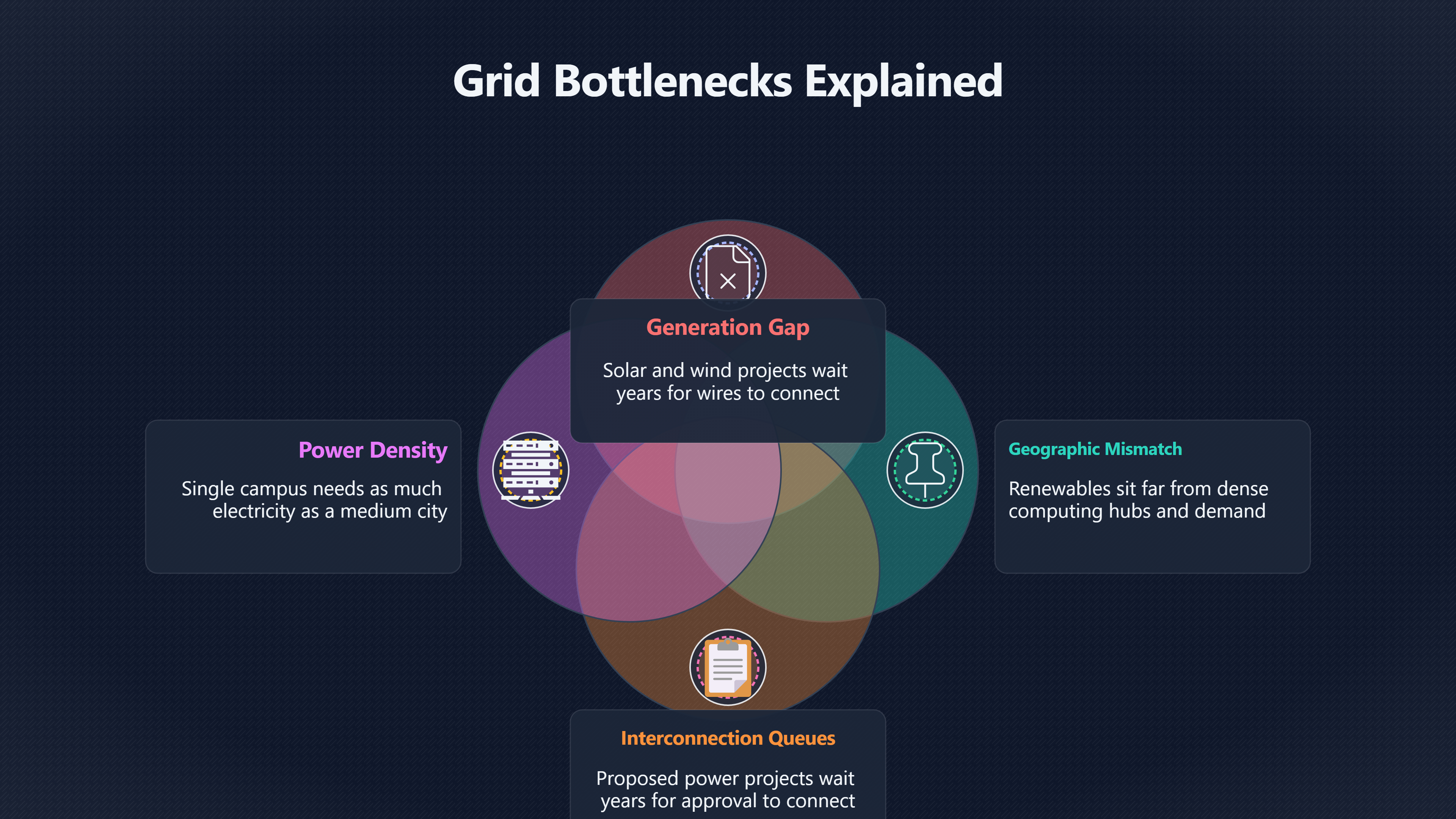
The best renewable resources are often far from the places where AI infrastructure is expanding fastest. Large solar projects tend to cluster in sunny, land-rich regions. Major wind resources are frequently remote. Meanwhile, AI data centres concentrate around existing internet exchanges, fibre routes, skilled labour pools and established cloud campuses.
That geographical mismatch creates a transmission problem before it creates a generation problem.
In the United States, for example, enormous renewable potential exists in the Midwest, Southwest and Great Plains, while many of the largest AI and cloud markets sit in northern Virginia, Phoenix, Dallas, Silicon Valley and other already-congested grid regions. Europe faces similar tensions between offshore wind zones and dense industrial or digital demand centres.
The International Energy Agency increasingly describes grids themselves as a major bottleneck in the energy transition, warning that transmission constraints are slowing the connection of new supply, storage and demand. [IEA]iea.orgIEAGrids – Electricity 2026 – AnalysisGrids are emerging as a bottleneck for connecting supply, demand and storage · Grid technologies an… [IEA]iea.orgIEAExecutive summary – Energy and AI – AnalysisData centres accounted for around 1.5% of the world's electricity consumption in 2024, or…
This is not merely an inconvenience. It changes the economics and timing of AI deployment.
A company may sign contracts for large volumes of renewable electricity, but that does not guarantee the power can physically reach a data-centre campus at the required time and reliability level. Congested transmission corridors can leave renewable projects waiting years for grid connection studies and upgrade approvals. Some renewable generators are already being curtailed — forced to reduce output because local transmission capacity is insufficient.
Interconnection queues have become one of the clearest symptoms. Across major electricity markets, proposed power projects now wait years for approval to connect to the grid. Reform groups and grid analysts increasingly describe these queues as a central constraint on both clean energy and AI infrastructure growth. [RMI]rmi.orginterconnection reform ai data centers generator queuesRMIThe Interconnection Queue Continues to Be a Barrier…17 Mar 2026 — Untapped solutions that can streamline processes and speed up gen… [2novoco.com]novoco.comEnergy Deployment to Meet DemandResolving the Interconnection Queue Bottleneck Along…Jan 21, 2026 — Resolving the Interconnection Queue Bottleneck Along with Transmis…
The problem compounds because AI data centres are unusually power-dense. A single advanced campus can require as much electricity as a medium-sized city. Utilities designed around slower industrial growth patterns were not built for clusters of gigawatt-scale computing loads appearing within a few years.
The IEA has also warned that data-centre demand is increasingly concentrated geographically, intensifying local bottlenecks. [Reuters]reuters.comGlobal trade war may produce headwinds for nascent AI sector, IEA saysIn its latest report, the IEA highlights that the U.S., China, and the EU are expected to drive 80% of the projected growth in data centr…
Why grid upgrades take longer than data centres
One of the striking features of the current AI buildout is the mismatch in construction timelines.
A hyperscale AI campus may be built in roughly two to four years, and sometimes faster for modular deployments. Transmission infrastructure often takes much longer. New high-voltage lines can spend a decade or more in planning, permitting, legal disputes, environmental review and land acquisition before construction even finishes. U.S. clean-energy groups estimate that transmission permitting alone commonly takes more than six years and can exceed ten. [ACP]
That timing mismatch creates a structural pressure toward whatever electricity source can arrive first.
In some regions, this favours natural gas because gas turbines can often be built closer to demand centres and connected more rapidly than long-distance transmission lines. The risk is not that renewables stop growing altogether, but that the clean buildout loses the race against immediate AI electricity demand.
Even where clean generation exists, transmission shortages can delay access. Reuters reported in 2026 that grid connection times for some projects now range from three to seven years, substantially longer than the build time for many data centres. [Reuters]reuters.comare experiencing growing interest from AI data centers due to skyrocketing power demands. These battery energy storage systems—used to ba…
The transmission system also faces physical supply constraints. Utilities and developers compete for transformers, switchgear, specialised cables and skilled electrical workers. Large transformers in particular have become notorious bottlenecks, with multi-year wait times in some markets.
AI intensifies these pressures because demand growth is arriving simultaneously with electrification elsewhere in the economy. Electric vehicles, heat pumps and industrial decarbonisation are all increasing the need for grid upgrades at the same time.
In effect, AI is entering an already constrained infrastructure system.
Why AI companies increasingly care about transmission politics
For years, technology firms could largely treat electricity as a background utility service. That era is ending.
Major AI firms are now deeply involved in grid planning, utility negotiations and energy policy because electricity availability directly shapes where new computing capacity can be deployed.
Google stated in early 2026 that the U.S. transmission system had become the single biggest obstacle to connecting new data centres, with some regions facing waits of up to twelve years for grid access. [Reuters]reuters.comelectrical transmission system as the primary obstacle in powering its data centers, citing lengthy wait times—up to 12 years in some reg…
This has produced several emerging strategies.
Co-location with power plants
Some firms are exploring “co-location”, placing data centres directly beside power generation to bypass congested transmission systems.
That can reduce reliance on overloaded grids, especially near nuclear plants, gas facilities or large renewable projects. But it also raises difficult regulatory questions. If a data centre uses dedicated generation while still relying on the wider grid during emergencies, who pays for the shared infrastructure?
Regulators increasingly worry that poorly designed arrangements could shift costs onto ordinary consumers while giving hyperscalers privileged access to scarce power capacity. [Federal Energy Regulatory Commission]ferc.govFederal Energy Regulatory CommissionFERC Directs Nation's Largest Grid Operator to Create…Dec 18, 2025 — Today, FERC directed grid ope… [Federal Energy Regulatory Commission]ferc.govFederal Energy Regulatory CommissionFERC Directs Nation's Largest Grid Operator to Create…Dec 18, 2025 — Today, FERC directed grid ope…
Flexible computing loads
Another emerging idea is to make some AI workloads more flexible.
Not all computing tasks are equally time-sensitive. Certain training jobs could theoretically pause, slow down or shift geographically during periods of grid stress. Researchers are beginning to model whether flexible AI loads could reduce congestion and defer transmission upgrades. [arXiv]arxiv.orgarXivTo Defer or To Shift? The Role of AI Data Center Flexibility on Grid InterconnectionApril 7, 2026…
This flexibility may help at the margins, especially for non-urgent training tasks. But there are limits.
Frontier AI training runs can involve enormous clusters operating continuously for weeks or months. Interruptions may be expensive. Inference systems powering consumer products also require constant availability. The most commercially valuable AI services often behave less like flexible industrial demand and more like critical infrastructure.
Building around transmission scarcity
Some AI developers are increasingly selecting sites based on available grid capacity rather than ideal business geography.
That could gradually redistribute computing infrastructure toward regions with surplus power and easier interconnection. But this creates trade-offs with latency, fibre connectivity, labour availability and water access.
In practice, many firms still prefer existing cloud corridors even when grids are strained, because those ecosystems already contain suppliers, networking infrastructure and operational expertise.
What faster planning could and could not solve
Transmission reform is possible. The harder question is how much it can accelerate in practice.
Governments in the United States and Europe are already attempting to shorten permitting timelines and coordinate approvals more centrally. The U.S. Department of Energy introduced reforms intended to cut federal transmission review timelines roughly in half, while FERC has begun considering new rules for integrating large AI-related loads more rapidly. [Utility Dive]utilitydive.comferc doe data center interconnection pjm backstop auctionDepartment of Energy's proposed reforms for interconnecting data centers and other large loads to the transmission…Read more…
There are also technical approaches that can increase grid capacity without waiting for entirely new transmission corridors.
These include:
- dynamic line ratings, which adjust transmission capacity based on weather conditions
- advanced power-flow controls that route electricity more efficiently
- reconductoring, replacing old wires with higher-capacity materials
- large-scale batteries that reduce peak strain
- software-based “grid-enhancing technologies” [reuters.com]reuters.comUS utilities scale up grid-boosting tech to meet surging demandelectricity demand surges, utilities are increasingly turning to grid-enhancing technologies (GETs) to boost capacity without waiting dec…
Reuters reported in 2026 that utilities are increasingly deploying these tools because building entirely new transmission infrastructure is so slow. [Reuters]reuters.comUS utilities scale up grid-boosting tech to meet surging demandelectricity demand surges, utilities are increasingly turning to grid-enhancing technologies (GETs) to boost capacity without waiting dec…
These measures matter because they can unlock capacity in years rather than decades.
But they are not a complete substitute for new long-distance transmission. The underlying physics still matter. A grid designed for twentieth-century demand patterns may simply lack enough bulk transfer capacity for a future with widespread electrification and AI-scale computing.
The deeper constraint is institutional as much as technical.
Transmission lines cross jurisdictions, private land, environmental review systems and local political opposition. The benefits are often spread broadly across regions while the costs are concentrated locally. That makes transmission politically difficult even when the economic case is strong.
AI demand may intensify this conflict. Residents asked to accept new high-voltage lines may not view “supporting data centres” as a compelling public-interest argument, especially if they fear higher electricity prices or local environmental impacts.
The transmission bottleneck could shape the pace of AI abundance
The broader AI bloom vision assumes that civilisation can scale intelligence, automation and scientific capability without hitting hard physical limits. Transmission infrastructure is one of the places where that assumption encounters reality.
The issue is not that humanity lacks enough sunlight, wind or technological knowledge to power advanced AI systems. At a global level, clean-energy potential remains vast. The problem is whether institutions can build the connecting infrastructure fast enough.
If transmission expansion remains slow, several outcomes become more likely:
- AI deployment concentrates in regions with existing surplus power
- fossil-fuel generation persists longer as a bridging solution
- electricity prices rise in congested markets
- grid politics becomes more contentious
- the environmental credibility of AI weakens
Some of these dynamics are already visible. PJM, the largest U.S. power market, has faced intense pressure from accelerating data-centre demand and rising interconnection complexity. [DataCenterKnowledge]datacenterknowledge.comDataCenterKnowledgeWhy AI Data Center Projects Face Years of Delays After…3 days ago — New PJM data reveals AI infrastructure projects…
At the same time, the transmission bottleneck is not necessarily permanent. Historically, infrastructure systems can expand rapidly once governments and industries treat them as strategic priorities. Railways, highways, internet backbones and electrical grids themselves all underwent periods of accelerated buildout once political coalitions aligned around them.
The key uncertainty is whether transmission reform can occur before grid congestion materially slows AI deployment or pushes large portions of new demand toward higher-emission energy sources.
That timing question matters well beyond the data-centre industry. If advanced AI genuinely could help accelerate medicine, science, clean technology and long-term human flourishing, then the ability to move electricity efficiently may become one of the hidden determinants of how quickly that future arrives — and how sustainable it is when it does.
Endnotes
-
Source: iea.org
Link: https://www.iea.org/reports/electricity-2026/gridsSource snippet
IEAGrids – Electricity 2026 – AnalysisGrids are emerging as a bottleneck for connecting supply, demand and storage · Grid technologies an...
-
Source: iea.org
Link: https://www.iea.org/reports/energy-and-ai/executive-summarySource snippet
IEAExecutive summary – Energy and AI – AnalysisData centres accounted for around 1.5% of the world's electricity consumption in 2024, or...
-
Source: iea.org
Title: electricity 2026
Link: https://www.iea.org/reports/electricity-2026Source snippet
Analysis6 Feb 2026 — It includes forecasts for electricity demand, supply and carbon dioxide (CO2) emissions for select countries, by reg...
-
Source: rmi.org
Title: interconnection reform ai data centers generator queues
Link: https://rmi.org/interconnection-reform-ai-data-centers-generator-queues/Source snippet
RMIThe Interconnection Queue Continues to Be a Barrier...17 Mar 2026 — Untapped solutions that can streamline processes and speed up gen...
-
Source: novoco.com
Title: Energy Deployment to Meet Demand
Link: https://www.novoco.com/notes-from-novogradac/resolving-the-interconnection-queue-bottleneck-along-with-transmission-expansion-is-critical-for-timely-us-energy-deployment-to-meet-demandSource snippet
Resolving the Interconnection Queue Bottleneck Along...Jan 21, 2026 — Resolving the Interconnection Queue Bottleneck Along with Transmis...
-
Source: reuters.com
Title: Global trade war may produce headwinds for nascent AI sector, IEA says
Link: https://www.reuters.com/technology/artificial-intelligence/global-trade-war-may-produce-headwinds-nascent-ai-sector-iea-says-2025-04-10/Source snippet
In its latest report, the IEA highlights that the U.S., China, and the EU are expected to drive 80% of the projected growth in data centr...
-
Source: reuters.com
Link: https://www.reuters.com/business/energy/battery-storage-firms-eye-ai-demand-face-grid-supply-hurdles-2026-05-18/Source snippet
are experiencing growing interest from AI data centers due to skyrocketing power demands. These battery energy storage systems—used to ba...
-
Source: reuters.com
Link: https://www.reuters.com/business/google-says-us-transmission-system-is-biggest-challenge-connecting-data-centers-2026-01-14/Source snippet
electrical transmission system as the primary obstacle in powering its data centers, citing lengthy wait times—up to 12 years in some reg...
-
Source: ferc.gov
Link: https://www.ferc.gov/news-events/news/ferc-directs-nations-largest-grid-operator-create-new-rules-embrace-innovation-andSource snippet
Federal Energy Regulatory CommissionFERC Directs Nation's Largest Grid Operator to Create...Dec 18, 2025 — Today, FERC directed grid ope...
-
Source: ferc.gov
Title: ferc act large load interconnection docket june 2026
Link: https://www.ferc.gov/news-events/news/ferc-act-large-load-interconnection-docket-june-2026Source snippet
Federal Energy Regulatory CommissionFERC to Act on Large Load Interconnection Docket...16 Apr 2026 — The Federal Energy Regulatory Commi...
Published: june 2026
-
Source: arxiv.org
Link: https://arxiv.org/abs/2604.05376Source snippet
arXivTo Defer or To Shift? The Role of AI Data Center Flexibility on Grid InterconnectionApril 7, 2026...
Published: April 7, 2026
-
Source: arxiv.org
Link: https://arxiv.org/abs/2605.14109 -
Source: energy.gov
Link: https://www.energy.gov/articles/biden-harris-administration-announces-final-transmission-permitting-rule-and-latestSource snippet
Biden-Harris Administration Announces Final Transmission...Apr 25, 2024 — DOE Announces New Federal Permitting Rule To Slash Transmissio...
-
Source: energy.gov
Link: https://www.energy.gov/gdo/coordinated-interagency-transmission-authorizations-and-permits-programSource snippet
If an agency does not adhere to the two-year deadline, then developers can begin a...Read more...
-
Source: reuters.com
Title: US utilities scale up grid-boosting tech to meet surging demand
Link: https://www.reuters.com/business/energy/us-utilities-scale-up-grid-boosting-tech-meet-surging-demand–reeii-2026-03-09/Source snippet
electricity demand surges, utilities are increasingly turning to grid-enhancing technologies (GETs) to boost capacity without waiting dec...
-
Source: datacenterknowledge.com
Link: https://www.datacenterknowledge.com/energy-power-supply/why-ai-data-center-projects-face-years-of-delays-after-approvalSource snippet
DataCenterKnowledgeWhy AI Data Center Projects Face Years of Delays After...3 days ago — New PJM data reveals AI infrastructure projects...
-
Source: ferc.gov
Link: https://ferc.gov/ -
Source: ferc.gov
Title: rm26 4
Link: https://www.ferc.gov/rm26-4Source snippet
Interconnection of Large Loads to the Interstate...13 Jan 2026 — This docket was opened in response to a DOE Section 403 proposal asking...
-
Source: iea.org
Link: https://www.iea.org/news/data-centre-electricity-use-surged-in-2025-even-with-tightening-bottlenecks-driving-a-scramble-for-solutionsSource snippet
Data centre electricity use surged in 2025, even with...16 Apr 2026 — Electricity demand from data centres soared by 17% in 2025, and th...
-
Source: iea.org
Link: https://www.iea.org/reports/energy-and-ai/energy-demand-from-aiSource snippet
demand growth between 2024 and 2030 in the...Read more...
-
Source: iea.org
Title: electricity 2024
Link: https://www.iea.org/reports/electricity-2024Source snippet
Analysis24 Jan 2024 — In addition, this year's report features in-depth analysis on the drivers of recent declines in electricity demand...
-
Source: iea.org
Title: share of electricity consumption by data centre and equipment type 2024
Link: https://www.iea.org/data-and-statistics/charts/share-of-electricity-consumption-by-data-centre-and-equipment-type-2024Source snippet
Share of electricity consumption by data centre and...9 Apr 2025 — Share of electricity consumption by data centre and equipment type, 2...
-
Source: iea.org
Link: https://www.iea.org/search/charts?q=Data+Centres+and+Data+Transmission+NetworksSource snippet
Data Centres and Data Transmission NetworksSpatial concentration of various facilities versus proximity to urban areas, 2024 · Global gro...
-
Source: arxiv.org
Link: https://arxiv.org/html/2509.07218v3Source snippet
Electricity Demand and Grid Impacts of AI Data Centers29 Sept 2025 — According to the IEA report [8], global data centers consumed aroun...
-
Source: utilitydive.com
Title: ferc doe data center interconnection pjm backstop auction
Link: https://www.utilitydive.com/news/ferc-doe-data-center-interconnection-pjm-backstop-auction/817804/Source snippet
Department of Energy's proposed reforms for interconnecting data centers and other large loads to the transmission...Read more...
Additional References
-
Source: instagram.com
Link: https://www.instagram.com/reel/DXNdD9_jTso/Source snippet
AnewZ on Instagram: "A new report by the International...The IEA warns that growth is increasingly constrained by real world bottlenecks...
-
Source: linkedin.com
Link: https://www.linkedin.com/posts/dr-irene-di-martino-88481823_datacenters-ai-energyinfrastructure-activity-7425556038529155072-tORiSource snippet
IEA Report: Grid Can't Keep Up with AI DemandElectricity demand is surging for the first time in decades, mainly due to the critical role...
-
Source: troutman.com
Link: https://www.troutman.com/insights/report-ai-boom-strains-us-power-network-driving-data-centers-off-grid/Source snippet
REPORT: AI Boom Strains US Power Network, Driving...8 days ago — Natural gas emerges as near-term backbone for AI infrastructure amid in...
-
Source: tomshardware.com
Link: https://www.tomshardware.com/tech-industry/ai-data-centers-trigger-massive-irreversible-76-percent-electricity-price-spike-in-largest-us-region-federal-watchdog-demands-tech-giants-pay-for-their-own-power-infrastructureSource snippet
power grid—has identified AI data centers as the primary cause of a dramatic 75.5% increase in electricity prices in the region. Wholesal...
-
Source: linkedin.com
Link: https://www.linkedin.com/posts/data-center-frontier_new-iea-report-contrasts-energy-bottlenecks-activity-7321554033561817088-oqgwSource snippet
IEA Report: AI's Power Demands and Energy Solutions25 Apr 2025 — New IEA Report Contrasts Energy Bottlenecks with Opportunities for AI an...
-
Source: npcelectric.com
Link: https://www.npcelectric.com/news/power-transformers-the-hidden-bottleneck-in-ai-compute-expansion-and-data-center-power-demand.htmlSource snippet
Power Transformers in AI Data Center ExpansionMar 31, 2026 — Global data center power demand is projected to double from around 415 TWh i...
-
Source: catf.us
Link: https://www.catf.us/2024/07/from-decades-years-does-citap-program-progress-towards-faster-transmission-projects/Source snippet
From decades to years: DOE's CITAP Program and...Jul 23, 2024 — The CITAP program implements DOE's authority as the lead agency for fede...
-
Source: powermag.com
Title: ferc sets june deadline to rewrite large load grid rules for ai era power demand
Link: https://www.powermag.com/ferc-sets-june-deadline-to-rewrite-large-load-grid-rules-for-ai-era-power-demand/Source snippet
FERC Sets June Deadline to Rewrite Large-Load Grid...Apr 16, 2026 — The Federal Energy Regulatory Commission (FERC) has set a June 2026...
Published: June 2026
-
Source: perkinscoie.com
Title: doe study finds us must double regional transmission capacity meet 2035 clean
Link: https://perkinscoie.com/insights/update/doe-study-finds-us-must-double-regional-transmission-capacity-meet-2035-cleanSource snippet
DOE Study Finds US Must Double Regional Transmission...Nov 10, 2023 — DOE Study Finds US Must Double Regional Transmission Capacity To M...
-
Source: carbonbrief.org
Title: ai five charts that put data centre energy use and emissions into context
Link: https://www.carbonbrief.org/ai-five-charts-that-put-data-centre-energy-use-and-emissions-into-context/Source snippet
AI: Five charts that put data-centre energy use15 Sept 2025 — Under the IEA's central scenario for data-centre growth, the sector's globa...
Amazon book picks
Further Reading
Books and field guides related to AI’s transmission bottleneck. Use these as the next step if you want deeper reading beyond the article.

Urban Energy Transition
This compendium of 29 chapters from 18 countries contains both fundamental and advanced insight into the inevitable shift from cities dom...

Empowering the Great Energy Transition
At a time when climate-change deniers hold the reins of power in the United States and international greenhouse gas negotiations continue...

Cyber Infrastructure for the Smart Electric Grid
Explore a thorough treatment of the foundations of smart grid sensing, communication, computation, and control As electric power systems...

The Global Energy Transition
Global energy is on the cusp of change, and it has become almost a truism that energy is in transition. But what does this notion mean ex...
eBay marketplace picks
Marketplace Samples
Example marketplace items related to this page. Use the search link to explore similar finds on eBay.

Example eBay listing
A.I. Artificial Intelligence Original Movie Poster Signed By Jude Law
USD 125.00 | Shipping USD 25.00 | US

Example eBay listing
Artificial Intelligence D/S Original Movie Poster - 27 x 40"
USD 19.50 | Shipping USD 13.65 | US

Example eBay listing
612388 Artificial Intelligence Movie Science Fiction Drama Wall Print Poster
USD 22.95 | Shipping USD 12.95 | JP

Example eBay listing
Companion - Artificial Intelligence Dark Comedy Cinema Film - POSTER 20"x30"
USD 23.99 | Free shipping | US

Example eBay listing
A.I. Artificial Intelligence Movie Film Poster Art Print
GBP 4.99 | Free shipping | GB

Example eBay listing
A I Artificial Intelligence 6 Movie Poster Art Print Print Classic Rare Gallery
GBP 49.00 | Free shipping | GB

Example eBay listing
AI - Artificial Intelligence (Poster + Slipcase) Blu-Ray
GBP 10.49 | Free shipping | GB

Example eBay listing
A. I. Artificial Intelligence. Jude Law. Original UK Video Poster.
GBP 8.11 | Shipping GBP 3.38 | GB
Topic Tree