Within Access Gaps
Access basics
AI expertise cannot become truly abundant while households, schools, and clinics lack the hardware, power, and connectivity to use it well.
On this page
- Why lower inference costs are not enough
- Devices, electricity, and broadband as access gates
- What public infrastructure can change
Page outline Jump by section
Introduction
Cheaper AI does not automatically mean universal AI. A student cannot use an AI tutor without a working phone or laptop. A rural clinic cannot rely on cloud-based diagnostic tools if the connection fails every few minutes. A farmer cannot ask an AI system for weather or crop advice if electricity is too unreliable to keep devices charged.
 That is why the future of widely shared AI expertise depends on something more basic than model capability alone: infrastructure. Devices, electricity, broadband networks, mobile coverage, local data capacity, and affordable connectivity all determine who can actually use advanced systems in daily life. The optimistic vision of AI-enabled abundance depends not just on making intelligence cheaper, but on making access dependable enough for ordinary people to use it continuously and confidently.
This matters because many of the most ambitious hopes around AI bloom — better education, broader medical access, scientific acceleration, and expanded human capability — assume that billions of people can regularly interact with advanced systems. In practice, much of the world still faces a more fundamental problem: getting online reliably at all. [Alliance for Affordable Internet]adi.a4ai.orgAlliance for Affordable InternetMeaningful Connectivity — unlocking the full power of internet…We have meaningful connectivity when we… [Brookings]brookings.edufixing the global digital divide and digital access gapBrookingsFixing the global digital divide and digital access gap5 Jul 2023 — Over half the global population lacks access to high-speed b…
Why lower inference costs are not enough
The cost of using AI systems has fallen rapidly. Tasks that once required expensive expert labour can now sometimes be handled through low-cost or free interfaces. This is one reason many researchers and technology companies believe AI could eventually function as a widely available “cognitive utility”: a system that helps millions of people learn, plan, diagnose, translate, design, and solve problems at scale.
But AI access is constrained by the same physical realities that shaped earlier technologies. Cheap electricity did not guarantee universal appliances. Cheap computers did not guarantee universal internet use. Likewise, cheaper AI does not guarantee that everyone can benefit from it.
Several bottlenecks remain stubbornly material:
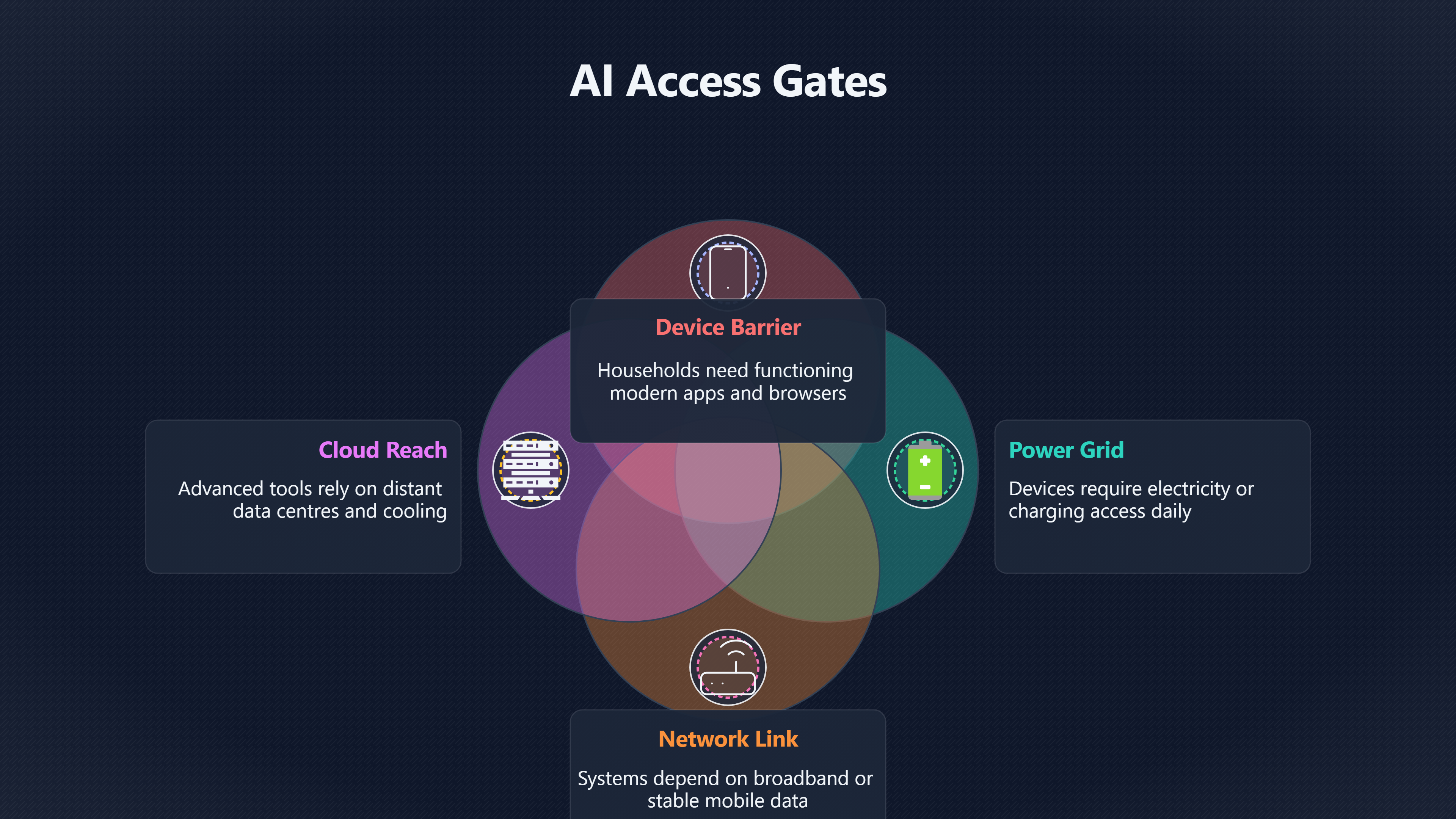
- A household still needs a functioning device capable of running modern apps and browsers.
- That device needs electricity or charging access.
- Many useful AI systems depend on broadband or stable mobile data.
- Video, voice, and multimodal AI tools often require much higher bandwidth than older internet services.
- Schools and clinics need routers, maintenance, cybersecurity, and technical support.
- Cloud AI systems depend on distant data centres and network infrastructure that can fail or become congested.
This distinction matters because public discussion often treats AI as if it were weightless software. In reality, advanced AI is built on physical infrastructure: chips, fibre-optic cables, energy grids, wireless towers, cooling systems, and data centres.
The result is a paradox. AI expertise may become technically abundant while remaining practically scarce for people with weak connectivity or unreliable infrastructure. Someone with a high-end laptop, fibre broadband, and constant electricity experiences AI very differently from someone sharing a low-cost phone over intermittent mobile data. [Alliance for Affordable Internet]adi.a4ai.orgAlliance for Affordable InternetMeaningful Connectivity — unlocking the full power of internet…We have meaningful connectivity when we… [Brookings]brookings.edufixing the global digital divide and digital access gapBrookingsFixing the global digital divide and digital access gap5 Jul 2023 — Over half the global population lacks access to high-speed b…
Devices, electricity, and broadband as access gates
Smartphones are now the main gateway
For much of the world, AI access is likely to arrive primarily through smartphones rather than desktop computers. The World Bank notes that nearly all internet users globally now access the internet through smartphones, making device affordability one of the largest remaining barriers to participation. [World Bank Open Data]data360.worldbank.orgGlobally, nearly all Internet users access it via smartphones.[reference: fndx1] One of the biggest reasons many communities remain…Re…
This changes what “AI access” actually means in practice. A frontier AI model may technically be available worldwide, but meaningful use depends on whether people own:
- a device modern enough to run AI applications smoothly,
- sufficient storage and memory,
- enough mobile data to support regular use,
- and a reliable way to keep the device charged.
Even relatively cheap smartphones can still represent a major financial burden in poorer regions. Reuters reported in 2025 that a basic $30 smartphone could bring internet access to billions more people, yet in some places such devices still cost the equivalent of a month’s income. [Reuters]reuters.comThis "usage gap" stems not from network availability, but from challenges such as affordability, limited digital skills, lack of electric…
This creates a layered access problem. A user may technically be “online” while lacking the practical conditions needed for serious educational or professional AI use.
“Meaningful connectivity” is different from basic connectivity
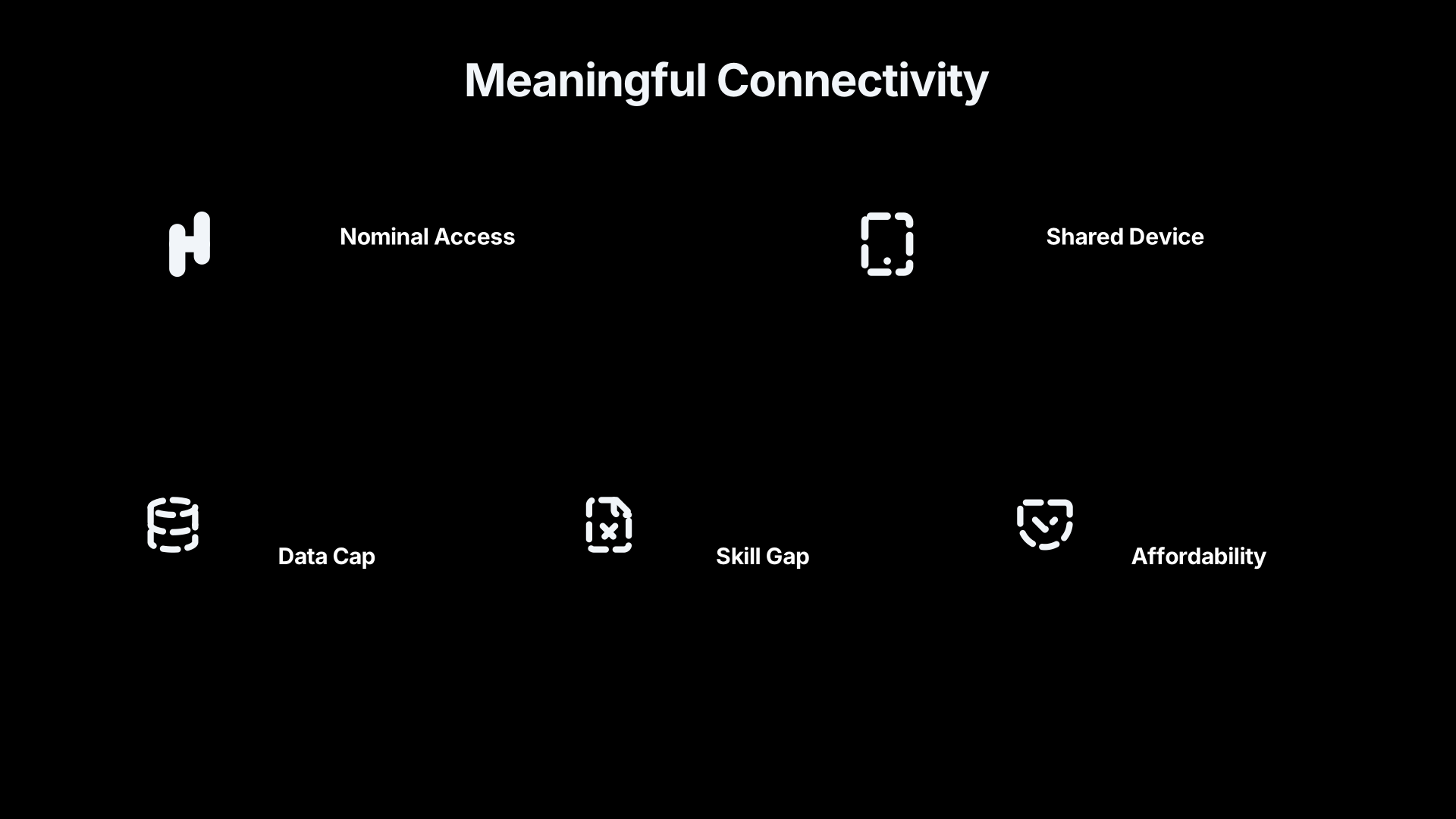
Development researchers increasingly distinguish between nominal internet access and what the Alliance for Affordable Internet calls “meaningful connectivity”. That means daily internet use through an appropriate device with sufficient speed and data allowance. [Alliance for Affordable Internet]adi.a4ai.orgAlliance for Affordable InternetMeaningful Connectivity — unlocking the full power of internet…We have meaningful connectivity when we…
This distinction becomes especially important for AI systems because advanced tools often require:
- persistent cloud access,
- large downloads,
- image or audio uploads,
- video generation,
- or continuous conversational interaction.
A weak or expensive connection can turn supposedly transformative AI into a frustrating or unusable service.
This problem already appears in education. Families may technically have internet access while relying on shared devices, unstable public Wi-Fi, or limited mobile data plans. Research on digital inequality in UK schools found students frequently completing schoolwork on borrowed smartphones or under poor connectivity conditions. [Digital Poverty Alliance]digitalpovertyalliance.orgA third of parents say schools wrongly assume they are digitally connected, despite…Read more…
For AI tutors, writing assistants, coding systems, or adaptive learning tools, these limitations matter even more. AI is often most valuable when used continuously and interactively, not occasionally.
Electricity remains an overlooked constraint
AI discussions in wealthy countries often assume constant electrical power. Yet hundreds of millions of people still lack reliable electricity access, while many more face frequent outages or unstable grids.
That matters because modern AI systems are unusually dependent on continuous infrastructure. Unlike printed textbooks or offline software, many AI tools stop functioning entirely during outages.
Microsoft’s 2025 analysis of global AI diffusion argued that the spread of AI depends on electricity and computing capacity as much as algorithms themselves. The report highlighted that more than 700 million people still lack reliable power access. [Business Insider]businessinsider.comHowever, this rapid uptake is uneven and is exacerbating a global digital divide. High-income nations like the UAE (59.4% adoption), Sing…
This affects not only households but also institutions central to the optimistic AI bloom vision:
- rural clinics,
- schools,
- agricultural extension services,
- community internet centres,
- and local governments.
An AI-assisted healthcare system cannot reliably support diagnostics or medical records if electricity fails unpredictably. A school cannot integrate AI tutors into daily learning if students cannot charge devices consistently.
In that sense, energy infrastructure becomes part of cognitive infrastructure.
AI can widen gaps even while becoming cheaper
One of the most important misconceptions around AI abundance is that lower costs automatically reduce inequality. Sometimes the opposite happens.
When a technology strongly amplifies productivity, the people and regions with the best infrastructure often gain the most first. AI can therefore deepen existing inequalities in education, research, medicine, and business before broader diffusion catches up.
Researchers increasingly describe this as an “AI divide”: unequal ability not merely to access AI systems, but to benefit meaningfully from them. Recent academic work argues that disparities in infrastructure, education, and institutional capacity can reinforce existing inequalities rather than erase them. [Taylor & Francis Online]tandfonline.comTaylor & Francis OnlineBridging the gap: inequalities that divide those who can…by T Hammerschmidt · 2025 · Cited by 41 — This AI divi…
This dynamic appears at multiple levels.
Within countries
Even wealthy countries contain major access gaps. Older adults, poorer households, rural communities, and people with lower digital skills often use advanced online services far less frequently.
The UK still has millions of adults lacking essential digital skills, while many households continue to experience device shortages or unreliable connectivity. [Reuters]reuters.comThis "usage gap" stems not from network availability, but from challenges such as affordability, limited digital skills, lack of electric…
That means AI-enhanced education or healthcare systems can unintentionally favour already advantaged users unless institutions actively design around these gaps.
Between countries
The international divide may become even sharper.
Advanced AI systems rely heavily on cloud infrastructure concentrated in a relatively small number of countries. The United States and China dominate much of the world’s AI compute capacity, while many poorer regions remain dependent on imported platforms and distant infrastructure.
Stanford’s AI Index and related international analyses show advanced AI investment and deployment heavily concentrated in richer economies. At the same time, broadband penetration, electricity reliability, and device affordability remain far lower in many low-income regions. [Brookings]brookings.edufixing the global digital divide and digital access gapBrookingsFixing the global digital divide and digital access gap5 Jul 2023 — Over half the global population lacks access to high-speed b…
This raises a broader question for the AI bloom thesis: if intelligence becomes dramatically more powerful but remains unevenly distributed, does humanity collectively flourish, or do existing hierarchies harden further?
Why offline and local AI only partly solve the problem
Some technologists argue that smaller local AI models running directly on phones or laptops could bypass internet dependence. There is truth in this. Offline AI can reduce bandwidth costs, improve privacy, and extend access in regions with weaker connectivity.
But local AI still depends on hardware quality.
Running capable models directly on a device requires:
- sufficient processing power,
- newer chips,
- battery capacity,
- storage,
- and operating systems modern enough to support AI features.
In practice, many low-cost or older devices struggle with advanced local AI tools. The newest “AI PCs” and AI-enabled smartphones are often concentrated in higher-income markets first.
Even where offline AI works well, important services still require connectivity:
- software updates,
- safety patches,
- cloud synchronisation,
- educational content,
- telemedicine systems,
- and institutional databases.
So while local AI may reduce infrastructure requirements, it does not eliminate them.
Schools and clinics reveal the real bottlenecks
Education and healthcare are often presented as proof that AI could massively expand human capability. In principle, this is plausible. AI tutors could provide personalised explanations at enormous scale. AI-assisted medicine could help clinicians triage patients, summarise records, or support diagnosis.
But these sectors also reveal how dependent AI remains on basic infrastructure.
Schools
A school may have access to free AI tools yet still lack:
- enough devices for students, [instagram.com]instagram.comces AI is rapidly entering education Technology is powerful —…
- stable Wi-Fi,
- technical support staff,
- secure systems,
- teacher training,
- or adequate electricity capacity.
British education discussions increasingly stress that AI access alone is insufficient without institutional readiness and digital literacy. [GOV.UK]GOV.UKThe biggest risk is doing nothing': insights from earlyJune 27, 2025 — 27 Jun 2025 — However, of those who do not use them, 64% say they do not know enough about AI to use it in their role and…
The risk is not merely unequal access to AI tools themselves, but unequal access to environments where those tools can be used productively and safely.
Healthcare
Healthcare systems face similar constraints. AI-assisted diagnostics and administrative systems may reduce costs or expand expertise, but clinics still require dependable infrastructure.
A rural health worker cannot rely on cloud-based imaging analysis if the connection repeatedly drops. Electronic records and AI-supported triage systems become liabilities during long outages.
This means the future benefits of AI in medicine are partly constrained by ordinary public infrastructure: power grids, telecoms, procurement systems, and maintenance capacity. [ScienceDirect]sciencedirect.comScienceDirectBridging the digital divide: artificial intelligence as a…by A Osonuga · 2025 · Cited by 46 — This comprehensive narrativ…
What public infrastructure can change
The optimistic case for AI abundance depends less on whether frontier models become powerful — that already appears likely — and more on whether societies build the conditions for broad participation.
Historically, transformative technologies spread most widely when paired with public infrastructure investment. Electrification, sanitation, roads, public education, and broadband all expanded the number of people able to benefit from economic and scientific progress.
AI may follow the same pattern.
Several interventions matter especially strongly:
- affordable smartphone and laptop programmes,
- rural broadband expansion,
- reliable electricity grids,
- community internet access points, [data360.worldbank.org]data360.worldbank.orgGlobally, nearly all Internet users access it via smartphones.[reference: fndx1] One of the biggest reasons many communities remain…Re…
- school and clinic modernisation,
- low-cost satellite and wireless connectivity,
- digital literacy education, [linkedin.com]linkedin.comBridging the AI Divide with Energy AccessAccess to electricity opens the door to a digital world where opportunities for education, entre…
- and support for local-language AI systems.
The Reuters and GSMA analysis of global connectivity argues that the remaining “usage gap” is now larger than the coverage gap. In other words, many people already live near networks but still cannot use digital systems effectively because of affordability, skills, electricity, or device barriers. [Reuters]reuters.comThis "usage gap" stems not from network availability, but from challenges such as affordability, limited digital skills, lack of electric…
That distinction is crucial for AI policy. The next phase of inclusion may depend less on building towers and more on making continuous digital participation economically realistic.
The long-term stakes for AI bloom
The larger AI bloom vision imagines intelligence becoming far more abundant than at any previous point in history. If advanced AI eventually helps accelerate science, extend healthy life, reduce dangerous labour, improve education, and expand human creativity, then access becomes a civilisational question rather than a consumer convenience issue.
A world where only wealthy regions can continuously use advanced AI may still become richer overall. But it would fall far short of the stronger abundance vision in which most people gain meaningful cognitive empowerment.
The deeper lesson is simple: intelligence abundance is not purely a software problem.
For AI expertise to become genuinely widespread, societies need the physical systems that allow people to reach it reliably every day. Fibre cables, mobile towers, electricity grids, affordable devices, and public digital infrastructure may ultimately shape the distribution of AI benefits almost as much as the models themselves. [Reuters]reuters.comThis "usage gap" stems not from network availability, but from challenges such as affordability, limited digital skills, lack of electric… [Alliance for Affordable Internet]adi.a4ai.orgAlliance for Affordable InternetMeaningful Connectivity — unlocking the full power of internet…We have meaningful connectivity when we… [Brookings]brookings.edufixing the global digital divide and digital access gapBrookingsFixing the global digital divide and digital access gap5 Jul 2023 — Over half the global population lacks access to high-speed b…
Endnotes
-
Source: brookings.edu
Title: fixing the global digital divide and digital access gap
Link: https://www.brookings.edu/articles/fixing-the-global-digital-divide-and-digital-access-gap/Source snippet
BrookingsFixing the global digital divide and digital access gap5 Jul 2023 — Over half the global population lacks access to high-speed b...
-
Source: reuters.com
Link: https://www.reuters.com/default/world-leaders-debate-ai-governance-three-billion-people-cant-even-get-online–ecmii-2025-12-10/Source snippet
This "usage gap" stems not from network availability, but from challenges such as affordability, limited digital skills, lack of electric...
-
Source: sciencedirect.com
Link: https://www.sciencedirect.com/science/article/pii/S1386505625002680Source snippet
ScienceDirectBridging the digital divide: artificial intelligence as a...by A Osonuga · 2025 · Cited by 46 — This comprehensive narrativ...
-
Source: GOV.UK
Title: ‘The biggest risk is doing nothing’: insights from early
Link: https://www.gov.uk/government/publications/ai-in-schools-and-further-education-findings-from-early-adopters/the-biggest-risk-is-doing-nothing-insights-from-early-adopters-of-artificial-intelligence-in-schools-and-further-education-collegesSource snippet
June 27, 2025 — 27 Jun 2025 — However, of those who do not use them, 64% say they do not know enough about AI to use it in their role and...
Published: June 27, 2025
-
Source: GOV.UK
Link: https://www.gov.uk/government/organisations/government-digital-serviceSource snippet
Digital ServiceWe are the digital centre of government. We serve the public, central government departments and the wider public sector...
-
Source: public.digital
Link: https://public.digital/about-pd/our-definition-of-digitalSource snippet
Our definition of digitalApplying the culture, processes, business models and technologies of the internet-era to respond to people's rai...
-
Source: adi.a4ai.org
Link: https://adi.a4ai.org/meaningful-connectivity/Source snippet
Alliance for Affordable InternetMeaningful Connectivity — unlocking the full power of internet...We have meaningful connectivity when we...
-
Source: data360.worldbank.org
Link: https://data360.worldbank.org/en/int/atlas/internet-accessSource snippet
Globally, nearly all Internet users access it via smartphones.[reference: fndx1] One of the biggest reasons many communities remain...Re...
-
Source: digitalpovertyalliance.org
Link: https://digitalpovertyalliance.org/research/new-research-reveals-the-hidden-cost-of-digital-inequality-in-uk-schools/Source snippet
A third of parents say schools wrongly assume they are digitally connected, despite...Read more...
-
Source: businessinsider.com
Link: https://www.businessinsider.com/ai-fastest-tech-in-history-microsoft-warns-billions-left-out-2025-10Source snippet
However, this rapid uptake is uneven and is exacerbating a global digital divide. High-income nations like the UAE (59.4% adoption), Sing...
-
Source: tandfonline.com
Link: https://www.tandfonline.com/doi/full/10.1080/0144929X.2025.2500451Source snippet
Taylor & Francis OnlineBridging the gap: inequalities that divide those who can...by T Hammerschmidt · 2025 · Cited by 41 — This AI divi...
-
Source: Wikipedia
Link: https://en.wikipedia.org/wiki/DigitalSource snippet
DigitalLook up digital in Wiktionary, the free dictionary. Digital usually refers to something using discrete digits, often binary dig...
-
Source: instagram.com
Link: https://www.instagram.com/p/DW02ZsdjF2u/Source snippet
ces AI is rapidly entering education Technology is powerful —...
Additional References
-
Source: linkedin.com
Link: https://www.linkedin.com/pulse/bridging-ai-divide-energy-access-karl-skare-tomlcSource snippet
Bridging the AI Divide with Energy AccessAccess to electricity opens the door to a digital world where opportunities for education, entre...
-
Source: merriam-webster.com
Link: https://www.merriam-webster.com/dictionary/digitalSource snippet
DIGITAL Definition & MeaningThe meaning of DIGITAL is of, relating to, or utilizing devices constructed or working by the methods or prin...
-
Source: yourfutureisdigital.com
Link: https://www.yourfutureisdigital.com/Source snippet
DIGITAL NEWCASTLEOfficial Website for DIGITAL NEWCASTLE. Find all Upcoming Events with Lineups and set times, latest news and announceme...
-
Source: thecatalyst.org.uk
Link: https://www.thecatalyst.org.uk/resource-articles/what-we-mean-by-digital-a-guide/Source snippet
What we mean by 'digital': a guideThis guide doesn't offer a single definition of digital. Instead, it tries to show the differences acro...
-
Source: wits-uwo.medium.com
Title: the global technology divide unequal access in a digital world a50ac499f710
Link: https://wits-uwo.medium.com/the-global-technology-divide-unequal-access-in-a-digital-world-a50ac499f710Source snippet
Global Technology Divide: Unequal Access in a Digital...While some countries are using AI, smart cities, and other advanced systems, oth...
-
Source: pmc.ncbi.nlm.nih.gov
Title: PMCThe Role of AI in Hospitals and Clinics: Transforming
Link: https://pmc.ncbi.nlm.nih.gov/articles/PMC11047988/Source snippet
PMCby SM Varnosfaderani · 2024 · Cited by 1035 — This section explores how AI is being leveraged to revolutionize hospital operations, en...
-
Source: facebook.com
Link: https://www.facebook.com/worldeconomicforum/posts/ai-and-advanced-tech-are-reshaping-industries-but-billions-still-lack-access-to-/1015126193988952/Source snippet
Mobile internet in Africa is 14 times more expensive than in Europe. Even where access exists...Read more...
-
Source: realinfluencers.es
Title: ai in education why access isnt enough and can be counterproductive
Link: https://www.realinfluencers.es/en/2026/04/13/ai-in-education-why-access-isnt-enough-and-can-be-counterproductive/Source snippet
AI in education: Why Access isn't enough and can be...13 Apr 2026 — AI in education: Impact on Learning, risks of access without pedagog...
-
Source: digileaders.com
Title: without intervention ai could widen the digital divide for students
Link: https://digileaders.com/without-intervention-ai-could-widen-the-digital-divide-for-students/Source snippet
Without intervention, AI could widen the digital divide for...25 Sept 2023 — With its potential to enhance the student experience, barri...
-
Source: globeducate.com
Title: the good the bad and the ugly in ai this week 110526
Link: https://www.globeducate.com/news-events/globeducate-blog/blog-details/~board/blogs/post/the-good-the-bad-and-the-ugly-in-ai-this-week-110526Source snippet
The Good, The Bad and The Ugly in AI this week 11/05/26...11 May 2026 — An OpenAI-native device with full system access and no app const...
Published: May 2026
Amazon book picks
Further Reading
Books and field guides related to Access basics. Use these as the next step if you want deeper reading beyond the article.

Digital Divide
First published 2020. Subjects: Computer literacy, Equality, Digital divide, Internet literacy, Digitale Spaltung.

AI and Society
AI's impact on human societies is and will be drastic in so many ways. AI is being adopted and implemented around the world, and governme...

Third Digital Divide
First published 2017. Subjects: Weber, max, 1864-1920, Equality, Marginality, social, Digital divide, Information society.
Bridging the Digital Divide
First published 2002. Subjects: Nonfiction, Sociology, Government policy, Social aspects, Aspect social.
Topic Tree