Within Long Future
Abundant Know how
Cheap AI guidance could widen access to education, diagnosis, law, design, and local problem-solving if infrastructure and trust keep up.
On this page
- Why expertise is a bottleneck
- Where AI guidance could change daily life
- What blocks access and usefulness
Page outline Jump by section
Introduction
Many of the world’s most painful shortages are not shortages of physical goods. They are shortages of skilled judgement at the right moment: a doctor who can interpret symptoms, a tutor who can explain algebra patiently, a lawyer who can navigate paperwork, an engineer who can diagnose a broken machine, or an adviser who understands local farming conditions. In large parts of the world, expert help is scarce because trained professionals are expensive, concentrated in wealthy regions, or overwhelmed by demand.
 This is one of the strongest reasons some researchers and policymakers think advanced AI could matter far beyond ordinary productivity gains. If AI systems can reliably provide useful guidance at very low cost, they could make parts of human expertise abundant in the same way the internet made information abundant. The shift would not merely save time. It could change who gets access to medicine, education, legal systems, technical knowledge, and economic opportunity.
The optimistic case, however, depends on more than model capability. Cheap advice is not the same thing as trustworthy expertise. AI systems still hallucinate, reflect biases in training data, struggle with context, and often fail in unfamiliar environments. Infrastructure, institutions, regulation, language access, and human oversight may matter just as much as the models themselves. The real question is not whether AI can generate answers, but whether societies can turn machine-generated guidance into dependable human capability at civilisation scale.
Why expertise is a bottleneck
Modern societies depend on specialised knowledge almost everywhere. Yet expertise does not scale easily because human training is slow, expensive, and geographically uneven.
A highly trained clinician may require more than a decade of education. Lawyers, engineers, teachers, accountants, and technical specialists often need years of supervised practice before they are trusted with independent judgement. Wealthier regions can attract and retain these professionals; poorer or rural areas often cannot. The result is that many people live in a world where formal rights, medical advances, or educational opportunities exist in theory but are inaccessible in practice.
This is why AI-assisted expertise matters within the broader “AI bloom” vision. A civilisation can possess immense scientific knowledge while leaving billions of people unable to use it. Much of modern scarcity is therefore “capability scarcity”: the inability to access know-how when it is needed.
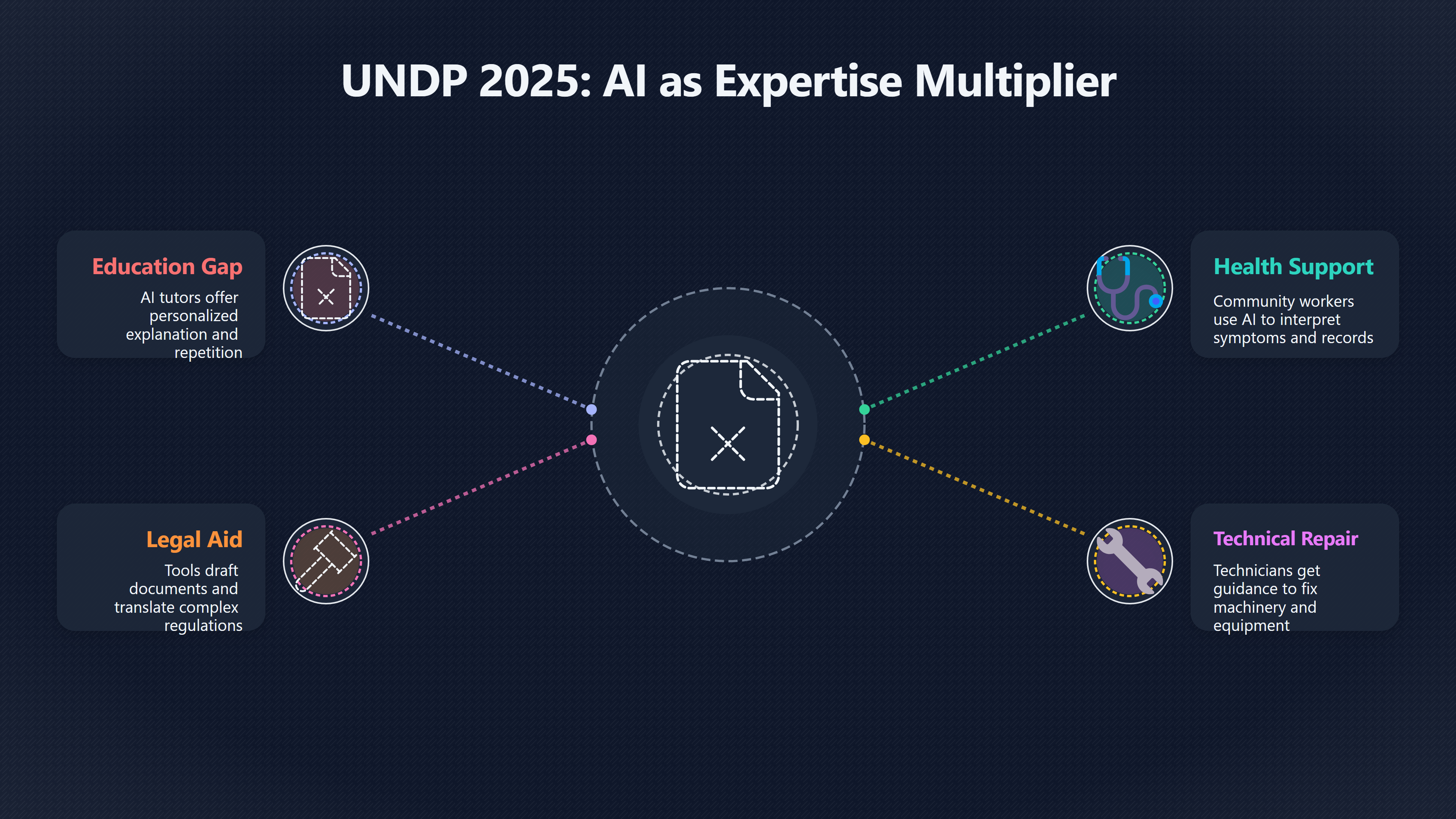
The UNDP’s 2025 Human Development Report argues that AI could widen access not only to information but also to practical know-how, potentially helping people solve problems in education, health, business, and local governance. But it stresses that outcomes depend on social and political choices, not technology alone. [Human Development Reports]hdr.undp.org2025 global survey ai and human developmentHuman Development Reports2025 Global Survey on AI and Human DevelopmentUNDP conducted a global public opinion survey to provide data-driv… [Human Development Reports]hdr.undp.org2025 global survey ai and human developmentHuman Development Reports2025 Global Survey on AI and Human DevelopmentUNDP conducted a global public opinion survey to provide data-driv…
This distinction matters. Search engines already made facts easier to retrieve. Large language models aim at something more ambitious: interactive reasoning assistance. Instead of merely pointing to documents, they attempt to explain, translate, summarise, diagnose, draft, simulate, tutor, and adapt responses to individual situations.
In principle, that changes the economics of expertise. A skilled teacher can only tutor a few students at once. A capable AI tutor could theoretically help millions simultaneously at near-zero marginal cost. A rural health worker who currently lacks specialist backup might gain continuous decision support through a smartphone. A small business owner could receive accounting or regulatory guidance previously affordable only to larger firms.
If those systems become reliable enough, expertise itself starts behaving more like digital infrastructure than an elite service.
Where AI guidance could change daily life
Education and cognitive support
Education is one of the clearest examples of expertise scarcity. Many schools operate with large classes, overstretched teachers, limited specialist instruction, and major regional inequalities. Even wealthy countries struggle to provide consistent one-to-one tutoring.
AI tutors could partly change this by offering personalised explanation, repetition, language translation, and feedback on demand. Early systems already help students practise writing, coding, mathematics, and foreign languages. The larger promise is not simply homework assistance, but continuous cognitive support: a system that adapts explanations to the learner’s pace, gaps, and interests.
This matters especially for adults outside formal education. Farmers learning new techniques, tradespeople updating skills, migrants navigating unfamiliar systems, or workers retraining after automation may all benefit from accessible AI guidance.
The optimistic argument is that abundant cognitive assistance could increase the effective “bandwidth” of human learning across entire populations. In the long run, societies may become less constrained by how many elite educators they can physically train and distribute.
But the risks are substantial. Weak systems can confidently teach errors. Overreliance may reduce independent reasoning. Wealthier schools may gain better AI systems while poorer communities receive inferior versions. Language and cultural biases also matter: many AI systems still perform best in English and on contexts heavily represented online.
The long-term value therefore depends not only on access, but on quality, oversight, and institutional trust.
Healthcare and diagnosis
Healthcare shortages illustrate both the promise and the limits of AI-enabled know-how.
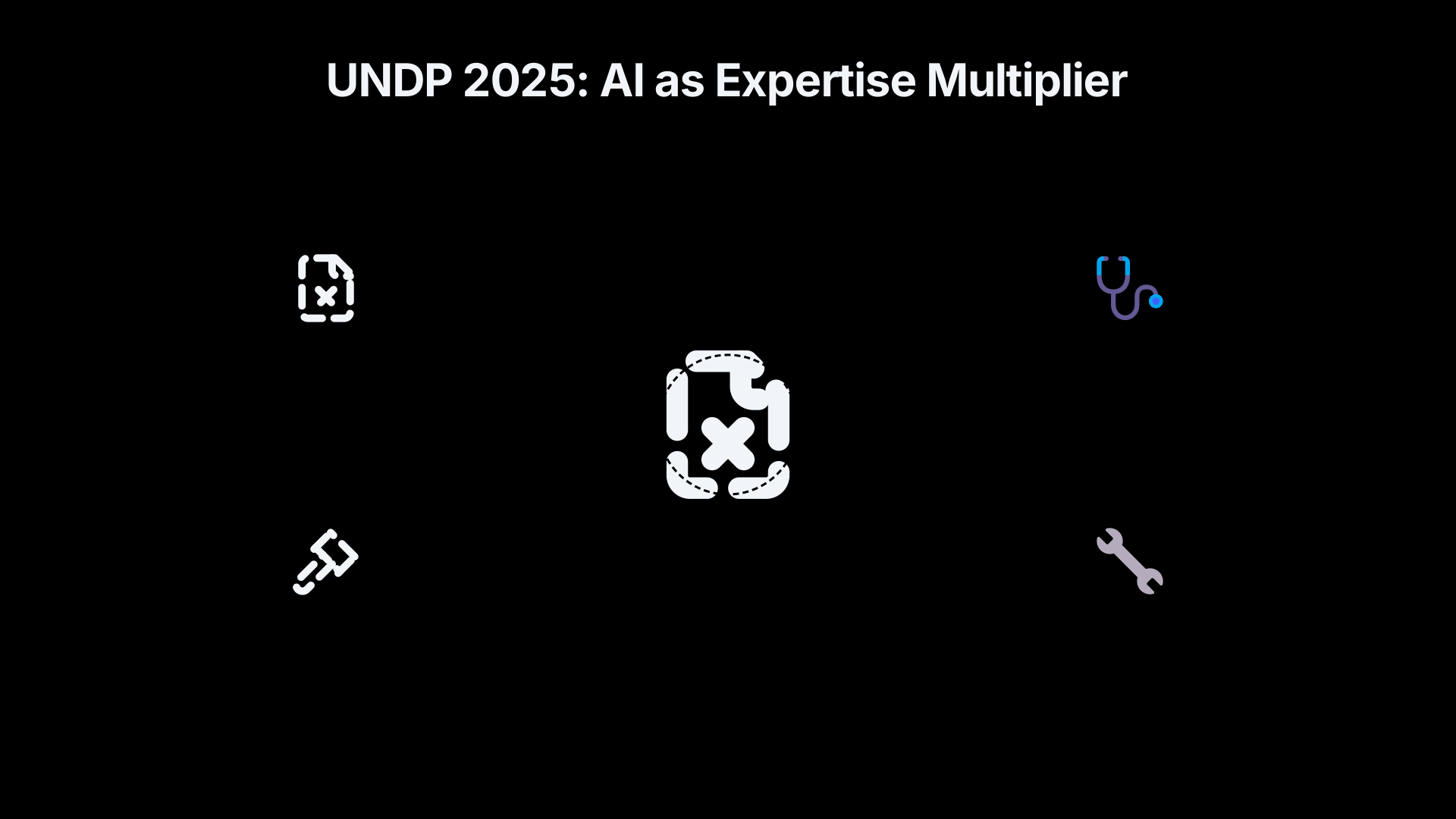
Many regions face severe shortages of doctors, nurses, radiologists, and specialists. Even when medical knowledge exists globally, patients often cannot reach it in time. AI clinical decision support systems aim to narrow this gap by helping frontline workers interpret symptoms, prioritise risks, manage records, and identify cases needing escalation.
The World Health Organization has repeatedly argued that AI could improve diagnosis, treatment support, and healthcare system efficiency if deployed carefully and ethically. [World Health Organization]who.intWorld Health OrganizationWHO issues first global report on Artificial Intelligence (AI)…28 Jun 2021 — This important new report provid… [World Health Organization]who.intWorld Health OrganizationWHO issues first global report on Artificial Intelligence (AI)…28 Jun 2021 — This important new report provid…
Recent studies suggest that AI-assisted clinical decision systems may reduce workload and improve consistency in some settings, though real-world evidence remains uneven. [PMC]pmc.ncbi.nlm.nih.govPMCArtificial-Intelligence-Based Clinical Decision SupportPMCby CA Gomez-Cabello · 2024 · Cited by 92 — This study underscores the potential of AI-CDSSs in improving clinical management, patient…
Some of the most interesting experiments are emerging in low-resource environments rather than elite hospitals. Researchers working with community health workers in Rwanda built datasets based on real frontline medical questions to test how large language models perform under practical conditions rather than benchmark-style exams. [PMC]pmc.ncbi.nlm.nih.govPMCArtificial-Intelligence-Based Clinical Decision SupportPMCby CA Gomez-Cabello · 2024 · Cited by 92 — This study underscores the potential of AI-CDSSs in improving clinical management, patient…
Other projects in Pakistan have explored speech-based maternal healthcare systems that allow workers and patients to generate medical records and receive guidance in Urdu through smartphones and messaging tools. [arXiv]arxiv.orgarXivSystem X: A Mobile Voice-Based AI System for EMR Generation and Clinical Decision Support in Low-Resource Maternal HealthcareDecembe…
These examples point toward a broader possibility: AI as a force multiplier for partially trained workers rather than a full replacement for experts. A nurse, technician, or community health worker equipped with reliable guidance may become dramatically more capable.
That distinction matters because many health systems cannot realistically train enough specialists quickly. If AI can safely expand the reach of existing professionals, it could ease one of humanity’s most persistent bottlenecks.
Yet medicine also exposes the dangers of overclaiming. Clinical errors can kill people. AI systems may perform poorly outside the environments they were trained on. Professional guidance bodies increasingly stress that clinicians need oversight frameworks, accountability rules, and transparency around how AI recommendations are generated. [Journal of Medical Ethics]jme.bmj.comWith the introduction of artificial intelligence (AI) to healthcare, there is also a need for professional guidance to support its use.Re… [British Medical Association]bma.org.ukBritish Medical AssociationPrinciples for Artificial Intelligence (AI) and its application in…Current use cases include diagnostics an…
The near-term future is therefore likely to involve “human-plus-AI” systems rather than autonomous medical expertise.
Legal advice and bureaucracy
Legal systems are another domain where scarcity often means exclusion.
Many people cannot afford lawyers or do not understand administrative procedures well enough to defend their rights. This is especially true for immigration, housing, benefits, debt disputes, employment conflicts, and small civil claims.
AI tools may help by drafting documents, summarising regulations, translating legal language into plain English, or guiding users through bureaucratic processes. Researchers and legal aid groups increasingly view this as part of a broader “access to justice” problem. [Justice Innovation]justiceinnovation.law.stanford.eduai goes to court the growing landscape of ai for access to justiceIt aims to lay a foundation for further case studies, observational studies, and…Read more… [Cambridge University Press & Assessment]cambridge.orgCambridge University Press & AssessmentUsing AI Powered Paraprofessionals to Meet the Access…by RW Campbell · 2025 — This Article asks…[BIICL The strongest use case may not be replacing lawyers]biicl.orgporting legal aid and advice providers through automation, document.Read more…, but extending their reach. A small legal aid organisation could use AI systems to handle routine enquiries, freeing human professionals for complex or sensitive cases.
This is potentially transformative because legal exclusion compounds other forms of scarcity. A person unable to navigate housing law, licensing rules, or public benefits may lose access to income, healthcare, or stability even when formal rights exist.
But legal AI also demonstrates why trust and accountability matter. Incorrect legal guidance can produce catastrophic outcomes. Many systems are poor at handling local variation, procedural nuance, or rapidly changing regulations. There is also a danger that governments or firms deploy low-cost AI systems as substitutes for adequately funded human services.
Cheap advice is valuable. Cheap abandonment disguised as innovation is not.
Local technical and economic problem-solving
Expertise shortages affect infrastructure and industry as well as public services.
In many low-income regions, machinery sits unused because trained maintenance specialists are unavailable. Agricultural productivity remains low because local farmers lack access to agronomy advice tailored to local conditions. Small manufacturers cannot afford consultants or engineering support.
AI guidance systems may help distribute practical technical knowledge more widely. Recent research has explored AI support tools for biomedical technicians maintaining medical equipment in resource-constrained environments, including systems that interpret fault codes and suggest repairs. [arXiv]arxiv.orgarXivSystem X: A Mobile Voice-Based AI System for EMR Generation and Clinical Decision Support in Low-Resource Maternal HealthcareDecembe…
This kind of capability matters because economic development often depends less on frontier inventions than on the spread of operational know-how. Societies become richer when ordinary people can apply useful knowledge reliably and repeatedly.
Historically, industrial expertise diffused slowly through apprenticeships, trade networks, migration, manuals, and formal education. AI could accelerate that diffusion dramatically by making interactive guidance cheap and continuously available.
If successful, this would represent a form of “cognitive infrastructure”: a persistent layer of technical assistance woven into everyday economic life.
Why abundant know-how could matter for the long future
Within the broader AI bloom framework, abundant expertise matters because intelligence is a foundational input into almost every other form of progress.
Scientific discovery depends on specialised reasoning. Effective institutions depend on informed judgement. Economic development depends on the spread of skills. Medical progress depends on diagnostic and research capability. Civilisational resilience depends on societies being able to solve problems quickly and coordinate effectively.
Historically, high-level expertise has been concentrated in relatively small populations: elite universities, wealthy countries, large corporations, specialist professions. AI raises the possibility that some of those cognitive advantages become far more widely distributed.
If billions more people gain access to reasonably competent tutoring, design assistance, translation, programming help, medical triage, legal drafting, or scientific support, the pool of people able to contribute meaningfully to knowledge creation could expand enormously.
This is one reason advocates of technological optimism sometimes describe AI as a tool for “making intelligence abundant”. The phrase does not mean everyone suddenly becomes a genius. It means that many cognitive tasks currently limited by scarce human attention could become cheaper and more accessible.
In the most ambitious versions of the long-future argument, this scaling effect compounds over decades. More people solving problems means faster discovery, better institutions, improved resilience, and a larger field of human possibility.
But this remains a conditional claim, not an established outcome.
What blocks access and usefulness
Reliability and hallucinations
The largest obstacle is still reliability.
Large language models can generate plausible but false answers, misread context, invent citations, or fail unpredictably on unfamiliar problems. In low-stakes settings this is annoying; in medicine, law, engineering, or governance it can be dangerous.
Even highly capable systems still struggle with uncertainty calibration. They often present guesses with unwarranted confidence, which makes them risky for inexperienced users who cannot independently verify outputs.
This means AI guidance works best when paired with human oversight, verification systems, or structured workflows rather than treated as infallible expertise.
Infrastructure inequality
Abundant know-how also depends on material infrastructure.
People need electricity, internet access, affordable devices, cloud infrastructure, and sufficient digital literacy to use AI systems effectively. Regions already excluded from digital infrastructure may therefore gain least from AI-enabled expertise.
The UNDP’s 2025 reporting repeatedly warns that AI could widen inequality if poorer populations lack the institutions and connectivity needed to benefit from it. [Human Development Reports]hdr.undp.org2025 global survey ai and human developmentHuman Development Reports2025 Global Survey on AI and Human DevelopmentUNDP conducted a global public opinion survey to provide data-driv… [Human Development Reports]hdr.undp.org2025 global survey ai and human developmentHuman Development Reports2025 Global Survey on AI and Human DevelopmentUNDP conducted a global public opinion survey to provide data-driv…
This is a central tension in the AI bloom debate. AI may reduce the cost of cognition while leaving other bottlenecks untouched. If compute, chips, networks, and data centres remain highly concentrated, the gains from abundant know-how may also remain concentrated.
Language and cultural bias
Many AI systems are strongest in contexts heavily represented online, especially English-speaking and wealthier societies. Performance can degrade sharply for underrepresented languages, local legal systems, indigenous knowledge, or region-specific medical realities.
That matters because expertise is often contextual. Good farming advice in Kenya may differ from good farming advice in Canada. Effective medical guidance depends on local disease prevalence, infrastructure, and treatment availability.
Without local adaptation, AI systems risk exporting generic assumptions that fail in practice.
Trust and institutional legitimacy
Expertise is partly social, not just informational.
People trust doctors, teachers, or engineers because of institutions: licensing systems, accountability mechanisms, professional norms, and shared standards. AI systems do not automatically inherit that legitimacy.
The more powerful AI guidance becomes, the more societies will need systems for auditing, certification, liability, and contestability. Otherwise people may either distrust useful tools or trust unreliable ones too much.
This may become one of the defining governance problems of an AI-rich civilisation: deciding which forms of machine expertise deserve authority and under what conditions.
Political and economic concentration
There is also a deeper political economy question.
If a handful of companies control the most advanced models, compute infrastructure, and training data, “abundant know-how” may still function as a gated commercial service rather than a broadly shared public good.
Some legal scholars and policy researchers have already argued that access-to-justice systems powered by AI may require public-interest models or stronger public oversight rather than relying entirely on commercial incentives. [Cambridge University Press & Assessment]cambridge.orgCambridge University Press & AssessmentUsing AI Powered Paraprofessionals to Meet the Access…by RW Campbell · 2025 — This Article asks…
The broader bloom question is therefore not simply whether expertise becomes cheaper, but who controls the systems distributing it.
The likely future: amplification rather than replacement
The strongest evidence today suggests that AI works best as an amplifier of human capability rather than a clean substitute for professional expertise.
A teacher using AI may reach more students. A nurse with AI support may triage more effectively. A technician with diagnostic assistance may repair equipment faster. A small business owner with AI tools may perform tasks once requiring specialised consultants.
This may still be historically significant. Civilisations often change when important capabilities become dramatically cheaper and more widely distributed. Literacy, printing, public schooling, telecommunications, and the internet all expanded who could participate in economic and intellectual life.
AI-assisted expertise could become another such expansion.
But the long-term outcome is not guaranteed to be egalitarian. A world where elite institutions use superhuman AI systems while poorer communities receive low-quality automated substitutes could deepen rather than reduce inequality. Equally, a world where trustworthy AI guidance becomes widely available through public infrastructure, education systems, healthcare networks, and open access tools could meaningfully expand human capability across billions of lives.
The core question is therefore not whether AI can generate expert-like answers. It already can in many domains. The deeper question is whether societies can build systems that turn those answers into reliable, trusted, widely shared capability.
That is what would make know-how genuinely abundant rather than merely automated.
Endnotes
-
Source: hdr.undp.org
Title: human development report 2025
Link: https://hdr.undp.org/content/human-development-report-2025Source snippet
Human Development ReportsHuman Development Report 20256 May 2025 — The 2025 Human Development Report explores the implications of artific...
Published: May 2025
-
Source: hdr.undp.org
Link: https://hdr.undp.org/system/files/documents/global-report-document/hdr2025reporten.pdfSource snippet
The 2025 Human Development Report. The cover and chapter images in the report feature portraits in the artistic styles of...Read more...
-
Source: who.int
Link: https://www.who.int/news/item/28-06-2021-who-issues-first-global-report-on-ai-in-health-and-six-guiding-principles-for-its-design-and-useSource snippet
World Health OrganizationWHO issues first global report on Artificial Intelligence (AI)...28 Jun 2021 — This important new report provid...
-
Source: who.int
Link: https://www.who.int/publications/i/item/9789240029200Source snippet
World Health OrganizationEthics and governance of artificial intelligence for healthJun 28, 2021 — The WHO guidance on Ethics & Governanc...
-
Source: who.int
Title: World Health Organization Artificial Intelligence for Health
Link: https://www.who.int/publications/m/item/artificial-intelligence-for-healthSource snippet
World Health OrganizationArtificial Intelligence for HealthMay 27, 2024 — Our mission is to assist countries in deploying AI technologies...
Published: May 27, 2024
-
Source: pmc.ncbi.nlm.nih.gov
Title: PMCArtificial-Intelligence-Based Clinical Decision Support
Link: https://pmc.ncbi.nlm.nih.gov/articles/PMC10969561/Source snippet
PMCby CA Gomez-Cabello · 2024 · Cited by 92 — This study underscores the potential of AI-CDSSs in improving clinical management, patient...
-
Source: pmc.ncbi.nlm.nih.gov
Link: https://pmc.ncbi.nlm.nih.gov/articles/PMC12880909/Source snippet
PMCLarge language models for frontline healthcare support in low...by S Rutunda · 2026 — Here we develop a dataset of 5,609 clinical que...
-
Source: arxiv.org
Link: https://arxiv.org/abs/2512.12240Source snippet
arXivSystem X: A Mobile Voice-Based AI System for EMR Generation and Clinical Decision Support in Low-Resource Maternal HealthcareDecembe...
-
Source: arxiv.org
Link: https://arxiv.org/abs/2604.22610 -
Source: pmc.ncbi.nlm.nih.gov
Link: https://pmc.ncbi.nlm.nih.gov/articles/PMC11662436/Source snippet
implications of AI-driven clinical decision support...by CY Elgin · 2024 · Cited by 61 — This study aims to explore healthcare professio...
-
Source: cambridge.org
Link: https://www.cambridge.org/core/journals/german-law-journal/article/using-ai-powered-paraprofessionals-to-meet-the-access-to-justice-crisis/A8DF0EA18862EC177DC094001429CD93Source snippet
Cambridge University Press & AssessmentUsing AI Powered Paraprofessionals to Meet the Access...by RW Campbell · 2025 — This Article asks...
-
Source: biicl.org
Link: https://www.biicl.org/documents/197_ai_legal_access_vulnerable_groups.pdfSource snippet
porting legal aid and advice providers through automation, document.Read more...
-
Source: arxiv.org
Link: https://arxiv.org/abs/2601.16967Source snippet
arXivEmpowering Medical Equipment Sustainability in Low-Resource Settings: An AI-Powered Diagnostic and Support Platform for Biomedical T...
-
Source: hdr.undp.org
Title: 2025 global survey ai and human development
Link: https://hdr.undp.org/data-center/2025-global-survey-ai-and-human-developmentSource snippet
Human Development Reports2025 Global Survey on AI and Human DevelopmentUNDP conducted a global public opinion survey to provide data-driv...
-
Source: hdr.undp.org
Title: 2025 global survey ai and human development main findings
Link: https://hdr.undp.org/2025-global-survey-ai-and-human-development-main-findingsSource snippet
Human Development Reports2025 Global Survey on AI and Human DevelopmentTwo-Thirds in Low to High HDI Countries Expect to use AI within On...
-
Source: undp.org
Link: https://www.undp.org/cambodia/speeches/launch-2025-human-development-report-cambodia-matter-choice-people-and-possibilities-age-aiSource snippet
Launch of the 2025 Human Development Report in...19 Jun 2025 — We invite you to explore how AI can help us map vulnerabilities, improve...
-
Source: undp.org
Title: human development report 2025
Link: https://www.undp.org/africa/publications/human-development-report-2025Source snippet
13 May 2025 — This year's Human Development Report asks what choices can be made so that new development pathways for all countries dot t...
Published: May 2025
-
Source: undp.org
Link: https://www.undp.org/angola/news/inequality-and-artificial-intelligence-highlighted-new-human-development-report-presented-undpSource snippet
Angola remains in the medium...Read more...
-
Source: undp.org
Link: https://www.undp.org/kyrgyzstan/blog/undp-human-development-report-2025-people-and-possibilities-age-ai-what-ai-means-kyrgyzstanSource snippet
UNDP Human Development Report 2025 - People and...21 Apr 2026 — Panel Session on Artificial Intelligence, Design Decisions and Human Dev...
-
Source: undp.org
Title: human development and ai paradox 35 year low new horizons ghana
Link: https://www.undp.org/ghana/press-releases/human-development-and-ai-paradox-35-year-low-new-horizons-ghanaSource snippet
A 35-Year Low with New Horizons for Ghana9 Jul 2025 — The 2025 Human Development Report “A matter of choice: people and possibilities in...
-
Source: hdr.undp.org
Title: envisioning human development opportunity ai
Link: https://hdr.undp.org/content/envisioning-human-development-opportunity-aiSource snippet
the human development opportunity of AI24 Jun 2025 — The 2025 Human Development Report argues that AI goes beyond simply having more powe...
-
Source: hdr.undp.org
Link: https://hdr.undp.org/system/files/documents/global-report-document/hdr2025overviewen.pdfSource snippet
Page 34. 20. HUMAN DEVELOPMENT REPORT 2025... published background paper, Human Development. Report Office...Read more...
-
Source: who.int
Link: https://www.who.int/teams/digital-health-and-innovation/harnessing-artificial-intelligence-for-health -
Source: who.int
Link: https://www.who.int/health-topics/digital-healthSource snippet
Digital healthDigital health can help make health systems more efficient and sustainable, enabling them to deliver good quality, affordab...
-
Source: iris.who.int
Link: https://iris.who.int/server/api/core/bitstreams/ad62580f-540f-4e36-b957-e7f2946ae1fb/contentSource snippet
Unlike traditional AI-based approaches, this strategy did...Read more...
-
Source: jme.bmj.com
Link: https://jme.bmj.com/content/50/7/437Source snippet
With the introduction of artificial intelligence (AI) to healthcare, there is also a need for professional guidance to support its use.Re...
-
Source: bma.org.uk
Link: https://www.bma.org.uk/media/njgfbmnn/bma-principles-for-artificial-intelligence-ai-and-its-application-in-healthcare.pdfSource snippet
British Medical AssociationPrinciples for Artificial Intelligence (AI) and its application in...Current use cases include diagnostics an...
-
Source: justiceinnovation.law.stanford.edu
Title: ai goes to court the growing landscape of ai for access to justice
Link: https://justiceinnovation.law.stanford.edu/ai-goes-to-court-the-growing-landscape-of-ai-for-access-to-justice/Source snippet
It aims to lay a foundation for further case studies, observational studies, and...Read more...
Additional References
-
Source: canlii.org
Link: https://www.canlii.org/en/commentary/doc/2021CanLIIDocs13978Source snippet
The Case for AI-Powered Legal AidThe authors suggest that using direct-to-public (DTP) tools, such as legal assistance systems powered by...
-
Source: digital-transformation.hee.nhs.uk
Link: https://digital-transformation.hee.nhs.uk/binaries/content/assets/digital-transformation/dart-ed/understandingconfidenceinai-may22.pdfSource snippet
healthcare workers' confidence in AIAI technologies have the potential to support existing clinical capabilities in diagnosis and screeni...
-
Source: health.org.uk
Link: https://www.health.org.uk/reports-and-analysis/briefings/priorities-for-an-ai-in-health-care-strategy -
Source: facebook.com
Link: https://www.facebook.com/UNDPZambia/posts/the-2025-human-development-report-is-outhdr2025-explores-how-ai-affects-people-a/1107645878063730/Source snippet
The 2025 Human Development Report is out. #HDR2025...#HDR2025 explores how AI affects people at different stages of their lives, and how...
-
Source: linkedin.com
Title: un two zero undp human development report 2025 activity 7398368230181859328 JMSq
Link: https://www.linkedin.com/posts/un-two-zero_undp-human-development-report-2025-activity-7398368230181859328-JMSqSource snippet
Human Development Report 2025 | UN 2.0 | United NationsUNDP warns AI divides nations. Your strategy must adapt. The recent UN report on t...
-
Source: londonlegalsupporttrust.org.uk
Title: ai in the free legal advice sector navigating opportunities and challenges
Link: https://londonlegalsupporttrust.org.uk/ai-in-the-free-legal-advice-sector-navigating-opportunities-and-challenges/Source snippet
AI in the Free Legal Advice Sector: Navigating...29 Jul 2025 — Others argue that AI can actually improve accessibility by offering 24/7...
-
Source: sdg.iisd.org
Title: human development report 2025 shows ais potential to reignite development
Link: https://sdg.iisd.org/news/human-development-report-2025-shows-ais-potential-to-reignite-development/Source snippet
Development Report 2025 Shows AI's Potential to...13 May 2025 — The Human Development Report 2025 reveals stalled progress on the HDI in...
Published: May 2025
-
Source: youtube.com
Link: https://www.youtube.com/watch?v=EIXe692sZ9kSource snippet
From Strategy to Action: Building AI Capacity in Legal AidLearn how four justice communities are building AI confidence and capacity thro...
-
Source: linkedin.com
Title: emreorhan hdr2025 humandevelopment ai activity 7325403796715520001 laS7
Link: https://www.linkedin.com/posts/emreorhan-_hdr2025-humandevelopment-ai-activity-7325403796715520001-laS7Source snippet
UNDP's HDR 2025: AI and human development5 May 2025 — The UNDP's Human Development Report 2025 is here! “A matter of choice: People and p...
Published: May 2025
-
Source: healthcare-bulletin.co.uk
Title: ai based clinical decision support in multidisciplinary medicine 4130
Link: https://healthcare-bulletin.co.uk/article/ai-based-clinical-decision-support-in-multidisciplinary-medicine-4130/Source snippet
AI-Based Clinical Decision Support in Multidisciplinary...by SR Borkar · 2025 · Cited by 1 — In primary care settings, AI-enabled CDSS h...
Amazon book picks
Further Reading
Books and field guides related to Abundant Know how. Use these as the next step if you want deeper reading beyond the article.

Artificial Intelligence in Education
This work reports on research into intelligent systems, models, and architectures for educational computing applications. It covers a wid...
Digital Literacy and Digital Inclusion
First published 2014. Subjects: Information society, Information policy, Libraries and society, Internet access for library users, Librar...

Artificial intelligence in education
First published 2001. Subjects: Educational applications, Congresses, Artificial intelligence, Computer-assisted instruction.
Digital Inclusion, Teens, and Your Library
First published 2005. Subjects: Internet in young adults' libraries, Internet and teenagers, Technology and youth, Libraries and teenager...
eBay marketplace picks
Marketplace Samples
Example marketplace items related to this page. Use the search link to explore similar finds on eBay.

Example eBay listing
A.I. Artificial Intelligence Original Movie Poster Signed By Jude Law
USD 125.00 | Shipping USD 25.00 | US

Example eBay listing
Artificial Intelligence D/S Original Movie Poster - 27 x 40"
USD 19.50 | Shipping USD 13.65 | US

Example eBay listing
612388 Artificial Intelligence Movie Science Fiction Drama Wall Print Poster
USD 22.95 | Shipping USD 12.95 | JP

Example eBay listing
Companion - Artificial Intelligence Dark Comedy Cinema Film - POSTER 20"x30"
USD 23.99 | Free shipping | US
Topic Tree