Within Warehouse Pace
Algorithmic quota pressure
Digital targets can turn ergonomic gains into tighter pace pressure by measuring every scan, pause and pick.
On this page
- How warehouse performance systems measure work
- Why real time targets can reduce autonomy
- What humane pacing rules would need to protect
Page outline Jump by section
Introduction
Robot warehouses are often described as cleaner, safer, and less physically punishing than older fulfilment centres. In some ways they are. Autonomous carts can eliminate miles of walking, conveyor systems reduce heavy carrying, and computer vision helps route stock more efficiently. But many workers describe a different problem replacing some of the old strain: a relentless pace set by software.
 The pressure does not come only from robots moving shelves around the building. It also comes from algorithmic quota systems that measure every scan, every pause, every pick, and every minute away from a workstation. In modern warehouses, management software can continuously compare a worker’s output against a target rate calculated in real time. The result is a workplace where physical effort may decline in one dimension while time pressure intensifies in another.
This matters for the broader debate around AI and automation because warehouses are among the clearest real-world examples of how advanced systems can both reduce drudgery and expand managerial control at the same time. If AI is eventually meant to help create a more abundant and humane economy, then the question is not merely whether machines can increase throughput. It is whether productivity gains translate into more sustainable work or simply faster labour.
How warehouse performance systems measure work
Modern warehouse management systems, usually called WMS platforms, do far more than track inventory. They increasingly monitor labour in real time, assigning tasks, timing completion rates, and comparing workers against expected productivity benchmarks. [Target Integration]targetintegration.comTarget Integration Warehouse Management System: A Comprehensive GuideTarget IntegrationWarehouse Management System: A Comprehensive GuideSeptember 13, 2023 — 13 Sept 2023 — Currently, 60% of warehouse manag… [Generix]generixgroup.comunlocking efficiency how does wms work in modern warehousingUnlocking Efficiency: How Does WMS Work in Modern…19 Mar 2024 — WMS technology provides real-time data on inventory levels, order stat…
In highly automated fulfilment centres, workers commonly interact with handheld scanners, wearable devices, barcode systems, or fixed workstations that record actions continuously. A picker scanning an item may generate a timestamp accurate to the second. The system can then calculate:
- Items picked per hour
- Average seconds per task
- Idle or “unproductive” time
- Error rates
- Walking speed and route efficiency
- Time spent away from a station
- Comparison with team averages
The crucial shift is that quotas no longer need to be checked occasionally by supervisors. Software can update expectations continuously across thousands of workers at once.
At companies such as Amazon, public reporting and labour investigations have described systems that automatically track “rate” targets and “Time Off Task” metrics. The National Employment Law Project reported that workers were monitored throughout the day and could receive automated warnings or disciplinary actions when productivity fell below algorithmic expectations. [National Employment Law Project]nelp.orgNational Employment Law ProjectAmazon's Disposable Workers: High Injury and Turnover…6 Mar 2020 — Amazon's algorithms and tracking sys…
This creates a different type of labour environment from traditional factory supervision. A human manager may overlook temporary slowdowns, fatigue, or small interruptions. An algorithm typically treats all lost seconds as measurable variance. The system does not get tired of monitoring because monitoring is built into the infrastructure itself.
The effect can feel especially intense in robot warehouses because automation removes many natural pauses that once existed in physical workflows. If shelves arrive automatically and routes are optimised constantly, workers can be expected to maintain near-continuous output. Time previously spent walking across a warehouse becomes available for more picks per hour.
That is one reason automation can reduce physical strain while simultaneously making work feel more relentless.
Why real-time targets can reduce autonomy
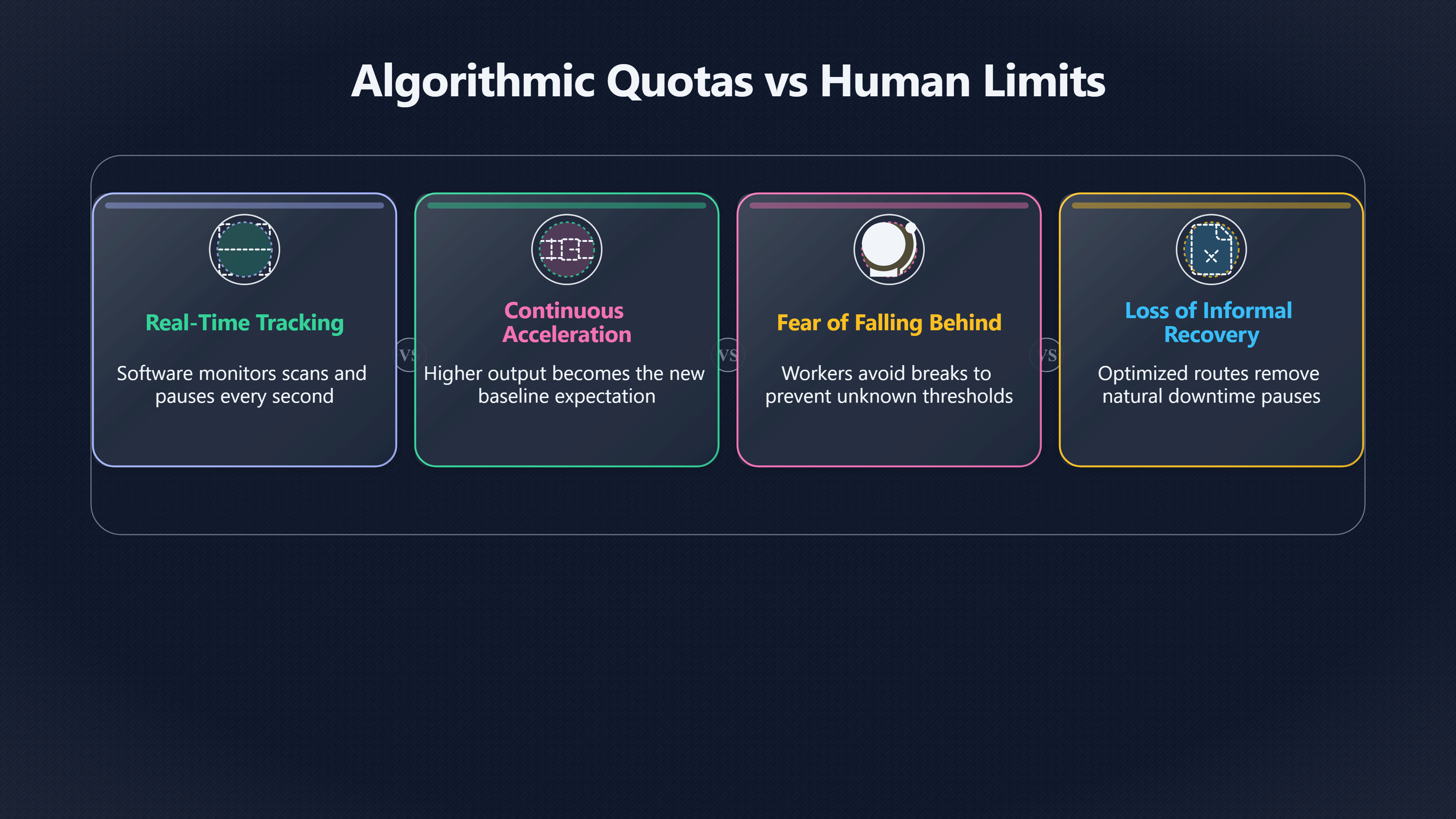
The psychological effect of algorithmic quotas is not only about speed. It is also about loss of control over pace.
Traditional warehouse work was often exhausting, but workers sometimes retained small forms of autonomy: deciding how quickly to walk, when to pause briefly, how to organise motions, or how to distribute effort across a shift. Real-time quota systems narrow that flexibility because the software is always comparing present performance against a target.
Workers and labour researchers frequently describe this as “management by metrics” or “algorithmic management”. The system effectively becomes a digital supervisor that never stops observing. [UC Berkeley Labor Center]laborcenter.berkeley.edudata algorithms at workUC Berkeley Labor CenterData and Algorithms at Work: The Case for Worker…3 Nov 2021 — A new report provides a comprehensive set of pol… [Sage Journals]journals.sagepub.com“The Militarization of Employment Relations: Racialized Surveillance and Worker Control in Amazon Fulfillment Centers.Read more…
In practice, this can produce several forms of pressure simultaneously.
Continuous acceleration
If a worker exceeds targets consistently, higher output can become the new baseline expectation. Productivity gains created by robots therefore risk being absorbed into tighter quotas rather than shorter hours or gentler pacing.
Warehouse consultancy material openly markets technologies that can increase picking productivity by 30%, 50%, or more. [Pallite Group]pallitegroup.comPallite Group7 New Approaches to Dramatically Boost Your WarehouseMay 21, 2025 — This article explores seven innovative approaches that forward-thinking warehouses are implementing to achieve pick rate i… From a business perspective, these gains are attractive because fulfilment speed has become a major competitive advantage in e-commerce.
But for workers, higher throughput can mean compressing more repetitive motions into each hour. A job that once involved varied movement across a warehouse may become a dense sequence of scans, reaches, grabs, and packing motions repeated hundreds or thousands of times per shift.
Fear of falling behind
Algorithmic systems can create uncertainty because workers may not fully understand how targets are calculated or adjusted. If performance metrics are opaque, employees may push themselves harder simply to avoid crossing an unknown threshold.
This matters psychologically. Humans can negotiate with supervisors. They cannot easily negotiate with a dashboard.
Several reports on large fulfilment centres describe workers feeling unable to take unscheduled pauses for stretching, recovery, or bathroom breaks because they fear accumulating too much idle time in the system. [National Employment Law Project]nelp.orgNational Employment Law ProjectAmazon's Disposable Workers: High Injury and Turnover…6 Mar 2020 — Amazon's algorithms and tracking sys…
Even short interruptions can feel risky when every minute is logged.
Reduction of informal recovery time
Older warehouse workflows often contained unavoidable downtime: waiting for stock, travelling between aisles, or coordinating manually with colleagues. Automation removes many of those interruptions.
From an efficiency standpoint, that is the point. But from a human perspective, those moments sometimes acted as informal recovery periods.
A fully optimised warehouse can therefore become physically smoother yet mentally harsher. The work rhythm starts to resemble continuous machine pacing rather than human pacing.
Why ergonomic gains do not automatically solve injury risks
One of the most important misunderstandings about warehouse automation is the assumption that reducing heavy lifting automatically creates humane work.
Ergonomic risk has multiple dimensions. Removing one type of strain can increase another.
US regulators and labour researchers have repeatedly linked warehouse quota systems to musculoskeletal disorders and repetitive strain risks. OSHA and the Department of Labor have warned that time-based quotas can compound injury hazards in warehouses where repetitive movement is already common. [oig.dol.gov]oig.dol.govCOVI D-19: OSHA Needs to Do More to Address High InjuryCOVID-19: OSHA Needs to Do More to Address High Injury…August 19, 2024 — 27 Sept 2023 — Warehouse workers face hazards that can result… [2parkerpoe.com]parkerpoe.comUnlike its published safety standards, the clause requires a…Read more…
This helps explain a pattern identified in some robotics studies: severe injuries may decline while lower-level repetitive injuries remain common or even rise.
The mechanism is straightforward:
- Robots reduce travel distance and some heavy transport
- Workers spend more time continuously picking or packing
- Repetition frequency rises
- Recovery opportunities shrink
- Quotas discourage slowing down when discomfort appears
The result is a trade-off rather than a simple improvement.
In AI bloom terms, this is an important warning. Technological progress does not automatically convert productivity gains into human flourishing. Institutions, incentives, and labour rules determine whether automation becomes liberating or merely more efficient at extracting output.

The hidden shift from human supervision to software governance
Algorithmic quotas also change who effectively governs the workplace.
Historically, supervisors exercised discretion. A manager might recognise that a worker was injured, exhausted, training a colleague, or dealing with equipment problems. Digital systems instead tend to standardise performance into numerical indicators.
This can make workplaces more legible to management but less adaptive to individual circumstances.
Researchers studying algorithmic management argue that software increasingly performs functions once associated with middle management itself: assigning tasks, evaluating productivity, flagging underperformance, and triggering disciplinary processes. [UC Berkeley Labor Center]laborcenter.berkeley.edudata algorithms at workUC Berkeley Labor CenterData and Algorithms at Work: The Case for Worker…3 Nov 2021 — A new report provides a comprehensive set of pol… [Sage Journals]journals.sagepub.com“The Militarization of Employment Relations: Racialized Surveillance and Worker Control in Amazon Fulfillment Centers.Read more…
The warehouse therefore becomes not just automated but computationally governed.
That distinction matters because it changes the social experience of work. Workers may feel they are responding less to human judgement and more to an impersonal optimisation system designed primarily around throughput metrics.
This is one reason some workers describe robot warehouses as emotionally exhausting even when the physical labour is lighter than older logistics jobs.
What humane pacing rules would need to protect
The existence of algorithmic quotas does not mean warehouse automation is inherently harmful. The same technologies could support safer and less exhausting work if productivity gains were shared differently.
The central policy question is whether software targets should adapt to human limits or whether humans are expected to adapt indefinitely to machine-paced systems.
Several approaches are increasingly discussed by labour researchers, regulators, and worker advocates.
Limits on quota-driven pacing
Some US states, including California and Washington, have introduced or discussed warehouse quota regulations requiring employers to disclose productivity expectations and preventing quotas from interfering with legally required breaks or safety rules. [LawNet]ir.lawnet.fordham.eduLawNetUnder Pressure: Addressing Warehouse Productivity Quotas…by JL Gordon · 2021 · Cited by 15 — The standard shall address, among o…
The underlying principle is simple: workers should not have to choose between meeting algorithmic targets and protecting their bodies.

Transparency around metrics
Workers often do not know exactly how their performance scores are generated, adjusted, or used. Humane systems would likely require clear disclosure about:
- How quotas are calculated
- What counts as idle time
- How productivity data affects discipline
- Whether algorithms adapt automatically
- How workers can challenge incorrect measurements
Transparency matters because opaque systems can intensify anxiety even when formal targets remain achievable.
Recovery time built into the system
A humane warehouse would not merely remove heavy lifting. It would preserve recovery capacity.
That could include:
- Mandatory micro-breaks
- Rotation between repetitive tasks
- Ergonomic pacing caps
- Reduced quotas during extreme heat or peak seasons
- Human override authority when workloads become unsafe
The deeper issue is philosophical as much as technical. Should AI systems optimise humans around machines, or should machines be designed around sustainable human flourishing?
Warehouses as an early test of the AI abundance promise
Warehouse automation offers a small but revealing preview of a larger economic question.
The optimistic vision of AI abundance imagines technology helping humanity escape degrading labour altogether. Robots and intelligent systems could eventually absorb dangerous, repetitive, or exhausting work, allowing people more freedom, security, creativity, and time.
Warehouses show that part of this future is technically plausible. Machines already perform tasks that once damaged human bodies routinely.
But warehouses also show that abundance does not emerge automatically from efficiency. Without rules, bargaining power, or institutional choices that protect workers, productivity gains can become tools for accelerating labour rather than easing it.
That tension may define much of the transition into more advanced AI economies. The same systems capable of reducing drudgery can also deepen surveillance, tighten optimisation, and compress human work into ever more measurable units.
The long-term promise of AI bloom therefore depends not only on whether machines become more capable, but on whether societies decide that the purpose of those capabilities is to maximise human flourishing rather than simply maximise throughput.
Endnotes
-
Source: laborcenter.berkeley.edu
Title: data algorithms at work
Link: https://laborcenter.berkeley.edu/data-algorithms-at-work/Source snippet
UC Berkeley Labor CenterData and Algorithms at Work: The Case for Worker...3 Nov 2021 — A new report provides a comprehensive set of pol...
-
Source: oig.dol.gov
Title: COVI D-19: OSHA Needs to Do More to Address High Injury
Link: https://www.oig.dol.gov/public/reports/oa/2023/19-23-013-10-105.pdfSource snippet
COVID-19: OSHA Needs to Do More to Address High Injury...August 19, 2024 — 27 Sept 2023 — Warehouse workers face hazards that can result...
Published: August 19, 2024
-
Source: parkerpoe.com
Link: https://www.parkerpoe.com/news/2023/08/can-osha-regulate-the-pace-of-work-toSource snippet
Unlike its published safety standards, the clause requires a...Read more...
-
Source: osha.gov
Link: https://www.osha.gov/warehousing/hazards-solutionsSource snippet
Hazards and SolutionsErgonomics and Musculoskeletal Disorders · Reduce case weights to 35 pounds or less. · For cases over 35 pounds, rai...
-
Source: osha.gov
Link: https://www.osha.gov/ergonomicsSource snippet
Overview | Occupational Safety and Health...Ergonomics --- fitting a job to a person --- helps lessen muscle fatigue, increases producti...
-
Source: targetintegration.com
Title: Target Integration Warehouse Management System: A Comprehensive Guide
Link: https://targetintegration.com/en_gb/warehouse-management-system-a-comprehensive-guide-for-2024-part-1/Source snippet
Target IntegrationWarehouse Management System: A Comprehensive GuideSeptember 13, 2023 — 13 Sept 2023 — Currently, 60% of warehouse manag...
Published: September 13, 2023
-
Source: generixgroup.com
Title: unlocking efficiency how does wms work in modern warehousing
Link: https://www.generixgroup.com/en/blog/unlocking-efficiency-how-does-wms-work-in-modern-warehousingSource snippet
Unlocking Efficiency: How Does WMS Work in Modern...19 Mar 2024 — WMS technology provides real-time data on inventory levels, order stat...
-
Source: nelp.org
Link: https://www.nelp.org/insights-research/amazons-disposable-workers-high-injury-turnover-rates-fulfillment-centers-california/Source snippet
National Employment Law ProjectAmazon's Disposable Workers: High Injury and Turnover...6 Mar 2020 — Amazon's algorithms and tracking sys...
-
Source: journals.sagepub.com
Link: https://journals.sagepub.com/doi/10.1177/23780231251318389Source snippet
“The Militarization of Employment Relations: Racialized Surveillance and Worker Control in Amazon Fulfillment Centers.Read more...
-
Source: pallitegroup.com
Title: Pallite Group7 New Approaches to Dramatically Boost Your Warehouse
Link: https://pallitegroup.com/en/news/boost-warehouse-pick-rate/Source snippet
May 21, 2025 — This article explores seven innovative approaches that forward-thinking warehouses are implementing to achieve pick rate i...
Published: May 21, 2025
-
Source: ir.lawnet.fordham.edu
Link: https://ir.lawnet.fordham.edu/cgi/viewcontent.cgi?article=2863&context=uljSource snippet
LawNetUnder Pressure: Addressing Warehouse Productivity Quotas...by JL Gordon · 2021 · Cited by 15 — The standard shall address, among o...
-
Source: journals.sagepub.com
Link: https://journals.sagepub.com/doi/10.1177/10711813241272124Source snippet
Sage JournalsUpdate on Ergonomics Standards in the United States18 Oct 2024 — This paper provides an overview of current ergonomics stand...
-
Source: dictionary.cambridge.org
Link: https://dictionary.cambridge.org/dictionary/english/algorithmicSource snippet
| English meaning - Cambridge Dictionary6 days ago — connected with or using algorithms that control what someone is shown on a computer...
-
Source: Wikipedia
Link: https://en.wikipedia.org/wiki/AlgorithmicSource snippet
AlgorithmicAlgorithmic may refer to: Algorithm, step-by-step instructions for a calculation. Algorithmic art, art made by an algorithm...
-
Source: collinsdictionary.com
Link: https://www.collinsdictionary.com/dictionary/english/algorithmicSource snippet
definition and meaning11 May 2026 — 3 meanings: relating to or using algorithms 1. a logical arithmetical or computational procedure that...
Published: May 2026
-
Source: vocabulary.com
Link: https://www.vocabulary.com/dictionary/algorithmicSource snippet
Definition, Meaning & Synonymsadjective of or relating to or having the characteristics of an algorithm synonyms: recursive of or relatin...
-
Source: en.wiktionary.org
Link: https://en.wiktionary.org/wiki/algorithmicSource snippet
(not comparable). (mathematics, computing) Of, relating to, or being an algorithm. 2017 May 23, Gavin Haynes, “Why BTS are the K-pop king...
Additional References
-
Source: researchgate.net
Link: https://www.researchgate.net/publication/377577909_THE_IMPLEMENTATION_OF_WAREHOUSE_MANAGEMENT_SYSTEM_WMS_TO_IMPROVE_WAREHOUSE_PERFORMANCE_IN_BUSINESS_TO_BUSINESS_B2BSource snippet
the implementation of warehouse management system...9 Apr 2026 — The goal of this study is to identify the problems with inventory manag...
-
Source: facebook.com
Link: https://www.facebook.com/departmentoflabor/posts/osha-has-again-cited-amazon-for-exposing-workers-to-ergonomic-hazards-the-colora/576118951230332/Source snippet
OSHA has again cited #Amazon for exposing workers to...OSHA has again cited #Amazon for exposing workers to ergonomic hazards. The Color...
-
Source: gmgenvirosafe.com
Link: https://www.gmgenvirosafe.com/blog-posts/incident-investigations-after-warehouse-injuries-why-looking-beyond-employee-error-protects-your-operationSource snippet
Incident Investigations After Warehouse Injuries30 Apr 2026 — OSHA has recognized for years that time-based quotas can compound injury ri...
-
Source: blog.pulpowms.com
Title: They also measure labor costs and customer satisfaction levels
Link: https://blog.pulpowms.com/key-performance-indicators-warehouseSource snippet
15 KPI Warehouse Metrics to Optimize Performance and...Warehouse KPIs track inventory turnover, order accuracy, total inventory, and cyc...
-
Source: ig.com
Link: https://www.ig.com/uk/trading-platforms/algorithmic-tradingSource snippet
trades according to set rules such as points of price movement in an...Read more...
-
Source: investopedia.com
Title: basics algorithmic trading concepts and examples.asp
Link: https://www.investopedia.com/articles/active-trading/101014/basics-algorithmic-trading-concepts-and-examples.aspSource snippet
Basics of Algorithmic Trading: Concepts and Examples29 Aug 2025 — Algorithmic trading (also called automated trading, black-box trading...
-
Source: bcpsoftware.com
Title: Business Computer Projects (BCP)The future of WMS
Link: https://www.bcpsoftware.com/the-future-of-wms/Source snippet
voice technology and warehouse...According to research, using voice technology to aid picking “increases productivity by up to 35%, decr...
-
Source: deposco.com
Title: top warehouse management metrics to track in 2024
Link: https://deposco.com/blog/top-warehouse-management-metrics-to-track-in-2024/Source snippet
Top warehouse management metrics to track (with examples)26 Sept 2023 — Throughput, error rates, processing cost per unit, and labor effi...
-
Source: naspweb.com
Link: https://www.naspweb.com/blog/the-pressure-behind-the-packages/Source snippet
rs little room to recover physically or work at a sustainable pace.Read more...
-
Source: facebook.com
Link: https://www.facebook.com/departmentoflabor/posts/as-part-of-ongoing-investigations-osha-has-cited-amazon-for-ergonomic-hazards-at/551926286982932/Source snippet
house workers experienced high rates of musculoskeletal disorders.Read more...
Amazon book picks
Further Reading
Books and field guides related to Algorithmic quota pressure. Use these as the next step if you want deeper reading beyond the article.
AI and Work
AI and Work Understanding How Artificial Intelligence Is Changing the AI Future of Jobs, Skills, and Employment As artificial intelligenc...
Algorithmic Management
The delegation of managerial functions to algorithms transforms management practices by automating repetitive tasks and enhances the role...
Algorithmic Management Consequences for Work Organisation and...
The use of software algorithms to automate organisational functions traditionally carried out by human managers has been termed "algorith...
The Algorithmic Management of Work and Its Implications in Di...
This paper provides a conceptual framework for the emerging phenomenon of algorithmic man-agement and outlines some of the implications f...
eBay marketplace picks
Marketplace Samples
Example marketplace items related to this page. Use the search link to explore similar finds on eBay.

Example eBay listing
A.I. Artificial Intelligence Original Movie Poster Signed By Jude Law
USD 125.00 | Shipping USD 25.00 | US

Example eBay listing
Artificial Intelligence D/S Original Movie Poster - 27 x 40"
USD 19.50 | Shipping USD 13.65 | US

Example eBay listing
612388 Artificial Intelligence Movie Science Fiction Drama Wall Print Poster
USD 22.95 | Shipping USD 12.95 | JP

Example eBay listing
Companion - Artificial Intelligence Dark Comedy Cinema Film - POSTER 20"x30"
USD 23.99 | Free shipping | US
Topic Tree