Within Know how
AI for Community Health Workers
AI could strengthen frontline healthcare by helping community workers triage symptoms, keep records and know when to escalate.
On this page
- Why specialist shortages make frontline support crucial
- Rwanda and Pakistan as low resource healthcare examples
- Why human oversight remains essential
Page outline Jump by section
Introduction
For many people around the world, healthcare does not begin with a specialist doctor. It begins with a community health worker carrying a paper notebook, a basic smartphone, or a blood pressure cuff while travelling between villages and crowded neighbourhoods. These workers often provide the first line of defence against dangerous illness, especially where doctors are scarce and clinics are far away.
 This is one of the clearest near-term examples of how AI could make expert know-how more widely available. AI decision-support systems can help frontline workers recognise warning signs, follow treatment guidelines, record patient information, and know when to escalate a case to a nurse or physician. In the optimistic “AI bloom” vision, this matters because it hints at a future where high-quality expertise is no longer confined to wealthy hospitals or major cities, but can reach billions of people at low cost.
The important word, however, is support. Most real-world systems are not replacing healthcare workers. They are trying to strengthen them. The central question is whether AI can reliably extend scarce medical expertise without introducing new risks, biases, or overconfidence into already fragile health systems.
Why specialist shortages make frontline support crucial
Large parts of the world face severe shortages of trained medical professionals. The World Health Organization has repeatedly warned that low-income countries often have the highest disease burden but the fewest clinicians per patient. In rural regions, a single doctor may serve tens of thousands of people. Rwanda, for example, has long struggled with low doctor-to-population ratios outside urban centres. [BJH]bjh.beAI-driven healthcare solutions adopted faster in lowThe new partnership will also see the introduction of an AI-powered triage and symptom checker…Read more… [The Borgen Project]borgenproject.orgtelemedicine in rwanda the future of healthThe Borgen ProjectTelemedicine in Rwanda: The Future of HealthJun 27, 2019 — The Rwandan Ministry of Health launched an app called Babyl…
That reality changes what healthcare systems optimise for. Instead of assuming every patient will see a specialist, many countries rely heavily on task-shifting: transferring some medical responsibilities to nurses, technicians, and community health workers with shorter training. Pakistan’s Lady Health Worker programme is one of the largest examples, deploying frontline workers to support maternal and child health in underserved communities. [Frontiers]frontiersin.orgFrontiers“Now You Have Become Doctors”: Lady Health Workers'…by MLW Kinshella · 2021 · Cited by 17 — Background: PIERS on the Move (PO…
These workers can save lives, but they operate under difficult conditions:
- Limited training time [pmc.ncbi.nlm.nih.gov]pmc.ncbi.nlm.nih.govPMCprotocol for a prospective, observational study in Rwandafor a prospective, observational study in Rwanda - PMCby V Menon · 2025 · Cited by 4 — In Rwanda, CHWs typically have limited formal clin…
- Heavy caseloads
- Poor connectivity
- Paper-based records
- Weak referral systems
- Long travel distances for patients
- Infrequent access to specialist supervision
AI decision-support tools are attractive in this environment because they aim to compress some forms of clinical expertise into software. A smartphone assistant can remind workers about guideline steps, flag dangerous symptoms, recommend follow-up questions, or identify patterns a less experienced worker might miss.
Within the broader AI abundance debate, this is important because it reframes expertise itself as something that could become partially distributable infrastructure. The claim is not that AI suddenly creates more doctors overnight. It is that software may allow existing medical expertise to reach many more people through frontline workers who already have community trust and local presence.
What AI decision support actually does in frontline healthcare
Most current systems are less dramatic than popular discussions of “AI doctors” suggest. They are usually combinations of decision trees, language models, risk scoring systems, and digital record tools designed to support routine judgement.
A frontline health worker using such a system might:
- Enter symptoms into a phone application
- Receive prompts about possible danger signs
- Follow structured triage pathways
- Generate electronic records automatically
- Receive reminders about medication or referral rules
- Translate medical guidance into local languages
- Consult remote clinicians through telemedicine systems
The most valuable gains often come from consistency rather than brilliance. A well-designed system may help ensure that warning signs are not forgotten during busy clinic days or home visits.
Maternal healthcare is a common target because many dangerous conditions are detectable through relatively simple observations if workers know what to look for early enough. High blood pressure during pregnancy, for instance, can escalate into life-threatening pre-eclampsia and eclampsia if warning signs are missed.
Research in Pakistan on the “PIERS on the Move” mobile health system found that community workers reported greater confidence and improved knowledge when using digital decision support for identifying pregnancy risks. [Frontiers]frontiersin.orgFrontiers“Now You Have Become Doctors”: Lady Health Workers'…by MLW Kinshella · 2021 · Cited by 17 — Background: PIERS on the Move (PO… The point was not that the software became the clinician. Rather, it acted as a structured memory and escalation system for workers operating far from specialist hospitals.
That distinction matters for the larger AI bloom argument. One possible future is not universal replacement of professionals, but large increases in the effective reach of each professional through AI-assisted networks.
Rwanda’s experiments with AI-supported triage
Rwanda has become one of the most closely watched examples of digital health experimentation in Africa. The country has invested heavily in centralised health infrastructure, community health networks, and digital public systems, making it a natural testing ground for AI-enabled healthcare support.
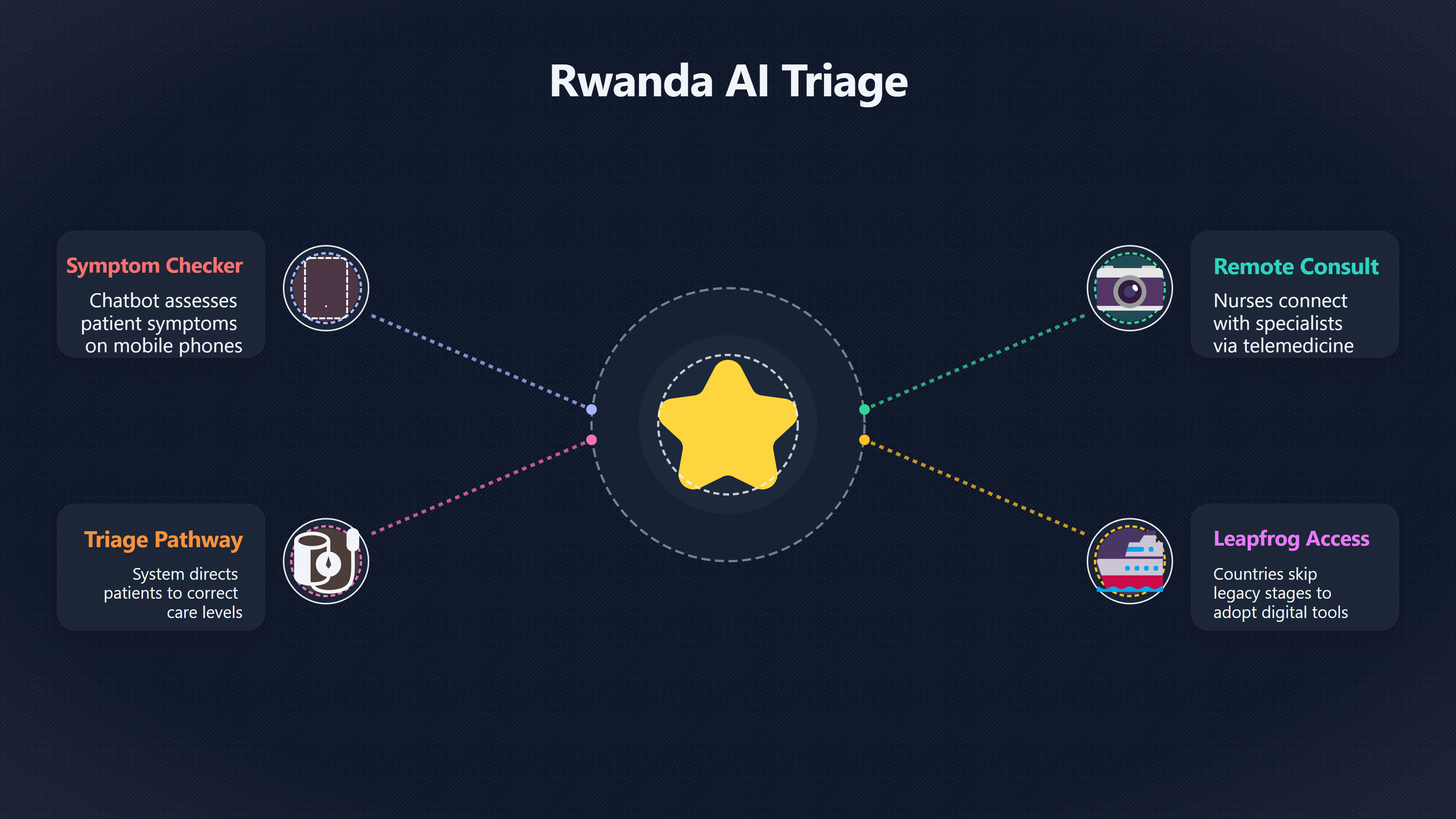
The telehealth company Babylon Health, operating locally as Babyl, partnered with the Rwandan government to provide AI-supported triage and remote consultations through mobile phones. The system used chatbot-style symptom assessment to help direct patients toward appropriate care pathways. [Rwanda Development Board]rdb.rwgovernment of rwanda babyl partner to provide digital healthcare to all rwandansRwanda Development BoardGovernment of Rwanda, Babyl partner to provide digital…02 Mar 2020 — The Government of Rwanda and Babylon Heal… [Digital Health]digitalhealth.netbabylon ai powered triage tool rwandaBabylon launches AI-powered triage tool in Rwanda13 Dec 2021 — Digital health provider Babylon has launched its AI-powered triage tool in…
More recent projects have explored whether generative AI and locally adapted language models can directly support community health workers. PATH and Rwandan partners announced studies examining whether large language models could assist workers with triage, diagnosis support, and referral decisions in Kinyarwanda. [PATH]path.orgPATHLarge language models for health equityPress release. New study examines how generative AI can assist community health workers in Rwa… [LinkedIn Rwanda’s appeal as a case study is not just technical. It illustrates a broader AI bloom idea: lower-income countries may sometimes adopt AI]linkedin.comRwanda's AI trial for community health workers: A new studyNew study: Can AI support Rwanda's community health workers (CHWs)? A sile… enabled systems faster than richer countries because the unmet need is larger and legacy systems are weaker. A hospital with extensive specialist staffing and entrenched software may change slowly. A country facing severe clinician shortages may have stronger incentives to experiment.
Some advocates describe this as “leapfrogging”: bypassing older institutional stages in the same way some regions skipped widespread landline infrastructure and moved directly to mobile phones. Reports from the Novartis Foundation and others have argued that low- and middle-income countries could adopt AI-enabled healthcare unusually rapidly if infrastructure and governance align. [Novartis Foundation]novartisfoundation.orgNovartis FoundationLower-income countries could soon leapfrog high…9 Sept 2020 — Low- and middle-income countries could soon leapfrog…
Still, Rwanda also shows the limits of technological optimism. Expanding access to triage software is easier than guaranteeing reliable diagnosis, treatment availability, electricity, connectivity, or emergency transport. AI advice cannot compensate for medicine shortages or weak hospital capacity.
Pakistan’s maternal health experiments show why language matters
Pakistan provides a different but equally revealing example. Here, many of the challenges are linguistic, cultural, and infrastructural rather than purely computational.
Researchers and healthcare organisations have experimented with voice-based AI systems designed for maternal health workers and patients with limited literacy. One project, Awaaz-e-Sehat, developed by researcher Maryam Mustafa and collaborators, uses speech interfaces in Urdu to help generate medical records and identify pregnancy risks. [Gates Foundation]gatesfoundation.orgai maternal health pakistanGates FoundationThe Scientist Using AI to Improve Maternal Health9 Apr 2025 — Maryam Mustafa is building an AI tool to close dangerous ga…
This work highlights a major issue in AI deployment: much global AI infrastructure is optimised for English-speaking, highly connected environments. Community healthcare in Pakistan often involves:
- Shared family phones
- Inconsistent internet access
- Low literacy
- Multiple local languages
- Time pressure on workers
- Informal decision-making within families
The design challenge therefore becomes social as much as technical. Researchers studying maternal-health chatbots in Pakistan found that many assumptions common in Silicon Valley products — such as private device ownership or continuous connectivity — did not fit real usage patterns. [arXiv]arxiv.orgSource details in endnotes.
That matters for the wider question of whether AI can truly democratise expertise. If systems only work well for wealthy, literate, urban users, then AI may deepen inequality rather than reduce it. Successful frontline systems often depend on localisation: local languages, local workflows, local medical guidelines, and culturally realistic assumptions about how care is actually delivered.
Pakistan’s experience also demonstrates that relatively simple AI functions may produce large practical gains. Automatically generating records from speech or flagging high-risk symptoms may sound modest compared with visions of superintelligence, yet these improvements can matter enormously in overstretched clinics where paperwork consumes scarce time.
Why human oversight remains essential
The strongest versions of the AI bloom argument sometimes imply that expert knowledge could become almost universally accessible through sufficiently advanced systems. Healthcare is one of the clearest reminders that access alone is not enough.
Medical AI systems still fail in important ways:
- They hallucinate false information
- They may miss rare conditions
- They can reflect biased training data
- They often perform unevenly across languages and populations
- They may appear more confident than they should
- They struggle with messy real-world context
For frontline healthcare workers, overtrust may become a serious danger. A poorly trained worker might defer too readily to software recommendations, especially if the system appears authoritative.
This is why many current projects emphasise “human in the loop” models rather than full automation. In Rwanda’s Babyl system, nurse-led triage remained central even as AI-supported tools expanded. [ScienceOpen]scienceopen.comScienceOpeninterrupted time series of babyl digital health services from…Jan 20, 2026 — Task-shifting was substantial: triage nurses m… Researchers studying community-health AI repeatedly stress escalation pathways and clinician oversight rather than autonomous diagnosis. [PATH]path.orgPATHLarge language models for health equityPress release. New study examines how generative AI can assist community health workers in Rwa… [PMC]pmc.ncbi.nlm.nih.govPMCprotocol for a prospective, observational study in Rwandafor a prospective, observational study in Rwanda - PMCby V Menon · 2025 · Cited by 4 — In Rwanda, CHWs typically have limited formal clin…
There are also governance questions beyond technical accuracy.
Who is legally responsible if AI-supported advice harms a patient? Who audits systems for bias? Which companies control patient data? Can governments verify how models reach recommendations? What happens if low-income health systems become dependent on foreign technology providers?
These concerns are not side issues. They are central to whether AI-supported healthcare becomes broadly empowering or merely another layer of unequal infrastructure.

What this suggests about AI and the wider “expertise abundance” thesis
Community healthcare is a useful test case because it sits between narrow automation and grand claims about superintelligence. The systems being deployed today are imperfect, limited, and heavily supervised. Yet even these early tools hint at a deeper shift.
Historically, sophisticated medical judgement was tied tightly to the physical presence of highly trained professionals. AI systems loosen that link. They allow parts of expert reasoning to travel digitally into remote clinics, village health posts, and home visits.
If this trend continues, several long-term implications follow.
First, the effective supply of expertise may rise faster than the number of formally trained experts. A small number of specialists could supervise much larger frontline networks.
Second, healthcare quality may become less geographically unequal. The gap between elite urban hospitals and rural first-contact care could narrow, even if it does not disappear.
Third, AI systems may gradually become integrated with diagnostics, translation, medical imaging, wearable monitoring, and scientific literature in ways that compound their usefulness over time.
This does not guarantee a post-scarcity future for healthcare. Human care, institutional trust, medicine supply chains, and political stability still matter enormously. But frontline health systems provide one of the clearest concrete examples of the broader AI bloom proposition: that intelligence itself may become more scalable, distributable, and widely accessible than at any previous point in history.
The evidence so far supports neither utopian certainty nor dismissal. AI tools are already helping some community health workers operate more effectively in difficult conditions. At the same time, the hardest problems are increasingly social and institutional rather than purely computational. The future impact may depend less on whether models become marginally smarter and more on whether societies can build trustworthy systems around them.
Endnotes
-
Source: bjh.be
Title: AI-driven healthcare solutions adopted faster in low
Link: https://www.bjh.be/ai-driven-healthcare-solutions-adopted-faster-in-low-and-middle-income-countries/Source snippet
The new partnership will also see the introduction of an AI-powered triage and symptom checker...Read more...
-
Source: path.org
Link: https://www.path.org/who-we-are/programs/digital-health/large-language-models-for-health-equity/Source snippet
PATHLarge language models for health equityPress release. New study examines how generative AI can assist community health workers in Rwa...
-
Source: linkedin.com
Link: https://www.linkedin.com/posts/eric-remera-phd-32041b5a_path-rbc-c4ir-activity-7359564421293142016-NqxUSource snippet
Rwanda's AI trial for community health workers: A new studyNew study: Can [AI support]({{ 'ai-bloom-abun/ai-bloom-abun-98d3a6-ai-tutors-lea-43972c-ai-support-hu-805d8e/' | relative_url }}) Rwanda's community health wo...
-
Source: arxiv.org
Link: https://arxiv.org/abs/2512.12240 -
Source: arxiv.org
Link: https://arxiv.org/abs/2604.22610 -
Source: arxiv.org
Link: https://arxiv.org/abs/2510.27401Source snippet
October 31, 2025...
Published: October 31, 2025
-
Source: scienceopen.com
Link: https://www.scienceopen.com/document?vid=a6356f1d-000a-4255-ba56-712fee27d9b6Source snippet
ScienceOpeninterrupted time series of babyl digital health services from...Jan 20, 2026 — Task-shifting was substantial: triage nurses m...
-
Source: linkedin.com
Link: https://www.linkedin.com/posts/society-for-family-health-rwanda_ai-rwanda-empowerchws-activity-7351200586324701184-4GZaSource snippet
EmpowerCHWs: AI-Powered Healthcare in RwandaWe're proud to spotlight a groundbreaking, #AI-powered digital innovation transforming commun...
-
Source: linkedin.com
Link: https://www.linkedin.com/posts/dr-ahmed-haq-bbb5959_pakistan-ai-healthcare-activity-7422001221063839745-xN2HSource snippet
connect supported health apps to the AI assistant. The...Read more...
-
Source: arxiv.org
Link: https://arxiv.org/html/2512.12240v1Source snippet
AI assistant developed to support maternal healthcare delivery by frontline health workers in Pakistan. The assistant leverages a large...
-
Source: borgenproject.org
Title: telemedicine in rwanda the future of health
Link: https://borgenproject.org/telemedicine-in-rwanda-the-future-of-health/Source snippet
The Borgen ProjectTelemedicine in Rwanda: The Future of HealthJun 27, 2019 — The Rwandan Ministry of Health launched an app called Babyl...
-
Source: novartisfoundation.org
Link: [https://www.novartisfoundation.org/news/media-release/lower-income-countries-could-soon-leapfrog-high-income-countries-ai-enabled-health-technologies-novartis-foundation-and-microsoftSource snippet
Novartis FoundationLower-income countries could soon leapfrog high...9 Sept 2020 — Low- and middle-income countries could soon leapfrog...
-
Source: frontiersin.org
Link: https://www.frontiersin.org/journals/global-womens-health/articles/10.3389/fgwh.2021.645705/fullSource snippet
Frontiers“Now You Have Become Doctors”: Lady Health Workers'...by MLW Kinshella · 2021 · Cited by 17 — Background: PIERS on the Move (PO...
-
Source: rdb.rw
Title: government of rwanda babyl partner to provide digital healthcare to all rwandans
Link: https://rdb.rw/government-of-rwanda-babyl-partner-to-provide-digital-healthcare-to-all-rwandans/Source snippet
Rwanda Development BoardGovernment of Rwanda, Babyl partner to provide digital...02 Mar 2020 — The Government of Rwanda and Babylon Heal...
-
Source: digitalhealth.net
Title: babylon ai powered triage tool rwanda
Link: https://www.digitalhealth.net/2021/12/babylon-ai-powered-triage-tool-rwanda/Source snippet
Babylon launches AI-powered triage tool in Rwanda13 Dec 2021 — Digital health provider Babylon has launched its AI-powered triage tool in...
-
Source: gatesfoundation.org
Title: ai maternal health pakistan
Link: https://www.gatesfoundation.org/ideas/articles/ai-maternal-health-pakistan/Source snippet
Gates FoundationThe Scientist Using AI to Improve Maternal Health9 Apr 2025 — Maryam Mustafa is building an AI tool to close dangerous ga...
-
Source: researchgate.net
Link: https://www.researchgate.net/publication/362774953_Digital_health_and_telemedicine_in_Pakistan_Improving_maternal_healthcareSource snippet
Digital health and telemedicine in Pakistan: Improving...A review of telemedicine adoption in the past and present for improving materna...
-
Source: Wikipedia
Title: Babylon Health
Link: https://en.wikipedia.org/wiki/Babylon_HealthSource snippet
Babylon HealthBabylon Health was a health service provider that utilized artificial intelligence and virtual clinical operations. Pati...
-
Source: Wikipedia
Link: https://en.wikipedia.org/wiki/PakistanSource snippet
PakistanPakistan is the 33rd-largest country by area. Bounded by the Arabian Sea on the south, the Gulf of Oman on the southwest, and...
Additional References
-
Source: researchgate.net
Link: https://www.researchgate.net/publication/399843409ARTIFICIAL_INTELLIGENCE-AUGMENTED_CLINICAL_DECISION_SUPPORT_IN_NURSING_AND_ALLIED_HEALTH_CARE_EXAMINING_TECHNOLOGICAL_POTENTIAL_PRACTICAL_LIMITATIONS_AND_ETHICAL_RESPONSIBILITIES_WITHIN_THE_PAKISTANISource snippet
artificial intelligence-augmented clinical decision support in...19-Jan-2026 — ARTIFICIAL INTELLIGENCE-AUGMENTED CLINICAL DECISION SUPPO...
-
Source: weforum.org
Link: https://www.weforum.org/videos/c4ir-rwanda/Source snippet
How Rwanda is using AI to transform healthcareLearn how Rwanda is leveraging AI-powered tools to support health workers, improve diagnose...
-
Source: phcglobal.org
Link: https://phcglobal.org/functions/badge-projects-detail/97Source snippet
Sehat SaheliE-learning web and mobile app for Lady Health Workers in Pakistan. Project... Clinical Decision Support System (CDSS) for IM...
-
Source: vitalpakistantrust.org
Link: https://vitalpakistantrust.org/vital-digital-platformSource snippet
VITAL Digital PlatformAn electronic health record system that captures longitudinal, multi-dimensional data points across the Maternal, N...
-
Source: researchgate.net
Link: https://www.researchgate.net/publication/399920221_Telemedicine_implementation_and_healthcare_utilization_in_Rwanda_interrupted_time_series_of_babyl_digital_health_services_from_2015_to_2024Source snippet
interrupted time series of babyl digital health services from...09 Jan 2026 — Telemedicine implementation and healthcare utilization in...
-
Source: jpma.org.pk
Link: https://jpma.org.pk/index.php/public_html/article/view/30505/4600 -
Source: gcgh.grandchallenges.org
Link: https://gcgh.grandchallenges.org/grant/ai-enhanced-clinical-decision-support-nurse-led-health-posts-rwanda-disrupting-primarySource snippet
grandchallenges.orgAI-Enhanced Clinical Decision Support for Nurse-Led...David Kamugundu of eFiche Limited in Rwanda will develop an AI...
-
Source: businesswire.com
Link: https://www.businesswire.com/news/home/20211203005293/en/Babylon-Launches-AI-in-Rwanda-in-Next-Step-Towards-Digitising-Healthcare-in-RwandaSource snippet
Babylon Launches AI in Rwanda in Next Step Towards...03 Dec 2021 — Babylon has launched its AI-powered triage tool in Rwanda to further...
-
Source: pjlss.edu.pk
Link: https://www.pjlss.edu.pk/pdf_files/2024_2/8529-8542.pdfSource snippet
e analytics, and workflow optimization can lead to improved patient outcomes, reduced mortality rates, and more...Read more...
-
Source: pmc.ncbi.nlm.nih.gov
Title: PMCprotocol for a prospective, observational study in Rwanda
Link: https://pmc.ncbi.nlm.nih.gov/articles/PMC12519661/Source snippet
for a prospective, observational study in Rwanda - PMCby V Menon · 2025 · Cited by 4 — In Rwanda, CHWs typically have limited formal clin...
Amazon book picks
Further Reading
Books and field guides related to AI for Community Health Workers. Use these as the next step if you want deeper reading beyond the article.

Digital Health
Healthcare systems globally are grappling with how best to implement effective and efficient patient-centred care while simultaneously tr...
Digital Health
This book presents a comprehensive state-of the-art approach to digital health technologies and practices within the broad confines of he...

Digital Health
The rise of digital health technologies is, for some, a panacea to many of the medical and public health challenges we face today. This i...
Topic Tree